INTRODUCTION
The PAS was established in 1997 as an initiative to record archaeological objects found by members of the general public and was extended to the whole of England and Wales in 2003.Footnote 1 Surveys of Roman period finds recorded by the PAS have been published in Britannia annually since 2004. This seventh report gives a brief overview of finds distribution and explores the distribution of the Bow and Fantail brooch as a case-study in the research potential of PAS data. As in previous years, descriptions of significant individual artefacts recorded by the Finds Liaison Officers then follow.
OVERVIEW
66,368 artefacts were recorded on the PAS database in 2009, 19,813 (29.85 per cent) of which are Roman in date. As before, this figure includes those finds to which a date has been attributed that spans the late Iron Age and early Roman period. The 2009 data include 2,497 pot sherds, 311 tile fragments, 14 quern fragments, 70 architectural fragments, and 16,921 coins and other metallic objects (as well as 1,100 coins in 33 hoards included in the Treasure process). The total number of non-Treasure metallic finds recorded is slightly higher than that from 2008. Objects that qualify as treasure under the terms of the Treasure Act 1996 are published in the Treasure Annual Report by the British Museum and are excluded from this survey.
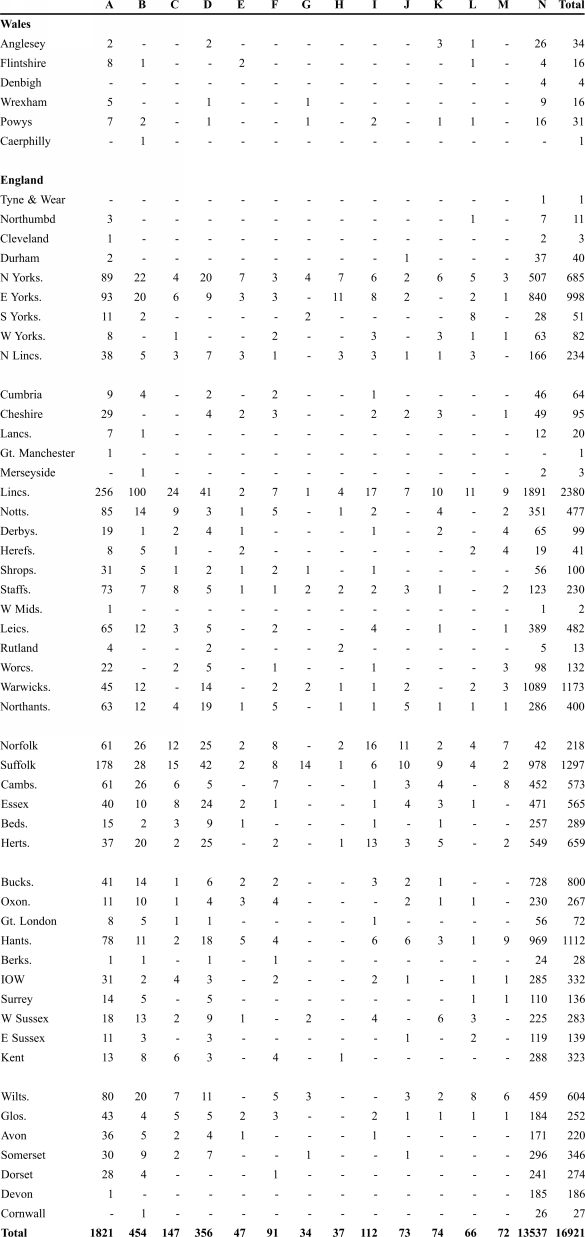
Table 1 shows the number of Roman non-ceramic artefacts recorded on the PAS database by county and grouped by PAS region. For convenience of presentation and to enable comparison with other datasets, the Roman non-ceramic artefacts have been subdivided according to function, based on the scheme proposed by Crummy, with some modifications.Footnote 2 As in previous years, the 2008 data include only a small quantity of the many artefacts recorded from Norfolk, although all records have been entered onto the Norfolk Historic Environment Record.
NUMBERS OF NON-CERAMIC ARTEFACTS RECORDED BY THE PAS IN 2009 BY COUNTY AND TYPE

KEY
A. Brooches
B. Other objects of dress and personal adornment
C. Toilet and medical equipment
D. Household utensils, furniture fittings, copper-alloy vessels, keys, weights, textile equipment
E. Objects associated with written communication
F. Objects associated with religious beliefs and practices
G. Harness equipment
H. Button-and-loop fasteners, toggles
I. First- to third-century military equipment
J. Fourth-century belt fittings
K. Studs/mounts
L. Miscellaneous objects
M. Objects of unknown/uncertain function
N. Coins
As in previous years, coins are the most common Roman artefact recorded: the 13,537 single coin finds recorded in 2009 account for 80 per cent of all metallic finds and include 19 Greek and Roman Provincial coins.Footnote 3 The total number of Roman coins recorded by PAS now stands at around 85,000. The percentage reported this year is higher than in previous years and reflects the continuing success of the initiative to record large assemblages of Roman coins in toto, including small late Roman types, known as ‘grots’ by detectorists. In 2009, as in previous years, the percentage of all finds accounted for by coins in each county varies. In 28 counties where more than 100 examples are recorded, coins comprise on average 81.3 per cent of all finds, but the range is quite wide: in Staffordshire coins account for 53.5 per cent of all finds, whereas in Devon they account for 99.5 per cent. In counties with high numbers of coins there is also considerable variability: in Lincolnshire they comprise 79.5 per cent of all finds, in Buckinghamshire 91 per cent, and in Warwickshire 92.8 per cent. As well as leading to the discovery of important new Roman sites, the very substantial dataset, now containing large assemblages from well-referenced single locations, is enabling significant new research.Footnote 4 Individual Iron Age and Roman coins of importance are published annually in the ‘Coin Register’ in the British Numismatic Journal.
For the most part, the quantities of artefacts grouped in other categories and the significance of different find types have remained broadly consistent with those recorded in previous years. Brooches account for 10.76 per cent of all finds recorded and other items of personal adornment 2.83 per cent. In both these categories, there are particularly high numbers from Lincolnshire and Suffolk, as before.
BOW AND FANTAIL BROOCHES
Using both PAS and non-PAS data, this study examines the quantity and distribution of hinged fantailed brooches.Footnote 5 It demonstrates the potential of PAS data to characterise better an artefact type that occurs in reasonable numbers, but has received limited attention previously. It also offers an interesting example of a focused regional distribution of a dress accessory.
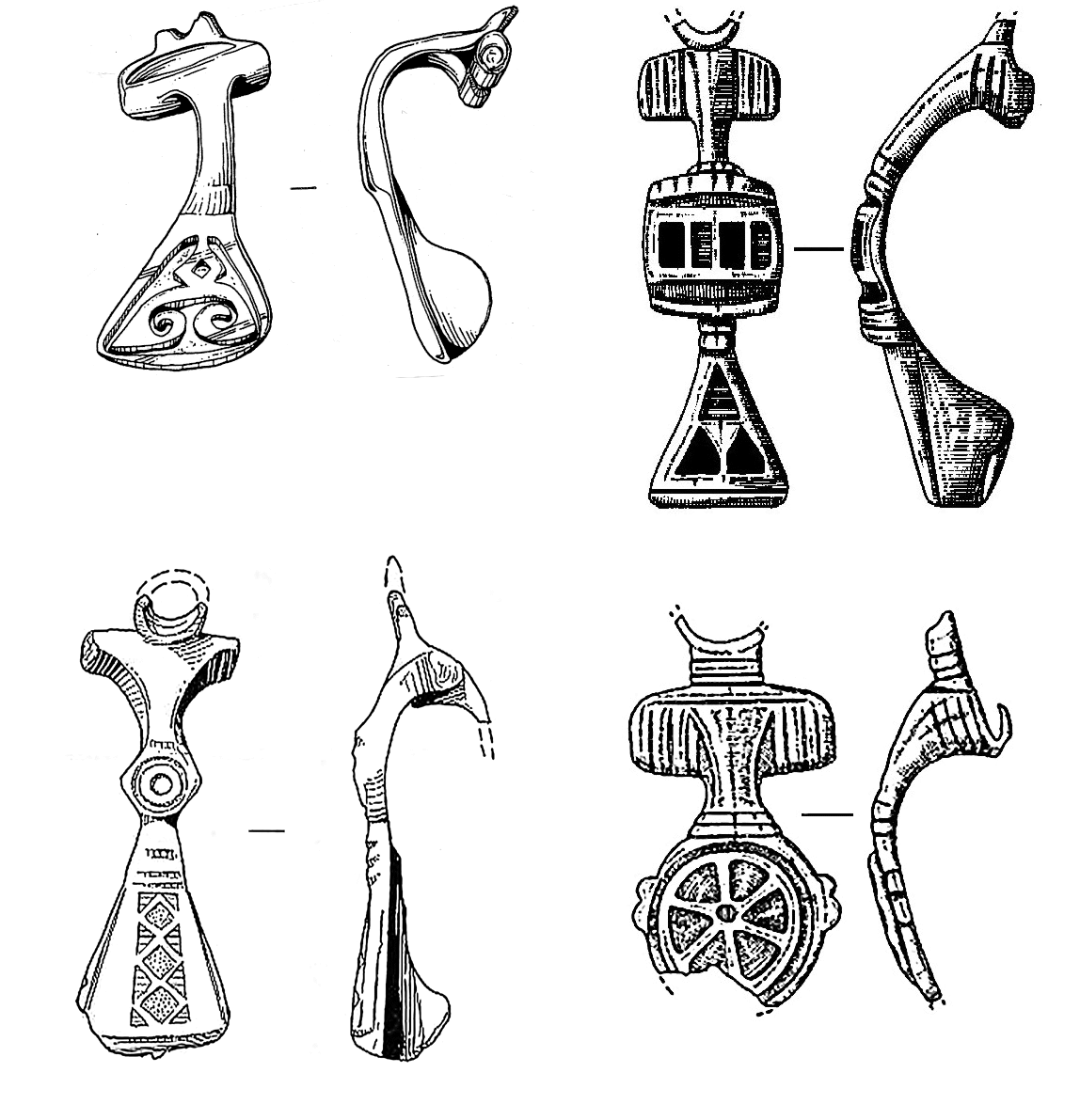
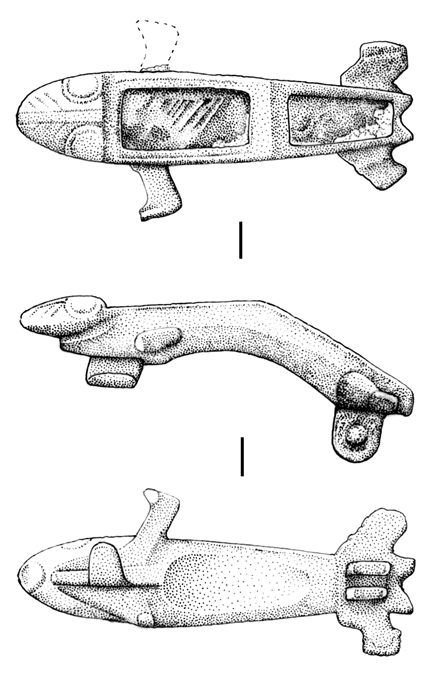
1 and 3. Marton, Lincs. (unpub.); 2 and 4. Hayton, East Yorks. (unpub.). Scale 1:1.

The brooch type, generally known as the ‘Bow and Fantail’ or ‘Fantail’ is defined by a hinged pin, a fixed headloop, short wings, which are either rounded or slightly angular (often with grooves at the end of each wing), a gently curving, narrow, rectangular-sectioned bow (often decorated with grooves parallel to each side), and a fan tail. The type has been dated to the later first to third century a.d. In the best studied subtype (Hull type 36) an expanded triangular fantail carries a Celtic broken-back scroll motif in reserved metal outlined by an enamelled field. In the variant forms, the fantail carries a variety of motifs, most commonly three enamelled triangular cells, but occasionally examples with one, two or four triangles or other motifs also occur. Similar forms include a circular or rectangular plate at the bow. Examples of this type may instead carry lozenges on the fantail.
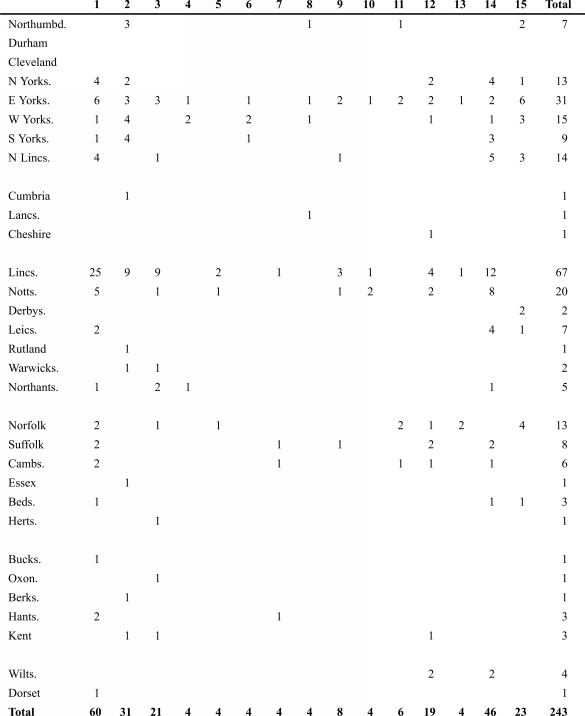
The distribution of the subtype with the fantail bearing the Celtic broken-back scroll motif (Hull type 36 — here the ‘Celtic’ type) has been noted as mainly occurring in the East Midlands, with outliers further north through Yorkshire, into Cumberland and as far south as Richborough.Footnote 6 The PAS has added a very considerable number of new examples of most of the variants identified above.Table 2 reports the PAS finds (recorded between October 1997 and May 2010) and compares numbers to those previously known.Footnote 7 There are 166 PAS finds in total, including 60 of the ‘Celtic’ type, 21 where the fantail carries three triangles, 19 where the brooch has a circular plate on the bow and lozenges on the fantail, and 50 with a circular plate on the bow.
BOW AND FANTAIL BROOCHES RECORDED BY PAS OCTOBER 1997 TO APRIL 2010 AND EXAMPLES OF THE TYPE NOT RECORDED BY PAS

1. ‘Celtic’ fantailed – PAS
2. ‘Celtic’ fantailed – non-PAS
3. Three triangles on fantail – PAS
4. Three triangles on fantail – non-PAS
5. Other triangle –PAS
6. Other triangle –non-PAS
7. Rectangular plate – PAS
8. Rectangular plate – non-PAS
9. Fantail only: lozenges – PAS
10. Circular plate, boss – PAS
11. Circular plate, boss – non-PAS
12. Circular plate, lozenges on fantail – PAS
13. Circular plate, lozenges on fantail – non-PAS
14. Circular plate, various – PAS
15. Circular plate, various – non-PAS
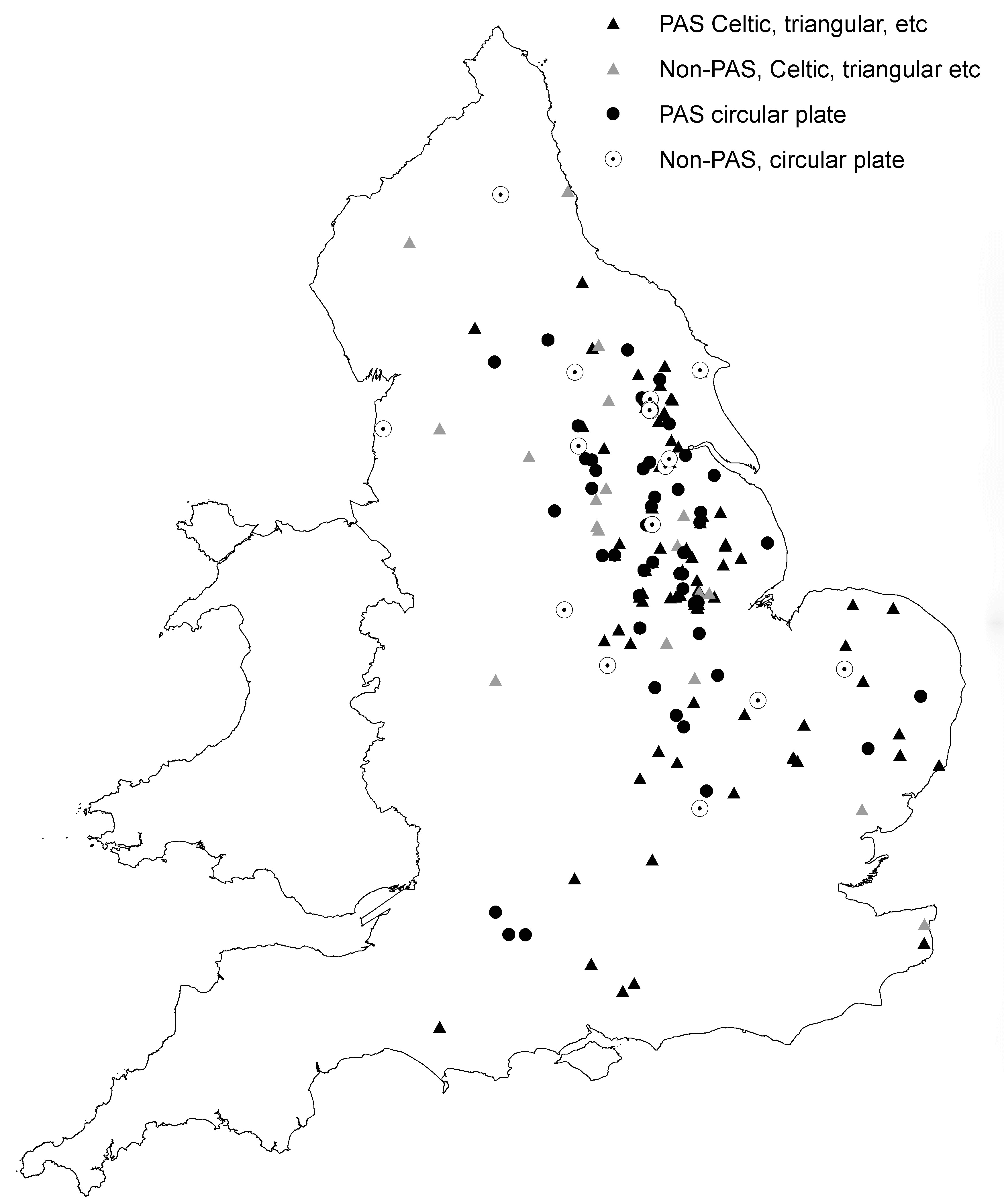
The new data confirm the pronounced regional focus in the distribution of the type, with a particular concentration of PAS finds in Lincolnshire, North Lincolnshire, East, North and West Yorkshire, and Nottinghamshire. In general the distribution of variant types differs little from this overall pattern. Some are more widely distributed: for example the few brooches with a rectangular plate on the bow occur from Hampshire to Northumberland. Others by contrast have a more focused distribution. A type with a circular motif on the plate on the bow, which is subdivided into six segments, resembling a wheel (one of the types amalgamated in columns 14 and 15 in Table 2), has been documented only in East and West Yorkshire. The type with a boss riveted through the centre of the circular plate is also unusual and is documented only in East Yorkshire, Lincolnshire, Nottinghamshire, and Norfolk. Types which are less common in the overall corpus are more frequent in particular areas: for instance, examples with a circular plate on the bow, frequently also with protrusions or lugs at each side, account for a higher proportion than other variants in East Anglia.
The core of the distribution fits within the areas commonly attributed to two civitates, the Corieltauvi and Parisi. The brooch type might be interpreted as a regional identity marker, but it is worth remembering that it generally occurs as single finds in larger site assemblages. Only occasionally are there instances of multiple brooches of this form occurring from the same site, for example Marton, Heckington and Thonock in Lincolnshire, Thoroton and Orston in Nottinghamshire, and Hayton in East Yorkshire, all rural settlements. The regional emphasis in this distribution may indicate shared traditions among artisans making brooches to meet a local taste.
Distribution of findspots of hinged Bow and Fantail brooches recorded by PAS October 1997 to June 2010 and examples of the type not recorded by PAS.

ARTEFACT DESCRIPTIONS
The entries below set out some highlights of the past year’s discoveries recorded by the Finds Liaison Officers. Fuller details of the objects recorded by the PAS can be obtained from the Schemes’s central office,Footnote 8 and there are full descriptions of finds on the PAS website: www.finds.org.uk. The reference number in brackets associated with each record is the PAS identifying find record.Footnote 9 As previously commented upon, research use of these data must take account of the processes by which they have accumulated.Footnote 10
WALES
MONMOUTHSHIRE
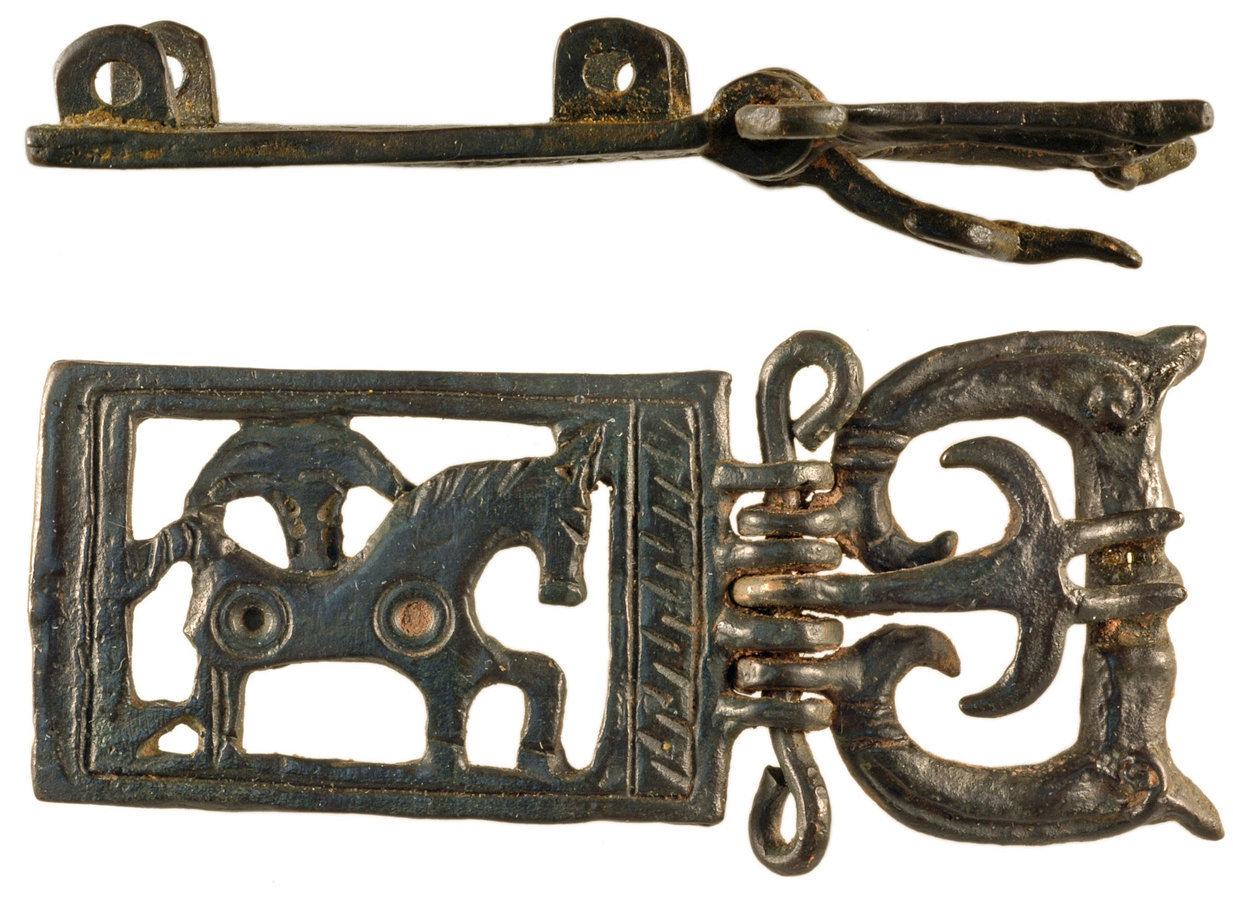
(1) Chepstow (NMGW-1ED1A1) (fig. 3).Footnote 11 A complete late Roman copper-alloy buckle, a variant of ‘soldiers and settlers’ type II AFootnote 12 of fourth- or early fifth-century a.d. date, consisting of the frame, tongue and plate. The buckle is 97 mm long, the frame is 42.9 mm wide, and it weighs 72.8 g. It has a rectangular plate and the frame consists of two confronting dolphin heads with ears instead of crests. On its upper edge, the snouts of the two dolphins are separated by grooves, defining a central rounded knop. The grooves accommodate the twin double-fork of the tongue. The eyes of the dolphins are defined in relief by cast spirals which extend into a rib. The buckle frame has in-turned or involuted terminals. The tongue has a double-forked pin and a wide, cast loop (10.2 mm external diameter) and gradually widens and thickens before forming rearward projections, which complement the in-turned terminals of the frame. The tongue and frame are secured to the plate with a circular-sectioned axis bar (2.8 mm diameter), which is held in place by closed loops in opposing directions at the terminals. The rectangular plate is 66.2 mm long and is held by four hinge loops which flank the two frame loops and the central tongue loop. It has openwork decoration and an incised border with a rectangular panel containing diagonal grooves from alternating sides. At its centre is a horse, trotting to the right. Grooves on the horse define the snout, eyes, ears, mane and hooves. Above and joining the back of the horse is a pelta motif enhanced with grooved arcs, perhaps representing a stylised helmeted rider. The rear of the horse is poorly executed. On the back of the plate are four integral D-shaped lugs positioned near each corner, each with a central circular perforation used to attach the buckle to the belt. The tongue rarely survives on this buckle type but when it does, it commonly has the rear-facing projections but rarely a double pin. The axis bar with terminal loops is also difficult to parallel and may either have been a replacement or a repair. The best parallel identified for this elaborate openwork plate is a buckle plate from Argeliers in southern France of a ‘Pseudo-Hispanic’ dolphin belt with figural decoration of ‘Santome’ type.Footnote 13 ‘Pseudo-Hispanic’ buckles are characterised by shanks on the rear for attachment to the belt; examples with perforated lugs at each corner of the plate are difficult to identify. On the Continent this type of buckle has been dated to between a.d. 350 and 380.Footnote 14 Scientific analysis using a scanning electron microscope was carried out and the average compositions were 88–90 per cent copper, 4 per cent zinc and 5 per cent tin. Minor amounts of lead, nickel and antimony were also detected.
Chepstow, buckle of ‘soldiers and settlers’ type IIA variant (No. 1). Scale 1:1.
(Photo: J. Wild; © National Museum and Gallery of Wales)

ENGLAND
NOTTINGHAMSHIRE
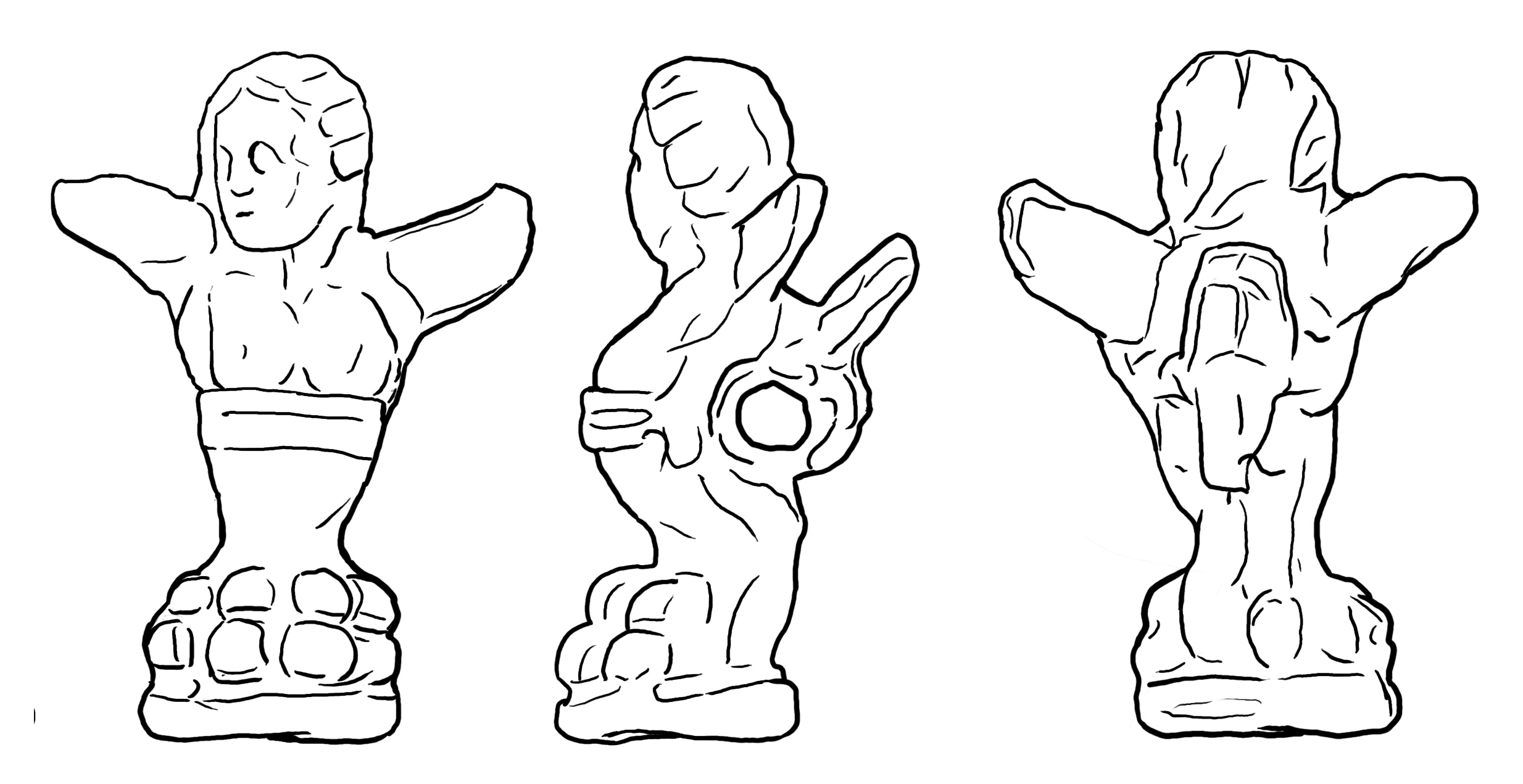
(2) Everton (SWYOR-174FC1) (fig. 4).Footnote 15 A copper-alloy furniture mount in the form of a sphinx. The creature has a four-toed claw with two transverse mouldings above which the body rises with well-developed breasts and out-stretched wings. The hair is slightly waved and the circular eye settings are hollow; the other facial features are worn. There is a loop at the small of the back with a sub-rectangular bar extending above it. The base is circular and slightly irregular. The object is 46.45 mm tall, 16.65 mm wide, 7.80 mm thick, and weighs 47.35 g. An example from Cirencester is broadly similar but the back is plain.Footnote 16
Everton, furniture mount in the form of a sphinx (No. 2). Scale 1:1.
(Drawn by D. Andrews; © D. Andrews and West Yorkshire Archaeology Advisory Service)

NORTH LINCOLNSHIRE
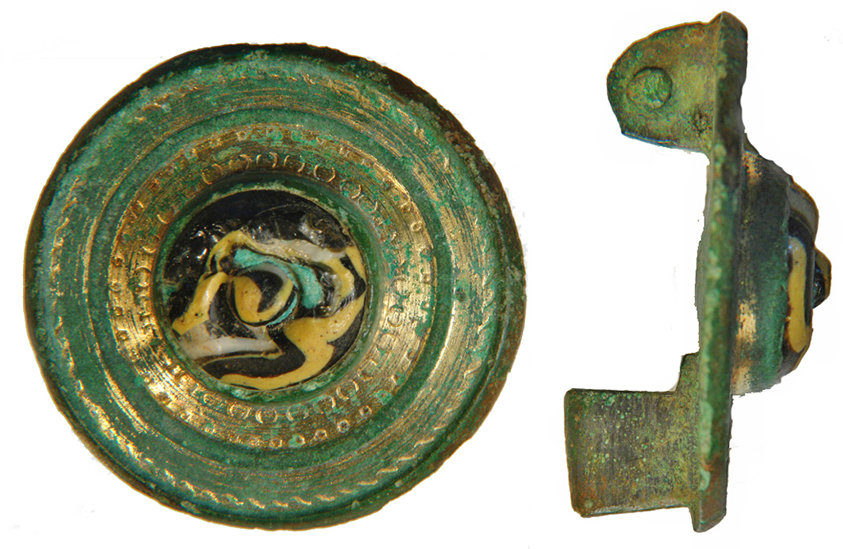
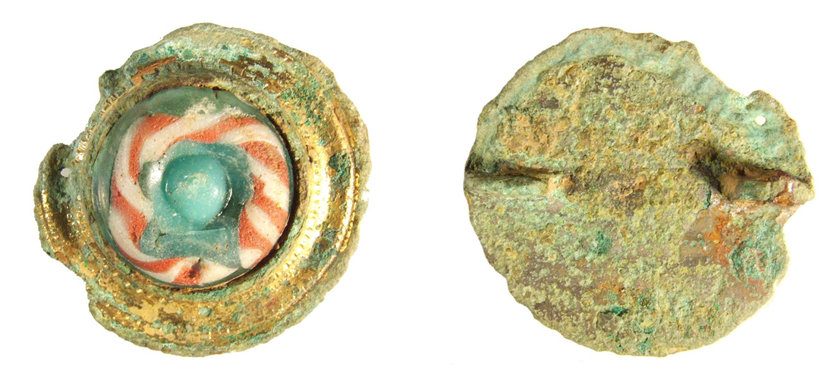
(3) Holme (NLM-F574D3) (fig. 5).Footnote 17 An incomplete circular copper-alloy brooch with a marbled glass centre-boss. The plate is divided into two zones by narrow, flat ribs. The outer channel is decorated with finely punched SSS and the inner channel with circles on one edge and crescents on the other. At the centre a circular setting holds a convex marbled polychrome boss of dark glass with inlaid trails of yellow, white and turquoise and with a ‘nipple’. The reverse of the brooch has a single semi-circular lug with the remains of a copper-alloy sprung pin. There are traces of gilding in both zones and the rear surface is coated with white metal. The external diameter is 38 mm, the diameter of the boss is 18.6 mm, the thickness of the plate is 2.1 mm, and it weighs 22.70 g.
Holme, centre-boss disc brooch with marbled glass setting (No. 3). Scale 1:1.
(Photo: L. Staves; © North Lincolnshire Museum)

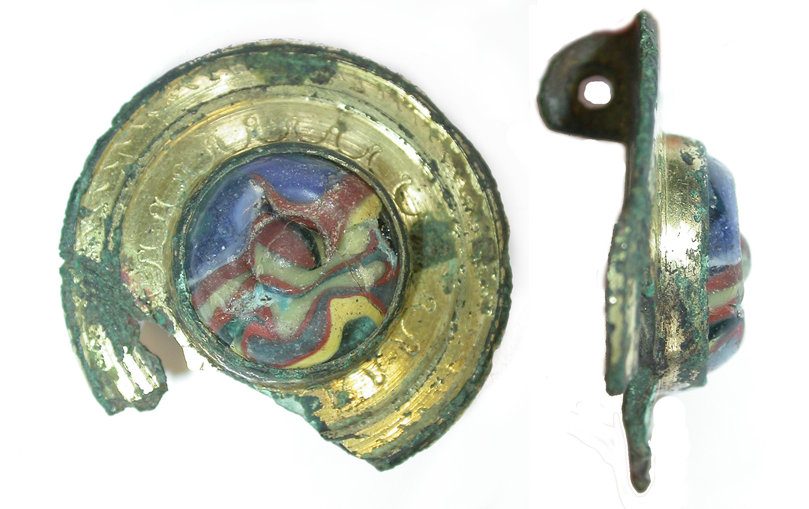
Gilded centre-boss disc brooches with marbled glass settings are uncommon finds, but an example is known from Derby with a red and yellow gem set on a bed of clear greenish glass or pasteFootnote 18 and other examples were noted by HattattFootnote 19 from ‘Lincolnshire’ in white, blue, green and black glass and from ‘near Luton, Bedfordshire’ in red, yellow and white with translucent bottle green respectively. Other examples recently recorded by PAS include an incomplete brooch from Clipstone, Nottinghamshire (DENO-C14931)Footnote 20 (fig. 6), the setting of which has red and yellow trails and a central ‘nipple’ set over mid-blue glass or paste. The plate also carries similar punched decoration in both its zones. It has a diameter of 34.4 mm, is 14.4 mm thick, and weighs 12.7 g. A brooch from Osbournby, Lincolnshire (LIN-1A4334)Footnote 21 (fig. 7) has a central concave setting consisting of marbled red and white glass set over a pale blue bed with a pale blue glass concave centre. The narrow rib close to the centre is decorated with small notches. It has a diameter of 24 mm and a thickness of 7 mm.
Clipstone, centre-boss disc brooch with marbled glass setting. Scale 1:1.
(Photo: R. Atherton; © Derby City Council)

Osbournby, centre-boss disc brooch with marbled glass setting. Scale 1:1.
(Photo: A. Daubney; © A. Daubney)

LINCOLNSHIRE
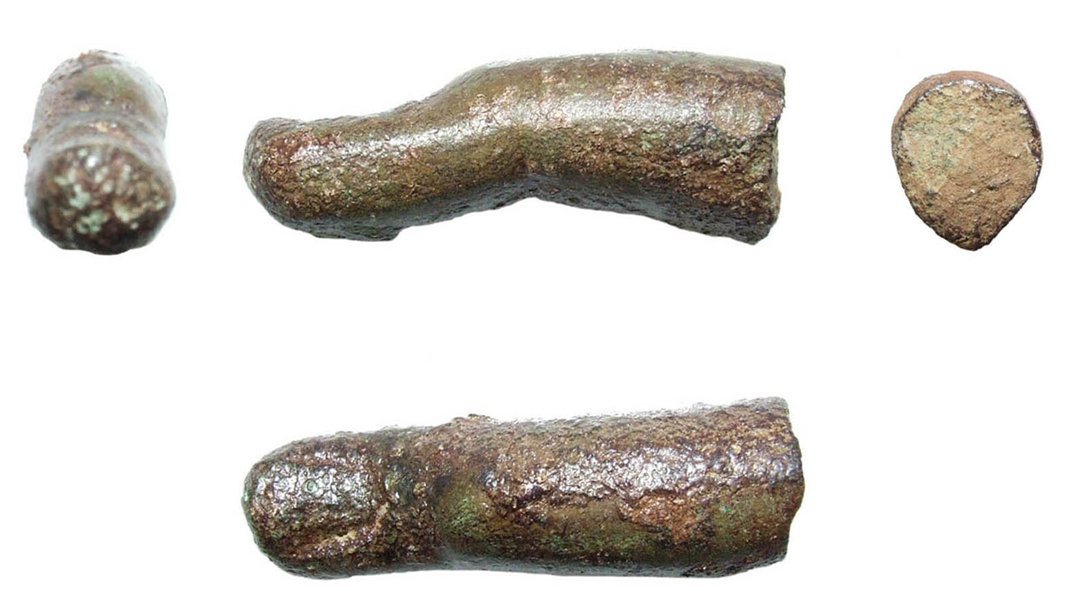
(4) Branston and Mere (LIN-A80353) (fig. 8).Footnote 22 A life-sized, solid, dismembered copper-alloy finger, probably representing the little finger. The surviving portion of a very slightly flexed finger, oval in section, includes the carefully shaped and well defined nail, the distal phalanx and a large portion of the middle phalanx. Just before the second knuckle the finger is neatly broken. The break is well patinated suggesting that the finger may have been intentionally severed in antiquity. No other statue fragment was discovered, but the finger was found close to a probable villa site of second- to third-century date, from which, during excavation, an epitaph for a woman (Aurelia Concessa), pottery, building material and tesserae were found.Footnote 23 Other bronze fingers recorded by PAS include an almost complete hand from Sutton Cheney, Leicestershire (LEIC-7F4CC3), and the tip of a finger from Offenham, Worcestershire (WMID4313). These are a not insignificant addition to the handful of examples known from excavation, such as two bronze fingers from Colchester.Footnote 24 Deliberate fragmentation of statuary has been posited in other instances, for example in the case of the recently published bronze arm from London.Footnote 25
Branston and Mere, life-sized copper-alloy finger (No. 4). Scale 1:1.
(Photo: A. Daubney; © A. Daubney)

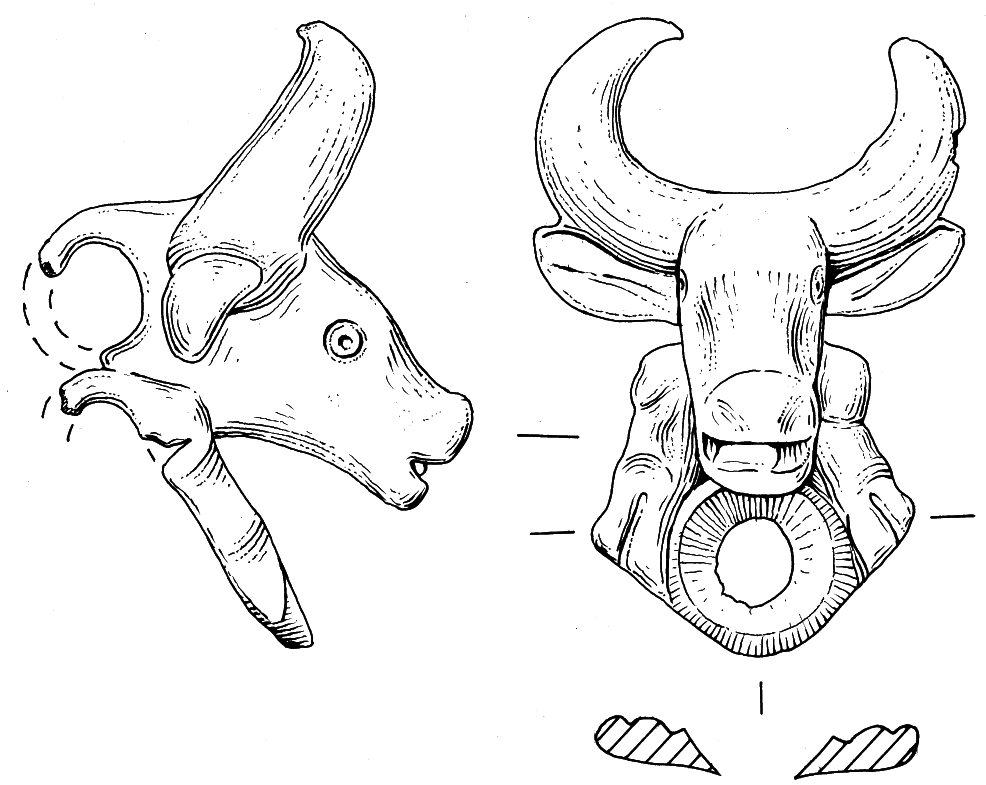
(5) Lusby with Winceby (LIN-40CE20) (fig. 9).Footnote 26 A Romano-British copper-alloy cast vessel mount in the form of a bovine head and forelimbs. The mount is 45 mm long, 31 mm at its widest point, and weighs 45.86 g. The semi-naturalistic head is solid and tapers to the nose. A ring-and-dot on either side marks the eyes, the nose is flat and the mouth is open with a small part of the tongue probably represented. The wide, inward curving horns form a large crescent and point forwards, tapering to their tips, one of which is missing. Below the horns, the wide, leaf-shaped ears have a deep concavity at the centre on the interior and are joined to the horns. Behind the head is the incomplete loop for the handle attachment. The forelimbs with knee and hoof extend below the animal’s head and are depicted on either side of a countersunk circular hole, 5 mm in diameter. This forms a trapezoidal plate, probably for attachment to the bucket at which point the plate is broken. Close in form and style to this vessel mount are the pair of ox-head bucket-handle escutcheons from Felmersham, Bedfordshire (although these differ slightly in having a loop for the handle above the head and a rivet behind) and also that from Kemmeys, Newport (NMGW-DBBD23).Footnote 27
Lusby with Winceby, bovine-headed vessel mount (No. 5). Scale 1:1.
(Drawn by D. Watt; © D. Watt and Lincolnshire County Council)

SHROPSHIRE
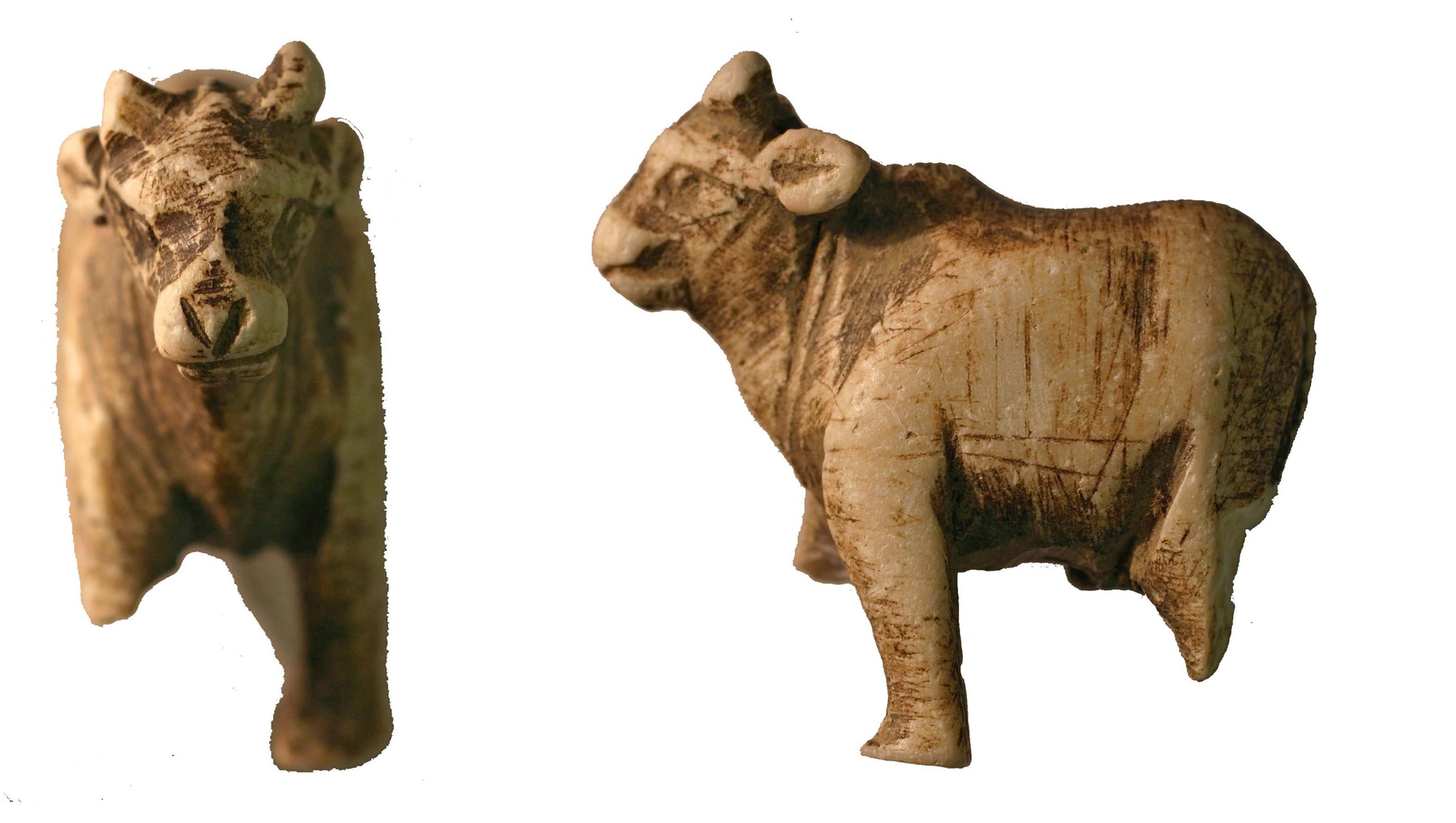
(6) Atcham (HESH-FF83C3) (fig. 10).Footnote 28 An incomplete bovine figurine carved in soapstone. It is life-like and well-proportioned; it is 51.3 mm tall, 52.7 mm long, 21 mm thick, and weighs 51.15 g. Only one leg is complete but two of the three broken legs were discovered close to the body. The head tapers to a broad, rounded nose; the horns are broken, the ears extend sideways and the eyes are deeply recessed. Lines define folds of flesh around the thick neck and the nose and eyes. Each leg terminates in a flat hoof and the position of the legs suggests that the animal was in mid-stride and leading with the right foot. Distinct wear can be seen on one face where the surface of the figurine is polished smooth and is pale yellow. Although a direct parallel for this figurine has not been found, there are similarities in the style of carving on a bone leopard knife-handle from Wroxeter and an ivory handle depicting two mating dogs from Silchester.Footnote 29
Atcham, bovine figurine (No. 6). Scale 1:1.
(Photo: P. Reavill; © P. Reavill and Birmingham City Council)

NORTHAMPTONSHIRE
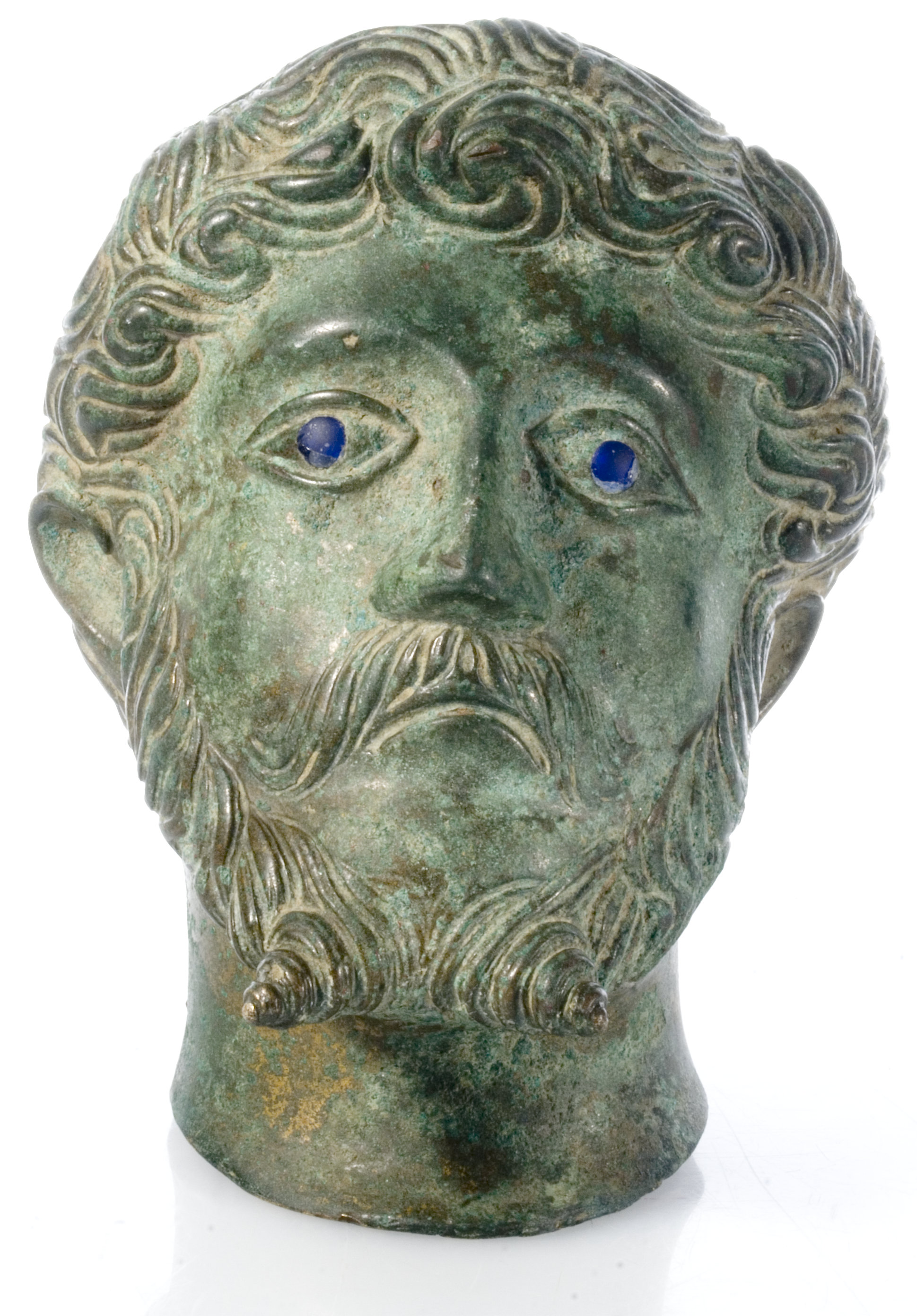
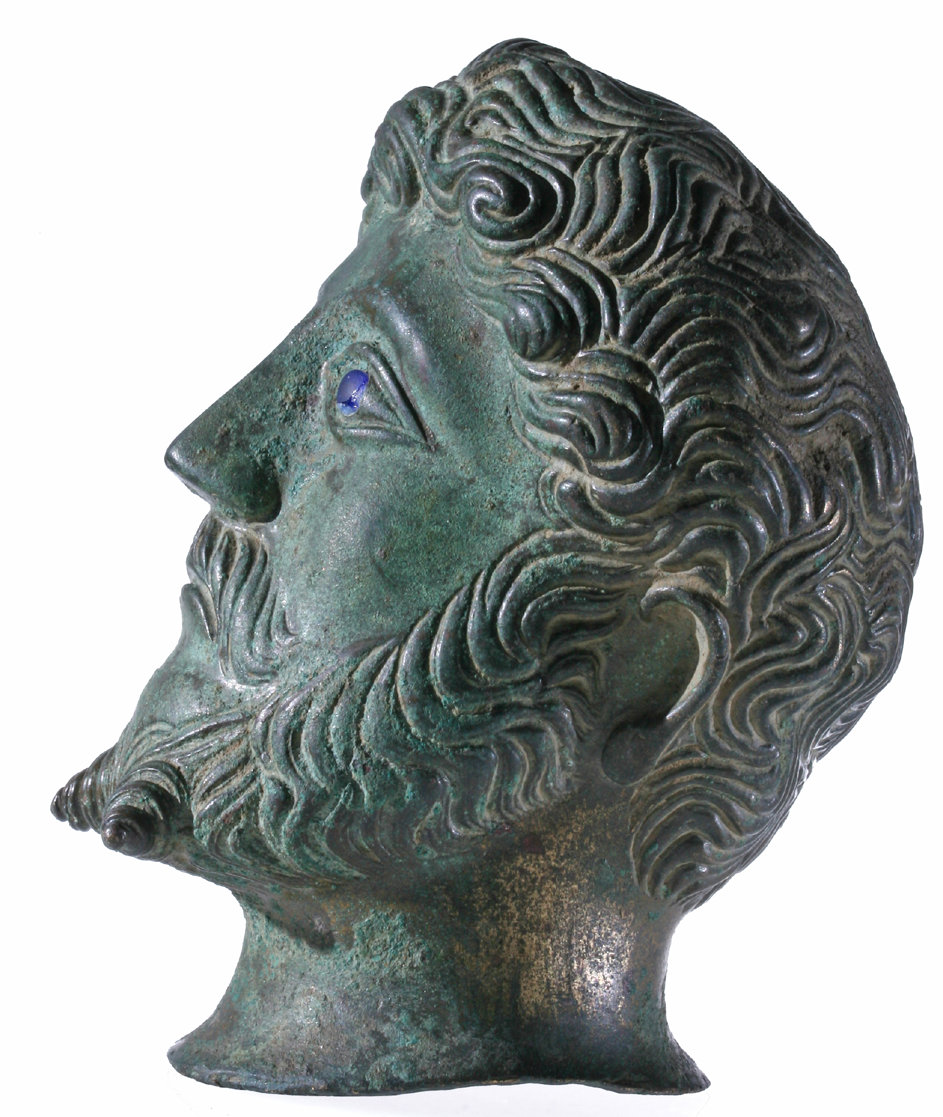
(7) Near Brackley (BERK-E24C84) (figs. 11–12).Footnote 30 A very unusual portrait head and neck of a bearded male, cast in bronze using the lost wax technique. It is 162 mm high, has a maximum width of 115 mm, is 99 mm wide from ear to ear, and weighs 2.1 kg. The base of the neck is flat, with an external base diameter of 80–86 mm and the thickness of the base edge is 5–6 mm. The head is portrayed in a provincial style, exhibiting a fusion of classical and native traits. It has a narrow face with a low brow framed by a fringe of seven gently twisted curls. The full hair on the crown and the back of the head is cast in low relief and consists of a richly textured style of swirls of three-strand curls, with curls of six or seven strands of hair extending to the nape of the neck. The small ears (34 mm long) are not realistically rendered and depict only the lobe and outer frame. The nose is also small (32 mm long) and has a straight bridge and no nostrils. No eyebrows are depicted. The beard and moustache are extremely stylised. The terminals of the relatively long moustache curve upwards very slightly and do not join the beard. The moustache follows the line of the sketchily treated down-turned mouth which is indicated by a single groove, giving a lugubrious effect. The short, curled beard is forked, with each conical ‘prong’ represented by a neat twist, formed by three coils of hair. Beneath the lower jaw, additional detail on the forked beard is defined with a cold-worked, narrow single groove. Similarly striking is the treatment of the eyes. The large, almond-shaped eyes are 31 mm wide and are slightly slanted, framed by a moulded ridge; the pupils consist of discs of blue glass set flush to the eye’s surface — there is slight damage to the glass pupil in the left eye. On the back of the head there are a small number of minor (≤5 mm) dents or flat areas where the detail of the hair curls appears interrupted. These are interpreted as evidence for the spacers or pins that would have pierced the wax model and connected the outer clay mould and the core. On the top of the head is a small (~10 mm) patch of brown corrosion where XRF analysis revealed greatly increased levels of iron. There is a similar corresponding dark patch on the inner surface which suggests that a small iron rod was used here as a spacer.
Near Brackley, male head (No. 7).
(Photo: S. Laidlaw; © S. Laidlaw)

Near Brackley, profile of male head (No. 7).
(Photo: S. Laidlaw; © S. Laidlaw)

Analysis of the metal surface was undertaken without any preparation or removal of corrosion products, using a handheld XRF spectrometer, Innov-X Systems Model Alpha 4000.Footnote 31 The analytical results for the neck and base consistently clustered around the composition of 75 per cent copper, 8 per cent zinc, 8 per cent tin and 8 per cent lead, in addition to traces of iron, nickel and titanium. The corroded areas of the head and the hair yielded more variable results, typically with higher concentrations of lead, probably resulting from the precipitation of lead oxide on the patina. Unfortunately, owing to the relatively high thickness and density of the object, radiography did not reveal any further information regarding these features. The chemical composition of the blue glass settings in the eyes cannot be quantified, given that the analyses were performed in air, and thus the concentration of light compounds such as soda, silica and lime (i.e. the main constituents of Roman glass) could not be detected reliably. More significant was the detection of small concentrations of antimony and manganese, both of which are known to have been employed as glass decolorants, as well as traces of cobalt, the element responsible for the deep blue colouration of the glass.
This is the sixteenth portrait-like head executed in similar provincial style currently known from Britain. This small group of bronze statuary includes heads or busts representing emperors and deities from Willingham Fen (Cambridgeshire), Duston (Northamptonshire), Felmingham Hall (Norfolk), and Icklingham (Suffolk) and the female head with almond-shaped eyes inset with black pebbles, probably from Silkstead, near Otterbourne (Hampshire).Footnote 32 The small number of heads or busts cast in bronze and found in Britain share characteristics such as slanting eyes and the textured patterning of the hair, which identify them as the products of a provincial Romano-British or Gaulish workshop. The Brackley head can be dated to the mid to late second century a.d. by its resemblance to images of Antonine emperors, especially Marcus Aurelius. It may perhaps be inappropriate to suggest that the head from Brackley represents the local rendering of an imperial portrait, but a profile image on a coin portrait of Marcus Aurelius might have been its inspiration.Footnote 33
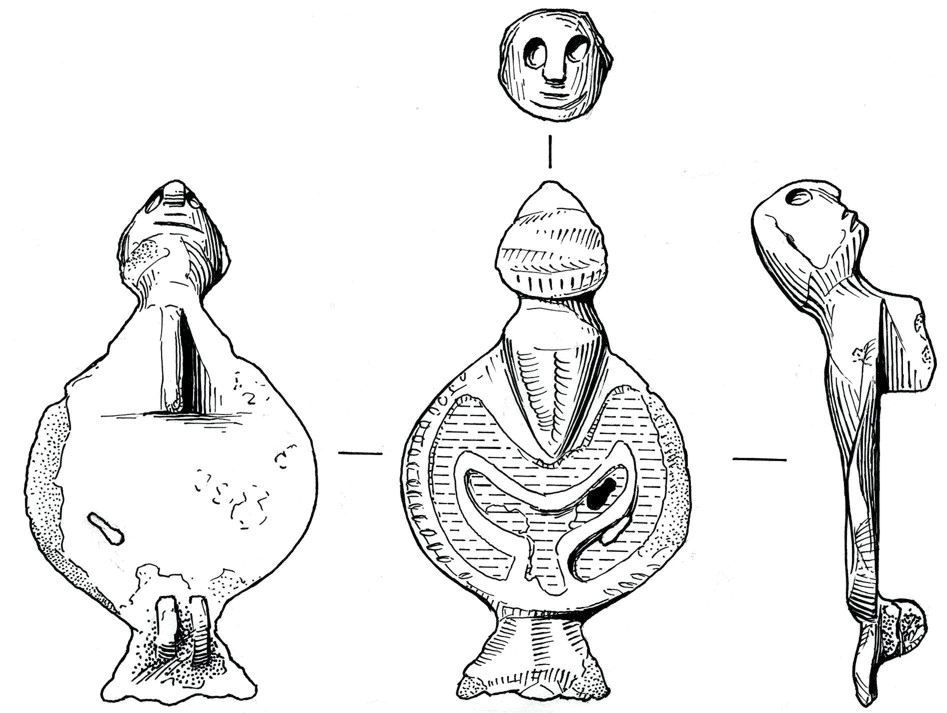
(8) Pottersbury (BUC-79B4D3) (fig. 13).Footnote 34 An enamelled plate-brooch cast in leaded bronze in the form of a swimming bird with an anthropomorphic head.Footnote 35 The body of the brooch is a flat disc dominated by a crescentric motif in reserved metal enclosing a further crescent panel. There are traces of orange enamel surviving and an oval cell infilled with dark red, appearing black, enamel in the right side. It is very likely that a similar cell decorated the left side and perhaps also the centre, although no traces now survive. The triangular tail is decorated with rows of small transverse lines. The creature’s tapering neck rises proud from the disc and is decorated with lines of punched semi-circles. The head is delineated by a pronounced chin which follows through to become the hair line. The round face has hollowed oval eyes, a blunt nose and a single slit for a mouth. The lower surface is undecorated. One of the two tabs that held the now missing hinged pin is present, as is the catchplate. The brooch is 47 mm long, 26 mm wide, 15.5 mm thick, and weighs 10.3 g. No parallel has been found for this brooch, but a small number of brooches representing swimming birds with a very similar body form are known from Britain.Footnote 36
Pottersbury, plate brooch of swimming bird type with anthropomorphic head (No. 8). Scale 1:1.
(Drawn by D. Williams; © D. Williams)

OXFORDSHIRE
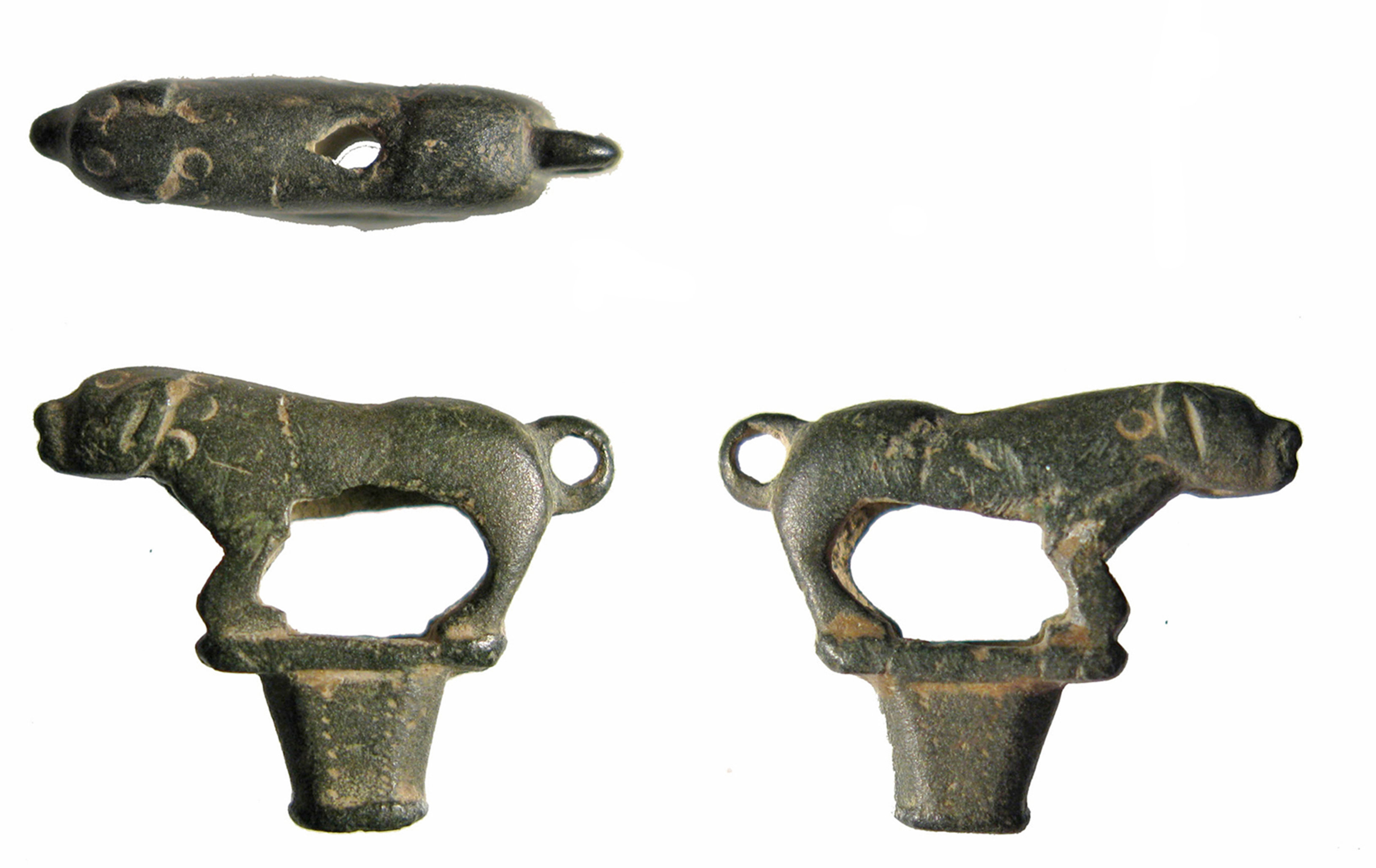
(9) Letcombe Regis (HESH-091D87) (fig. 14).Footnote 37 Copper-alloy hairpin fragment in the form of a well-proportioned but stylised dog standing on a trapezoidal pedestal. It is 21.7 mm long, 5.1 mm wide, 16.7 mm high, and weighs 5.22 g. The animal has a short snout with facial features and collar indicated by incised lines and circles. The tail is turned back upon itself and joins the body forming a loop. In the centre of the back is an irregular sub-oval perforation which extends through the hollow pedestal. The animal stands on a ledge above the faceted pedestal. The latter is decorated on one side only with two columns of stamped pellets. Similar examples with the pin’s shank extending from the dog’s back are known from Kaiseraugst, Cologne, Vechten, Utrecht and London.Footnote 38
Letcombe Regis, hairpin head in the form of a stylised dog (No. 9). Scale 2:1.
(Photo: J. Wild; © National Museum and Gallery of Wales)

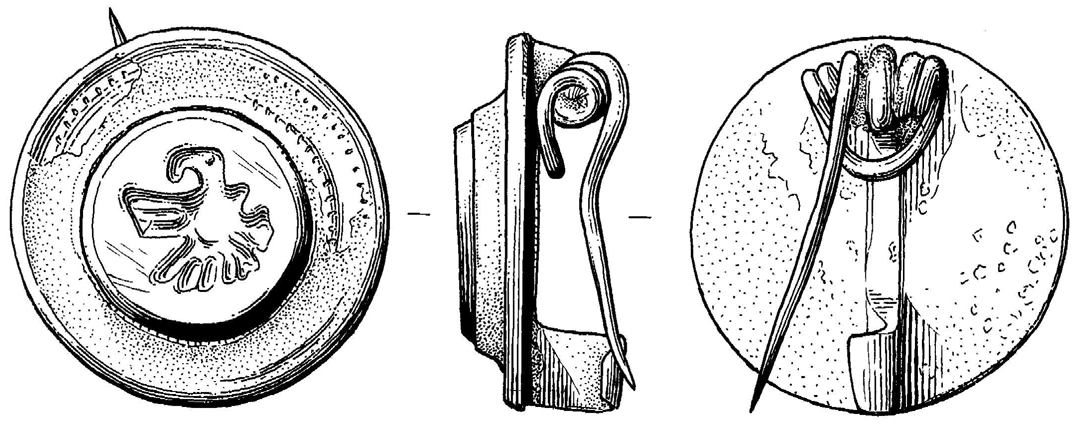
(10) Northmoor (FASW-9426A5) (fig. 15).Footnote 39 A well-preserved gilded disc-brooch with a cast glass central setting. The copper-alloy circular disc is divided into two zones by bold concentric ribs. The central royal blue glass setting is flat-topped and bears the boldly executed cast impression of a bird with raised wings and hooked beak which is most likely to represent an eagle. The upper surface is gilded; the outer ring has surface accretions, but it is very likely to have been decorated with ‘S’-shaped motifs. The back surface has a thin white-metal coating. The spring of four turns is mounted on a single projecting lug and the pin has an internal chord. The catchplate is large and the return is intact. The brooch weighs 15.2 g and has a diameter of 31.4 mm; the diameter of the setting is 18.85 mm. Very similar brooches with a moulding of an eagle are known from Richborough, Kent, and Cottenham and Barrington, Cambridgeshire.Footnote 40
Northmoor, gilded disc brooch wih cast glass setting (No. 10). Scale 1:1.
(Drawn by D. Williams; © D. Williams)

HERTFORDSHIRE
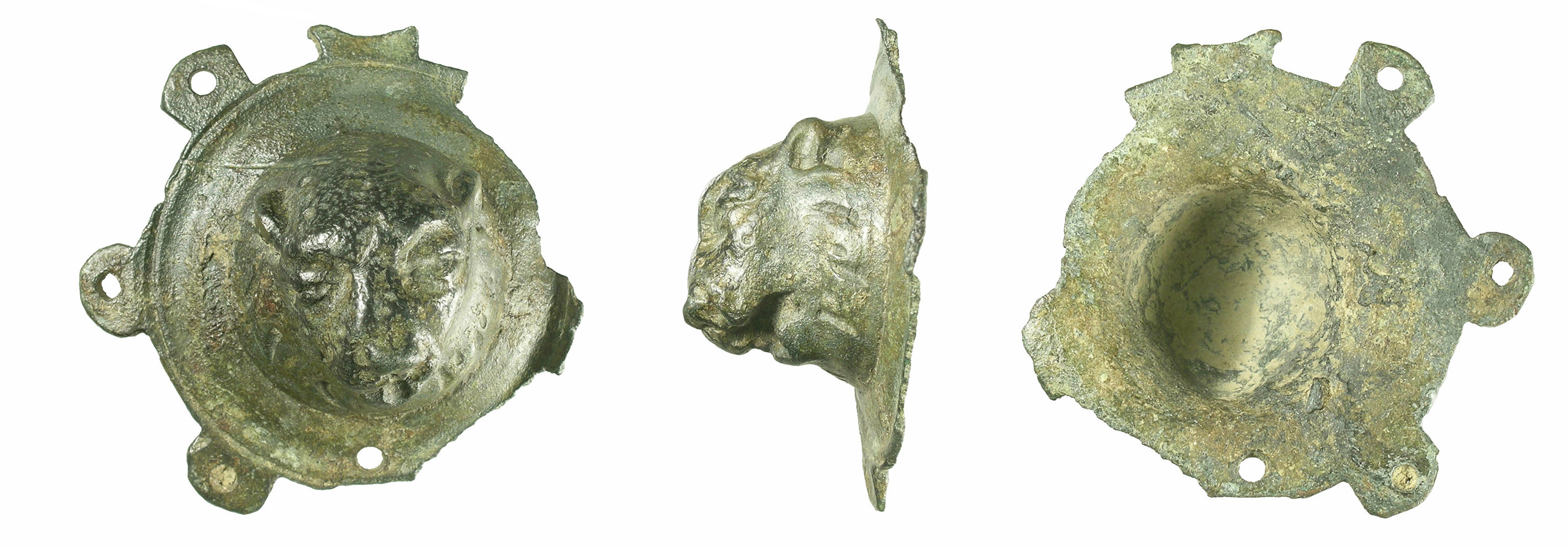
(11) Barkway (BH-A6B8A3) (fig. 16).Footnote 41 A copper-alloy mount, possibly a phalera, dating to the third century a.d. The mount is circular with three perforated lugs and traces of another two projecting from the incomplete outer edge. At the centre is a well-modelled lion’s mask cast in high relief. The eyes are deeply set, pointed oval in plan and with central circular depressions for the pupils. The mane is indicated around the lower neck by curving grooves. At the top of the head is a central band of herringbone-like indentations surrounded by a U-shaped configuration of punched dots. The head is flanked by a flange which is marked by a narrow, sharply defined groove at the outer edge and punctuated by a circular perforation below the head. On the back, the area behind the animal’s head is hollow. It measures 58.7 mm in diameter, is 26.7 mm high, and weighs 60.61 g. A phalera from Reepham, Norfolk (NMS-909494), also depicts a lion’s mask, but differs in being set within an openwork running-vine motif and plain flange with a series of rivet holes. It is also similar to a baldric phalera from Vimose, Funen, Denmark.Footnote 42
Barkway, possibly a phalera with lion’s mask at the centre (No. 11). Scale 1:2.
(Photo: J. Watters; © J. Watters)

BEDFORDSHIRE
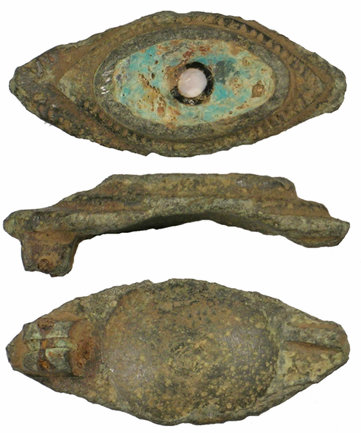
(12) Maulden (SUSS-2DC505) (fig. 17).Footnote 43 A copper-alloy enamelled brooch in the form of an eye. The brooch is a pointed oval with the front rising in three steps, the lower two of which have a border of small raised triangles while the upper is sub-oval and has a copper-alloy rim enclosing turquoise enamel surrounding a small central black enamel ring enclosing white enamel. The back is concave at the centre and flat at either end, with the remains of the catchplate at one end and at the other two perforated D-shaped lugs to secure the pin, now missing; these bear traces of iron corrosion from the axis bar which secured the pin. The brooch is 28.4 mm long, 12.3 mm wide, 4.2–8.4 mm thick, and weighs 4.54 g. Specific parallels are rare, but the general form with the concave back and stepped front is consistent with second-century a.d. plate brooches. A brooch found at Camelon is broadly similar, but has small side lugs.Footnote 44
Maulden, skeuomorphic brooch in the form of an eye (No. 12). Scale 1:1.
(Photo: L. Burnett; © L. Burnett)

NORFOLK
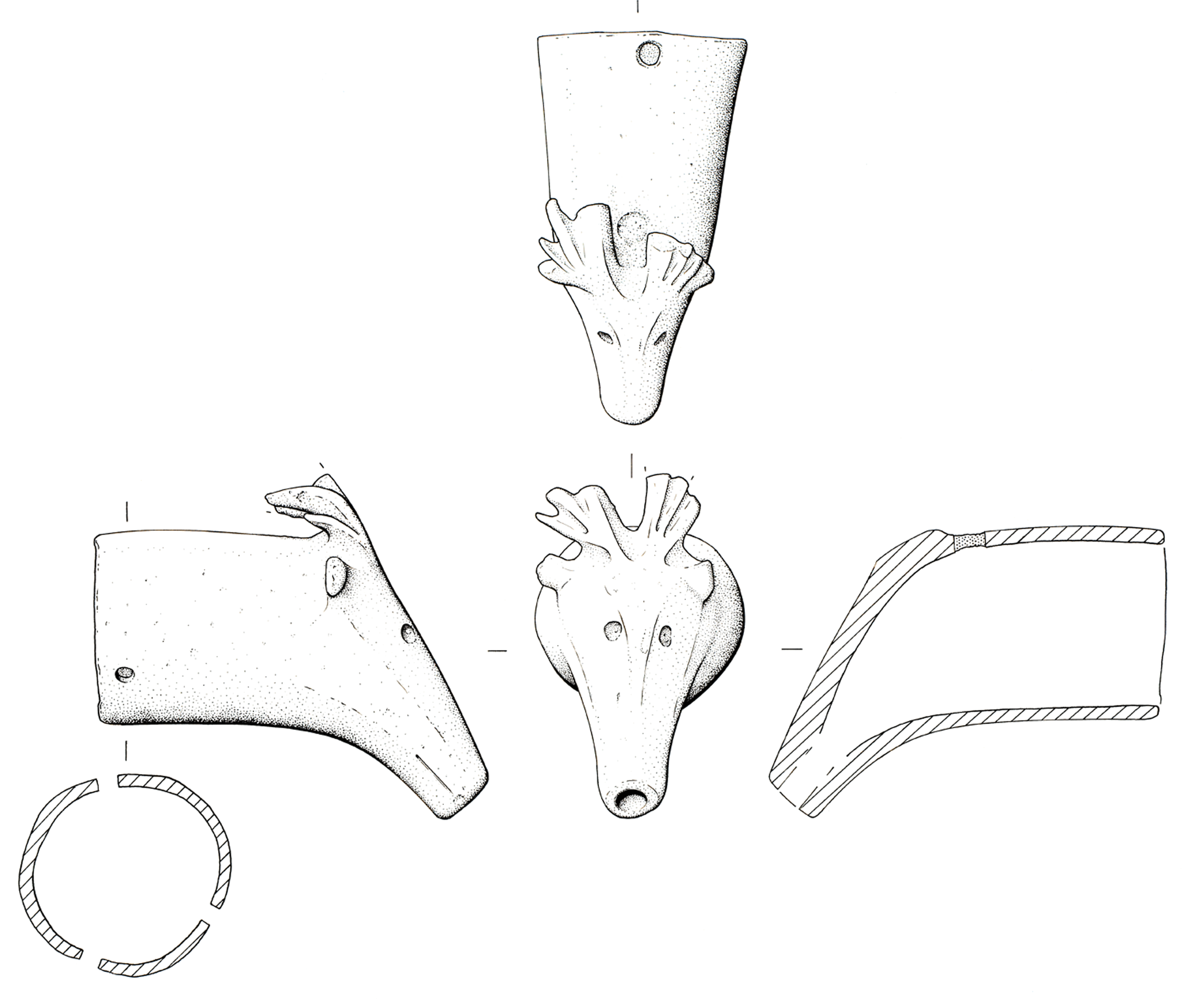
(13) Attleborough (NMS-6FF7C4) (fig. 18).Footnote 45 A copper-alloy ferrule or cap, probably from a staff. Hollow-cast in the form of the head of a stag, with an elongated tapering muzzle, a blind hole in the narrow terminal for a mouth, drilled dots for eyes, short ears, and splayed, notched, sub triangular antlers. There are three drilled holes for attachment around the socket. It is 42 mm long and 22 mm in diameter. The stag is associated with Silvanus, the Romano-Celtic hunter god, and with the Celtic god Cernunnos, but stags are uncommon as small objects in Britain.Footnote 46 Green illustrates a head of a bull with a perforated neck, which may have been mounted in a similar manner and have served a similar purpose to this example, and a mount for a sceptre-head depicting a wolf or jackal is known from Caister-on-Sea, Norfolk.Footnote 47
Attleborough, ferrule or cap in the form of a stag (No. 13). Scale 1:1.
(Drawn by J. Gibbons; © Norfolk Landscape Archaeology)

SUFFOLK
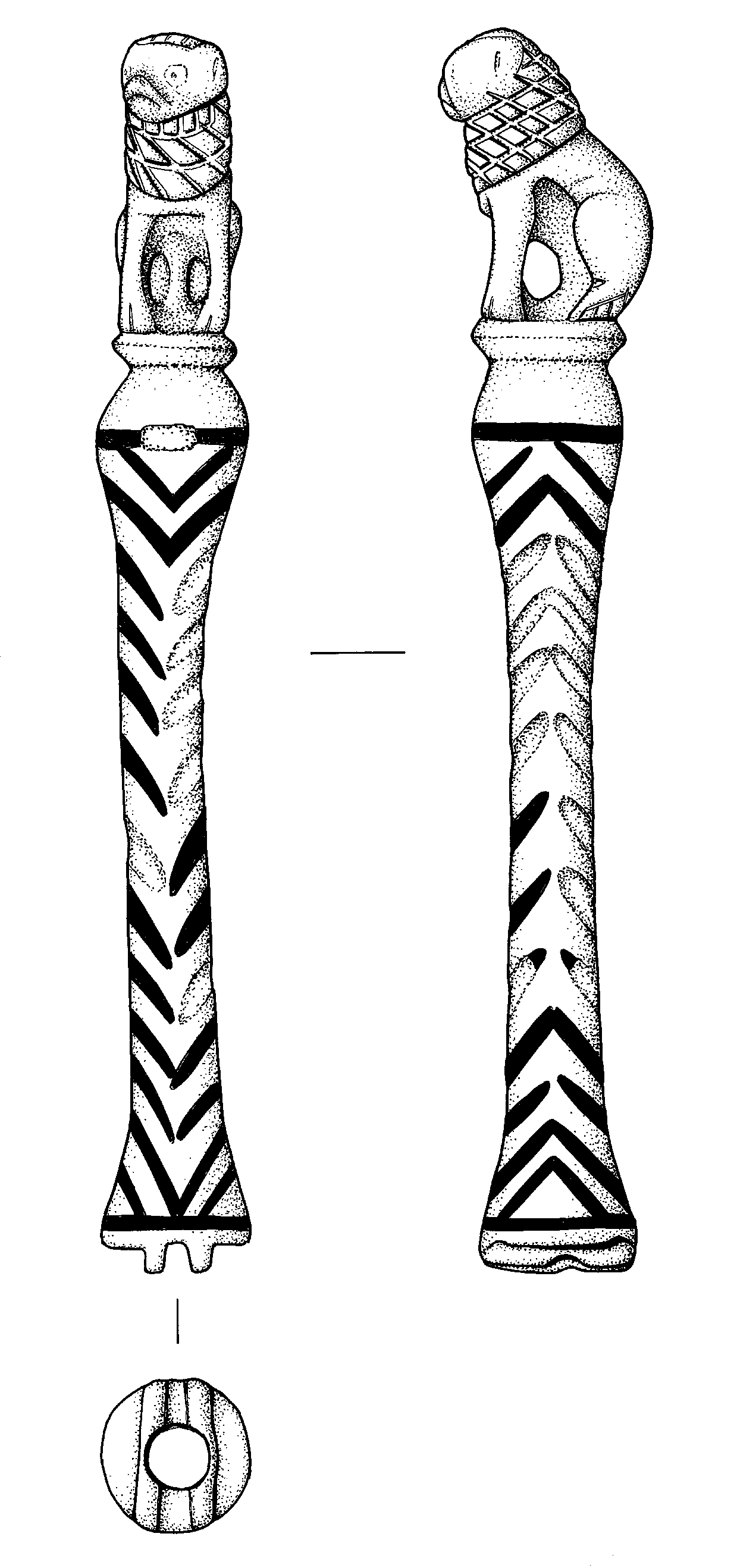
(14) Battisford (SF-290B92) (fig. 19).Footnote 48 A complete copper-alloy handle of a possible stirring rod. The handle’s shaft flares to a ledge (11.15 mm in diameter) from which a zoomorphic terminal extends in the form of a seated lion (22.8 mm high). Its front legs are straight and the head rises directly above them, turned slightly to its right. The hind quarters are rounded mouldings on each side defining the rear legs beneath which a tail is folded. A moulded collar represents the mane, defined by three circles of diagonal cross-hatched incisions on the upper back and the top of the head. A fourth row behind the ears brings the mane to the top of the head where there is also a cap of hair. On either side are two small projecting ears. The head is rounded with a squat, flattened snout. Small circular eyes project slightly and have a small central circular perforation. The shaft of the handle expands to a conical terminal with a flat base and a central circular perforation, flanked by two transverse ridges. The faces of the shaft are decorated with inlaid niello of single circumferential bands at each end and 13 or 14 rows of short diagonal lines in alternating directions, of which some are now missing the niello inlay. These give the impression of chevrons or a herringbone pattern running the entire length of the shaft. The handle is 87.4 mm long, 10.95–15.3 mm wide, 6.5 mm in diameter and the cylindrical shaft is 64.6 mm long; it weighs 28.97 g. It has not been possible to find a parallel for this object, but the general form is similar to a stirring rod from Augst decorated with a cockerel.Footnote 49
Battisford, handle of a possible stirring rod (No. 14). Scale 1:1.
(Drawn by D. Wreathall; © Suffolk County Council)

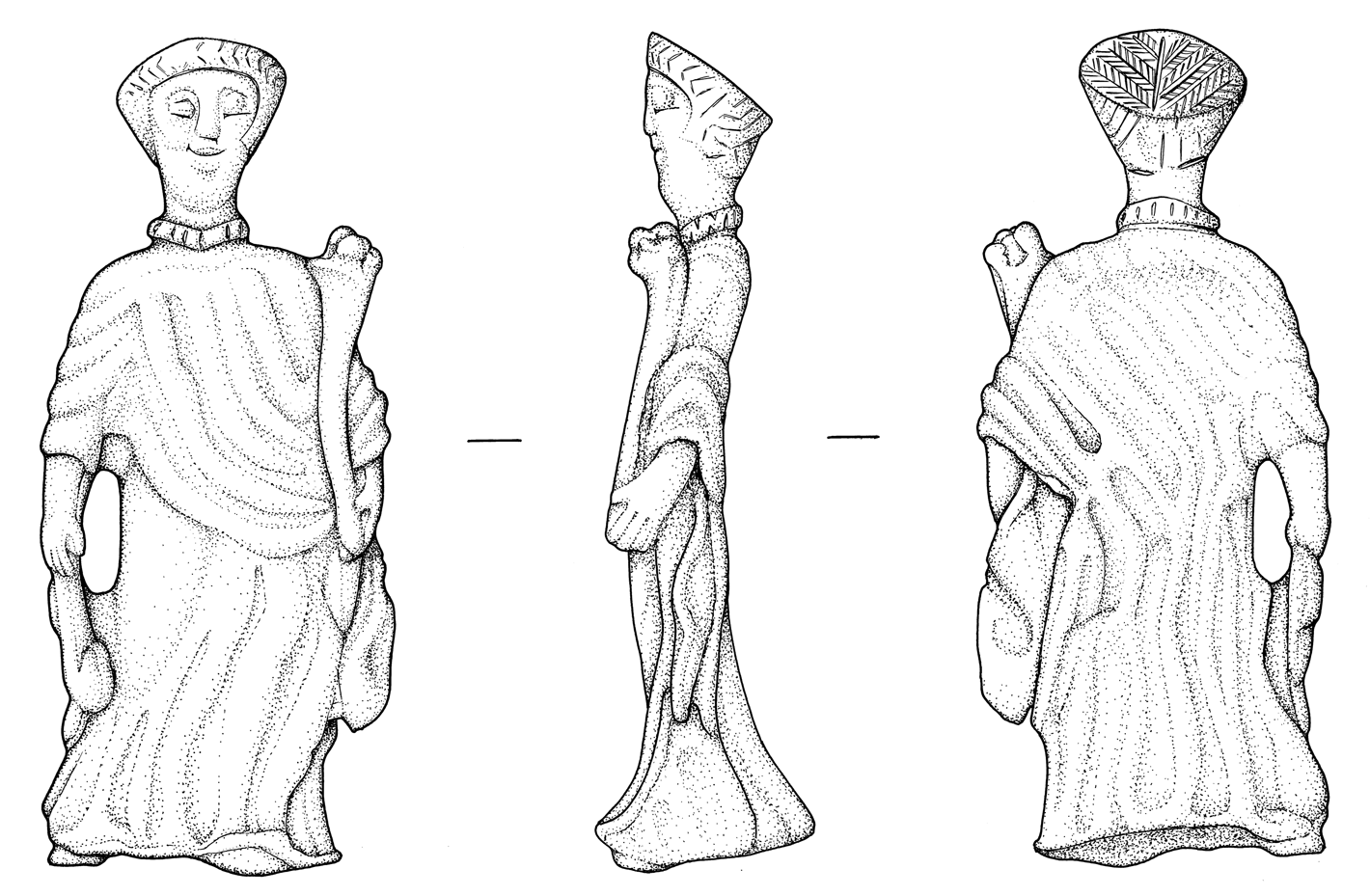
(15) Kettlebaston (SF-302EF1) (fig. 20).Footnote 50 A copper-alloy figurine, depicting a standing female figure. The figurine has an oval head with incised oval eyes, a small nose and an incised smiling mouth. She either has an elaborate hair-style or is perhaps wearing an unusual head-dress, which frames the face, the top having a flat downwards-sloping surface. This surface is decorated with a central deep groove and to either side are opposing diagonal lines with further smaller diagonal cross-hatching between these representing braiding or the filaments of a head-dress. Around the neck of the figurine is a thick necklace or torc. The shoulders are sloping and the figurine is dressed in a draped garment with three-quarter length sleeves, the hem of which reaches to the base of the figurine. Its folds are depicted by moulded ribs and grooves which flow towards the left across the upper body of the figurine and fall vertically below the waist. The change in direction may indicate that it is belted at the waist. The left hand holds a cornucopia. The right arm is straight, held at the side of the figurine, and the right hand holds an unknown object, perhaps a young animal. There are spots of a white metal on the lower front face of the garment. At its base the hem of the garment flares outwards: here the figurine is incomplete and any pedestal or base is now missing and the feet are not visible. The underside is oval in shape and concave with traces of a possible white lead solder within it, presumably to attach the figurine to its base. There is also reddish brown iron staining around its outer edges, possibly the remains of the base or the attachment to it. The figurine probably represents Fortuna or a native goddess whose attributes draw on her iconography. The torc around her neck is similar to that of the Henley Wood figurine.Footnote 51 The figurine is 73.14 mm in height, 31.3 mm in width, and weighs 17.59 g.
Kettlebaston, figurine of a female probably representing Fortuna or a native goddess (No. 15). Scale 1:1.
(Drawn by D. Wreathall; © Suffolk County Council)

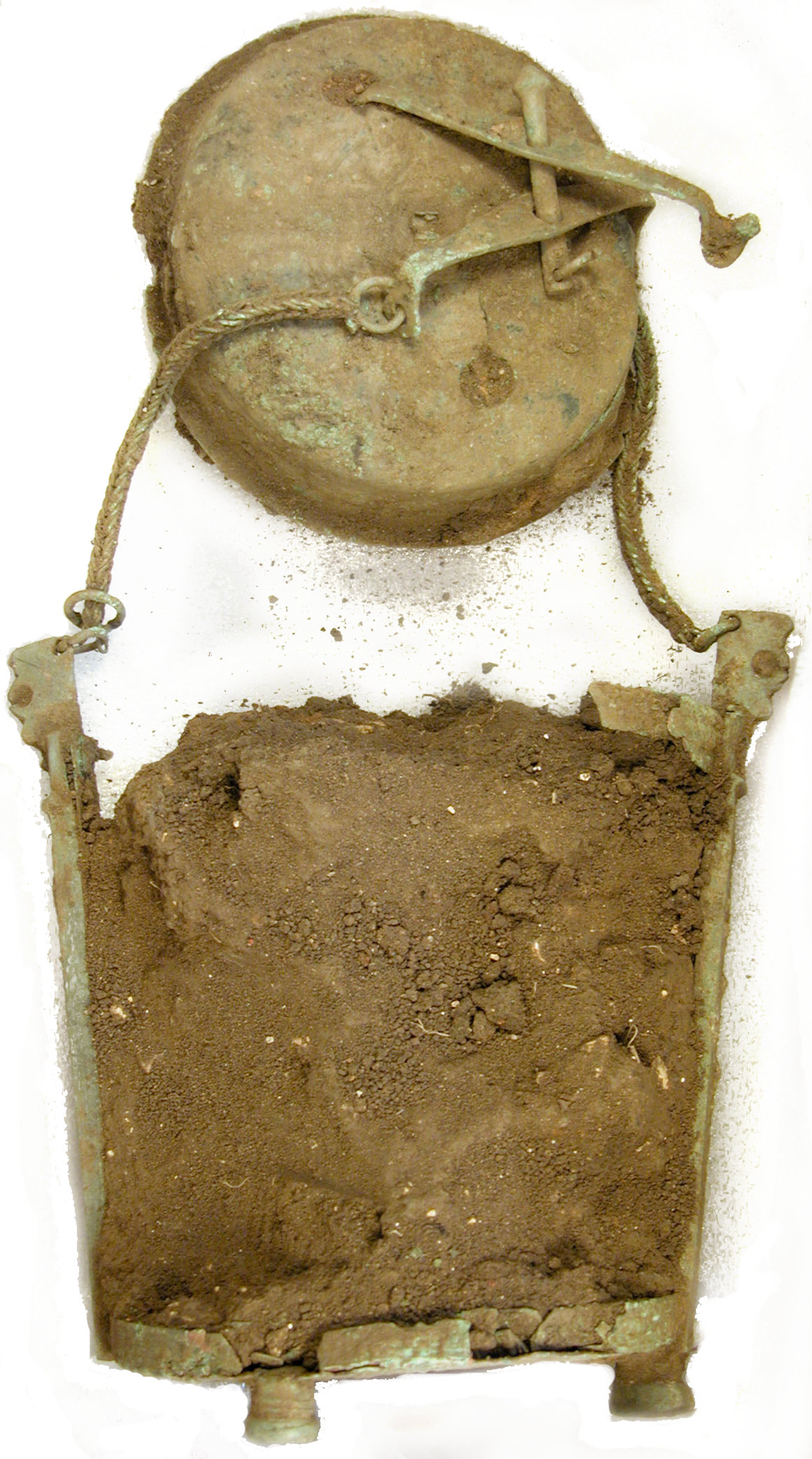
(16) Glemsford (SF-4BD264) (fig. 21).Footnote 52 A very unusual and almost complete lantern; it is 306 mm in height, the body is 141 mm in diameter and the base diameter is 130 mm. It has a dome-shaped lid with simple incised decoration and possible traces of a white-metal coating and a cylindrical body comprising two uprights and a circular base plate with feet, three of which are now missing. The cylindrical surround, which would probably have been in horn, is missing. Projecting from the centre of the upper face of the lid are the remains of an applied copper-alloy loop, about half of which is still attached. To either side of this central loop there is a large oval hole, which probably acted as an air hole at the top of the lantern. The lid and body are joined by two chains approximately 155 mm long and formed from four double-strands of twisted wire joined together. At the top of the lantern there are three bars that enable suspension and attachment of the lid to the body. A split loop in copper-alloy wire runs through the hole at the base of the vertical bar and would presumably have been attached to the centre of the lid. At the centre of the base there is a circular hole and two opposing rectangular slots, presumably to enable a copper-alloy attachment with a wick to be inserted through the base and twisted through 90 degrees. Extending from the base are two opposing rectangular uprights measuring 175 mm in height, 14.60 mm in width and 9.5 mm in thickness, both of which have elaborate rectangular terminals at the top with U-shaped notches on the outer edge. Each terminal has a circular hole in the centre of the outer edge. Beneath the terminals the uprights are flattened and have transverse projecting collars. On their internal faces there are traces of flattened sheet copper-alloy plates of the same width as the uprights that presumably served to keep the horn inserts in place. A foot was attached to the base using a single cylindrical copper-alloy rivet; the second foot is larger, cruder and may have been a later addition or repair.
Glemsford, incomplete lantern (No. 16). Scale 1:2.
(Photo: A. Brown; © Suffolk County Council)

The lantern was probably of Italian manufacture and dates to the first to third centuries a.d. It may have formed part of a funerary assemblage, probably accompanying a cremation burial, although this is at present uncertain owing to the lack of associated contextual data. It is to date the most complete lantern of its type to be found in Roman Britain, although the presence of possible fragments of similar lamps at Richborough, Fishbourne, Strageath, and possibly in Corbridge Museum is noted. Other more complete parallels are known from Torre Annunziata, Oplontis, Boscoreale, Pompeii and Tripoli, Libya.Footnote 53 Whether the internal workings of the lantern are contained within the soil inside the frame may be revealed through X-rays and further conservation.
Building material, pottery and other metalwork dating from the late Iron Age to the late Roman period have been found in the environs of the lantern findspot. A geophysical (magnetometer) survey of a sample 0.4 ha, including the area of the find, was undertaken as part of a student training project by the Faculty of Classics, University of Cambridge. This showed traces of a series of small enclosures, possibly rooms within a building, on an alignment different to the present fields, and an indistinct area of probable building rubble. It is hoped that a larger area can be surveyed in the future. The finder and landowner have kindly donated the lantern to Ipswich Museum where it is currently being conserved.
GREATER LONDON
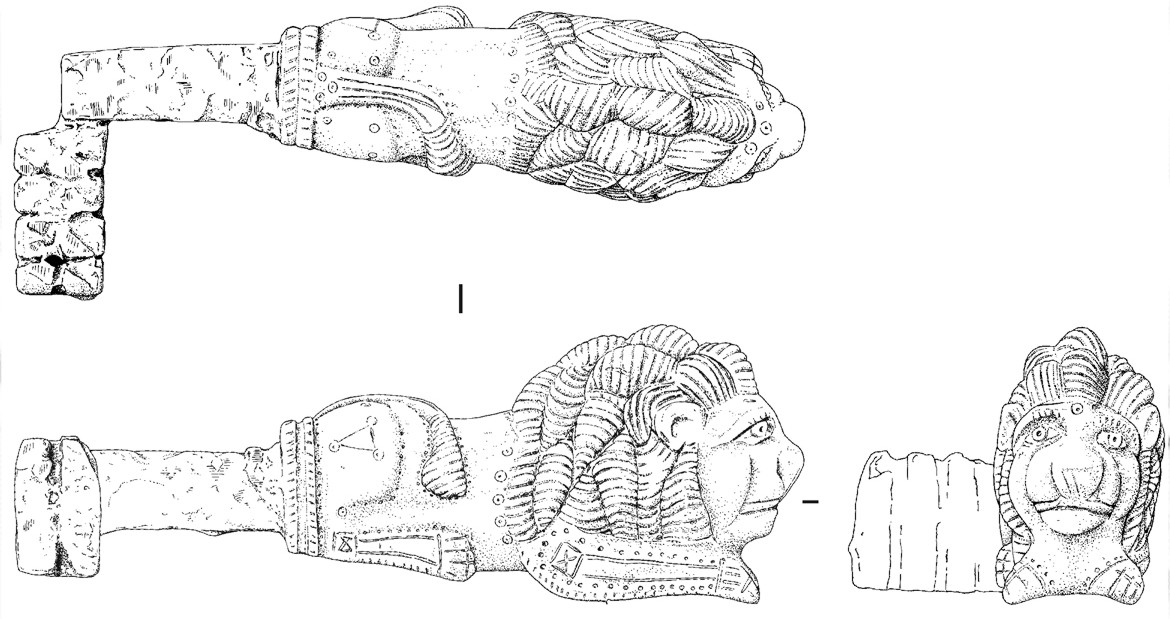
(17) Southwark (LON-465FC5) (fig. 22).Footnote 54 A very fine complete copper-alloy and iron tumbler-lock slide-key in the form of a lion whose body emerges from a square mount made up of two slightly knurled mouldings. It is 133.5 mm long, 29.9 mm wide and weighs 382.3 g. The handle is in the form of a stylised, but well modelled, recumbent lion, which adopts a ‘relaxed’ pose. His four paws, indicated by three or four linear grooves, are turned forwards, the mouth is closed and the tail brought forward and flicked to the right. The full mane is neat and its strands are bunched in clusters in a similar manner to that on a key handle from Horren, Nordrhein-Westfalen.Footnote 55 The facial features are unusually well-defined: the large oval eyes have a pupil and iris and the eye-brow is fully modelled. Between the brow and the mane are three stamped ring-and-dot motifs. The ears are small, the nose rounded, and the wide mouth is defined by two parallel horizontal lines. The body is decorated: rows of ring-and-dot stamps mark the junction between mane and body and accentuate the limbs on the haunches, down the legs and at the base of the tail. A saltire within a square is incised at the top of each foreleg and a triangle with a ring-and-dot at each apex is incised on both haunches. The decoration has not been paralleled on other zoomorphic key handles. The stylisation and decoration may reflect a provincial artistic tradition. The iron key of Manning’s Type 2Footnote 56 is complete and has four close-set teeth arranged on a straight ward.
Southwark, complete lion-headed tumbler-lock slide key (No. 17). Scale 1:2.
(Drawn by C. Harward; © C. Hayward and MOLAS)

Key handles in the form of a sleeping lion are relatively frequent finds in Britain, as seen at Caistor-on-Sea, Fishbourne and Caerleon, for example.Footnote 57 The PAS has recorded six examples with a lion handle from Brundish, Suffolk (SF9345), Colchester, Essex (ESS-6DD2D1), Rocklands, Norfolk (NMS-1447F6), Much Hadham, Hertfordshire (BH-E96707), Wendover, Buckinghamshire (BUC-7AAC21), and Winthorpe, Nottinghamshire (SWYOR-F1D5D6). The Southwark example is the first instance of the key being preserved intact with its zoomorphic handle. On the Continent zoomorphic handles with iron keys intact are known from various sites.Footnote 58
WILTSHIRE
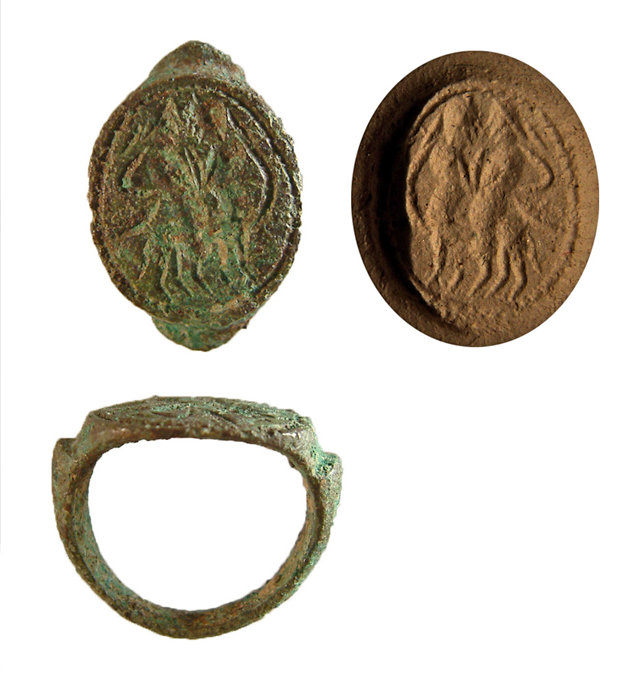
(18) West Lavington (WILT-FD7978) (fig. 23).Footnote 59 An early third-century a.d. copper-alloy finger-ring of Henig type Xb. It weighs 7.28 g and measures 24.51 by 21 mm (internally 18.21 by 16.76 mm). The oval bezel is flat with a beaded outer edge and the device depicts a human figure, the child Achilles, sitting on the back of the centaur Cheiron, who is teaching him to play the lyre.Footnote 60 Such a scene is known on a much earlier first-century b.c. intaglio from Iran, now in the Getty MuseumFootnote 61 and the cornelian gem now in the Royal Coin Cabinet, The Hague.Footnote 62 This is the only representation of this scene known from Britain.
West Lavington, finger-ring with device depicting the child Achilles, sitting on the back of the centaur Cheiron (No. 18). Scale 1:1.
(Photo: K. Hinds; © K. Hinds and Salisbury and South Wiltshire Museum)

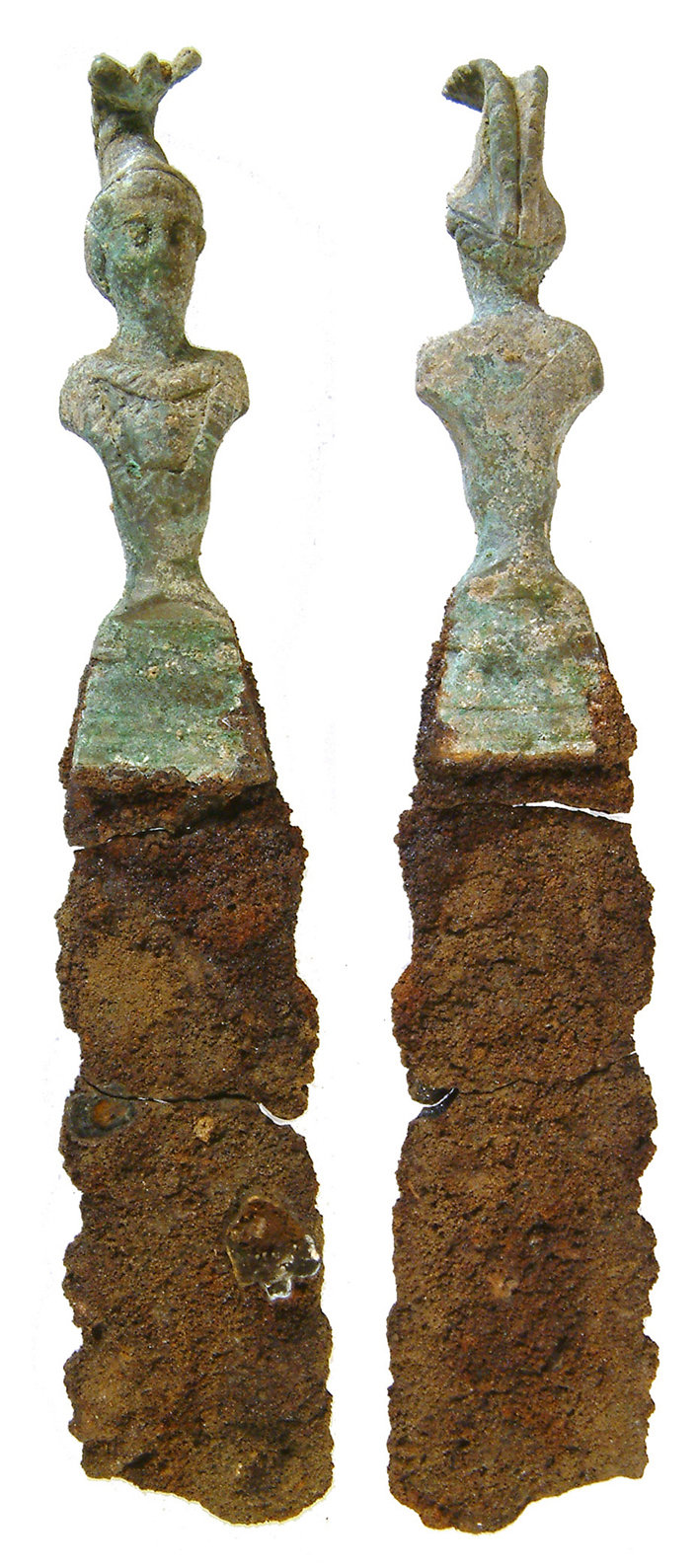
(19) Highworth (WILT-9ECD01) (fig. 24).Footnote 63 An almost complete copper-alloy and iron wax spatula of Feugère’s Type A5,Footnote 64 the best preserved spatula of its type after that found at Ospringe, Kent.Footnote 65 It was found in three joining fragments; its edges display some damage and the sides of the blade, now parallel, probably originally expanded to a broad end. The bust and face are well-modelled but worn, with waved hair and an elaborate high-crested Corinthian helmet. The drapery is indicated by a series of grooves on the chest which do not extend to the undecorated back. A slight moulding in the large trapezoidal recess on the rounded breastplate may represent the worn traces of the aegis or some other motif. The figure on the spatula from Kington Langley, Wiltshire (NMGW-DED9D2), is not depicted as wearing the aegis, but has two V-shaped grooves on the chest, with a raised heart-shaped motif between them. A large trapezoidal split plate extends on both front and back of the blade to secure it, in a similar fashion to that seen on the Minerva handle from Scawby, North Lincolnshire.Footnote 66 The straight-sided spatula is 170 mm long, 30 mm wide and weighs 82 g, and the handle is 80 mm long and 22 mm wide. It was found during a watching-brief,Footnote 67 on which a burial and the foundations of a wall in sandstone blocks were also documented, close to a large storage jar of Alice Holt/Farnham ware, repaired with nine lead straps and rivets, found adjacent to the wall.
Highworth, Minerva wax-spatula handle (No. 19). Scale 3:4.
(Photo: K. Hinds; © K. Hinds and Salisbury and South Wiltshire Museum)

Since the Britannia publication in 2008Footnote 68 which lists sixteen Type A5 spatula handles recorded by PAS, a further six have been recorded by the Scheme: from Northop Hall, Flintshire (DEN-3907E8), Stretton Grandison, Herefordshire (HESH-9283B6), Warthill, North Yorkshire (YORYM-1200F1), Watton-at-Stone, Hertfordshire (BH-2EE223), Twyford, Hampshire (SUR-2997A3), and Nether Wallop, Hampshire (HAMP-41EC60).
HAMPSHIRE
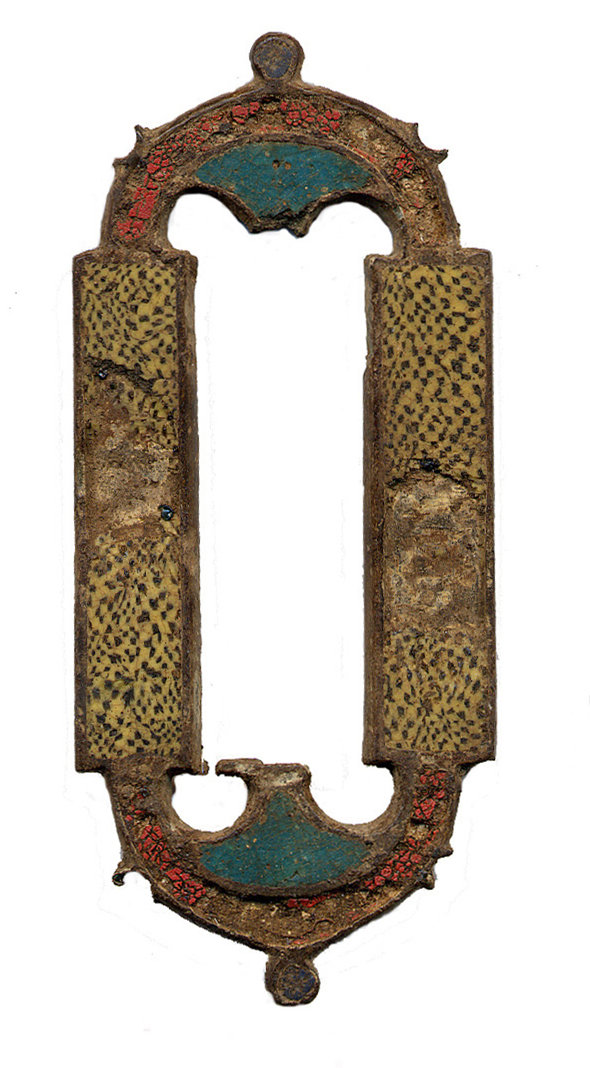
(20) Kingsclere (FASW-B52BC2) (fig. 25).Footnote 69 A third-century enamelled openwork copper-alloy belt plate — sub-rectangular, with semi-circular ends, each with a central, circular lug with blue enamel and a trace of a semi-circular loop to either side of the central lug, probably the traces of further lugs. At each end an outer semi-circular band, inlaid in red enamel with traces of black dots, much of which is missing, encloses a peltiform cell infilled with turquoise enamel. Neither peltiform cell is complete, but both have traces of short rectangular bars which would have extended to the rectangular panel making the body of the belt plate and thus formed a D-shaped openwork recess on each side of the cell. The rectangular cells on each side of the frame are inlaid with black and yellow millefiori mosaic glass, a section of which is missing from each panel. There are two studs with flattened ends projecting from the back of the plate. The object is 83 mm long, 36 mm wide, and 3 mm thick. A close parallel is known from CaerleonFootnote 70 and plates linked by three-link chains for a broad leather belt found at South Shields are very similar.Footnote 71
Kingsclere, enamelled openwork copper-alloy belt plate (No. 20). Scale: 1:1.
(Image: S. Worrell; © Winchester Museums Service)

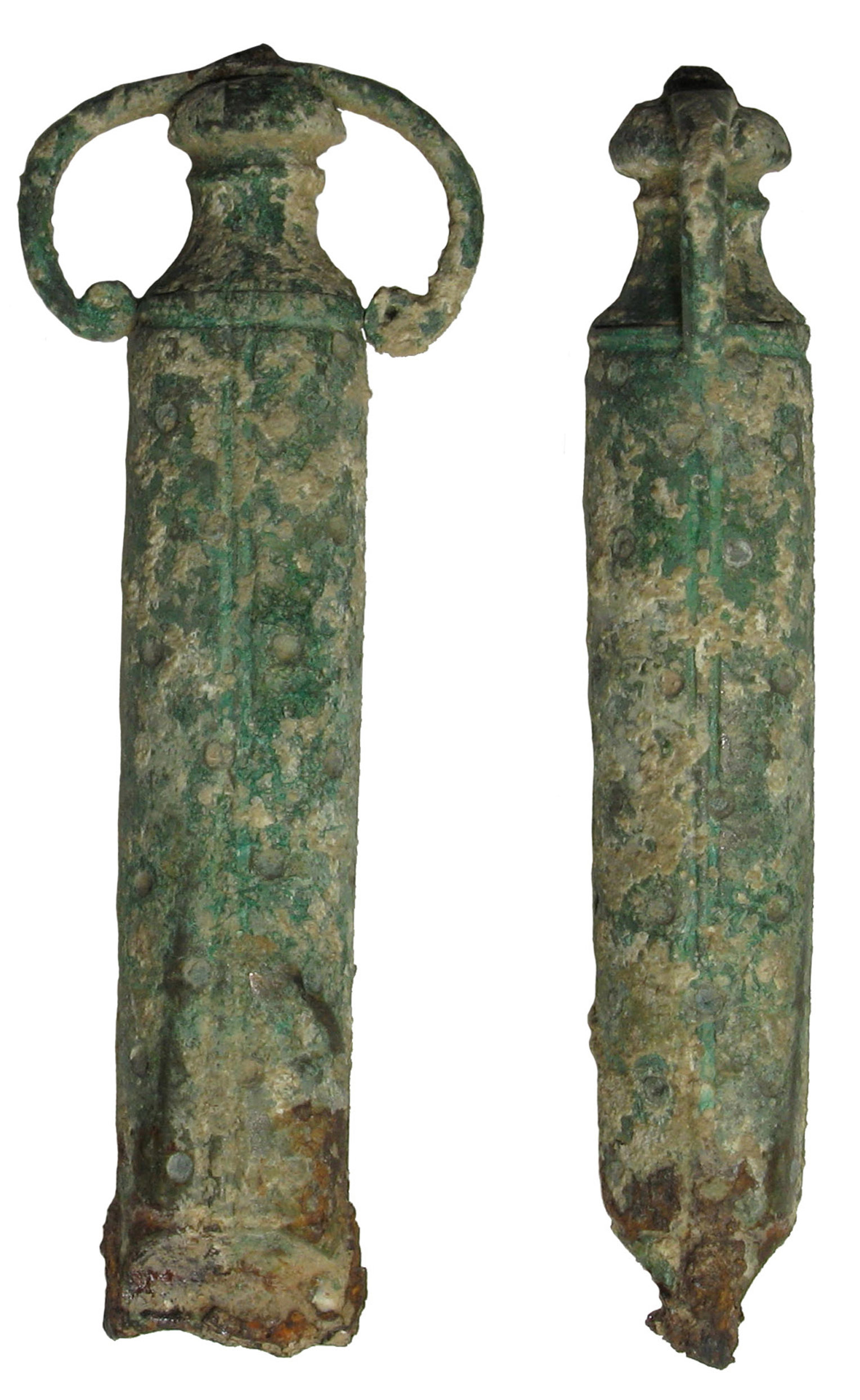
(21) Weston Corbett (HAMP-AE5D17) (fig. 26).Footnote 72 A copper-alloy cylindrical handle with elaborate terminal from an incomplete knife of Manning Type 1d,Footnote 73 dating to the first to mid-second century a.d. A short section of the iron blade remains (4.3 mm thick). The cylindrical body is decorated with three pairs of incised lines running along its length and punched circles arranged in regular diagonal rows spiralling around the handle. The terminal has a ‘baluster’ cap at the end of the cylinder containing a spring with flattened ends to secure the handle on each side. The central part of the spring curves up over the top of the end cap. The end of the iron knife tang runs through the end cap and through the central piercing on the spring where it is then hammered into a flat stop to hold both in place. Handles of Type 1d knives were usually made in bone or ivory and had a wide but relatively thin distribution throughout the Western Empire.
Weston Corbett, handle of key of Manning Type 1d (No. 21). Scale 1:1.
(Photo: R. Webley; © R. Webley and Winchester Museum Service)

(22) Micheldever (HAMP-73A142) (fig. 27).Footnote 74 An incomplete copper-alloy zoomorphic Roman plate-brooch in the form of a frog of Feugère’s Type 29a2. The head stands proud of the body and is decorated with incised semi-circles that delineate the eyes. The arched body, concave beneath, is bent at the lower back, between its shoulders and a forked tail. There are two trapezoidal recessed cells decorating its back, both containing traces of red enamel, and other features include circular cells in reserved metal. A leg with a moulded foot extends from the side of the brooch below the head; the other front leg has been lost. The catchplate can be seen below the head and between the hind legs are two perforated semi-circular lugs. The pin is missing. The brooch is 34.25 mm long, 16.5 mm wide, 4.85 mm thick, and weighs 46 g. This type of brooch is extremely rare in Britain, but a very similar example has been found at Le Vieil-Évreux.Footnote 75
Micheldever, zoomorphic plate brooch in the form of a frog (No. 22). Scale 1:1.
(Drawn by A. Cracknell; © Winchester Museum Service)

ISLE OF WIGHT
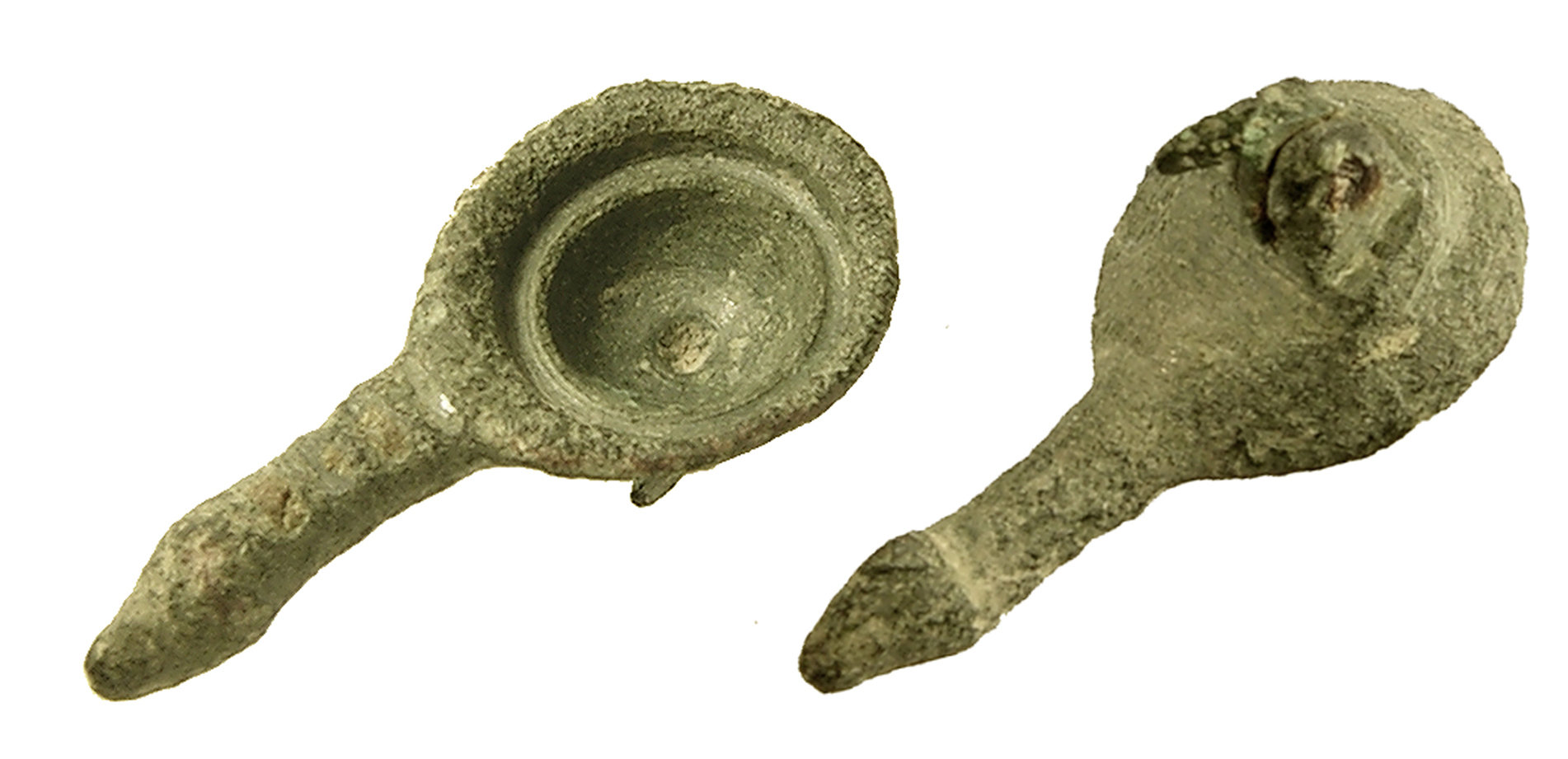
(23) Newchurch (IOW-1EE0B7) (fig. 28).Footnote 76 An incomplete cast copper-alloy skeuomorphic brooch in the form of a skillet of late first- to second-century a.d. date. Below the internal rim there is a wide, concentric groove forming a ledge and at its centre is a small central pit, 1.2 mm in diameter. The groove and the lower concave, internal face appear to have been finished off with the use of a lathe since there are numerous concentric tool marks. The handle is 9.7 mm long and has a maximum width of 3.2 mm. The upper surface is moulded with transverse ribs and the convex rear surface is undecorated. The terminal is zoomorphic, perhaps intended to represent a ram’s head with a long nose, although no other features survive. At the rear of the ‘pan’ is a pair of perforated pin lugs. An iron axis bar secures the remains of a hinged copper-alloy pin secured between two D-shaped lugs. The brooch is 21.7 mm long, with a diameter of 10.7 mm, and weighs 1.8 g. Similar brooches are rare in Britain, but a brooch in the form of a handled vessel of Riha’s Type 7.25, but with a circular rather than zoomorphic terminal, is known from Augst.Footnote 77
Newchurch, skeuomorphic brooch in the form of a skillet (No. 23). Scale 2:1. (Photo: F. Basford; © F. Basford)