




Background
Despite the US Surgeon General identifying oral disease as a priority health concern and urging all health professionals to address it, there has been minimal progress in restructuring the healthcare delivery system to adequately meet the nation’s oral health needs and eliminate the artificial divide between oral and systemic health (National Institute of Dental and Craniofacial Research, 2021). Other calls to action further highlight oral healthcare as a social justice issue and highlight the need for collaborative programming and health policy support including building upon existing health safety nets to link oral health services with primary care (U.S. Department of Health and Human Services, 2003; Treadwell HM, Reference Treadwell and Northridge2007; Laurie Smith et al., Reference Smith2024).
Access to oral healthcare at the population level is hindered by macro-level factors such as population-wide policies and systems in place that prevent the seamless and integrated delivery of oral and general health services (Prasad et al., Reference Prasad, Manjunath, Murthy, Sampath, Jaiswal and Mohapatra2019; Patro et al., Reference Patro2024). Historically, dental professionals, including dentists, dental hygienists, and dental assistants have been trained, reimbursed, and practiced separately from their medical counterparts. This long-standing division has reinforced the disconnect between dentistry and other healthcare fields (Atchison et al., Reference Atchison, Rozier and Weintraub2018; Northridge et al., Reference Northridge, Kumar and Kaur2020). With the exclusion of dentistry at the establishment of medical schools, there is minimal participation in the development of health policies or the involvement of dental professionals in the care of adults at the primary healthcare (PHC) level (McCauley et al., Reference McCauley2003; Northridge et al., Reference Northridge, Kumar and Kaur2020). Separate medical and dental systems exacerbate disparities in healthcare access for underserved groups who already face limited access to oral health services. This division also leads to disorganized service delivery for healthcare workers, ultimately resulting in poor oral health outcomes and worsening existing disparities (Northridge et al., Reference Northridge, Kumar and Kaur2020).
To provide whole-person, integrated, patient-centred, and comprehensive care, it is important to connect oral health with PHC because oral health directly affects overall health and quality of life. Integration has generally centred on providing some oral health services in PHC because primary care clinicians are well positioned to reduce the burden of oral diseases. This can involve integrating oral health into routine care by providing counselling on oral hygiene and diet, promoting smoking cessation, offering fluoride supplementation or application, and screening for dental diseases (Stephens et al., Reference Stephens, Wiedemer and Kushner2018).
The 2021 National Institute of Dental and Craniofacial Research report, ‘Oral Health in America: Advances and Challenges’ cites the achievements of dental programmes situated in health centres (National Institute of Dental and Craniofacial Research, 2021). These programmes served 5.7 million patients through 13.7 million visits, with dental sealant applications in children aged 6–9 increasing from 42% to 56% in 2021 (Health Resources and Service Administration 2024).There is value in considering PHC settings essential for integrating oral health services. More Americans lack dental insurance than medical insurance (Mascarenhas et al., Reference Mascarenhas, Okunseri and Dye2020), making them more likely to visit their PHC provider for health issues linked to or originating from poor oral health, such as respiratory diseases, cardiovascular diseases, and diabetes (Stephens et al., Reference Stephens, Wiedemer and Kushner2018). For example, in a cohort of diabetic participants who had dental visits through primary care, such visits were associated with an approximate 0.5% improvement in glycated haemoglobin levels (Horbach et al., Reference Horbach, Baldisserotto and Celeste2021). Similarly, a longitudinal cohort study using NHANES data highlighted the benefits of professional dental treatment for overall health, reporting a reduced risk of mortality associated with preventive dental visits (Xu et al., Reference Xu, Ma, Gu, Liu, He, Li, Jia, Ji, Tay, Zhang and Niu2023). The authors also noted that poor dental visits for dental treatments were linked with higher risks for cause-specific and all-cause mortality. Although the findings come from a self-reported data source, which may be associated with some subjectivity, they are based on a large, nationally representative sample size with robust control of confounders and sensitivity analyses. Furthermore, a study on the implications of medical and dental integration in the United States highlighted missed opportunities for dental care among adults with chronic conditions who had medical visits in the previous year but no dental visits (Wei et al., Reference Wei, Griffin, Parker and Thornton-Evans2022). The study also estimated that integrating oral healthcare into primary care could benefit approximately 50% more adults, as medical visits provide a key opportunity for delivering oral health services and making dental referrals.
Access to insurance significantly influences dental visits and the utilization of dental services. The dental insurance market is currently experiencing notable growth and transformation. While most healthcare systems do not provide dental insurance, some Health Maintenance Organizations (a type of health insurance plan focused on preventive care and offering services within a network of providers) are beginning to include dentistry as part of their covered medical services. This shift is often facilitated through Medicare Advantage Plans, approximately 65% of which now offer basic dental insurance coverage (Mascarenhas et al., Reference Mascarenhas, Okunseri and Dye2020; Pope, Reference Pope2016). This trend is expected to continue, as integrating dental insurance into medical insurance plans lowers overall costs. These savings stem from reduced administrative expenses and increased reliance on allied dental health professionals, such as dental hygienists (Mascarenhas et al., Reference Mascarenhas, Okunseri and Dye2020; Pope, Reference Pope2016).
Despite its significance, integrating oral health into primary care remains an emerging practice within healthcare services (Phillips et al., Reference Phillips and Hummel2016). This paper provides an evidence basis to improve the integration of oral healthcare into primary care, given the critical linkages between oral health and many systemic diseases, both in their manifestation and treatment. The aim was to examine the relationship between access to routine PHC and past-year dental visits. We hypothesized that access to routine PHC may be associated with past-year dental visits.
Methods
Epidemiologic design and study population
This is a cross-sectional study and a retrospective analysis of 2017–2020 National Health and Nutrition Examination (NHANES) Survey data representative of US non-institutionalized adults aged 20 years and older. NHANES uses a multistage, stratified, clustered, probability sampling design to identify a nationally representative sample of non-institutionalized civilians in the USA (Stierman et al., Reference Stierman, Afful, Carroll, Chen, Davy, Fink, Fryar, Gu, Hales, Hughes and Ostchega2021). Participants completed a household interview, laboratory measurements, and physical examinations, and the details of the survey design have been published previously (Stierman et al., Reference Stierman, Afful, Carroll, Chen, Davy, Fink, Fryar, Gu, Hales, Hughes and Ostchega2021). This is a secondary analysis of data publicly available from NHANES; hence IRB and ethics approvals were waived according to guidelines of the National Center for Health Statistics (NCHS) Ethics Review Board which manages consent to participate in NHANES, with NCHS ERB Protocol Approval Number #2018-01. Individuals participating in NHANES have specifically consented to the release of their personal information.
Dependent variable
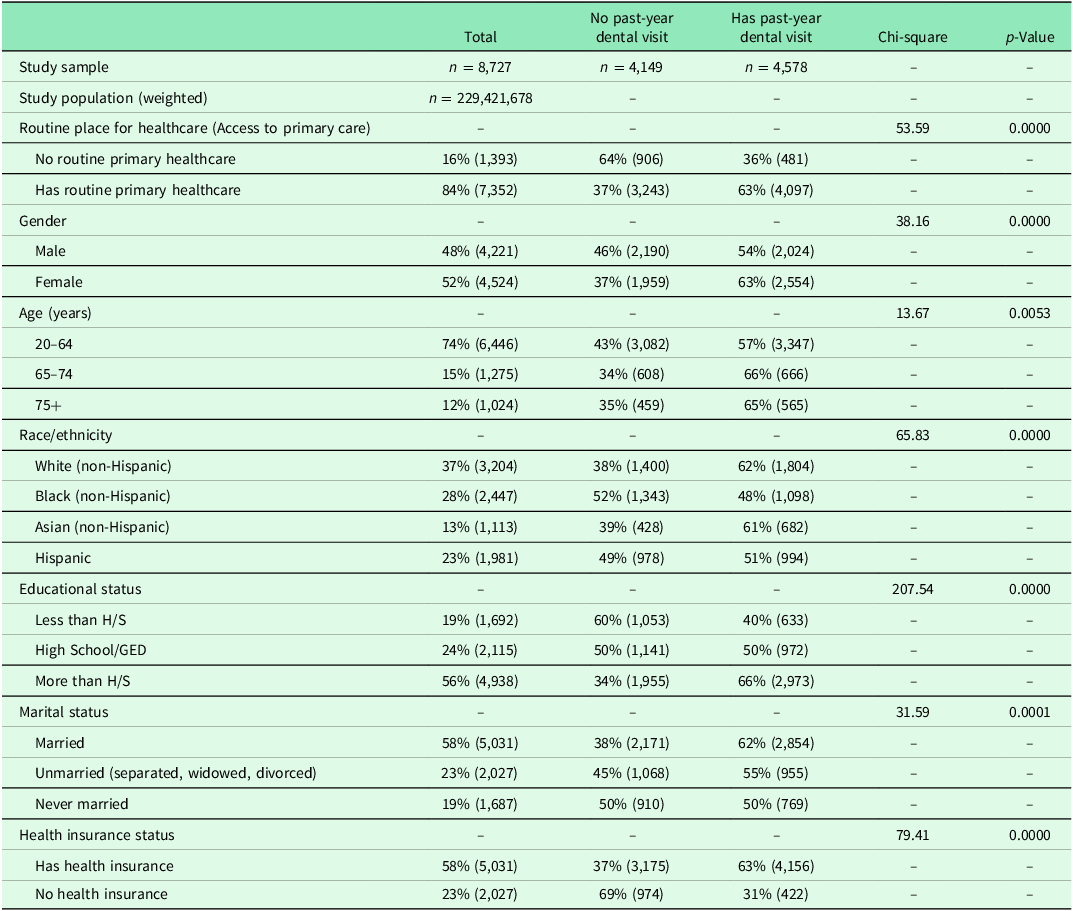
The dependent or outcome variable was past-year dental visits, measured as a binary (yes/no) variable. In NHANES, dental visits were recorded as a categorical variable, which included visits to any healthcare provider for dental care, such as orthodontists, oral surgeons, dental hygienists, and other dental specialists across 10 categories. This was recoded into a binary variable, as shown in Table 1.
Descriptive statistics and bivariate results for covariates by past-year dental visits, NHANES 2017–2020

Note. *Statistically significant P-values for the Chi-square tests are set at p < 0.05. All provided data are weighted using NHANES sample weights provided for 2017–2020.
Independent variable
The key independent or predictor variable was access to a routine place for healthcare, described here as access to routine PHC, assessed as a binary (yes/no) variable. Access to routine PHC in NHANES was a categorical variable in six categories in answer to the question: ‘Is there a place that you usually go when you are sick, or you need advice about your health’? This was recoded into an indicator, binary variable as shown in Table 1.
Covariates
These consisted of sociodemographic factors such as sex, age, race/ethnicity, education level, marital status, and health insurance status), as shown in Table 1.
Statistical analysis
Frequencies and percentages were calculated to present a descriptive analysis. Bivariate analyses for comparing past-year dental visits (dependent variable) in the sample were performed using weighted Chi-square tests for the key independent variable (access to routine PHC) and covariates. This informed variable selection for our unadjusted logistic regression model.
The relationship between access to primary care and past-year dental visits was assessed using unadjusted and adjusted (multivariable analysis) logistic regression models resulting in odds ratios (ORs) and 95% confidence intervals (CIs). The multivariable analysis was adjusted for all sociodemographic factors that were statistically significant in the unadjusted logistic regression model – sex, age, race/ethnicity, education level, marital status, and health insurance status.
All survey data were weighted using NHANES provided survey weights to adjust for the differential probabilities of selection and non-response, making results generalizable. No imputation was performed for missing data, with complete case analysis utilized in all analyses. Analyses were conducted using Stata/MP version 17.0 (StataCorp LP, College Station, TX).
Findings
Descriptive results
There were 8,727 adult participants in our 2017–2020 NHANES analytic sample representing 230 million American adults ≥ 20 years old (weighted study population). In total, 84% of US adults had access to routine PHC, with 63% having had a past-year dental visit. In the study population, 52% were female, 74% were aged 20–64, 37% identified as White, 56% had an education level higher than high school, 58% were married, and 58% had health insurance (Table 1).
Bivariate analysis results
Chi-square tests were conducted to evaluate the relationships between access to routine PHC, past-year dental visits, and covariates. All variables showed statistically significant results at p < 0.05 (Table 1).
Multivariable and stratified analysis results
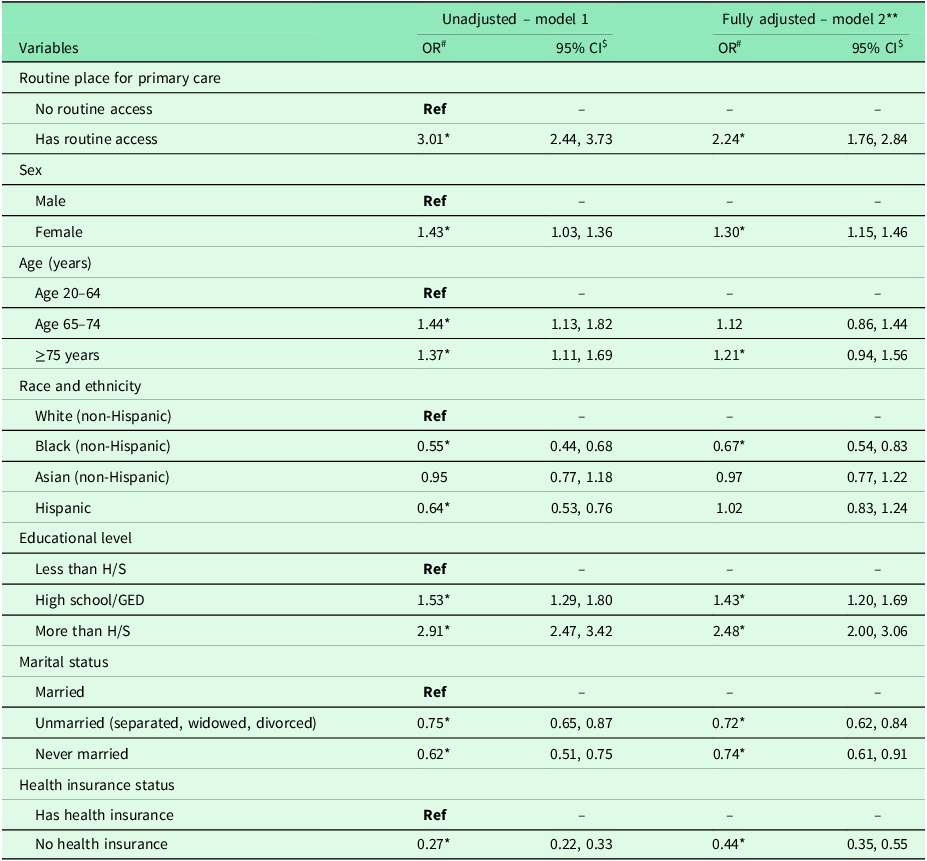
The main results are presented for both unadjusted and adjusted analyses. In the unadjusted regression (Table 2 - Model 1), all variables were significantly associated with past-year dental visits. Participants with access to routine PHC had three times the odds of having a past-year dental visit compared to those without access (unadjusted OR = 3.01; 95% CI: 2.44–3.73; p < 0.001).
Unadjusted and adjusted analysis: odds ratios (ORs) and 95% confidence intervals (CIs) for past-year dental visits, NHANES 2017–2020

Note. Ref stands for reference category.
*Statistically significant ORs are set at P < .05.
# ORs: Odds ratios.
$ CI: Confidence interval at the 95% level.
**Model 2 was adjusted for sociodemographic variables (sex, age, race/ethnicity, education level and marital status), and health insurance status.
All provided data are weighted using NHANES sample weights provided for 2017–2020.
In the adjusted analysis (Table 2 – Model 2), all variables remained significantly associated with past-year dental visits. Participants with access to routine PHC had 2.24 times the odds of having a past-year dental visit compared to those without access (adjusted OR = 2.24; 95% CI: 1.76–2.84; p < 0.001). This was also true for women (adjusted OR = 1.30; 95% CI: 1.15–1.46; p < 0.001), those ≥75 years (adjusted OR = 1.21; 95% CI: 0.94–01.56; p < 0.001), and those with high school/GED (adjusted OR = 1.43; 95% CI: 1.20–1.69; p < 0.001) and more than high school (adjusted OR = 2.48; 95% CI: 2.00–3.06; p < 0.001) education. Black participants were 33% less likely to have a past-year dental visit (adjusted OR = 0.67; 95% CI: 0.54–0.83; p < 0.001). Those without health insurance were 56% less likely to have a past-year dental visit (adjusted OR = 0.44; 95% CI: 0.35–0.55; p < 0.001).
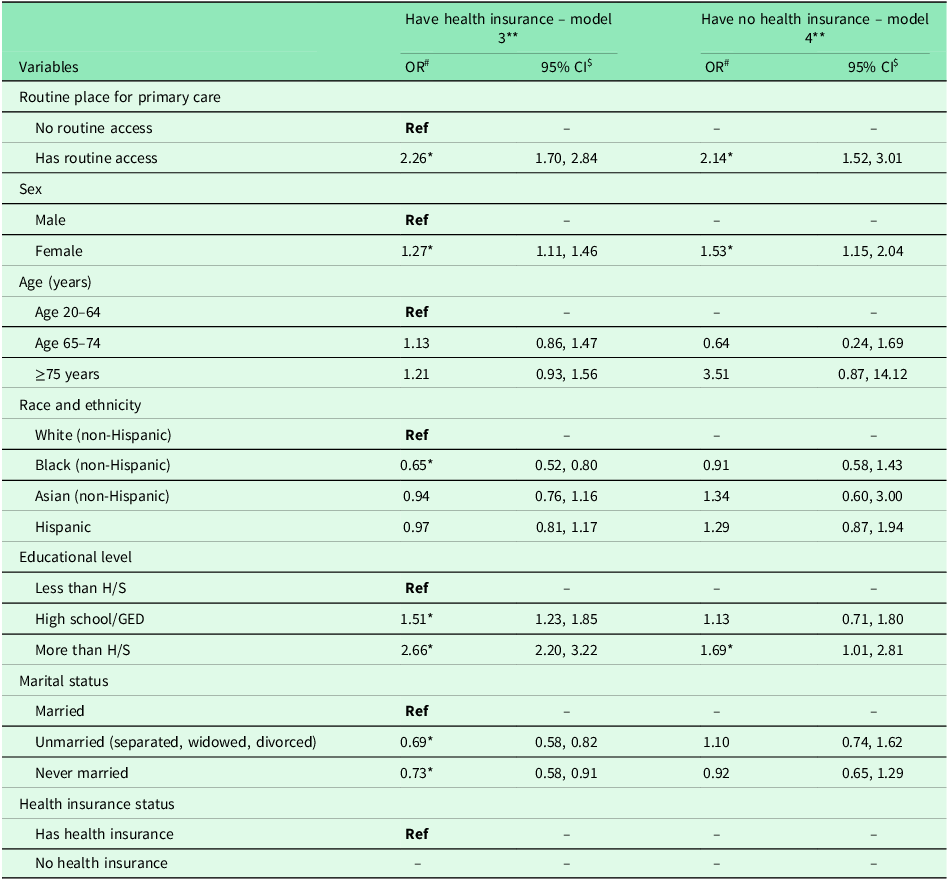
In stratified analysis by health insurance status, the strength, direction, and significance for the predictor, access to routine PHC remained largely unchanged (Table 3 – Models 3 and 4). Among those with health insurance (Table 3 – Model 3), participants with access to routine PHC had 2.26 times the odds of having a past-year dental visit compared to those without access (adjusted OR = 2.26; 95% CI: 1.70–2.84; p < 0.001). Among those with no health insurance (Table 3 – Model 4), participants with access to routine PHC had 2.14 times the odds of having a past-year dental visit compared to those without access (adjusted OR = 2.14; 95% CI: 1.52–3.01; p < 0.001). Importantly, in this stratified analysis, among those with health insurance (Table 3 – Model 3), Black participants continued to be less likely (35% less likely) to have a past-year dental visit (adjusted OR = 0.65; 95% CI: 0.52–0.80; p < 0.001).
Stratified analysis by health insurance: odds ratios (ORs) and 95% confidence intervals (CIs) for past-year dental visits, NHANES 2017–2020

Note. Ref stands for reference category.
*Statistically significant ORs are set at P < .05.
# ORs: Odds ratios.
$ CI: Confidence interval at the 95% level.
**Models 3 and 4 are a stratified analysis by health insurance status and adjusted for sociodemographic variables (sex, age, race/ethnicity, education level and marital status).
All provided data are weighted using NHANES sample weights provided for 2017–2020.
Discussion
The overarching objective of this study was to highlight the effect having access to routine PHC has on past-year dental visits among US adults aged ≥ 20 years though we were able to parse out other results. Our analysis revealed that 84% of US adults have a regular source of PHC, which aligns with broader healthcare trends where approximately 90% of insured adults report having a usual source of care (Newacheck et al., Reference Newacheck, McManus, Fox, Hung and Halfon2000; Dubay et al., Reference Dubay and Kenney2001; Institute of Medicine (US) Committee on the Consequences of Uninsurance et al., 2002; Stevens et al., Reference Stevens, Seid and Halfon2006; Pleis et al., Reference Pleis and Lethbridge-Cejku2007). This study also shows that over half of US adults with access to routine PHC had a past-year dental visit, compared to only one-third with no access to routine PHC. This significant result supports our hypothesis that access to routine PHC increases the likelihood of past-year dental visits. Given that more Americans have medical insurance (91%) compared to dental insurance (77%), integrating oral care into routine primary care could improve and expand access to dental care (Mascarenhas et al., Reference Mascarenhas, Okunseri and Dye2020). This impact is particularly evident in children, where having a personal healthcare provider has been shown to increase the likelihood of dental visits and access to preventive dental care (Martin et al., Reference Martin, Probst, Wang and Hale2009).
Our study also shows that even with health insurance, Black participants were still less likely to have a past-year dental visit compared to their White counterparts. Access-to-care challenges are complex and do not have simple or immediate solutions. While more Americans are experiencing improved oral health, these benefits are not equally distributed. Disparities persist, particularly among low-income individuals, minority groups, and institutionalized elderly populations who often lack adequate access to care (Guay et al., Reference Guay2004). Our study findings highlight this disparity among Black individuals. However, in contrast to published work, the oldest adults in our study were more likely to have had a “past-year dental visit” if they had access to routine PHC. We suspect this may be because these individuals are non-institutionalized.
PHC providers play a critical role as entry points for accessing dental care, largely due to the higher prevalence of medical insurance compared to dental insurance (Cruz et al., Reference Cruz, Rozier and Slade2004). Understandably, having health insurance is distinct from the integration of medical and dental services; nevertheless, it improves access to care and reduces cost-related delayed dental visits (Amedari et al., Reference Amedari, Atanda, Amedari, Monger and Walker2025; Atanda et al., Reference Atanda, Amedari, Agaku, Hayman and Hossain2025), and may be a necessary pathway for cooperation and collaboration for the delivery of integrated medical and dental services. Moreover, enhanced reimbursement rates in Medicaid may increase dentists’ participation (Cruz et al., Reference Cruz, Rozier and Slade2004). However, the absence of a primary care provider is a significant risk factor for not receiving preventive dental care, therefore, strengthening coordination and referral systems between medical and dental providers can help improve oral health outcomes (Crall et al., Reference Crall2005). In a survey of medical providers in North Carolina, about three out of four physicians reported that they were likely to make dental referrals for patients exhibiting early symptoms or at risk of caries (Cruz et al., Reference Cruz, Rozier and Slade2004). An important implication of the significant association reported in our study is that the delivery of oral health services alongside PHC may overcome noted disparities in receiving necessary dental care that marginalized populations face. Additionally, the management of dental conditions in the primary care system decreases the likelihood of utilization of emergency medical services for dental ailments, a typically more expensive visit, which favours more efficient resource allocation and a resultant decrease in healthcare costs (Lutfiyya et al., Reference Lutfiyya, Gross, Soffe and Lipsky2019; Okunev et al., Reference Okunev, Tranby, Jacob, Diep, Kelly, Heaton and Frantsve-Hawley2022; Wei et al., Reference Wei, Griffin, Parker and Thornton-Evans2022).
A major strength of our study is the generalizability of its findings, supported using data from NHANES, a nationally representative and well-established survey. Additionally, the secondary analysis of pooled data provided sufficient statistical power for our analyses. There are however limitations; for example, since cross-sectional data is largely only suitable for estimating prevalence, most outcomes do not support a high level of causality, only associations. Despite this limitation, the study yields valuable findings for public health leaders responsible for addressing the oral health status of Americans. Given the consistent access to medical providers and their significant influence on overall health, physician-dentist-patient partnerships are crucial for improving the oral health of all Americans. A consideration for future related investigations should involve the incorporation of both individual and area-level data on expanded social determinants of health, dental insurance status, and costs of healthcare in an analysis – this data is not available in NHANES, however. This approach would allow for a more comprehensive evaluation of how these complexity of factors also influence the relationship between access to routine PHC and past-year dental visits.
Conclusions
We have demonstrated a significant positive association between access to routine PHC and the utilization of dental services among US adults. Specifically, individuals who identified having a regular place to go when they are sick or need health advice were more than twice as likely to have had a dental visit in the past year compared to those without a routine PHC provider. This relationship remained robust even when adjusting for sociodemographic factors and health insurance status. While the study highlights the vital role of PHC as an entry point for dental care, it also reveals persistent disparities. Black non-Hispanic adults were significantly less likely to have had a past-year dental visit than their White counterparts, a finding that held true even among those with health insurance. This underscores that simply having a regular medical provider or insurance coverage is not enough to eliminate racial gaps in oral healthcare utilization. A policy shift where specific service-level integration (such as dental screenings, oral health counselling, and direct referral protocols) are embedded within the routine workflow of primary care clinics could address these disparities and move us beyond the current administrative divide where medical and dental providers often practice in isolation. Such an approach can help reduce dental visit gaps faced by Black US adults, improve access for other underserved populations, and emphasize the importance of preventive dental care.
Data availability statement
The data supporting the findings of this study are included in the published article. Raw data used for the study are publicly available from NHANES and the National Center for Health Statistics (NCHS). Clean datasets generated and/or analysed during the current study are available from corresponding author, upon reasonable request.
Acknowledgments
AA is currently serving as Senior Policy Researcher at RAND; however, the views, opinions, findings, conclusions, and recommendations contained herein are the author’s alone and not those of RAND or its research sponsors, clients, or grantors.
Author contributions
MA, SC, and AA conceived and designed the study, generated figures and tables, analysed the data, interpreted the results, and drafted the manuscript. All authors read and approved the final version of the manuscript.
Funding statement
This research received no specific grant from any funding agency, commercial or not-for-profit sectors.
Competing interests
The author(s) declare none.
Ethical standards
This is a secondary analysis of data publicly available from NHANES; hence, IRB and ethics approvals were waived according to guidelines of the National Center for Health Statistics (NCHS) Ethics Review Board which manages consent to participate in NHANES, with NCHS ERB Protocol Approval Number #2018-01. Individuals participating in NHANES have specifically consented to the release of their personal information.

 Open access

