Introduction
The global prevalence of alcohol use disorders (AUDs) in 2003 was estimated to be 1.7% (World Health Organisation, 2003), though rates vary across country, ethnic grouping, age, and gender. Lifetime risk for alcohol dependence is estimated to be ~15% in the general population (American Psychiatric Association, 2000). Given the prevalence and costs of AUDs, effective treatment is important.
The most frequently cited approaches for treatment of AUDs are brief intervention therapy, cognitive behaviour therapy, motivational enhancement therapy, and 12-step facilitation (TSF). Research indicates that these approaches are equally effective (e.g. Project MATCH, 1997; UKATT Research Team, 2005). The Minnesota Model, which underpins the programme in St. John of God Hospital, is the original intervention that is classed under the umbrella of what is now known as the TSF approach.
Available research reports on the effectiveness of the Minnesota Model generally indicate benefits for a sizeable number of those treated (e.g. Rossi et al. Reference Rossi, Stach and Bradley1963; Laundergan, Reference Laundergan1982; Gilmore, Reference Gilmore1985; Higgins, Baeumler, Fisher & Johnson, Reference Higgins, Baeumler, Fisher and Johnson1991; Hoffmann & Harrison, Reference Hoffmann and Harrison1991; Stinchfield & Owen, Reference Stinchfield and Owen1998; Harrison & Asche, Reference Harrison and Asche2001; Grønbæk & Nielsen, Reference Grønbæk and Nielsen2007), though one study indicated limited benefit from this form of treatment (Keso & Salaspuro, Reference Keso and Salaspuro1990). Stinchfield & Owen (Reference Stinchfield and Owen1998) and Cook (Reference Cook1988) reviewed a number of these studies and indicated that there was a tendency to overestimate positive outcomes. Their re-examination of these data indicated that broadly speaking around two-thirds of those treated had a good outcome from treatment (i.e. complete abstinence or lower alcohol use after treatment). Overall, the figures suggest that 40–70% of individuals show improved alcohol use up to 1 year later.
A number of factors have been identified in the literature that may be useful in predicting outcomes from treatment for AUDs. These include (a) age and gender (e.g. Harrison & Asche, Reference Harrison and Asche2001; Bottlender & Soyka, Reference Bottlender and Soyka2005; Dawson et al. Reference Dawson, Goldstein and Grant2007), (b) social support and interpersonal difficulties (e.g. Harrison & Asche, Reference Harrison and Asche2001), (c) self-efficacy and personal treatment goals (e.g. Bodin & Romelsjo, Reference Bodin and Romelsjo2006; Moos & Moos, Reference Moos and Moos2007; Warren et al. Reference Warren, Stein and Grella2007), (d) presence of co-morbid psychiatric problems (e.g. Harrison & Asche, Reference Harrison and Asche2001; Kushner et al. Reference Kushner, Abrams, Thuras, Hanson, Brekke and Sletten2005; Kodl et al. Reference Kodl, Fu, Willenbring, Gravely, Nelson and Joseph2008), (e) presence of cognitive impairments (e.g. Blume et al. Reference Blume, Schmaling and Marlatt2005), and (f) severity of initial alcohol problem (e.g. Harrison & Asche, Reference Harrison and Asche2001). However, no single variable or set of variables have been identified as consistently predictive of outcomes across studies.
Aims of study
The data reported on in this paper were collected as part of a larger study examining co-morbidity among individuals seeking treatment for AUDs and looking at 6-month alcohol-related outcomes for those undergoing this treatment. In terms of the purpose of this paper, two aims of the study are relevant here. First, the study sought to ascertain whether or not the alcohol treatment programme being investigated was beneficial to the patient group undergoing treatment, and if so how effective this programme was. Second, the study sought to determine whether it was possible to predict at pre-treatment who was likely to benefit from treatment.
Method
Study design
The present study was designed as a prospective study examining co-morbidity among individuals seeking treatment for AUDs and looking at 6-month alcohol-related outcomes for those undergoing this treatment.
Study sample
Saint John of God Hospital is a private psychiatric hospital in the Republic of Ireland. As it is a private hospital, costs of each patient’s hospital stay are met by private health insurance or by the individual. The sample used in this study consisted of individuals entering the St. John of God Hospital Alcohol Treatment Programme, a programme based on the Minnesota Model of treatment. All patients who were accepted onto the alcohol treatment programme were considered eligible to participate in this research project. Whilst programme co-ordinators make every attempt possible to offer treatment to any patient with alcohol use problems, a number of inclusion/exclusion criteria apply. These are as follows: (a) patients must have a diagnosis of alcohol dependence rather than alcohol abuse, (b) patients must not be currently actively psychiatrically unwell (e.g. actively psychotic), (c) patients must not be taking any addictive medications, (d) patients must have some desire to stop drinking, and (e) patients displaying signs of serious memory, attention, or other cognitive deficits that would likely impair their ability to learn from the experience of the 28-day programme were considered unsuitable for this form of treatment.
The target participants in this study were a cohort of patients commencing the alcohol treatment programme in St. John of God Hospital in the 12-month period between February 2008 and January 2009. All patients who commenced the programme in this 12-month period were approached to participate in this study. Out of a total of 127 patients, 93 (73.23%) agreed to participate. There were no significant differences in age, t (125)=−0.76, p>0.05, or gender χ 2 (1)=0.102, p>0.05, between those who gave consent and participated in the study and those who declined to participate.
Baseline sample (treatment entry)
The study sample contained 44 males and 49 females. They had an average age of 48.10 years (s.d.=11.81). On average participants had received 14.55 years of formal education. Their mean Full Scale IQ, as assessed using the Wechsler Test of Adult Reading (WTAR) (Psychological Corporation, 2001), was 101.79. Participants in the present study all received a diagnosis of alcohol dependence, which was made by their clinical team prior to their commencement of the alcohol treatment programme. The Alcohol Use Disorders Identification Test (AUDIT) (Babor et al. Reference Babor, Higgins-Biddle, Saunders and Monteiro2001) was used to quantify participants’ alcohol problems in a standardised manner. The study group had a mean score of 27.96 (s.d.=5.73) on this measure at treatment entry.
Follow-up sample (6-month follow-up)
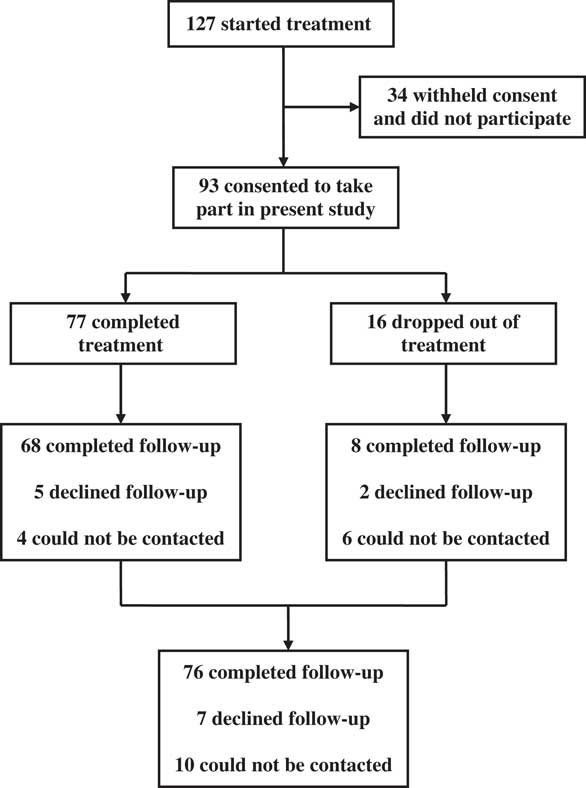
Of the 93 who initially agreed to participate in the study seven declined follow-up and a further 10 could not be contacted. This left a group of 76 individuals for whom follow-up outcome data were available. Of this group, 37 were male and 39 were female. They had a mean age of 48.49 years (s.d.=11.36). This paper is concerned with the outcomes and predictors of outcome for these 76 individuals, though all 93 participants are considered when drawing conclusions about the effectiveness of the treatment programme in order that the danger of drawing misleading conclusions about treatment effectiveness be reduced. Figure 1 gives a graphical representation of the study group for whom follow-up data were available.
Graphical representation of participants who took part in the study.

Measures
Demographic data
A demographic questionnaire was used to gather general information on each individual’s age, gender, marital status, level of education completed, number of years of formal education, occupational status, social class, and living situation. These comprised the demographic variables that were to be considered as potential predictor variables of treatment outcome.
Psychosocial functioning
A number of areas of psychosocial functioning were considered in this study as variables that could potentially predict outcomes from treatment for alcohol dependence. These areas were anxiety symptoms, depressive symptoms, self-concept, social support, general cognitive functioning, executive functioning, readiness-to-change, and severity of alcohol dependence. The following measures were used to assess each of these areas:
-
∙ Beck Anxiety Inventory (BAI) (Beck & Steer, Reference Beck and Steer1990)
-
∙ Beck Depression Inventory – 2nd Edition (BDI-II) (Beck et al. Reference Beck, Steer and Brown1996)
-
∙ Tennessee Self-Concept Scale – 2nd Edition (TSCS:2) (Fitts & Warren, Reference Fitts and Warren1996)
-
∙ Multidimensional Scale of Perceived Social Support (MSPSS) (Zimet et al. Reference Zimet, Dahlem, Zimet and Farley1988)
-
∙ Wechsler Test of Adult Reading (WTAR) (Psychological Corporation, 2001)
-
∙ Self-report Dysexecutive Questionnaire (DEX-S) (Wilson et al. Reference Wilson, Alderman, Burgess, Emslie and Evans1996)
-
∙ University of Rhode Island Change Assessment (URICA) (McConnaughy et al. Reference McConnaughy, Prochaska and Velicer1983)
-
∙ Alcohol Use Disorders Identification Test (AUDIT) (Babor et al. Reference Babor, Higgins-Biddle, Saunders and Monteiro2001)
In addition, the Mini Mental State Examination (MMSE) (Folstein et al. Reference Folstein, Folstein and McHugh1975) was used as a brief screening tool for severe cognitive impairment at baseline. All participants scored above the cut-off level of 26/30 on this test, thereby indicating the absence of severe cognitive impairment in the study group. While this means that there was limited variance within the group on this measure, it was still included as a potential predictor of outcomes.
Outcome measures
The AUDIT was used as a quantitative measure of alcohol-related outcomes. In addition, a qualitative means of classifying outcomes was also devised. Five categories of outcomes were constructed as follows:
-
(a) ‘Fully abstinent’ – these individuals had not consumed any alcohol since leaving hospital.
-
(b) ‘Abstinent but with slips’ – these individuals had remained largely abstinent since leaving hospital. They may have had an occasional slip, lasting no more than a week, but then returned to full abstinence.
-
(c) ‘Controlled drinking’ – these individuals had consumed alcohol since leaving hospital but their consumption patterns did not show evidence of any problems in consumption, and consumption levels were within safe weekly guidelines.
-
(d) ‘Partial relapse’ – these individuals had consumed alcohol since leaving hospital and their consumption patterns showed evidence of a return to problematic levels, albeit less severe than when they entered treatment.
-
(e) ‘Complete relapse’ – these individuals had consumed alcohol since leaving hospital and their consumption patterns showed evidence of a return to problematic levels that were as severe as when they entered treatment.
Procedure
Participants completed the aforementioned measures at treatment entry. Self-report questionnaires were given to the patients the evening before commencing the alcohol treatment programme. Demographic data were also gathered and brief assessments were conducted at this time. Follow-up data were collected via telephone interview. Follow-up contact was initiated 6 months after the individual had been due to complete treatment, thereby allowing all study participants to be followed-up irrespective of whether or not they had completed treatment. All reasonable efforts were made to contact all participants, but some could not be contacted and were therefore excluded from the analysis of treatment outcomes.
Results
Quantitative outcomes
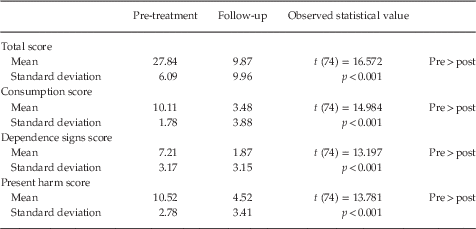
The first method of assessing outcome was to look at changes in the average scores of the group on the AUDIT from pre-treatment to follow-up. The Total score on the AUDIT was examined in this way, as were the scores for the three aspects of alcohol problems that the AUDIT assesses, namely ‘Consumption’, ‘Dependence signs’, and ‘Present harm’. Four t-tests for dependent samples were used to analyse these data. Table 1 contains summary data on the pre-treatment and follow-up AUDIT scores for this group along with the results of the comparisons. At follow-up, participants had significantly reduced scores on all aspects of the AUDIT, indicating that their alcohol problems were less severe at follow-up than before treatment.
Comparison of pre-treatment and follow-up AUDIT scores of participants

Qualitative outcomes
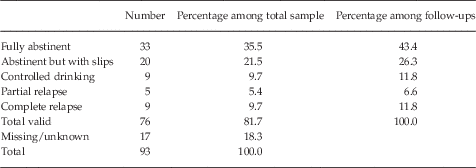
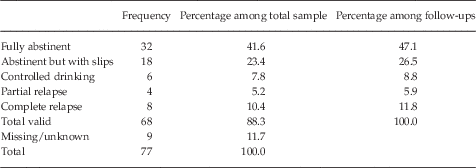
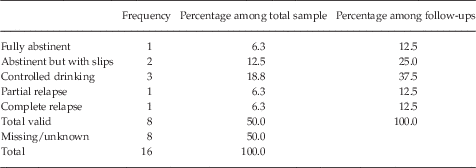
A more meaningful way of analysing outcomes is to classify outcomes into different categories and to examine the number and proportion of individuals falling within each category. ‘Fully abstinent’, ‘Abstinent but with slips’, and ‘Controlled drinking’ were considered good outcomes, while ‘Partial relapse’ and ‘Complete relapse’ were considered poor outcomes. Participants were assigned to one of these categories on the basis of their reported alcohol consumption patterns over the 6-month follow-up period. This was done for all individuals for whom follow-up data were available (see Table 2), and separately for those who completed treatment (see Table 3) and those who did not complete treatment (see Table 4). The first thing that is apparent from Table 2 is the large number of individuals classed as having a ‘good outcome’. Two-thirds of the total group who were eligible for follow-up were classed as having a good outcome. Only 15% were classed as having had a poor outcome. For the remaining individuals (just under one-fifth) their outcomes were unknown. From Tables 3 and 4 it is apparent that participants who completed treatment were more likely to have good outcomes than those who did not complete treatment.
Outcomes at 6-month follow-up for all individuals who consented to take part in the present study

Outcomes at 6-month follow-up for all individuals who consented to take part in the present study and completed treatment

Outcomes at 6-month follow-up for all individuals who consented to take part in the present study and did not complete treatment

In order to examine whether the classification of outcomes differed from chance for those who did and did not complete treatment, two χ 2 analyses were carried out on the data contained in Tables 3 and 4, respectively. A significant χ 2 value was obtained for those who completed treatment, χ 2 (4)=39.647, p<0.001, indicating that classification of outcome was significantly different from chance. There were more individuals than would be expected by chance alone in the ‘Fully abstinent’ and ‘Abstinent but with slips’ groups, and less than chance expectations in the remaining three outcome groups (‘Controlled drinking’, ‘Partial relapse’, and ‘Complete relapse’). The χ 2 for non-completers was not significant, χ 2 (4)=2.000, p>0.05. Due to low expected counts in each cell, this value cannot be interpreted reliably. However, visual examination of the number of participants with each outcome in Table 4 suggests that this distribution does not differ from chance and that the χ 2 result is likely accurate.
Reclassifying these data as indicating that participants had a ‘good outcome’ or a ‘poor outcome’ and analysing these data using χ 2 tests revealed similar results as those above. A significant χ 2 value was obtained for those who completed treatment, χ 2 (1)=28.471, p<0.001, indicating that more individuals had a ‘good outcome’ and fewer had a ‘poor outcome’ than would be expected by chance alone. The χ 2 for non-completers was not significant, χ 2 (1)=2.000, p>0.05.
Predictors of outcomes
The second aim of this study was to try to establish whether any demographic factors or pre-treatment test scores could be used to predict outcomes from treatment in this client group, and, if so, what these factors were. In order to answer this question, the data were analysed using stepwise multiple linear regression. The potential predictor demographic variables were: age; gender; marital status; level of education completed; number of years formal education; occupational status; social class; living situation; MMSE total; and WTAR full scale IQ. The pre-treatment test/symptom measures that were used were: BAI; BDI-II; TSCS:2; MSPSS; DEX-S; URICA Readiness-to-change; and AUDIT scores. Whether or not the person completed treatment was also included as a potential predictor variable.
Due to the number of potential predictor variables, an attempt at data reduction was made before carrying out the regression analysis. First all potential predictor variables were correlated with the outcome variable. In this instance, the outcome variable of interest was the AUDIT total score at 6-month follow-up. Where the data were scale in nature Pearson’s correlations were used, whereas Kendall’s τ-b correlations were used for variables that were not scale in nature.
Significant correlations were found between the AUDIT Total score at 6-month follow-up and the pre-treatment AUDIT scores: Total, r (75)=0.396, p<0.01, Consumption level, r (75)=0.271, p<0.05, Dependence signs, r (75)=0.369, p<0.01, and Present harm, r (75)=0.271, p<0.05. None of the other variables were correlated significantly with the AUDIT total score at follow-up. Given the high correlations among the pre-treatment AUDIT scores, only the total score was retained for use as a predictor variable. This variable (AUDIT total) was then entered as a predictor variable for the AUDIT total at follow-up in a regression analysis. Using this method, a significant model emerged, F (1, 73)=13.570, p<0.001. Although significant, this model only explained 14.5% of the variance (adjusted R 2=0.145).
Although the analysis described above is of interest regarding prediction of outcome when the AUDIT total score is used, more clinically meaningful outcomes are those where outcomes are classified into different categories. In part because of this fact and in part because the regression model identified using the AUDIT total score at follow-up was overall a relatively weak predictor of outcome, it was decided to perform a similar analysis but this time using the categorical classification of outcomes at follow-up as the outcome variable. Although multiple linear regression is not recommended for variables that are not scale in nature, such analyses are commonly reported in the literature. Nevertheless, the results of this analysis should be interpreted cautiously.
The number of variables entered into the analysis was reduced by correlating all potential predictor variables with the outcome variable and selecting only those that were significantly correlated with the classification of outcomes. This was done using Kendall’s τ-b correlations, owing to the fact that a number of the variables in question (including the outcome variable) were not scale in nature. The only predictor variable that correlated significantly with the ‘Outcome’ variable was the AUDIT dependence signs from pre-treatment, r (75)=0.205, p<0.05.
This was entered as a predictor variable in a regression analysis. Using this method, a significant model emerged, F (1, 73)=8.203, p<0.01. While this model was significant, it accounted for only 8.9% of the variance (adjusted R 2=0.089).
It had been anticipated that participants with a good outcome would differ in some way at treatment entry from those with a poor outcome. Due to the fact that the efforts at prediction of outcomes described above returned results that were of limited use, it was decided to carry out a further series of analyses at this point. The outcomes from treatment were coded as ‘Good outcomes’ (‘Fully abstinent’, ‘Abstinent but with slips’, and ‘Controlled drinking’) and ‘Poor outcomes’ (‘Partial relapse’ and ‘Complete relapse’) and the participants in these two groups were compared on the range of demographic and psychological functioning variables. Independent t-tests were used for analyses involving scale data (age, number of years education, MMSE total, full scale IQ, and scores on the measures of psychological functioning) and Mann–Whitney U tests were used for the remaining non-parametric comparisons (gender, marital status, level of education, occupational status, social class, and living situation), with the exception of the comparisons for gender and treatment completion, where χ 2 tests were used. With regard to demographic information, none of the results were significant.
With regard to the analyses involving the measures of psychological functioning, the only significant result was for the pre-treatment AUDIT total score, t (73)=−3.955, p<0.005, where the ‘Good outcome’ group had less severe alcohol problems than the ‘Poor outcome’ group before entering treatment. No other differences were significant. Due to the limited number of participants classed as having a ‘Poor outcome’ (n=14), it was not possibly to carry out any more complex analyses as results might not have been reliable owing to small sample size.
Discussion
The purpose of this paper was to present the findings of a study examining outcomes from a programme designed to treat alcohol dependence. The results indicate that entering into treatment was successful in producing significant improvement in the severity of the study cohort’s alcohol problems, as measured by the AUDIT. In addition, the results indicate that a clinically significant proportion of the study group obtained a good outcome from treatment. Taking the entire group who entered the study (i.e. 93 individuals), if we assume that those who were not available to follow-up all had poor outcomes, the data indicate that two-thirds (66.7%) still had a good outcome from treatment at 6-month follow-up. This is a worst case scenario in that we do not know what the outcomes were for the 17 individuals who declined or could not be contacted for follow-up. Even taking this worst case scenario, the data indicate that a minimum of 66.7% of individuals entering treatment can be expected to have a good outcome from treatment. For those who completed treatment (n=77) the figures are even more promising, with at least 72.8% having a good outcome from treatment. As might be expected, those who did not complete treatment have a poorer prognosis with only 39.6% evidencing a good outcome from initiating engagement in treatment.
The finding that a substantial proportion of individuals who undertook treatment had a good outcome extends previous research reports that treatment is effective in reducing the severity of AUDs. The outcomes from the present study are not directly comparable to those of previous Minnesota Model studies due to differences in follow-up periods and differences in the numbers considered appropriate for follow-up. Nonetheless, the proportion of clients who were classified as having had a good outcome in the present study is comparable to the 1-year outcomes reported by Gilmore (Reference Gilmore1985) for clients who received treatment at Hazelden in 1978, 1980, and 1983. Furthermore, the 63% with a good outcome in the present study is also comparable to, if not superior to, those reported by Higgins et al. (Reference Higgins, Baeumler, Fisher and Johnson1991) at 6- and 12-month follow-up when their figures are adjusted to take account of those whose outcomes were not known.
The numbers reporting total abstinence in the follow-up period are marginally lower in the present study than those reported in the Hazelden studies (Laundergan, Reference Laundergan1982; Gilmore, Reference Gilmore1985; Higgins et al. Reference Higgins, Baeumler, Fisher and Johnson1991). However, they are similar to those reported in a 12-month follow-up in Denmark by Grønbæk & Nielsen (Reference Grønbæk and Nielsen2007) and superior to the 14% reported after a similar 12-month follow-up in Finland by Keso and Salaspuro (Reference Keso and Salaspuro1990). Overall, the proportion of individuals in the present study with good outcomes is broadly similar to that of other studies reporting outcomes from Minnesota Model treatments. On this basis, it can be concluded that the present study has demonstrated that the Minnesota Model of treatment for alcohol problems is equally effective in Ireland as it is elsewhere.
Our inclusion of individuals with controlled drinking may seem at odds with the abstinence-based doctrine of the Minnesota Model. However, while the Minnesota Model promotes abstinence, the literature (as included in the introduction) evaluating outcomes using this model considers complete abstinence or lower alcohol use after treatment to equate to a good outcome. For ourselves, we required ‘lower alcohol use after treatment’ to fit within safe consumption guidelines (i.e. controlled drinking) in order for us to consider it a good outcome.
The present attempt to identify reliable and useful predictors of treatment outcome proved relatively fruitless. Although severity of alcohol problem at treatment entry significantly predicted outcome (both quantitative and qualitative outcome), it only accounted for a small proportion of the variance and consequently can be seen as a relatively weak predictor of outcome. The lack of any strong predictors of outcome in the present study was surprising. Considering the fact that previous research has identified a large number of predictors of outcome (e.g. Bottlender & Soyka, Reference Bottlender and Soyka2005; Moos & Moos, Reference Moos and Moos2007), albeit inconsistently, it was anticipated that the present study should find some manner of reliably predicting outcome from treatment. It may well be that the large proportion of those eligible for follow-up who were classed as having a good outcome (compared to the limited number classed as having a poor outcome) limited the ability of the present study to reliably identify factors that discriminated between individuals with good and poor outcomes. Furthermore, the fact that the present study group were generally from higher social class groupings and were all privately funded in undertaking treatment meant that there was greater similarity within this group than may have been the case in other studies where significant predictors were identified.
The findings of this study have implications for future treatment of individuals who are dependent upon alcohol. First, the treatment approach used in the current study sample appears to be an effective one from which a sizeable number of individuals can be expected to benefit. Second, earlier identification and treatment of alcohol dependence may result in better prognosis for the individual concerned in terms of their post-treatment relationship with alcohol assuming that earlier means a less severe alcohol dependence problem.
Limitations
The sample size was relatively small and was not specifically powered to identify predictors of outcome. The relative homogeneity of the sample itself and the small numbers with poor outcomes may have resulted in true predictor variables not being detected due to insufficient statistical power. Obviously the efficacy of any treatment is best assessed using a double-blind randomised placebo-controlled trial. Such a trial was beyond the scope of this project, which was designed to look at the effectiveness of a working clinical intervention. The fact that this study used a single sample and did not have a control group means we cannot be certain that the treatment provided was responsible for the improvements in alcohol consumption and the 6-month outcomes reported herein. Longer follow-up periods beyond 6-months were not feasible in this study, but would give a better indication of success not just in the short- to medium-term post-treatment completion.
Financial Support
This research received no specific grant from any funding agency, commercial, or not-for-profit sectors. It was undertaken as part of the requirements for the Doctorate in Clinical Psychology undertaken by the first author. This training was sponsored by Saint John of God Hospital and Saint John of God Menni Services.
Conflicts of Interest
Colin Gallagher has no conflicts of interest to disclose. Zita Radmall has no conflicts of interest to disclose. Colin O’Gara has no conflicts of interest to disclose. Teresa Burke has no conflicts of interest to disclose.
Ethical Standards
The authors assert that all procedures contributing to this work comply with the ethical standards of the relevant national and institutional guidelines on human experimentation and with the Helsinki Declaration of 1975, as revised in 2008. Ethical approval for this research project was sought and obtained from the Saint John of God Provincial Ethics Committee in Stillorgan, Dublin, Ireland, and from the Human Research Ethics Committee in University College Dublin, Ireland.