What is food? In a variety of places and time periods, people have probed the border between food and non-food and used decisions about what's edible and what's not to define themselves against other people. And that's because cultural definitions of edibility are usually about much more than what's toxic and what's digestible. Many people find dogs and horses and ants to be edible and delicious, for instance, but most Americans don't eat them for cultural reasons. Biological edibility is a bigger category than cultural edibility, because, as the anthropologist Claude Lévi-Strauss famously put it, something has to be “good to think” before it can be good to eat.Footnote 1
The story I'm telling here is about one unlikely ingredient that has straddled the border between good to think and not good to think for more than a century. The ingredient is cottonseed, and especially cottonseed oil, a fabulously successful commercial product that served as an ingredient in all kinds of processed foods and as the basis of a range of supermarket fats during the twentieth century, including Crisco, Cottolene, Wesson Oil, and many other margarines and vegetable oils.Footnote 2 Yet, for the most part, cottonseed oil was successful in secret. That is, huge numbers of Americans bought it and ate it, but relatively few people have known they were doing so. Cotton had perhaps the strongest identity of any American commodity crop throughout the twentieth century. It was instantly recognizable, with its cloud of white fiber and its deep associations with the industrial revolution, slavery, the Civil War, and the New South.Footnote 3 Virtually all Americans knew cotton, and they knew it wasn't food. Cotton was a shirt, or a bed sheet, or a tablecloth. As a food, cottonseed wasn't good to think.
But the secrecy around cottonseed oil's big role in the American food system was not inevitable. Lots of other foods that most Americans had never eaten before became openly popular in the twentieth century, from peanut butter to pizza to high-fructose corn syrup. The history of American food can look like one big parade of items moving from strange to normal. What's fascinating about cottonseed's history is that for a few decades, it was following this pattern, too. During the early Progressive Era, marketers loudly advertised the cottonseed content of their products, and consumers in large numbers knowingly bought them. And yet in the two decades following the passage of the 1906 Pure Food and Drug Act—an act that ostensibly led to more transparency—marketers talked less about cottonseed oil. Eventually they stopped talking about it at all. In the wake of the Pure Food legislation of 1906 and in conjunction with an exploding food advertising industry that highlighted factory processing as a unique virtue, American consumers spent increasing amounts of money on food produced in factories.Footnote 4 Cottonseed oil's history is ultimately a story of consumers’ growing trust in industrially processed food and their growing comfort with ignorance about the ingredients that went into it.
Oil from Cotton
Before cottonseed was a commercial success, it was a waste product.Footnote 5 The cotton gin, patented in 1793, had made southern planters rich by stripping the sticky seeds from cotton fiber at lightning speeds. While the fiber was sold for a profit, mounds of seeds were left behind. Some people put leftover seeds in livestock feed or strewed them over fields as a fertilizer. But much cottonseed was simply left to rot.Footnote 6 Cotton gin owners regularly charged farmers extra if they refused to take the cottonseed away with them, and farmers often resorted to dumping cottonseed in ditches or empty fields.Footnote 7 In fact, hogs sometimes died from gorging on untended cottonseed waste piles because raw cottonseed can be toxic to non-ruminants, and as a result, some states passed laws mandating the seeds’ disposal.Footnote 8
From the beginning, there was interest in cottonseeds’ potential as a source of oil because, by the nineteenth century, people had been searching for decades for palatable vegetable fats.Footnote 9 Of course, there were already animal fats like butter, lard, suet, bacon fat, and chicken fat. But like all animal products, these were costly, requiring bushels of grain and vegetable feed to produce every pound of edible fat. People hoped that making fat directly from plants would be cheaper and more efficient. Nineteenth-century southerners tried large-scale oil production from sesame seeds, poppy seeds, and olives, but these efforts met with very limited success. Those hills of cottonseeds left after the cotton had been ginned made them irresistible as a potential source of fat, especially for slave rations. Slave owners dreamed of feeding oil from cotton's leftovers to the very people picking it for them in the first place.Footnote 10
The problem was, producing palatable cottonseed oil wasn't easy. Cottonseeds aren't very oily, and the relatively meager oil that could be produced by hulling and pressing them was dark, muddy tasting, and foul smelling.Footnote 11 With any other seed the project would have been abandoned. But unlike poppy seeds or sesame seeds or anything else, cottonseeds didn't need to be grown, or even harvested. They were a preexisting byproduct and they were already all over the nineteenth-century South, tons and tons of them.Footnote 12 Ever more of them, in fact: cotton production exploded throughout the nineteenth century, increasing dramatically not just before the Civil War but also after the war and well into the twentieth century.Footnote 13 And so cottonseed oil pressing continued despite its conspicuously mediocre results. By 1880, there were cottonseed oil mills in small towns around the South, and local processors banded together to form the American Cottonseed Oil Trust.Footnote 14
By then, a number of “compound” fats were on the national market, and that number would grow as cottonseed oil became ever cheaper.Footnote 15 Lard prices were high in the late nineteenth century, and compounds beckoned to consumers as a cheaper alternative. Compound fats were commercial cooking fats that combined lard or beef fat with relatively small amounts of cottonseed oil, roughly at a ratio of two to one. This combination stretched the costlier animal fats while masking cottonseed oil's bad smell.Footnote 16 The most successful of these compounds was a product called “Cottolene,” a mix of cottonseed oil and beef fat launched in 1887 by the Chicago-based N. K. Fairbank Company, which was heavily advertised throughout the first decade of the twentieth century.Footnote 17
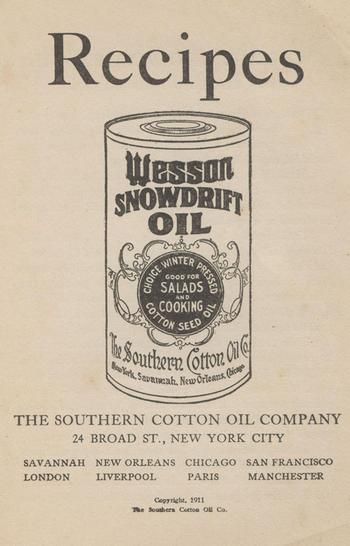
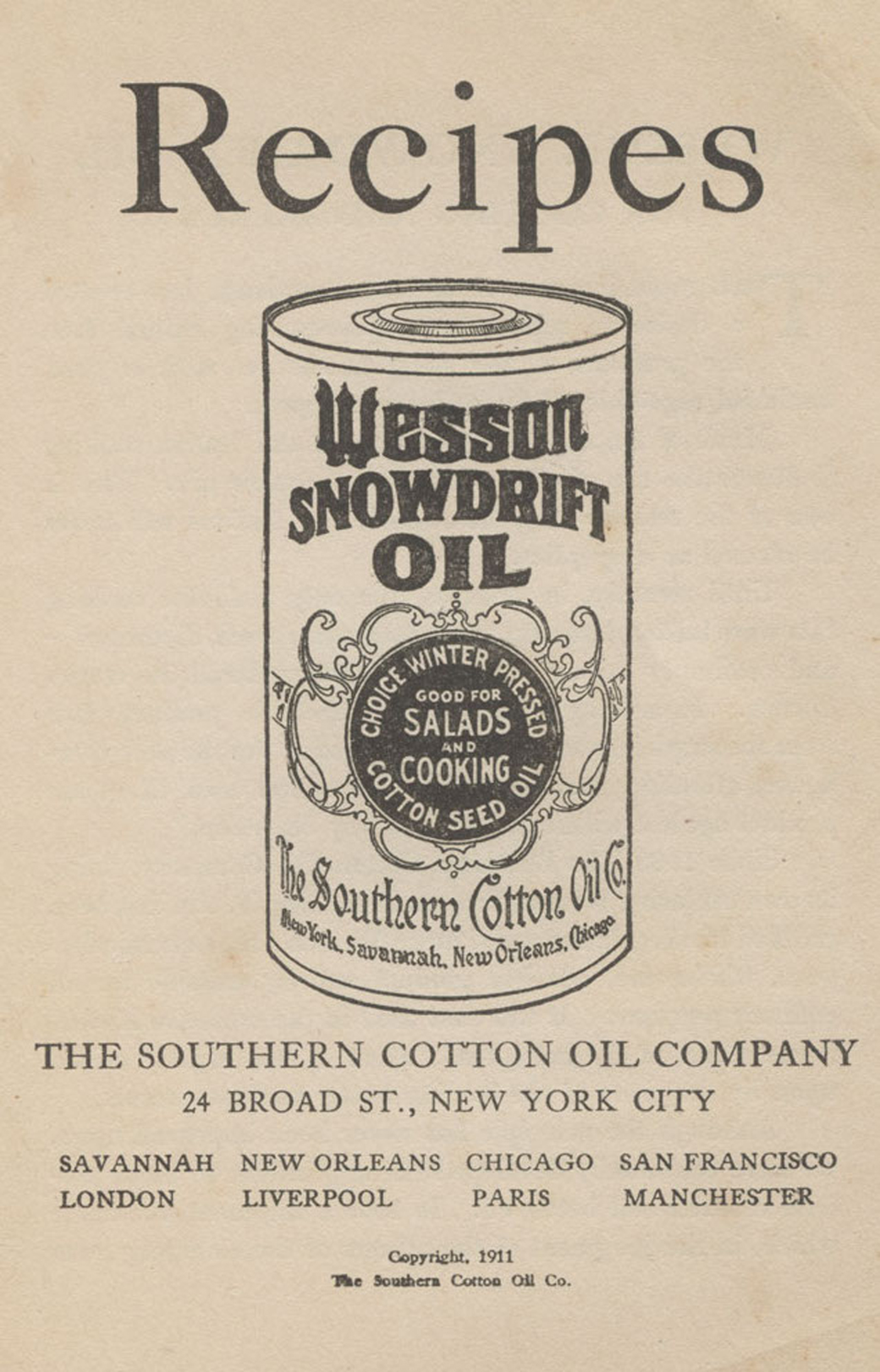
But even as the sheer abundance of cottonseeds in the decades after the Civil War made it profitable to mix small quantities of the muddy oil with animal fats, cottonseed oil only truly took off commercially once advances in laboratory chemistry and industrial processing made cottonseed oil more palatable. In the mid-1880s, a chemist working for the Fairbank Company named David Wesson discovered that when steam was forced through cottonseed oil, it carried away volatile odor, flavor, and color compounds, lightening and deodorizing it.Footnote 18 Processed cottonseed oil's lighter look and less offensive smell meant that food companies could use much larger percentages of it in their products. Immediately after Wesson's advances, processors began creating compound cooking fats consisting of up to 80 percent cottonseed oil.Footnote 19 And Wesson's deodorization process only got better. By the end of the century he was producing cottonseed oil that was virtually odorless, and in 1899 he formed the Wesson Oil Company and soon after launched the Snowdrift product line. Wesson's Snowdrift was sold both as 100 percent liquid cottonseed oil and as a solid shortening made mainly from cottonseed oil, solidified with a little beef fat (fig. 1).Footnote 20
It took industrial bleaching and deodorizing to make liquid cottonseed oil, like Wesson's Snowdrift, commercially viable. Early advertising and packaging for Snowdrift included prominent references to cottonseed oil. “Recipes,” booklet, Southern Cotton Oil Company (New York: American Lithographic Co., 1911), The Alan and Shirley Brocker Sliker Collection, MSS 314, Special Collections, Michigan State University Libraries.
Inventing Modern Shortening
“Shortening” had not originally referred to any specific product. For generations, it had simply meant any fat added to dough to make it flakier. One 1830s source, for instance, mentioned Kentucky women who “shortened” wheat cake with raccoon fat.Footnote 21 Instead, shortening is a literal description of what fat does to dough: it shortens its bonds, making baked goods crumble into short little flakes. As a culinary technique, shortening was ancient. People have been adding fats to dough for millennia, and English speakers have used “short” as an adjective to describe crumbly baked goods since at least the early fifteenth century.Footnote 22 But “shortening,” as a noun, is relatively new and it is particularly American. Its first recorded appearance is in the first American cookbook, Amelia Simmons's 1796 American Cookery.Footnote 23 By “shortening,” Simmons wrote, she meant a homemade compound made from “half butter, half lard,” and she called for it in several recipes.Footnote 24 In the century that followed, American cookbook authors regularly called for “shortening” as an ingredient, usually without specifying any particular kind of fat.Footnote 25
By the early twentieth century, however, Americans were using “shortening” more specifically to refer to solid, industrially produced fats made mainly from vegetable sources—and in clear distinction from lard. Indeed, once solid shortening made mostly from cottonseed oil hit the market at the end of the nineteenth century, lard emerged as its principal rival. Much more so than beef suet, lard had been a fixture of nineteenth-century kitchens, especially as an ingredient in baked goods and as a medium for frying. Cottonseed oil's most obvious advantage in the competition with lard was that it was cheaper. Pork and lard prices stayed high throughout the Progressive Era, while cottonseed prices stayed low.Footnote 26
Yet when advertising for shortening brands like Snowdrift and Cottolene attacked lard, they focused on flavor at least as much as cost. Lard was still sometimes produced at home in the late nineteenth century after the slaughtering of individual pigs, and, especially in the case of home production, it was a changeable product.Footnote 27 Lard's taste and texture could vary depending on the season and on the hog's breed, feed, and even age.Footnote 28 In contrast, industrial cottonseed-based shortening did not have what you might call terroir. It was not affected by season or region. As far as consumers were concerned, it was not affected by anything: its defining properties were its neutrality and its consistency, and advertisers highlighted these traits as unique and desirable virtues. Shortening made mainly from deodorized cottonseed oil was a predictable industrial food that consumers came to expect to be exactly the same across seasons, across the country, and across time.Footnote 29
Home lard production was already in decline by the time cottonseed-based shortenings appeared, however. Instructions on making lard had been commonplace in U.S. cookbooks in the mid-nineteenth century, but they declined noticeably by the end of the century, and by the 1910s they had virtually disappeared, thanks to competition from industrial slaughterhouses, urbanization, and the eventual passage of ordinances in many cities prohibiting pig-keeping.Footnote 30 Just as it became harder for Americans to raise pigs, it became easier to buy industrially produced fats. By the early twentieth century, there was little competition: it was vastly easier simply to open a grocer's pail—either of lard or of shortening—than it was to keep and kill a pig and then render its fat at home.
And thus, it was commercially produced lard that cottonseed shortening companies sought to replace. To heighten the comparison between the two products, shortening manufacturers sold it in pails or tubs, just as commercial lard was sold; in contrast, oleomargarine manufacturers usually sold it in crockery or paper-wrapped blocks, highlighting its interchangeability with butter.Footnote 31 “Hogless Lard” was the slogan of Wesson's Snowdrift shortening, and Cottolene's marketing relentlessly stressed its superiority to lard, pitting images of muddy pig pens against dreamy pictures of white cotton fields, with taglines telling consumers their choice of fats came down to a choice between “the Swine or the Flower.”Footnote 32 Since lard had a noticeable flavor while processed cottonseed oil was virtually tasteless, cottonseed advertising told consumers pointedly that they should think of lard's taste as obnoxious. In one turn-of-the-century advertisement, for instance, the famed home economist Christine Herrick praised Cottolene as a welcome change from “the unpleasant taste frequently noticed in food cooked in lard.”Footnote 33 In 1912, another cottonseed shortening advertisement boasted that the “objectionable ‘lardy’ taste” was a “thing of the past.”Footnote 34
Yet it's not clear that people in the past had particularly objected to the taste of lard, noticeable as it may have been. Animal fats had been ubiquitous in nineteenth-century American kitchens, and eaters had not only been accustomed to their tastes but had clearly valued the meaty savor these fats imparted to foods. The omnipresence of animal fats in home baking was one reason the boundary between meats and desserts was not well established in the nineteenth century, a time when popular dessert recipes not only routinely called for lard and suet but also, sometimes, for hefty portions of ground or chopped beef or pork as well, in sweets like Mincemeat Pies and Pork Cakes.Footnote 35 The vilification of animal fat in Progressive Era advertising campaigns for cottonseed oil products was one factor that made meaty dessert recipes dramatically less popular in the twentieth century. As Americans ate more highly processed cottonseed shortening, many of them came to prefer its neutral taste. Indeed, by the 1910s, some meat-packers were actually deodorizing lard to “make it smell and taste more like vegetable shortening,” a prime example of what the historian Gabriella Petrick argues was food companies’ growing power to shape not only “the flavor of their products” but consumers’ “perceptions of taste” itself.Footnote 36
A Quintessential Progressive Food
When cottonseed marketers condemned lard, they generally did so by holding up cottonseed oil as a superior, modern alternative—not as a dark secret. Evasion and euphemism would come to characterize the marketing and labeling of cottonseed oil products in the twentieth century, but they were not the settled strategy when the century began. Quite the contrary, in fact. Most cottonseed oil marketers in the Progressive Era openly advertised the fact that their products came from the same cotton fields as the shirts on everyone's backs, and they celebrated this versatility as the result of ingenuity. If anything, cottonseed's long history as a byproduct of dubious utility became a special virtue according to progressive values. It was a leftover and a nuisance transformed into something useful, profitable, and problem-solving in its own right, a cheap and novel source of fat and a remarkable shape-shifter that could serve as the basis of all kinds of other processed foods.Footnote 37 Cottonseed oil could make “oil without olives,” as one industry spokesman exulted in 1911, and “butter without cows; ice cream without cream; lard without hogs.”Footnote 38 All this from a former waste product—from “mere garbage,” as another writer put it.Footnote 39 Still another gushed, “Magic, miracles, Aladdin, wine from water, something for nothing … by-products are set down in the first course of the feast.”Footnote 40 Highly processed cottonseed oil was the result of a kind of industrial alchemy that Americans in the Progressive Era liked and admired.Footnote 41
Another reason that cottonseeds seemed so uniquely promising in the Progressive Era was that they could do more than make fat: they could also make a high-protein flour. After cottonseeds had been pressed for their oil there was still a mass of crushed seeds left behind. Finding a way to eat this leftover cottonseed meal—in essence, the byproduct of a byproduct—was a quintessential progressive food project. There was a catch, however. Cottonseed contains a natural insecticide called gossypol, from the Latin gossy, meaning cotton.Footnote 42 Toxic to prospective insect predators, gossypol could also sicken and kill larger animals that ate it in large quantities. Cottonseed oil contained virtually no gossypol, but cottonseed meal did. Ruminants like cows and sheep had few problems eating it, but attempts to feed large amounts to pigs and horses sickened and even killed some of them.Footnote 43 Yet even as farmers in the 1900s and 1910s grappled with emerging knowledge about cottonseed meal's toxicity and tried to find appropriately small ratios for animal feed, its lure as a potential source of cheap protein for humans remained strong.Footnote 44
Around the country, people experimented. A variety of cakes and breads made partially from cottonseed meal were “eaten with a relish” at the annual meeting of the cottonseed crushers association in 1910.Footnote 45 That same year, the New York Times published a glowing article hailing cottonseed meal as an affordable protein product that would help everyone from rural southerners to northern factory workers stretch their grocery budgets. As the writer put it, cottonseed meal's high-protein levels meant people who ate it “will require less meat—something that is much to be desired in these days of high prices for the products of the packing house.”Footnote 46 That idea was repeated in newspapers, magazines, extension literature, and home economics materials in the years that followed.Footnote 47 The president of the Louisiana health board claimed to have discovered that pure cottonseed flour was “30 times more nutritious than eggs” and had “50 times as much protein as white flour.” He himself, he claimed, ate only baked goods made partly from cottonseed flour.Footnote 48 Other calculations were not quite so exuberant, but the big idea was the same: protein from cottonseed was significantly cheaper than protein from meat.Footnote 49
A Texas woman named Mrs. Dan McCarty was one of several people who started selling baked goods made with cottonseed flour. Mrs. McCarty sold bread, doughnuts, ginger snaps, and “cottonseed Jeff Davis plum pudding” at her local general store, and when she mailed a selection to a scientist at the Texas Agricultural Experiment Station, he declared them “pleasant” and “palatable” and published a bulletin discussing cottonseed meal's potential as human food.Footnote 50 A few years later, in 1913, a young chemist named James Rather at the same Texas experiment station conducted the first experiments on cottonseed toxicity in humans.Footnote 51 For two days he fed a group of men milk, meat, and regular corn bread, and then for two additional days he fed the same group milk, butter, and bread made partially from cottonseed meal. After four days, everyone's health seemed fine, and Rather was disappointed not to have induced any symptoms of toxicity.Footnote 52 And so he began experimenting on his own family. For ten days, he and the members of his household—which included his young wife, widowed mother, and toddler son—ate bread made partially with cottonseed meal.Footnote 53 Rather had “hoped that sufficient cottonseed meal would be eaten for the observer to be able to judge whether there were any toxic effects,” but his family turned out not to be “very hearty bread eaters.” Thus, Rather wrote, the second experiment also failed to establish whether the meal was toxic to humans, but it did at least suggest that there was little danger in eating it in small amounts.Footnote 54 Through the 1910s and early 1920s, writing about cottonseed meal in the popular press would follow that same arc—warning against eating too much while suggesting that small amounts were harmless.Footnote 55
Cottonseeds’ unique ability to produce both a cheap oil and a cheap high-protein meal took on moral as well as financial significance once the United States entered World War I in 1917 and the country launched a national food conservation campaign. The United States Food Administration, a temporary wartime agency headed by Herbert Hoover, urged Americans to eat less red meat, butter, and wheat flour so that those commodities could be sent to Europe as food aid for U.S. allies and as rations for American soldiers.Footnote 56 Instead of eating foods needed for export, the Food Administration urged, Americans should eat substitute foods instead. Cottonseed products, which had the unique virtue of being able to stand in nutritionally for meat, fat, and flour, got special attention in the media and in wartime conservation literature.Footnote 57 For instance, a New Orleans clubwoman named Kate Gordon made national headlines when she developed a cottonseed flour blend made from 20 percent cottonseed meal and 80 percent wheat flour that she said could be substituted into virtually any recipe calling for pure wheat flour.Footnote 58 The war years saw an outpouring of interest in cooking with cottonseed meal, with recipes for cottonseed-based breads, biscuits, and desserts appearing in virtually every wartime food conservation cookbook. At the same time, cottonseed oil regularly showed up alongside oleomargarine and peanut butter in lists of fats to be used as substitutes for the butter needed for export.Footnote 59
Crisco's New Approach
Yet even at the highpoint of Progressive Era enthusiasm, not everyone found cottonseed good to think. Indeed, a new product had entered the national market in the early 1910s that capitalized both on cottonseed products’ unique virtues and on lingering popular ambivalence about them, and its marketers’ approach helped to transform American thinking on cottonseed oil and on industrial food at large. The product was Crisco, launched in 1911 by Procter & Gamble, a company that had worked with fats in other forms for decades. Founded in the 1830s, Procter & Gamble had originally focused on candle manufacturing but shifted to soap after the Civil War, as candles were being replaced by kerosene (and as Americans bathed more often).Footnote 60 Their Ivory Soap, made from cottonseed oil, became a top seller, but executives observed closely as new companies emerged selling cottonseed oil in the form of cooking fat.Footnote 61 In 1901, Procter & Gamble executives created the Buckeye Cotton Oil Company and leased their first cottonseed oil mill. By 1905, they controlled eight mills, which gave them a steady supply of oil and independence from outside suppliers.Footnote 62 That same year, they started investing in intensive research and development to produce their own shortening.Footnote 63 After 1907, when they learned about emerging hydrogenation techniques, they aimed specifically to develop the world's first solid shortening made entirely of cottonseed oil.Footnote 64 Years of research resulted in a salable product, but before Crisco's official debut, Procter & Gamble did product testing around the country and tinkered with the formula in response to consumer reaction.Footnote 65 Today, it's normal for companies to sink time and capital into a product before its launch. At the time, however, Procter & Gamble's years-long investment in research, development, and product testing was extraordinarily novel.Footnote 66 The historian Susan Strasser describes Crisco's creation as “the most elaborate and expensive development process any consumer product had ever been through” up to that point.Footnote 67
When Crisco finally launched in 1911, it was a juggernaut. A solid fat made entirely from a once liquid plant oil, it was a wholly new product made possible by the novel technology of hydrogenation. Pure liquid cottonseed oil had been on the market since Wesson's Snowdrift in 1900, but to many American consumers, liquid fats were the obviously inferior cousins of the solid fats such as lard and butter they had long cooked with. Crisco's debut meant that for the first time, cooks could substitute a cheap, shelf-stable vegetable shortening for butter or lard in virtually any recipe.Footnote 68 Within five years of its introduction, with the American population just over 100 million, Crisco was selling 60 million cans annually and was well on its way to “becom[ing] a household word.”Footnote 69 Sales only increased in the years that followed, and Crisco would go on to dominate the U.S. shortening market throughout the twentieth century.Footnote 70
Crisco's success was so sweeping that it can seem inevitable in hindsight, but it wasn't. Thousands of new U.S. food processing businesses emerged in the Progressive Era, and the great majority did not survive long.Footnote 71 Those that did were often successful marketers as much as anything else, but even aggressive advertising could not guarantee longevity. The heavily advertised Cottolene, for instance, was already sputtering before Crisco's launch. But Crisco's approach to marketing was different. It was both highly intensive and, for the time, inventive.Footnote 72 Indeed, Procter & Gamble was not only a pioneer in research and development but also in brand promotion. They paid the advertising firm J. Walter Thompson to craft a national marketing campaign, and they spent lavishly on advertisements in national magazines and newspapers.Footnote 73 From the outset, Crisco's marketing strategy was more coordinated than that of comparable products, even as the company experimented by trying out different promotional techniques in different cities, sometimes using only newspaper ads, sometimes using only outdoor advertising, and sometimes sending promoters door-to-door.Footnote 74 They sent free cans of Crisco to grocers around the country, as well as to university scientists and home economists, whose positive reports they quoted in advertisements. For the first few years, they also hired six full-time demonstrators who toured the United States giving cooking classes that made hefty use of Crisco, and they partnered with newspapers to publicize the events.Footnote 75
Crisco also aggressively sought to dominate specific market segments. One of its most enduring strategies was its appeal to Jewish cooks who had a special interest in cooking fats. Not all American Jews kept kosher in this era, and some followed no particular dietary rules whatsoever (some explicitly Jewish cookbooks from the early twentieth century included recipes calling for lobster, shrimp, and ham, for instance).Footnote 76 But many did follow Jewish dietary laws, and those laws not only included prohibitions against eating shellfish and pork but also prohibitions about mixing certain foods within a single meal. As Florence Greenbaum explained in her 1919 International Jewish Cook Book, “In conducting a kosher kitchen care must be taken not to mix meat and milk, or meat and butter at the same meal.”Footnote 77 The prohibition against combining meat and dairy made the choice of cooking fat a weighty one for Jewish cooks. Lard, a pork product, was obviously out. Suet, made from beef or mutton fat, counted as meat and couldn't be used in a meal with dairy. Schmaltz, rendered chicken or goose fat, was likewise considered a meat under most interpretations of Jewish law and was, in all cases, difficult to obtain in large quantities.Footnote 78 Butter, meanwhile, was a dairy product and couldn't be used in a meal with meat. Hence the categorization of desserts, in at least one Jewish cookbook, into “Meat Sweets” and “Butter Sweets,” and hence the heavy reliance in many Jewish kitchens on olive oil, despite its strong taste and low smoking temperature.Footnote 79
Early on, Procter & Gamble understood that observant Jews represented a potential niche market.Footnote 80 The company obtained kosher certification before Crisco's launch, and they aggressively advertised it as a unique contribution to Jewish cuisine. An early ad, for example, claimed that “Jews who for years have paid forty cents a pound for chicken fat” appreciated Crisco's economy.Footnote 81 A 1915 advertisement trumpeted: “Rabbi Margolies of New York, said that the Hebrew Race had been waiting 4,000 years for Crisco.”Footnote 82 The following year, a promotional brochure stated that the coming of Crisco was “a boon to the Jew. It can be used with both ‘milchig’ and ‘fleischig’ (milk and flesh) foods.”Footnote 83 Procter & Gamble also extended its promotions beyond print advertising. They produced special “Kosher packages” for Jewish grocers that included seals from individual rabbis.Footnote 84 And by the early 1930s, the company would produce a full-length Yiddish-English cookbook called Crisco Recipes for the Jewish Housewife.Footnote 85 As the historian Eileen Solomon notes, Crisco's overtures were “among the first efforts of a mainstream corporation to specifically target Jewish consumers.”Footnote 86 Kosher-observant consumers responded.Footnote 87 Starting early in the 1910s and continuing through the late twentieth century, Jewish cookbooks not only called for shortening, in general, but many mentioned Crisco by name.Footnote 88
Evasion as Strategy
Crisco had only one ingredient: hydrogenated cottonseed oil. Yet one of the most remarkable things about its debut was that its marketers obscured its cottonseed content. A very few early Crisco materials mentioned cottonseed oil in the fine print, but the vast majority of its packaging and advertising stayed completely silent about its sole ingredient.Footnote 89 For example, the first full-length Crisco cookbook, first published in 1913 and reissued in at least twenty subsequent editions, never mentioned cottonseed oil.Footnote 90 Even its name hid the truth: Crisco was short for “Crystallized Cottonseed Oil,” but the average consumer never learned that.Footnote 91 Instead, marketers stressed Crisco's unparalleled purity while dodging questions about its actual ingredients. Crisco was not mixed with lard or suet like compounds fats, advertisements exerted, but instead was “a purely vegetable product,” a “strictly vegetable product,” and “absolutely all vegetable.”Footnote 92 And lest consumers start asking hard questions about exactly which “vegetables” were yielding so much oil, marketers volunteered evasive non-answers like “It is 100% shortening.”Footnote 93
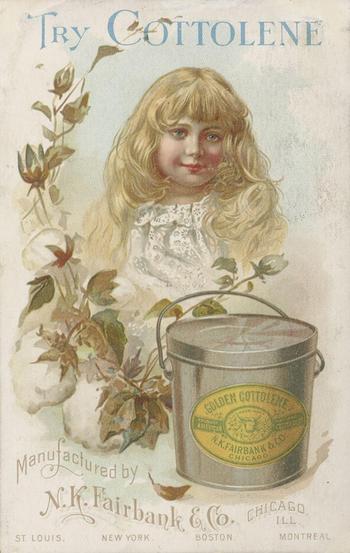
Why such evasion? Competitors like Cottolene, Cotosuet, and Snowdrift had always been transparent about their cottonseed content. In fact, their marketing had drawn consumers’ attention to it. Cottolene was a case in point. For more than two decades, it advertised its cotton content aggressively both in print media and through the force of traveling salesmen the company hired to peddle it around the country.Footnote 94 Huey Long, later a populist governor of Louisiana and a U.S. senator, was one of many men who worked as a traveling salesman for Cottolene in the early twentieth century.Footnote 95 Cottolene's manufacturers made full use of cotton's botanical beauty (fig. 2). Sprigs of cotton appeared in garlands and bouquets on all packaging and promotional materials, and its trademark image was a cow's head wreathed by cotton.Footnote 96 They also leant heavily on nostalgic associations between cotton and slavery, with advertising materials featuring bucolic scenes of African Americans laboring in southern cotton fields.Footnote 97 In 1894, the Central Lard Company had actually sued the Fairbank Company, unsuccessfully, claiming the word “Cottolene” was so close to the word “Cotton” that it couldn't legally be trademarked.Footnote 98
Like other early cottonseed shortening brands, Cottolene emphasized its connection to cotton both through the product name and its marketing imagery. “Try Cottolene” trade card, ca. 1890s, The Alan and Shirley Brocker Sliker Collection, MSS 314, Special Collections, Michigan State University Libraries.

Other brands likewise highlighted their cotton connection. Cotosuet, a popular cottonseed-beef compound launched by the Swift meat-packers in 1893, used images of cotton fields in its advertisements. A brand called Flakewhite played on associations between cotton and snowy whiteness, as did Wesson's Snowdrift, which prominently included “Cotton Seed Oil” and “Southern Cotton Oil Company” in its advertising.Footnote 99 From the 1890s through the early 1920s, journalists wrote openly and approvingly about the oil's origins in cotton fields, and a wide variety of cookbooks by some of the biggest names in Progressive Era cookery and food reform praised cottonseed oil and called for it by name. Everything from Fannie Farmer's Boston Cooking-School Cook Book to Ellen Richards's The Chemistry of Cooking and Cleaning to the Harvey Wiley-approved Pure Food Cook Book to Progressive Era editions of The “Settlement” Cook Book put their seal of approval on cottonseed oil and on products such as Cottolene and Cotosuet.Footnote 100
At a time when journalists, food reformers, and other companies alike were loudly promoting cottonseed as a desirable ingredient, Crisco's near silence about it is all the more noteworthy. And it's striking, too, because unlike more recent cases of industry evasion and cover-up, such as turn-of-the-twenty-first-century efforts by the tobacco industry to obscure research on secondhand smoke, Crisco wasn't hiding anything real, as far as its producers knew.Footnote 101 (Information about the risks of consuming the trans fats in hydrogenated oils wouldn't emerge for decades.)Footnote 102 Instead, with their silence about Crisco's sole ingredient, its promoters accomplished two things: they responded to tenacious consumer doubts about cottonseed; and they forged a revolutionary new approach to food marketing that was geared toward industrial food, an approach that would deeply affect American consumers’ attitudes to food brands and processed foods themselves in the decades that followed.
Lingering Doubts About Cottonseed
First, Crisco's silence about its cottonseed content was a savvy response to genuine consumer prejudice against cottonseed products, which had persisted into the 1910s despite positive promotion efforts from other companies over the previous three decades.Footnote 103 Popular prejudice lingered for a number of reasons. One was that many Americans primarily thought of cottonseed oil as a subpar stand-in for olive oil, which they generally perceived as the superior culinary oil in terms of taste and general quality.Footnote 104 It was not merely that people thought olive oil was better, but that many of them thought of cottonseed oil as an adulterant.Footnote 105 Government tests in the early twentieth century had borne out what many consumers long suspected: fraudsters regularly used cottonseed oil to adulterate or altogether impersonate more expensive olive oil.Footnote 106 As one journalist warned in 1910, “Many a pretentious and aristocratic looking bottle contains oil which came not from the groves of sunny Italy, but from the cotton fields of the South.”Footnote 107 In response to fears of fakery, instructions appeared in newspapers and magazines in the 1900s and 1910s telling consumers how they could test ostensible “olive oil” for cottonseed oil adulteration.Footnote 108
Adulteration was of course a major concern throughout this era; it was the driving focus of the Pure Food laws of 1906.Footnote 109 Many of the substances added duplicitously to foods in this era were undesirable and some were even toxic, ranging from chalk to sawdust to lead, and especially before 1906, consumers had legitimate fears about eating foods tainted with harmful adulterants.Footnote 110 But just because a substance was used as an adulterant did not mean it was inherently harmful, and consumers for the most part realized this. Adulteration was an economic concern as well as a health concern, and at a time when food prices were rising and when poor Americans on average spent half of their wages on food, people were outraged to think they might be swindled into paying upmarket prices for inferior foods.Footnote 111 Despite attempts by some to distinguish between cottonseed oil's undesirability when used duplicitously and its general wholesomeness when labeled honestly, its well-publicized role as an adulterant of olive oil fueled lingering prejudice against it into the 1910s.Footnote 112
Another reason for consumer reluctance to eat cottonseed products was that Americans already associated them with a variety of non-food functions. Cottonseed oil was widely used in soap, and cottonseed meal was widely used as a fertilizer. By the early 1900s, cottonseed products had found a range of other industrial uses, too, and manufacturers were using them to make everything from hats to dye stuffs to explosives to roofing tar.Footnote 113 Throughout this era, too, cottonseed meal's importance as an animal feed was expanding. The association not only seemed unpleasant in its own right to some, but it kept concerns about cottonseed toxicity in the news. Indeed, far from fading, worries that cottonseed meal might be dangerous to eat were strengthened by new research in the 1910s. When two USDA scientists in the mid-1910s fed gossypol to a group of laboratory rabbits, every one died.Footnote 114 A few years later, a series of USDA experiments found that feeding horses sizable amounts of cottonseed meal resulted in “digestive disorders” and “death,” and researchers recommended a maximum of one pound of cottonseed meal a day for a thousand-pound horse.Footnote 115 For years in the 1910s and 1920s, government bulletins warned farmers against feeding too much cottonseed meal to their animals.Footnote 116 News about the dangers of cottonseed meal to livestock kept gossypol toxicity a live issue. And indeed, by the 1930s, scientists increasingly recommended that people not eat cottonseed meal at all.Footnote 117
In response to various negative associations, worried consumers expressed concerns about cottonseed products throughout the Progressive Era.Footnote 118 Some wrote to magazines for advice, and especially to Harvey Wiley at Good Housekeeping magazine, who was at the time the best-known food expert in the country. Wiley had taken a job at Good Housekeeping in 1912 after resigning from his position as head of the Bureau of Chemistry out of frustration over what he saw as the enfeeblement of the Food and Drug law.Footnote 119 The move from head of a federal regulatory agency to a job at a women's magazine might sound like a step down, but that was not as Wiley saw it, or at least not as he described it. He had come to believe, he claimed, that he could do more good as a private citizen than as a member of government.Footnote 120 He took full advantage of his position at Good Housekeeping. He directed their Bureau of Foods, Sanitation, and Health and greatly expanded the scope and authority of the Good Housekeeping Seal of Approval, one of the country's earliest and most influential systems of third-party certification.Footnote 121 The magazine also gave Wiley a direct line to American consumers, and he used his monthly column, Dr. Wiley's Question-Box, to respond to a variety of questions about health and food safety from a readership that grew from over 300,000 to well over a million during his tenure.Footnote 122
Wiley proved to be a champion of cottonseed products in general and of Crisco in particular.Footnote 123 In 1916, for example, he published a letter from a reader in New York who had heard that Crisco contained white lead and “was made from the by-products of a soap factory.” Wiley responded scathingly to what he called a “silly” and “wicked” rumor. Yes, he said, Crisco was made by a company that also made soap, but that did not mean it was a soap byproduct, and it had never contained “even a trace of white lead.”Footnote 124 Three years later, a Pennsylvania woman wrote because her daughter had learned in a cooking class “that cottonseed oil is hard on the kidneys.” Was that true? Wiley told her that it wasn't, and he assured her that although there was a “poisonous principle” in cottonseed meal, there was none in the oil.Footnote 125 In 1920, an Indiana woman said she had heard that Crisco “was made of the garbage gathered from the large hotels.”Footnote 126 A woman in Montana the next year asked if it was possible to get “metallic poisoning” by eating Wesson Oil.Footnote 127 In 1923, a Connecticut woman worried because her tuna fish came packed in cottonseed oil and she asked, “Is that a healthful oil?” In all cases, Wiley responded reassuringly, swatting away rumors and telling readers that cottonseed oil was “perfectly harmless.”Footnote 128 Yet despite reassurances from Wiley and other advice givers throughout the era, popular doubts about cottonseed persisted.
A Product More Than a Food
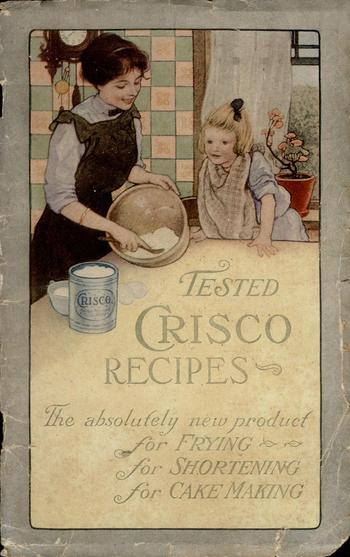
With their conspicuous silence about its sole ingredient, Crisco's marketers did more than avoid evoking negative cottonseed associations. They also pioneered a revolutionary approach to food marketing geared to industrial food, directing consumer attention away from food's ingredients and toward values like modernity, hygiene, and purity, and—perhaps more than anything else—toward the trustworthiness of their own brand. In the case of Crisco, they had a lot to talk about, because hydrogenated vegetable shortening was a genuinely new product that represented a true milestone in industrial food processing. Before Crisco, most factory food processing had differed from home food processing primarily in terms of scale. That is, food prepared in factories was made in vats instead of bowls, and some unscrupulous processors introduced adulterants; but in terms of technique, most factory food processing up to that time simply used much larger proportions for familiar cooking procedures. Hydrogenation, however, was something else entirely: it manipulated an ingredient on the molecular level, giving it altogether new properties. First developed by chemists in the early 1900s, it allowed processors to fill most of the chemical bonds in oil with hydrogen, turning an unsaturated liquid fat into a saturated fat that was solid at room temperature, whose texture and density could be adjusted by raising or lowering the amount of hydrogen forced into the oil.Footnote 129 Since cottonseed oil had already been bleached and deodorized before hydrogenation, cottonseed shortening was a doubly processed product, and it was utterly unreproducible at home (fig. 3).
Hydrogenated vegetable oil had never appeared commercially before Crisco's 1911 launch, and early advertising highlighted its newness and modernity. The cover of this recipe booklet stressed that Crisco was an “absolutely new product.” Tested Crisco Recipes (Cincinnati, OH: Procter & Gamble Co., [ca. 1915]), The Alan and Shirley Brocker Sliker Collection, MSS 314, Special Collections, Michigan State University Libraries.
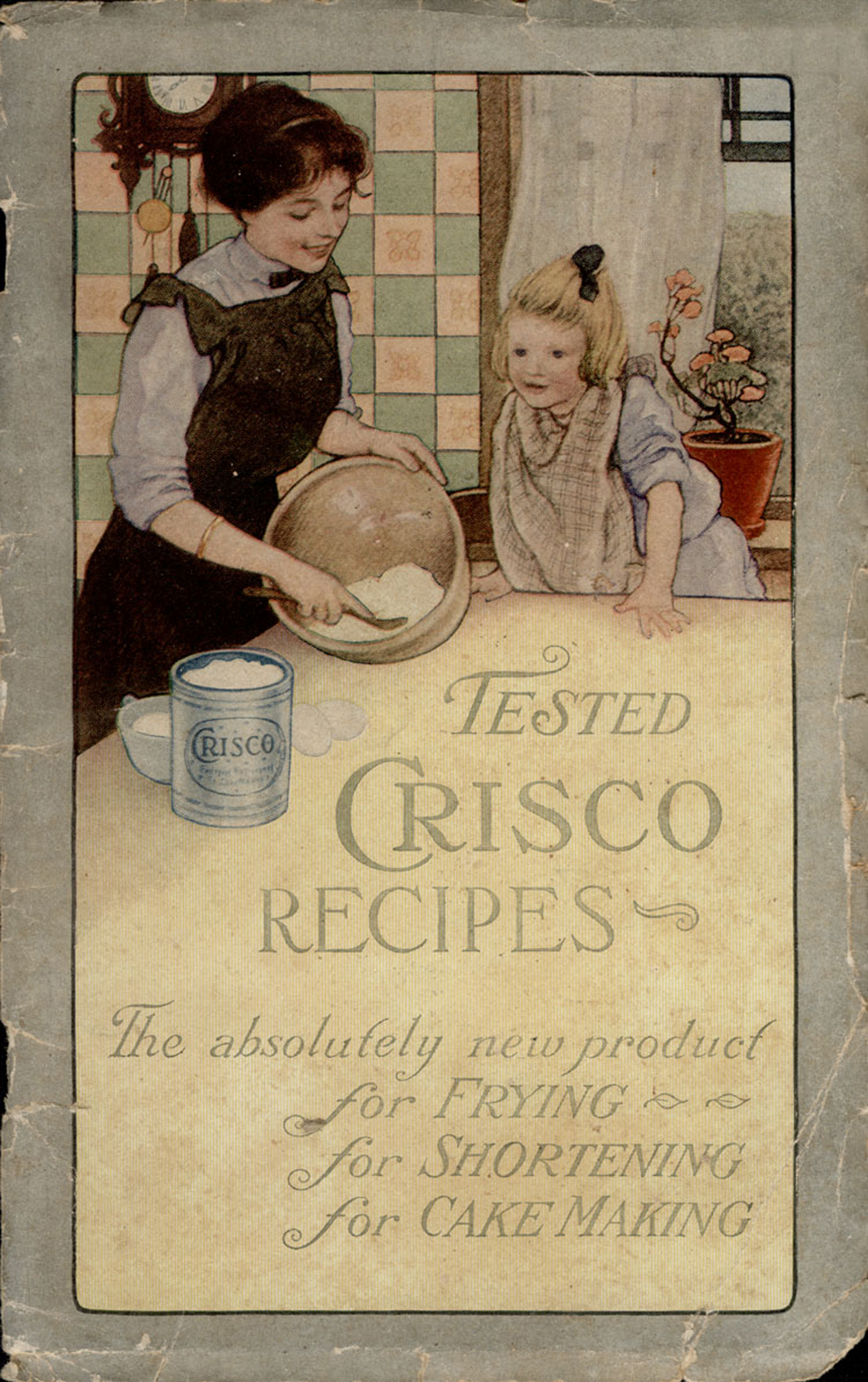
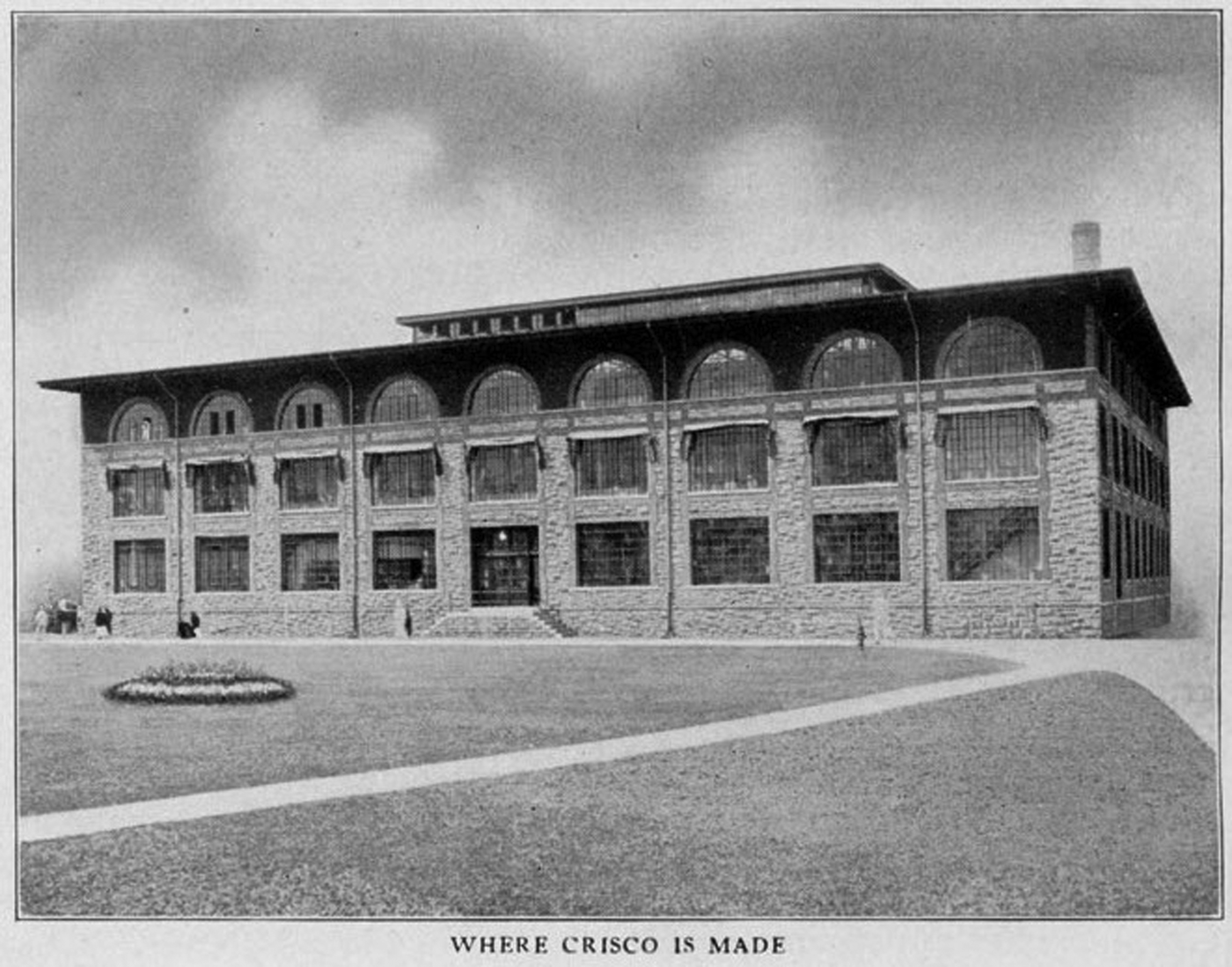
Early ads relentlessly touted Crisco's modernity, which they hailed as an unalloyed good. Crisco was “an absolutely new product,” a “heretofore unknown food.”Footnote 130 It was “an entirely new cooking fat.”Footnote 131 Crisco represented “Progress in Cooking,” and “the most progressive housewives, chefs, hospital dietitians, and physicians” had been quick to adopt it.Footnote 132 The crowning jewel of Crisco's newness was the hydrogenation process itself, which marketers called “a special process,” “an important scientific process,” or—most often—“the Crisco Process.”Footnote 133 Ads were likewise unequivocal about the benefits of producing food in a factory. The Crisco factory was staffed by “uniformed, cleanly workers” who never touched the product itself.Footnote 134 The factory was “immaculate,” white, and “flood[ed]” with sunshine.Footnote 135 The air itself was purified, passing “through water-sprays which take out the dust and leave it freshened and clean.”Footnote 136 Industrially produced Crisco was not just as trustworthy as homemade food but better: “No kitchen in the land is cleaner” than Crisco's “scrupulously clean, bright factory” (fig. 4).Footnote 137
Crisco's marketing materials focused on the modern, sanitatary nature of industrial production while almost entirely omitting mention of its sole ingredient: cottonseed oil. An image of the Crisco factory from Janet McKenzie Hill, Recipes for Everyday, p. 8, The Alan and Shirley Brocker Sliker Collection, MSS 314, Special Collections, Michigan State University Libraries.
Even as marketers highlighted Crisco's modernity and the unprecedented nature of hydrogenation, they simultaneously talked about Crisco's naturalness and purity. “The color, flavor and odor are natural,” one advertisement claimed, and “there is nothing artificial about it.”Footnote 138 It had a “natural wholesomeness,” other ads claimed, and it was “sweet and pure, because it is wholly vegetable.”Footnote 139 Today, of course, these claims seem jarring, even oxymoronic: American consumers now routinely conceive of factory processing and naturalness as mutually exclusive properties. That was not the case in the Progressive Era, however, and in fact ideas about the purifying powers of industrial processing extend to the nineteenth century.Footnote 140 Crisco's marketers boldly claimed that highly processed foods were not just acceptable stand-ins for less processed foods but were better in all ways, offering levels of cleanliness and purity impossible in nature; in effect, factory processing made them more natural by removing impurities.Footnote 141 Even Crisco's shelf stability—a hallmark of highly processed food—was supposedly a result of purity: marketers claimed that Crisco “remains pure and sweet indefinitely” because all impurities were “eliminated by the Crisco Process.”Footnote 142 The more processed that cottonseed oil became, the purer it seemed to be.Footnote 143
As Crisco's early marketing incessantly discussed the advantages of how it was made while omitting mention of what it was made from, the result was a new form of consumer ignorance. When we think about ignorance, we often think of it as natural, an “absence or void where knowledge has not yet spread,” as the historian Robert Proctor puts it.Footnote 144 Proctor coined the term “agnotology” to describe the study of ignorance, and one of his big points is that there is, in fact, something to study. Ignorance is not simply a natural absence; in some cases, indeed, it is a “deliberately engineered and strategic ploy.”Footnote 145 Crisco's marketing involved just such engineering. Marketers aggressively directed consumer attention away from ingredients and toward a new conception of shortening as a platonic whole—a modern product that was, in effect, an ingredient in its own right. “Crisco is Crisco, and nothing else,” its ads claimed; “Crisco is all shortening.”Footnote 146 With their laser focus on the virtues of factory processing, Crisco's marketers helped to create a sense that industrial food products were wholly new entities created far from farmyards and desirably distinct from agricultural commodities. Procter & Gamble's emphasis on product over ingredients would come to characterize the retailing of highly processed food throughout the twentieth century.Footnote 147
In the early twentieth century, a time when the kind of individual knowledge needed to safely navigate the food landscape could feel overwhelming, brands could assume enormous power.Footnote 148 A successful brand functions as a kind of shorthand, making it possible for consumers to avoid research and simply to trust. Procter & Gamble poured effort into instilling consumer confidence in the Crisco brand by endowing it with a reputation for purity, cleanliness, consistency, and all-around trustworthiness.Footnote 149 Starting with their earliest ads, they informed consumers relentlessly that other people already trusted it.Footnote 150 Everyone from “old negro cooks in the South” to the “most orthodox” Jews had already adopted Crisco, a 1912 ad exerted, just months after Crisco's launch.Footnote 151 In 1916 they claimed that “countless housewives” trusted Crisco “because they know it is clean.”Footnote 152 The next year they claimed that a “million American women” were already using it, and they challenged readers to “follow the many who know Crisco.”Footnote 153 This kind of bandwagon strategy would become a pillar of twentieth-century advertising of all kinds, but it was relatively new in the 1910s, and it had special pull at a time when consumers were living through fundamental changes in virtually all aspects of food production, distribution, processing, and regulation.Footnote 154 In this context, Crisco's marketers perceived the paramount importance of building trust in their specific brand. One illustrated ad, for instance, depicted smiling children eating fried chicken, pie, and other foods made with shortening, with a caption reading, “Mothers say: We want to give our families the right foods. We want to be sure that everything which they eat is pure and wholesome, but HOW CAN WE KNOW?”Footnote 155 Their point was that mothers could know their food was wholesome when it was made with Crisco. The brand was all they needed to know.
* * *
Cottonseed shortening was one of the first highly processed foods, and in many ways the Progressive Era was the perfect time to bring it into the spotlight. Journalists and boosters at the time touted it as a modern miracle: a former waste product transformed through the ingenuities of industrial processing into an affordable and uniquely clean, safe food whose purity was guaranteed not only by U.S. law but by industrial processing itself. Cottonseed was extraordinarily successful. The growing national markets for cottonseed as an industrial product, a farm fertilizer, a source for animal feed, and an edible oil for human consumption all helped cotton farmers. Meanwhile, the cottonseed industry supported not just rural agriculture but also rural food processing.Footnote 156 Historians have long talked about southern cotton mills, but there were also hundreds of small cottonseed oil mills around the South in the first decades of the twentieth century. The presence of an oil mill in a small town could help to keep the whole place afloat.Footnote 157 By the late 1930s, cottonseeds’ value as a southern cash crop was second only to that of cotton itself.Footnote 158
Cottonseed oil's success was not inevitable, but neither was widespread consumer ignorance about its presence in the American food system. In 1905, The Atlanta Constitution had reported a prescient conversation between a western hog grower and a southern “cotton oil man.” The oil man was confident that consumers would come to appreciate cottonseed oil, which he called a “pure vegetable product.” But the hog grower dismissed such confidence as foolhardy. Consumers “will never use it,” he predicted darkly. “There is too much prejudice against it.”Footnote 159 As it turned out, both men were right, in a sense. Americans did come to appreciate cottonseed shortening as a “product,” but in the years after Crisco's launch most did so with any cottonseed prejudices fully intact, precisely because they often had no idea what shortening was made from. Instead, Crisco's Progressive Era advertising described it as an ingredient in its own right—one that came from a sparkling white, modern factory, not from a farm.
More than a century later, few Americans have any idea when they eat cottonseed products, or even that they eat them at all. Cottonseed oil has been eliminated from some brands, including from Wesson and Crisco, where it's been replaced by soy, palm, and canola oils. But you can still find cottonseed oil all over.Footnote 160 It's in mayonnaise and salad dressing and crackers and cereals, in margarine and shortening, in Skippy Peanut Butter and Utz Potato Chips and premade Toll House cookie dough. It appears in Passover products and in Girl Scout cookies. Restaurants use it in their deep fryers. Cottonseed oil is one of the most widely consumed oils in the United States.Footnote 161 The chances you haven't eaten it are small. Yet despite its ubiquity, many Americans still have no idea how often they eat foods made from the cotton plant.
Crisco paved the way for this kind of consumer ignorance. Its marketers made ignorance acceptable not by hiding their product, but by putting a pail of 100 percent cottonseed oil right in front of people and telling them to think about other things. Bolstered by growing consumer confidence in government oversight of industrial processing, especially after the Pure Food laws of 1906, marketers promoted the idea that processing was akin to purification and encouraged consumers to put trust in brands rather than to focus on ingredients. The Progressive Era is supposed to be a period when food processing became increasingly transparent, and in some ways it was. But one result of growing consumer trust—in government regulation in general and in specific food brands in particular—was that Americans became increasingly comfortable with ignorance about the ingredients in their processed food. Today, as in the Progressive Era, a food only has to be good to think if you think about it. With cottonseed oil, for more than a century, most people haven't.
Acknowledgements
I am very grateful to Joseph M. Gabriel and another anonymous reviewer who provided extremely helpful suggestions on a draft of this article. Thank you, too, to audience members at the Invention of Food Conference at the University of Texas in April 2017, where I presented an early version of this paper; and to Allie Pail, an undergraduate assistant who contributed research on Crisco and cottonseed advertising. Finally, I am very grateful for the help I received from the staff members of Michigan State University's Special Collections and the University of Michigan's Special Collections.