INTRODUCTION
Pearl millet (Pennisetum glaucum) is the major staple crop grown in the Sahelian region of Niger and neighbouring countries. Current productivity of millet-based cropping systems is very low; average millet grain yields seldom exceed 500 kg ha−1 (De Rouw, Reference De Rouw2004). Unfavourable native soil fertility as well as frequent droughts and high inter-annual rainfall variability are the main reasons for the low productivity.
The nutrient balances of conventional cropping systems are, on average, negative indicating nutrient mining. Smaling et al. (Reference Smaling, Stoorvogel and Windmeijer1993) estimated that the annual average nutrient loss for sub-Saharan Africa would be of the order of 26 kg nitrogen (N), 3 kg phosphorous (P) and 19 kg potassium (K) per hectare in 2000. Although some authors have reported large responses to K fertilizer in the absence of crop residue restitution (Rebafka et al., Reference Rebafka, Hebel, Bationo, Stahr and Marschner1994), nutrient management strategies have generally focused on satisfying plant requirements for N and P, the two most limiting nutrients (Bationo et al., Reference Bationo, Mokwunye, Vlek, Koala, Shapiro, Gichuri, Bationo, Bekunda, Goma, Mafongoya, Mugendi, Murwuira, Nandwa, Nyathi and Swift2003). Except for management strategies such as long-term vegetated fallowing and biological N fixation that may also contribute positively to the N and P balance, manure, crop residue and mineral fertilizers constitute the main potential sources of N and P in the Sahel to prevent nutrient depletion and preserve the long-term productivity of soils.
It has long been recognized that an integrated approach to nutrient management (INM) must be developed rather than relying on a single source of nutrients to maximize nutrient use efficiency (Kimani et al., Reference Kimani, Nandwa, Mugendi, Obanyi, Ojiem, Murwira, Bationo, Gichuri, Bationo, Bekunda, Goma, Mafongoya, Mugendi, Murwuira, Nandwa, Nyathi and Swift2003). Indeed, although the effectiveness of manure, crop residue or fertilizers for improving soil fertility and crop yields has been demonstrated repeatedly through on-station and on-farm trials (e.g. Bationo and Mokwunye, Reference Bationo and Mokwunye1991; Brouwer and Powell, Reference Brouwer and Powell1998), all these sources are limited for farmers' use by availability (Harris, Reference Harris2002; Palm et al., Reference Palm, Myers, Nandwa, Buresh and Sanchez1997), competing uses (Harris, Reference Harris2002; Lamers et al., Reference Lamers, Bruentrup and Buerkert1998), price or financial risk (Shapiro and Sanders, Reference Shapiro and Sanders1998). Hence, consideration of multiple sources of nutrients is a necessity.
Besides the socio-economic reasons mentioned above, there are other reasons for combining different sources of nutrients rather than relying on a single one. For instance, use of mineral N and P fertilizers alone is not advisable as, in the long run, it may lead to a decrease in soil organic content, soil acidification, decreasing base saturation and a large increase in exchangeable aluminium (e.g. Kretzschmar et al., Reference Kretzschmar, Hafner, Bationo and Marschner1991), or even reduce P availability to crops despite the addition of P fertilizer (Michels and Bielders, Reference Michels and Bielders2006). The sole application of fertilizer P, the most limiting nutrient for millet growth in the region (Geiger et al., Reference Geiger, Manu and Bationo1992), exacerbates the negative N and K balances (Buerkert et al., Reference Buerkert, Bationo and Dossa2000). Whereas fertilizers release their nutrients rather rapidly, manure and crop residue act as slow-release fertilizers. In addition, they are a source of multiple nutrients, including micronutrients, supply carbon for soil micro-organisms involved in nutrient cycling and may significantly improve soil physical and chemical quality (Bielders and Michels, Reference Bielders and Michels2002; Buerkert et al., Reference Buerkert, Bationo and Dossa2000), and are appropriate for rehabilitation of degraded soils (Michels and Bielders, Reference Michels and Bielders2006). The use of either crop residue or manure can buffer soil acidification resulting from fertilizer use, thereby enhancing fertilizer use efficiency by preventing P immobilization (e.g. Hafner et al., Reference Hafner, George, Bationo and Marschner1993). Manure often has a residual effect which may last for two or more further growing seasons depending on the amount of manure applied (De Rouw and Rajot, Reference De Rouw and Rajot2004; Schlecht et al., Reference Schlecht, Hiernaux, Achard and Turner2004). Short-term (1–2 years) and particularly long-term (five years) application of residue has been shown to significantly increase millet dry matter or grain yields whereas its omission resulted in an immediate, severe yield decrease (Bielders et al., Reference Bielders, Michels and Bationo2002; Buerkert and Lamers, Reference Buerkert and Lamers1999).
Additive and synergistic effects have been reported in the literature as a result of the combined use of organic and mineral amendments (Bationo et al., Reference Bationo, Christianson and Klaij1993; Buerkert et al., Reference Buerkert, Bationo and Dossa2000; Hafner et al., Reference Hafner, George, Bationo and Marschner1993). The synergistic effects may result from the side effects of using organic fertilizers, besides their role as nutrient providers: P mobility enhancement, decrease in exchangeable aluminium, enhancement of root growth, decreased surface temperature and soil penetration resistance, and soil protection against wind erosion (Buerkert et al., Reference Buerkert, Bationo and Dossa2000).
Although several studies have evaluated the benefits of combining two sources of nutrients, none have evaluated the possible interactions resulting from the combined application of manure, crop residue and fertilizer. The objective of this study was therefore to evaluate the effect of the combined application of the three types of amendments on millet yield, partial factor productivity and nutrient balances of a millet crop in order to derive practical recommendations for INM.
MATERIALS AND METHODS
Experimental site
The experiment was conducted at Sadoré, Niger (13°15′N, 2°17′E; 240 m asl) on the experimental station of the International Crops Research Institute for the Semi-Arid Tropics (ICRISAT), located 45 km southwest of Niamey, the capital city of Niger. The climate is typical of the southern Sahelian zone, with summer rainfall and high temperature throughout the year. The annual rainfall in Niamey is 545 mm and the average temperature is 29 °C.
The soil is classified as a sandy, siliceous, isohyperthermic psammentic Paleustalf with 91% sand, 5% silt and 4% clay in the A horizon and a bulk density of about 1.65 Mg m−3 (West et al., Reference West, Wilding, Landeck and Calhoun1984). Soil water content at field capacity is 0.09–0.10 m3 m−3 (Klaij and Vachaud, Reference Klaij and Vachaud1992).
Experimental design and crop management
The experiment was run in the 1994 and 1995 rainy seasons as a randomized complete block design with three replications. The experimental field had been cultivated in 1993 for a homogeneity trial without any inputs or tillage. Prior to this, it had been left fallow for more than 10 years and never used previously for experiments. Individual plot size was 10 × 20 m. There were three experimental factors with three levels each, resulting in a total of 81 plots: (i) broadcast millet stover application (stems with leaves) at rates of 300, 900 and 2700 kg ha−1, hereafter referred to as 300R, 900R and 2700R, respectively; (ii) uniform cattle manure application at rates of 300, 900 and 2700 kg ha−1, referred to as 300M, 900M and 2700M, respectively; and (iii) mineral fertilizer application: unfertilized control, 15 kg N ha−1 + 4.4 kg P ha−1 and 45 kg N ha−1 + 13.1 kg P ha−1 referred to as 0N0P, 15N4P and 45N13P, respectively. In 1994, manure and residue application was delayed until two and five weeks after millet sowing, respectively, due to logistical constraints. The implications of this late application are discussed below. In 1995 residue was applied in January and manure approximately four weeks before sowing. N was applied as calcium ammonium nitrate (26% N) placed 0.1 m from pockets and incorporated with a hoe. In the case of the 45N13P treatment, the application of N was split (15 and 30 kg N ha−1 approx. 30 and 60 days after sowing (DAS)). P was broadcast prior to sowing as single super phosphate (SSP, 18% P2O5) and incorporated with a light cattle-drawn implement. Manure nutrient content was 1 ± 0.05 % N, 0.2 ± 0.01% P and 1.6 ± 0.09% K (mean ± SD; n = 5). Average millet stover nutrient content across all treatments computed from weighted leaf and stem content was 0.74 ± 0.14 % N, 0.05 ± 0.01% P and 2.54 ± 0.44% K (mean ± SD; n = 162 from both years). The millet cultivar CIVT (Composite Inter-varietal de Tarna, early maturing, 95 days) was sown by hand on 6 June 1994 and 20 June 1995 in pockets on untilled soil after the first rainfall event exceeding 20 mm, at a density of 12 500 pockets ha−1 and two plants pocket−1 in 1994, and 10 000 pockets ha−1 and three plants pocket−1 in 1995. Weed control (hilaire) was done by hand two or three times depending on weed prevalence. The crop was also protected by pest control (weekly Deltamethrine spray) and bird-scaring.
Water balance
Daily rainfall data was recorded by means of an automatic rainfall gauge located at the experimental station. Soil moisture measurements were made in all the plots with an on-site calibrated neutron probe (Didcot®) at approximately 10-day intervals throughout the growing season from 0.15 to 2.1-m depth at 0.15-m intervals. A separate calibration was used for 0.15 m and all depths >0.15 m. Water balance (change in soil water stock, drainage at maximum rooting depth (1.5m) and evapotranspiration) was computed from water content data. Details of the method used were given by Klaij and Vachaud (Reference Klaij and Vachaud1992).
Soil and nutrient analyses
Soil samples were taken in 1994 prior to sowing in each plot at depths of 0.0–0.2 and 0.2–0.4 m. Each sample was analysed for pH(H2O) (soil/water ratio of 1:2.5), organic carbon (Walkley and Black), total nitrogen (N) (Kjeldhal), available phosphorus (P) (Bray1) and exchangeable aluminium (KCl extraction). Samples of millet leaves, stems and grain were analysed for total N, P, and K content in each plot in 1994 and 1995 at harvest.
Partial factor productivity refers to the ratio of grain yield to the total nutrient application rate (Pandey et al., Reference Pandey, Maranville and Bako2001). A simplified nutrient balance was calculated by subtracting the amount of N, P or K exported with the harvest (grain, stems and leaves) from the total amount of N, P or K added through manure, residue and fertilizer.
Statistical analyses
All results were submitted to analysis of variance in GenStat 6 (Laws Agricultural Trust, 2002) using a randomized complete block structure with three treatments and three replications in which the two years were considered at the split-plot level. When year by treatment interaction was significant, the analysis was done for each year. A log transformation was applied to the partial productivity data of all three nutrients because of non-normality. Differences between treatments were considered at error probabilities ≤0.05.
RESULTS
Rainfall characteristics and water balance
The rainfall during the cropping period was 721 mm in 1994 and 431 mm in 1995, whereas for the whole year it was 794 mm in 1994 and 486 mm in 1995. The latter correspond, respectively, to 146 and 89% of the long-term annual average. Rainfall was more evenly distributed in 1995 than in 1994 despite the higher rainfall amount during the 1994 cropping cycle. In 1994 there were 37 rainfall events during the cropping cycle, six of which exceeded 40 mm whereas in 1995 two events out of 29 exceeded this threshold. A dry spell of 16 days occurred from 13 to 28 DAS (juvenile stage) in 1994. In 1995 two dry spells were observed, from 22 to 50 DAS and from 72 to 85 DAS (maturing stage).
There was no significant difference between seasonal cumulative millet evapotranspiration and drainage with regard to any of the treatments in 1994 and 1995. Average seasonal millet evapotranspiration was 459 mm in 1994 and 286 mm in 1995. Drainage in 1994 (158 mm) was more than three-fold the estimated value in 1995 (44 mm). Plant available water (PAW) did not reach critically low levels during the dry spells identified on the basis of rainfall in either year (data not shown).
Initial soil chemical properties prior to the experiment
Differences were highly significant (p < 0.001) among depths for all soil chemical properties. The pH(H2O) was acidic for all plots and depths (5.4 ± 0.1 in the 0–0.20 m depth). The topsoil (0–0.20 m) was poor in organic carbon (0.18 ± 0.04%), total N (163 ± 30 mg kg−1) and available P (2.1 ± 0.5 mg kg−1); all decreased with depth. Exchangeable aluminium content was fairly high and increased with depth (0.11 ± 0.06 cmol kg−1 in the 0–0.20 m depth) as a result of the decreasing pH. All properties are typical of the sandy soils of the region. The low P-Bray values clearly indicate the absence of prior P fertilization.
Millet stover yield
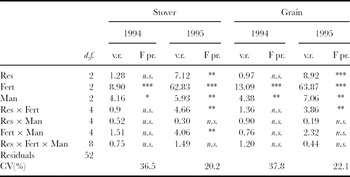
Overall millet stover yield was significantly higher in 1994 (1658 kg ha−1) than in 1995 (1337 kg ha−1) (p < 0.001). A year × treatment interaction was observed only in the case of residue application (p = 0.001). The addition of residue had no effect in 1994, but significantly increased millet stover yield in 1995 (p = 0.002, Table 1) by 14% and 23% for 900R (1360 kg ha−1) and 2700R (1461 kg ha−1), respectively, compared to 300R (1189 kg ha−1; s.e.d. = 73 kg ha−1).
Analysis of variance of millet stover and grain yield as affected by combined application of cattle manure (Man), millet residue (Res) and mineral fertilizer (Fert) in 1994 and 1995 at ICRISAT Sahelian center, Sadoré, Niger.

v.r.: variance ratio; F pr.: Fisher's probability (of significance); n.s.: not significant; *,**,*** probability significant at 0.05, 0.01, 0.001 respectively.
Significant effects of both mineral fertilizer (p < 0.001) and manure (p < 0.05) application in 1994 and 1995 were observed (Table 1). On average over the two years, fertilizer improved stover yield by 40% and 67% for 15N4P (1537 kg ha−1) and 45N13P (1841 kg ha−1), respectively, compared to the no-fertilizer treatments 0N0P (1099 kg ha−1; s.e.d. = 109 kg ha−1). On average over the two years, manure application increased stover yield by 23% and 27% for 900M (1575 kg ha−1) and 2700M (1625 kg ha−1), respectively, compared to 300M (1277 kg ha−1; s.e.d. = 109 kg ha−1).
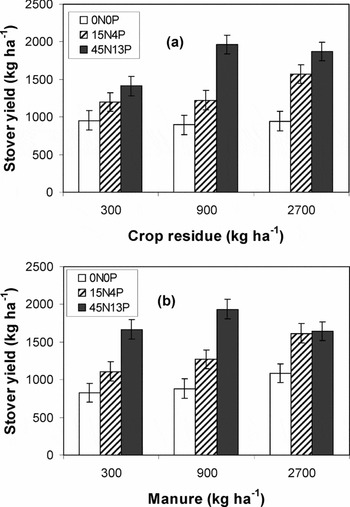
There was no interaction between any of the treatments in 1994 (Table 1). In 1995, however, significant residue × fertilizer (p = 0.003) and fertilizer × manure interactions (p = 0.006) were observed (Table 1). Whereas the addition of 45N13P more than doubled stover yields compared with the 0N0P in the presence of 900R and 2700R, for 300R the increase in stover yield was only 48% after adding 45N13P (Figure 1a). With respect to the fertilizer × manure interaction, one observes that the response to fertilization is similar in the presence of 300M and 900M, but there was no response to the highest rate of fertilization (45N13P) in the presence of 2700M compared to the 15N4P treatment (Figure 1b).
Millet stover yield as affected by combined application of cattle manure, millet residue and mineral fertilizer (N, P) in 1995 at ICRISAT Sahelian center, Sadoré, Niger. Error bars denote s.e.d. Values are interaction means; (a) residue × fertilizer, (b) manure × fertilizer.

Millet grain yield
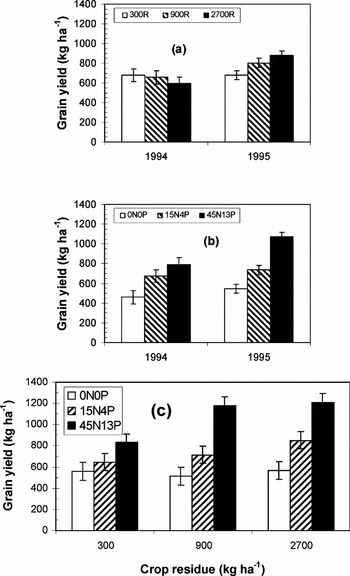
Unlike stover yield, average millet grain yield was better in 1995 (785 kg ha−1) than in 1994 (642 kg ha−1). There was a strong year effect (p < 0.001), and a year × treatment interaction was observed in the case of residue application (p < 0.001). The addition of residue significantly increased millet grain yield in 1995 (p = 0.001) but had no effect in 1994 (Table 1; Figure 2a). In 1995, grain yield was improved by 18% and 29%, respectively, for 900R and 2700R compared to 300R.
Effect of residue (R) and mineral fertilizer (N, P) on millet grain yield in 1994 and 1995 at ICRISAT Sahelian center, Sadoré, Niger. Error bars denote s.e.d. Values are interaction means; (a) year × residue, (b) year × fertilizer, (c) residue × fertilizer (1995).

In both years, increased application rates of fertilizer (p < 0.001) and manure (p < 0.05) significantly increased grain yields (Table 1). On average over the two years, manure increased grain yield by 19% and 29% for 900M (733 kg ha−1) and 2700M (789 kg ha−1), respectively, compared to the 300M (613 kg ha−1; s.e.d. = 47 kg ha−1). Overall, fertilizer improved grain yield by 40% and 86% for 15N4P (699 kg ha−1) and 45N13P (933 kg ha−1), respectively, compared to the no fertilizer (503 kg ha−1; s.e.d. = 47 kg ha−1) treatments. However, fertilizer response was significantly higher in 1995 than in 1994 (p < 0.01; Figure 2b).
A significant residue × fertilizer interaction for millet grain yield was observed in 1995 (p = 0.008), similar to that of millet stover yield. Whereas the addition of 45N13P increased grain yields by 129% and 113% for 900R and 2700R, respectively, compared to 0N0P, for 300R the increase was only 49% following the application of 45N13P (Figure 2c).
Partial factor productivity (PFP) of N, P and K
As a result of the higher grain yields in 1995 than in 1994, PFP (on a grain basis) of N (23.6 kg grain kg−1 N), P (141.7 kg grain kg−1 P), and K (21.1 kg grain kg−1 N) in 1995 was higher than in 1994 (20.3 kg grain kg−1 N, 121.4 kg grain kg−1 P, 18.4 kg grain kg−1 K).
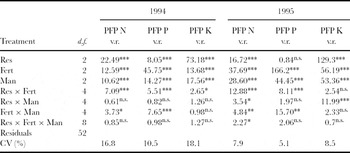
In 1994, all three types of amendments had a significant effect on the PFP of N, P and K on a grain yield basis (Table 2). For N and P, PFP decreased with increasing application rates of residue, manure or fertilizer (data not shown). For K, the PFP also decreased with increasing rates of manure and residue. Following fertilizer additions, however, the PFP of K increased with increasing fertilization.
Analysis of variance of partial factor productivity (PFP) of N, P and K as affected by combined application of cattle manure (Man), millet residue (Res) and mineral fertilizer (Fert) in 1994 and 1995 at ICRISAT Sahelian center, Sadoré, Niger.

v.r.: variance ratio; n.s.: not significant;*,**,*** probability significant at 0.05, 0.01, 0.001 respectively.
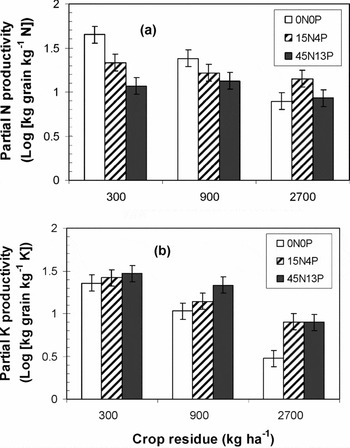
There was a significant residue × fertilizer interaction in 1994 (Table 2) for N (Figure 3a) and P (data not shown). The PFP of N (or P) decreased rapidly with increasing rate of fertilizer application at low levels of residue (300R), yet at higher rates of crop residue, the PFP of N (or P) decreased much less or even remained stable for the various fertilizer application rates. There was also a significant residue × fertilizer interaction in 1994 for the partial K productivity (Table 2; Figure 3b). The increase in the partial K productivity following fertilization was significant only for the two highest residue application rates.
Effect of crop residue and fertilizer on the partial factor productivity of N (a) and K (b) in 1994. Error bars are s.e.d. Values are interaction means.

A significant fertilizer × manure interaction was observed for the PFP of N and P in both years (Table 2). At the lowest rate of fertilization (0N0P), manure application induced a strong decrease in the PFP of N. The decrease in PFP of N was less with increasing fertilizer rate and it was little affected by manure application at the highest fertilizer application rate (data not shown). A similar response was observed for P (data not shown).
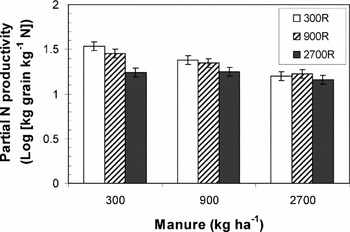
As in 1994, the application of residue, fertilizer and manure had a significant effect on the PFP of N and K in 1995 (Table 2). Although fertilizer and manure had a significant effect on the PFP of P, residue application did not (Table 2). There were significant residue × fertilizer (N, P), residue × manure (N, K) and fertilizer × manure (N, P) interactions as well as a residue × fertilizer × manure (N) interaction (data not shown). The residue × fertilizer and fertilizer × manure interactions for N and P were similar to 1994. At the highest rate of fertilization, there was little effect of residue (or manure) application on the PFP of N and P, whereas for 0N0P and 15N4P the PFP of N and P decreased with increasing residue (or manure) application, and this decrease in PFP was strongest at the lowest fertilizer rate (data not shown). Regarding the residue × manure interaction for N and K, the decrease in PFP as the residue application rate increased was strongest at the lowest manure application rate (300M). At high rates of manure (2700M), the PFP of N (Figure 4) and K (not shown) was little affected by the rate of residue application.
Effect of crop residue and manure on the partial factor productivity of N in 1995. Error bars are s.e.d. Values are interaction means.

Soil nutrient balances
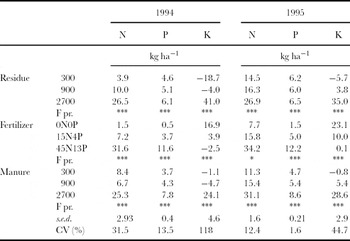
Average nutrient balances were positive in 1994 (13.5 kg N, 5.3 kg P and 6.1 kg K ha−1) and in 1995 (19.3 kg N, 6.2 kg P and 11 kg K ha−1). However, large differences were observed between treatments, ranging from −17.7 to 53.7 kg ha−1 for N, −2 to 15.7 kg ha−1 for P and −39.7 to 87.3 kg ha−1 for K. In 1994, there were significant residue (p < 0.001), fertilizer (p < 0.001) and manure (p < 0.001) effects on the N, P and K balances but no significant interactions (Table 3). In general, the nutrient balances increased as the application rate of amendments increased, except for the K balance, which decreased as the application rate of fertilizer increased. In 1995, there were also significant residue (p < 0.001 for N and K, p < 0.05 for P), fertilizer (p < 0.001) and manure (p < 0.001) effects on the N, P and K balances, with similar trends to 1994 (Table 3). In addition, there was a significant residue × fertilizer interaction for N (p = 0.025) and P (p = 0.002). As the rate of fertilizer application increased, the positive impact of increasing residue application rates on the N and P balances became less and less marked (data not shown).
Nutrient balance (N, P, K) in 1994 and 1995 as affected by the application of millet residue, fertilizer and manure on.

*,**,***probability significant at 0.05, 0.01, 0.001 respectively; F pr.: Fisher's probability (of significance); CV: Coefficient of variation.
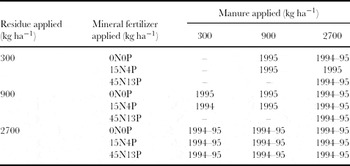
Table 4 highlights which treatments presented neutral or positive balances for all three elements and in what year. At a residue application rate of 2700 kg ha−1, all combinations of manure and fertilizer had a positive soil nutrient balance. At the intermediate residue application rate (900R), all treatments involving 2700 kg manure ha−1 presented positive balances in both years. At 300R, positive balances were observed in both years only for the highest and lowest fertilization treatments in combination with 2700 kg ha−1 manure.
Classification of the 27 residue × fertilizer × manure treatment combinations according to their N, P, and K balances in 1994 and 1995. The number in each cell represents the year when the balances were neutral† or positive.

†Neutral balance refers to balances within 20% of the average nutrient exported by the experiment : −2.5 < N < 2.5 kg ha−1; −0.3 < P < 0.3 kg ha−1; −5 < K < 5 kg ha−1.
DISCUSSION
For this research to be relevant in the context of Sahelian INM, reasonable rates of organic inputs were used: 300 to 2700 kg ha−1 of residue or manure. A recommendation was made not to exceed 2500 kg manure ha−1 a−1 (Brouwer and Powell, Reference Brouwer and Powell1998) to minimize leaching of nutrients. Average millet stover production in the Sahel is of the order of 1300 kg ha−1, but for high input systems stover yields in excess of 6000 kg ha−1 have been reported (Yamoah et al., Reference Yamoah, Bationo, Shapiro and Koala2002). In the present experiment, stover yields reached at most 2700 kg ha−1. However, average stover yield for all the treatment combinations involving 2700 kg residue ha−1 was 1490 kg ha−1. Hence, these treatment combinations could not be sustained without external input of residue. On the contrary, treatments involving 300R and 900R produced 1178 and 625 kg stover ha−1 in excess of their mulching requirement, respectively, which leaves some stover available for alternative purposes. Treatment combinations involving 300R and 900R can therefore easily be sustained.
Traditionally, the results of fertility management trials have been compared to zero-input control plots. Such plots invariably suffer from rapid acidification and severe nutrient deficiency (e.g. Bielders et al., Reference Bielders, Michels and Bationo2002; Buerkert and Lamers, Reference Buerkert and Lamers1999), which is not representative of traditional farmers fields. In the present study, the lowest input treatment consists of a low application rate of both manure (300 kg ha−1) and crop residue (300 kg ha−1). Such rates are representative of the amount of residue present in farmer fields at the start of the rainy season. De Rouw and Rajot (Reference De Rouw and Rajot2004) estimated that passing herds leave behind about 100 kg ha−1 of dung. The manure application rates used here for the control are therefore only slightly larger the amount that would be expected to be deposited by grazing animals.
Millet response to INM
Grain yields were higher in 1995 than 1994 despite lower rainfall and generally lower values of PAW (data not shown) and lower stover yields in 1995. Wang et al. (Reference Wang, Cai, Hoogmoed, Perdok and Oenema2007), combining NP fertilizer, maize stover and cattle manure in a long-term experiment, found a year effect on maize grain yield in northern China that was ascribed to the effect of the amount of rain during the growing season and the soil water at sowing. The year effect often observed in agricultural experiments in the Sahel is to a large extent induced by the rainfall pattern (Christianson et al., Reference Christianson, Bationo, Henao and Vlek1990; Sivakumar and Salaam, Reference Sivakumar and Salaam1999). The high drainage observed in 1994 could be attributed to the high total seasonal rainfall and numerous heavy rainfall events (six events exceeding 40 mm recorded during the cropping cycle), which may have resulted in important N leaching during that year and N deficiency towards the end of the growing season, even for highly fertilized treatments. In 1995, lower PAW during the early growing season may have constrained biomass production compared to 1994, yet appears to have had little impact on grain production.
In both years of the experiment, millet responded positively to even modest amounts of manure and fertilizer applications (in the range of 0–50 kg N ha−1 and 0–13 kg P ha−1), despite the contrasting rainfall conditions. This is in agreement with previous results and reflects the low native fertility of the soils (Bationo and Buerkert, Reference Bationo and Buerkert2001). Rockstrom and De Rouw (Reference Rockstrom and De Rouw1997) found that small quantities, 25 or 50 kg ha−1 of N and 10 kg ha−1 of P buried next to individual pockets, were sufficient to double or triple the grain yields in normal rainfall years. The lack of impact of residue application on millet yields in 1994 may result from the late application of the residue. Early application of residue during the dry season may lead to partial decomposition (e.g. through termites) and a faster release of nutrients and organic compounds during the rainy season, with a stronger positive effect on soil pH and P availability (Hafner et al., Reference Hafner, George, Bationo and Marschner1993; Rebafka et al., Reference Rebafka, Hebel, Bationo, Stahr and Marschner1994). In addition, Buerkert et al. (Reference Buerkert, Stern and Marschner1995) reported that millet responded positively to residue application on low productivity plots whereas little response was observed on high productivity plots. Given that the experimental field had only been cultivated for one year prior to the experiment following a long-term fallow period, the overall level of productivity of the field was probably higher in 1994 than in 1995. Hence a proportionally stronger response to residue application might be expected in 1995 than in 1994. It is also possible that the late application of stover in 1994 resulted in only partial decomposition and hence a residual effect. Such residual effect is usually not observed, however, as evidenced by the very rapid decline in millet yields as soon as no residue is returned to the soil (Bielders and Michels, Reference Bielders and Michels2002).
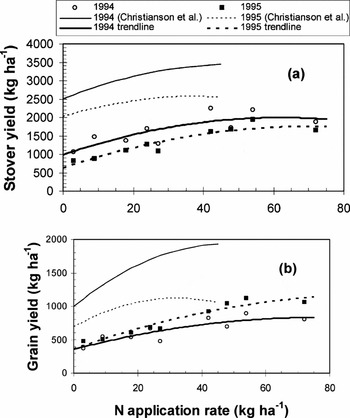
The response of millet to combined application of residue and manure was additive, as indicated by the absence of interaction. The response to N and P supplied by manure and fertilizer appear fairly linear (Table 1), but only up to a certain application rate of N and P. Indeed, in 1995, there was a significant fertilizer × manure interaction. Combining the highest rates of manure and fertilizer resulted in no further increase or even a decrease in millet yields (Figure 1b). Although not statistically significant, a similar fertilizer × manure interaction was observed in 1994 (data not shown), and this was confirmed by the significant interaction for PFP of N and P in both years (Table 2). This may reflect the fact that yields were limited by factors other than N or P fertilization under the soil and climatic conditions of the experiment. Figure 5 shows the average (over all residue application rates) response of millet stover and grain to N application from manure and fertilizer in 1994 and 1995. Similar graphs can be drawn for millet response to P (data not shown). Although stover yields were lower on average in 1995, the graph indicates that maximum stover yields could have been expected in both years at combined application rates of the order of 40–60 kg N, given that P and K were also applied in all treatments. Christianson et al. (Reference Christianson, Bationo, Henao and Vlek1990) reported N response curves averaged over different sources of mineral N as a function of mid-season (16 July–31 August) rainfall amounts. Mid-season rainfall for 1994 and 1995 was 411 and 230 mm, respectively. The response curves proposed by these authors are shown in Figure 5. For stover yield, the shape of the N response curve of the present study is consistent with that derived from Christianson et al.'s results, albeit shifted towards lower yields. For 1995, the maximum stover yield is achieved at higher N rates than expected from Christianson et al.'s work. For grain yield, observed and predicted curves are rather different. Maximum predicted yields occur at lower N rates than found in the present study. In addition, the regression model of Christianson et al. (Reference Christianson, Bationo, Henao and Vlek1990) predicts higher grain yields in 1994 than 1995, contrary to the observed response. One must not forget, however, that the mid-season rainfall of 1994 falls outside the validation range of the Christianson et al. (Reference Christianson, Bationo, Henao and Vlek1990) study. It is therefore likely that the probable high leaching losses of N in 1994 are not properly taken into account by Christianson et al.'s model. In addition, these authors did not consider organic sources of N, part of which may be immobilized during decomposition or remain in organic form after a single rainy season. It is unlikely that K became limiting at high combined rates of manure and fertilizer. Indeed, neglecting K losses through leaching and wind erosion and K additions through dust deposition, the nutrient balance for the 300R-2700M-45N13P treatment was positive in both years (Table 5). This is because the manure supplied large quantities of K. At high rates of fertilizers (45N13P) but low rates of residue and manure, K balances were negative in both years, such that K deficiency may develop (Table 5). Rebafka et al. (Reference Rebafka, Hebel, Bationo, Stahr and Marschner1994) reported large responses to K fertilizer in the absence of crop residue restitution. Voortman and Brouwer (Reference Voortman and Brouwer2003) also highlighted the importance of K in explaining spatial variability of crop growth.
Millet stover (a) and grain (b) yield response to N input from combined application of cattle manure and mineral fertilizer in 1994 and 1995 at ICRISAT Sahelian center, Sadoré, Niger. Measured yields (dots) are averaged over all residue application rates; and are modeled (parabolic trendlines) and compared to data from Christianson et al. (Reference Christianson, Bationo, Henao and Vlek1990).

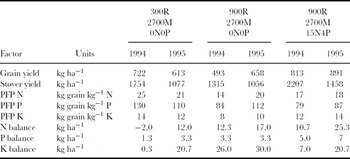
Pearl millet yield, partial factor productivity (PFP) of N, P and K, and N, P, K balances for three selected treatments suitable for recommendation based on the experiment conducted at ICRISAT Sahelian center, 1994–1995.

A strong synergistic effect between fertilizer and residue was observed, as evidenced by the residue × fertilizer interaction in 1995 for both stover and grain yield. The response to fertilizer was strongly amplified at 900R and 2700R compared to 300R (Figure 1a and 2c). This was also reflected in the residue × fertilizer interactions for the PFP of N (Figure 3a), P and K (Figure 3b) in 1994 despite the late application of stover. At higher levels of crop residue, millet is better able to take up the nutrients added through fertilizer, which leads to a fairly constant partial N productivity of about 10 kg grain kg−1 N in 1994 at the highest rate of fertilization in the presence of 2700R. Because no K is added through the fertilizer, the PFP of K strongly increases in response to fertilization for 2700R. At 300R, the PFP of N and P decreases sharply and the PFP of K remains stable as the fertilizer rate increases, indicating poor use of N and P. In 1995, the same synergistic effect was observed for the PFP of N and P. Synergistic effects between residue and fertilizer have been reported by, for example, Bationo et al. (Reference Bationo, Christianson and Klaij1993) and Yamoah et al. (Reference Yamoah, Bationo, Shapiro and Koala2002) yet few experiments have reported on the response of millet to low levels of residue. However, the rapid acidification of the soil and resulting millet yield decline in the absence of residue restitution is well documented (e.g. Bielders et al., Reference Bielders, Michels and Bationo2002; Buerkert and Lamers, Reference Buerkert and Lamers1999). In the present case, it may be that fertilizer application and the low return of millet stover biomass to the soil resulted in some acidification of the soil for the 300R treatment, with, among others, negative consequences on P availability. With the application of 900 kg stover ha−1 or more, this negative effect is suppressed and millet response to fertilizer much stronger.
Recommendations
No third level (residue × manure × fertilizer) interaction was generally observed. Wang et al. (Reference Wang, Cai, Hoogmoed, Perdok and Oenema2007) also found no such interaction in a similar INM and long-term experiment on maize grain yield, and N, P and K uptakes under reduced tillage in northern China. But they pointed out that added manure and stover were more important especially in dry years and NP fertilizer in wet years because the annual rainfall and soil water condition at sowing played a major role, contrary to the Sahelian environment. Our experiment did not reveal any treatment combinations that could be viewed as particularly favourable or unfavourable. However, a number of recommendations can be drawn from the experiment. Although high rates of residue had no adverse effects and a positive response to residue was observed in 1995, for technical reasons the highest rate of residue (2700R) cannot be recommended in practice as the production of the mulching material cannot be sustained. Hence only treatment combinations involving 300R or 900R should be considered for practical applications. Maintaining a positive nutrient balance is an essential requirement of INM. At residue rates of 300 kg ha−1, positive balances were obtained in both years only for the highest rate of manure (2700M; Table 5). This is required in particular to sustain the K balance, in the absence of K fertilization, as the manure supplied large quantities of K. A viable option would therefore be to combine low levels of residue (300R) as observed at the end of the dry season in most fields, with 2700 kg ha−1 of manure. With a supply of 27 kg N ha−1, this treatment combination results in a 95% increase in yields on average over the two years (Figure 5). Given the poor response of millet to fertilizer at low rates of residue (300R; residue × fertilizer interaction, Table 2), these treatment combinations cannot be recommended. All treatment combinations involving 900R and 2700M presented a positive nutrient balance in both years (Table 5) and may therefore be considered in practice. The combination of high rates of manure (2700M) and fertilizer (45N13P) should not be recommended, however, given the manure × fertilizer interaction observed in 1995 (Table 2) and the shape of the yield response curves (Figure 5). Hence, besides the 300R-2700M-0N0P, the 0N0P or 15N4P fertilization in combination with 2700M and 900 R could be retained in practice. Table 5 provides an overview of the various agronomic criteria for the three selected treatments. On that basis, it appears that the 900R-2700M-0N0P offers no advantages over the 300R-2700M-0N0P. On the basis of the agronomic criteria used here and depending on socio-economic factors (access to manure and fertilizer, cost of fertilizer or manure, opportunity cost for crop residue), one would recommend the 300R-2700M-0N0P or 900R-2700M-15N4P treatments. The 2700 kg manure ha−1 may not be available on all smallholder farms in the Sahel. Manure was applied uniformly in the present experiment; hill placement might substantially reduce the amount needed to have the same effect although additional labour would be required (Harris, Reference Harris2002) but with a negative impact on nutrient balances. These results would need to be confirmed through longer-term experiments and may have to be refined on the basis of complete nutrient balances. Indeed, the present balances, though easy to perform, neglect a number of inputs and outputs (leaching, atmospheric deposition, N fixation, volatilization). For calcium ammonium nitrate for instance, Christianson et al. (Reference Christianson, Bationo, Henao and Vlek1990) reported losses of the order of 25–37%. The recommendations derived here should not be considered as mutually exclusive but may be implemented differentially depending on site-specific differences in productivity (Harris, Reference Harris2002; Voortman and Brouwer, Reference Voortman and Brouwer2003).
CONCLUSIONS
The beneficial effects of combined organic and mineral nutrients sources on soil fertility have been repeatedly claimed, yet no previous experiments have dealt with the combined management of residues, manure and mineral fertilizers in the Sahel and hence no guidelines are available for their combined management (Palm et al. Reference Palm, Myers, Nandwa, Buresh and Sanchez1997). This study revealed some additive effects of the three amendments tested and some positive synergistic effects. The main additive effect concerns manure and crop residue application in both years. A synergistic effect between residue and fertilizer was revealed in 1995 for yields and PFP of N and P and for PFP of N, P and K in 1994. It appeared that high rates of fertilizer should not be combined with low rates of crop residue. The highest rates of manure (2700 kg ha−1) and fertilizer (45N13P) should also not be combined as this leads to no additional yield increase or even to a yield decrease. At lower rates (up to 50 kg N ha−1), the effects of manure and fertilizer seemed to be largely equivalent, leading to a consistent yield response, yet one should not forget that manure constitutes a major supply of K and other micronutrients as well. There was no third order interaction between residue, manure and mineral fertilizer except for PFP of N in 1995.
Two treatments stand out as particularly relevant in practice based on yield, partial factor productivity and nutrient balance criteria. A combination of 300 kg ha−1 of millet stover and 2700 kg ha−1 of manure without fertilizer would be appropriate in case of poor access to mineral fertilizer (for availability or cost reasons) and resulted in a 95% yield increase compared to 300R + 300M. A higher input combination of 900 kg ha−1 millet stover, 2700 kg ha−1 manure and 15kg N + 4 kg P ha−1 as fertilizer lead to an average increase in grain yield of 132%. In this treatment, the higher rate of residue application seems essential to counteract any acidification that may result from the use of mineral fertilizers, as well as to provide K and enhance P mobilization. These results would need to be confirmed through longer-term experiments and may have to be refined on the basis of comprehensive nutrient balances.
Acknowledgements
The authors are grateful to M. V. K. Sivakumar for initiating this study and to the staff of ICRISAT for their help in collecting the data. Data analysis was supported by the project entitled ‘Improved livelihoods in the Sahel through the development and implementation of household level bio-economic decision support systems’ funded by the Belgian Directorate-Generale for Development Cooperation (DGDC).