Tetralogy of Fallot is the most common form of cyanotic CHD. Considered a rare disease, tetralogy of Fallot occurs in ~5 out of every 10,000 live births. 1 According to the Centers for Disease Control and Prevention, and the North Carolina State Center for Health Statistics, the incidence of tetralogy of Fallot is 1 in 1660 live births in the United States of America each year, and 1 in 2497 live births in North Carolina. 2 , 3
Little is known about the underlying causes of tetralogy of Fallot, particularly with regard to environmental and geographic risk factors.Reference Jenkins, Correa and Feinstein 4 , Reference Neill and Clark 5
Although tetralogy of Fallot exists on a clinical spectrum, all children with tetralogy of Fallot eventually require heart surgery to prevent death before adulthood.Reference Hickey, Veldtman and Bradley 6 Prematurity and low birth weight are the top two risk factors for neonatal death in North Carolina, and both factors are associated with poor outcomes after surgical repair of tetralogy of Fallot.Reference Zampi, Armstrong and Hirsch-Romano 7 , Reference Wren 8 In North Carolina, publicly available data show disproportionately high numbers of low birth weight infants (>150/year) born in certain North Carolina counties compared to others. 3 Studying how geography influences early and late outcomes for the survivors is uniquely challenging. Available birth-defect and administrative databases can shed light on the geographic location of patients with tetralogy of Fallot at birth, as well as the location of patients with tetralogy of Fallot suffering from early mortality, but it is currently impossible to link these outcomes to specific clinical data, such as operative and pathological reports.Reference Nelson, Stebbins and Strassle 9 – Reference Riehle-Colarusso, Bergersen and Broberg 11 To determine whether there is an association between certain tetralogy of Fallot subtypes or potential risk factors for poor outcome and the birth mother’s geographic location during early pregnancy, statewide data in the form of a registry would be ideal.
Patient-reported outcomes studies in tetralogy of Fallot patients are lacking. A possible explanation is that location, recruitment, and longitudinal follow-up investigation of adult patients with CHD across institutions is particularly challenging. Without a global unique identifier for patients who have undergone congenital heart surgery, an online statewide or nationwide registry can fill the gaps left by clinical and administrative databases. If the challenges of enrolment in such registries can be overcome, patient-reported outcomes may be feasibly collected and analysed in order to improve long-term outcomes for this unique and growing patient population.
The University of North Carolina Health Care system currently follows-up ~900 patients living with tetralogy of Fallot, and 158 are ⩾18 years of age. Given that the University of North Carolina has historically been a regional leader in surgical case volume for repair of tetralogy of Fallot, and patients tend to return for their related follow-up heart care, it is an ideal setting for a tetralogy of Fallot cohort study. This pilot study was proposed as a first step in the process of creating a statewide tetralogy of Fallot registry. The primary long-term goals of a North Carolina statewide registry are to study geographic risk factors for poor tetralogy of Fallot outcomes and longitudinal patient-reported outcomes in long-term survivors of tetralogy of Fallot repair. Specific aims of this pilot study were to assess the feasibility of contacting and recruiting adult patients with tetralogy of Fallot into a survey-based study with a patient-reported outcomes component; to understand and record challenges to patient recruitment; and to evaluate the feasibility of developing a secure online tetralogy of Fallot registry to house the data collected. Secondary aims were to evaluate the feasibility of abstracting data from older medical records and the feasibility of learning the specific geographic location of the birth mother of a patient with tetralogy of Fallot during her first trimester of pregnancy.
Materials and methods
Identification of patients
A cohort of 158 adult patients living with tetralogy of Fallot in University of North Carolina was identified using a query of the Carolina Data Warehouse for Health for any encounter with a patient with tetralogy of Fallot between 1 July, 2004 and 29 June, 2015. The Carolina Data Warehouse for Health is a central repository of clinical data that include current and legacy hospital systems for the University of North Carolina Health Care system, including the main campus and all affiliated clinics and facilities. Eligible patients were identified using International Classification of Disease, 9th Revision, Clinical Modification diagnostic codes for tetralogy of Fallot and pulmonary atresia with ventricular septal defect (745.2). 12 Inclusion criteria were living patients, currently aged 18–59 years, with surgically repaired tetralogy of Fallot. Initial exclusion criteria were failure to meet inclusion criteria, non-English speaking patients, and decisionally impaired individuals. After recruitment for Part I began, the exclusion criteria and data-collection tools were modified to allow inclusion of decisionally impaired individuals with parental consent and to allow parental completion of a caregiver version of the survey. The University of North Carolina institutional review board approved all protocols, and informed consent was obtained from all patients.
Part I: phone survey
Stratified random sampling was used to select patients. Out of each of four age groups by decade – 20–29, 30–39, 40–49, and 50–59 years – five patients were randomly selected for inclusion on the basis of the medical record number using STATA software (version 13.1; Stata Corp, College Station, Texas, United States of America). 13 A spectrum of adult age groups was chosen to better assess the feasibility of recruiting patients of different ages by phone versus email, as well as to assess the feasibility of retrieving older medical records in both paper and outdated electronic formats.
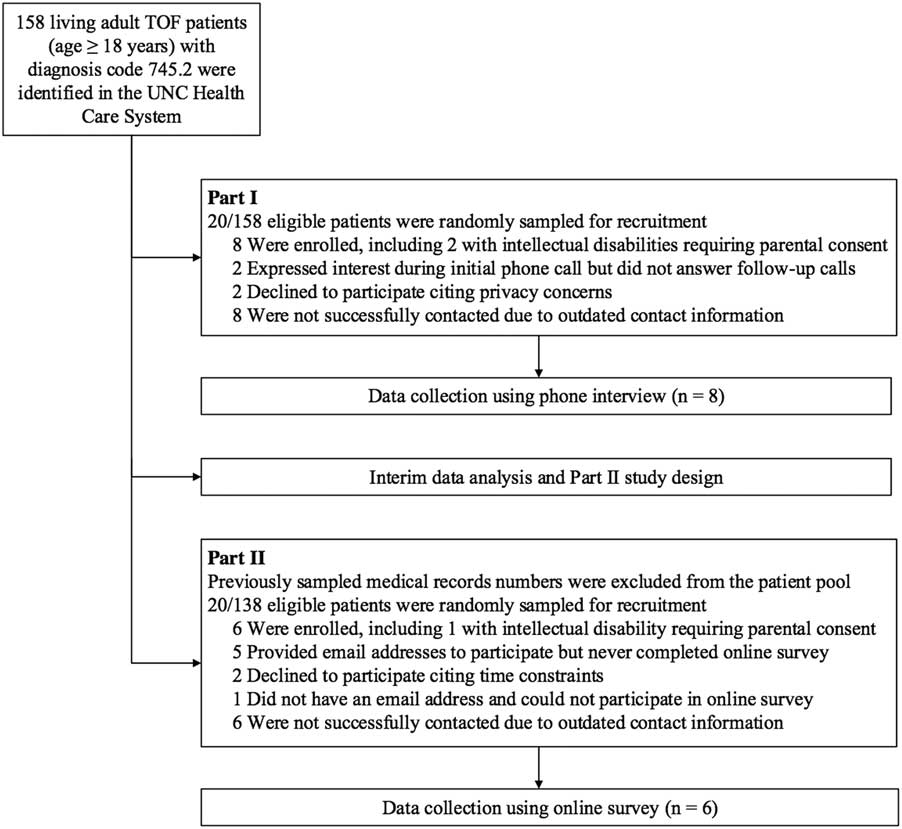
Recruitment was attempted via phone, email, and United States of America mail using contact information available in the electronic medical record, or through phone number, email address, or mailing address provided by the potential patient’s primary-care physician or cardiologist (Fig 1).
Study design. TOF=tetralogy of Fallot; UNC=University of North Carolina.

Data were collected through one scripted phone interview and a retrospective review of medical records from the University of North Carolina and additional providers. During the phone interview, patients were asked to provide their birth mother’s geographic location during the first trimester of being pregnant with them. If study patients did not know their birth mother’s zip code during early pregnancy, permission was requested to contact their birth mother directly for the information. Patients were also asked if they had other family members who had CHD and if they used email or other forms of social media. Using medical record review we attempted to abstract the following information: demographics; gestational age at birth and birth weight; tetralogy of Fallot disease subclassification; surgical history or operative reports; and echocardiogram, MRI, and catheterisation results. Study data were managed using Research Electronic Data Capture (REDCap), a secure online data cloud hosted by the North Carolina Translational and Clinical Sciences Institute.Reference Harris, Taylor and Thielke 14
When Part I concluded, interim data analysis was completed. Part II was designed accordingly to test an alternate recruitment strategy, evaluate the feasibility of collecting patient-reported symptoms and outcomes using an online data-collection process, and to better understand educational opportunities for the tetralogy of Fallot population that could be addressed via a future online platform associated with a registry. As Part I had already identified clear barriers to obtaining outside medical records, but revealed no significant obstacles to chart abstraction for records maintained internally, no chart review was conducted in Part II.
Part II: online survey
Out of each of four age groups by decade – 18–27, 28–37, 38–47, and 48–57 years – five different patients were randomly selected from the eligible pool. Part I patients were not eligible for participation in Part II. Recruitment for survey completion was attempted by email and phone. Email addresses and phone numbers were obtained via medical-record and public-record search. A REDCap survey with a linked database was custom-designed, and patients received a secure survey link via email. For patients who did not complete the survey, phone calls were made to gauge interest in the study and to confirm email addresses. In addition to the survey questions asked in Part I of the study, this survey asked patients whether they were experiencing symptoms perceived to be related to tetralogy of Fallot, what tetralogy of Fallot educational topics would be of greatest benefit to them, and whether they were willing to be contacted once a year as a patient in the tetralogy of Fallot registry. Survey responses were automatically uploaded into REDCap.
Data analysis
Data analysis included thematic grouping of recruitment challenges and descriptive statistics based on survey responses. An a priori feasibility threshold of 75% for recruitment and for electronic data fields completed per patient was selected based on previously published work as well as on the investigators’ general clinical familiarity with the University of North Carolina patient population.Reference Ashley, Jones and Thomas 15
Results
Part I: phone survey
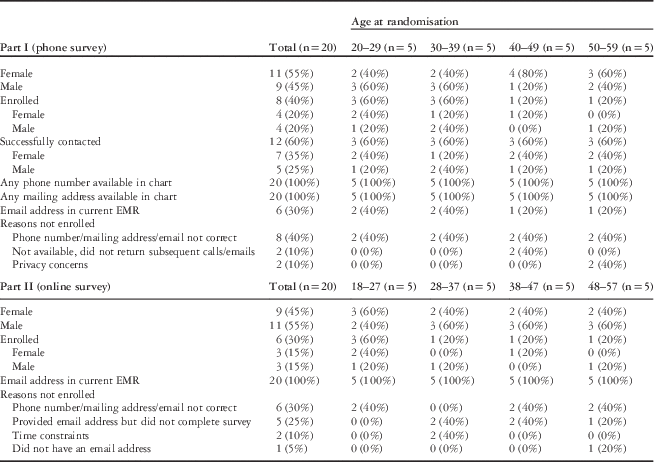
Of the 20 randomly selected patients, 12 (60%) were successfully contacted (Table 1), eight (40%) were enrolled in the study, and two (10%) declined to participate citing privacy concerns. The two individuals who declined to participate in the study were both in the 50–59-years age group. Of the enrolled patients, two had genetic syndromes and intellectual disability; therefore, their birth mothers provided consent by proxy. Both birth mothers were enthusiastic about participating in research and both cited the opportunity to potentially help future tetralogy of Fallot patients as the primary reason for their enthusiasm. The patients who declined to participate in the study because of privacy concerns were both in the 50–59-years age group. None of the younger patients we contacted voiced any privacy concerns regarding research studies.
Recruitment outcomes by age group (n=40).

EMR=electronic medical record
In all, two individuals expressed interest in the survey during the first phone call but did not answer subsequent phone calls. Phone recruitment was more successful in the 20–29-and 30–39-years age groups (60% in both groups) compared with the 40–49- and 50–59-years age groups (20% in both groups). Recruiting patients by phone was challenging, as many of the phone numbers in the electronic medical record were outdated or missing. A higher proportion of younger patients had updated phone numbers in the electronic medical record, most likely because they were seen more recently by their primary-care physician and/or cardiologist, at which time clinic staff are trained to verify contact information at check-in. Moreover, the older individuals were less likely to have been seen at the University of North Carolina within the last year compared with the younger tetralogy of Fallot patients.
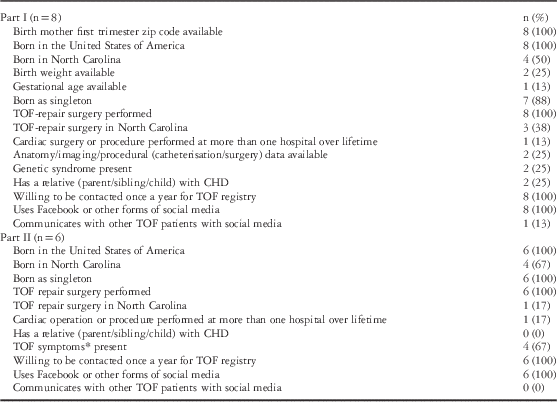
Demographics and birth mother’s first trimester geographic location were obtained for 100% of the enrolled patients (Table 2). We were able to complete 100% of the data fields in the REDCap database for two (25%) of the eight enrolled patients; thus, the 75% feasibility threshold for data fields completed per patient was met in only 25% of patients who participated in the survey.
Completeness of data fields for adult patients with tetralogy of Fallot (TOF) enrolled in Part I (phone survey) and Part II (online survey) (n=14).

* TOF symptoms reported included “heart murmur and backwash”, “dyspnoea upon exertion”, “occasional shortness of breath, wear out easily”, and “occasional angina and murmur”. TOF educational materials desired included “effects on pregnancy, valve replacement”, “long-term outcomes for patients with complete repair”, “what to expect as I age, how will it affect me in my later years – 40 years and on”, and “any that address adult experiences after surgery, esp. if they are as long term as mine – 47 years since surgery”
Part II: online survey
Of the 20 sampled patients, 14 (70%) were successfully contacted via email or phone calls (Table 1). Overall, six (30%) of the 20 were enrolled and completed all data fields (100%) of the online survey; two were in the 18–27-years age group, one in the 28–37-years age group, two in the 38–47-years age group, and one in the 48–57-years age group. In all, five (25%) of the 20 expressed interest in the study and provided their email addresses via a phone call but never completed the survey. A total of two individuals declined to participate in the study because of time constraints; both were in the 28–37-years age group. Less than 20% of patients reported cardiac surgeries and procedures performed at outside hospitals (Table 2). Of the six enrolled patients, four (67%) noted current symptoms related to tetralogy of Fallot, including dyspnoea, chest pain, and fatigue. Regarding desired tetralogy of Fallot educational resources, three of the patients indicated an interest in learning more about long-term outcomes after complete repair of tetralogy of Fallot, and one patient was interested in learning about the effect of pregnancy on tetralogy of Fallot patients.
All of the enrolled patients (100%) reported use of both email and some form of social media and willingness to be contacted once a year as a tetralogy of Fallot registry patient. All of the enrolled patients completed 100% of the data fields in the REDCap online survey, thus meeting the feasibility threshold. The median time for survey completion was 8 minutes (range 4–16 minutes), and automatic electronic data entry from the online survey was uncomplicated.
Discussion
The overall goals of this single-centre pilot study were to assess the feasibility of recruiting adults with repaired tetralogy of Fallot into a patient-reported outcomes study, to document associated recruitment and data-collection challenges, and to construct an interactive online tetralogy of Fallot registry with a linked database. Although recruitment of contacted patients (14/26, or 54%) fell below our feasibility threshold, enrolled adults with tetralogy of Fallot were willing to complete phone or online surveys, provide their birth mothers’ first trimester geographic location, and all patients indicated use of social media. Online database creation was successful. As a whole, these results make it uncomfortable to draw a firm conclusion about the feasibility of creating a larger registry, particularly given the small sample size and the compelling rationale behind this pilot study.
Part I (phone survey) of this study demonstrated that it is feasible to obtain demographics and birth mothers’ first trimester geographic location from enrolled patients; however, there were challenges during the REDCap data-collection process. A single challenge is best understood by examining the historical context of congenital heart surgery during the time when most of the patients in this cohort were born. The individuals we sought to enrol in the current study were born between 1957 and 1996. Until about 1985, only a handful of hospitals in the world were offering reliable tetralogy of Fallot repair; therefore, patients often sought care at regional hospitals such as the University of Alabama Birmingham even if they lived in North Carolina. Obtaining these old birth records and operative notes from outside institutions was not straightforward even with permission from the patients. Many records were lost, destroyed, or otherwise not accessible. As individuals with tetralogy of Fallot may require multiple operations over a lifetime, they have typically been cared for by more than one hospital. Many external medical records including birth records, operative reports, clinic summaries, discharge summaries, echocardiography reports, cardiac catheterisation reports, and cardiac-MRI reports were not previously scanned into the University of North Carolina electronic medical record, and we had difficulty obtaining them from outside hospitals. Authorisation to request these medical records generally required written permission from the patient, and as the Part I survey was conducted through a phone interview, obtaining signatures was not practical.
Unlike Part I, in Part II – that is, the online survey – recruitment success did not seem to be related to the age of the patients.There were unique challenges, however. It was difficult to find current email addresses for patients. Only a quarter of the patients’ email addresses were found in the University of North Carolina electronic medical record. In addition to searching insurance, pharmacy, and billing records, online public records were searched to find email addresses. Phone calls were also made to some of these patients to obtain email addresses. Although 14 (70%) of the 20 sample patients were successfully contacted via email or phone calls, it is unclear why five of those patients expressed interest in the study and provided their email addresses via phone call but never completed the survey. Time constraints emerged as a theme in a younger age group (28–37 years), possibly because these individuals were more likely to be in school or working.
On the basis of the symptoms and educational needs reported by individuals with repaired tetralogy of Fallot in this cohort, a registry could reasonably collect data that would shed light on the clinical entity of right heart failure in repaired tetralogy of Fallot and provide a sustainable conduit of public health information to the adult CHD community. Giving back to the registry patients by providing access to information related to preconception planning and the need for long-term speciality care by trained adult CHD providers could have a lasting, positive impact on the quality of life for individuals with tetralogy of Fallot. It stands to reason that other adults living with CHD could benefit from similar programmes.
Rare disease registries are helpful repositories of information for health-care planning, implementation, and follow-up investigation in specific populations, but patients must be aware of their existence.Reference Cavero-Carbonell, Gras-Colomer and Guaita-Calatrava 16 Innovative online methods for reaching patients with rare CHD have recently proven effective. For example, in 2014, Schumacher et alReference Schumacher, Stringer and Donohue 17 successfully utilised social media to recruit a large international patient cohort with two rare complications of CHD: Fontan-associated protein-losing enteropathy and plastic bronchitis. The finding that all of the patients in the current study used email and some form of social media and were willing to be contacted annually by a tetralogy of Fallot registry was compelling. Future use of social media as a recruitment tool in CHD research is realistic and promising.
Conclusions
It is technically feasible to create an online tetralogy of Fallot survey and linked database, but obtaining current contact information and outside medical records for adult patients with tetralogy of Fallot is rate-limiting; here, the feasibility threshold of 75% was unmet. Social media had a near-universal presence in the lives of even the oldest individuals living with repaired tetralogy of Fallot in this study. Prospective enrolment in a tetralogy of Fallot registry at the time of birth, in addition to recruiting individuals with tetralogy of Fallot in the community using social media is recommended.
Acknowledgements
This University of North Carolina Children’s Heart Collaborative project was supported by the Carolina Medical Student Research Program Medical Alumni Fund and the National Center for Advancing Translational Sciences, National Institutes of Health, through Grant Award Number UL1TR001111. The content is solely the responsibility of the authors and does not necessarily represent the official views of the National Institutes of Health.
Financial Support
Carolina Medical Student Research Program (Medical Alumni Fund). National Center for Advancing Translational Sciences, National Institutes of Health, through Grant Award Number UL1TR001111.
Conflicts of Interest
None.
Ethical Standards
The authors assert that all procedures contributing to this work comply with the ethical standards of the Belmont Report and with the Helsinki Declaration of 1975, as revised in 2008, and has been approved by the University of North Carolina institutional review board.