INTRODUCTION
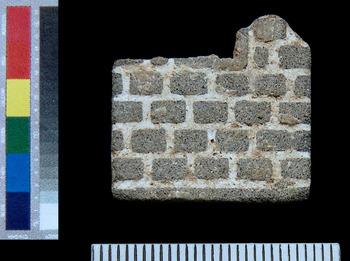
In 2007, Laura Phillips, while working on a programme of digital cataloguing and reorganisation of the reserve collections in the Bristol City Museum and Art Gallery (BCMAG henceforth) as well as on her MPhil dissertation on Minoan artefacts in the Bristol collections (Phillips Reference Phillips2009), rediscovered a number of Minoan objects. These were originally taken on loan in 1969 and then acquired in 1971 by the BCMAG, but had since been misplaced in the museum's storerooms, and had remained unnoticed, mainly because they were separated from other existing Bronze Age Greek materials, and stored in the Ancient Near East reserve collection. These items were shown to Nicoletta Momigliano, who noticed that they included an intriguing fragment of faience, reportedly from Knossos (Fig. 1), which looked remarkably similar to some of the faience plaques from the well-known Town Mosaic – a unique find from Minoan Crete, discovered during Sir Arthur Evans's excavations at Knossos at the beginning of the twentieth century (Evans Reference Evans1902–3, 14–22, and 1921, 301–14), of which examples were known to be curated in the Heraklion Museum on Crete and in the Ashmolean Museum in Oxford. This article presents this previously unknown fragment, the curious story of how it came to Bristol (as far as it can be reconstructed today) and the technological study conducted on it and on similar plaques from the Knossos Town Mosaic (now kept in the Ashmolean Museum, Oxford). This analytical work provides more evidence concerning the genuineness of the Bristol piece, and also contributes to our understanding of Minoan faience production in general.
Bristol Museum fragment BCMAG Fa62 (23 × 16 mm, maximum 21 mm high, 4.5 mm thick) showing the grey-blue ‘brick’ and white ‘mortar’ design and surface deposits of brown and translucent white material (gypsum). Copyright the British Museum.

THE BRISTOL FAIENCE PLAQUE AND THE KNOSSOS TOWN MOSAIC
The fragmentary plaque now in the BCMAG (BCMAG Inventory Number Fa62) measures 23 by 21 mm at its maximum extension, and is 4.5 mm thick. It has a grey-bluish body decorated with white inlay creating a brick-like pattern on the front side of the plaque. The fragment is closely comparable to the faience plaques from the Knossos Town Mosaic showing house facades, and is almost identical to one slightly larger piece illustrated by Evans (Reference Evans1921, fig. 226:U) and Foster (Reference Foster1979, fig. 54). This comparison shows that the white-grey pattern on the Bristol plaque most likely represents isodomic ashlar masonry, and that the piece preserves the base, lower sides and what appears to be the lower part of a window from a house facade. The Bristol fragment fits very nicely in Group 1 of Foster's classification of the Town Mosaic plaques, which comprises
… [P]ieces with ashlar and isodomic masonry. The blocks are brown, white or gray, and the joins are sealed with plaster painted buff or dark gray. This masonry seems to have been a common type of construction and occurs, for example, on the Siege Rhyton [from Mycenae Shaft Grave IV], the Thera ‘Libya’ fresco, a LM I steatite vessel from Knossos, a MM III crystal plaque from Knossos, an ivory piece from a Late Minoan I deposit in the Royal Road at Knossos, and a miniature fresco from Tylissos. The windows are either cut all the way through … or slightly hollowed and filled with red. None of the façades seems to have an entrance at ground level (Foster Reference Foster1979, 107).
The similarity between the Bristol fragment and the Knossos Town Mosaic plaques also extends to its chemical composition and other technological features, as shown by the scanning electron microscopy with energy dispersive X-ray (SEM-EDX) presented below.
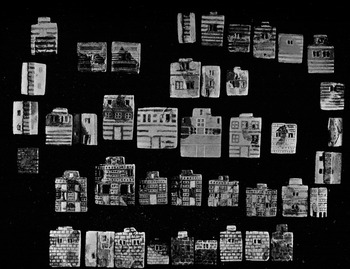
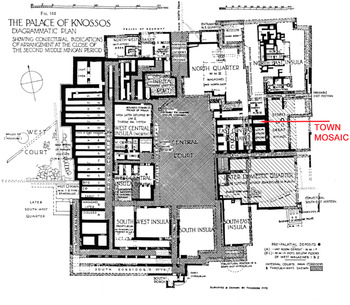
The Knossos Town Mosaic faience plaques comprise over a hundred fragments, which are kept in the Heraklion Museum on Crete and the Ashmolean Museum in Oxford. The pieces in the Ashmolean Museum (about 50) are fairly small, and were given by Evans in 1936 (one fragment) and in 1938. In addition, Dr Marina Panagiotaki (pers. comm.) has identified one small fragment in the Stratigraphical Museum at Knossos. Of these fragments, over 70 were illustrated by Evans (Reference Evans1902–3, 14–22, and Reference Evans1921, 301–14; cf. Fig. 2). They show architectural elements (mostly house facades), men, animals, trees and plants, and possibly water, which could have been inlaid into some wooden object (see also below). They were found during the 1902 excavations at Knossos in the East Wing of the Palace, and more specifically in an area dubbed by Evans the ‘East Central Enclave’, in a basement located between the North-East Portico and the Loom-weight Basement (see Fig. 3 for location; Evans Reference Evans1902–3, 14–23; Evans Reference Evans1921, 301–14; Foster Reference Foster1979, 99–115; Waterhouse Reference Waterhouse1994; MacGillivray Reference MacGillivray1998, 39–42, ‘The Enamel Deposit’; Karetsou and Fotou Reference Karetsou, Fotou, Cadogan, Hatzaki and Vasilakis2004, 589 for all the original excavation sources, such as Mackenzie's daybooks, Evans's notebooks, etc. now kept in the Evans Archive; Panagiotaki Reference Panagiotaki, Jackson and Wager2008, 39; Foster Reference Foster, Jackson and Wager2008, 177–8).
Some house facades from the Town Mosaic (after Evans Reference Evans1921, fig. 223).

Plan of Knossos showing find spot of Town Mosaic (after Evans Reference Evans1921, plan opposite p. 203, with additions).

Concerning the more specific context of discovery, from the excavation daybooks kept by Evans's assistant, Duncan Mackenzie, and from Evans's annual report published in the Annual of the British School at Athens for 1902, one can gather that the faience plaques were found in a substantial fill deposit (c.1.5 m thick) between two floors (Mackenzie Reference Mackenzie1902 vols. I and II, excavations conducted between 10 April and 12 May, and especially entries for 10–21 April; Evans Reference Evans1902–3, 14). Mackenzie's excavation daybooks indicate that the fragments were recovered over a number of weeks, and at some point the excavated soil was also sieved to recover even the smallest fragments from the deposit. The upper floor, which gives a terminus ante quem for the finds, consisted of a slab pavement upon which rested some tripod pots, later assigned to the early Neopalatial period (Middle Minoan IIIB: cf. Evans Reference Evans1921, 301–14; Popham Reference Popham1977, 192–3), while the lower floor was assigned to what is now referred to as the Old Palace period (Mackenzie Reference Mackenzie1902 vols. I and II, excavations conducted between 10 April and 12 May, and especially entries for 10–21 April; Evans Reference Evans1902–3, 23). In the first volume of his magnum opus, The Palace of Minos, Evans (Reference Evans1921, 301–14, esp. 302) argued that the Town Mosaic could be an heirloom, and date to the end of the Old Palace period, i.e. to the Middle Minoan IIB phase. Most scholars, however, now prefer a Middle Minoan IIIA or even IIIB date, because of its stratigraphic position (much higher than the floor with Protopalatial or Middle Minoan IIB vases) and associated artefacts, and also because the best comparanda for the technique employed in the faience plaques (polychrome inlay) can be found in materials that are clearly associated with Neopalatial contexts (see e.g. Waterhouse Reference Waterhouse1994; MacGillivray Reference MacGillivray1998, 42; Foster Reference Foster, Jackson and Wager2008, 177; and Panagiotaki Reference Panagiotaki, Jackson and Wager2008, 39 with further references).
While it is widely agreed that the Town Mosaic greatly contributes to our understanding of Minoan architecture (e.g. Evans Reference Evans1902–3, esp. 16 and 18; Foster Reference Foster1979, 114, with further references; Waterhouse Reference Waterhouse1994, 166–8), its overall interpretation and significance remain more controversial. Evans suggested that the plaques were part of the inlaid panels of a wooden chest, which illustrated a linked historical narrative pertaining to a military event: an expedition to Libya (because of the presence of what he regarded as dark-skinned or ‘grotesque’ figures), also involving a siege scene similar to that found on the silver Siege Rhyton from Mycenae (Evans Reference Evans1902–3, 19–22; Reference Evans1921, 301–14; cf. also Wiener Reference Wiener, Hardy, Doumas, Sakellarakis and Warren1990, 141).
The idea that the plaques were part of some kind of inlay decoration, probably attached to some wooden object(s), is generally accepted, but Evans's suggestion of a linked historical narrative on the panels, which related to a military operation, has not met with similar consensus. For example, Waterhouse (Reference Waterhouse1994, 167 ff. with further references) and other scholars reject the assumption that the scenes on the panels were necessarily connected, and dismiss many of Evans's military elements (e.g. a helmet with plume becomes a recumbent animal; bowmen disappear; the nudity of some figures is seen as suggesting a ritual rather than a warlike setting, etc.). Waterhouse and other scholars also reject the very idea that Minoan figurative art could be linked in any way to some form of historical narrative, preferring to see it, instead, largely as an adjunct to religion, illustrating religious activities and ritual performances. One may note, however, that in recent (and also not so recent) years there have been numerous attempts to link Aegean art to some kind of narrative, and even possibly to epic poetry (Morris Reference Morris1989; Laffineur Reference Laffineur, Morris and Laffineur2007; Bennet Reference Bennet, Morris and Powell1997; Sherratt Reference Sherratt2010; see also Evans Reference Evans1912).
The Bristol fragment does not provide new features that could bear on the significance and interpretation of the Knossos Town Mosaic. Its post-Bronze Age biography, however, provides some interesting facets to the history of collecting in Bristol and to the history of archaeological scholarship, as discussed below.
THE ACQUISITION OF THE FAIENCE PLAQUE BY THE BCMAG
As mentioned above, the faience fragment, together with other objects, was on loan in 1969 and subsequently acquired by the BCMAG in 1971 from a source who has asked to remain anonymous, since radical changes towards this kind of collecting have occurred in the last few decades, as shown, for example, by the publications of important works highlighting the damaging material consequences caused by the acquisition of illicit antiquities (e.g. Gill and Chippindale Reference Gill and Chippindale1993, or Renfrew Reference Renfrew1993 and Reference Renfrew2002), and by the fact that in 2002 the UK became a signatory to the 1970 UNESCO Convention on the Means of Prohibiting and Preventing the Illicit Import, Export and Transfer of Ownership of Cultural Property (Roberts Reference Roberts, Robson, Treadwell and Gosden2006).
The other objects acquired in 1971 by the BCMAG from the same anonymous source include, beside other items, a large fragment of a Neolithic ladle reportedly from Knossos; a seal stone said to be from Kamilari but regarded as a ‘gemma dubitanda’ by some specialists (John Betts, Olga Krzyszkowska, and Ingo Pini, pers. comms.); a talismanic-style seal stone said to be from Knossos (published in Onassoglou Reference Onassoglou1985, 291, no. 48, Pl. LXV, but wrongly identified in that publication as being in the collection of John Betts); a complete stone lid allegedly from Kamilari; and part of a pottery vessel with model offerings, with no provenance given other than Crete, but also, perhaps, from Kamilari.
These objects were reportedly acquired in 1962 from one of the antiques stalls in the Portobello Road market in London (anonymous source, pers. comm., letter of 27 November 2007 to Laura Phillips). They were said to be kept in paper bags, on which their provenances were listed. Although one should not necessarily trust these provenances, the finds generally match what one would expect to discover in the listed locations. It is unclear when these objects arrived in the United Kingdom, but the 1960s provide a terminus ante quem (well before the UK became a signatory to the aforementioned UNESCO Convention). The items said to be from Kamilari may have been originally from the tholos tomb excavated there by Doro Levi in in 1959 (Levi Reference Levi1962 and Reference Levi1963). One could speculate concerning what happened to the faience fragment published here between its date of discovery (probably 1902, on the likely assumption that it was part of the Knossos Town Mosaic) and its reported purchase in London in 1962. The scarcity of information, however, makes speculation fruitless, whereas the scientific analyses discussed below can link the faience piece with known finds from Knossos, and the documentation in the BCMAG can provide some more information about the subsequent history of this and the other objects acquired from the anonymous source in 1971.
This acquisition occurred when Leslie Valentine Grinsell (1907–95) was Curator of Archaeology and Ethnography, a post he held from 1952 until 1972. Grinsell's main archaeological interests were in the fields of British archaeology, Bristol coinage and Egyptology, but also extended to the Aegean Bronze Age, particularly its relationship to British prehistory. This relationship had been the subject of considerable debate, especially since the 1953 discovery, by R.J.C. Atkinson, of an alleged ‘Mycenaean type’ dagger carved on Stone 53 at Stonehenge, which had prompted some scholars to believe that the inhabitants of Bronze Age Greece were trading, intermarrying, and building monuments with the prehistoric inhabitants of south-west Britain (Cleal, Walker and Montague Reference Cleal, Walker and Montague1995). In 1961 Grinsell himself organised a display of Minoan and Mycenaean objects in the BCMAG ‘… with particular reference to the question of relations with south-western England’ (Anonymous 1961, 10), clearly a reflection of the interest sparked by this debate. The issue concerning the contacts between south-west Britain and the Aegean Bronze Age was settled, some years later, by unquestionable evidence showing that the Wessex culture predated the Mycenaeans by many hundreds of years (Renfrew Reference Renfrew1968). This, which nowadays may appear as a curious debate, forms part of the intellectual, scholarly context for Grinsell's interest in acquiring and displaying Aegean Bronze Age artefacts at the BCMAG.
Grinsell exhibited Minoan objects (including some acquired from the anonymous source) also on later occasions. One of Grinsell's achievements in the BCMAG was the creation of the South West Archaeology gallery between 1969 and 1970, with an accompanying Guide Catalogue to the South Western British Prehistoric Collections (Grinsell Reference Grinsell1968; see also Walton Reference Walton1980). This gallery included a ‘Timescale’ display along the back wall, which incorporated Minoan materials. Files in the Department of Foreign Archaeology of the BCMAG contain documents relating to the planning of this display, as well as the original display panel with accompanying labels. Some labels and card notes indicate that some objects acquired from the anonymous source were on display in October 1971, and may have been part of the Timescale display. Not long after 1971, however, these objects were misplaced, and were ‘rediscovered’ by Laura Phillips only in 2007.
TECHNOLOGICAL STUDY OF THE FAIENCE: MICROSCOPY AND ANALYSIS
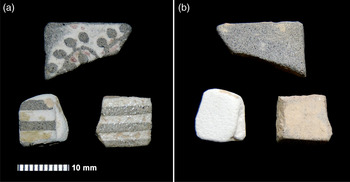
The unexpected discovery of the decorative faience fragment in the BCMAG raised the possibility of technological investigation to compare the physical and chemical characteristics of the object with three known examples of the Town Mosaic loaned by the Ashmolean Museum, in order to establish whether the Bristol fragment might be an original piece associated with the excavated Knossos mosaic. Comparing the illustration of the brick-pattern fragment (Fig. 1) with the three Ashmolean pieces (Fig. 4) shows the notable similarity of the blue-grey and white material forming the geometrical patterns.
Three examples of the Town Mosaic. (a) Front side of all objects at same scale (AM1938.863a [bottom left], 11 × 10 mm, 3.8 mm thick; AM1938.863b [top], 17 × 12 mm, tapering to 6 mm high; AM1938.863c [bottom right], 12 × 10 mm, 4 mm thick). Note the visual similarities in design and colours; (b) back side of all objects at same scale. Note the oatmeal-coloured clay-type deposits on the grey-blue AM1938.863.a, c and Bristol pieces. AM1938.863a has a white body. Copyright the British Museum.

Two complementary non-invasive techniques were used to study the objects. Optical microscopy was undertaken to examine (i) the physical form of the coloured patterned areas, (ii) the inlaying technique, and (iii) the particle colours, size and distribution. The objects were further examined by variable pressure scanning electron microscopy with associated energy dispersive X-ray analysis (SEM-EDX) for detailed imaging and chemical analysis (for a more detailed discussion of the scientific analyses and results see Spataro et al. Reference Spataro, Meeks, Meek and Shapland2013). The overall technological findings were compared to publications of microscopy and analyses of faience (e.g. Tite et al. Reference Tite, Maniatis, Kavoussanaki, Panagiotaki, Shortland and Kirk2009).
Optical microscopy
The Bristol fragment (BCMAG Fa62)
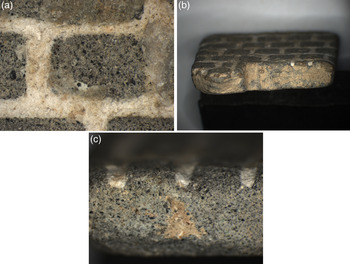
The Bristol fragment has a grey-blue body, the front featuring a regular grey-blue brickwork pattern, defined by white lines of inlaid faience (Fig. 1, detail Fig. 5a ), similar to examples illustrated in Foster Reference Foster1979, pl. 27. Tiny dark translucent grains uniformly distributed within a lighter grey-blue matrix of finer particles give the grey-blue ‘bricks’ a speckled appearance (Fig. 5a ). Seen end-on, the white inlay grooves are c.0.8 mm deep (Fig. 5b, c ). Other illustrations of Town Mosaic fragments show light-colour ‘bricks’ and dark ‘mortar’ (e.g. Evans Reference Evans1921, fig. 223).
Bristol Museum fragment BCMAG Fa62. (a) Optical detail. The white lines representing ‘mortar’ between the bricks are quite dirty and have a brownish colour and a semi-translucent whitish surface deposit (gypsum). Note the dark grains in the ‘bricks’. Width of the object area in image is 6 mm; (b), (c) edge-on showing white lines inlaid into blue-grey body. Width of object, 23 mm. Grooves with white faience are c.0.8 mm deep. Copyright the British Museum.

On one of the grey-blue bricks, there are a few green crystalline deposits that could be a corrosion product of copper (M. Tite pers. comm.), and a few other translucent white and discoloured calcareous accretions (Fig. 5a ). Very few remnants of residual glaze were seen. The back of the fragment is, overall, the same grey-blue colour as the front bricks, but with a thin oatmeal-coloured surface deposit, which may be the fine clay or mortar used to secure the mosaic piece to the original location. There is a similar deposit on the back of Ashmolean piece AM1938.863c (Fig. 4b ).
The vertical sides and the base appear to be undamaged original edges, whereas the top appears to be broken along the window-sill line.
The fragments from the Ashmolean Museum
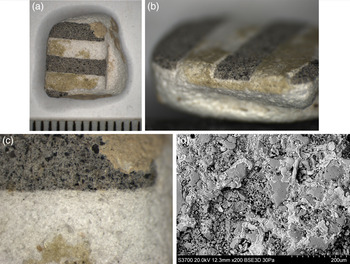
Object AM1938.863a has a white body and two grey-blue inlaid stripes, each about 2 mm wide (Fig. 4a, b and Fig. 6a, b ). The grey-blue stripes have a speckled appearance similar to the bricks in the Bristol piece, which is also caused by the uniform distribution of tiny dark grains within a lighter matrix. The grain size distribution is similar in the grey-blue and white faience (Fig. 6c ). The white areas are partly covered with a greenish-brown coloured material that extends around the sides of the piece (Fig. 6a, b ). This may be the weathered remnants of an original glaze over the white areas, identified by SEM-EDX (detail Fig. 6d ). The back of the fragment is white and fairly clean, with no surface deposits (Fig. 4b ). Seen end-on, the grooves containing the grey-blue-coloured inlay are c.0.5 mm deep (Fig. 6b ).
Ashmolean fragment AM1938.863a. (a), (b) showing greenish-brown residual weathered glaze on the white stripes. The grey-blue stripes are c.2 mm wide. Width of the object in (a) is 10 mm; (c) front detail (top right area of object) showing a fine distribution of tiny grey-blue angular crystals with a uniform distribution of darker angular crystals. Note the same particle size distribution of the angular translucent white crystals in the body of the fragment, and a post-depositional oatmeal-coloured clay-rich surface deposit top right. Width of object in image area is 3.5 mm; (d) SEM detail of weathered glaze on white region. Copyright the British Museum.

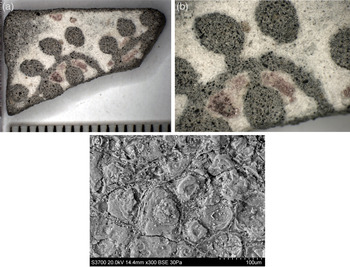
Object AM1938.863b is irregularly shaped, and is probably part of a larger piece (Fig. 4a, b ). It has a grey-blue body and white inlay that outlines a pattern which may represent rounded fruits growing on stems – possibly olives or grapes (Fig. 7a, b ). There are a few small areas of red-purple coloured glaze on the white surface, which appears to be highly weathered when seen in the SEM (Fig. 7c ) (Newton and Davison Reference Newton and Davison1989; Tite et al. Reference Tite, Maniatis, Kavoussanaki, Panagiotaki, Shortland and Kirk2009). The edges and back are grey-blue, but with some evidence of a fine oatmeal colour surface deposit of clay-like material similar to that found on the other objects (Fig. 4b ).
Ashmolean fragment AM1938.863b. (a), (b) showing the decorative pattern of white inlaid faience on the grey-blue matrix and weathered purple-red glaze on some white areas. Width of object in (a) 17 mm; (c) SEM detail showing the characteristic weathered nature of the glaze. Copyright the British Museum.

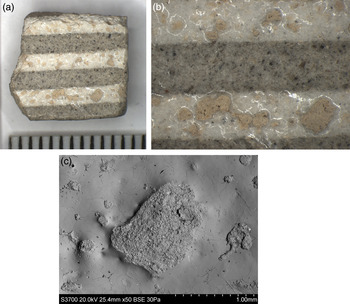
Object AM1938.863c is another small striped piece, of similar appearance to AM1938.863a (Fig. 4a, b , Fig. 8a ). In this case the body of this object is grey-blue with three white stripes filling the grooves in the grey-blue body (c.2 mm wide), essentially the opposite of AM1938.863a. This is the only object that has a fairly thick colourless glaze on the front surface and one edge that protects the underlying grey-blue and white stripes (Fig. 8a, b ). There are several small areas where the clear glaze does not cover the whole of the front surface, leaving small unglazed dips which are now filled with an oatmeal-coloured clay-like material which is also seen on the sides and back, and on the other pieces (Fig. 8b and SEM detail Fig. 8c ).
Ashmolean object AM 1938.863c. (a), (b) showing the clear glazed surface. Note the unglazed regions, where the glaze did not flow, which have an oatmeal-coloured post-depositional clay-rich deposit. Note also that the grey body stripes below the glaze show the same particle distribution with dark crystals as the unglazed fragments. Width of object 12 mm. The grey-blue stripe shown in (b) is c.2 mm wide; (c) SEM detail of smooth glaze, but incomplete flow leaves dip in the surface with an oatmeal-coloured clay deposit. Copyright the British Museum.

SEM-EDX analysis
The four samples were analysed using a Hitachi S-3700N Variable Pressure scanning electron microscope equipped with energy dispersive X-ray analysis (SEM-EDX; Fig. 9a–d ). Analyses were carried out on each sample at various magnifications (between 21 and 100×, covering areas of between c.6 × 4.5 mm and 1.3 × 1 mm; Spataro et al. Reference Spataro, Meeks, Meek and Shapland2013, table 1) using Oxford INCA system software. Twelve elements (Na, Mg, Al, Si, K, P, S, Ca, Ti, Mn, Fe and Cu) were quantified and the results were converted into oxide percentages. These percentages are normalised (oxygen by stoichiometry) to take into account the fact that oxygen and carbon are not measured (for details see Spataro Reference Spataro2011). The set-up used resulted in detection limits of approximately 0.1% for most oxides measured.
SEM details. (a), Bristol white stripe; (b), AM1938.863.b white area; (c), (d), AM1938.863a white area and grey-blue areas respectively. Note the similarity between grain sizes of different objects and colours. Essentially the same crushed quartz starting material was used for the faience. Copyright the British Museum.

Body and paste
The different coloured faience areas, white and grey-blue (body and paste) were examined. In addition, the raised grey-blue patterned areas of object AM1938.863b and the oatmeal-coloured deposits in 1938.863c were also analysed (see Spataro et al. Reference Spataro, Meeks, Meek and Shapland2013, table 2 for analytical details).
The analysis of the grey-blue body of object BCMAG Fa62 shows that it is composed mainly of silica (SiO2, c.90%), with some alumina (Al2O3), magnesium oxide (MgO), iron oxide (FeO) and copper oxide (CuO). There are also high proportions of calcium oxide (CaO) and sulphur (S), but these are likely to represent calcium sulphate (probably gypsum), which may be a post-depositional accretion or degradation-related.
To compensate, the results have also been recalculated and normalised with CaO and SO3 removed. The removal of the gypsum contribution highlights the similarities between the chemical composition of the grey-blue areas of the Bristol and Ashmolean samples. The white inlay paste appears to be purer silica, containing lower proportions of other oxides than the grey areas (Spataro et al. Reference Spataro, Meeks, Meek and Shapland2013).
The grey-blue areas of AM1938.863a also have a high silica content, some calcium oxide, alumina, iron and copper oxides. The white body contains almost exclusively silica with less than 1% calcium oxide and very low iron and copper oxides. There are a few areas of what appears to be a weathered green glaze on the surface, discussed further below.
The grey-blue body of AM1938.863b has very high silica, some calcium and iron oxides, relatively low alumina, copper, sodium and magnesium oxide contents. The white faience has very high silica content, low calcium oxide (<1%) and traces of alumina and iron oxide, and possibly sodium, magnesium and copper oxides (close to the detection limits).
In sample AM1938.863c, the grey-blue body and the white paste stripes were analysed on an unglazed edge. The grey body has high silica, calcium and iron oxide contents, some alumina, potassium oxide and traces of copper oxide. The colour of the grey-blue body suggested that more copper oxide would be present. The low level of copper oxide in the analyses may be due to surface alteration caused by weathering (Tite et al. Reference Tite, Maniatis, Kavoussanaki, Panagiotaki, Shortland and Kirk2009). The white paste stripe has higher silica content, and lower alumina, calcium and iron oxide contents. The analyses of the light-brown post-depositional clay-like material infilling areas where the glaze does not cover the surface indicate the presence of silica, some alumina, and very high calcium (c.29%) levels.
The SEM-EDX results show that the Bristol fragment is microscopically and chemically similar to the three Ashmolean objects from the Town Mosaic. Furthermore, all the chemical results are within the range obtained by Tite et al. (Reference Tite, Maniatis, Kavoussanaki, Panagiotaki, Shortland and Kirk2009) on seven Minoan faience samples from Phaestos and Knossos (for details see Spataro et al. Reference Spataro, Meeks, Meek and Shapland2013).
Glazes
Ancient faience objects have a layered structure consisting of a surface glaze and a partially fused granular quartz-rich body with an interaction layer. Like many other ancient faience objects, the Bristol Museum piece is heavily weathered and has lost much of its surface glaze layer. However, observation using the SEM in backscattered imaging mode revealed some areas of interstitial glass within the semi-fused quartz-rich body and remnants of the surface glaze. The surface of the Bristol piece is unlike that of Ashmolean object AM1938.863c, which is far less weathered and still exhibits a large amount of surface glaze (compare Fig. 8c and Fig. 9a ).
Two of the Ashmolean objects (AM1938.863a and b) have areas of decoration that show evidence of residual glaze. In the case of AM1938.863a, these areas are stripes, of which the white surface of the faience core now appears greenish-brown (see Fig. 6a and b ). The high copper contents of these stripes, reported in Spataro et al. Reference Spataro, Meeks, Meek and Shapland2013, 916, suggest that they were originally green and that the weathering process has led to their current coloration. Object AM1938.863b has a blue-grey core and some areas of red-purple surface glaze, which overlie a white faience surface layer (see Fig. 7a and b ). As discussed in Spataro et al. Reference Spataro, Meeks, Meek and Shapland2013, 920, copper and iron were found to be present in this red-purple surface decoration. Based on previous analyses, the colorant used seems likely to be iron in the form of hematite, as copper has never been found as a red colorant in Minoan or Ancient Egyptian faience (see Tite et al. Reference Tite, Maniatis, Kavoussanaki, Panagiotaki, Shortland and Kirk2009, 370; Kaczmarczyk and Hedges Reference Kaczmarcyzk and Hedges1983, 169).
CONCLUSION
The microscopic examination and SEM-EDX analyses of the Bristol and Ashmolean samples show that the sample BCMAG Fa62 is similar to those from the Ashmolean, and in particular to sample AM1938.863c (see Spataro et al. Reference Spataro, Meeks, Meek and Shapland2013 for further analytical details). The optical and chemical similarity of these fragments and with those of the published work by Tite et al. (Reference Tite, Maniatis, Kavoussanaki, Panagiotaki, Shortland and Kirk2009) reinforces the suggestion, based on stylistic comparison, that the Bristol faience was originally part of the Knossos Town Mosaic excavated by Evans in 1902. This conclusion is also based on the fact that, so far, no finds of this particular type have been recovered from any other Aegean sites or, indeed, from other areas of Knossos.
The Bristol fragment does not present features that can add to our knowledge of the Knossos Town Mosaic, or of Minoan archaeology more generally. Nevertheless, its subsequent biography provides some insights into the history of collection of Aegean Bronze Age artefacts in Britain, and its relationship to the history of archaeology. In particular, its 1971 acquisition by the BCMAG, together with other Minoan artefacts, is indicative of the eclectic archaeological interests of the BCMAG's then Curator of Archaeology and Ethnography (L.V. Grinsell), and especially of his interest in the relationship between British and Aegean Bronze Age cultures, which had been the subject of considerable archaeological debate at the time.
ACKNOWLEDGEMENTS
We would like to thank Lesley Fitton and Andrew Shapland (British Museum), Mavis Bimson (British Museum), Ian Freestone (University College London, Institute of Archaeology), Andrew Middleton (British Museum), Mike Tite (Oxford University), and Marina Panagiotaki (University of Rhodes) for their valuable comments. We are also very grateful to Amber Druce and Sue Giles of the Bristol City Museum and Art Gallery, and to the Ashmolean Museum, in particular to Ioannis Galanakis and Mark Norman, who generously loaned three fragments of the Town Mosaic for comparison. Last but not least, we would like to thank the late Chris Mee (who was one of our referees, but waived his anonymity) for his help, and we wish to dedicate this article to his memory. He is much missed.