Introduction
Europeanization bears potentially important implications for European Union (EU) member states. Yet, while political scientists have said much about the domestic consequences of European integration in the areas of policy, politics, and political structures and institutions (polities), we know less about its national legal-constitutional consequences. Given the importance of European legal integration, this would seem a particularly important avenue of inquiry. Insofar as European law is absorbed into national legal arenas, we may witness important domestic institutional and constitutional consequences that are obscured by a narrowly political focus.
We address ourselves to the Europeanization of judicial discourses in the UK, and specifically within English courts. Building an original dataset of national case law, we test two models of the infiltration of external legal concepts into the domestic legal system. A first, ‘statist’ model emphasizes a process of legal infiltration that is consciously controlled by state actors. It suggests that European law will enter domestic judicial discourses in politically-predicted and -limited ways. A second, ‘indigenization’ model posits that domestic judicial discourses will invoke alien legal concepts in excess of this baseline, in unforeseen and potentially uncontrolled and constitutionally important ways. While of great theoretical interest, this issue also has potentially important consequences for domestic legal and constitutional orders.
The paper proceeds in four parts after this introduction. The second part frames the issue of ‘legal Europeanization’ and sets forth the alternative models along with their empirical implications. The third part introduces our research design and characterizes the data to be used in our empirical analysis. This analysis is undertaken in the fourth part, focusing on invocation in English courts of the EU law principles of purposive construction, proportionality, and legitimate expectations. The fifth part summarizes the findings, identifies their implications, and identifies avenues for future research. Our broadest conclusion is that European law has been indigenized into domestic law in ways neither foreseen nor controlled by state actors, with potentially profound consequences for domestic constitutional orders.
Europeanization and judicial discourses
Political science research on Europeanization has taken off in the last decade (see, generally, Featherstone and Radaelli, Reference Featherstone and Radaelli2003). In addition to general conceptual work (e.g., Harmsen and Wilson, Reference Harmsen and Wilson2000; Olsen, Reference Olsen2002), Graziano and Vink (Reference Graziano and Vink2007) identify three main strands in a burgeoning corpus of research. Because the literature has become so voluminous, we can do little more than give examples of work in each category.
The Europeanization of policies gave rise to some of the earliest work in the genre (Andersen and Eliassen, Reference Andersen and Eliassen1993), and has continued to generate a steady stream of insights into just about every issue area imaginable, including education (Bache, Reference Bache2006), environmental policy (Knill and Lenschow, Reference Knill and Lenschow2001; Börzel, Reference Börzel2002; Jordan and Liefferink, Reference Jordan and Liefferink2004), refugee policies (Lavenex, Reference Lavenex2001), and citizenship policies (Checkel, Reference Checkel2001; Vink, Reference Vink2001). The Europeanization of politics (see, generally, Goetz and Hix, Reference Goetz and Hix2001) has been similarly broad-ranging, covering, for example, work on interest groups (Warleigh, Reference Warleigh2001), the media (Semetko et al., Reference Semetko, de Vreese and Peter2001; Meyer, Reference Meyer2005), and political parties (Cole, Reference Cole2001; Mair Reference Mair2001, Reference Mair2007; Ladrech, Reference Ladrech2002; Pennings, Reference Pennings2006). The third strand, focusing on the Europeanization of polities, especially interests us. In addition to general work on domestic structural change (Cowles et al., Reference Cowles, Caporaso and Risse2001) and on democratic institutions (Anderson, Reference Anderson2002), it has most frequently focused on the transformation of core executives (Goetz, Reference Goetz2001), legislatures, and parliamentary democracy (Raunio and Hix, Reference Raunio and Hix2001; Auel, Reference Auel2005 (and contributions to the same volume)), and public administrations (Lægreid et al., Reference Lægreid, Steinthorsson and Thorhallsson2004).
With some exceptions (Conant, Reference Conant2001; Nyikos, Reference Nyikos2007), little of the political science work on Europeanization focuses on domestic law, courts, and constitutions. Law and courts are most widely studied, instead, in the context of the EU’s own ‘constitutionalization’, whereby it has been transformed from a compact among sovereign states to a vertically integrated legal order conferring rights on individuals (Stone Sweet, Reference Stone Sweet2004). In this vein, scholars have focused on variations among national courts in willingness to refer cases to the European Court of Justice (ECJ) (Golub, Reference Golub1996; Stone Sweet and Brunell, Reference Stone Sweet and Caporaso1998; Stone Sweet and Caporaso, 1998; Conant, Reference Conant2002; Carrubba and Murrah, Reference Carrubba and Murrah2005); on their interactions with the ECJ, litigants, lawyers, and other courts in their own judicial hierarchies (Burley and Mattli, Reference Burley and Mattli1993; Mattli and Slaughter Reference Slaughter1995, Reference Mattli and Slaughter1998; Alter, Reference Alter1996); and on acceptance (especially by national high courts) of key EU law doctrines (Weiler, Reference Weiler1994; Slaughter et al., Reference Slaughter, Stone Sweet and Weiler1998; Alter, Reference Alter2001). In brief, most studies that include domestic courts ‘focus … on the impact of adjudicating EC law on the institutional evolution of the EU, rather than on the impact of EU law on (or the Europeanization of) national legal systems’ (Stone Sweet, Reference Stone Sweet2004: 23, emphasis in original).
We build from this literature precisely by focusing on the proposition, frequently identified by legal scholars, that European legal integration can implicate domestic courts and judges. Specifically, we consider changes to English judicial discourses wrought, in the first instance, by the courts’ exposure to alien legal concepts emanating from a EU which itself is in the midst of a process of judicialization. This focus on law and courts separates us from most recent work on Europeanization of policies, politics, and polity in the UK (Rosamond, Reference Rosamond2003; Blair, Reference Blair2004; Bulmer and Burch, Reference Bulmer and Burch2005; Bache and Jordan, Reference Bache and Jordan2006; Rosamond and Wincott, Reference Rosamond and Wincott2006; Schmidt, Reference Schmidt2006). Our focus on general patterns in the concrete judicial discourses surrounding quotidian (i.e., not ‘history-making’) but alien legal principles builds on complementary work in the legal literature which, with the rare exception (Chalmers, Reference Chalmers2001), tends to focus on handfuls of (usually) ‘history-making’ cases (Levitsky, Reference Levitsky1994; Snyder, Reference Snyder2000). Everyday judicial discourses surrounding alien legal principles represent novel terrain on which to take the measure of the penetration of domestic legal systems by European law, and from there, to gain leverage on the politics of legal integration.
Alternative models
What theoretical priors should guide an inquiry into the impact of Europe on domestic judicial discourses? Though there is little political science work on this particular topic, we outline two alternative models, which we identify as ‘statist’ and ‘indigenization’ models.
We term our first model statist because it emphasizes the role of a hierarchically organized state, especially the executive, serving as a potential gatekeeper that shapes what is ‘imported’ into domestic politics (Moravcsik, Reference Moravcsik1994). In this model, external legal activity may be important for domestic polities, but this activity does not flow into domestic arrangements independently of political intent. A statist model would trace domestic judicial discourses surrounding alien EU legal principles to original interstate bargains and ongoing, if implicit, government control. We derive it by analogy to Stephen Krasner’s pathbreaking work on Westphalian sovereignty. Krasner (Reference Krasner1993, Reference Krasner1995–96, Reference Krasner1999, Reference Krasner2001) conceptualizes sovereignty as a system of ‘organized hypocrisy’ in which clear norms exist but in which these norms are regularly compromised for reasons of state. Specifically, he argues that states can, and often do, rationally choose to violate Westphalian norms, for example, by ‘inviting in’ authoritative external (e.g., EU) law. This argument can accommodate many existing claims about European legal integration and domestic law: member states have entered into a contract in which they exchange the benefits of EU membership for some ‘compromise of Westphalia’, and in particular submission in well-defined areas to the supremacy, direct effect and other attributes of European law. European legal integration, then, represents merely another rationally chosen, consciously undertaken, and fundamentally political compromise in a long string, traceable back to Westphalia itself.
This approach suggests that we should see domestic judicial discourses reflecting external law concepts to the extent that these have been ‘invited into’ the domestic system by acts of state. In the case of the UK and European law, English courts should invoke EU law to the extent foreseen and agreed to by the Parliament in the 1972 European Communities Act, enshrining Community membership into the domestic legal order. Specifically, it was well understood at the time of British accession that membership would bring domestic courts into dialogue with European law through the ‘preliminary reference’ procedure (article 234 of the present treaty), whereby lower courts may and higher courts must refer unresolved questions of European law to the European Court of Justice in Luxembourg. This leads to the statist hypothesis that domestic judicial discourses should be highly, consistently and uniquely correlated with direct importations of EU law in the form of preliminary references to the ECJ. This approach can easily account for many existing observations about the take-up of EU law by domestic courts. The preponderant focus of the literature is on doctrines such as direct effect and supremacy handed down in accordance with, and as foreseen by, the preliminary reference procedure. According to this statist account, these and other European law doctrines penetrate domestic legal orders (and judicial discourses) only by virtue of a treaty which sovereign states have signed, and only to the extent foreseen in that treaty. Of course, state actors cannot anticipate the precise level of demand for preliminary reference procedures. Nevertheless, this should represent an empirical baseline, and work seeking to demonstrate deeper effects needs to identify changes that go above and beyond those anticipated by it.
An alternative account can be labeled the ‘indigenization’ model and is related to work by legal scholars on ‘transjudicial dialogues’ (Slaughter, Reference Slaughter1994, Reference Slaughter1995; Black and Epstein, Reference Black and Epstein2007) and ‘cross-fertilization’ (Anthony, Reference Anthony1998, Reference Anthony1999, Reference Anthony2002; Slaughter, Reference Slaughter2003). In this account, a first stage of legal Europeanization sees domestic courts embracing changes in areas touched directly by EU law. This is consistent with statism, which can fully account for the domestic judicial take-up of ‘historic’ doctrines such as supremacy and direct effect and for the invocation of a variety of other EU law concepts in areas recognizably and, at the time of accession, foreseeably implicated in European law. In a second step, however, indigenization departs from statism. Here, domestic courts (and, presumably, other members of the discursive community, such as litigants and lawyers) borrow from their experience with EU law in its domain and indigenize it through conscious or unconscious application into otherwise purely domestic areas of law. This temporal sequence suggests an indigenization hypothesis, whereby domestic judicial discourses should initially be correlated with direct importations of EU law in the form of preliminary references to the ECJ but should, over time, increasingly exceed this baseline. While the precise mechanisms of indigenization cannot be observed here, we can imagine that lawyers and judges increasingly read what others are writing in their judgments, as well as ECJ judgments themselves. We expect a diffusion of legal ideas that goes slowly at first, then accelerates as a critical mass is achieved. The indigenization account implies a deeper, less politically controlled, and possibly more enduring penetration of domestic judicial discourses by EU law concepts than expected by the statist hypothesis.
Summary and testable implications
We focus on legal Europeanization and think about it in terms of the domestic judicial-discursive consequences of European legal integration. We identify and, in the next section, will test, two models of this relationship. A statist model sees a relatively circumscribed penetration based on the foreseeable implications of Community membership and bounded in areas directly touched by EC law. An indigenization model, by contrast, anticipates the spill-over of ‘European’ law concepts into the (otherwise) domestic sphere, and the gradual decoupling of domestic judicial discourses from direct importations via preliminary rulings. These two accounts generate partially distinct observable implications. While the statist account would expect judicial discourses around alien law concepts to correlate directly, consistently, and uniquely with importations (via preliminary references) from the ECJ in Luxembourg, the indigenization approach implies that discourses surrounding foreign legal concepts will also reflect autonomous (domestic) usage and will decouple over time from direct importations. In the following section, we set up an empirical analysis aimed at testing these implications.
Research design and dataset
In order to test the observable implications of the statist and indigenization hypotheses, we focus on English (and Welsh) judicial discourses surrounding legal concepts that are alien to the domestic legal tradition and native to the European one. By discourses we have in mind ‘speech acts’ seen in the arguments before, and decisions of, judges and Courts. We follow Rosamond and Wincott (Reference Rosamond and Wincott2006) in suggesting that such discourses are particularly fruitful in understanding some of the deepest changes potentially wrought by Europeanization. We focus on cases originating in English courts, to the exclusion of their Scottish and Northern Irish counterparts, in order to generate the cleanest possible look at the data against the sharpest possible baseline.Footnote 1 In describing our research design, we begin by identifying the alien and external legal concepts that form our core focus. In the subsequent section we describe our data and measurement strategy.
Legal Concepts
Our research strategy is to start from a source that is both authoritative and theoretically disinterested (with respect to our questions) and to let it identify for us some of the relevant empirical terrain. We thus follow Usher (Reference Usher1991) in focusing on three specific legal concepts that are both European in origin and substantially alien to the English legal tradition: purposive interpretation/construction,Footnote 2 proportionality, and legitimate expectations. Let us briefly characterize each principle.
Purposive Interpretation. In the British legal tradition, it is the duty of courts to interpret the plain meaning of black-letter statutory language. Little room exists to go beyond the text by interpreting statutes in light of their purpose or effects, for to do so would be to risk judicial lawmaking rather than mere interpretation of the dicta of the sovereign parliament (Bridge, Reference Bridge1981). We characterize this traditional judicial method as one of literal interpretation. By contrast, the EU legal tradition often involves interpreting statutes in light of the goals that they pursue (Rensen, Reference Rensen1993). This can involve mere teleology (adjudication in service of legislative intent) or the more expansive method of instantiating the ‘spirit of the law’.Footnote 3 In either case, EU law invites judges to move beyond black-letter language and toward an interpretive style that can be characterized as purposive interpretation.
Proportionality. The proportionality principle is a second European (originally German) legal concept that is substantially alien to the English legal tradition (Levitsky, Reference Levitsky1994: 376–378; Craig, Reference Craig1999; Green, Reference Green1999; Thomas, Reference Thomas2000: 77–100; Wong, Reference Wong2000; Schwartze, Reference Schwartze2000: 167; cf. Hoffmann, Reference Hoffmann1998, Reference Hoffmann1999a, Reference Hoffmannb). It establishes that public actions can only impinge on rights and liberties to the extent necessary to achieve other legitimate public aims, and asks judges to weigh the various issues and interests at stake in assessing the validity of public action. In contrast, English law traditionally allows for three standards by which administrative action can be reviewed: procedural propriety, legality, and rationality (de Burca, Reference de Burca1997). For present purposes, this last is the most important. According to the so-called ‘Wednesbury unreasonableness’ standard, an English court can only impugn a decision that is ‘so outrageous in its defiance of logic or of accepted moral standards that no sensible person who had applied his mind to the question could have arrived at it’.Footnote 4 This represents an extremely loose standard, what Shapiro (Reference Shapiro2002: 189) refers to as a ‘lunacy test’. In contrast, the EU law principle of proportionality eases the task of scrutinizing administrative behavior, insofar as it involves not a singular determination of reasonableness – which is likely to be upheld -- but a mere balancing of the respective interests of public authorities and affected third parties (Anthony, Reference Anthony1999: 424; Anthony, Reference Anthony2000: 95). Some ‘reasonable’ actions might still be thrown out by courts by virtue of disproportionality. For these reasons, at least one judge characterized proportionality (though not by name, and not in reference to Europe) as a ‘novel and dangerous doctrine’ with respect to English law.Footnote 5
Legitimate Expectations. This well-established principle of European law implies that circumstances exist in which individuals can justifiably hold expectations that, though not quite enjoying the status of rights, could nonetheless enjoy legal protection. The principle of legitimate expectations thus confers on individuals a basis on which to challenge administrative actions, even where they act in furtherance of parliamentary statutes and satisfy other standards of review. This concept has no real corollary in English law (Levitsky, Reference Levitsky1994: 375–376; Craig and Schønberg, Reference Craig and Schønberg2000; Schønberg, Reference Schønberg2000). In the words of one eminent observer, the idea of legitimate expectations represents ‘a novelty in English law and lacks discernible English parentage. To find the true ancestry one does not have to look far across the Channel’ (Stuart, Reference Stuart1987: 417).
Measurement Strategy
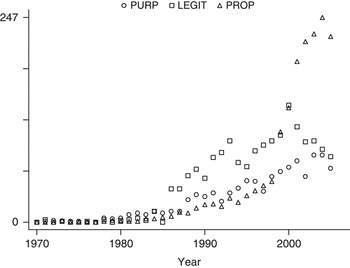
We coded data drawn from the Lexis-Nexis Academic ‘UK Cases, Combined Courts’ database. The database contains full-text of almost all reported cases and large numbers of unreported ones (currently numbering over 200 000) decided at all levels of the British judicial hierarchy. Some minor unreported cases are not included, but any resulting bias will tend to understate European influence (Chalmers, Reference Chalmers2001: 171–173). We use event counts to tally the invocation of these three concepts. Using text searches in Lexis-Nexis, we downloaded information on every English case reported between 1970 and 2005 that included the natural-language term ‘proportionality’ (N = 1704) or the term ‘legitimate expectations’ (N = 1685), or either of the terms ‘purposive construction’ or ‘purposive interpretation’ (N = 1000). The total event count is 4389.Footnote 6 Since we are interested in trends over time, we aggregate these observations to produce annual counts of the appearance (by judgment date) of each concept for the 1970–2005 period, which covers the time just prior to British accession and the history of its membership through the last year for which complete data were available at the time of coding.Footnote 7Figure 1 maps the 1970–2005 event trends for each concept.
Invocations of Three EU Law Concepts in British Courts, 1970–2005. PURP = purposive construction/purposive interpretation, LEGIT = legitimate expectations, PROP = proportionality.

We hasten to note that we do not code acceptance, rejection, transformation or any other substantive aspect of the invocation of these European law doctrines within the English courts. Such analysis may become important to research moving forward. Our aim is the more preliminary one of mapping their appearance inside domestic judicial discourses, precisely to test alternative general expectations about change over time. By beginning with this relatively objective and arguably conservative indicator,Footnote 8 we hope to invite further inquiry into the more specific dynamics and consequences of legal Europeanization.
European concepts and english judicial discourses
To reiterate, we identify two alternative hypotheses about the relationship between European law and domestic judicial discourses. The statist hypothesis states that domestic judicial discourses should be highly and consistently correlated with direct importations of EU law in the form of preliminary references to the ECJ. The indigenization hypothesis states that domestic judicial discourses should initially be correlated with direct importations of EU law in the form of preliminary references to the ECJ but should, over time, increasingly depart from and exceed this baseline. We use two empirical strategies to test these alternatives. First we use ordinary-least squares (OLS) regression analysis to test the relative explanatory power of these two claims about the appearance of the three European law concepts in English judicial discourses. Second, we examine, more closely, the temporal relationship between direct importations of European law and domestic usage, identifying and interpreting trends and discontinuities in each time series.
OLS model specification and results
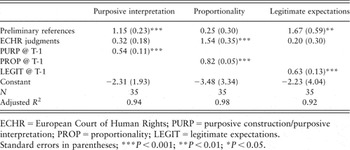
We estimate three OLS regressions, one for each of the three concepts that we consider.Footnote 9 The dependent variable is the number of times that each concept appeared in each year of the dataset. We code the statist predictors as annual UK preliminary references under article 234 of the EC treaty (European Court of Justice, 2006, table 17). It was well understood and accepted at the time of British accession to the Community that such importations would occur – they constituted part of the bargain surrounding membership. For indigenization, we use a lagged dependent variable, that is, the year-prior count for the concept in question. When controlling for direct importations (preliminary references), this captures the domestic content of judicial discourses. In order to isolate the true EU effects that form the core of our analysis, we also include a control variable for the number of European Court of Human Rights (ECHR) judgments directed to the UK in every given year (European Court of Human Rights, 2008). We have no strong priors on this variable, but include it to account for the UK’s involvement in a second well-developed European legal system.
Table 1 reports the results of these analyses.
Ordinary-least squares regression results

ECHR = European Court of Human Rights; PURP = purposive construction/purposive interpretation; PROP = proportionality; LEGIT = legitimate expectations.
Standard errors in parentheses; ***P < 0.001; **P < 0.01; *P < 0.05.
All three models – that is, models for each of the three concepts that we consider – have high explanatory power, accounting for over 90% of the variance in the dependent variable. This is not surprising, given the presence of a lagged dependent variable in the equations. The statist covariate, preliminary references, is significant in two of the three models (purposive interpretation and legitimate expectations) but insignificant for proportionality. ECHR judgments, by contrast, significantly predict proportionality but neither of the other two concepts. Proportionality thus seems to differ from the other two concepts in terms of the external sources by which it is transmitted into English courts. At the same time, though, a true reading of the statist model demands that there be no time-dependence in the appearance of these concepts that operates distinctly from their direct importation. The consistent significance of the lagged dependent variables across the three models disconfirms this expectation of statism while confirming a key prediction of the indigenization hypothesis. English judicial discourses surrounding previously alien legal concepts appear to enjoy a ‘life of their own’, independent of direct importation from the Continent.
Temporal Processes
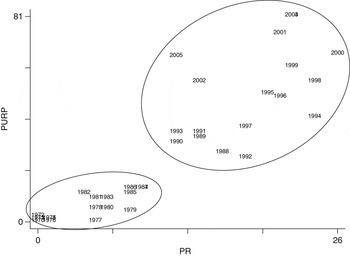
The two theoretical accounts also generate divergent expectations about temporal processes. Statism implies that the take-up of external concepts will relate to direct importation consistently over time. Indigenization, by contrast, implies that domestic usage will decouple from direct importation as English judges, lawyers, and litigants ‘domesticate’ previously alien concepts. To scrutinize these claims, we generated simple scatterplots for each concept, relating them to preliminary references to the ECJ. We begin with purposive interpretation, as displayed in Figure 2.
Twoway Scatterplot: Purposive Interpretation and Preliminary References.

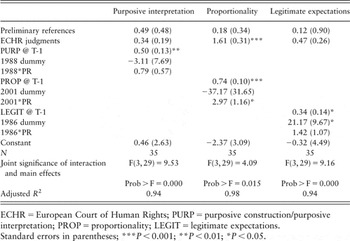
The scatterplot immediately reveals the sort of temporal pattern denied by the statist account and emphasized by the indigenization hypothesis. We have circled the clusters that reveal themselves through visual inspection. Of note is that, for purposive interpretation, there appears to be a structural break around 1988. All of the observations clustered in the lower left date before that year. All of those clustered toward the upper right date from 1988 and later. We induced from this observation a ‘structural break’, or a decoupling of domestic judicial discourses from direct European imports, at 1988, and re-ran our regressions using this information. (We produce the results for all three concepts in Table 2, in the Appendix.) The effect of this decoupling is thus easily quantifiable: while the pre-1988 observations show a slope on preliminary references of 0.49 (i.e., every preliminary reference to the ECJ generates about half of an invocation to purposive interpretation), for the latter period the transformation function (slope) increases to 1.28.
Doctrinal analysis supplies at least part of the explanation for this shift in the role of purposive interpretation in English judicial discourses (see Usher, Reference Usher2005: 495–498). Recall that literal interpretation formed the traditional approach of English courts to statutory construction. With entry into the European Communities, English courts were authorized in the realm of European law and in interpreting ambiguous statutory language to construe domestic law as if it were consistent with European law. The House of Lords extended this to unambiguous statutory language in its 1989 judgment in Pickstone vs. Freemans,Footnote 10 a move that was endorsed in numerous subsequent cases (Rensen, Reference Rensen1993).Footnote 11Pickstone also smashed a second interpretive canon insofar as the Lords referred extensively to the House of Commons published debates (Hansard) in ascertaining the purpose of the statute.Footnote 12 In traditional English judicial practice, such use of anything outside the ‘four corners’ (i.e., plain words) of the statute was forbidden. The change was a watershed that broke with several hundred years of respect for the so-called ‘exclusionary rule’ whereby Parliamentary proceedings could not be used in court. Doctrinal analysis shows that this change was subsequently generalized to all (including domestic) statutory interpretation in a 1993 judgment, Pepper vs. Hart.Footnote 13 This evolution has sufficiently advanced ‘for the courts to regard [purposive construction] as established practice’.Footnote 14 Of special note for our purposes, what began in a domain of law foreseeably touched by Europe now operates across the spectrum of English law, independently of any such connection.
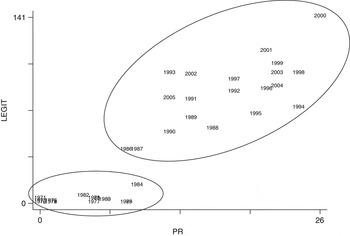
The concept of legitimate expectations, plotted against preliminary references to the ECJ in Figure 3, reveals a similar pattern.
Twoway Scatterplot: Legitimate Expectations and Preliminary References.

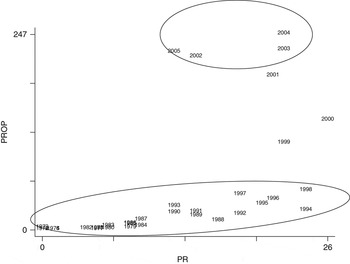
We note a similar structural break here, which shows a cluster of earlier observations (through 1985) with a relatively flat slope and a cluster of later observations (beginning in 1986) with a much steeper transformation function. We have again circled these clusters for easier visual inspection and undertaken supplementary regressions based on the observed discontinuities. As reported in Table 2, we can quantify what visual inspection reveals: while the slope in the pre-1986 period is a relatively flat (0.13), from 1986 it rises sharply to 1.55.
In this case, doctrine took considerably longer to reflect the discursive shift that our analysis identifies. Qualitative analyses do identify explicit areas of diffusion from European cases to the ‘purely domestic’ arena, but they typically do so with reference to the leading case of Coughlan, judged in 2001.Footnote 15 In that case, a severely disabled woman successfully advanced the European law concept and claimed a legitimate expectation to a home for life, thereby thwarting a planned policy that would have closed her care facility. Our analysis suggests that Coughlan may well have codified a 15-year-old discursive shift, in which the concept of legitimate expectations was already being domesticated. It now seems clear, as one specialist put it, that ‘post-Coughlan, there are not two separate systems of law operating in relation to legitimate expectations – one domestic and one European; there is, instead, just one unified system’ (Roberts, Reference Roberts2001; Hilson, Reference Hilson2003: 144).Footnote 16 The notion that citizens could hold legally defensible expectations about administrative behavior had clearly crossed the Channel, domesticated by and into English judicial practice (see Usher, Reference Usher2005: 499–504).
In considering the concept of proportionality, finally, Figure 4 reveals a slightly different temporal pattern.
Twoway Scatterplot: Proportionality and Preliminary References.

Use of the alien principle of proportionality by English courts is increasing (Usher, Reference Usher2005: 504–507), and this increasingly takes place not only in direct dialogue with European courts, but indirectly through domestic courts taking up European law principles on their own (Legrand, Reference Legrand2002: 247). Yet, several features distinguish proportionality from the other two concepts that we examine. First, the decoupling occurs much later in time, around the start of the twenty-first century. Second, related, and also as revealed in the original regression results, it seems to reflect ECHR influence much more strongly than any exerted by the ECJ. It occurs around the time that the Human Rights Act 1998, incorporating the European Convention on Human Rights into British law, came into force in 2000. Third, the change seems to involve a shift in the intercept (i.e., a higher number of references to proportionality, irrespective of preliminary references) rather than a shift in slope. Despite these differences, influential English judge Lord Slynn of Hadley neatly summarized the new situation when he noted in 2003 that ‘the time has come to recognize that [the proportionality] principle is part of English administrative law, not only when judges are dealing with Community acts but also when they are dealing with acts subject to domestic law’.Footnote 17
Discussion
The results of this analysis provide strong support to the indigenization hypothesis and raise important questions about the statist account. The data do support the claim that direct importations from the outside are important, even very important, predictors of the take-up of alien legal concepts in English judicial discourses. It is extremely hard to imagine that the discourses surrounding the concepts of purposive interpretation, legitimate expectations, and proportionality would have changed as they have without Europe’s initially invited influence. At the same time, the analysis simply does not bear out statism’s expectation that these effects would remain bounded (a separate domain of law) and consistent over time. Instead, we repeatedly find that while Europe may have opened the door, the participants in England’s judicial discourses have taken these novel concepts and run with them, often far outside of the European realm in which – alone – the concepts were anticipated to operate. And members of the discursive community seem to have done so to an increasing extent over time, having apparently ‘obtained inspiration from [EC law] in solving problems which have no Community law element’ (Schiemann, Reference Schiemann1998: 140). Previously alien concepts have been domesticated, spilling over into the otherwise national legal realm. This is the essence of an account organized around the idea of indigenization. In our concluding section, we draw out some broader implications of this analysis for understandings of Europeanization, the future of autonomous domestic constitutional arrangements, and for promising avenues for future research.
Conclusion and discussion
The ‘Great Debate’ over British entry into the European Community (EC) in the 1960s and1970s hinged not only on substantive economic, policy, geopolitical, and related concerns, but also to a large degree on domestic institutional questions, most notably parliamentary sovereignty (see George, Reference George1990; Lord, Reference Lord1992; Gowland and Turner, Reference Gowland and Turner2000; Milward, Reference Milward2002). Strikingly, though, domestic courts and judicial practices received very little attention (Harlow, Reference Harlow2000a: 362, Reference Harlow2000b). Some participants in the debate feared that joining the EC would ‘subordinate British courts on internal issues to a court of law external’ to the UK,Footnote 18 vitiating the power of the domestic judiciary. More commonly, what rare consideration was given to the courts, ignored or denied any Community-driven effects that would operate outside the conscious control of state officials (e.g., Her Majesty’s Stationery Office (HMSO], 1967). Even the famous 1974 speech in which Lord Denning likened Community law to ‘an incoming tide’ limited the simile to areas directly touched by the EC, maintaining that ‘The Treaty does not touch any of the matters which concern solely the mainland of England and the people in it. These are still governed by English law. They are not affected by the Treaty’.Footnote 19 In 1975, the Government argued that ‘The English and Scottish legal systems will remain intact. … The common law will remain the basis of our legal system, and our courts will continue to operate as they do at present’ (HMSO, 1975, para. 31, emphasis added).Footnote 20 These expectations formed the terms of the UK’s conscious compromise of Westphalia undertaken with accession to the EC.
The evidence we present shows that European legal principles and practices (purposive interpretation, proportionality, and legitimate expectations) indeed entered the ‘domestic’ legal order in England. But beyond that empirical fact, what model best explains this incorporation? The first model we proposed is the statist model where the state foresees and is in control of what enters the domestic order. Recall that Westphalian sovereignty is the capacity to exclude external authority structures (Krasner, Reference Krasner1999: 20–25). Nothing could be closer to compromising Westphalian sovereignty than the intrusion of an external authority into the domestic legal order, even if such intrusion is initially due to the signing of a convention allowing it. If this model is the correct one, incorporation should be profoundly, consistently, and uniquely tied to the direct importations, via the preliminary reference procedure, foreseen at the time of British accession. On this view, government leaders, through appropriate bureaucratic institutions, define and control the membrane that separates domestic from international legal orders.
The second model, which we call indigenization, works somewhat differently. In this model, we expect that while the first push toward importing alien legal concepts is made by the state entering into a treaty, further growth and expansion are increasingly outside the control of state leaders. This component points us toward the domestic polity itself as the site where these expansive forces gather, but it does not tell us what the precise mechanisms for legal incorporation are. We can imagine a variety of mechanisms such as imitation, socialization of legal community members into a new body of law (Burley and Mattli, Reference Burley and Mattli1993; Slaughter, Reference Slaughter1994), and the reliance on precedent and analogy as a basis for making legal decisions (Stone Sweet and McCown, Reference Stone Sweet and McCown2003). Each of these mechanisms is consistent with a diffusion or contagion model of legal incorporation, which could produce the kinds of dramatic upswings and changes of slopes that we found in our data. Change would be expected to be slow at first, and then as more judges read and cross-reference the judgments of others through precedent within the common law, we should expect to see increases in slope and perhaps even discontinuities in trends. Of note, though, this is not mere transplantation of alien concepts into English legal practice. It resembles, instead, a process of domestication in which the graft is naturalized into an existing and highly developed legal order.
Our evidence systematically suggests that an initial logic of conscious, intended and controlled ‘compromises’ of Westphalia gives way, over time, to an alternative logic in which legal concepts and discourses cross-fertilize each other. The domestication of European law does not seem to follow a statist pattern. If the political gatekeepers of the state’s domestic legal order – the official enforcers of Westphalian and domestic sovereignty (Krasner, Reference Krasner1999: 11, 20) – were carefully controlling the importation of legal concepts, the process would be tightly bound by them, in conformity with their interests and expectations. What is at issue here, though, is the spread of complex principles of legal reasoning, the taking off of a discursive community, and the increased use of cross-citations and precedents that is deeply rooted in the common law.
What are the implications of our analysis for future research? First, there is an unresolved series of questions relating to discursive communities. How are these communities formed? What mechanisms (socialization, legal interaction, and imitation, an unconscious imbibing of legal ideas akin to osmosis?) are at work in the formation of these communities? What are the interests of the actors involved? We have barely scratched the surface with regard to the issue of relevant mechanisms.
Second, our approach in this paper suggests both a friendly amendment to the prevailing conceptualization of international legalization as well as a refinement of the basic definition. As currently conceptualized, legalization varies along three dimensions: degree of obligation, degree of rule precision, and delegation of some functions of interpretation, monitoring, and implementation to a third party. (Goldstein et al., Reference Goldstein2000: 387). We suggest that this approach omits an important fourth dimension of legalization, namely the degree to which legal constraints, which were previously external, become part of the domestic order. Our proposed refinement of the basic definition of legalization goes along the following lines. Goldstein et al. (Reference Goldstein2000: 386) define legalization as ‘…the decision in different issue areas to impose international legal constraints on governments’. Our approach makes clear that legalization is neither always a discrete decision, nor is it limited to imposition of international constraints on domestic governments, nor are domestic governments the exclusive receptors of legal rules. So we propose that legalization be seen as a process by which international rules (not only constraints) are imposed on or internalized by domestic governments and domestic legal orders.
Third, returning to the theme of Europeanization, we note that the process of indigenization has implications for the balance of responsibilities and power among domestic institutions. Even if European legal concepts enter the domestic order initially through convention, they could still influence the balance of power and function among domestic institutional actors. It is broadly accepted that the judicialization of British politics (Nicol, Reference Nicol2001) has occurred at the expense of the national executive (Chalmers, Reference Chalmers2001). Its impact on parliamentary sovereignty is rather more ambiguous, but altogether more important since it founds the British constitutional order. On the one hand, the increased power of national courts could strengthen the power of Parliament. If the courts apply European law in such a way as to increase administrative compliance with the will of Parliament, as they often do in administrative law cases, then Parliamentary sovereignty is strengthened. If, on the other hand, domestic judges interpret European law to find Acts of Parliament contrary to the European legal order, as they did in the (in)famous Factortame judgment,Footnote 21 this weakens Parliament (Craig, Reference Craig1991). While addressing these issues empirically is fraught with difficulties, it stands as a hugely consequential possibility, with deep implications for member state sovereignty in a legalizing EU.
Fourth, what about the external validity (generalizability) of the English case? With respect to England, we see a mixed inferential profile. On the one hand, the common law tradition might make it more likely to find the kind of indigenization effects observed in our data. Precedent might serve as a kind of engine by which new concepts diffuse throughout the judiciary. On the other hand, standard views of the UK as a euroskeptical ‘awkward partner’ (George, Reference George1990) would seem to make indigenization less likely here than among continental and other EU member states. Rather than offering a definitive judgment on this question, we leave it an open one that might be addressed in future research.
With respect to the European component of the case, we note a cult of exceptionalism among many students of the EU, a belief, often unexamined, of ‘sui generis Europe’. Here, the particular history of Europe, its wartime struggles, its politically shaped postwar memories, and its decrease in valuation of sovereignty, merge with the highly specialized institutional characteristics of the EU and the Court of Justice (direct effect, supremacy) and conspire to differentiate the EU from its regional schemes around the world. Work on legalization outside the EU provides numerous examples of how things are different in other regional settings. Kahler (Reference Kahler2000: 395) argues that regionalism in the Asia-Pacific region represents an explicit choice (a strategy) in favor of a low level of legalization, and he demonstrates this in three regional organization settings: Association of Southeast Asian Nations (ASEAN), the ASEAN Regional Forum, and Asia-Pacific Economic Cooperation (APEC). Frederic Abbott (Reference Abbott2000) argues that NAFTA has a high degree of obligation and precision but a low degree of delegation of judicial functions. Laws are clear and carry obligational weight, but the content of the rules is controlled by governments.
While accepting these factual differences between Europe and the rest of the world, we want to distinguish between descriptive generalization and theoretical generalization. The former asks if a set of facts present in one case (region) also exists in another case. Does the level of delegation in the EU also occur in ASEAN? The answer, of course, is no: descriptions of Europe are different from descriptions of other regions. Theoretical generalization, by contrast, asks about the generic conditions under which certain features of regional integration would exist. The question would be posed as follows: If conditions {x, y, z} exist in settings {A, B, … N}, would the outcomes of interest (in our case, indigenization of alien legal concepts into domestic judicial discourses) also occur? Again, we have no firm answers, but we note that the European case could be quite general theoretically, yet have no actual descriptive companions in other regions. It would still be important to make this argument since, if other areas of the world approach Europe in terms of relevant theoretical features (strong economic ties, compatibility of values, devaluation of sovereignty), then we would expect more similarities in terms of legal and institutional outcomes. Thus, Europe’s descriptive uniqueness reflects the particular values that the theoretical variables take in this setting, rather than any alleged theoretical particularity.
In this spirit, we note the analysis by Slaughter and Burke-White (Reference Slaughter and Burke-White2006) suggesting that, in the future, international law will have to intrude into the domestic order – not only the domestic political order but the legal one as well. ‘The world is not likely to replicate [the European] experience in terms of actual political and economic integration monitored by coercive supranational institutions. But to the extent that the European way of law uses international law to transform and buttress domestic political institutions, it is a model for how international law can function, and in our view, will and must function to address twenty-first century international challenges’ (2006: 352). Our theoretical bet is precisely that what is happening in Europe is a leading indicator of trends unfolding more broadly.
A final set of implications involves the interaction of authority structures across different levels, including domestic, regional, and international. Concern for domestic–international connections has long animated comparative and international relations scholars (e.g., Katzenstein, Reference Katzenstein1976; Gourevitch, Reference Gourevitch1978; Putnam, Reference Putnam1988; Caporaso, Reference Caporaso1997). Systematic work incorporating legal matters (doctrine, legal principles such as direct effect) is of relatively recent vintage. While we join others in isolating the ‘second image reversed’ linkage, whereby international causes have domestic effects, we differ insofar as we focus not on domestic change induced through the market, imposed through exploitation or war, or constructed through social exchange, but on change authoritatively instantiated through legalization. Embracing the agency of English courts and other actors, we nonetheless hold that law operates according to a logic of structural authority, which is especially important insofar as it underpins the constitutive aspect of sovereignty (Philpott, Reference Philpott2001). We locate ourselves in the next generation of work on EU legalization by emphasizing the domestic dynamics and consequences of EU legal integration, and in calling for a move beyond doctrine and into areas of everyday judicial practice (Alter, Reference Alter1998, Reference Alter2001; Alter and Vargas, Reference Alter and Vargas2000; Conant, Reference Conant2002). Believing that there is more at work than the judicial acceptance of a few core doctrines, and more at stake than domestic policy and politics, we seek to move the agenda forward with new questions and hard tests using original and systematic data. While this is a modest beginning, we hope that it is indeed a beginning, a new look at the small increments of change operating across the vast periphery of Westphalian sovereignty (Rosenau, Reference Rosenau1966).
Acknowledgements
The authors would like to thank Meghan Callahan-Peters for research assistance. We also thank Karen Alter, Christopher Ansell, Miriam Aziz, Leonard Besselink, Damian Chalmers, Lisa Conant, Bruno de Witte, Giuseppe Di Palma, Francesco Duina, Peter Katzenstein, R. Daniel Kelemen, David Leblang, Lisa Martin, Nicol Rae, Sidney Tarrow, Helen Wallace, Chris Whytock, and participants in the Workshops on Territoriality and the Nation-State held at Berkeley and Fiesole for their helpful comments on earlier and related drafts.
Appendix
Ordinary-least squares regressions with induced structural breaks

ECHR = European Court of Human Rights; PURP = purposive construction/purposive interpretation; PROP = proportionality; LEGIT = legitimate expectations.
Standard errors in parentheses; ***P < 0.001; **P < 0.01; *P < 0.05.