Introduction
Major depressive disorder (MDD) is chronic relapsing–remitting brain disorder characterized by both psychological (eg, low mood, negative thoughts, cognitive dysfunction) and physical (eg, poor sleep, low energy, psychomotor changes) symptoms that are associated with significant functional impairments across multiple domains.Reference Kennedy1 More than 50% of adult patients with MDD have severe functional impairments, with deficits in occupational, social, and family functioning.Reference Kessler, Berglund and Demler2, Reference Hong, Novick, Moneta, El-Shafei, Duenas and Haro3 Function impairments are also related to worse cognition or anhedonia and often persist after the resolution of depressive symptoms.Reference Paykel4
Symptom reduction does not always translate into recovery of function in all domains, with inter-episodic disability being common and problematic.Reference Hammer-Helmich, Haro and Jonsson5 The relationship between function and depressive symptoms is complicated, due to the fact that individuals who function at a higher level before receiving antidepressant therapy may exhibit greater cognitive benefits with some agents.Reference McIntyre, Florea, Tonnoir, Loft, Lam and Christensen6 With growing recognition of the importance of functional recovery in patients with depression, the restoration of patient functioning is a critical therapeutic priority in individuals with MDD.Reference Sheehan7, Reference Oluboka, Katzman and Habert8 Indeed, functional outcomes remain inadequate in MDD and many individuals prioritize improvements in function above symptom reduction, however, clinical trials and drug approval are based on symptom scales that do not adequately capture improvements in function.Reference Rosenblat, Simon and Sachs9 Thus, improving functional outcomes may be a priority for patients and it contributes most to the cost of illness.
Pharmacological interventions are the most widely used treatment modality for moderate to severe MDD in most parts of the worldReference Gautam, Jain, Gautam, Vahia and Grover10, Reference Kennedy, Lam and McIntyre11 and antidepressants remain to have high popularity index based on a recent scientometric analysis.Reference Tran, Ha and Vu12 Traditionally, the efficacy and approval of pharmacological treatments are determined by changes in depressive symptom severity, as assessed by changes of Montgomery Åsberg Depression Rating Scale (MADRS) or Hamilton Depression Rating Scale (HAM-D) scores.Reference Zimmerman, Posternak and Chelminski13, Reference Carneiro, Fernandes and Moreno14 Hitherto, the improvements of pharmacological treatments in depressive symptoms have been well studied with hundreds of completed randomized controlled trials (RCTs) using the MADRS and HAM-D as primary outcomes, as summarized in numerous network meta-analyses comparing the efficacy of various treatments.15-18
Conversely, there has been markedly less systematic assessment of the effect of treatments on functional improvements in MDD; only two systematic reviews have summarized the efficacy of pharmacological treatments or psychotherapies in the improvements of overall functional outcomesReference Sheehan, Nakagome, Asami, Pappadopulos and Boucher19 and specifically occupational function outcomes in MDD.Reference Lee, Rosenblat and Lee20 However, no study has yet comprehensively and quantitatively pooled the results (ie, doing meta-analysis) of functional outcomes studies to determine overall effect sizes and compare all pharmacological treatments to determine the comparative benefits of specific medications for improving functional outcomes. It is a testable hypothesis that there may be differences between agents and classes. For example, an antidepressant that improves reward and motivation (eg, ketamine, vortioxetine) may be better at improving patient function.Reference McIntyre, Woldeyohannes and Soczynska21, Reference McIntyre, Cha and Soczynska23 Secondly, a patient that can improve general cognition could improve function as these symptoms are known to disproportionately mediate function.Reference Ulbricht, Rothschild and Lapane22, Reference McIntyre, Cha and Soczynska23
The Sheehan Disability Scale (SDS) is a well-validated and widely accepted self-report subjective rating scale of functional impairment,Reference Sheehan, Mancini and Wang24, Reference Coles, Coon, DeMuro, McLeod and Gnanasakthy25 which was successfully and frequently used to evaluate the changes of functional outcomes in patients with MDD during the treatment of several pharmacological treatments and demonstrated to be sensitive to changes over time.Reference Lee, Rosenblat and Lee20, Reference Goldstein26, Reference Weiller, Weiss and Watling27 In comparison to other self-rated measures of functional impairment (eg, Social Adaptation Self-evaluation Scale, Short-Form Health Survey), the SDS is the most widely reported standardized metric of functional impairment in the extant literature.Reference McKnight and Kashdan28 Although subjective measures of function (ie, SDS) does not necessarily align with performance-based measures, it is also meaningful and essential in human performance studies. Until now, there has been no credible evidence that the functional outcomes are different due to which antidepressant assigned to an individual.
Given the importance of functioning recovery of MDD, ranking the efficacy of different pharmacological treatments on functional outcomes is of great importance. In order to reduce between-study heterogeneity and enhance our ability to rank the comparative efficacy of interventions, only studies with SDS scale data were included in the network meta-analysis. Therefore, we aimed to pool the results of all RCTs comparing pharmacological treatments with placebo or other pharmacological treatments among patients with MDD that reported the functional outcomes with SDS; a network meta-analysis (NMA) was conducted to compare the efficacy of pharmacological treatments on measures of functional outcomes, as measured by the SDS with all domains in patients with MDD.
Methods
Search strategy
We conducted a systematic review and NMA in accordance with the Preferred Items for Reporting Items for Systematic Reviews and Meta-Analyses (PRISMA) statement for NMA Reference Moher, Liberati, Tetzlaff, Altman and Group29 (eTable 1). We searched the databases PubMed, EMBASE, PsycINFO, Cochrane Library, and ClinicalTrials.gov from inception to December 10, 2019 without language restrictions. Our search strategy is described fully in the eAppendix 1. This study is registered with PROSPERO (CRD42018116663).
Selection criteria
We included randomized, double-blind, placebo-, or active comparator-controlled clinical trials evaluating the efficacy of pharmacological treatments in adults (ie, ≥18 years old) with MDD as defined by the Diagnostic and Statistical Manual (DSM; no restrictions on editions). The outcome of interest was operationalized using the SDS (although, did not need to be primary outcome). Trials of non-pharmacological intervention (eg, cognitive behavior therapy), pharmacological treatments combined with another pharmacological or non-pharmacological intervention (ie, augmentation study) were excluded from the analysis, as were studies including individuals who had a primary diagnosis other than MDD (eg, schizophrenia, bipolar disorder). Moreover, for duplicated studies, we only include the one with the most informative results. Post hoc analysis or sub-study of included trials were also excluded.
Outcome measures and data extraction
The outcome for the NMA was the efficacy of pharmacological treatments on measures of functional outcomes in patients with MDD, as measured by the mean differences (MDs) in SDS. SDS is a brief self-report measure that evaluates three functional domains (ie, work/school, social life, and family life or home responsibilities). The sum of all domain scores yields the global SDS score, which ranges from 0 to 30.Reference Leppink, O’Sullivan and Winston30 The effect size is calculated by dividing the mean difference in score by its standard deviation (SD). From the review of Sheehan et al, the average difference of 1.5 to 2.0, could be considered as treatment difference.Reference Sheehan, Nakagome, Asami, Pappadopulos and Boucher19 If the study reported data at multiple study visits, the primary endpoint as defined by the study’s investigators was considered. Paired investigators (Xin Wang, Xinyue Zhang; Panqi Liu, Jianxin Liu; and Bing Cao, Yan Chen) independently selected the studies, reviewed the main reports and supplementary materials, extracted the relevant information. All reference lists of the retrieved articles were reviewed by Bing Cao and Yan Chen to identify potential studies. The following were extracted from each study using a standardized data collection form: first author, publication year, study design, country, geographic location, age, sex, body mass index, sample size, name of pharmacological treatments, and the prescribed dosage, the MD in SDS and standard deviation (SD), the MDs and SDs for the disrupted domains of SDS (if available), study completion or all-cause discontinuation rate, and other necessary information.
Statistical analysis
Summary statistics are reported as weighted mean differences with 95% confidence intervals (CIs). Where a study reported outcomes separately for different dosages of the same pharmacological agent, we combined the MDs, SDs, and sample sizes in these arms as a single arm to represent the corresponding agent (eAppendix 3). The random-effects models were used for pooling data since previous studies reported that a random-effects approach is typically adopted in a network meta-analysis.Reference Bucher, Guyatt, Griffith and Walter31, Reference Law, Jackson, Turner, Rhodes and Viechtbauer32 To rank interventions based on a given outcome of interest (ie, efficacy, acceptability), the surface under the cumulative ranking probabilities (SUCRA) was used. Pre-specified subgroup analyses were also carried out, which were used to compare the statistical significance of findings within separate subgroup analyses. Subgroups were created based on sample size (ie, <500 vs ≥500), whether conducted in multiple countries (ie, Yes vs No), geographic location (ie, all Continents), and study duration (<10 weeks and ≥10 weeks) (eFigure 10 to eFigure 13). Additionally, we assessed the sensitivity of our findings by repeating each NMA after excluding studies with all-cause discontinuation rate ≥20% and excluding a study of antipsychotic (ie, quetiapine) which is not a classical antidepressant (eFigure 14 and eFigure 15). The funnel plot for individual comparisons in the NMA was used to evaluate the publication bias. The existence of heterogeneity, local inconsistency, and global inconsistency was assessed by network forest plotReference Veroniki, Mavridis, Higgins and Salanti33 (eTable 4 and eFigure 4). The risk of bias (ROB) of included studies was assessed according to the Cochrane Collaboration’s tool ROB 2.034 (eTable 9 and eFigure 24). All the data analyses were conducted using Stata (version 15.0), the NMA were conducted by using the network command in Stata.Reference Shim, Yoon, Shin and Bae35
Results
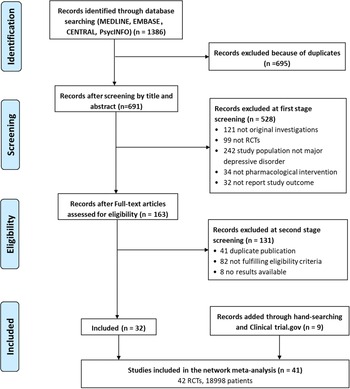
Our systematic database search yielded 1 386 articles (Figure 1). After removing duplicates (excluding 695 articles), and screening titles and abstracts to exclude articles that did not adhere to the primary objectives of the current study (excluding 528 articles). Herein, 163 articles were selected for full-text review and further evaluation. Following detailed assessment, we included 32 articles from databases. Additionally, nine articles were added through hand-searching and clinicaltrials.gov. Finally, a total of 41 articles with 42 RCTs (n = 18 998) published between 2000 and 2019 were included in the NMA (eAppendix 2).
PRISMA flow diagram of study selection process.

The efficacy of 13 classes of pharmacological treatments, including the melatonergic agents (ie, agomelatine), tricyclic antidepressant (TCA) (ie, amitriptyline), norepinephrine-dopamine reuptake inhibitor (NDRI) (ie, bupropion), serotonin, and norepinephrine reuptake inhibitors (SNRIs) (ie, desvenlafaxine, duloxetine, levomilnacipran venlafaxine), selective serotonin reuptake inhibitors (SSRIs) (ie, escitalopram, fluoxetine, paroxetine, sertraline), antipsychotic agents (ie, quetiapine), multi-modal agent (ie, vortioxetine), on measures of functional outcomes by SDS were used in this NMA. Publication year varied from 2000 to 2019. The average age of included patients was 44.1 years [standard deviation (SD): 5.1]. 63.5% (11 506 in 18 115, one original study missed the sex information) of the sample population were women. The duration of treatment was 6 to 12 weeks [median 8 weeks (interquartile range, IQR 6 to 8)]. The median of all-cause discontinuation rate was 17.6% (IQR 11.0 to 22.7). The details of included RCTs are shown in eTable 2. The boxplots in eFigure 1 show the distribution of baseline mean age and sample size in included trials.
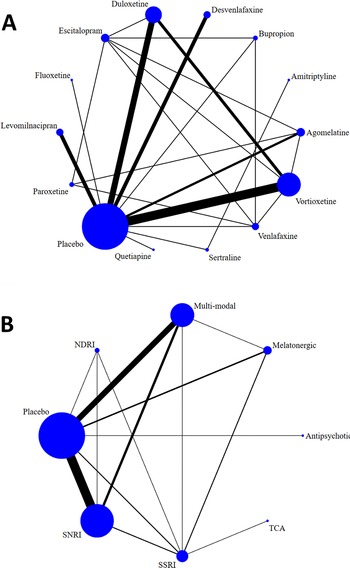
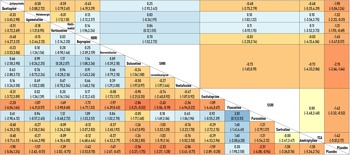
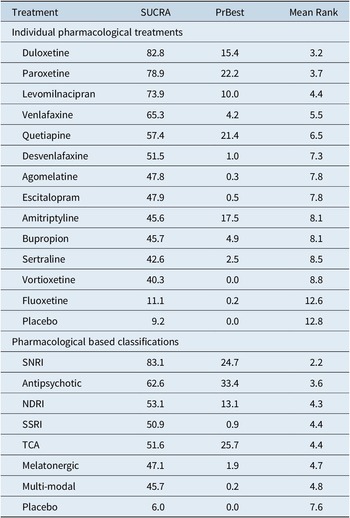
All available comparative functional outcome data were included in the network meta-analyses and are visualized in Figure 2. For individual pharmacological treatments, no placebo-controlled trials on amitriptyline, escitalopram, and paroxetine existed; four pharmacological agents (ie, fluoxetine, levomilnacipran, desvenlafaxine, quetiapine) were not directly compared with another active drug in any of the networks. For pharmacological-based classifications, only the category of antipsychotic did not have a direct comparison with active drug; and only TCA was not included in a placebo-controlled trial. The main results of the comparative efficacy of pharmacological treatments and pharmacological-based classifications on measures of functional outcomes in individuals with MDD are shown in Figure 3. Eight pharmacological treatments were more effective than placebo in improving functional performance: duloxetine (−2.56, 95% CI = −3.37 to −1.75), paroxetine (−2.51, 95% CI = −4.08 to −0.94), levomilnacipran (−2.33, 95% CI = −3.37 to −1.28), venlafaxine (−2.06, 95% CI = −3.41 to −0.71), desvenlafaxine (−1.67, 95% CI−2.67 to −0.67), escitalopram (−1.59, 95% CI = −2.89 to −0.28), agomelatine (−1.57, 95% CI = −2.63 to −0.51), and vortioxetine (−1.39, 95% CI = −2.02 to −0.75). The top seven treatments (ie, duloxetine, paroxetine, levomilnacipran, venlafaxine, desvenlafaxine, escitalopram, and agomelatine) with the average changes in SDS of more than 1.5 were considered as meaningful changes. The NMA revealed that duloxetine was associated with the greatest improvement in functional outcomes relative to (in rank order of efficacy): paroxetine, levomilnacipran, venlafaxine, quetiapine, desvenlafaxine, agomelatine, escitalopram, amitriptyline, bupropion, sertraline, vortioxetine, and fluoxetine. The pairwise comparisons by standard pairwise meta-analyses were also performed, which indicated the similar results with the network comparisons (eTable 3). Additionally, no obvious heterogeneity and local inconsistency existed (eFigure 3, eFigure 4, and eTable 4), but the test for inconsistency at the overall level showed the risk of global inconsistency might exist (P = .014). After dropping a direct comparison between vortioxetine and agomelatine (ie, Study 5. Montgomery SA, 2014),Reference Montgomery, Nielsen, Poulsen and Haggstrom36 the risk of global inconsistency was not statistically significant (P = .135, eFigure 5). The post-hoc results of dropping Study 5 are shown in eFigure 6 and eFigure 7. We also performed an NMA to assess the acceptability (ie, the percentage of patients that completed the study) of each pharmacological treatment (eFigure 16, eFigure 17, and eTable 7). The results revealed that no pharmacological treatment exhibited significantly different rates of acceptability when compared to placebo. The rank of pharmacological-based classifications on measures of functional outcome were SNRIs, antipsychotics, NDRIs, SSRIs, TCAs, melatonergic agents, and multi-modal antidepressants (Table 1). Four of the seven classifications (ie, SNRI [−2.15, 95% CI = −2.66 to −1.64], SSRI [−1.42, 95% CI = −2.32 to −0.52], melatonergic agents [−1.32, 95% CI = −2.33 to −0.31], and multi-modal antidepressants [−1.31, 95% CI = −1.93 to −0.69]) were more effective than placebo in the NMA. The pairwise comparisons were also performed (eTable 6). Nineteen of 42 (45.2%) studies reported the MDs and SDs for the three domains of SDS, and the results pointed out that agomelatine was associated with the greatest improvement in all three domains (Appendix p. 52-57).
Network of eligible comparisons for efficacy. A. Individual pharmacological treatments, B. Pharmacological based classifications. The width of the lines is proportional to the number of trials comparing every pair of treatments, and the size of every circle is proportional to the number of randomly assigned participants (sample size).

Network meta-analysis of efficacy of individual pharmacological treatments and pharmacological based classifications. This figure illustrates the treatment efficacy by mean differences (MDs) and 95% CIs. The lower triangle is the results of individual pharmacological treatment, and the estimation was calculated as the column-defining treatment compared with the row-defining treatment. The upper triangle is the results of pharmacological based classifications, and the estimation was calculated as the row-defining treatment compared with the column-defining treatment. Comparisons should be read from left to right. The efficacy estimate is located at the intersection of the column-defining treatment and the row-defining treatment. An MD below 0 (ie, color of orange) favors the column-defining treatment in the lower triangle and the row-defining treatment in the upper triangle, which indicates the antidepressant/ classification to the left is numerically better than the one to the right and vice versa (ie, color of blue). Abbreviations: NDRI, norepinephrine-dopamine reuptake inhibitor; SNRI, serotonin, and norepinephrine reuptake inhibitors; SSRI, selective serotonin reuptake inhibitors; TCA, tricyclic antidepressants.

Clustered Ranking Plots for the Network with SUCRA Values

Abbreviations: NDRI, norepinephrine-dopamine reuptake inhibitor; PrBest, probability of being the best; mean rank, average ranking place for each treatment; SUCRA, surface under the cumulative ranking probabilities; SNRI, serotonin, and norepinephrine reuptake inhibitors; SSRI, selective serotonin reuptake inhibitors; TCA, tricyclic antidepressants.
Visual inspection of the funnel plot symmetry suggested a low risk of publication bias (eFigure 9). The Cochrane ROB 2.0 tool was used to assess the quality of studies by evaluating six ROB items (ie, random sequence generation, allocation concealment, blinding of participants and personnel, blinding of outcome assessment, complete outcome data, selective reporting). All studies had low risk of random sequence generation; 11 studies had high risk of blinding of outcome assessment; 24 studies had high risk of not complete outcome data; 8 studies had high risk of selective reporting. The summary of the qualitative assessment is provided in eTable 9 and eFigure 22.
Discussion
There is a growing interest in treatments that may improve function, not only symptomatic improvement, as function has been found more strongly linked to MDD-related disability and economic burden.Reference Montgomery, Nielsen, Poulsen and Haggstrom36, Reference Soares, Endicott, Boucher, Fayyad and Guico-Pabia37 The present NMA included 42 RCTs comprising of data from 18 998 individuals with MDD randomly assigned to 13 different pharmacological treatments or placebo. Duloxetine, paroxetine, levomilnacipran, venlafaxine, quetiapine, desvenlafaxine, agomelatine, escitalopram, and vortioxetine, all significantly improved patient-reported ratings of functional outcomes relative to placebo. The present findings provide further support for the function enhancing effects of pharmacological treatments in MDD.
Functional improvement is usually accompanied with the reduction in depressive symptoms, Conversely, poor social and interpersonal function may cause depression symptoms and reduce antidepressant efficacy.Reference McIntyre, Florea, Tonnoir, Loft, Lam and Christensen6, Reference Kennedy, Heun and Avedisova38 The previous findings indicated that functional improvement often lags behind symptomatic improvement.Reference Sheehan, Nakagome, Asami, Pappadopulos and Boucher19 In most of the included studies, symptomatic and functional outcomes were measured concurrently at endpoints. It was possible that symptomatic improvement was observed before functional improvements.Reference Sheehan, Nakagome, Asami, Pappadopulos and Boucher19 For example, duloxetine, paroxetine, and venlafaxine are in the top five when using functional measures as efficacy outcome in current study, they also rank among the top five (ie, amitriptyline, mirtazapine, duloxetine, venlafaxine, and paroxetine) when using depressive symptoms as efficacy outcome.Reference Cipriani, Furukawa and Salanti15 It is unknown why SNRI antidepressants would manifest greater improvement on observer-related functional measures. It is conjectured that the observed improvement may be due toReference Blier, Gommoll, Chen and Kramer39 beneficial effects on aspects of depression mediating functionality (eg, fatigue).Reference Kennedy, Heun and Avedisova38
Both SSRIs and SNRIs are superior to placebo in terms of pharmacological-based classifications. It is worth noting that from the perspective of individual pharmacological treatments, all SNRIs (ie, duloxetine, levomilnacipran, venlafaxine, desvenlafaxine) have moderate effect size in better performance of functional outcome than placebo. In the subgroup of studies with a sample size of ≥500, only three SNRIs (ie, duloxetine, levomilnacipran, and venlafaxine) and vortioxetine performed better than placebo (eFigure 10). Moreover, duloxetine has best performance when compared with placebo in subgroup of duration <10 weeks, and levomilnacipran has best performance when compared with placebo in subgroup of duration ≥10 weeks. The results of subgroup analyses by study duration indicated that SNRIs have good performance on functional outcomes, and the study duration should be considered when assessing functional changes. For desvenlafaxine treatment, a significant treatment by menopausal status interaction was observed for SDS scores, that is, mean changes from placebo were larger for perimenopausal women compared with postmenopausal women.Reference Kornstein, Clayton, Bao and Guico-Pabia40
Vortioxetine, a multi-modal antidepressant that was found to increase hippocampal brain-derived neurotrophic factor (BDNF) levelsReference Lu, Ho, McIntyre, Wang and Ho41 and proposed for improving cognitive symptoms independent of its effect on depressive symptoms.42-45 Fifteen original RCTs included comparisons of vortioxetine with placebo and/or other treatments for SDS scores. Although the effect size is small, vortioxetine has shown significant improvement in function when function measures of SDS are used. Our subgroup analysis showed that the significant improvement of functional outcomes in the treatment with vortioxetine among Asian population was no longer existed in American population (Figure 12). Previous evidence also indicated that the cross-cultural difference could influence the early diagnosis and selection of psychological treatments.Reference Jeon, Walker and Inamori46, Reference Williams, Nakagawa and Sado47 Thus, the large-scale population-based samples from different countries, cultures, and developmental stages should be taken into consideration when assessing the efficacy of pharmacological treatments on functional outcomes in future research. Inconsistent with our current results of the ranks between vortioxetine and duloxetine, an RCT using an objective indicator named University of California San Diego Performance-based Skills Assessment (USPA) observed that vortioxetine, but not duloxetine, had a robust combined effect on depressive symptoms and functional capacity in patients with MDD.Reference Christensen, Sluth and McIntyre48
Agomelatine is a novel melatonergic antidepressant, with a primary purpose of stabilizing circadian rhythms and increases hippocampal BDNF level and of BDNF positive neurons.Reference Kennedy, Heun and Avedisova38, Reference Cao, Zhu and Zuckerman49, Reference Lu, Ho, McIntyre, Wang and Ho50 Agomelatine has significantly larger changes in SDS scores and better acceptabilityReference Cipriani, Furukawa and Salanti15 than placebo. Additionally, agomelatine performed best on measures of the three domains (ie, work/studies, social life or leisure activities, family life or home responsibilities) of SDS (eFigure 18). The clinical value of agomelatine is worth noting according to mutual improvement in multiple aspects of MDD.
In our NMA, only one original research evaluated the functional outcomes of antipsychotic agent (ie, quetiapine) in individuals with MDD. Although quetiapine ranked fourth among all pharmacological treatments, there is no direct or indirect evidence indicated that quetiapine significantly improves functional outcomes when compared to placebo or any other agent. The results of the classifications also showed the same trend. We did a sensitivity analysis by excluding a study of quetiapine, which indicated that excluding quetiapine do not have big effect on the summary results (eFigure 15). Additionally, evidence from adjunctive quetiapine XR vs placebo suggests that adjunctive quetiapine is inferior to placebo in SDS changes.Reference Hobart, Skuban and Zhang51
A major strength of our NMA is that it comprehensively synthesizes the comparative efficacy of pharmacological treatments on functional recovery based on extant direct and indirect evidence. The pharmacological interventions included in current analysis are mainly new drugs that have recently been approved for marketing. From our findings herein, we can provide the most up-to-date evidence to assist in shared decision making between patients, caregivers, and their clinicians.
There are several limitations that affect inferences and interpretations of our NMA. Firstly, the sample sizes were relatively small. Especially, only one included study reported the functional outcomes in the comparison of three pharmacological treatments (ie, amitriptyline, fluoxetine, quetiapine) with placebo or another antidepressant. The conclusion of these pharmacological treatments needs to be carefully considered. Secondly, many comparisons were assessed as having a high ROB using the Cochrane Collaboration’s tool framework, which restricts the interpretation of the results. Thirdly, several trials included the population with special features (such as peri- and postmenopausal women, elderly patients), which may limit the generalizability of our results. Lastly, augmentation with other pharmacological treatments or pharmacological interventions (eg, cognitive behavioral therapy, sleep normalization) may additionally facilitate the return to patients’ pre-morbid levels of functioning. Thirdly, the systematic review by Weiller et al reported that four adjunctive treatments (ie, aripiprazole, brexpiprazole, edivoxetine, and risperidone) improved functioning vs placebo.Reference Weiller, Weiss and Watling27 Our current research only included the clinical trial settings with monotherapy intervention but did not include settings with adjunctive treatments, limiting the assist in decision-making of real-world clinical practice. The restriction to SDS limits the generalizability of the results, future systematic reviews should include more scales in evaluating the efficacy of pharmacological treatments on functional outcome. Moreover, SDS, a subjective rating in the differences, would be different from the objective indicators, such as the USPA,Reference Christensen, Sluth and McIntyre48 which might be more reliable than subjective measurements. Lastly, the results of the NMA are not completely same with the results of pairwise meta-analysis, which may be caused by the imbalance in the distribution of effect modifiers (eg, age, sample size, geographic location) between different types of direct comparisons. Notwithstanding the foregoing limitations, the current study provides meaningful evidence in support of the effects of pharmacological treatments on measures of functional outcomes by SDS in patients with MDD.
In summary, our findings provide evidence that pharmacological treatment improves functional outcomes, and most of them have better performance than placebo for the efficacy of pharmacological treatments on functional outcomes. Future research is needed to overcome the above limitations for validating and replicating our findings in large-scale population-based samples with different countries, cultures, and developmental stages. In addition, integrating performance-based scales in antidepressant drug discovery and development is strongly encouraged especially given the increasing emphasis on patient-reported outcomes in clinical trials with antidepressants.Reference Rosenblat, Simon and Sachs9 We hope that these results will assist in shared decision-making between patients, caregivers, and their clinicians.
Funding
This work was supported by the Startup Foundation for Talents from Southwest University (SWU019039) and National Natural Science Foundation of China (NSFC71673003). The funding agents had no role in the design and conduct of the study; collection, management, analysis, interpretation of the data; preparation, review, or approval of the manuscript.
Disclosures
Dr. Roger S. McIntyre has received Research Grants from Stanley Medical Research Institute, Lundbeck, Janssen Ortho, Purdue, AstraZeneca, Shire, Pfizer, Otsuka, and Allergan. He is on the Advisory Board for Lundbeck, Pfizer, AstraZeneca, Eli Lilly, Janssen Ortho, Purdue, Johnson & Johnson, Moksha8, Sunovion, Mitsubishi, Takeda, Forest, Otsuka, Bristol-Myers Squibb, and Shire. He has also been a Speaker for Lundbeck, Pfizer, AstraZeneca, Eli Lilly, Janssen Ortho, Purdue, Johnson & Johnson, Moksha8, Sunovion, Mitsubishi, Takeda, Forest, Otsuka, Bristol Myers Squibb, and Shire. All other authors have nothing to disclose.
Supplementary Materials
To view supplementary material for this article, please visit http://doi.org/10.1017/S1092852921000171.