1. Introduction
Having studied attitudes towards usage problems such as the notorious split infinitive or the ubiquitous literally in British English as part of my doctoral thesis, I was intrigued by the sheer lack of scientific studies investigating such attitudes. What was even more intriguing was to discover that the same field and the same usage problems seem to have received a different treatment in the United States of America. While my search for previously conducted usage attitude studies in Great Britain has largely remained fruitless, besides two notable exceptions which I will discuss in detail below (see Section 3), a similar search for American usage attitude studies resulted in a different picture. Considerably more such studies seem to have been conducted in the US than in Great Britain. On top of cultural and linguistic differences between these two nations, it seems as if they also hold different attitudes towards studying attitudes towards usage problems. Now the following question arises: why do we find such contradictory scientific traditions in these two countries? In this paper, I will provide an overview of a selection of American and British usage attitude studies. Taking into account differences between the American and British studies with regard to the number of usage problems studied, the populations surveyed and the methods applied, I will attempt to capture manifestations of two seemingly diverging attitudes towards the study of usage problems. By doing so, I will provide a possible explanation for the lack of attention being paid to usage attitudes in Great Britain.
In the next section, I will discuss the main methodological approaches taken in studying usage attitudes, before providing an overview of eight American and British usage attitude studies. This overview illustrates differences in how usage attitudes have been treated in both countries. In Section 3, I will describe four usage attitude studies in more detail, which are presented in chronological order to provide a glimpse at methodological developments the study of usage attitudes has undergone. Lastly in Section 4, I will provide a possible explanation for the diverging attitudes towards studying usage attitudes in Great Britain and the United States of America.
2. An overview of American and British usage attitude studies
Before discussing an overview of a selection of usage attitude studies, I will provide a brief summary of the three main methodological approaches applied in attitude studies, which have been classified by Garrett (Reference Garrett2010) as the Direct Approach, the Indirect Approach and the Societal Treatment Approach. Using a Direct Approach entails asking respondents in a straightforward manner to express their attitudes towards a particular language item without disguising the study's objective (cf. Garrett, Reference Garrett2010: 39). While this attitude elicitation method has been widely used, it has its drawbacks, as informants may answer questions by providing socially desirable answers (i.e. what they think the researcher would like to hear), rather than expressing their own true attitude (Garrett, Reference Garrett2010: 44). To avoid this social desirability bias, the Indirect Approach is often used. The main difference to the Direct Approach is that the objective of the study is disguised (Garrett, Reference Garrett2010: 41). One of the most famous indirect attitude elicitation techniques is Lambert et al.’s (Reference Lambert, Hodgson, Gardner and Fillenbaum1960) ground-breaking matched-guise test, in which voice recordings of bilingual speakers are used. Participants in a matched-guise test are made to believe that they are listening to different speakers, rather than to bilingual speakers that were recorded twice. The Societal Treatment Approach is less frequently used. Using existing data, such as written texts about language (e.g. letters to the editor, see Lukač, in progress), the researcher is required to deduce the author's attitudes to the object of analysis, which constitutes a delicate undertaking for two reasons. First of all, the researcher has limited access to attitudinal data, which could furthermore have been edited by copy editors, as in the case of published texts. Secondly, the researcher runs the risk of deducing not the author's attitudes, but rather inferring their own (McKenzie, Reference McKenzie2010: 41). For these reasons, the Societal Treatment Approach is not often applied in attitude studies. In the more detailed description of four attitude studies in Section 3 below, I will show examples of the two most frequent approaches: the Direct Approach and the Indirect Approach.
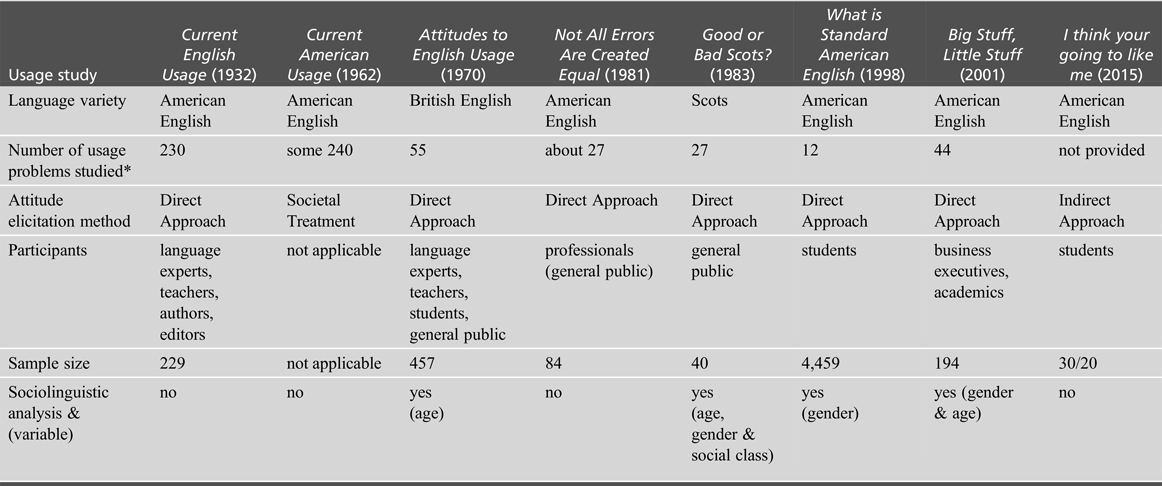
In order to investigate the diverging attitudes towards studying usage attitudes, I have chosen eight usage attitude studies for a contrastive overview illustrated in Table 1 below. For the purpose of comparing the studies, I have drawn up the following criteria:
-
(1) language variety investigated
-
(2) number of usage problems studied
-
(3) attitude elicitation method applied
-
(4) type of participants surveyed
-
(5) size of the sample
-
(6) type of sociolinguistic analysis & variables included.
Despite including only eight usage attitude studies in the overview, I was able to identify further studies which I will, however, not discuss in this paper (e.g. Marckwardt & Walcott, Reference Marckwardt and Walcott1938; Tieken–Boon van Ostade, Reference Tieken–Boon van Ostade2013; Kostadinova, in progress, see also this issue).Footnote 1 My selection of usage attitude studies aims at localising any potentially diverging methodological developments between the American and British contexts. Besides the four usage attitude studies which I will discuss in detail in Section 3 (Leonard, Reference Leonard1932; Mittins et al., Reference Mittins, Salu, Edminson and Coyne1970; Sandred, Reference Sandred1983; Queen & Boland, Reference Queen and Boland2015), I also included two so-called botheration studies: Hairston's Not All Errors are Created Equal (Reference Hairston1981), and Gilsdorf and Leonard's Big Stuff, Little Stuff (Reference Gilsdorf and Leonard2001). The label ‘botheration study’ derives from the elicitation technique applied, according to which respondents are asked to state how much they are bothered by specific usages. What is special about these two studies is the populations surveyed, i.e. business executives and professionals, which are very different from earlier usage attitude studies such as the ones conducted by Leonard, and Mittins et al. Another usage attitude study I included in the overview is Bryant's Current American Usage (Reference Bryant1962), which is an example of the less frequently used Societal Treatment Approach. Bryant (Reference Bryant1962: xiv) used written records of language use to deduce attitudes towards American English usage, so her study shows how corpora can be used in attitude studies. The last of the attitude studies added to the four studies described above is Albanyan and Preston's What is Standard American English (Reference Albanyan and Preston1998), which stands out due to the enormous size of the survey's sample. With 4,459 students surveyed, the study is by far the largest of all eight included in the overview presented in Table 1.
Overview of eight attitude studies towards usage problems

* Issues of punctuation have been excluded.
A look at the overview in Table 1 brings to light specific patterns. Most of the studies used the Direct Approach to elicit attitudes towards usage: six out of eight. Another interesting feature is the development over time of an increased interest in sociolinguistic analysis. With the birth of sociolinguistics as a discipline in the mid-1960s, sociolinguistic analyses have been gradually and consistently incorporated in attitude studies. Two notable exceptions in this are Hairston (Reference Hairston1981) and Queen and Boland (Reference Queen and Boland2015). A reason for the absence of a sociolinguistic treatment of the attitudes elicited in these two studies can be found in the homogeneity of their samples, which in the case of Hairston (Reference Hairston1981: 795) consisted of mainly old men, and in that of Queen and Boland (Reference Queen and Boland2015: 286) of young undergraduate students. Additionally, a small sample size, such as the one found in Queen and Boland, makes a sociolinguistic analysis difficult. While both sample size and the number of usage problems studied seem to vary in the different studies, the frequency of studies focusing on American English is striking in comparison to those focusing on British English. Why is this so? Before providing a possible answer to this question, I will, however, briefly discuss four usage attitude studies in more detail in the following section.
3. detailed synopsis of four usage attitude studies
3.1 Leonard's Current English Usage (Reference Leonard1932)
One of the earliest usage attitude studies I was able to identify is Leonard's Current English Usage (Reference Leonard1932). This study was initiated by the National Council for Teachers of English in the United States, so it is not surprising to find that it exclusively deals with American English. Leonard explained the study's aim as being grounded in the questionable validity of language rules in English language teaching (Reference Leonard1932: xiii), arguing that in order to make an informed decision on what constitutes correct English usage, an assessment of actual English usage was necessary, which he hoped to provide through his study (Leonard, Reference Leonard1932: xiii). Yet Leonard was not interested in determining what was considered correct by the majority of the speech community, i.e. what the vast general public thought to be correct and proper, but rather in the attitudes of the educated elite, which he thought would help settle the debate on disputed usage (Reference Leonard1932: xiii). As a consequence, his survey sample consisted of educated professionals such as language experts (i.e. lexicographers and grammarians), teachers, and well-known authors (Leonard, Reference Leonard1932: 96).
Regarding the adopted methodology, Leonard followed the Direct Approach. His 229 informants were presented with stimuli sentences and asked to determine whether they constituted ‘illiterate, permissible, or good’ usage (Leonard, Reference Leonard1932: xiii). The directness of this approach was reinforced by highlighting the usage feature under investigation. Leonard's Current English Usage (Reference Leonard1932) consisted of two ballots. While the first investigated issues of punctuation, the second ballot dealt with usage problems such as the split infinitive, the dangling participle and the placement of only. The result of this survey was a ranking of all 230 usages investigated in the survey. The least acceptable usage item investigated by Leonard was the past participle swang in the sentence They swang their parents in the reel (Leonard, Reference Leonard1932: 117), while the use of the indefinite article an before words starting with h, as illustrated in A Tale of Two Cities is an historical novel, was considered the most acceptable usage item by Leonard's respondents.
Leonard's Current English Usage (Reference Leonard1932) represents a noteworthy study as it has shaped and influenced the scientific study of attitudes towards usage problems insofar as others have built on the data collected by him, using the study as a starting point for their own investigations (e.g. Marckwardt & Walcott; Reference Marckwardt and Walcott1938; Bryant, Reference Bryant1962; Mittins et al., Reference Mittins, Salu, Edminson and Coyne1970).
3.2 Mittins et al.’s Attitudes to English Usage (Reference Mittins, Salu, Edminson and Coyne1970)
Attitudes to English Usage (Reference Mittins, Salu, Edminson and Coyne1970), a study conducted by W.H. Mittins, Mary Salu, Mary Edminson and Sheila Coyne at the University of Newcastle upon Tyne in the late 1960s, constituted the starting point for my own endeavour to elicit and assess current attitudes of the general public. The so-called Mittins study was part of a wider research initiative undertaken by the Schools Council for Curriculum and Education in 1966 (Burgess, Reference Burgess and Gordon1996: 55–6). This initiative was set into motion at a time when English grammar teaching had become a heated topic in Great Britain (Hudson & Walmsley, Reference Hudson and Walmsley2005: 595). After abandoning a prescriptive approach towards teaching English, which had come under criticism for being outdated, a new approach was sought by grassroots educationalists and the government. The search, however, proved more complicated than probably anticipated, triggering what Cameron (Reference Cameron1995: 87) calls a moral panic centred on the decay of the English language and subsequently British society. This moral panic has been fiercely reignited most recently with the introduction of a new and controversial spelling, punctuation and grammar (SPaG) test by the former Education Secretary, Michael Gove (‘Dear Mr Gove’, Reference Rosen2013). Like Leonard's study, the Mittins study shows clear links to the educational sector. Mittins et al. (Reference Mittins, Salu, Edminson and Coyne1970: 3) state that their study's purpose was to provide teachers with an updated insight into current usage attitudes.
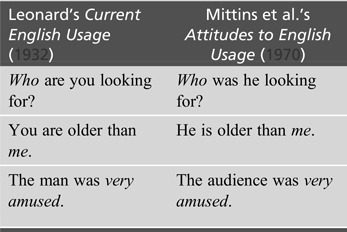
Another similarity between Leonard's and Mittins et al.’s studies is their methodological approach. Using the Direct Approach to elicit attitudes, Mittins and his colleagues further drew on Leonard's study when choosing their stimuli sentences, which were slightly modified, as shown in Table 2.
Comparison of stimuli sentences used by Leonard (Reference Leonard1932) and Mittins et al. (Reference Mittins, Salu, Edminson and Coyne1970)

The examples included in Table 2 also show how the usage problems were highlighted in both studies. Yet, the Mittins study included a much smaller number of usage problems, namely 55 compared to the 230 in Leonard's study. Mittins et al. asked their 457 respondents to categorise these 55 usage problems according to whether these sentences were acceptable in four different contexts: formal writing and speech, and informal writing and speech. The researchers, however, limited the contextual choices for five of the stimulus sentences, as they thought the stimuli sentences would not occur in these contexts. For instance, the option formal writing was not available for the sentence Who was he looking for? (Mittins et al., Reference Mittins, Salu, Edminson and Coyne1970: 10). Despite aiming at providing an insight into what educationalists and teachers considered acceptable in the 1960s, the sample used by Mittins and his colleagues also included a small number of members of the general public, which can be seen as an influence of an early interest in sociolinguistics at the time. This is also reflected by Mittins et al.’s limited analysis of the effect of age on usage attitudes (Reference Mittins, Salu, Edminson and Coyne1970: 22–3). For all that, Mittins et al.’s contribution remained the only study focusing on attitudes towards usage problems in Standard British English.
3.3 Sandred's Good or Bad Scots? (Reference Sandred1983)
Yet another usage attitude study was conducted in Great Britain. In the early 1980s, Karl Inge Sandred investigated attitudes towards Scots in Edinburgh. Having developed from Old Northumbrian, Scots has been in direct opposition with English in Scotland (Sandred, Reference Sandred1983: 13) and is said to consist of two varieties: Doric Scots and Demotic Scots. While the former is associated with the elite and urban speakers, the latter is often described as rural and ‘vulgar’ (Sandred, Reference Sandred1983: 18–19). Therefore, the linguistic setting in Scotland is rather complex as these two varieties and a Scottish Standard English variety are all in use. An assessment of the vitality of Scots and the speech community's attitudes towards disputed usages was taken as the basis for Sandred's investigation. Although his study does not deal with Standard English, it is nevertheless of interest since it exclusively focused on the attitudes of the general public and included a more detailed sociolinguistic analysis of usage attitudes than Mittins et al. (cf. Sandred, Reference Sandred1983).
Like Leonard, and Mittins et al., Sandred also applied the Direct Approach in his attitude study by highlighting the usages features (Reference Sandred1983: 44). However, the sampling technique differs considerably from the two previously conducted usage attitude studies. Sandred made use of the Voters’ Roll through which he randomly selected 40 respondents in different residential areas (Sandred, Reference Sandred1983: 27–8). This random selection contributes to the representativeness of Sandred's survey sample, while it also facilitated Sandred's thorough sociolinguistic analysis of the variables gender, social class and age.
The study included 27 stimuli sentences containing either grammatical or lexical usages, such as Do you ken him?, Wait on me here and She's awful smart (Sandred, Reference Sandred1983: 124). Sandred asked his respondents to classify these stimuli sentences according to whether they are good or bad Scots or English, or to provide another suitable label (Reference Sandred1983: 125). Besides conducting a thorough sociolinguistic analysis and focusing on the general public, Sandred's study differs even further from those by Leonard and Mittins et al. insofar as Sandred did not include context as a factor determining the acceptability of specific usages. He stated that excluding the distinction between the spoken and written media would not require accounting for a possible bias against specific accents (Sandred, Reference Sandred1983: 44). Thus, he was able to identify correlations between usage attitudes and social variables. For instance, older informants found the vernacular use of wait on, as opposed to wait for, less acceptable than younger informants did. Furthermore, Sandred was able to prove a connection between higher acceptability ratings and social class membership, since lower-working-class respondents held more favourable attitudes towards this particular usage feature (Sandred, Reference Sandred1983: 74–7).
3.4 Queen and Boland's ‘I think your going to like me’ (Reference Queen and Boland2015)
The last attitude study I would like to discuss here in detail is one of the most recent studies I was able to identify. While previous attitude studies, such as Leonard, Mittins et al., and Sandred, focused on eliciting whether a specific usage feature is acceptable or not, Queen and Boland's ‘I think your going to like me’ (Reference Queen and Boland2015) aims at assessing the effects of specific nonstandard usages on speakers. The researchers from the University of Michigan make a distinction between three different types of errors: typos, grammos and hypos. While Queen and Boland consider all three error types spelling errors, a distinction needs to be made in that typos ‘violate lexicality constraints’, while grammos ‘violate syntactic constraints’ (Queen & Boland, Reference Queen and Boland2015: 286). Hence a typo such as <gdoo> for <good> is considered a non-word by Queen and Boland and is believed to be caused by mechanical or technical difficulties rather than a lack of knowledge (cf. Queen & Boland, Reference Queen and Boland2015: 286). A grammo such as the failure to distinguish between to and too, on the other hand, would not only render a written sentence ungrammatical, but is also said to be caused by a lack of knowledge (cf. Queen & Boland, Reference Queen and Boland2015: 286). Lastly, hypos or hypercorrections are errors which are also found in the spoken language. An example of what constitutes a hypo is the use of nominative pronouns in non-nominative position, as in Maria and I vs. Maria and me. Queen and Boland (Reference Queen and Boland2015: 285) argue that this kind of error is caused by a change in formality, as the use of the nominative pronoun I in Maria and I is frequently considered to be more formal even if, strictly speaking, grammatically incorrect. What needs to be questioned, however, is the researchers’ lack of recognition of hypos like these as stigmatised language features in the usage debate. The use of the nominative pronouns I for me, for instance, has triggered proscriptions by usage guide authors consistently since 1950s (Ebner, Reference Ebner2017: 277). Furthermore, no complete overview of the usage features investigated is provided in the study.
Having a different purpose than the other usage attitude studies discussed here, Queen and Boland's study focuses on written American English. To assess the effects of typos, grammos and hypos on speakers, the researchers made use of an indirect attitude elicitation technique in two experiments. In the first of these, short email messages representing responses to an advertisement for a housemate were evaluated by 30 undergraduate students. These messages either contained no errors, or only typos and grammos. Hypos were not included in the first experiment. Having read the messages, the respondents were asked to complete a questionnaire containing twelve questions about their perceptions of the message. The respondents’ questionnaire answers were used to calculate a ‘Housemate Scale’ which consisted of an academic scale (i.e. text-related questions) and a social scale (i.e. author-related questions) (Queen & Boland, Reference Queen and Boland2015: 287). According to Queen and Boland's statistical analysis, their respondents evaluated the email messages and consequently their authors more negatively if the message contained errors (Reference Queen and Boland2015: 288–9), resulting in grammos coming at a higher cost on the social scale. This means that messages containing grammos were evaluated more negatively than in the case of typos. In the second experiment, 20 respondents were asked to correct similar emails from potential housemates which contained 24 typos, 31 grammos and 31 hypos (Queen & Boland, Reference Queen and Boland2015: 289–90). The results of this second experiment showed that typos were more frequently corrected by the participants, which Queen and Boland (Reference Queen and Boland2015: 290) argue is most likely due to their salience. They conclude that grammos ‘engage more strongly the mechanisms of social cognition influenced by ideologies of the standard language’ (Reference Queen and Boland2015: 290). Thus, as this study demonstrates, non-conformity to standard language ideologies can have negative effects on how a speaker is perceived.
The four attitude studies I have discussed here provide insights into how the scientific study of attitudes towards usage problems has developed in two parts of the Anglophone world. While Leonard's and Mittins et al.’s studies show a clear connection to education, Sandred's and Queen and Boland's studies indicate a shift in focus on the wider social context as well as the consequences of language use on speaker perception. Needless to say, the grammar-crisis which revolved around the changes in teaching English grammar in schools had a significant role to play in the study of attitudes towards usage problems (cf. Hudson & Walmsley, Reference Hudson and Walmsley2005; Ebner, Reference Ebner2017), but it remains intriguing to see where the lack of studies focusing on British Standard English stems from.
4. Great Britain and the United States: Divided by an attitude
A possible explanation for the difference identified in the preceding section is provided by Lesley Milroy (Reference Milroy2001), who argues that Great Britain and the US are two nations with different language ideologies. Central to her discussion is the so-called ‘standard language ideology’, which encompasses popular notions of one language variety being considered the only legitimate and correct variety (Milroy & Milroy, Reference Milroy and Milroy2012: 30–1). Yet, the factors which influence popular notions of what the standard variety is seem to differ between the two nations. According to Milroy (Reference Milroy2001: 58), accent seems to play a central role in the definition of what standard language means in Great Britain in contrast to the US, while the absence of nonstandard lexical and grammatical features, such as double negatives, is foregrounded in the American context. These two factors are intrinsically connected to the historical development of the two language varieties. Looking back at a history of migration and immigration, language ideologies in the United States of America, including the standard language ideology, seem to be more defined by ethnicity than in Great Britain, where belonging to a specific social class has a greater impact on a speaker's perceived standardness (cf. Milroy, Reference Milroy2001: 61). Received Pronunciation (RP) is considered the ‘standardised accent of English’ (Trudgill, Reference Trudgill, Bex and Watts1999: 118) and is clearly associated with an elite upper class, which does not come as a surprise in the light of the accent's historical connection to public schools (Leith, Reference Leith1997: 56). According to Cameron (Reference Cameron1995: 93), moreover, ‘[i]t is frequently assumed that grammar, at least in Britain, is essentially a symbol of class’ , while she also notes that the middle classes in the UK tend to feel ‘exaggerated respect’ for standard grammar (Reference Cameron1995, 107; see also Tieken–Boon van Ostade, Reference Tieken–Boon van Ostade2013 :10).
If social class plays a crucial role in British society and in how the standard language variety has come to be viewed in Great Britain, this further helps to explain why attitude studies towards usage problems, particularly when they deal with features of grammar, seem to have been less popular in Great Britain than in the US. With a rather rigid social class system in place, academics seem to have somewhat neglected the impact of social class membership in Great Britain on how differences in language use can reflect such social class affiliations. Emphasizing the impact of what is known as ‘classism’ in society, Halliday (Reference Halliday and Pütz1992: 72) argues:
It is acceptable to show up sexism – as it is to show up racism – because to eliminate sexual and racial bias would pose no threat to the existing social order: capitalist society could thrive perfectly well without sexual discrimination and without racial discrimination. But it is not acceptable to show up classism, especially by objective linguistic analysis … because capitalist society could not exist without discrimination between classes.
Hence, the lack of usage attitude studies could stem from a fear of possible ramifications of highlighting social differences, which could ultimately have an impact on the existing social class system in Great Britain. Since social hierarchies in the United States seem to be more bound to ethnicity than social class, as Milroy argues in her paper, investigations dealing with attitudes towards disputed, nonstandard usage features do not violate popular notions of what standard language means, whereas in Great Britain such studies might potentially bring to light a divided society in which the majority of speakers is denied access to the linguistic code which breaks the social-class-ceiling. This is in line with Milroy's (Reference Milroy2001: 70) argument for differing national language ideologies between the two countries stating that ‘language varieties indexing race and ethnicity come to the fore in American ideologies, while those that index class recede’.
5. Conclusion
With this paper, I illustrated two diverging attitudes towards the scientific study of attitudes towards usage problems, i.e. in Great Britain and the United States. The different factors shaping American and British standard language ideologies as described by Milroy (Reference Milroy2001) illustrate how the two nations are not only divided by how the standard variety is defined but are also separated by their attitudes towards studying usage attitudes. The importance of social class in the definition of British Standard English needs to be emphasized, as this crucial social factor could have had an impact on these attitudes. Despite my fruitless efforts in identifying usage attitude studies in the British context, I need to stress that the studies discussed in this paper are, most likely, not the only scientific treatments of usage attitudes in American and hopefully also in British English. With my own investigation into the subject (Ebner, Reference Ebner2017), I have tried to reduce the gap in usage attitudes studies between Great Britain and the United States of America somewhat as well as to provide a current snapshot of usage attitudes in British English.
 CARMEN EBNER is currently a
Teaching Fellow in Sociolinguistics at Queen Mary University of London.
She obtained her doctorate in Linguistics from Leiden University, the
Netherlands, in 2017 where she was part of the NWO-funded project
Bridging the Unbridgeable: Linguists, Prescriptivists and
the General Public led by Prof. Ingrid Tieken–Boon van
Ostade. Her current research focuses on linguistic discrimination,
language variation and change, language attitudes and language
ideologies. Email: carmen.ebner@qmul.ac.uk