Introduction
The Great East Japan Earthquake occurred on March 11, 2011 and was an unprecedented major disaster. The earthquake and the subsequent tsunami caused devastating destruction in the coastal areas of Tohoku region in Japan. As a result, 15,891 people lost their lives and 2,584 people are still missing (as of March 11, 2015). Many health care providers themselves were victims of the disaster, and the maternity institutions also were damaged seriously. In Miyagi Prefecture, there were 19,445 births before the earthquake disaster (in 2010). After the disaster, the perinatal care system reached an unprecedented critical state in this area. In addition, valuable medical information was lost and it became very difficult to determine the accurate trends and conditions of pregnant patients.
There have been reports on analysis of perinatal outcomes after recent major disasters such large earthquakes, floods, and typhoons. These reports have shown an increase in miscarriages, premature births, and low birth weight infants.Reference Sugawara, Hoshiai, Sato, Tokunaga, Nishigori, Arai, Okamura and Yaegashi 1 - Reference Xiong, Harville and Mattison 6 However, there have been only a few reports on the state of regional obstetrical care after a major disaster.
No advanced country has experienced this type of a tsunami disaster following a major earthquake. In this study, surveys were conducted in hopes that statistics of obstetric emergencies could be useful in devising future disaster countermeasures in Japan and other countries.
Materials and Methods
Surveys on Disaster Damages of Maternity Institutions
In May 2011, an interview survey was conducted to examine disaster damages of maternity institutions (50 institutions) in Miyagi Prefecture. The damages were classified into complete, partial, or slight damage. Another interview survey was performed to examine the stoppage of childbirth services after the earthquake disaster.
Surveys on Evacuation Status of Pregnant Women
In May 2011, a survey was conducted on 48 maternity institutions: 11 hospitals and 37 medical clinics. An evacuation or a transport problem caused some pregnant women to deliver their children at institutions other than where they had their childbirth appointment. The survey examined the number of cases of delivery at unplanned institutions in a two-month period after the earthquake disaster (March 11, 2011-May 10, 2011). A questionnaire survey was performed on the same evacuee cases regarding perinatal outcomes (gestational age at delivery and birth weight).
In June 2011, a subsequent survey was conducted in 12 key hospitals in Miyagi Prefecture to examine the number of cancelled childbirth appointments in each institution during the three months after the earthquake disaster (March 11, 2011-June 10, 2011) and to examine the location where the patients had their cancelled childbirth appointments.
Surveys on Prehospital Childbirths
A questionnaire survey was used to examine the state of emergency transport of pregnant women in a two-year period: one year before and after the earthquake disaster (before: April 1, 2010-March 10, 2011; after: March 11, 2011-March 31, 2012). The survey was conducted on all 12 fire departments that handle emergency transport in Miyagi Prefecture. In Japan, ambulances are dispatched from fire departments. These time intervals were used because statistics in Japan are compiled annually from April 1st to March 31st. The items analyzed were the number of cases involving transport of pregnant women, mean transport time, and number of cases with prehospital childbirths.
Results
Surveys on Disaster Damages of Maternity Institutions
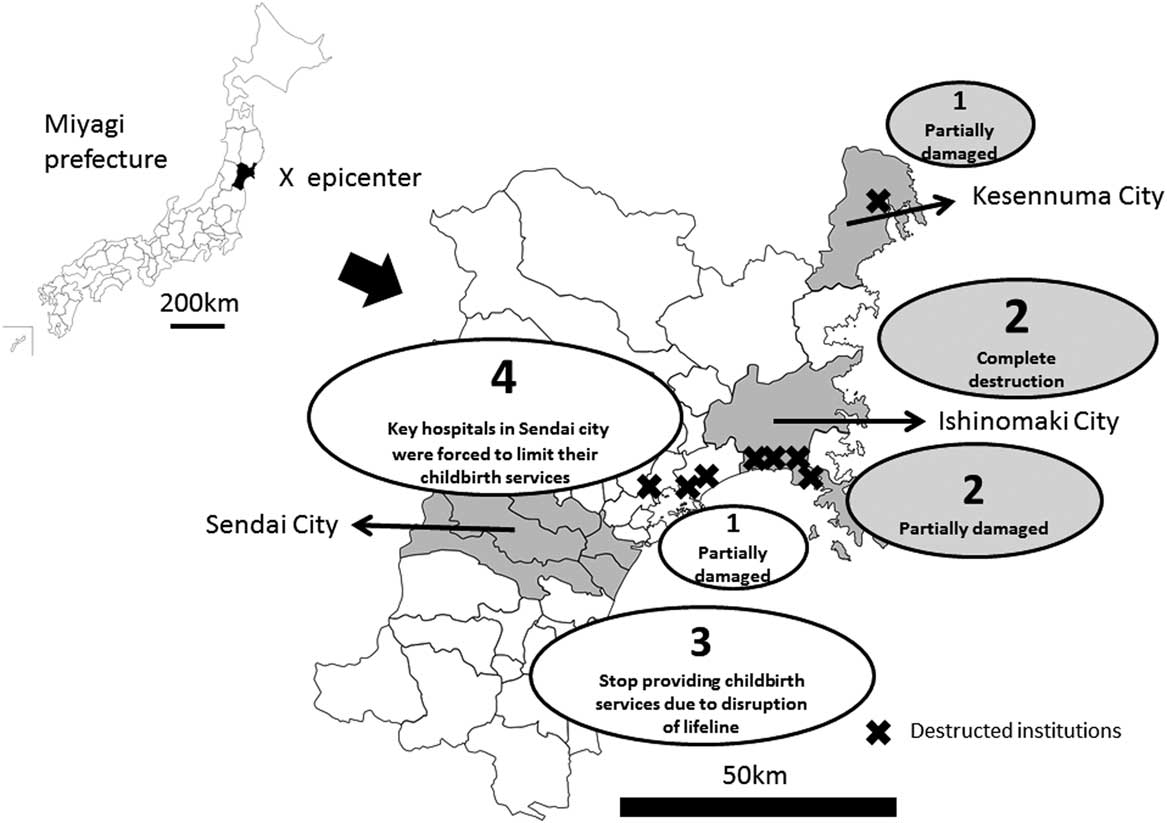
In this questionnaire survey, the response rate was 100% from 50 maternity institutions. The Ishinomaki region was the most devastated area with 3,541 deaths due to tsunami (as of March 11, 2015). In this region, two clinics were closed due to complete destruction and two clinics were damaged partially. There were two clinics with partial damage in other regions. Ishinomaki Red Cross Hospital and Kesen-numa City Hospital are key hospitals in the tsunami disaster area and were spared of flooding. In the outskirts of Sendai City, three clinics had to stop providing childbirth services due to disruption of lifeline. There were four key hospitals in Sendai city that were forced to limit their childbirth services (Figure 1).
Results of Survey on Disaster Damages of Maternity Institutions. Survey was conducted to examine disaster damages of maternity institutions in Miyagi. The damages were classified into complete, partial, or slight damage. Another interview survey was performed to examine the stoppage of childbirth services after the disaster.

Surveys on Evacuation Status of Pregnant Women
In this questionnaire survey, the response rate was 100% from 48 maternity institutions. In the two-month period after the earthquake disaster, 217 pregnant women gave birth at institutions other than where they planned because of transport or evacuation. In the tsunami disaster area, Ishinomaki Red Cross Hospital had 93 childbirths without an appointment, which was over twice the normal number. There were 17 childbirths without an appointment in Kesen-numa City Hospital, which played a major role at the frontline of the tsunami disaster. Many childbirths without an appointment occurred in key hospitals in Sendai City: 24 cases in Tohoku University Hospital, 23 cases in Sendai Red Cross Hospital, and 23 cases in Tohoku Kosai Hospital. The survey results are shown regarding perinatal outcomes in pregnant women who gave birth at unplanned institutions due to evacuation or transport for the same two-month period after the earthquake disaster. The mean gestational age at birth was 38.9 weeks (SD=1.5 weeks; 31 weeks, 5 days-41 weeks, 6 days), the mean birth weight was 3,040.6 grams (SD=424.3g; 1,688g-4,272g), the premature birth rate was 4.1% (nine cases), and the low birth weight rate was 6.9% (15 cases; Table 1).
Perinatal Outcomes in Pregnant Women Who Gave Birth at Unplanned Institutions

Outcomes in childbirth with evacuation or transport for the two-month period after the disaster (n=217). Data are shown as mean (SD).
Abbreviation: SFD, small for dates.
Overall, there were 196 cases of childbirth appointment cancellations. Seventy of these cases were due to out-of-town patients canceling their trip to the disaster area where their parents live. Many such patients were from the Kanto region: 12 patients from the Tokyo metropolitan area, nine patients from Kanagawa Prefecture, and eight patients from Chiba Prefecture. Among the evacuees, many patients who cancelled childbirth appointments had opted to give birth near the Tohoku region where their relatives lived (43 patients) or were overseas students who returned to their home country (14 patients). There were 20 unconfirmed patients whom a contact could not be established with the patients and could not be tracked.
Surveys on Prehospital Childbirths
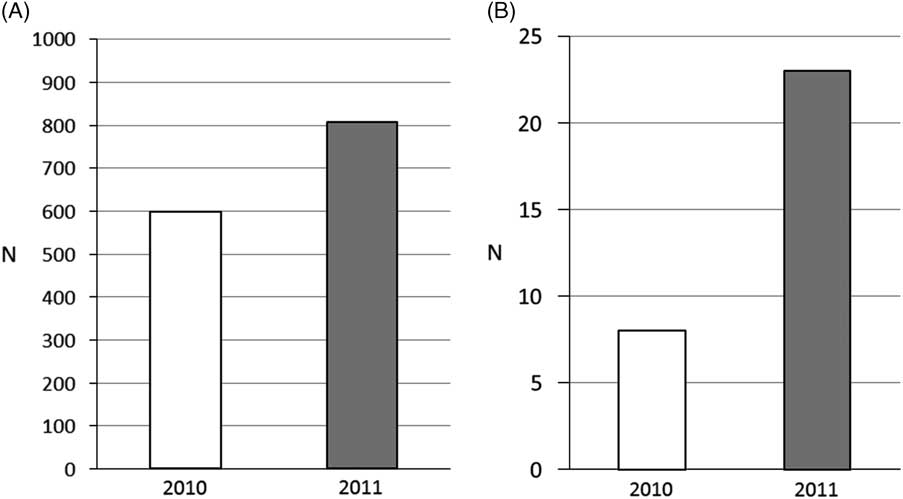
In this questionnaire survey, the response rate was 100% and 433 respondents were emergency medical technicians. There were 807 transported pregnant women after the earthquake disaster, which was approximately 1.4 times the number before the disaster (598 transported pregnant women before the disaster; Figure 2A). When transported pregnant women were examined by region, there were 394 such women after the disaster (377 before the disaster) in Sendai City, indicating a similar number before and after the disaster. However, it was 214 women after the disaster (131 before the disaster) in the coastal area, resulting in a post-disaster number that was approximately 1.6 times the pre-disaster number. The mean transport time was 32.1 minutes after the disaster (33.8 minutes before the disaster) in Sendai City and 31.7 minutes after the disaster (28.5 minutes before the disaster) in the coastal area, indicating a longer time after the disaster. Before the disaster, eight prehospital childbirths occurred among cases from all prefectures. Twenty-three prehospital childbirths occurred after the disaster, a number approximately three times the pre-disaster number (Figure 2B). Of these childbirths after the disaster, eight were in Sendai City and seven were in coastal municipalities. Nineteen childbirths occurred before the emergency team reached the patients.
Number of Transported Pregnant Women and Prehospital Childbirths after the Disaster. (A) 807 pregnant women were transported after the earthquake, which was approximately 1.4 times the number before the disaster. (B) There were 23 prehospital childbirths after the disaster, indicating a marked increase to approximately 3 times the number of the previous year.

Discussion
This study is the first detailed report on the following items which have not been elucidated in previous reports on perinatal outcomes after a major disaster: disaster damages of maternity institutions in tsunami disaster areas, evacuation status and transport of pregnant women, and prehospital childbirths. Damages from such a major earthquake and subsequent tsunami could not be foreseen, even in the Tohoku region in an advanced country like Japan, which is prepared for major disasters. The results of this study will provide useful information for future disaster countermeasures.
Miyagi Prefecture was better prepared for an earthquake disaster compared with other regions because the Miyagi-oki Earthquake had been predicted to hit the area. However, the disaster damage surveys of maternity institutions revealed that coastal institutions still suffered extensive damages due to the tsunami that greatly exceeded predictions. In particular, there tended to be more damages in institutions where much of their medical equipment was located on the first floor. In addition, there were problems of deterioration of key hospitals and non-working emergency electrical power sources.
The surveys on evacuation status of pregnant women showed that perinatal transport was not possible in the hyper-acute phase of the disaster, and pregnant women inevitably gave birth in institutions different from their planned institutions. The patients still managed to achieve satisfactory outcomes due to the efforts of health care professionals in perinatal care. However, the ability to obtain satisfactory outcomes is a major issue in the construction of a future disaster management system.
The survey of prehospital childbirths indicated a dangerous state. Difficult access to hospitals caused many pregnant women to give unplanned births outside the hospitals. Since this type of situation can occur at any time, training in obstetric emergency management needs to become prevalent among all providers involved in obstetric emergency care, such as obstetricians and midwives.
Limitations
In the surveys of this study, one limitation was that accurate clinical statistics could not be obtained because part of the non-electronic medical information had been lost permanently due to the tsunami. Thus, it is speculated that there were difficulties in more pregnant evacuees than this study showed. For prehospital births, it is realized that there were women who had given birth at home or in evacuation centers unbeknownst to the emergency medical teams. A more detailed analysis is currently ongoing regarding perinatal outcomes in the entire prefecture. It is necessary to construct a special system that recognizes pregnant women as people with special needs in disaster situations.
Conclusion
After the major disaster, the perinatal care system reached an unprecedented critical state, even in well disaster-prepared regions. To maintain regional obstetrical care in unexpected situations, it is recommended that simulation training for prehospital or unplanned births should be accepted widely in all obstetric care providers and the disaster command system for emergent maternal transfers needs to be established at regional and national levels.