Cases of transposition of the great arteries with an intact ventricular septum and aortopulmonary collateral arteries are common, although cases of symptomatic collateral arteries are rare. We report a case of transposition of the great arteries with an intact ventricular septum in a male neonate, with postoperative pulmonary haemorrhage due to an aortopulmonary collateral artery that we discovered after surgical repair.
Case report
The neonate was born at 39 weeks of gestation, and he weighed 2902 g. Severe cyanosis was detected immediately after birth with a peripheral oxygen saturation of 65–70% on room air. Echocardiography revealed suspected transposition of the great arteries with an intact ventricular septum. Therefore, he was immediately referred to our hospital.
Echocardiography confirmed the anterior-to-posterior relationship of the great vessels, typical of transposition of the great arteries, with the usual branching pattern of the coronary arteries, as well as an intact ventricular septum, restrictive patent foramen ovale, and a patent ductus arteriosus. There was no evidence of coarctation of the aorta. Using echocardiography, balloon atrial septostomy was immediately performed, which increased his room air oxygen saturation to 80%.
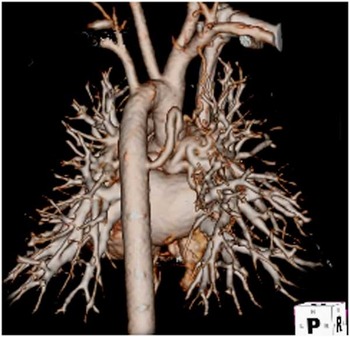
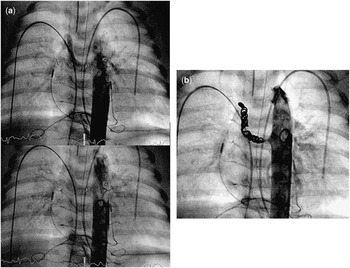
On day 17, the patient underwent a successful arterial switch operation. Preoperative echocardiography confirmed that the left ventricular pressure was well maintained at systemic levels and that there was no echocardiographic evidence for the presence of aortopulmonary collateral vessels. During the surgery, we noted an unusually high pulmonary venous return, although there were no other remarkable findings. The patient was subsequently weaned off cardiopulmonary bypass, although postoperative chest radiography subsequently revealed pulmonary oedema, and bloody sputum was aspirated with endotracheal suctioning immediately after he arrived at the ICU. The airway bleeding did not improve over the following 3 days, and echocardiography suggested the presence of a large aortopulmonary collateral artery. CT images subsequently confirmed the existence of a large aortopulmonary collateral artery arising from the descending aorta and connecting to the right pulmonary artery (Fig 1). We initially assumed that the physiological impact of the collateral artery was not clinically important and we, therefore, attempted to wean respiratory support, although without success. Owing to prolonged low cardiac output during this time, we provided continuous inotropic support. On postoperative day 9, we performed coil embolisation of the aortopulmonary collateral artery (Fig 2). Contrary to our initial expectation, angiography revealed that this collateral artery mediated antegrade perfusion of the entire right lung and that it was connected to small collaterals that were running into the left lung. After the coil embolisation process, his condition improved dramatically, and we were able to begin tapering of the inotropic support. He was extubated on postoperative day 11, and was discharged with no subsequent complications.
An aortopulmonary collateral artery arising from the descending aorta and connecting to the right pulmonary artery.

( a ) A massive aortopulmonary collateral artery is visible, arising from the descending aorta and connecting to the right pulmonary artery, and resulting in perfusion of the entire right lung. There are small collaterals that are connected to this large collateral and connect to the left lung. ( b ) Successful coil embolisation of the aortopulmonary collateral artery.

Discussion
The concomitant presence of aortopulmonary collateral arteries and transposition of the great arteries is common, although symptomatic large collaterals are rare – for example, Wernovsky et alReference Wernovsky, Bridges, Mandell, Castañeda and Perry 1 have reported that a significantly increased bronchial flow was observed in 55 of 119 (46%) patients with transposition of the great arteries, although most patients remained asymptomatic. In the literature, we found five cases of transposition of the great arteries with an intact ventricular septum that were complicated by aortopulmonary collateral arteries, which affected the postoperative course, leading to death in one case.Reference Santoro, Carrozza, Russo and Calabrò 2 – Reference Aghaji, Freiberg, Burlingame and Litwin 5 These anomalous aortopulmonary collateral arteries can cause airway haemorrhage with hypoxia and low cardiac output due to pulmonary hyperperfusion.Reference Santoro, Carrozza, Russo and Calabrò 2 – Reference Aghaji, Freiberg, Burlingame and Litwin 5 In four of the five reported cases, preoperative pulmonary over-circulation was not apparent, and even preoperative aortic angiography failed to demonstrate the aortopulmonary collateral arteries that later became apparent.Reference Santoro, Carrozza, Russo and Calabrò 2 Interestingly, in the case that was diagnosed preoperatively, the collateral artery had a diameter of only 1.2 mm, and it immediately increased to 2.7 mm after the operation, which caused lethal pulmonary haemorrhage into the airway.Reference Golej, Trittenwein, Marx and Schlemmer 4 Santoro et alReference Santoro, Carrozza, Russo and Calabrò 2 have also reported that vasoconstriction – caused by local pulmonary hypoxaemia – and ductal steal can obscure the flow through some aortopulmonary collateral arteries.
In the present case, we did not consider the possibility of collateral pulmonary blood supply, based on the preoperative echocardiography findings. It is also possible that other more aggressive preoperative imaging modalities such as angiography and/or CT imaging with contrast might not detect a potentially problematic aortopulmonary collateral artery if the aortopulmonary collateral vessel is small and constricted due to ductal steal and/or local tissue hypoxaemia, as previously reported.Reference Golej, Trittenwein, Marx and Schlemmer 4 Even if a small or constricted aortopulmonary vessel had been detected preoperatively, its diminutive size may have dissuaded us from further investigation or aggressive treatment. The increased pulmonary venous return seen during the operation might also have led us to consider the possibility of a collateral pulmonary blood supply, although, at the time of the surgical repair, this did not appear to affect our ability to wean him from cardiopulmonary bypass; however, given the existing reports, increased pulmonary venous return may indicate an extra-pulmonary blood supply, which might increase in size intra-operatively, thereby adversely affecting the postoperative clinical course. This knowledge should stimulate earlier investigation in similar cases and certainly supports the earlier use of coil embolisation compared with the present case. We assume that this problematic aortopulmonary collateral dilated intra-operatively, rather than postoperatively, because of the intra-operative finding of a remarkable increase in pulmonary venous return. Furthermore, the preoperative echocardiograms did not show probable aortopulmonary collateral vessels, whereas the postoperative echocardiograms did. The reason for the intra-operative dilation of the aortopulmonary collaterals remains unclear, but we speculate that this may relate to hyperoxia associated with cardiopulmonary bypass and/or lower pulmonary vascular resistance associated with general anaesthesia.
The existence of aortopulmonary collateral arteries should be considered in patients with transposition of the great arteries who have postoperative signs of important pulmonary over-circulation. Clinicians should maintain a low threshold for performing more aggressive investigations such as angiography and/or CT imaging with contrast to direct subsequent therapy when the clinical course is suggestive.
Acknowledgement
The authors are grateful to Dr. Kim Sung-Hae, a staff of the Department of Cardiology at Mt. Fuji Shizuoka Children’s Hospital, Shizuoka, Japan for his support in this work.
Financial Support
This research received no specific grant from any funding agency, commercial, or not-for-profit sectors.
Conflicts of Interest
None.