Introduction
The number of people without health insurance coverage in the US is large and growing (Tanne, Reference Tanne2006). About 15.9% of the US population (46.6 million) was uninsured in 2005 and the lack of health insurance is associated with limited health care access and poor health outcomes for lower income people (DeNavas-Walt et al., Reference DeNavas-Walt, Proctor and Lee2006; Institute of Medicine: Committee on the Consequences of Uninsurance, 2002). The value of uncompensated health care services provided to the US uninsured population has been estimated at about $35 billion (Hadley and Holahan, Reference Hadley and Holahan2003; Institute of Medicine: Committee on the Consequences of Uninsurance, 2003).
Research has shown that, as would be expected, the higher the local uninsurance rate, the more likely it is that the uninsured will report having difficulties accessing health care (Cunningham and Kemper, Reference Cunningham and Kemper1998; Cunningham, Reference Cunningham2004). More recent research has shown a less obvious result: that the relative size of the local population without health insurance coverage is also positively related to insured adults reporting that they had unmet medical needs (Pagán and Pauly, Reference Pagán and Pauly2006).
However, the path by which high rates of community uninsurance worsen access and quality for the insured is not well understood. Some part of the connection is surely financial: higher costs for uncompensated care reduce resources available for the insured population if insurance premiums are not able to rise. For hospitals and other organizations that must meet a bottom line, this may be the entire story. But physicians in private practice almost always earn positive net incomes; while they would obviously prefer not to have lower incomes they are rarely forced to cut back purely for financial reasons. Hence, for physicians, the connection between high local uninsurance and the quality of, or access to, health care for the insured population is less direct and less clear. In this study, we use some recent survey data from individuals and physicians in 60 US communities to try to fill in the picture of how more uninsured patients turns into less access to high quality physician services for insured patients.
The path we can trace in the data has two steps. Recent research has shown that physician income, core professional values, and autonomy are all related to overall career satisfaction (Stoddard et al., Reference Stoddard, Hargraves, Reed and Vratil2001). Satisfaction, we will assume, has as a major component the ability to deliver high quality and high value care to patients. If such health care is delivered, doing so should enhance patient trust. This is not just speculation; some research shows the individual trust in physicians is related to aspects of the local health care and financing system, such as gatekeeping restrictions of managed care (Haas et al., Reference Haas, Phillips, Baker, Sonneborn and McCulloch2003).
The objective of this paper therefore is to link an indicator of community uninsurance both with measures of physician satisfaction and quality, and with measures of patient trust among insured patients. To be specific, we hypothesize that physicians practicing medicine in communities with relatively large uninsured populations have lower career satisfaction and lower perceptions of the quality of care because their local health care systems in general and their medical practices in particular are faced with financial difficulties that limit their ability to deliver high quality care. As a result, patients in high uninsurance communities would be less likely to trust that their physician is acting in their best interest when they provide them with health care services.
Methods
Data description
The data for this study come from three sources: the 2000–2001 Community Tracking Study (CTS) Physician Survey and the 2000–2001 and 2003 CTS Household Surveys. The CTS is conducted by the Center for Studying Health System Change in 60 randomly selected communities throughout the contiguous United States about every two years. The 2000–2001 and 2003 CTS Household Surveys include 59,725 person-level records in 2000–2001 and 46,587 person-level records in 2003. Interviews were conducted from September 2000 to September 2001 and from February 2003 to February 2004 (Inter-university Consortium for Political and Social Research, 2003; Center for Studying Health System Change, 2003; Inter-university Consortium for Political and Social Research, 2005).
The CTS Household Survey focuses on assessing changes in consumer access to the health care system across both time and US communities. Fifty-one metropolitan areas and nine non-metropolitan areas were selected at random for the CTS, and respondent households were drawn from these communities using random-digit dialing. The CTS used area probability sampling to ensure that the sample was representative of households without a phone. Our study included adults between 18 and 64 years of age. After excluding respondents with missing data, our final sample consisted of 25,637 adults in the 2003 CTS Household Survey.
The 2000–2001 CTS Physician Survey includes responses from 12,406 practicing physicians throughout the country in order to obtain information about differences in the delivery of health care across US communities. Interviews were conducted from August 2000 to November 2001. The CTS Physician Survey is conducted over the phone and physicians must have spent at least 20 hours per week in direct patient care to be included in the sample. The 2000–2001 CTS Physician Survey data were collected by the Gallup Organization (Inter-university Consortium for Political and Social Research, 2003). Physicians were asked questions about their practice, their ability to obtain medical services for their patients, quality of care, information technology, financial incentives, practice characteristics, compensation arrangements, and income and career satisfaction. Only physicians specializing in internal medicine and family general practice were considered for this study. These physicians account for 46.9% of the total sample in the 2000–2001 CTS Physician Survey and they are typically the first point of contact for most patients. After excluding respondents with missing data, our final sample consisted of 4,920 physicians.
This paper attempts to simultaneously investigate two separate issues: physicians’ career satisfaction and perceptions about the quality of care provided, and patients’ trust in their physicians. Accordingly, we have two sets of dependent and independent variables.
Dependent variables: physicians’ career satisfaction and quality of care provided
The survey recorded physician responses to the question, ‘Thinking very generally about your satisfaction with your overall career in medicine, would you say that you are currently (very satisfied, somewhat satisfied, somewhat dissatisfied, very dissatisfied, neither satisfied nor dissatisfied)?’ For our analysis, we dichotomized the responses to this question as very satisfied (versus otherwise).
We used five other variables that represent the physician’s perception of the quality of care provided. The responses were ranked from one to five denoting agreement or disagreement with the following statements: (a) ‘I have the freedom to make clinical decisions that meet my patients’ needs’; (b) ‘It is possible to provide high quality care to all of my patients’; (c) ‘I can make clinical decisions in the best interest of my patients without the possibility of reducing my income’; (d) ‘The level of communication I have with specialists about the patients I refer to them is sufficient to ensure the delivery of high quality care’; and (e) ‘It is possible to maintain the kind of continuing relationships with patients over time that promote the delivery of high quality care’. We used a dichotomous variable to indicate whether the physician agrees strongly or agrees somewhat with the above statement (versus otherwise).
We hypothesize that a higher level of community uninsurance will lead to lower levels of career satisfaction among physicians as well as to decreases in the physician’s perception of the quality of care provided in these communities. This would be the case if the proportion of the uninsured population at the local level creates financial pressures on physician practices and local health care systems. Thus, we are expecting to find a negative correlation between level of community uninsurance and the above dependent variables.
Dependent variable: patient trust
The 2003 CTS Household Survey recorded patient responses to the following statements: (a) ‘I trust my doctor to put my medical needs above all others when treating my medical problems’; (b) ‘I think my doctor is strongly influenced by health insurance company rules when making decisions about my medical care’; (c) ‘I sometimes think that my doctor might perform unnecessary tests or procedures’; and (d) ‘I think my doctor may not refer me to a specialist when needed.’ Similar to the physician variables, the responses were ranked from one to five indicating agreement or disagreement with the statement. We used a dichotomous variable indicating whether the patient strongly agrees or somewhat agrees with the above statements (versus otherwise).
Independent variables
The key independent variable explaining differences in physicians’ career satisfaction and their perception of the quality of care provided and patients’ trust is the proportion of the local population without health insurance coverage (i.e., percentage of community uninsurance). This measure has been used successfully in other studies analyzing community effects of uninsurance (Pagán and Pauly, Reference Pagán and Pauly2006). A number of individual- and practice-level control variables were used to predict physicians’ career satisfaction and perceptions of the quality of care provided; and several individual- and community-level variables were used to predict patients’ trust.
Our physicians’ analyses included the following individual-level demographic characteristics: years of age, years of work experience as a physician, gender, country of study (US or foreign medical school graduate) and ethnicity/race. Along with these, the analyses also included the type of practice (primary care physician in internal medicine or family/general practice) and the type of practice/employment (owner of practice, solo or two-physician practice, group practice, group/staff model HMO, medical school/university, non-government hospital and other).
Our patients’ analyses included the following individual-level variables: years of age, years of education, ethnicity/race, marital status, gender, self-reported health status, health insurance coverage status and household income divided by the poverty level. The community-level variables included were median household income (to control for community wealth) and the Gini coefficient in the community of residence (to control for income inequality). All the community-level variables were calculated using person-level sampling weights designed for site-specific estimates with the CTS Household Survey (Center for Studying Health System Change, 2003; Inter-university Consortium for Political and Social Research, 2005). The Gini coefficient is a summary measure of local-level income inequality that ranges from zero to one (i.e., perfectly equal to perfectly unequal distribution of income). Community-level variables were included as adjustments because they are likely to capture the degree by which communities support health-related services that could be linked to health care utilization and improvements in health (Subramanian et al., Reference Subramanian, Blakely and Kawachi2003). For example, median household income is related to the community-level demand for medical care and health. Income inequality – as measured by the Gini coefficient – may capture the degree of social distance across different income groups as well as disparities in community-level spending in health care (Kawachi and Kennedy, Reference Kawachi and Kennedy1999). All of these variables have been included in other studies of community uninsurance and health care access (Pagán and Pauly, Reference Pagán and Pauly2006).
Statistical model
Multilevel logistic regression was utilized to analyze how the proportion of the uninsured population at the community level was related to physicians’ career satisfaction, physicians’ perceptions of the quality of care provided, and patients’ trust in health care providers. We used multilevel logistic regression models because we have individual-level (physicians and patients) dependent variables and both community- and individual-level variables as independent variables. Thus, the statistical model permits us to make inferences about how community-level variables impact a set of physician-level and patient-level outcomes after adjusting for a large set of individual- and community-level variables (Diez Roux, Reference Diez Roux2001). The multilevel models included community-specific random effects and they were estimated using the GLLAMM (Generalized Latent, Linear and Mixed Models) program in Stata 9.2 (Rabe-Hesketh and Skrondal, Reference Rabe-Hesketh and Skrondal2005; Skrondal and Rabe-Hesketh, Reference Skrondal and Rabe-Hesketh2004).
Results
Physicians’ career satisfaction and the quality of care provided
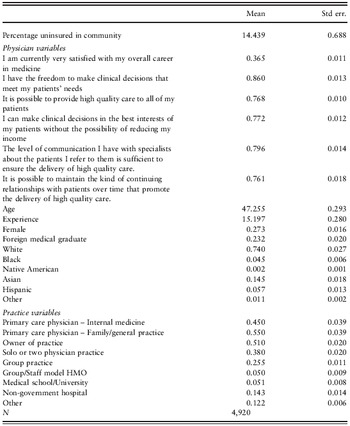
Table 1 presents the means and standard errors for all the variables utilized from the 2000–2001 CTS Physician Survey. The weighted-mean percentage of uninsured adults in the communities where physicians practiced was 14.44%. Local uninsurance rates for the 60 communities in the CTS were estimated using the 2000–2001 CTS Household Survey. These local uninsurance rates were then matched to the community where each physician practiced in the 2000–2001 CTS Physician Survey.
Sample means – 2000–2001 CTS Physician Survey

Almost 37% of the physicians were very satisfied with their overall career in medicine. Eighty-six percent somewhat or strongly agreed with the statement that they had the freedom to make clinical decisions that met their patients’ needs. Almost 77% percent agreed that it is possible to provide high quality care to all their patients. Seventy-seven percent agreed that they can make clinical decisions in the best interest of their patients without seeing reductions in their income. Almost 80% agreed with the statement that their level of communication with specialists to whom they refer patients is sufficient to ensure the delivery of high quality care. About 76% agreed that it is possible to maintain continuing relationships with patients that promote the delivery of high quality care.
Physicians were on average 47 years old and had 15 years of experience after completing their medical education. About 27% were women, 23% were graduates of foreign medical schools, 74% were non-Hispanic white, 4.5% were black, 0.02% were Native American, 14.5% were Asian, and 5.7% were of Hispanic origin. Forty-five percent were primary care physicians in internal medicine and 55% were in family or general practice. Fifty-one percent own their practice, 38% work in a solo or two-physician practice, 25.5% work in a group practice, 5% in a group/staff model HMO, 5.1% in a medical school or university, 14.3% in a non-government hospital, and 12.2% in other types of facilities.
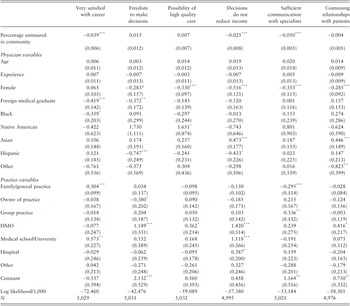
Table 2 reports the coefficients from the multilevel logistic regression models for physicians’ career satisfaction and the five measures of their perceptions of the quality of care provided to their patients. The main independent variable of interest is in the first row – the percentage uninsured in the community where the physician practices medicine. This variable was calculated using the 2000–2001 CTS Household Survey and merged with the 2000–2001 CTS Physician Survey sample. The coefficient for community uninsurance is negative and statistically significant at the 1% level in the career satisfaction equation. Thus, physicians were less likely to respond that they were very satisfied with their career in medicine with increases in the proportion of the population without health insurance coverage. Community uninsurance was also negatively related to the likelihood that a physician believed that they could make clinical decisions in their best interest of their patients without seeing reductions in their income. There was also a negative relationship between community uninsurance and the likelihood that a physician would agree with the statement that their level of communication with specialists was sufficient to ensure the delivery of high quality care. The regression coefficient for community uninsurance was not statistically related to whether physicians believed that they had the freedom to make clinical decisions that met their patients’ needs, whether it was possible to maintain continuing relationships with patients that promoted the delivery of high quality care and whether it was possible to provide high quality care to all patients. Although we were expecting to find an association between community uninsurance and the quality of care delivered by physicians to all their patients, the CTS Physician Survey only captures the doctors’ opinion about the quality of care provided, and this may be an imprecise measure of actual quality.
Multilevel logistic regression – 2000–2001 CTS Physician Survey

Notes: Standard errors in parentheses.
* significant at 10%; **significant at 5%; ***significant at 1%.
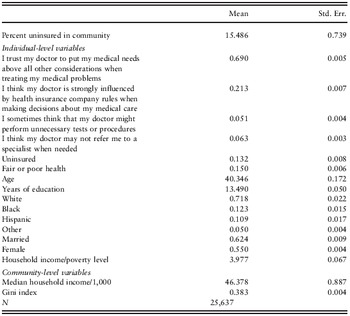
Table 3 presents the means and standard errors for all the variables utilized from the 2003 CTS Household Survey. Sixty-nine percent of the respondents agreed with the statement that they trusted that their doctor would put their medical needs above all other considerations when treating their medical problems. Twenty-one percent agreed with the statement that their doctor was strongly influenced by health insurance company rules when making decisions about their medical care. About 5.1% agreed with the statement that their doctor might perform unnecessary tests and procedures and 6.3% thought that their doctor would not refer them to a specialist when needed.
Sample means – 2003 CTS Household Survey

Slightly over 13% of respondents were uninsured and 15% reported to be in fair or poor health. The average age of respondents was 40.3 years and the average education was almost 13.5 years. About 72% of respondents were non-Hispanic white, 12.3% were black, 10.9% were Hispanic, and 5% belonged to other race/ethnic groups. Sixty-two percent were married and 55% were women. The ratio of household income to poverty level was almost four (that is, the average household earned four times the federal poverty level). The weighted-mean percent community uninsurance was 15.5%, the median household income was $46,378, and the Gini index was 0.383.
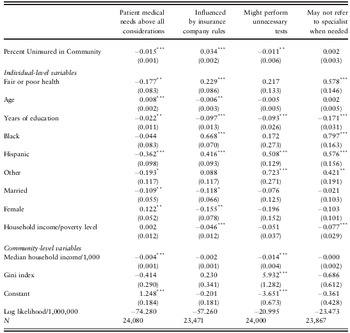
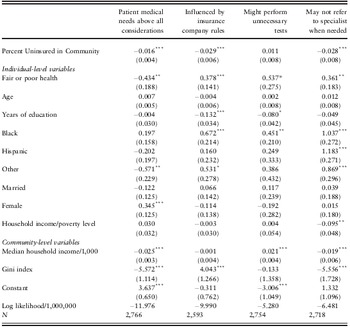
Tables 4a and Table 4b report the coefficients from the multilevel logistic regression models for patient trust in health care providers, separated by health insurance status. The coefficient for the main independent variable of interest – the percentage uninsured in the community of residence – is located in the first row of the community-level variables in each table. For both the insured and uninsured populations, the coefficient for community uninsurance is negative and statistically significant at the 1% level in the first regression. Thus, community uninsurance was negatively related to the likelihood that a respondent would agree with the statement that they trusted their doctor would put their medical needs above all other considerations when treating their medical problems. Community uninsurance was also positively related to the likelihood that an insured respondent would agree with the statement that their doctor was strongly influenced by health insurance company rules when making decisions about their medical care. For the uninsured, the coefficient is negative and statistically significant. However, the responses to this question are probably unreliable, given that the statement refers to whether patients believe that doctors are influenced by health insurance company rules; yet, the population responding the question did not have health insurance coverage.
Multilevel logit models – 2003 CTS Household Survey: insured

Notes: Standard errors in parentheses.
* significant at 10%;
** significant at 5%;
*** significant at 1%.
Multilevel logit models – 2003 CTS Household Survey: uninsured

Notes: Standard errors in parentheses.
* significant at 10%;
** significant at 5%;
*** significant at 1%.
Community uninsurance was negatively – and unexpectedly – related to the likelihood that an insured respondent would agree with the statement that their doctor might perform unnecessary tests and procedures. The coefficient for this variable is positive but statistically insignificant for the uninsured sample. There was no evidence that community uninsurance was related to whether insured respondents believed that their doctor would refer them to a specialist when needed. The coefficient of this variable, however, was negative and statistically significant for the uninsured sample.
Discussion
Using survey data from various years of the CTS Household and Physician Surveys, we found that the higher the proportion of uninsured adults in a given community, the lower the likelihood that physicians would be satisfied with their careers. Community uninsurance was also negatively related to the likelihood that a physician believed that they could make clinical decisions in the best interest of their patients without seeing reductions in their income, as well as to the likelihood that a physician would agree with the statement that their level of communication with specialists was sufficient to ensure the delivery of high quality care. However, we found no statistically significant relation between community uninsurance and whether physicians believed that they had the freedom to make clinical decisions, whether it was possible to provide high quality care to all patients, and whether it was possible to maintain continuing relationships with patients that promoted high quality care.
We also found that community uninsurance was negatively related to whether patients trusted that their doctor would put their medical needs above all other considerations when treating their medical problems. Community uninsurance was also positively related to whether insured patients believed that their doctor was strongly influenced by health insurance company rules when making decisions about their medical care. We found no evidence that community uninsurance is positively related to doctors performing unnecessary tests and procedures. There was no evidence that community uninsurance was related to whether insured respondents believed that their doctor would refer them to a specialist when needed.
The results presented above are consistent with the premise that physicians practicing medicine in communities with relatively large uninsured populations have lower career satisfaction and, to some extent, a negative perception of their ability to make relevant clinical decisions related to the quality of care they provide. A possible explanation for this result is that the size of the local population without health insurance coverage exerts financial pressure on local health care systems and medical practices, thus reducing the willingness or ability of physicians to deliver high quality care.
A corollary of this finding would be that users of health care services in high uninsurance communities would be less likely to trust their physician and whether he/she is acting in their best interest when providing medical care. This is important from a health policy perspective because patient trust has been linked to higher patient satisfaction with health care services, higher acceptance and adherence to therapy, better relationship with heath care providers, and a lower likelihood that patients report having unmet medical needs or health care delays (Altice et al., Reference Altice, Mostashari and Friedland2001; Mollborn et al., Reference Mollborn, Stepanikova and Cook2005; Safran et al., Reference Safran, Taira, Rogers, Kosinski, Ware and Tarlov1998; Thom et al., Reference Thom, Ribisl, Stewart and Luke1999). Thus, physician trust is linked to several outcomes related to health care and it gives us a good idea of the overall performance of physicians and the heath care system (Hall et al., Reference Hall, Dugan, Zheng and Mishra2001).
Our results are also policy relevant because they clearly show several mechanisms by which the size of the local population without health insurance coverage affects physician practices and even patients, regardless of whether they are insured or uninsured. Most studies about the negative consequences of community uninsurance have focused on assessing health and health care outcomes for the uninsured only, but our results clearly show that the insured population experiences negative spillovers from uninsurance in the form of lower quality of health care and less trust in physicians.