Introduction: Uprooting People
The practice of resettling people, uprooting them from their homes and homelands, has deep-seated social, economic and political implications. A large body of literature has examined the contentious politics surrounding the coerced resettlement schemes operating in many nondemocratic and democratizing states of the Global South (Wilmsen and Webber, Reference Wilmsen, Webber, Grugel, Singh, Fontana and Uhlin2017; Martin, Reference Martin, Weiner and Russell2001). Bringing together three familiar features of social life—contention, collective action and politics—contentious politics encompass wide-ranging strategies of both lethal and nonlethal group resistance, including less sustained forms of contention, such as strikes and riots, and more extensive ones, such as civil wars and episodes of democratization (Tilly and Tarrow, Reference Tilly and Tarrow2007: 4). But authoritarian states are not the only regime type that engages in demographic engineering. Canada (Withers, Reference Withers2016) and the United States (Maldonado et al., Reference Maldonado, Shearer, Bronen, Peterson and Lazrus2013) have also implemented resettlement schemes, and studies suggest that they will continue to do so in the foreseeable future due to economic and ecological pressures (see, for example, Hamilton et al., Reference Hamilton, Saito, Loring, Lammers and Huntington2016). Notwithstanding the upsurge of media and government attention to large migration flows, there have been few efforts to theorize the contentious politics of population resettlement programs involving the so-called voluntary relocation of internal or domestic migrants.Footnote 1 Are “voluntary” community resettlement programs contention-free? What sources of coercion are present and how do they operate in situations where resettlement is community-driven?
This article contributes to the literature on population resettlement, contentious politics and coercion by providing an in-depth analysis of the Community Relocation Policy (CRP) of Newfoundland and Labrador (NL) from 2009 to present.Footnote 2 The CRP represents a crucial case for the study of coercion in resettlement since, in an effort to avoid critiques of heavy-handedness that plagued previous resettlement schemes,Footnote 3 the government now requires all communities interested in obtaining relocation assistance to pass through a four-stage process ending with a community vote, and it also provides generous financial assistance to cover the costs of relocation. If a resettlement program were to be genuinely contention- and coercion-free, the CRP should be it.
We first review the literature on resettlement and contentious politics before summarizing our methodological approach. We then provide an in-depth assessment of the latest resettlement program in NL, identifying the conditions fostering contention between the three primary stakeholders involved: the individuals/families resettled, the host communities where people resettled and the government officials participating in the process. Our media analysis shows that the CRP has been fraught with (nonlethal) contention, despite being community-initiated and community-driven. Delving into this puzzle, we show that a growing source of contention within the CRP is the indirect coercive pressure emerging from within the very communities seeking resettlement. We pinpoint two new sources of coercion: the small group of people “holding hostage” the rest of the population wishing to relocate (that is, coercion by the minority) and those exercising pressure on the few undecided voters (that is, coercion by the majority). We conclude with a discussion of the policy implications of resettlement programs for NL and rural communities in the Western world.
Resettlement Programs and Contentious Politics
The broad field of resettlement studies focuses on planned population movements and takes stock of the causes and consequences of resettlement, as well as the structure, actors and policies involved. According to Vanclay's (Reference Vanclay2017: 6) definition, resettlement involves “the comprehensive process of planning for and implementing the relocation of people, households, and communities from one place to another for some specific reason, together with all associated activities.” In other words, resettlement is a process that begins before and continues long after communities or individuals move. It is distinct from other forms of ad hoc relocation because it involves relatively permanent, organized movement by an entire community (King, Reference King2017).
Resettlement schemes are common practices in several nondemocratic or democratizing states of the Global South (Kassymbekova, Reference Kassymbekova2011; Xue et al., Reference Xue, Wang and Xue2013; Tirtosudarmo, Reference Tirtosudarmo, Weiner and S2001; Martin, Reference Martin, Weiner and Russell2001; Baird and Shoemaker, Reference Baird and Shoemaker2007). Authoritarian states—with their extensive reliance on coercion (that is, on the compelling of individuals to obey by threatening their lives or livelihoods), limited room for debate, control over the media and access to extensive financial and material resources—are particularly well positioned to organize population movements (Côté, Reference Côté2014). This is not to say that other political regimes have shied away from relying on population resettlement to promote their respective agendas. In India, over 60 million people have been involuntary displaced for various development projects since the country's independence (CSD, 2008). Established Western democracies have likewise adopted resettlement schemes—for example, Canada's controversial Inuit Resettlement Project relocated Inuit families to Resolute Bay and Grise Fiord in the 1950s so that Canada could claim sovereignty in the High Artic (Grant, Reference Grant2016).
While a country's political regime and institutions affect the parameters of resettlement (such as the organization of resettlement or the rapidity of implementation), they also affect resettlement's political impacts, shaping how groups respond to it and making it more or less contentious (Tilly and Tarrow, Reference Tilly and Tarrow2007; Ramos and Rodgers, Reference Ramos and Rodgers2015). In particular, a major debate within the scholarship on resettlement concerns the role that coercion plays in fostering contentious politics (see, for example, Wilmsen and Wang, Reference Wilmsen and Wang2015). What constitutes coercion is not always clear, however, and dissatisfaction has grown in recent years over the conventional categorization of migration and resettlement as either voluntary or forced. Even when resettlement is voluntary, Lyall (Reference Lyall2017) cautions that observers must not lose sight of the potentially coercive practices of the state, nor should they ignore the legacies of oppression and disenfranchisement that may have led to certain kinds of decision making. Along similar lines, Schmidt-Soltau and Brockington's (Reference Schmidt-Soltau and Brockington2007: 2184) investigation of development-induced resettlement in Cameroon revealed how prevalent coercive pressures are, even in cases where people formally consented to, and were compensated for, relocation. As the authors conclude, the current understanding of voluntary resettlement is missing the needed emphasis on informed, prior and free consent, along with the option not to relocate (2007: 2194). Gebre's (Reference Gebre2002: 270) framework further expands on the voluntary/involuntary dichotomy by introducing two additional categories of resettlement: compulsory-voluntary, where resettlement is deliberately induced by outside agencies or government; and induced-voluntary, where people embrace relocation out of desperation. The latter draws parallels with Wilmsen and Wang's (Reference Wilmsen and Wang2015: 617) “coercion by deprivation,” where people may initially choose to stay behind and not participate in resettlement programs but are ultimately forced to relocate due to the long-term consequences of state-organized resettlement.
Together, these studies highlight the multiple forms that coerced resettlement may take, contributing to a more refined understanding of the full spectrum of resettlement practices. However, nearly all of them adopt a narrow understanding of coercion, focusing on state-exercised coercion to the exclusion of other sources of coercion. This is not entirely surprising since a majority of resettlement schemes are initiated, organized and funded by state actors, be they national government officials, as in Indonesia (Tirtosudarmo, Reference Tirtosudarmo, Weiner and S2001), or subnational government workers, as in NL or Quebec (see Loo, Reference Loo2019). For this reason, the most common form of resettlement-induced contentious politics involves community members and state actors, where those carrying out resettlement policies and applying coercion—that is, government officials—are targeted by the population (to be) resettled. But state representatives are not all equally at risk of being targeted by contention. Oliver-Smith (Reference Oliver-Smith1991) points out that ethnic differences between the ruling elites and the population to be relocated make resistance more likely. Conversely, ethnic differences between agents of resettlement and the host communities may turn migration into a contentious process if the receiving community sees mass resettlement as a tool to reduce their demographic and political power (Bookman, Reference Bookman2002). In this context, host communities may express their opposition to resettlement by clashing with incoming migrants, a dynamic best examined by Weiner (Reference Weiner1978) in his work on “Sons of the Soil” conflicts.
Absent from this academic literature is a focus on the tensions and coercion emerging within the communities considering resettlement. Despite their small size, such communities are far from homogenous, consisting of people of different socio-economic backgrounds, with access to varying levels of social and financial capital. Focusing solely on state coercive practices glosses over the fact that within-community power differentials and inequalities exist and that these may affect group relations and resettlement dynamics.
Approaching Resettlement in Newfoundland and Labrador
European populations first started settling in the territory currently encompassed by the province of NL in the sixteenth century; their reliance on fishing resources ultimately lead to the creation of 1,200 sparsely populated communities scattered over 29,000 kilometres of coastline. When NL joined Canadian Confederation in 1949, the highly dispersed population and economic dependence on small-scale fishing was blamed for the province's high unemployment, low levels of production, lack of technical advancement and difficulties in ensuring access to government services and health care facilities (Matthews, Reference Matthews1978). Resettling poor, isolated communities in NL was one tool in a broader set of postwar strategies that sought to modernize the fisheries, centralize populations around “growth poles” and spread “social and material rights” to all Canadian citizens (Blake, Reference Blake2015: 104; Loo, Reference Loo2019).
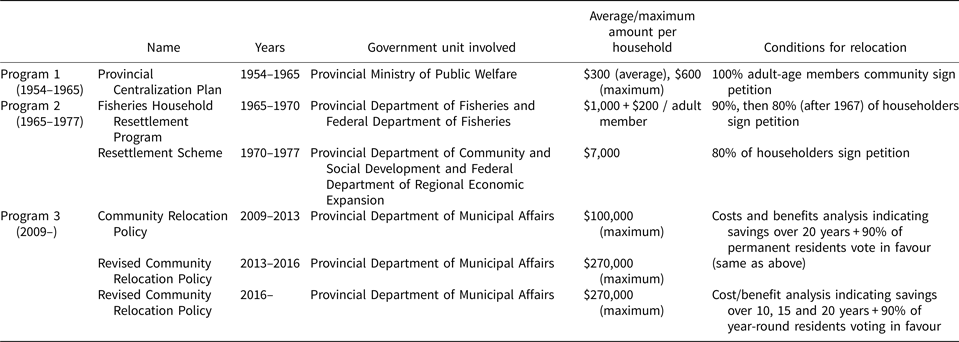
There have been three distinct economic resettlement programs in NL's history (see Table 1). The province's Centralization Plan (1954–1965) saw the relocation of 115 communities as part of a broader set of socio-economic reforms introduced by Premier Joseph R. Smallwood (Matthews Reference Matthews1978: 89). The second program, the Newfoundland Fisheries Household Resettlement Program (FHRP) was a federal-provincial program, later called the Resettlement Scheme (1970–1977). In total, these two programs moved 20,614 people (or 4,094 households) (Federal-Provincial Resettlement Program, n.d.) to 77 “growth centres” (Matthews, Reference Matthews1978: 98). In 2009, after three decades of dormancy, the province introduced a third program: the Community Relocation Policy (CRP). While a substantial body of literature has focused on the first two programs—linking them to fisheries modernization (Wright, Reference Wright2001), the evolution of Canadian federalism (Blake, Reference Blake2015) and the political culture of postwar Canada (Loo, Reference Loo2019)—the current wave of resettlement is still unexplored.
Phases of Population Resettlement in Newfoundland and Labrador and Key Characteristics

Recent research on the pre-1977 resettlement programs underscores that the state held far from complete control over the resettlement process. Some communities, such as Fogo Island and Harbour Deep (Withers, Reference Withers2016), successfully resisted pressure to resettle, while others, such as Pushthrough, fought for their own resettlement (Blake, Reference Blake2015). People and households used resettlement for their own advantage and often in ways that undermined the government's goals (Loo, Reference Loo2019). Previous research has also documented the anger and contentious politics surrounding the first two resettlement periods, including in letters of correspondence to government agencies and local officials (Matthews, Reference Matthews1970). Withers (Reference Withers2016) illustrates the considerable tension between existing and new residents within communities such as Arnold's Cove that were designated as growth centres. Local and national media coverage played a role in magnifying these tensions (Withers, Reference Withers2016).
Resettlement in NL was—and still is—closely intertwined with the fisheries. The collapse of northern cod stocks in the early 1990s shook NL's economy to its core, prompting a moratorium that put 35,000 fishers and plant workers out of work, inducing out-migration and decline across NL's coastal communities (Mather, Reference Mather2013). Although resettlement was no longer actively pursued from 1978 to 2009, the economic downturn propelled some small and isolated communities to quietly request—and obtain—government assistance to relocate, including Great Harbour Deep in 2002, Petites in 2003 and Big Brook in 2004. In 2009, the CRP formalized the process by which communities could potentially receive financial compensation for resettlement. Like the pre-1977 resettlement programs, the CRP has been the subject of substantial controversy. This article focuses on the community dynamics of this process, asking what the CRP reveals about the relationship between coercion and contentious politics in democratic resettlement decisions and exploring the sources of coercion in situations where resettlement is community-driven.
Methodology
To address these questions, we adopted a qualitative multisource approach, including analysis of media, publicly available policy documents and unpublished government documents. Mixed data collection has the benefit of minimizing selection bias (what is covered) and description bias (how information is covered) (Mügge, Reference Mügge2016).
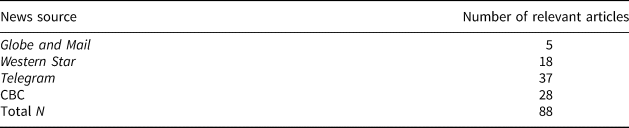
Newspapers are important data sources because they provide an information record of human activity, from protests to rebellion, and enable historical and comparative analysis (Earl et al., Reference Earl, Andrew, McCarthy and Soule2004). We used news stories as a record of public debate on resettlement, which allowed us to make inferences about attitudes toward resettlement and about the political impact of resettlement programs. We analyzed 88 news articles covering population resettlement in NL from four news sources available on Factiva and/or LexisNexis (two electronic news databases) that best represent the regional and national information landscapes: the Canadian Broadcasting Corporation (CBC), Canada's national public broadcaster; the Globe and Mail, one of Canada's leading daily newspapers; the Western Star, a local newspaper based on NL's west coast; and the Telegram, NL's major daily newspaper based in St. John's, the provincial capital. The media analysis covered the period from 2009, when the CRP was first introduced, to December 2016. Table 2 summarizes the frequency of relevant articles in the sample by newspaper.
Number of Articles Covering NL Resettlement and News Source

After compiling the news stories, we manually applied a three-part coding scheme that categorized excerpts according to three research objective–driven frames: government, economic development and contentious politics. In the last, we included all excerpts associating resettlement with violent and nonviolent resistance, such as coalition formation, boycotts, building occupations, demonstrations, press statements, petitioning, letter writing to government officials, and arguments among community members or between resettled populations and the host communities (among others). Table 3 shows the code occurrence of contentious politics and the populations involved, while Table 4 shows the main factors contributing to contentious events.Footnote 4
Code Occurrence of Contentious Politics during CRPs and Populations Involved

Underlying Factors behind Contentious Events by Resettlement Period

In an effort to triangulate and supplement the information obtained via our media analysis, we examined unreleased and/or unpublished documents, which we gained access to through three formal requests made under the Access to Information and Protection of Privacy Act (also known as ATIPP requests) to the NL government. The requests cover the period from 2009, when the CRP was first introduced, to December 2016. The final sample totals nearly 1100 pages: approximately half of this material consists of correspondence involving members of NL communities who submitted expressions of interest in resettling to the provincial government, who requested information on the cost/benefit analysis or who contacted government staff to express their opinion on resettlement; the other half consists of internal memos between government officials on issues related to resettlement.
A relatively new method for gathering qualitative data, ATIPP requests allow researchers to move beyond what is publicly available and access materials that government institutions may consider to be internal or even secret in nature (Turnbull, Reference Turnbull2015). By getting at what Walby and Larsen (Reference Walby and Larsen2011) call the “live archive”—the multitude of texts produced within governments on a daily basis—these documents provide detailed, dynamic insights into the tensions existing within and between communities and government officials, which otherwise are often beyond the reach of outsider researchers (Given, Reference Given2008).
Case Study: Resettlement and Contentious Politics in NL, 2009–
NL's Community Relocation Policy (CRP)
After a lull of nearly 30 years, the latest wave of policies actively supporting resettlement began in NL with the introduction of the 2009 CRP, resulting in the relocation of Grand Bruit in 2010. Socio-economic concerns motivated this new wave of government-assisted relocation: chronic unemployment in the fishery and an aging demographic, combined with the strain of providing government services to a far-flung population, made the government more receptive to community demands (CBC News, 2013). A civil servant working in the Ministry of Municipal Affairs noted that requests for relocation started coming “fast and furious” (ATIPP, 2013: 263) after the introduction of the second CRP in 2013, which nearly tripled the buyout package offered to families, from $100,000 to $270,000 (Government of Newfoundland and Labrador, 2013). The savings generated by the withdrawal of infrastructure, including power generation, regular ferry services and other essential utilities over a 20-year period, were expected to compensate for the high immediate costs of the program.
The various CRP instalments (2009, 2013 and 2016) went to great lengths to emphasize the CRP's voluntary nature, stipulating that the Department of Municipal Affairs could only distribute information about relocation “provided it receives clear indication that it is responding to a community-initiated, community-driven request for relocation assistance” via a petition from community residents or a written request from a municipality (Government of Newfoundland and Labrador, 2013). To qualify for resettlement, communities need to go through four distinct stages: 1) an initial expression of interest demonstrating that at least 90 per cent of the permanent population supports relocation, 2) a residency status determination conducted by the Department of Municipal Affairs confirming voter eligibility, 3) a cost/benefit analysis indicating clear savings for the government over a 20-year period, and 4) a community vote confirming support from at least 90 per cent of the permanent population of the community considering resettlement.
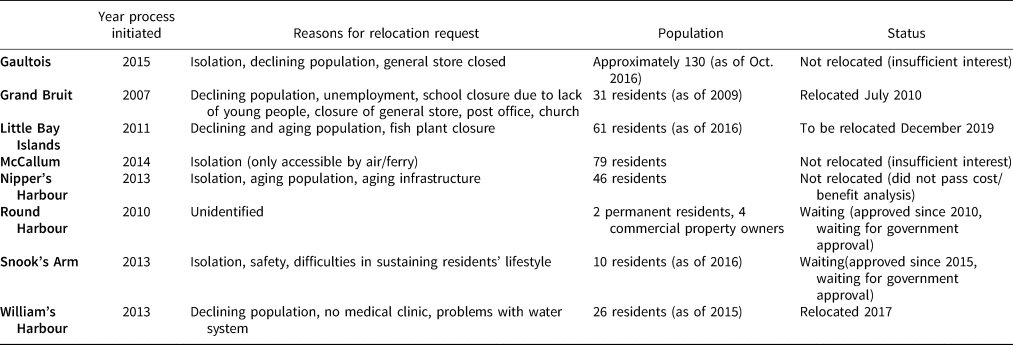
These steps have proven so stringent that only the tiny community of William's Harbour has relocated since the implementation of the 2013 CRP (CBC News, 2017), although Little Bay Islands will relocate on December 31st, 2019 (CBC News, 2019b), making it difficult to claim that the NL government is today actively and forcefully promoting out-migration from small outport communities. Of the other six communities that formally applied for resettlement, three have been rejected at various stages of this process (Nipper's Harbour, McCallum and Gaultois) and two are still waiting to find out their fate (Round Harbour and Snook's Arm) (see Table 5 for a full list of communities that initiated the resettlement process).
Summary of NL Communities That Have Applied for CRP since 2009

The CRP and contentious politics
Unlike forced resettlement schemes in nondemocratic states that often result in violent clashes between the main stakeholders, resettlement never took a bloody turn under the CRP. Our media analysis reveals, however, that nonlethal contentious politics was prevalent, with 79 instances of resettlement-associated contentious politics from 2009–2016 (see Table 3). Coercive pressures to relocate (or not) were the main source of contention, followed by a lack of information and concerns over the decision process (see Table 4). Thanks to the increases to the buyout package over the years, the amount of financial compensation has rarely been the object of contention. One exception, however, occurred during a brief period after the introduction of the 2013 CRP, when communities resettled under older, less generous programs tried to retroactively obtain financial compensation along the lines of the 2013 CRP.
Table 3 also highlights that most instances of contentious politics reported in our media analysis (48 out of 79) pit communities against government officials or state actors, a finding in line with the existing literature on resettlement and contention. It did not, however, reveal a single instance of contentious politics pitting resettled communities against their potential host communities. The comparatively modest scale of contemporary resettlement schemes in NL, typically affecting communities of 100 permanent residents or less, may have played a role in reducing the alleged demographic threat resettled families posed to the host communities (Pottie-Sherman and Wilkes, Reference Pottie-Sherman and Wilkes2017). Prior to their move, many of the soon-to-be-resettled people had already established connections with their future host communities, visiting them for medical appointments or shopping, for instance. These regular interactions meant that the migrants were not unknown to the host communities, as was often the case in earlier resettlement programs.Footnote 5 Together with the fact that resettled individuals can now relocate wherever they wish—in NL or elsewhere—these measures have dispersed migrants and made it easier for host communities to absorb a more gradual population intake.
The 31 instances of contentious politics occurring within the communities considering resettlement were the most surprising result revealed by our analysis, especially given the silence of the literature on this dynamic. Digging deeper into the contentious politics in NL's voluntary resettlement programs, we examine three aspects of the CRP—the negotiation of voting rights, the challenges of community voting and the slow and uncertain nature of the consultation process—that capture how coercion operates between communities and government officials, as well as within the communities seeking resettlement. In doing so, we uncover an important paradox: that the very measures initially designed to ensure the voluntary nature of resettlement in democratic settings such as NL often generate, rather than deter, coercive pressure and contentious politics.
1) Negotiating voting rights
The 2009 CRP restricted voting to permanent residents only, defined as those residing in the community for at least 183 days in each of the two 12-month periods immediately preceding the town's relocation request (ATIPP, 2016: 28). If the vote was positive, permanent residents would receive the full compensation package for the commercial and residential properties they were leaving behind. In contrast, seasonal residents were barred from voting on this issue and did not qualify for the full government buyout.
With such high stakes, deciding who had the right to vote became litigious. Since 2013, residents have filed 39 appeals in four separate relocation cases (ATIPP, 2016: 1, 62). Given the size of most NL communities and the high threshold required for resettlement to proceed, a small adjustment to the number of eligible voters could have a major impact on the outcome. In the case of Little Bay Islands, a small fishing community off the northern coast that had seen the closing of its fish plant, the successful appeals of voting-aged permanent residents resulted in eight additional people able to cast their vote in the first resettlement vote in 2015 (ATIPP, 2013: 10). Considering its close results, with 85 ballots in favour of resettlement and 10 against, the inclusion of a handful of votes may have been sufficient to sway the outcome.
Several residents from Little Bay Islands expressed concerns that the vote was an “unfair process” because it included nonpermanent residents who were absent from the community for nearly half a year (Barry, Reference Barry2016). Seasonal, nonpermanent residents were equally irate about not having their voice heard and being barred from financial compensation from the government for their seasonal residence, should resettlement proceed. As one letter to the Minister of Municipal Affairs from the Coalition to Save Little Bay Islands stated:
We feel that if all homeowners/taxpayers do not have a say, they are being treated unfairly, as we are all taxpayers paying the same amount whether we live in the town full time or not as taxes are not adjusted for part time residents. (ATIPP, 2013: 183–84)
Another resident from Little Bay Islands addressed the Minister in a postcard, pleading: “This is my home. Please do not attempt to destroy it” (ATIPP, 2013: 176–77). Seasonal residents of other communities considering resettlement shared similar concerns. A letter sent to the same Minister by seasonal residents in the South Coast community of McCallum noted:
We have invested a great deal of money into our home and my question to you and your department Mr. O'Brien is why? Why should we have to lose everything that we have worked so hard over the years because the majority rules and we have no other choice but to leave? (ATIPP, 2013: 318–20)
In response to these concerns, a 2016 review of the CRP changed the definition of permanent residents to require year-round residency, with appropriate exemptions for work, schooling and medical reasons. It is unclear if this amendment will resolve the eligibility problems raised earlier by both permanent and temporary residents. Indeed, when asked about these changes, one part-time resident from Little Bay Islands stated: “I'm not impressed. They [government officials] are just trying to separate one taxpayer from another” (Cook, Reference Cook2016).
2) Community voting: coercive pressures from the minority and the majority
In most instances of voluntary economic migration, the decision to relocate is an individual or household one. Even then, the decision to relocate is the result of a long and intricate reflection about the respective pros and cons. In contrast, when relocation takes place at the community level—for example, when nearly every inhabitant of a community must agree to relocate for the resettlement scheme to go ahead—household decisions are compounded by many additional circumstances, notably the need to decide the minimum threshold necessary for community relocation to take place.
The threshold for resettlement under the CRP has fluctuated between 90 and 95 per cent, which is significantly higher than the 50 per cent + 1 vote usually required for a majority in democracies. Although meant to foster community-based decision making, the high threshold for resettlement ultimately gave tremendous power to a handful of people (sometimes as few as one or two individuals) who steadfastly refused to relocate, thereby “holding hostage” the rest of the community who may have preferred to move. A resident of George's Cove, a small community that failed to meet the threshold for resettlement, explained: “Quebec would have separated from Canada if they got 50-plus one per cent. If you have 70 or 80 per cent, they [the government] should let the people move who wants to move” (Hurley, Reference Hurley2013). This criticism raises the question whether government-assisted resettlement may, in fact, be counterproductive, to the degree that it encourages holdouts among households with the means to relocate but who prefer to wait for the government buyout package to do so. Were the financial incentives to disappear, such individuals would leave their community, thus allowing the government to stop ensuring services. While this question is valid, a newspaper interview with the town clerk from Little Bay Islands suggests that most people who had the means to relocate have already done so:
I cannot believe that 10 people out of 95 are able to hold the other 85 of us hostage in this community, with the majority being seniors and the majority of them who worked in the fishery all their life and being seasonal workers, they don't have the income to back them up to move on their own. (Telegram, 2016)
The results of the 2015 relocation vote in Little Bay Islands, with 89.47 per cent of the population in favour of resettlement, tested the strictness of government adherence to the threshold and highlighted the highly controversial nature of a few decimal points. A former mayor of Little Bay Islands cautioned: “It's not going to be a pleasant time in this community if the number is not there” (that is, if the government did not round up the figure to the required 90 per cent) (CBC News, 2015). After a lengthy review of the rules, the province reaffirmed that community relocation would only proceed if at least 90 per cent of all permanent residents in a town agreed (Barry, Reference Barry2016).
As expected, this decision was not well received in Little Bay Islands. When one resident found out that the process of relocation would not proceed, he indicated his “unbelief and utter disgust,” claiming that residents of Little Bay Islands, after being part of this process for several years, felt as if they had been “kicked in the gut while [they] were down” (ATIPP, 2016: 57–58). Another resident said: “My disappointment is not in the people of Little Bay Islands, my disappointment is in the government” (Cook, Reference Cook2016). The residents of Little Bay Islands eventually mended their wounds and voted unanimously in favour of resettlement in February of 2019 (CBC News, 2019a), while the NL government recently approved 10 million dollars to relocate the remaining 54 permanent residents (Power, Reference Power2019). This high threshold was adopted to ensure that no one would be forced to move against their will. But requiring such a high degree of consensus, where a handful of votes may suffice to prevent resettlement, damaged the unity of small communities. Asked about the effect of resettlement talks in his town, a resident of McCallum said: “There's a lot of animosity within the community and it's really hard to communicate with people … they've created a lot of broken families, friends and divided the community” (Howells, Reference Howells2015). Part of the problem is that it is nearly impossible for people to vote truly anonymously in small communities, where everyone knows one another:
No one knows who voted for or who voted against because that was never released by government, but of course you live in the town and it's a small place and you hear people say “Well I hope this don't go through” or “I hope it do go through”, so you do have ideas of which way they voted. … Everyone has their suspicions. (Telegram, 2016)
Alternatively, individuals who wanted to stay often experienced coercive group pressures from the majority of the population. In these cases, employed permanent residents, often a small segment of the population in aging communities dependent on fishing, resented being driven from their homes by the unemployed or underemployed majority. As one employed resident of Little Bay Islands explained in his personal communication to the Minister of Municipal Affairs, not-so-subtle threats were made toward him and his family:
We are being told by those wanting to leave, if we do not vote for the latest offer, this will not be a friendly neighbourhood. This program [resettlement] is already destroying our community and it will certainly destroy my life if I have to give up my job and move, but irreparable damage has already been done and for the safety and well-being of my family, I will have to go. (ATIPP, 2013: 174)
In an effort to accommodate those wishing to stay put, the 2009 CRP initially ensured that the government would provide residual services (electricity, water, snow-clearing) to residents choosing to remain in a relocated community. This provision was, however, cut in the 2016 revisions of the CRP.Footnote 6 Residents must now weigh their desire to stay in a community without access to drinking water or electricity against saying goodbye to a place that has been their home for generations. The 31 permanent residents of Grand Bruit faced such a dilemma as they saw their school close, followed by the post office, and the end of ferry and power services in the summer of 2010 (Thomas, Reference Thomas2010). When communities have fewer and fewer services at their disposal, one can wonder about the way in which the subtle pressure on people to either move or do without amenities undermines the claim that these individuals are truly “choosing” to relocate.
3) Slow nature of consultation process
The above discussion also highlights another disputed dimension of resettlement in NL: the slow and uncertain nature of the current community-oriented consultative process. The four distinct steps of the process can easily drag on over several years, creating substantial uncertainty for those directly involved. In Little Bay Islands, over six years elapsed from the time the community initially expressed interest in participating in the CRP in April 2013 to their relocation on December 31st, 2019 (CBC News, 2019b). During this time, communities considering resettlement are frozen. Months—and in some cases, years—of uncertainty drain small outport communities of their social vitality. Towns that are already struggling to prevent youth out-migration now face the seemingly insurmountable task of filling vacancies on a town council or maintaining a functioning fire department in the context of an aging population. Once these vital community services are lost, total abandonment is almost inevitable. Residents, fearing they will have to leave sooner or later, refuse to invest in the upkeep of either communal or private property, making it harder for them to sell their properties in the future were resettlement not to go ahead. A series of letters written by residents of Little Bay Islands to various government officials captured increasing frustration at the length of the process and the negative impact it had on community morale and relations (ATIPP, 2016: 65, 67). Little Bay Islands was not the only community in limbo. After a decisive 97 per cent vote in favour of resettlement in the spring of 2009, the community of Grand Bruit spent the summer wondering if the government would agree with its wishes. As the chair of the local service district explained:
We've been on hold and everyone in the community has been worried about this all summer long. Some people have things they would want to do with their homes if they are going to be staying here for the next five years or more, but which can probably wait if they will only be using their homes as summer cottages. (Kean, Reference Kean2009)
Conclusion
As this case study demonstrates, community-initiated and community-driven resettlement programs like CRP are also fraught with contention due to the nature of the voting process and the slow and uncertain nature of the community-oriented consultative process. Measures that were meant to democratize resettlement and give agency to those most affected by it—that is, voting rights for permanent residents only, a community vote, the high minimum threshold needed, the numerous occasions where public opinion was sought and the generous financial compensation offered—have, in fact, generated insidious and indirect coercive pressures affecting people's decision to relocate or not to relocate.
The literature on large-scale resettlement had so far emphasized the coercive pressures government officials exert on individuals, stripping them of agency. While direct government pressures are largely absent from contemporary NL resettlement programs, indirect government coercion remains, in the form of delays and service disruption. Our examination of the CRP showed, however, that state officials are not the only actors applying coercive pressures. Coercion may emerge from within the very communities considering resettlement, either from a small minority of the population wanting to stay (coercion by the minority) or from a larger number of people keen to reach the necessary threshold required for relocation (coercion by the majority)—two sources of coercion that were largely absent from previous studies on resettlement and contentious politics.
All communities, big and small, have their own power dynamics. Talks of resettlement can bring to the surface within-community power differentials, and these inequalities may manifest themselves in the form of coercive pressures. In this context, some people may be presented with the option to relocate and earn a living elsewhere or to stay put, but the most vulnerable or marginalized people (that is, elderly or unemployed) rarely are. Even in a democratic context such as NL, where households vote on and receive financial compensation for relocating, it is difficult to remove indirect coercion from the resettlement equation. While this case study does not necessarily delegitimize such policies, nor label them authoritarian or even illiberal practices (Glasius, Reference Glasius2018),Footnote 7 it does force scholars and policy makers to acknowledge the internal power dynamics at play in so-called community-oriented programs like the CRP and to try to even out the playing field. It also provides a more nuanced understanding of the various sources of coercive pressures in democratic contexts and forces us to scrutinize the labelling of “voluntary” and “coerced” resettlement.
While acknowledging the particular historical, social and economic circumstances of NL, much can be gained by placing the CRP in conversation with other contemporary resettlement projects. Studies on resettlement politics would do well to investigate the many forms that resettlement may take and the various roles played by state and nonstate actors. In Ireland, for instance, urban underemployed households wishing to relocate to rural areas—and rural communities wishing to make housing available to resettled families—may call on a grassroots organization called Rural Resettlement Ireland to facilitate the process (Rosegrant, Reference Rosegrant2002). The creation of a global resettlement typology that categorizes resettlement projects according to their agendas (rural development, mitigating community isolation, coastal retreat), main actors (government, NGO) and procedures (voting thresholds, individual or community-level compensation) is a worthwhile project for future scholars, as it would help to shed further light on the factors that mitigate the contentious politics surrounding resettlement. Given how many rural communities throughout the Western world are faced with uneven economic growth, declining demographics and climate change–induced hazards (Hamilton et al., Reference Hamilton, Saito, Loring, Lammers and Huntington2016), the ongoing resettlement processes in NL and Ireland offer contrasting policy templates worth closer examination.
Acknowledgments
This work was supported by the Harris Center Applied Research Fund and the J. R. Smallwood Foundation for Newfoundland and Labrador Studies Grant. The authors thank Hannah Barry, Mira Raatikainen, Cindy Robin, Lauren Onsom and Rebecca Wilton for their superb research assistantship, as well as Alex Marland for providing insightful comments on a previous draft of this article.