*
Lisa French, the first female Director of the British School at Athens, from 1989 to 1994, died in Cambridge on 10 June 2021, aged 90.
Lisa devoted most of her adult life and career to the site of Mycenae, which for her represented something of a family inheritance. Her father, Alan Wace, who was Director of the British School at Athens from 1914 to 1923 (some 75 years before Lisa) first excavated at Mycenae in 1920–3. By the time Lisa was born in London in 1931 he held the post of Deputy Keeper in the Department of Textiles at the Victoria and Albert Museum. Her mother, Helen (née Pence) was an American citizen who had married Wace in 1925 after meeting him at Mycenae three years earlier. A couple of years after Lisa's birth the family moved to Cambridge when Wace was elected to the Laurence Chair of Classical Archaeology in the University.
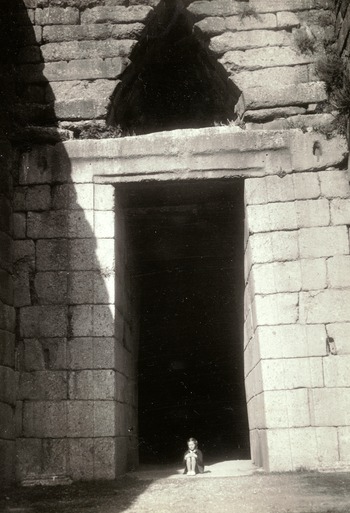
Lisa first visited Mycenae in 1939, at the age of eight, when her father returned to excavating at Mycenae during the last season before the Second World War broke out. There are a number of photographs of her from that year, including an often reproduced one which shows her sitting at the entrance to the Atreus Tholos where her diminutive figure provided a very effective scale (Fig. 1).
Lisa, aged eight, at the entrance to the Atreus Tholos, 1939. Courtesy of Faculty of Classics Archives, University of Cambridge.

The family spent the first months of the war in Athens, where Lisa attended a British Council school, but in June 1940, a few months before the Italian army invaded Greece, Lisa and her mother set sail for America, where they remained until 1944. On their return, they joined her father in Alexandria, where he had just been appointed as Professor of Classics and Archaeology at King Farouk 1 University, and in 1946 Lisa was enrolled at Cheltenham Ladies’ College, where it is said that at the time she wanted to study mathematics although the College would not allow her to do so. This was the last of a number of different schools she had attended in Cambridge, Athens, Alexandria and America. According to her daughter, Ann, she felt this left gaps in her education which troubled her deeply and perhaps contributed to a certain feeling of insecurity. In 1949 she went up to Newnham College, Cambridge, to read Classics, concentrating on Group D (Classical Art and Archaeology) in part II of the tripos. After graduating, she studied for a Diploma in Conservation at the Institute of Archaeology in London, and subsequently embarked on a part-time PhD at University College London on the development of Mycenaean terracotta figurines, while also teaching Classics at the Royal Masonic School for Girls in Rickmansworth. She was awarded her PhD in 1961, and published it as a substantial article in the Annual of the British School at Athens for 1971 (French Reference French1971).
Wace resumed his excavations at Mycenae in 1950, and from then until her father's death in 1957 Lisa took part in every excavation season. From 1959 until 1969 she continued to excavate on the south-west side of the Mycenae Citadel with Lord William (Billy) Taylour in collaboration with the Archaeological Society of Athens and Professor George Mylonas, and thereafter into the 1980s she returned virtually every year for annual study seasons and the preparation of the results of the excavations for publication.Footnote 1 It was at Mycenae that she first met David French in 1955, and in 1956 they worked together on pottery from the area of the Prehistoric Cemetery. This was the start of a long-lasting archaeological partnership, which outlived their marriage. They were married in 1959 and spent 1959–60 on excavations together at Mycenae, Ayios Stephanos and Knossos. They had two daughters, Ann (b. 1963) and Catharine (b. 1966), who accompanied Lisa on the Mycenae excavations and later during study seasons on the finds stored in the old Turkish Medrese (also known briefly from 1926 as the Leonardo prison) in Nauplia. When David became Director of the British Institute of Archaeology at Ankara in 1968 the whole family moved to Ankara, where Lisa in effect ran the Institute, played an important part in his excavations (both before and after David became Director) – for example at Can Hasan where she took charge of the dig house and organised the registration of finds – and accompanied him on his regular excursions to various parts of Turkey in search of Roman milestones.Footnote 2
Lisa's organisational experience in Turkey was to prove invaluable when, after David and she parted company in 1976, Lisa moved with her daughters to Manchester to take up the Wardenship of Ashburne Hall at Manchester University and, of course, later still when she became Director of the British School at Athens in 1989. While in Manchester, she taught evening classes and day schools with John Prag, led annual study tours to different parts of the ancient Greek world, gave lectures as an Honorary Lecturer in the Department of Archaeology, supervised PhD students and continued to present papers at international conferences. John Prag has written of her time in Manchester that some of the new elements of teaching and outreach that were introduced then were ground-breaking for their day and needed someone of Lisa's strength of purpose to carry them through. He adds: ‘I became very familiar with Lisa's first reaction to a suggestion – a firm and often scathing rejection – but I also learned that within a very short time not only would she have come round to it but would already have set the wheels in motion’ (Prag, per epistolam). In 1986 she organised a very successful conference to mark the British School's Centenary on some of the issues then exercising archaeologists of the Greek Neolithic and Bronze Ages, which was published shortly afterwards under the title of Problems in Greek Prehistory (French and Wardle Reference French and Wardle1988).
All this time, as well as during and after her stint as Director of the School in Athens, Lisa continued to work on the site of Mycenae in various capacities: on continuing study seasons and preparation for publication of the excavations in the area of the Citadel House and their finds; inaugurating, with Billy Taylour and Kenneth Wardle, the Well Built Mycenae series of publications, which produced some 10 fascicules between 1981 and 2012 (Taylour, French and Wardle Reference Taylour, French and Wardle1981–); publishing Mycenae: Agamemnon's Capital, an up-to-date overview of the site's various monuments, in Reference French2002; overseeing the transfer of the material previously stored in Nauplia to the new Mycenae Museum in 2003; and in Reference Iakovidis, French, Shelton, Ioannides, Jansen and Lavery2003 compiling and publishing, with Spyridon Iakovidis, the Archaeological Atlas of Mycenae, a monumental gazetteer and survey of all the remains in the wider area around the Mycenae Citadel, which, among other work, led to her being awarded an honorary doctorate by the University of Athens in the following year. One of her latest – and not least – contributions to the prehistory (and history) of Mycenae was her donation of the Mycenae archive, containing records of all the British excavations at Mycenae, to the Faculty of Classics at Cambridge in 2013 (now available online at https://cudl.lib.cam.ac.uk/collections/mycenae). On a wider front, she also played an important part in setting up, in 1997, the Association for the Study of Travel in Egypt and the Near East (ASTENE) to promote education and research in all aspects of the history of travel and travellers to, from, and within the region.
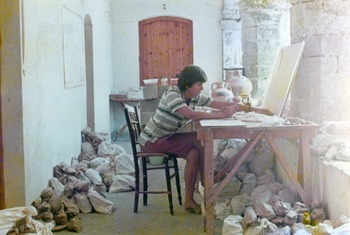
Among Lisa's greatest contributions to the archaeological understanding of Mycenae and the Mycenaean world more generally were the foundations she laid for an increasingly systematic and detailed record of various aspects of its material culture. Her work on the typology and chronology of the human and animal figurines was one example of this that led to her becoming acknowledged as an unrivalled expert on those characteristic yet intriguing objects (French Reference French1971; see also e.g. French Reference French, Hägg and Marinatos1981; Reference French and Evely2006; Reference French, Gallou, Georgiadis and Muskett2008; Reference French, Schallin and Pakkanen2009). However, just as important, if not more so, was her work on the Mycenaean pottery, which provided a framework for relative dating of the figurines and other manifestations of material culture. Between 1963 and 1969 she published a series of articles in BSA and elsewhere, which documented the various phases and sub-phases of Late Helladic (LH) III pottery at Mycenae, from LH IIIA1 to an early phase of LH IIIC, based on the detailed study of coherent, stratigraphically associated sherd assemblages from the site (French Reference French1963; Reference French1964; Reference French1965; Reference French1966; Reference French1967; Reference French1969a; Reference French1969b; Wardle, Crouwel and French Reference Wardle, Crouwel and French1973). These introduced a more systematic, comprehensive approach to what had hitherto often been cursory or selective pottery reports, and led to Lisa becoming a recognised ‘guru’ of Mycenaean pottery (Fig. 2). Over many years she taught numerous students how to deal with it practically – how to strew bags of sherds and sort and describe them, identify shapes and decorations (including Furumark numbers), draw rim and base profiles and photograph all decorated sherds. She once admitted that she much preferred dealing with sherds rather than complete pots, as the latter were often more unpredictable and tended to present unexpected anomalies which made them less easy to categorise neatly. As time went on, she became increasingly interested in scientific techniques, particularly Neutron Activation Analysis, for chemically analysing pottery to determine provenance, resulting in several solely or jointly written articles (e.g., Tomlinson and French Reference Tomlinson and French1997; French and Tomlinson Reference French and Tomlinson2012).
Lisa working on pottery from Mycenae, Nauplia, early 1970s. French family archive, courtesy of Ann French.

Indeed, as with the sherds, Lisa maintained a very practical and organised approach to most aspects of life, as well as to archaeology. According to her daughter Ann, among the achievements of which she was perhaps proudest as Director of the British School were the introduction of the extensive use of computers, the organisation of the digitisation of the library catalogue and the systematisation of the School's various collections, including those at Knossos, and the development of a watering system for the garden. While excavating with Billy Taylour and in subsequent study seasons, she took the role of sergeant-major, as it were, to his commander-in-chief, shouldering responsibility for ensuring that the practical, organisational aspects of the excavation ran smoothly. During study seasons at Nauplia with Taylour, it was she who organised the regular Sunday picnics, leaving Billy to decide which beach he wanted to go to that week, and she was also the one who organised occasional outings to the theatre at Epidauros. While Billy worked by himself on the stratigraphy of the Citadel House in a gloomy cell of the Medrese, Lisa made full use of her training in conservation by mending pots, ensuring that small finds were properly stored, finding material for visiting specialists, doing her share of sherd-strewing, and trouble-shooting any problems that arose. In the early 1970s the Medrese was like a little United Nations, including variously Germans from Tiryns, Americans from the Southern Argolid Survey and Swedes from Berbati. Lisa was at the centre of friendly scholarly interaction with these groups. It was just this kind of scholarly interaction that allowed her and Philipp Stockhammer to publish a joint article in BSA in Reference French, Stockhammer and Damm-Meinhardt2009 on the later thirteenth-century BC pottery of Mycenae and Tiryns in which they succeeded in reconciling the confusions caused by different approaches to stratigraphy which had led to different ceramic terminologies at the two sites.
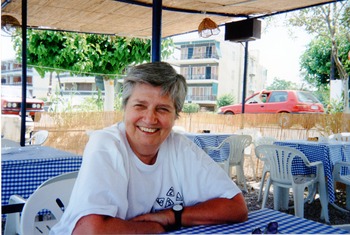
It is perhaps true to say that Lisa sometimes had difficulty in suffering fools or what she saw as foolish ideas gladly, and she could on occasion seem a little intimidating. Martin Robertson, who supervised her PhD thesis at the Institute of Archaeology and later became Lincoln Professor of Classical Archaeology at Oxford, once admitted that he was really rather scared of her. But one was ever conscious of her anxiety to fulfil the duty she felt to continue and expand her father's work at Mycenae, so this was perhaps not entirely surprising. Nevertheless, she was capable of acts of remarkable kindness, and was always extraordinarily generous with her hospitality, whether in Athens, Ankara, Manchester or Cambridge. Particularly memorable was her smile, which would often suddenly light up her face like the sun appearing from behind the clouds (Fig. 3). She also had a lively and sometimes mischievous sense of humour, as, for example, when recounting the time when, as a passenger in Billy's Land Rover, she found herself suddenly hurtling down a steep flight of steps in the town of Pylos, or in the faintly, but discernibly, tongue-in-cheek manner with which during Nauplia study seasons she ensured that Billy's insistence that his breakfast egg be boiled for precisely 4 minutes 30 seconds was met, usually without a timer, by members of the team.
Lisa at Rafina, c. 1993. French family archive, courtesy of Ann French.

After leaving Athens, Lisa returned to Cambridge, first of all to live in the family house in Millington Road and then, when the house became too much for her to manage, in a retirement flat close to Christ's Pieces in the centre of town. She continued to engage with Mycenae, contributing to and editing fascicules for the Well Built Mycenae series and other papers and articles, and mentoring those studying Mycenaean pottery and Mycenaean culture more generally; at the same time she bore her increasing lameness, the result of a long-standing knee problem, with considerable feistiness. In January 2016, when the Faculty of Classics organised a Mycenae Archive Day in honour of her 85th birthday and to celebrate her donation of the Mycenae Archive, she was in sparkling form. Her final year was a difficult one. She lost her daughter Catharine to cancer in May 2020, and a two-day event to commemorate the centenary of the start of her father's Mycenae excavations, planned by the Cambridge Faculty of Classics and originally scheduled to take place in 2020, unfortunately had to be postponed because of the pandemic. It finally took place online at the end of September 2021, when it also, sadly, became a memorial tribute to Lisa. It was clear from this event just how many people felt a deep affection for her and just how much she is and will be missed.
ACKNOWLEDGEMENTS
I am deeply grateful to Ann French for her support and the information she has supplied about her mother, as well as for providing the photographs for Figs 2 and 3. I also wish to thank John Prag for allowing me to quote from his remarks about Lisa and for his eagle-eyed proofreading of the text.