Introduction
Obsessive–compulsive disorder (OCD) and body dysmorphic disorder (BDD) share characteristics such as intrusive thoughts and repetitive behaviors.Reference Phillips, Stein and Rauch 1 Patients with OCD typically experience obsessional thoughts, images, or impulses that cause anxiety or distress, which can be neutralized by overt compulsive behaviors or mental acts.Reference Heyman, Mataix-Cols and Fineberg 2 Patients with BDD are preoccupied with a perceived defect in physical appearance and engage in repetitive excessive grooming, mirror checking, or reassurance-seeking behaviors.Reference Grant and Phillips 3
OCD and BDD share a number of important clinical features, including sex ratio, age of onset, and treatment response to selective serotonin reuptake inhibitors.Reference Koran, Abujaoude, Large and Serpe 4 Evidence from a twin study supports a genetic overlap between OCD and BDD.Reference Monzani, Rijsdijk, Iervolino, Anson, Cherkas and Mataix-Cols 5 Moreover, studies suggest that 27.5% of patients primarily diagnosed with BDD have comorbid OCD, whereas 10.4% of patients primarily diagnosed with OCD have comorbid BDD.Reference Frías, Palma, Farriols and González 6 , Reference Monzani, Rijsdijk, Harris and Mataix-Cols 7 Although OCD and BDD are presumably related to each other regarding underlying psychological and pathophysiological mechanisms, and grouped together in the Obsessive–Compulsive and Related Disorders chapter of the Diagnostic and Statistical Manual of Mental Disorders, Fifth Edition (DSM-5), 8 evidence supporting this nosological approach requires comparative studies between BDD and OCD.
Dysfunctional connectivity in frontostriatal networks is implicated in both OCD and BDD and overlaps with networks responsible for executive functions (EFs).Reference Menzies, Chamberlain, Laird, Thelen, Sahakian and Bullmore 9 , Reference Beucke, Sepulcre, Buhlmann, Kathmann, Moody and Feusner 10 The function of these neural circuits can be assessed by specific psychometric tests.Reference Menzies, Achard and Chamberlain 11 , Reference Lezak 12 Spatial working memory (SWM) captures our ability to retain and organize visuospatial information, which involves frontoparietal circuitries.Reference McAfoose and Baune 13 , Reference Owen, McMillan, Laird and Bullmore 14 Attentional set shifting, which is the ability to switch focus, is a form of cognitive flexibility that depends on the function of ventrolateral prefrontal cortex.Reference Hampshire and Owen 15 Response inhibition, a measure of impulsivity, measured in the present study with the stop signal task (SST), is dependent on the inferior frontal cortex and its subcortical connections.Reference Menzies, Achard and Chamberlain 11
Studies using computer-standardized and validated neuropsychological tests, such as the Cambridge Neuropsychological Test Automated Battery (CANTAB), have been used to assess important aspects of EFs in patients with OCD and BDD. Three studies found that patients with OCD perform worse on the SWM task compared with healthy controls, and one additional study suggests that there could be a sex difference in task performance among patients with OCD.Reference Purcell, Maruff, Kyrios and Pantelis 16 - Reference Martoni, Salgari, Galimberti, Cavallini and O’Neill 19 Similarly, Dunai et al found worse performance on the SWM in patients with BDD compared with healthy controls.Reference Dunai, Labuschagne, Castle, Kyrios and Rossell 20 Worse performance on the intra–extra-dimensional set shifting (IED) in patients with OCD has been reported by Nedeljkovic et al, Watkins et al, Purcell et al, and Chamberlain et al,Reference Purcell, Maruff, Kyrios and Pantelis 16 , Reference Nedeljkovic, Kyrios and Moulding 21 - Reference Chamberlain, Fineberg and Menzies 23 but not replicated by Purcell et al, Nielen et al, and Veale et al.Reference Purcell, Maruff, Kyrios and Pantelis 17 , Reference Nielen and Den Boer 24 , Reference Veale, Sahakian, Owen and Marks 25 Both Jefferies-Sewell et al and Greenberg et al showed that patients with BDD performed poorer on IED compared with healthy controls.Reference Greenberg, Weingarden, Reuman, Abrams, Mothi and Wilhelm 26 , Reference Jefferies-Sewell, Chamberlain, Fineberg and Laws 27 SST has been found to be deficient in patients with OCD in several studies,Reference Menzies, Achard and Chamberlain 11 , Reference Chamberlain, Fineberg, Blackwell, Clark, Robbins and Sahakian 18 , Reference Chamberlain, Fineberg and Menzies 23 , Reference Boisseau, Thompson-Brenner, Caldwell-Harris, Pratt, Farchione and Barlow 28 - Reference Lei, Zhu and Fan 31 but recent findings by Kalanthroff et al could not demonstrate any difference, independent of medication status.Reference Kalanthroff, Teichert and Wheaton 32 Similarly, Jefferies-Sewell et al showed worse test performance on the SST among patients with BDD in comparison to healthy controls.Reference Jefferies-Sewell, Chamberlain, Fineberg and Laws 27 In summary, these studies suggest that similar EFs could be deficient in patients with OCD and BDD; however, the results are inconclusive for OCD and scarce for BDD.
Direct comparisons between patients with OCD and BDD on EFs are limited. A study that compared 14 patients with BDD to 23 patients with OCD from previously published data detected similar, but not equivalent task performance on spatial span, SWM, executive planning, and pattern recognition.Reference Labuschagne, Rossell, Dunai, Castle and Kyrios 33 Another study showed poorer test performance on executive planning and the Stroop test between 14 patients with BDD and 10 patients with OCD compared with healthy controls.Reference Hanes 34 The question whether patients with OCD and BDD have similar or separate EFs has important implications, since knowledge about neurocognitive performance in OCD and BDD could improve our neurobiological understanding, facilitate classification of these disorders, uncovering potentially important predictors of treatment outcome, and inform clinical care for these patients.
The aim of this study was therefore to use CANTAB to compare EFs (SWM, set shifting, and response inhibition) between patients with OCD, BDD, and healthy controls. We hypothesized that OCD and BDD would exhibit similar executive dysfunction compared with healthy controls. Furthermore, we hypothesized that higher burden of symptoms is correlated with poorer EF among patients with OCD and BDD.
Methods
Participants
Patients with OCD (n = 29) were recruited from two psychiatric outpatient clinics in Stockholm specialized in obsessive–compulsive and related disorders between May 2013 and December 2015. Patients with BDD (n = 26) were participants in two studies on Internet-delivered cognitive behavior therapy for BDD, conducted at Karolinska Institutet.Reference Enander, Andersson and Mataix-Cols 35 , Reference Enander, Ivanov, Andersson, Mataix-Cols, Ljótsson and Therapist-guided 36 Inclusion criteria were a principal diagnosis of OCD or BDD according to the DSM-5. 8 Exclusion criteria were i) psychotropic medication changes within at least 2 weeks prior to inclusion, ii) completed cognitive behavioral therapy for OCD or BDD within the last 12 months, iii) comorbid OCD or BDD, respectively, iv) current substance dependence or abuse, v) bipolar disorder, vi) psychotic disorders, vii) acute suicidal ideation, viii) severe personality disorder, and ix) concurrent psychological treatment.
Healthy controls (n = 28) similar in age, sex, and education were recruited by online advertisement in the greater Stockholm catchment area. Exclusion criteria for healthy controls consisted of previous or present psychiatric disorder, psychotropic medication, or chronic somatic disease. All participants were screened for eligibility and subsequently underwent a diagnostic interview using the Mini International Neuropsychiatric Interview and Structured Clinical Interview with an experienced psychologist or psychiatrist before inclusion.
Ethics
The regional ethical review board in Stockholm approved the study (registration ID 2015/1088-32 and 2013/1773-31/4). All trial subjects gave their written consent prior to participation in the study. The authors assert that all procedures contributing to this work comply with the ethical standards of the relevant national and institutional committees on human experimentation and with the Helsinki Declaration of 1975, as revised in 2008.
Psychometric scales
Symptom severity of patients was assessed using the Yale–Brown Obsessive Compulsive Scale (Y-BOCS) for OCD or the modified version (Yale–Brown Obsessive Compulsive Scale for Body Dysmorphic Disorder [BDD-YBOCS]) for BDD.Reference Goodman, Price and Rasmussen 37 , Reference Phillips, Hollander, Rasmussen, Aronowitz, DeCaria and Goodman 38 Depressive symptoms were assessed with the self-rated version of the Montgomery–Åsberg Depression Rating Scale (MADRS).Reference Svanborg and Asberg 39 The National Adult Reading Test (NART-SWE) was administered to all participants. NART-SWE is a validated test with sufficient reliability for assessment of premorbid IQ.Reference Rolstad, Nordlund and Gustavsson 40
Neurocognitive tests
Three tests from the CANTAB were administered in a fixed order and in a quiet room with a trained administrator giving standardized instructions. The tests were chosen to assess neurocognitive abilities of the participants, and key outcome measures for each test are presented below.
SWM measures the ability to retain and systematically organize visuospatial information.Reference Harkin and Kessler 41 Participants are instructed to search for blue tokens hidden inside colored squares on the screen. Four levels of difficulty: three, four, six, or eight boxes are presented at the same time. Two outcome measures are obtained. A between-search error means revisiting boxes in which a token has already been found. Strategy scores reflect how often search sequences are initiated from the same box within a trial.
IED measures cognitive flexibility and specifically the ability to shift attention from irrelevant to relevant stimuli.Reference Robbins, James and Owen 42 Study subjects are asked to choose the right figure from two artificial dimensions with two figures each. Through trial and error, the rule of the game can be acquired. The rule changes after each block, and at block eight, the previously relevant dimension becomes irrelevant and vice versa. This is called the extra-dimensional shift, a measure of reversal learning. Outcome measures of interest include number of stages completed, total number of errors, and number of errors in the extra-dimensional shift.
The SST measures response inhibition.Reference Logan, Cowan and Davis 43 Left and right arrows are presented randomly on a screen, and participants are asked to press the corresponding button as fast as possible (go trial). However, participants are instructed to inhibit the response of pressing a button if an auditory signal is given, which occurs after an arrow is shown (no-go trial). The main outcome variable, stop signal reaction time (SSRT), is the mean time in milliseconds (ms) taken by the participant to suppress a prepotent response. The average reaction time for “go” trials (ie, trials without a stop signal) is a measure of a subject’s reaction time (psychomotor speed).
Statistical analysis
Analysis was conducted between December 3, 2020, and March 5, 2021. Baseline demographic differences (age, sex, education, IQ, depressive symptoms, and medication status) are presented as summary statistics, and between-group differences were tested using Analysis of variance (ANOVA) for continuous variables and chi-square for ordinal variables. Multiple linear regression models, controlled for age, sex, NART-SWE score, and MADRS depressive symptoms, were used to compare test performance between the groups. Standardized effect sizes (Cohen’s d) were obtained by dividing the estimated marginal means by the residual degrees of freedom from the regression model described above, using the standard deviation of the model residuals as sigma (population standard deviation) as implemented in the emmeans R package.Reference Lenth, Singmann, Love, Buerkner and Herve 44 For the two clinical groups, symptom severity scores (Y-BOCS and BDD-YBOCS, respectively) were standardized and compared to test performance using main diagnosis as covariate. Pearson’s r was used as a measure of effect size. The linear models were deemed appropriate for the data by inspecting residuals, homoscedasticity, and outliers using diagnostic plots. Missing values (<10% for all variables) were assumed to be missing at random and were imputed using bagged trees, a nonlinear ensemble method that can impute both continuous and categorical data. In bagged trees imputation, each missing value is predicted in bootstrap resampling of data and aggregated to form a single prediction using averages for continuous values and majority vote for categorical outcomes. Regular bagged trees allow for nonlinear ensemble imputation whereby all predictors are available, and the best one is selected, at each decision node split for each tree in the ensemble.Reference Cevallos Valdiviezo and Van Aelst 45 , Reference Kuhn and Johnson 46 All statistical analyses were performed using R version 4.0.2 and STATA version 15 (StataCorp, College Station, TX). 47 Code for the statistical analyses is available on the Open Science Framework (https://doi.org/10.17605/OSF.IO/63YNF).
Results
Demographic and clinical characteristics
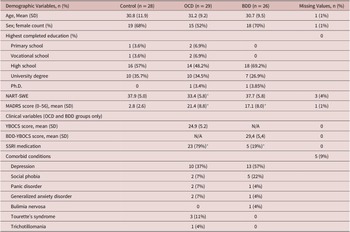
In the present sample, groups did not differ in age, sex, or highest completed education (Table 1). The proportion of patients on selective serotonin reuptake inhibitor (SSRI) was higher in the OCD group compared with the BDD group, and patients with OCD had lower NART-SWE premorbid IQ. Moreover, OCD and BDD groups scored higher on depressive symptoms compared with healthy controls. On average, symptom severity was in the moderate-to-severe range for OCD and BDD groups. See Table 1 for demographic and clinical characteristics of the participants.
Sociodemographic and Clinical Characteristics of Participants with Obsessive–Compulsive Disorder (OCD), Body Dysmorphic Disorder (BDD), and Healthy Controls

Abbreviations: BDD-YBOCS, Yale–Brown Obsessive Compulsive Scale for Body Dysmorphic Disorder; MADRS, Montgomery–Åsberg Depression Rating Scale; NART-SWE, National Adult Reading Test-estimated verbal IQ in Swedish; SSRI, selective serotonin receptor inhibitor; Y-BOCS, Yale–Brown Obsessive Compulsive Scale.
* P-value < .05.
Neurocognitive task performance
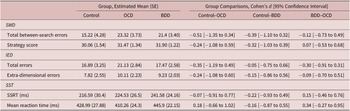
Table 2 shows estimated means and standardized effect sizes across groups on the specific CANTAB tests.
Estimated Mean Group Differences on Principal Outcomes for Spatial Working Memory (SWD), Intra–Extra-Dimensional Set Shifting (IED), and Stop Signal Task (SST)

Note: Estimated marginal means based on the linear models using age, sex, language score, and depressive symptoms as covariates.
Abbreviations: BDD, body dysmorphic disorder; OCD, obsessive–compulsive disorder; SE, standard error; SSRT, stop signal reaction time.
Spatial working memory
There were no statistically significant differences in SWM strategy score when comparing the OCD group (Estimate = 1.41 [95% CI −3.42 to 6.24], SE = 2.43, P = .56) and the BDD group (Estimate = 1.84 [95% CI −2.24 to 5.92], SE = 2.05, P = .37) to healthy controls. Furthermore, there were no statistically significant main effects of age, sex, NART-SWE score, or MADRS score.
Similarly, for the SWM between errors estimates for each group, there were no statistically significant differences between the OCD group (Estimate = 8.11 [95% CI −5.30 to 21.52], SE = 6.74, P = .23) and the BDD group (Estimate = 6.18 [95% CI −5.14 to 17.50], SE = 5.68, P = .28). There was, however, a small but statistically significant main effect of age (Estimate = 0.41 [95% CI 0.04 to 0.78], SE = 0.19, P = .03) showing an association between a higher age and a higher SWM between errors score.
Intra–extra-dimensional set shifting
All participants in the groups passed stages 1 to 7. Twenty-four percent (n = 7) of the OCD group failed to pass the extra-dimensional shift stage (stage 8) compared to 19% (n = 5) in the BDD group and 10% (n = 3) of the control subjects. Neither the OCD group (Estimate = 4.23 [95% CI −5.97 to 14.43], SE = 5.12, P = .41) nor the BDD group (Estimate = 0.57 [95% CI −8.04 to 9.18], SE = 4.32, P = .89) differed from the control group in total IED errors; however, there was a statistically significant effect of sex where women had a higher mean than men (Estimate = 6.11 [95% CI 0.32 to 11.90], SE = 2.91, P = .04).
Extra-dimensional shift errors were similar with no differences between the OCD (Estimate = 2.29 [95% CI −5.72 to 10.30], SE = 4.02, P = .57) and BDD (Estimate = 1.41 [95% CI −5.35 to 8.17], SE = 3.40, P = .68) groups compared to healthy controls, but a statistically significant effect of sex where females scored higher (Estimate = 8.64 [95% CI 4.10 to 13.19], SE = 2.28, P < .001).
Stop signal task
The difference in SSRT did not differ between the OCD (Estimate = 7.94 [95% CI −87.41 to 103.29], SE = 47.88, P = .87) and BDD (Estimate = 24.99 [95% CI −55.50 to 105.48], SE = 40.42, P = .54) groups compared to healthy controls, and there were no statistically significant associations with other covariates.
Similarly, the mean reaction time did not differ between the OCD group (Estimate = −18.72 [95% CI −106.16 to 68.71], SE = 43.91, P = .67) and the BDD group (Estimate = 16.91 [95% CI −56.89 to 90.72], SE = 37.07, P = .65) compared to healthy controls; however, there was a statistically significant main effect of age (Estimate = 3.06 [95% CI 0.64 to 5.47], SE = 1.21, P = .01) where a higher age was associated with a longer average reaction time.
Symptom severity and neurocognitive task performance
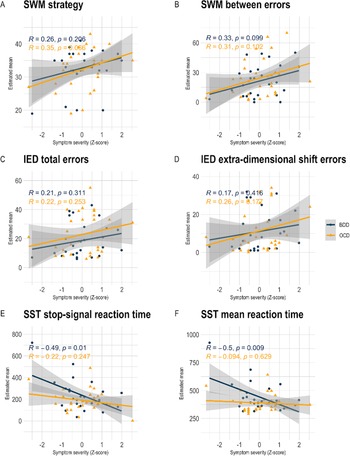
In a subgroup analysis of the patients with OCD and BDD, we investigated a standardized symptom severity score based on the Y-BOCS and BDD-YBOCS total scores, respectively, as well as group. Figure 1 displays the correlations between symptom severity and neurocognitive task performance.
Linear associations between symptom severity and executive function in obsessive–compulsive disorder and body dysmorphic disorder clinical groups.

Spatial working memory
Symptom severity was statistically significantly associated with SWM strategy (Estimate = 1.80 [95% CI 0.22 to 3.78], SE = 0.79, P = .03), and there was a positive but not statistically significant correlation between symptom severity and SWM strategy score (OCD: r = 0.35, P = .066; BDD: r = 0.26, P = .206).
The model for SWM between errors showed an association between symptom severity and test performance (Estimate = 5.64 [95% CI 0.95 to 10.33], SE = 2.41, P = .02), which was also seen in the correlation between symptom severity and test performance in the OCD (r = 0.31, P = .102) and BDD (r = 0.33, P = .099) groups.
Intra–extra-dimensional set shifting
There was no statistically significant association between symptom severity and intra–extra-dimensional total errors (Estimate = 2.76 [95% CI −0.76 to 6.28], SE = 1.75, P = .12), with weak correlations between symptom severity and performance in both the OCD (r = 0.22, P = .253) and BDD (r = 0.21, P = .311) groups.
Similar results were found in the analysis of extra-dimensional errors, with no statistically significant association between symptom severity (Estimate = 2.37 [95% CI −0.62 to 5.36], SE = 1.59, P = .12), and weak correlations in both groups (OCD: r = 0.26, P = .177; BDD: r = 0.17, P = .416).
Stop signal task
The model for SSRT indicated a statistically significant association between symptom severity and task performance (Estimate = −46.31 [95% CI −78.69 to −13.95], SE = 16.13, P = .005), and correlations differed between the groups with a statistically significant correlation in patients with BDD (r = −0.49, P = .01) but not in patients with OCD (r = −0.22, P = .247).
When analyzing mean reaction time, there was an effect of symptom severity (Estimate = −35.76 [95% CI −64.49 to −7.04], SE =14.31, P = .02) and a moderate negative correlation between symptom severity and mean reaction time in patients with BDD (r = −0.5, P = .009) but not OCD (r = −0.094, P = .629).
Sensitivity analyses
Results were attenuated but similar when adding age, sex, and SSRI medication status into the models. Both SWM strategy score (Estimate = 1.81 [95% CI 0.01 to 3.61], SE = 0.90, P = .05) and between errors (Estimate = 8.71 [95% CI 3.56 to 13.85], SE = 2.56, P = .001) showed an association with clinical symptoms. As in the main analysis, symptom severity showed a weak association to both IED total errors (Estimate = 2.37 [95% CI −1.73 to 6.47], SE = 2.04, P = .25) and IED extra-dimensional errors (Estimate = 0.84 [95% CI −2.35 to 4.04], SE = 1.59, P = .60). Finally, the estimates from the SSRT (Estimate = −46.45 [95% CI −81.59 to −11.31], SE = 17.49, P = .01) and mean reaction time (Estimate = −30.37 [95% CI −61.58 to 0.84], SE = 15.53, P = .06) were similar but slightly weakened. Overall, associations between clinical symptoms and CANTAB test scores were in the same direction and of similar magnitude in the sensitivity analyses compared to main analyses.
Discussion
In this study, we compared EFs between patients with OCD, BDD, and healthy controls using computerized and standardized tests. There were no statistically significant differences in group means for either of the three tests: SWM, IED, and SST. Age was found to be a covariate associated with performance on SWM and SST, whereas sex was associated with performance on IED. There were statistically significant associations between symptom severity and test performance in SWM between errors and the SST, but not for the IED task. The correlation coefficients indicated that higher symptom severity was associated with worse performance for both the BDD and OCD groups in SWM, but reverse correlation for the BDD group in the SST.
Our findings differ from previous studies in that the clinical groups did not perform significantly worse than healthy controls. One explanation could be that the clinical cases in previous studies were more severe than the present cases, yet this seems unlikely given that the present cases were regular psychiatry patients diagnosed, assessed, and treated by gold standard procedure. Instead, comparing crude numbers on performance on IED and SST shows that patients with OCD and BDD in our study are comparable to those in previous studies; however, healthy controls perform much better in previous studies.Reference Greenberg, Weingarden, Reuman, Abrams, Mothi and Wilhelm 26 , Reference Jefferies-Sewell, Chamberlain, Fineberg and Laws 27 Recruiting healthy controls from universities constitutes a risk for selection bias, since university students may have prominent EFs and are therefore not representative for the general population. In addition, OCD is a prevalent comorbidity in patients with BDD from previous studies, up to 75% of all participants in one study.Reference Jefferies-Sewell, Chamberlain, Fineberg and Laws 27 The evidence for deficient EFs in all three tests is more robust in patients with OCD compared with studies on BDD.Reference Shin, Lee, Kim and Kwon 48 , Reference Abramovitch, Abramowitz and Mittelman 49 Therefore, high comorbidity of OCD in a BDD population could be a major confounding factor when interpreting the results.
It has been suggested that certain executive dysfunctions, such as cognitive inflexibility and deficient response inhibition, constitute an increased risk for developing compulsive behaviors, due to inadequate habit formations, inability to stop a response or sequence, and failure to maintain goal-directed behavior.Reference Chamberlain and Menzies 50 - Reference Kashyap, Fontenelle and Miguel 52 Nevertheless, using neuropsychological tests to probe for specific EFs is treacherous, since EFs require multiple cognitive processes.Reference Gruner and Pittenger 53 Furthermore, comparability between studies is limited by the use of different neuropsychological tests, both manually administered and computer-standardized tests.Reference Abramovitch, Mittelman, Tankersley, Abramowitz and Schweiger 54
Even if patients with OCD and BDD had impaired EFs in cognitive flexibility or response inhibition, other cognitive processes could compensate for substantial abnormalities, which has been suggested for IED and SST in patients with OCD.Reference Deckersbach, Savage and Curran 55 - Reference Remijnse, Nielen and van Balkom 57 Moreover, major psychiatric disorders, such as attention deficit hyperactivity disorder, major depressive disorder, bipolar disorder, and schizophrenia, are associated with deficits in EFs with similar or larger effect sizes.Reference Mesholam-Gately, Giuliano, Goff, Faraone and Seidman 58 - Reference Mann-Wrobel, Carreno and Dickinson 60 This is in line with meta-analyses of patients with OCD showing broad impairment in EFs, but small-to-moderate effect sizes compared to healthy controls.Reference Shin, Lee, Kim and Kwon 48 , Reference Abramovitch, Abramowitz and Mittelman 49 , Reference Snyder, Kaiser, Warren and Heller 61 This raises the question whether specific executive dysfunctions are characteristic for patients with OCD and BDD or whether they exhibit nonspecific cognitive impairments.
Symptom severity was associated with worse performance on some, but not all, tasks in the CANTAB for both diagnostic groups. This is in line with previous literature, where results are inconsistent. Furthermore, methodological shortcomings from previous studies limit the generalizability of these findings.Reference Abramovitch, McCormack, Brunner, Johnson and Wofford 62 The lack of a clear association between symptom severity and neuropsychological test results dampens expectations that results from neurocognitive tests can serve as markers of severity or predictors of treatment outcomes. However, impaired EF has been suggested to impact the outcome of cognitive behavioral therapy,Reference Hybel, Mortensen, Lambek, Højgaard and Thomsen 63 - Reference Vandborg, Hartmann, Bennedsen, Pedersen and Thomsen 65 and well-powered longitudinal studies are warranted to further study these associations.
Limitations
First, EFs involve several higher-order cognitive processes, and the tasks that participants have accomplished in this study assess important aspects of it. However, for comprehensive characterization of EF in patients with obsessive–compulsive and related disorders, other neuropsychological tests could be considered.Reference Delis, Kaplan and Kramer 66 Second, patients with OCD had significantly lower NART-SWE scores and used medication to a greater extent than patients with BDD or healthy controls, although previous studies do not suggest a correlation between IQ and EF.Reference Jefferies-Sewell, Chamberlain, Fineberg and Laws 27 , Reference Boisseau, Thompson-Brenner, Caldwell-Harris, Pratt, Farchione and Barlow 28 Moreover, studies so far have not yielded convincing results that indicate significant interaction between SSRI and cognitive functions.Reference Nielen and Den Boer 24 , Reference Kalanthroff, Teichert and Wheaton 32 Finally, a small sample size can limit the power to detect significant differences.Reference Button, Ioannidis and Mokrysz 67 However, despite a comparable or larger sample size compared with previous studies, we did not see a generally deficient EF in patients with OCD or BDD.
Conclusion
Patients with OCD, BDD, and healthy controls performed comparably on neuropsychological tests assessing EF, tentatively suggesting that EFs in SWM, cognitive flexibility, and response inhibition are similar on a group level. There were associations between symptom severity and test performance on some, but not all, neurocognitive tests for the participants with OCD and BDD, generally indicating worse performance with higher symptom severity. A larger sample size might be needed to determine the presence or absence of group differences in EFs with more certainty, especially in patients with BDD. Moreover, longitudinal studies may reveal the clinical relevance of neuropsychological test performance for prognosis and treatment outcome.
Disclosure
The authors do not report any additional financial or other relationships that pose a conflict of interest.
Funding Statement
This work was supported by Fredrik O Ingrid Thurings stiftelse (grant number 2018-00388, Chen), the Söderström-König Foundation (grant number SLS-941192, Wallert), and the Center for Innovative Medicine (CIMED 96328, Wallert).