Tricuspid atresia with common arterial trunk has been reported rarely. In isolation, prevalence of tricuspid atresia and common arterial trunk are 2/10,000 and 7/100,000 live births, respectively. Thus, the expected prevalence of these two lesions being found concomitantly using point estimates of the two lesions in isolation is approximately 1 in every 100 million live births.
Common arterial trunk is a ventriculoarterial arrangement with a single, common intrapericardial arterial trunk and a single ventriculoarterial junction. Intuitively, as the arterial trunk represents the only egress of blood from the heart, the systemic and pulmonary circulations are both supplied by the common arterial trunk.
Classification systems to segregate common arterial trunks into subsets are utilised routinely in clinical practice; however, the two most frequently used classification systems each have limitations. It is perhaps simplest to classify common arterial trunk based on whether there is aortic or pulmonary dominance. Pulmonary dominance is noted when there is hypoplasia of the aorta, coarctation of the aorta, or interruption of the aortic arch. This binomial system offers a simple yet practical anatomic and clinical classification system. Reference Jacobs, Franklin and Beland1–Reference Gupta, Aggarwal and Shaw5 As common arterial trunk is simply a ventriculoarterial arrangement, the remainder of the heart should be appropriately described utilising sequential segmental anatomy.
Tricuspid atresia is an atrioventricular arrangement in which the right-sided tricuspid valve is atretic. Tricuspid atresia is often classified based on the presence or absence of a ventricular septal defect and the relationship to the aorta and the pulmonary trunk.
Considering common arterial trunk is a ventriculoarterial arrangement, and tricuspid atresia is an atrioventricular arrangement, it is possible for the two to coexist. The presence of both these features in the same heart, however, is quite rare. This report describes a child born with tricuspid atresia and common arterial trunk and also reviews all previously reported cases of concomitant tricuspid atresia and common arterial trunk.
Case report
A 28-year-old G4P2012 female was referred for a fetal echocardiogram at 19 2/7 weeks gestation due to dichorionic diamniotic twin gestation and suspected CHD by a routine screening ultrasound. There was a history of maternal intravenous drug abuse and depression. There was also history of prior fetal demise at 18 weeks from Rh sensitisation. Fetal echocardiography demonstrated complex CHD consisting of usual atrial arrangement, tricuspid atresia, right-handed ventricular topology, common arterial trunk with a two-leaflet valve, and branch pulmonary arteries arising from a pulmonary trunk segment originating from the common arterial trunk. The right ventricle was noted to be hypoplastic and the aortic arch appeared interrupted. Additionally, there was concern for duodenal atresia. The family declined prenatal genetic testing.
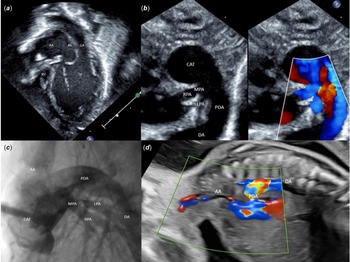
The mother presented at 33 + 6 weeks gestation with preterm, premature rupture of membranes. The infant was delivered via caesarean section due to breech presentation at 34 0/7 weeks gestation. Birthweight was 1710 g, and Apgar scores were 7 and 9 at 1 and 5 minutes, respectively. She required continuous positive airway pressure in the delivery room for poor respiratory effort and was transferred to the neonatal intensive care unit. Postnatal transthoracic echocardiogram confirmed the intracardiac anatomy suspected by fetal echocardiography (Fig 1). The interruption of the aortic arch was confirmed and found to be between the left common carotid artery and the left subclavian artery. The infant was also diagnosed with duodenal atresia and hypothyroidism. A genetic microarray was normal. Of additional note, the infant’s twin had normal intracardiac and extracardiac anatomy.
( a ): Transthoracic apical 4 chamber view. Significant findings include tricuspid atresia (TA), hypoplastic right ventricle (RV), aneurysmal atrial septum (AS) with a normal appearing left atrium (LA) and left ventricle (LV). ( b ): Transthoracic high left parasternal view showing a dilated common arterial trunk (CAT) that gives rise a main pulmonary artery (MPA) and a patent ductus arteriosus (PDA). The main pulmonary artery bifurcates to the left and right pulmonary arteries (LPA and RPA). The patent ductus arteriosus gives rise to the descending aorta (DA). ( c ): Angiogram of the CAT. Contrast is seen going superiorly to the ascending aorta (AA) and the head and neck vessels. Contrast is also seen going towards the MPA and PDA. The DA fills with contrast from the PDA. ( d ): Fetal echocardiography view of the CAT. Again, the CAT gives rise to the AA and the PDA. The PDA is also shown to give rise to a head and neck vessel and the DA.

A prostaglandin infusion was initiated immediately. Next, a hybrid procedure, including bilateral pulmonary artery banding and ductal stenting, was performed due to the infant’s small size and need for abdominal surgical intervention. Following the hybrid procedure, she was extubated on day of life 17 and monitored in the neonatal ICU where feeds were advanced to promote weight gain in anticipation of further cardiac surgical intervention. The immediate postoperative course was complicated by atrial flutter requiring amiodarone therapy. Over several weeks, she developed a worsening upper and lower extremity blood pressure gradient, and cardiac catheterisation confirmed narrowing of the ductal stent. On day of life 63, at a weight of 2.9 kg, she was taken for a repair of her interrupted aortic arch, placement of a four-millimeter innominate artery to main pulmonary artery (modified Blalock-Tausig-Thomas) shunt, branch pulmonary artery debanding, and ductal stent removal. No advanced imaging was done prior to this operation. The aortic repair began with transection of the arterial duct with the incision being extended to the descending aorta. A flap of ascending aortic tissue was utilised to bring this part of the aorta down to bridge the gap between the aortic arch and the descending thoracic aorta. This was sutured to the descending aorta posteriorly. The anterior portion of this area was then patched with PhotoFix membrane. The operation was done utilising cardiopulmonary bypass with a bypass time of 177 minutes. Aortic crossclamp time was 80 minutes. Hypothermia with a minimum temperature of 28°C was utilising during the operation. The postoperative course was uncomplicated, and she was discharged home on day of life 81 on aspirin, digoxin, and 0.4 L nasal cannula. The ductal narrowing did lead to the operation being done sooner than originally intended.
She displayed adequate weight gain following discharge and did not require any inpatient admissions. She did well in the interstage period but due to intercurrent illness had a delayed Glenn procedure at 8 months of age. She tolerated the procedure well.
Review of literature
A review of the literature resulted in 17 studies that described cases of concomitant tricuspid atresia and common arterial trunk. Reference Bharati, McAllister and Tatooles6–Reference Malec, Mroczek, Pajak and Kordon21 Each of these reports had a single patient and thus there were a total of 17 previously reported cases. With the current case added, there was a total of 18 cases. Data for each variable were not always available and so the denominators for each variable are specified.
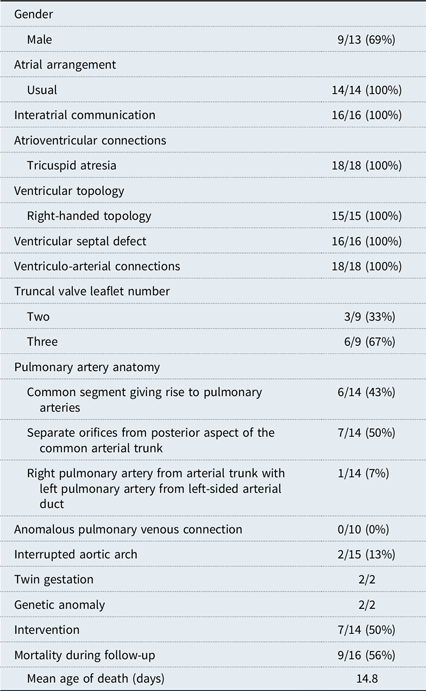
Of these 18 children (including the subject of this report), 9 (69%) were male. All had usual arrangement of the atria, and all had an interatrial communication. The atrioventricular connections consisted of tricuspid atresia in all reported cases. Ventricular topology was right handed, and a ventricular septal defect was noted in all cases. The ventriculo-arterial connection consisted of common arterial trunk in all cases with one-third having a bileaflet truncal valve and two-thirds having a trileaflet truncal valve. The pulmonary artery anatomy consisted of pulmonary arteries arising from separate orifices from the posterior aspect of the common arterial trunk in half of the cases. There were normal pulmonary venous connections in all reported cases. An interrupted aortic arch was noted in two cases (16.7%).
Surgical intervention was performed in half of all reported cases. A 56% mortality was reported, with the mean age at death being 14.8 days (Table 1).
Demographics and characteristics compiled from case reports of patients with concomitant tricuspid atresia and common arterial trunk.

Comment
In this case report, we describe the diagnosis and management the exceedingly rare combination of tricuspid atresia and common arterial trunk. Of particular note, this case also had interrupted aortic arch, making this only the second such reported case. Early and accurate diagnosis was critical in this patient to ensure adequate perinatal resuscitation and ductal patency.
Current understanding of atrioventricular valve and outflow tract development indicates these structures have different embryologic origins and occur in isolation of one another. The atrioventricular valves develop within the initial primary heart tube, which develops after the third gestational week. Following rightward looping after the 25th day, separate atrioventricular junctions begin developing with fusion of the atrioventricular endocardial cushions. This fusion divides the atrioventricular canal, forming the early right and left atrioventricular junctions. These junctions then further develop into right and left atrioventricular valves over several weeks. Tricuspid valve development involves myocardial remodeling to align the right atrium and ventricle followed by development of leaflets and their tension (or subvalvar) apparatuses.
Simultaneously, the right ventricle and outflow tracts develop as myocardial tissue. The cardiac jelly lining the heart tube converts to endocardial cushions via endothelial-to-mesenchymal transformation, ultimately leading to septation with formation of two distinct outflow tracts. Once the intrapericardial arterial trunks appear there is a non-myocardial contribution from the secondary heart field, with ongoing migrations producing the walls of the arterial valvar sinuses. The concomitant existence of tricuspid atresia and common arterial trunk thus does not seem to be developmentally related by a singular mechanism of development. This does not imply that an underlying genetic or molecular aberration may not unite the two, although, this patient had normal genetics as have other reported cases. This may simply reflect the current limitations of genetic testing.
These cases highlight the importance of sequential segmental anatomy. Describing each component of the heart concisely allows for a concise but complete description of the anatomy. Segmental sequential anatomy also highlights that atrioventricular connections and ventriculo-arterial connections are simply components of the underlying anatomy and not diagnoses in and of themselves. Such sequential segmental anatomy requires thorough echocardiographic evaluation, and these evaluations are made simpler if there is a priori knowledge of suspected lesions to direct imaging.
Once the anatomy is well delineated, then management must be considered. The presence of tricuspid atresia necessitates a functionally univentricular palliation strategy. Thus, there will be a phase where the child will have parallel circulation, followed by Glenn circulation, and, finally, a Fontan physiology. Initial palliation has been variable with previous reports discussing primary separation common arterial trunk and a systemic-to-pulmonary shunt as the initial procedure. When interrupted aortic arch is present, aortic arch reconstruction is also required as part of the initial palliation. The current case is unique as prematurity and weight made the aforementioned palliation strategies less feasible early in life. Instead, initial palliation was a hybrid procedure, with arterial ductal stenting and bilateral pulmonary artery banding was chosen.
This case highlights a unique series of cardiac malformations and highlights the important of sequential segmental anatomy. This is the first case to describe a child with tricuspid atresia, common arterial trunk, and interrupted aortic arch that required an initial hybrid procedure.
Acknowledgments
None.
Conflicts of interest
None.