Implications
A certain level of body fatness is desirable in pig systems aiming to high-quality dry-cured meat products that is not easy to attain at commercial slaughter BW due to genetic selection for lean. The restriction of dietary lysine during the finisher period (over 100 kg BW) as a strategy to achieve this goal has not been successful, leading to impaired growth performances without influence on carcass fat but had a positive effect on intramuscular fat content.
Introduction
Lean genotypes are very efficient converting feed into BW gain and for this reason, during the last decades, early maturing genotypes have been replaced in the pork industry. However, a certain level of body fatness is desirable in pig fattening systems intended for dry-cured meat production, such as ham, due to the beneficial effects on processing and eating quality (Ruíz et al., Reference Ruíz, García, Muriel, Andrés and Ventanas2002). Nowadays, to attain minimum backfat thickness in carcass and also intramuscular fat (IMF) in meat is not easy with the current genotypes even at heavy market weights (Latorre et al., Reference Latorre, Ripoll, García-Belenguer and Ariño2009).
Since lysine (Lys) is the first-limiting amino acid (AA) for growth, its restriction in diet would decrease the rate of protein synthesis increasing the proportion of energy retained as fat (Friesen et al., Reference Friesen, Nelssen, Goodband, Tokach, Unruh, Kropf and Kerr1994; Deng et al., Reference Deng, Li, Chu, Huang, Li, Kong, Liu, Wu and Zhang2007). That effect might also be modulated by AAs imbalance and the energy source (Tous et al., Reference Tous, Lizardo, Vilà, Gispert, Font-i-Furnols and Esteve-Garcia2014). In a recent work, a total Lys restriction from 11 to 5.2 g/kg during the grower phase produced an incomplete compensatory growth in the subsequent phase and increased carcass fat depth (Suárez-Belloch et al., Reference Suárez-Belloch, Guada and Latorre2015) in agreement with previous results from other researchers (Campbell et al., Reference Campbell, Taverner and Curie1988; Fabian et al., Reference Fabian, Chiba, Kuhlers, Frobish, Nadarajah, Perth, McElhenney and Lewis2002). The effects of Lys restriction during the finisher period are more controversial. Some authors (Bidner et al., Reference Bidner, Ellis, Witte, Carr and McKeith2004; Rodríguez-Sanchez et al., Reference Rodríguez-Sanchez, Sanz, Blanco, Serrano, Joy and Latorre2011) have reported a limited success to increase body fatness although Lys restriction contributed to lowering feeding cost. Whereas other authors (Cisneros et al., Reference Cisneros, Ellis, McKeith, McCaw and Fernando1996; Daza et al., Reference Daza, Latorre and López-Bote2010) have found a positive effect on IMF content of meat.
Our hypothesis is that Lys restriction in the finisher diet might be a possible strategy to manipulate body fatness at slaughter in pigs intended for dry-cured products. Therefore, a trial was carried out aiming to quantify the effect of different levels of Lys in the finisher phase on growth performances and serum and meat quality parameters of barrows and gilts slaughtered at heavy BW.
Material and methods
All the experimental procedures used in this study were in compliance with the Spanish guidelines for the care and use of animals in research (Boletin Oficial del Estado, 2007).
Animals and experimental diets
A total of 160 pigs, 50% barrows and 50% gilts, of 28.3±4.52 kg BW and 73±3 days of age were used. All animals were the progeny of Duroc sires and Landrace×Large White dams (PIC, Sant Cugat del Valles, Spain). Males had been castrated at 5±3 days of age. At the arrival on the farm, pigs were individually identified, weighed and housed in 40% slatted floor pens of 9 m2 (3×3 m) in a natural environment barn. Animals were allotted by sex, in groups of four, to blocks of increasing BW and distributed within each block to the experimental diets.
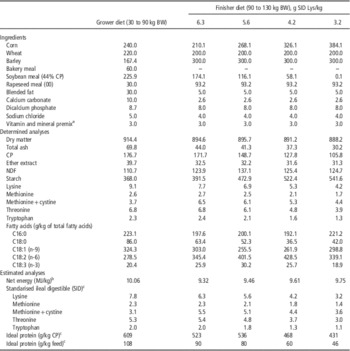
During the grower period (from 30 to 90 kg BW), all pigs fed a common diet containing 7.8 g of standardised ileal digestible (SID) Lys/kg of feed. This Lys level involves a slight AA restriction, over requirements of −0.42 g SID Lys/kg for pigs of 30 to 60 kg BW, which was estimated in a previous study (Suárez-Belloch et al., Reference Suárez-Belloch, Guada and Latorre2015). When animals achieved 89.2±6.23 kg BW, four diets were offered depending on the SID Lys content (6.3, 5.6, 4.2 or 3.2 g/kg). These diets were formulated to be isoenergetic. The diet containing 6.3 g SID Lys/kg met the Lys recommendations of the National Research Council (2012) for pigs of that BW and was considered as the control. The other diets were formulated by progressive replacement of soybean meal by maize, and synthetic Lys were not added in any case. An attempt was made to maintain a constant relationship between Lys and the remaining essential AAs, following the ideal protein concept (National Research Council, 2012). However, for diets containing 4.2 and 3.2 g SID Lys/kg, it was not possible with the same ingredients without adding synthetic AAs. Therefore, it was preferred to maintain an excess of non-limiting essential Aas, which was reflected in a lower ideal protein content. In spite of it, the restriction in ideal protein and Lys supplies were highly correlated. Table 1 shows the ingredient and nutrient composition of experimental diets. The energy content was estimated according to the Fundación Española para el Desarrollo de la Nutrición Animal (2010) and the SID AAs and the ideal protein content were calculated according to the National Research Council (2012).
Ingredient composition and estimated and determined nutrient content of the experimental diets (g/kg as-fed basis, unless otherwise indicated)

a Provided per kilogram of complete diet: 7000 IU Vitamin A; 1300 IU Vitamin D3; 10 IU Vitamin E; 0.4 mg Vitamin K3; 0.8 mg Vitamin B1; 3 mg Vitamin B2; 1 mg Vitamin B6; 15 μg Vitamin B12; 12 mg Vitamin B3; 8 mg calcium pantothenate; 10 mg choline chloride; 1 µg Biotine; 15 mg Cu (copper sulphate); 80 mg Fe (ferrous carbonate); 35 mg Mn (manganese sulphate); 80 mg Zn (zinc oxide); 0.1 mg Co (cobalt carbonate); 0.3 mg Se (sodium selenite) and 0.3 mg I (potassium iodate).
b According to the Fundacion Española Desarrollo Nutricion Animal (2010).
c Assuming 72.5 and 70.2 g Lys/kg ideal protein for grower and finisher phases, respectively, according to the National Research Council (2012).
Feed supply and analyses
Feed, in mash form, and water were provided ad libitum through the trial. Samples of each diet were weekly taken, pooled at the end of experimental period and preserved at room temperature for analysis. Dry matter was determined by oven drying method (934.01), total ash by muffle furnace (942.05), CP by Kjeldahl method (976.05) and ether extract by Soxhlet analysis (2003.05), following the procedures of the Association of Official Analytical Chemists (2005). The NDF was analysed with an ANKOM 220 Fibre Analyser as described by Mertens (Reference Mertens2002), and were expressed as ash-free residues. Total starch content was enzymatically determined, using a commercial kit (Total Starch Assay Kit K-TSTA07/11, Megazyme, Bray, Ireland). The AA composition was analysed in an external laboratory (Office, Barcelona, Spain) by HPLC-Fluorescence (PNT-M-109), with the exception of tryptophan and cystine that were determined by HPLC-UV and gas chromatography, respectively. The fatty acids of diet were extracted and quantified as described by Jenkins (Reference Jenkins2010). Laboratory equipment used will be described in the meat analyses section.
Growth performance controls and blood analyses
Mortality and the possible presence of pathologies were daily checked. All pigs were individually weighed at the beginning and at the end of the grower period to calculate average daily gain (ADG). Also, during the finisher period, individual BW and feed consumption per pen were recorded every 2 weeks and used to calculate ADG, average daily feed intake (ADFI) and feed conversion ratio (FCR) per replicate.
When the average BW of each pen was close to 130 kg (prefixed slaughter BW), a sample of 3.5 ml of blood was taken by jugular venipuncture into disposables tubes BD Vacutainer SSTTM II Advance Plus (Becton Dickenson, Belliver Industrial Estate, Plymouth, UK). After centrifugation (3000×g, 10 min), serum was stored at −20°C until analysis. Enzymatic kits (RAL, Barcelona, Spain) were utilised for the determination of serum urea (with urease and glutamate dehydrogenase) and triglycerides (using glycerol-3-phosphate oxidase), using a GernonStar equipment (RAL), in an external laboratory (Albeitar, Zaragoza, Spain).
Carcass measures and sampling
After blood sampling, pigs were moved 80 km to a commercial abattoir (Agroalimentaria de Teruel S.A., La Mata de los Olmos, Teruel, Spain), where they were kept in lairage for 15 h with full access to water but not to feed. Animals were stunned by exposure to CO2 (83% mean atmosphere concentration of gas; CO2 cycle of 90 s, with 60 s interval between discharges and sticking). After stunning, pigs were exsanguinated, scalded, dehaired, eviscerated and split down the midline according to standard commercial procedures. Then, hot carcass weight was individually recorded and used to calculate carcass yield. At 45 min postmortem, carcass length (from the anterior edge of the symphysis pubis to the anterior edge of the first rib), ham length (from the anterior edge of the symphysis pubis to the hock joint) and ham circumference (at its widest side) were measured, using a tape with centimetre precision, on the left side of each carcass. In addition, the backfat depth between third and fourth last ribs and also at level of Gluteus medius (GM) muscle was measured, using a rule with millimetre precision, on the left side of each carcass.
The head was removed at the atlanto-occipital junction and carcasses were suspended in the air and refrigerated at 2°C (1 m/s of air speed; 90% of relative humidity) for 12 h. After, carcasses were processed and main lean cuts (left ham, shoulder and loin) were trimmed, to fit commercial requirements, and weighed to calculate their yield in carcass. Then, from each left carcass, three samples were taken for subsequent analyses; 400±20 g of loin (longissimus thoracis (LT) muscle) at the last rib level, 200±25 g of ham (GM muscle) and 50±5 g of subcutaneous fat including fat layers, skin and lean at the tail insertion in the coxal region. All of them were individually vacuum-packaged and stored during 24 h at 4°C.
Meat measures and analyses
Colour was evaluated in fresh samples of LT muscle with a chromameter (CM 2002, Minolta Camera, Osaka, Japan) using objective measurements as described by Latorre et al. (Reference Latorre, Ripoll, García-Belenguer and Ariño2009). The illuminant used was D65 and the standard observer position was 2°. Previously, the chromameter was calibrated with a white tile, according to manufacturer’s recommendations. The average of three random readings was used to measure lightness (L*, a greater value is indicative of lighter colour), redness (a*, a greater value is indicative of redder colour) and yellowness (b*, a greater value is indicative of more intense yellow colour). In addition, chroma (C*) and hue angle (H°) were calculated as C*=
 $\sqrt {a^{{{\asterisk}2}} {\plus}b^{{{\asterisk}2}} } $
and H°=tan−1(b*/a*)×57.29, respectively. Chroma is related to the quantity of pigments, and greater values represent a more vivid colour denoting lack of greyness, and hue is the attribute of a colour perception, denoted by blue, green, yellow, red, purple and so on related to the state of pigments. After, all meat and fat samples were individually vacuum-packaged and stored at −20°C until subsequent analyses.
For analysing the other meat traits, the LT samples were thawed for 24 h at 4°C, removed from packages, blotted dry for 20 min and then the colour was measured again. Thawing loss was calculated taking into account the fresh and thawed weight. For cooking loss calculation, the pre- and post-cooked weights were considered. Briefly, a slice (148±32 g) was taken from each chop, weighed, placed in a plastic bag and cooked to an internal temperature of 70°C in a 75°C water bath. Internal temperature was monitored during cooking with a handheld temperature probe (model HI 9063, Hanna Instruments, Woonsocket, RI, USA). Cooked samples were allowed to cool at 15°C for 30 min, blotted dry and weighed. In addition, the texture was determined by a Warner–Bratzler device attached to an Instron Universal testing machine model 4301 (Norwood, MA, USA). Chops were cut with a cross-section of 100 mm2 (10×10 mm) with the fibre direction parallel to a long dimension of at least 30 mm and six slices of each sample were obtained. Chemical components analysed were moisture by the oven drying method, CP using a Kjeldahl MT 2300 analyser (Höganäs, Switzerland) and IMF by an ANKOM XT15 equipment (New York, NY, USA) according to Boletín Oficial del Estado (1979). Also, in the samples of GM muscle, the thawing process and the chemical composition analyses were done as has been described above.
Fat analyses
Lipids from LT and subcutaneous fat samples were extracted in chloroform methanol, according to Bligh and Dyer (Reference Bligh and Dyer1959) and butylated hydroxytoluene was used as antioxidant. Fatty acid methyl esters were generated by trans-esterification of lipids extracts, dissolved in n-hexane with KOH in methanol, and were collected in hexane. After, their composition was determined using a Hewlett-Packard 6890 II gas chromatograph (Wilmington, DE, USA) with a capillary column SP2380 (100 m×0.25 mm×0.20 μm). Nitrogen was used as gas carrier and the methyl esters were identified using retention times of Sigma chemical Co. standards (St. Louis, MO, USA). The proportions of total saturated (SFA), monounsaturated (MUFA) and polyunsaturated fatty acids (PUFA) were calculated from individual fatty acid proportions.
Statistical analysis
Data were analysed as a randomised block design with treatments arranged factorially (2×4) using the GLM procedure of the SAS package (version 9.2). Therefore, the model included initial BW as block, sex (barrows and gilts) and diet (6.3, 5.6, 4.2 and 3.2 g SID Lys/kg) as main effects and the interaction sex by diet. The linear and quadratic effects of dietary Lys content were analysed by orthogonal polynomials. The experimental unit was the pen (with four animals) for all the parameters. A P-value<0.05 was considered as a significant difference and a P-value between 0.05 and 0.10 as a trend.
Results
No significant interaction was detected for the variables studied and then only main effects are reported.
Growth performances and blood metabolites
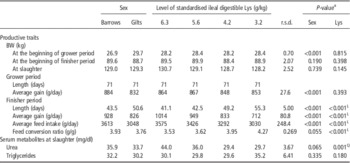
The effects of sex and diet on growth performances and serum traits are shown in Table 2. During the grower period, when all pigs received the same diet, barrows grew faster than gilts (P<0.001). During the finisher period, when the dietary Lys content was evaluated, barrows also grew faster (P<0.001) and ate more feed (P<0.001) but tended to be less efficient converting feed into gain (P=0.055). In addition, Lys restriction affected linearly (P<0.001) all performance traits, reducing ADG and ADFI and increasing FCR and the length of the fattening period (P<0.001). However, due to the longer fattening period, total feed intake was higher for the highest restricted pigs compared with unrestricted (663 v. 562 kg of feed; P<0.001). Also, the concentration of serum urea at slaughter tended to be higher in barrows than in gilts (P=0.065) and was reduced quadratically by the restriction of dietary Lys (P<0.001). No effect of sex or experimental feed was observed in the blood content of triglycerides.
The effect of sex and dietary lysine (Lys) restriction during the finisher period on growth performance and serum parameters of heavy pigs

r.s.d.=residual standard deviation.
aL=linear effect; Q=quadratic effect. No significant interaction (sex×Lys) was found.
Carcass characteristics
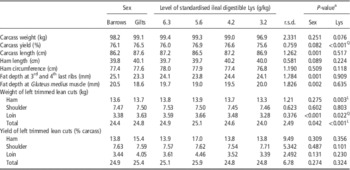
Barrows tended to have lower dressing percentage (P=0.082) and shorter hams (P=0.089) and showed shorter and fattier carcasses (P<0.01) than gilts (Table 3). Also, the weight of main trimmed lean cuts (ham+shoulder+loin) was higher for gilts than for barrows (P<0.05), mainly due to the heavier loins (P<0.001), but no difference was observed in the yield of these pieces when were expressed as proportion of carcass. The Lys restriction during the finisher period decreased quadratically carcass yield (P<0.001) with no influence on carcass size or fatness. In addition, the weight of major trimmed lean cuts was reduced linearly as dietary Lys content decreased (P<0.001), particularly due to the responses of ham and loin (linear, P<0.01 and quadratic, P<0.05, respectively).
The effect of sex and dietary lysine (Lys) restriction during the finisher period on carcass characteristics of heavy pigs

r.s.d.=residual standard deviation.
a L=linear effect; Q=quadratic effect. No significant interaction (sex×Lys) was found.
Meat characteristics
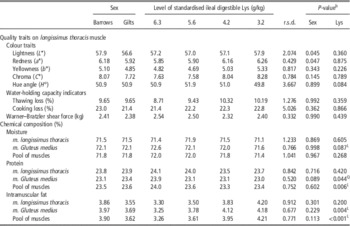
The average results for the colour of fresh LT samples (data not shown) were 59.9 for L*, 6.54 for a* and 4.00 for b*. It seems that the fresh muscle has higher lightness and redness but lower yellowness than the thawed muscle (Table 4), although it has not been analysed statistically. Sex and diet had limited effect on meat quality. Loin from barrows had higher (P<0.05) L* and a* values than that from gilts and ham from barrows tended to have lower protein content (P=0.089) than that from gilts. The dietary SID Lys restriction from 6.3 to 3.2 g/kg reduced quadratically the protein percentage (P<0.05) and increased linearly the IMF (P<0.01) proportion in m. Gluteus medius. Moreover, when the pooled data from both muscles were analysed, a similar effect was evidenced, showing a linear decrease of protein (P<0.01) and a linear increase of IMF (P<0.001).
The effect of sex and dietary lysine (Lys) restriction during the finisher period on meat characteristics of heavy pigsFootnote a

r.s.d.=residual standard deviation.
a Measured on thawed samples.
b L=linear effect; Q=quadratic effect. No significant interaction (sex×Lys) was found.
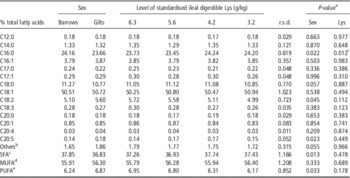
Fat composition
Barrows had higher SFA proportion (P<0.05) than gilts in the IMF from LT muscle (Table 5), due to the higher proportion of C16:0 (P<0.05) and C18:0 (P=0.057). Also, fat from barrows had lower levels of PUFA (P<0.05) than that from gilts because of the lower proportion of C18:2 (P<0.05) and C20:5 (P<0.05). However, Lys restriction only affected the C16:0 proportion which increased linearly (P<0.05) with no consequences on total SFA.
The effect of sex and dietary lysine (Lys) restriction during the finisher period on fatty acid profile of the intramuscular fat from longissimus thoracis muscle of heavy pigs

r.s.d.=residual standard deviation.
aL=linear effect. No significant interaction (sex×Lys) was found.
b The sum of some minor fatty acids.
c ∑ Saturated fatty acids.
d ∑ Monounsaturated fatty acids.
e ∑ Polyunsaturated fatty acids.
In the subcutaneous fat (data not shown), the differences between sexes were similar to those found in IMF, with barrows having higher SFA (P<0.001) and lower PUFA (P<0.001) proportions than gilts. However, Lys restriction decreased linearly the PUFA percentage (P<0.01) due to the reduction of C18:2 (P<0.05), C18:3 (P<0.001) and C20:5 (P<0.05) proportions.
Discussion
Growth performances and serum metabolites
The differences between sexes in productive traits were similar to those previously detected by other authors (Latorre et al., Reference Latorre, Ripoll, García-Belenguer and Ariño2009; Rodríguez-Sanchez et al., Reference Rodríguez-Sanchez, Sanz, Blanco, Serrano, Joy and Latorre2011). The higher ADG showed by barrows during the finisher period in comparison with gilts was associated to an increase in ADFI resulting in a negative effect on FCR. Barrows tended to have higher blood urea than gilts, probably as a result of the lower protein requirements and the higher feed intake than gilts (National Research Council, 2012).
Different strategies can be implemented to reduce the Lys concentration in the diet. Loughmiller et al. (Reference Loughmiller, Nelssen, Goodband, Tokach, Titgemeyer and Kim1998) formulated diets by altering the dietary ingredients without AA supplementation. However, Hahn et al. (Reference Hahn, Biehl and Baker1995) used low-protein corn–soybean meal diets supplemented with methionine, threonine, isoleucine, valine and tryptophan to meet or exceed an ideal AA pattern relative to Lys. In the current experiment, the first strategy was used. The clear response observed in productive performances to the restriction of dietary Lys (ADG decreased and FCR increased) confirms previous observations on the effectiveness of Lys to manipulate the pattern of growth. So, Rodríguez-Sanchez et al. (Reference Rodríguez-Sanchez, Sanz, Blanco, Serrano, Joy and Latorre2011) reported a linear decrease in ADG and ADFI as total dietary Lys was reduced from 7 to 6 g/kg in diets from 100 to 128 kg BW. Also, Jin et al. (Reference Jin, Oh, Piao, Jang, Choi, Heo, Jang and Kim2010) found an impairment of ADG and FCR with 30% of Lys restriction over a control diet containing 6 g total Lys/kg.
Some authors have used the blood urea content to define Lys requirements (Roux et al., Reference Roux, Donsbough, Waguespack, Powell, Bidner, Payne and Southern2011), although not always successfully (Cameron et al., Reference Cameron, McCullough, Troup and Penman2003), depending on the supply of non-limiting AAs relative to Lys. In the current study, the formulation of diets for similar content of ideal protein prevented the response of serum urea to dietary Lys. Anyway, a significant increase in urea content was recorded in the diet exceeding Lys requirements (6.3 g SID Lys/kg), confirming the usefulness of blood urea for estimating AA needs, providing all diets ensure excess of non-limiting AAs. In spite of the apparent high serum concentration of triglycerides recorded with the lowest Lys level (3.2 g SID Lys/kg), differences did not reach statistical significance, which suggests no metabolic change as confirmed by the results on carcass backfat depth.
Carcass characteristics
Carcass weight was similar for barrows and gilts because both were slaughtered at the same BW. However, gilts tended to have higher carcass yield than barrows, which agrees with Ellis et al. (Reference Ellis, Webb, Avery and Brown1996) and Latorre et al. (Reference Latorre, Ripoll, García-Belenguer and Ariño2009), although other authors (Daza et al., Reference Daza, Latorre and López-Bote2010) did not find any difference. The discrepancies observed in the literature could be related to differences in the method used for trimming reproductive organs at the slaughterhouse. In addition, carcasses of gilts were longer and also tended to have longer hams than those of barrows. Rodríguez-Sanchez et al. (Reference Rodríguez-Sanchez, Sanz, Blanco, Serrano, Joy and Latorre2011) found similar size of carcass and ham for both sexes when animals were slaughtered at the same age (196 days old) but different BW (132 and 126 kg for barrows and gilts, respectively). Therefore, the age/BW could be responsible, at least in part, for these differences. Also, as it was expected, and has been widely demonstrated (Cisneros et al., Reference Cisneros, Ellis, McKeith, McCaw and Fernando1996; Latorre et al., Reference Latorre, Ripoll, García-Belenguer and Ariño2009), barrows were fatter than gilts, which is related to the higher feed intake shown by castrated animals allowing higher fat deposition. To this respect, the lower weight of total main cuts found in barrows confirm that carcasses from gilts were leaner, because these pieces are the main contributors to lean tissue. In fact, loin was the most affected piece and is the leanest one of them. Mas et al. (Reference Mas, Llavall, Coll, Roca, Díaz, Gispert, Oliver and Realini2010) reported higher lean yield in gilt carcass than in barrow carcass when were slaughtered at a fixed BW. Unfortunately, in the current trial, it was not measured to confirm it.
Scarce effects of diet were observed on carcass characteristics. The dressing percentage was reduced as dietary Lys decreased, especially with the lowest level, which is in agreement with Cisneros et al. (Reference Cisneros, Ellis, McKeith, McCaw and Fernando1996) and Bidner et al. (Reference Bidner, Ellis, Witte, Carr and McKeith2004). In addition, the Lys content of the finisher diet affected the main trimmed cuts reducing the weight of hams and loins. The reason could be again the lean nature of these pieces. To this respect, greater lean yield and wider loin eye area have been observed in pigs fed diets with higher Lys concentration than in those fed less Lys (Loughmiller et al., Reference Loughmiller, Nelssen, Goodband, Tokach, Titgemeyer and Kim1998; Witte et al., Reference Witte, Ellis, McKeith and Wilson2000; Bidner et al., Reference Bidner, Ellis, Witte, Carr and McKeith2004). Also, it is well documented that inadequate dietary Lys limits protein synthesis and increases the energy available for fat deposition (Campbell et al., Reference Campbell, Taverner and Curie1988; Friesen et al., Reference Friesen, Nelssen, Goodband, Tokach, Unruh, Kropf and Kerr1994). Taking into account this consideration, fatter carcasses would be expected as a response to Lys restriction but the concomitant decrease in feed intake prevented the surplus of energy for fat deposition. However, an effect was observed in the meat of ham (IMF), as described below.
Meat characteristics
The differences in meat traits between sexes were limited. The LT muscle from gilts had lower lightness and redness than that from barrows but no difference was detected in water-holding capacity or tenderness, confirming previous reports (Cisneros et al., Reference Cisneros, Ellis, McKeith, McCaw and Fernando1996; Ellis et al., Reference Ellis, Webb, Avery and Brown1996). Also, ham from barrows tended to have lower protein content than ham from gilts with no significant difference on IMF content. To this respect, a higher IMF proportion was expected in meat from barrows, taking into account their fatter carcasses and in accordance with several authors (Ellis et al., Reference Ellis, Webb, Avery and Brown1996; Rodríguez-Sanchez et al., Reference Rodríguez-Sanchez, Sanz, Blanco, Serrano, Joy and Latorre2011). However, in this case, the differences were only numerical and the reason could be that, in many reports, animals are usually slaughtered at the same age and then gilts were lighter than barrows, which has influence on meat composition (Latorre et al., Reference Latorre, Ripoll, García-Belenguer and Ariño2009), whereas, in this case, both sexes had similar BW, which would reduce the differences. A greater IMF concentration has been associated with more juiciness and acceptable meat (Madeira et al., Reference Madeira, Costa, Alfaia, Lopes, RJB, JPC and JAM2013).
The Lys restriction did not affect colour, which agrees with other works where it was determined by visual score and by objective measures (Witte et al., Reference Witte, Ellis, McKeith and Wilson2000). Also, dietary Lys level had no effect on thawing and cooking loss or tenderness. Other productive factors, such as genotype or slaughter weight, seem to have more influence than diet on meat characteristics as suggested by Latorre et al. (Reference Latorre, Ripoll, García-Belenguer and Ariño2009). However, the diet affected chemical composition of meat, being the differences significant in ham and also in the pool of both muscles, where Lys restriction decreased CP and increased IMF percentage, in agreement with other reports. Cisneros et al. (Reference Cisneros, Ellis, McKeith, McCaw and Fernando1996) detected an increase in IMF of loin of 1.8 percentage units from feeding Lys-deficient diets (5.6 v. 4.0 g Lys/kg) and Witte et al. (Reference Witte, Ellis, McKeith and Wilson2000) also observed an increase of 0.55 percentage units testing 6.4 g Lys/kg v. 4.8 g/kg in pigs from 90 to 126 kg BW. The lack of effect of dietary Lys level on carcass fat depth and the linear effect found on IMF of meat was unexpected in view of the moderate but positive correlation (+0.45) between subcutaneous fat depth and IMF content reported by Huff-Lonergan et al. (Reference Huff-Lonergan, Bass, Malek, Dekkers, Prusa and Rothschild2002). However, the responses found in the literature are controversial. Some authors have reported that protein restriction increases backfat thickness, being lower the effect on muscle lipid deposition (Lebret, Reference Lebret2008; Rodríguez-Sanchez et al., Reference Rodríguez-Sanchez, Sanz, Blanco, Serrano, Joy and Latorre2011) but others concluded that the influence can be higher on IMF proportion (Wood et al., Reference Wood, Enser, Fisher, Nute, Sheard, Richardson, Hughes and Whittington2008; Daza et al., Reference Daza, Latorre and López-Bote2010). Also, Madeira et al. (Reference Madeira, Costa, Alfaia, Lopes, RJB, JPC and JAM2013) tested restricted Lys diets against a control in a fatty genotype (Alentejano) and in commercial crossbred pigs (Landrace×Pietrain) finding no effect on backfat depth but with an increase of IMF recorded only in the commercial pigs. These results suggest that the protein restriction has higher effect on modern breeds (Large White and Duroc) than in traditional breeds (Berkshire and Tamworth; Wood et al., Reference Wood, Enser, Fisher, Nute, Sheard, Richardson, Hughes and Whittington2008). In addition, these authors attribute the response to the breed-specific expression of muscle fibre types and key lipogenic enzymes, which have been described as the most important factors influencing IMF in pigs (Guo et al., Reference Guo, Tang, Wang, Liu and Wang2011). Other reasons for the discrepancies among experiments may be related to diet composition or degree of AA restriction.
Fat composition
Fat from barrows was more saturated and less polyunsaturated than fat from gilts in agreement with previous reports (Warnants et al., Reference Warnants, Van Oeckel and Boucque1999; Mas et al., Reference Mas, Llavall, Coll, Roca, Díaz, Gispert, Oliver and Realini2010). It is related to differences in fatness as SFA and MUFA increase faster than PUFA with increasing fatness. The greater SFA percentage in barrows was particularly due to C16:0 concentration, and the greater PUFA proportion in gilts was mainly explained by the 10% higher level of C18:2. The linoleic acid accumulated in the carcass is completely derived from the diet and its proportion has been negatively associated with fatness and positively to lean weight (genetic correlations=−0.74 and 0.47, respectively) by Cameron (Reference Cameron1990). It is confirmed, in the present trial, by the differences in carcass fatness between sexes. The C18:2 plays an important role in human nutrition because it can reduce firmness and cohesiveness of adipose tissue and increase the fat oxidation rate (Wood et al., Reference Wood, Enser, Fisher, Nute, Sheard, Richardson, Hughes and Whittington2008).
The dietary Lys restriction had scarce effect on fat composition, which agrees with results of Rodríguez-Sanchez et al. (Reference Rodríguez-Sanchez, Sanz, Blanco, Serrano, Joy and Latorre2011) testing the same crossbred and providing less restricted Lys diets (7 v. 6.5 or 6 g total Lys/kg) during a similar period (100 to 130 kg BW). It was expected because the influence of feeding Lys on carcass fat composition depends more on sex, BW or environment than on diet (Campbell et al., Reference Campbell, Taverner and Curie1988; Friesen et al., Reference Friesen, Nelssen, Goodband, Tokach, Unruh, Kropf and Kerr1994; Jin et al., Reference Jin, Oh, Piao, Jang, Choi, Heo, Jang and Kim2010).
Conclusions
The above results confirm the negative influence of deficient Lys diets during the finisher period (over 100 kg BW) on growth performances with no effects on carcass fat deposition; although it might have influence on some pork characteristics such as a higher IMF proportion.
Acknowledgements
This work was funded by the CDTI Project IDI-20090836, from the Ministry of Science and Technology (Spanish Government), with participation of the Department of Industry and Innovation of the Government of Aragón and the European Social Fund. Jesús Suárez was granted a fellowship by the University of Zaragoza.