But then Bloody Sunday happened and again this incredible sense of outrage … And following along Bloody Sunday I decided that what I was doing … was wanting to go home more and more. And as soon as I came home, I got into Sinn Fein, and it was a natural progression from there. Because my beliefs were fairly well formulated at the time. The British were killing our people, they were locking them up, and they were nothing more than Stormont.Footnote 1
Introduction
What explains why and how terrorist groups decide to end their campaigns? The factors influencing the duration and outcomes of terrorist campaigns have only recently started to attract the attention of terrorism researchers. This article argues that government repression undermines terrorist groups in non-democratic regimes, but is counterproductive in democracies because it leads to a backlash against the government and more durable terrorist organizations. In democracies, harsh government responses harm the regime's legitimacy and thus reduce co-operation from local communities, increase recruitment and support for terrorist organizations, and erode popular support for the government. Conversely, authoritarian regimes are less constrained by legitimacy considerations in their counter-terrorism efforts, and their repressive measures can thus reduce the lifespan of terrorist groups in non-democratic regimes.
The British government's response to escalating terrorist violence in Northern Ireland in the late 1960s, for example, was characterized by harsh repressive measures. Interventions included internment without trial, criminalization of terrorism suspects, coercive interrogation, curfews, extensive search operations and military deployment.Footnote 2 The adoption of repressive counter-terrorism policies increased Catholics’ distrust in the government and resulted in a wave of recruitment for the Irish Republican Army (IRA).Footnote 3 When British counter-terrorism policy gradually shifted from suppression to accommodation in the 1980s, Catholics started to believe that reform in Northern Ireland was possible, which opened the door for peace negotiations.Footnote 4 A series of ceasefires negotiated with paramilitary forces culminated in the Good Friday Accords in 1998.
This example illustrates our claim that coercive responses to terrorism tend to be counterproductive in democracies. Our article contributes to terrorism research in several ways. First, our explanation of why the effects of repression on terrorist organizations differ between democratic and non-democratic regimes helps reconcile the contradictory findings in existing studies. Secondly, our study evaluates the effects of repression on terrorist campaign outcomes, including government victory, settlement, group victory and splinters. Our findings for campaign outcomes demonstrate that repression in democracies is counterproductive: coercion reduces the probability of negotiated settlements, but increases the likelihood of group victory. Thirdly, our empirical analysis controls for both group- and state-level characteristics, thus improving on earlier studies that lacked information on terrorist groups.
The article first reviews the existing research on terrorist group duration and outcomes. The next section develops our theoretical argument, which expects the effects of repression on terrorist group termination and campaign outcomes to be conditional on states’ regime type. The argument is tested using data on terrorist groups provided by Jones and Libicki.Footnote 5 The results support many of our expectations and are robust to a number of different model specifications.
The Duration of Terrorist Campaigns
While past research has significantly increased our understanding of the formation of terrorist groups, the dynamics of terrorist attacks and target selection, and state responses to terrorism, scholars have only recently started to pay attention to the question of why and how terrorist campaigns end. Case study assessments of particular groups dominated research on the subject until a recent increase in systematic evaluations.Footnote 6 One strand of research focuses on how the characteristics of terrorist groups are related to group disengagement.Footnote 7 Findings show that religious groups have longer durations than leftist, right-wing or nationalist organizations.Footnote 8 In addition, group strength – measured as the size of terrorist groups – has been shown to increase the lifespan of terrorist groups.Footnote 9 No clear findings have emerged with regard to the breadth of terrorists’ goals.Footnote 10
A second strand in the literature emphasizes the relevance of state characteristics and state responses for explaining the duration of terrorist groups. Research has not produced conclusive findings on the effect of regime type on group duration. Blomberg et al. do not find a consistent relationship between groups operating in democratic countries and group termination, whereas Jones and Libicki and Young and Dugan find no association between democracy and group termination.Footnote 11 With regard to repression, no research has systematically evaluated the effect of coercive government responses on group termination.Footnote 12 Case study research on the effect of repression on individual terrorist groups has produced contradictory findings. Studies of groups in Northern Ireland, Italy, Germany and Israel show that the use of repressive policies backfired and exacerbated the growth, intensity and duration of terrorist campaigns.Footnote 13 However, analyses of cases in Egypt, Argentina, Uruguay and a set of Middle Eastern countries indicate that coercive government responses can successfully terminate terrorist groups.Footnote 14 Consequently, repression seemingly exacerbates the intensity and duration of terrorist groups in some cases, but contributes to their decline in others. The theoretical argument developed below helps account for these contradictory findings.
Repression, Regime Type and Disengagement from Terrorism
Our argument maintains that the effect of coercion on group duration and outcomes depends on whether repressive measures alter governments’ legitimacy.Footnote 15 Similar to earlier research, we conceptualize terrorism as a competition over popular support and legitimacy between the government and the terrorist group, but expect that the outcome of this battle is conditional on the importance of legitimacy considerations for the regime in power.Footnote 16 Political regimes vary considerably in the extent to which they depend on the support of the public at large. We therefore anticipate that repression leads to backlash effects (that is, lengthens the duration of terrorist groups) in regimes that depend on the perceived legitimacy of their actions, such as democracies. Conversely, in regimes that rely less on popular support, such as authoritarian regimes, coercion is expected to produce deterrence effects (that is, reduce the duration of terrorist groups).Footnote 17
Repression and Terrorist Group Duration in Democracies
We expect that adopting harsh techniques in response to terrorist events results in backlash effects in democracies. While repressive measures are intended to weaken a terrorist group and compromise its security, such strategies likely backfire in regimes that derive their support from the guarantee of civil rights and liberties. Since the existence of civil rights and liberties is widely accepted in democracies, harsh government responses to terrorism – such as holding suspects without charging them, assassinating suspected terrorists, curbing civil freedoms or imposing retribution on alleged sponsors – thus contradict the fundamental values of such regimes. As Crenshaw points out, governments risk becoming ‘the victims of their own stereotype of terrorism as responsive only to force’.Footnote 18 Consequently, government crackdowns on extremists, and accompanying policies that limit political freedoms and rights, undermine the government's legitimacy and can increase support for terrorist groups, facilitate terrorist recruitment, and prolong the lifespan of terrorist groups.Footnote 19
Such backlashes are particularly likely if counter-terrorist measures do not discriminate between supporters of terrorist organizations and innocent citizens.Footnote 20 Proactive measures may thus increase popular sympathies for terrorist groups’ grievances, and could even boost terrorist recruitment. As Rosendorff and Sandler point out, coercive tactics ‘may have a downside by creating more grievances in reaction to heavy-handed tactics or unintended collateral damage’.Footnote 21 We propose three mechanisms to explain why elites in democracies experience backlash effects.Footnote 22
First, we argue that the use of harsh policies reduces local communities’ co-operation with government authorities. Since terrorism is a relatively rare and dispersed form of violence, effective counter-terrorism policing depends on complete, accurate and well-timed information from local communities.Footnote 23 However, intrusive government actions in response to terrorist threats can undermine government legitimacy and estrange local communities from government authorities.Footnote 24 Hence, government responses that are perceived as harsh and excessive can lead individuals to withhold information out of fear of unfair treatment. Surveys of Muslims in the United States and the United Kingdom show that their willingness to alert the police to threats is ‘negatively affected by the belief that Muslims are subject to discrimination’.Footnote 25 Research has also documented that perceptions of intrusive police tactics against Muslim Americans can reduce non-Muslims’ perceptions of the police as legitimate.Footnote 26
Secondly, harsh counter-terrorism policies can increase popular sympathy for the group's cause and subsequently spur recruitment for terrorist organizations in democratic regimes.Footnote 27 Coercive responses that undermine a government's legitimacy can thus increase: overall support for a terrorist group, the number of potential recruits and the resources available to the group.Footnote 28 Accounts of the escalation of violence in several democracies illustrate this dynamic. Several studies of the Northern Ireland conflict emphasize that coercive government measures in the 1970s helped drive the growth and intensity of the IRA during this period.Footnote 29 Similarly, Della Porta's analysis of counter-terrorism in Italy emphasizes how hard-line policies can produce counterproductive results by ‘stiffening individuals as regards their own choices and increasing solidarity outside’.Footnote 30 In addition, harsh government tactics against terrorism in Israel have reportedly resulted in a large number of civilian casualties, which can fuel the cycle of violence by mobilizing new supporters and strengthening the motivation of group members.Footnote 31
Thirdly, we expect that democratic states’ use of repression will jeopardize their ability to combat terrorism more generally. Democratic leaders are accountable to the public and can be removed from office if their counter-terrorism policies are perceived as unnecessarily harsh and excessive. The use of coercive measures undermines the values that democratic regimes represent, and can thus threaten the survival of leaders. Leadership turnover may result in changes to counter-terrorism policies that can subsequently reduce the government's effectiveness in combating terrorist groups.Footnote 32 Moreover, simply being threatened with removal can produce inconsistent counter-terrorism policies, since democratic leaders may decide to ‘change policies midstream’ to avert popular criticism.Footnote 33 In addition, Walsh and Piazza maintain that opposition parties will try to gain political capital by criticizing counter-terrorism policies, which will likely reduce the overall resources devoted to counter-terrorism.Footnote 34
Repression and Terrorist Group Duration in Non-Democratic Regimes
We expect that coercive government action can successfully deter terrorist group survival in non-democratic regimes, because authoritarian leaders are less dependent on whether their counter-terrorism policies are perceived as legitimate.Footnote 35 First, we do not expect repression to deter public co-operation in authoritarian regimes. Since repression is more common in non-democratic regimes, government legitimacy is already low. Research in the criminology literature shows that legitimacy becomes largely irrelevant for public co-operation when governmental abuse is considered an inevitable fact of life.Footnote 36 Compliance in authoritarian regimes is thus likely to be driven by fear of punishment rather than legitimacy, so coercive counter-terrorism strategies are unlikely to further reduce community co-operation with the government.
Secondly, we anticipate that repressive measures by authoritarian regimes can successfully depress recruitment for terrorist groups. Gathering information on suspected terrorists and their sympathizers (and detaining them without trial) is unlikely to lead to backlash effects, because authoritarian governments can suppress information about their actions and curtail media reports.
Finally, leaders of authoritarian regimes are not as constrained in their counter-terrorism efforts as their democratic counterparts because they are less dependent on public opinion for remaining in office.Footnote 37 Legal and normative constraints are subordinate in authoritarian regimes’ responses to anti-government violence.Footnote 38 Authoritarian leaders can thus be less concerned with the public's response to repressive counter-terrorism policies or the electoral consequences of such actions.Footnote 39
Therefore our main hypothesis expects the effects of repression on group duration to vary by regime type. Coercive measures in democracies constrain the civil rights and liberties expected by citizens and thus inadvertently increase the resilience of terrorist groups. Conversely, proactive measures are expected to be successful in deterring the use of terrorism and reducing the lifespan of terrorist organizations in non-democratic regimes.
Hypothesis 1: Repression reduces the hazard of terrorist group termination in democracies, but increases the hazard of terrorist group termination in non-democratic regimes.
Repression, Regime Type and The Outcome of Terrorist Campaigns
We now turn to the implications of our argument for terrorist campaign outcomes. We distinguish between four main endings for terrorist campaigns: government victory, political settlement, group victory or splintering. Since these outcomes vary in the extent to which they are desirable from the perspective of the government and the terrorist group, evaluating group termination in the aggregate risks masking substantial variation in the influence of repression on these outcomes. We expect that repression makes outcomes favourable to the government less likely in democratic regimes, but more likely in authoritarian regimes.
Government victory and negotiated settlements likely represent the most favourable outcomes for governments. Because we suspect that repression has counterproductive effects in democracies, we anticipate that its use will reduce the likelihood of such outcomes in democracies. Conversely, because harsh government responses are not expected to harm the government's counter-terrorism efforts in authoritarian regimes, we expect that repression will increase the chance of government victory or settlement in these regimes.
Hypothesis 2: Repression reduces the hazard of government victory or political settlement in democracies, but increases the hazard of government victory or political settlement in non-democratic regimes.
A victorious terrorist group is likely the least desirable outcome from the perspective of the government. The logical implication of our argument thus suggests the opposite expectation for campaigns ending with a group victory.Footnote 40 We expect that repression will increase the likelihood of group victory in democracies because of backlash effects, but reduce the probability of group victory in non-democratic regimes.
Hypothesis 3: Repression increases the hazard of group victory in democracies, but decreases the hazard of group victory in non-democratic regimes.
The final possible outcome is terrorist campaigns that break up or splinter. The implications of our argument are most ambiguous with regard to splinters, especially since splintering might be a favourable outcome for the government in some cases but unfavourable in others. In some instances, splintering could be the result of successful government pressure if extremist elements break apart because moderate group members switch to nonviolent tactics. Yet in other cases, splinter groups could continue using terrorist tactics to undermine negotiations with the government.Footnote 41 Consequently, it is unlikely that repression and regime type have systematic effects on splintering. Therefore we do not develop expectations on the likelihood of splintering.
Empirical Analysis
Data
We evaluate our theoretical arguments in a statistical analysis of 539 terrorist groups in eighty-five countries for the 1976–2006 period.Footnote 42 We use data on terrorist organizations collected by the RAND-MIPT project and presented in Jones and Libicki. Our unit of analysis is the group-year; the last year of observation is 2006 (or earlier, if the group terminated prior to that date). The data include terrorist organizations that carried out international incidents before 1998 and organizations that carried out international or domestic incidents from 1998–2006. We include terrorist groups engaging in both domestic and transnational terrorism for several reasons. First, Jones and Libicki identify the host country (the country in which groups base their operations) rather than the target country (the country experiencing the violence) for terrorist organizations carrying out international incidents.Footnote 43 Our empirical analysis investigates how government responses in the host country (in which groups base their operations) affect group duration, rather than government responses in the country that is targeted. Secondly, the RAND-MIPT database's definition of international terrorism includes many incidents committed by groups to which our theoretical argument should apply rather straightforwardly. Terrorist events are defined as international if terrorists go abroad to strike their targets, select victims or targets with foreign connections or attack airlines’ personnel or equipment.Footnote 44 For attacks that occur within a host country and are thus in the natural environment of the group (the second and third categories of international terrorism), responses from that government should clearly be relevant for group duration. For example, the data include groups such as the African National Congress (ANC) because it engaged in attacks against international corporations in South Africa, yet the ANC's goal was arguably to establish racial equality in South Africa. Finally, we think our argument may also apply to groups that target internationally. While repressive government measures may not be aimed at groups that carry out attacks in other countries, coercion that affects large parts of the population would likely also affect the capabilities of such groups.Footnote 45 A robustness test excluding groups that target internationally is presented in the online appendix and shows support for our main contention.
Dependent Variables
The first dependent variable is used to evaluate our hypothesis on group termination. It is a dummy variable coded 0 for each year that a particular group was in operation, and 1 for the year in which the group terminated. Groups still active in 2006 were coded as 0 in the last year of observation. Of the 539 groups studied, 322 groups ended their campaigns during 1976–2006. Data on start and end dates of terrorist organizations come from Jones and Libicki.Footnote 46 Jones and Libicki used the following criteria to code the beginning and end of terrorist campaigns:
The start year of a terrorist group was assigned based on first indication that the group existed and was dedicated to the use of violence. The end year of a terrorist group was assigned based on earliest evidence that the group no longer used terrorism to achieve its goals. This may be because security forces captured and killed most of its members, the group reached a peace agreement with the government, its members shifted to nonviolent means to achieve their goals, or its members splintered to join other groups or start new ones. Regardless of the reason, the group did not commit further terrorist attacks under its name.Footnote 47
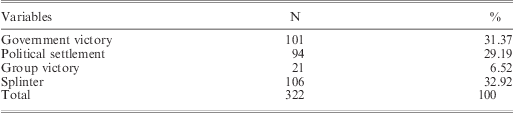
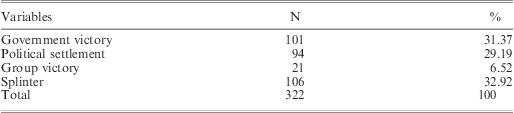
Jones and Libicki provide information on how terrorist campaigns end, which we used to create four additional dependent variables to examine the outcome of terrorist campaigns: government victory, political settlement, group victory and splintering.Footnote 48Table 1 presents the distribution of terrorist campaign outcomes for the 322 groups that ended their campaigns in the period under analysis. The table shows that splinters, government victory and settlement are approximately equally common, whereas group victory is by far the least likely outcome of terrorist campaigns.
Terrorist Campaign Outcomes, 1976–2006
Independent Variables
The data provided in Jones and Libicki include information on a number of group characteristics that we append with state-level characteristics, described in more detail below.Footnote 49 The first independent variable measures the level of repression in states. Data for this variable were obtained from the Political Terror Scale (PTS).Footnote 50 The variable is coded 1 through 5, ranging from least repressive to most repressive.Footnote 51 The second key independent variable measures how democratic countries are; it is taken from the Polity IV Project data.Footnote 52 The scale for this variable ranges from −10 (fully authoritarian) to +10 (fully democratic).Footnote 53 To model the interaction between repression and regime type outlined in the first hypothesis, we create an interaction variable by multiplying the repression and democracy variables.Footnote 54
Additional variables control for other group and state characteristics that likely affect group termination. Data for all group characteristics come from Jones and Libicki.Footnote 55 First, group size has been shown to affect the likelihood of group termination in previous research: larger groups have greater longevity. The measure of the size of the terrorist group is an ordinal variable coded 1 for less than 100 people, 2 for 100–999, 3 for 1,000–9,999 and 4 for 10,000 or more.Footnote 56
Secondly, the previous literature also identifies terrorist groups’ ideological views as a significant factor that affects group longevity; religious terrorist organizations are more durable than leftist or right-wing groups. We separate the ideology measures from Jones and Libicki into four dummy variables:Footnote 57 nationalist groups, religious groups, leftist groups and right-wing groups.Footnote 58 In our models, right-wing groups are the excluded category because they were least represented in the data.
Thirdly, we control for the breadth of terrorist goals. This measure is coded as an ordinal variable according to the scope of the groups’ goals.Footnote 59 A fourth control variable incorporates information about the number of countries in which individual terrorist organizations operate or have bases of support. The foreign presence variable is a dummy coded 0 if the terrorist group is based in only one state and 1 if the group is present in two or more states.
Two additional variables account for other state characteristics. Gross domestic product (GDP) per capita – gathered from the Penn World TablesFootnote 60 – serves as our measure of state economic development. Data for population size come from the World Bank's World Development Indicators.Footnote 61
Methodology
We use a Cox proportional hazards model to estimate the hazard of group termination, our first dependent variable. The model allows us to estimate the hazard function by predicting the failure or termination of conflict within a particular time interval. The hazard rate for any observation i at time t is given by the function hi(t) = h0(t) exp (x′tβ), where h0(t) is the baseline hazard of the event. In this type of model, hazard rates are only calculated as failures and are not sensitive to distribution issues because the baseline hazard rate cancels out when the hazard ratio is taken in the event of a failure. We use a stratified Cox model to analyse terrorist campaign outcomes, the second set of dependent variables in our empirical analyses.Footnote 62 This model lets us estimate the effect of covariates on a particular terrorist campaign outcome, rather than estimating the average effect of independent variables across different outcomes.Footnote 63
One restriction imposed on the Cox model is the assumption of proportionality, meaning that the effect of the covariates on the hazard ratio has to be proportional during the lifespan of a terrorist group. Tests of the proportional hazards assumption indicated evidence of non-proportionality for several independent variables, in particular the group size variable.Footnote 64 We follow Box-Steffensmeier and Jones’ advice and deal with time-varying covariates by interacting such variables with the logarithm of time.Footnote 65
In the following tables for group duration and outcomes, the hazard ratio is a covariate's effect on the baseline hazard of group termination.Footnote 66 Hazard ratios smaller than 1 indicate that an independent variable reduces the hazard rate of event occurrence within a specified time interval, and ratios larger than 1 mean that an independent variable increases the hazard rate of event occurrence. The statistical significance of hazard ratios is measured using two-tailed tests, and all models employ robust standard errors.Footnote 67
Data Analysis
Terrorist Campaign Duration
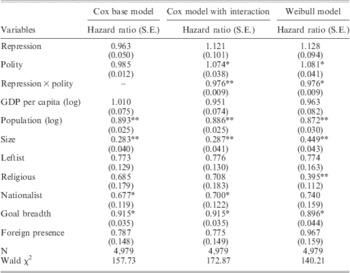
Table 2 presents the results for models of terrorist group duration. The first model in Table 2 includes all independent variables except the product term. In this model, findings for the polity variable mirror past studies that found no significant relationship between this indicator and terrorist group termination. Similarly, the hazard ratio for the repression variable is negative but insignificant. Previous large-sample studies have not included a measure for repression, and our findings suggest that repression does not affect group termination independently.
The Determinants of Terrorist Group Termination

Note: Hazard ratios with robust standard errors in parentheses are reported.
**p < 0.01; *p < 0.05 (two-tailed tests)
Among the control variables, the coefficient for population is negative and significant, indicating that the larger the population of a particular country, the less likely it is that terrorist groups will terminate. The variable for group size is significant and negative, which indicates that larger groups are less likely to fail. Nationalist terrorist groups are less likely to terminate than right-wing terror groups (the excluded category). With regard to terrorist group goals, we find that groups with more extensive aims are less likely to end their campaigns than groups pursuing less ambitious goals. Coefficients for the GDP per capita variable, leftist groups, religious groups and the variable for a group's foreign presence are not significant.
The second model in Table 2 includes the interaction term. The hazard ratio is significant and negative (z = −2.69), indicating that repression is a counterproductive strategy in democracies because it decreases the risk of terrorist group termination, but increases the hazard of termination in authoritarian regimes. This finding supports Hypothesis 1, which expected that the effect of repression varies with regime type. The results for the control variables are similar to the first model. The third model in Table 2 presents the results for a parametric model with a Weibull hazard function. While the Weibull model is more restrictive than the non-parametric Cox model in assuming that the underlying shape parameter is known, the results show that our findings are robust to alternative estimation techniques.Footnote 68 The hazard ratio for the interaction is negative and significant. The control variables are similar to the first two models in Table 2, although we find that religious groups (rather than nationalist groups) are less likely to terminate than right-wing organizations in the Weibull model.
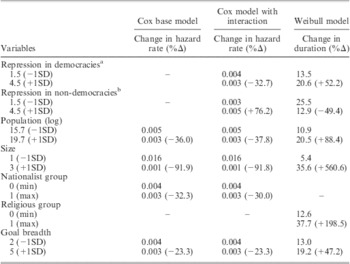
Table 3 presents substantive effects for all models in Table 2. We first discuss substantive effects for the interaction in the Cox model. When the polity variable is set at 10, the repression variable is varied from 1.5 to 4.5 and the interaction is varied along with the respective values of the constitutive terms, the hazard of group termination decreases by 33 per cent. Conversely, repression increases the likelihood of terrorist group failure in non-democratic regimes. Setting the polity variable at −3, varying the repression variable from 1.5 to 4.5 and varying the interaction along with the respective values of the democracy and repression variables produces a 76 per cent increase in the hazard rate of termination. Substantive effects for the Weibull model are more meaningful to interpret, as they indicate the change in the expected duration of terrorist groups. For democracies, the expected duration of terrorist groups increases from thirteen to twenty-one years if the repression variable and the interaction are varied from 1.5 to 4.5. Conversely, the duration of groups in authoritarian regimes decreases from twenty-five to thirteen years if the repression variable is varied from 1.5 to 4.5, together with the interaction.
The Determinants of Terrorist Group Termination (Substantive Effects)

a Polity is set at 10 (+1 SD from the mean) and repression is varied from 1.5 to 4.5 ( ±1 SD from the mean) together with the interaction to calculate marginal effects on the hazard rate in democracies.
b Polity is set at −3 (−1 SD from the mean), repression is varied from 1.5 to 4.5 ( ±1 SD) together with the interaction to calculate marginal effects on the hazard rate in non-democracies.
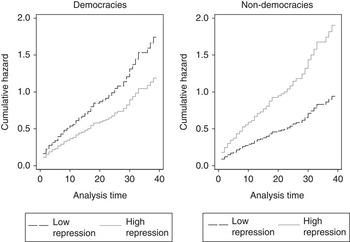
Figure 1 is based on the second model in Table 2 and illustrates the effect of repression on the likelihood of failure in democratic and non-democratic states.Footnote 69 In this figure, the first graph depicts the effect of repression on group termination when the democracy variable is set at 10 (+1 SD from the mean) and the second graph presents the same effect when the democracy variable is set at −3 (−1 SD from the mean). In both graphs, repression is varied from 1.5 to 4.5 (±1 SD from the mean), and the interaction is varied along with the respective values of the constitutive terms. The first graph in Figure 1 illustrates the effect of repression on group termination in democratic states. High repression in democracies, as represented by the solid line, results in lower rates of termination than low levels of repression, as represented by the dotted trend line. The opposite effect is observed in the second graph shown in Figure 1. For non-democracies, higher repression (solid line) leads to substantially higher cumulative hazard ratios and therefore a greater likelihood of terrorist group termination over time than low repression (dotted line). Taken together, the results presented in Tables 2 and 3 and illustrated in the figure support our expectations.
The effect of repression on terrorist group duration

Terrorist Campaign Outcomes
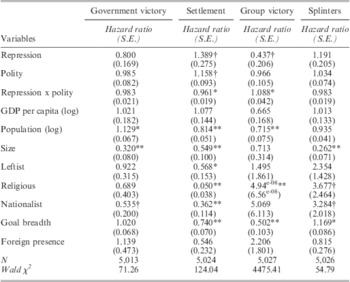
Next we evaluate how repression and democracy influence the outcome of terrorist campaigns. Two caveats are necessary before we discuss our empirical results presented in Table 4. First, the results for our outcome models are based on a small number of data points, in particular for campaigns ending with a terrorist group victory (an outcome observed in less than 7 per cent of campaigns that ended). Secondly, it may be difficult to determine, in practice, whether an outcome was in fact favourable to the government or the group. A government victory, for example, may come only after a protracted and costly counter-terrorism campaign, such as the Sri Lankan government's defeat of the Tamil Tigers in 2009.
The Determinants of Terrorist Campaign Outcomes

Note: Reported are hazard ratios with robust standard errors in parentheses.
**p < 0.01 *p < 0.05 †p < 0.1 (two-tailed tests).
The second hypothesis expects that repression in democracies reduces the likelihood of government victory and settlements, outcomes that are more favourable for governments. We find partial support for this hypothesis. The hazard ratio for the interaction between the repression and polity variables is negative in both the government victory and settlement models, but reaches statistical significance only for terrorist campaigns that resulted in political settlements (z = −1.99). While we expected that government coercion would be counterproductive for all outcomes favourable for the government, it is interesting to observe that repression in democracies appears particularly damaging for outcomes in which governments depend on groups’ willingness to enter negotiations and come to a mutual agreement. Coercive responses thus appear to be less influential for outcomes in which governments are capable of imposing their preferred outcome.
The model for group victory shows support for Hypothesis 3. The hazard ratio for the interaction is positive and significant (z = 2.20), which demonstrates that repressive measures increase the risk of group victory in democracies, but reduce the hazard of group victory in authoritarian regimes. As expected in Hypothesis 3, we find that the effect of coercive responses is reversed for outcomes that are unfavourable for governments. Our findings thus show the importance of distinguishing among different outcomes rather than collapsing all groups that ended their campaigns into a single category. As expected, we do not find a significant relationship between repression and regime type for groups that end in splinters.
Some interesting findings emerge for other covariates in the outcome models. Population size increases the likelihood of a government victory, but reduces the likelihood of settlements or group victories. Findings for the group size variable show that campaigns fought by larger groups are less likely to end with government victories, settlements or splinters, but do not affect the hazard of group victories. Compared to right-wing groups, leftist, religious and nationalist groups are less likely to negotiate settlements to their campaigns. Yet we also find that religious groups are less likely to defeat the government and more likely to splinter. The breadth of groups’ goals reduces the hazard of settlement and group victory and increases the hazard of splintering, but has no effect on government victory. We do not find evidence that GDP or foreign bases affect terrorist campaign outcomes.
Robustness Tests
We conducted a large number of additional robustness tests to evaluate whether findings for terrorist group duration are robust to the inclusion of potentially influential observations, additional operationalizations of key independent variables, alternative samples of terrorist organizations and terrorist attacks as the dependent variable. The results for robustness tests are described in detail in the online appendix. Statistical models that exclude splinter groups, groups that target internationally and insurgent groups confirm that repression increases group duration in democracies but lengthens terrorist campaigns in authoritarian regimes. The results also remain consistent when we use Cingranelli and Richards’ measure on physical integrity rights.Footnote 70 An additional robustness check disaggregates authoritarian regimes and shows that personalist regimes are less susceptible to backlash effects when using repression than other types of authoritarian regimes. We also find that the conditional effects of repression and regime type on group duration are supported for two alternative samples of terrorist groups. Findings using data on terrorist groups from Asal and Rethemeyer and the Global Terrorism Database (GTD) are largely consistent with earlier results.Footnote 71 Finally, a robustness check using terrorist attacks from the GTD as the dependent variable demonstrates that the implications of our argument hold for the incidence of terrorism: repression in democracies increases the likelihood of terrorist attacks, but reduces the probability of incidents in authoritarian regimes.
Conclusion
In this article, we argued that the effect of repression on terrorist group termination is conditional on countries’ regime type. In democracies, coercive tactics can have counterproductive effects by jeopardizing citizens’ perceptions of the government's legitimacy. Coercive government responses in democracies can reduce the public's co-operation with government authorities and increase support for terrorist groups. Yet since coercive measures are unlikely to change the government's perceived legitimacy in authoritarian regimes, we expect that repression reduces the duration of terrorist campaigns. An empirical analysis of 539 groups for the 1976–2006 period supports our expectations on group duration, and these findings are robust to additional model specifications. Evaluating the implications of our arguments for terrorist campaign outcomes shows that repression decreases the likelihood of negotiated settlements in democracies, but increases the hazard of group victory in democratic regimes.
For policymakers, our research indicates that using coercive, indiscriminate responses to terrorism is counterproductive for democracies; thus limited and selective counter-terrorism strategies have the highest potential for success. Policy implications for non-democratic states are more problematic, since our findings suggest that strong-arm tactics can force terrorist groups to settle their claims. Yet iron-fist strategies can have negative consequences even in non-democratic states, especially in the long run. While repression may successfully end a terrorist campaign in the affected country, it can create an exodus into other states. For example, Chechen rebels fled to surrounding republics in response to the Russian government's hard-line strategy.Footnote 72 Indiscriminate repression, while successful against terrorist groups in the short term, may also lead to widespread opposition and eventual rebellion against authoritarian regimes in the long run. For example, the use of repressive tactics in Egypt, while successful in extracting a ceasefire from terrorist organizations such as al-Jama’a al Islamiyya, arguably fueled popular discontent against the regime and may have contributed to Mubarak's overthrow in 2011. Future research is necessary to investigate such possible consequences of repressive counter-terrorism policies in authoritarian states.