1. Introduction: In Denial
One of the defining signs that a new musical genre has come into circulation is when the artists that it clumsily draws under one umbrella renounce it. Concerning the term ‘IDM’ (intelligent dance music) the Tigerbeat6 founder Kid 606 has said: ‘[I]t’s a label invented by PR companies who need catchphrases. I like sounds, but hate what people attach to sounds’ (Cowan Reference Cowan2003). Richard D. James of Aphex Twin voices similar sentiments when he says of the same term: ‘I just think it’s really funny to have terms like that. It’s basically saying “this is intelligent and everything else is stupid.” […] I don’t use names. I just say that I like something or I don’t’ (Gross Reference Gross1997). It is perhaps easy to see why the classification of music causes anxiety for practitioners. The names that accrue to musical texts are not typically something that individual artists can exert much control over. The film theorist Steven Neale defines genres as ‘systems of orientations, expectations and conventions that circulate between industry, text and subject’ (Neale Reference Neale1980: 19). Whilst some agents in this triangular relation have more power in categorisation, it is only in-circulation, once a work or artist has been released into the world, that a given grouping acquires meaning and agency. In theory, a name dreamt up by an individual fan can enter into mass circulation if it is taken up and understood by an audience in relation to other genres in circulation at that time. Just the same, a category imposed from ‘above’ by a radio station, label, record store, or other powerful actor can fail to take hold if it does not successfully communicate something about musical similarity and difference to an audience (Brackett Reference Brackett2015: 204). For practitioners who write their own music, and whose production is not bound to any explicit corporate purpose, this post-hoc, circulatory process can seem to relieve them of agency. The more arbitrary, misleading, or just plain annoying the semantic meaning of the category – like intelligent dance music – the more brutal is the retroactive betrayal of the text or artist’s particularity perceived to be.
Yet genre categories do not simply operate outside musical practice, like the taxonomy of plants and animals (Barber Reference Barber2007: 32). The way the musical world is parsed and hierarchised into genres is performative, informing and, indeed, constituting the musical practices that develop within them (ibid.). It would be quite easy to show how a concept of genre does in fact influence the musical practices of Kid 606 and Aphex Twin, despite their pronouncements to the contrary. The mutations, hybridisations and transgressions of the late 1990s IDM period, for instance, or the ‘return to acid house’ phase of the mid- to late 2000s are only legible as such when they are considered in the context of the meta-genres that inform and regulate them: in this case, house and techno music. In this way (and this is already alluded to in Neale), we might see genre as the name given to the shared ‘horizons of expectation’ (Jauss Reference Jauss1982) that govern communication. Just as audiences apprehend texts with an idea in mind of how they might conform to particular conventions, cultural producers operate with a tacit sense – whether precise or fuzzy – ‘of the kind of thing that is appropriate to the type of text they are producing’ (Barber Reference Barber2007: 31).
It is in the shared horizon of expectation that binds authors and audiences that the kinship of artistic genres to ‘speech genres’ and the related concept of ‘addressivity’ comes to the fore (Bakhtin Reference Bakhtin1986; Brackett Reference Brackett2005). Highlighting the formative role of the addressee in speech utterances, Deleuze and Guattari (Reference Deleuze and Guattari2004: 104) write that ‘in the course of a single day, an individual repeatedly passes from language to language. He successively speaks as “father to son” and as a boss; to his lover, he speaks an infantilized language; while sleeping he is plunged into an oneiric discourse, then abruptly returns to a professional language when the telephone rings’. But if the affinity with speech genres (Deleuze and Guattari’s ‘languages’) highlights the necessity and inevitability of genre in human communication (Tonybee Reference Toynbee2000: 107), then it also draws attendant problems of scale and heterogeneity into view. For if the horizon of expectation participates in a restaurant booking and the reflexive creation of a literary novella equally, then the question of genre’s utility as a tool for critical analysis cannot be assumed.
Fabian Holt argues that problems of scale, differentiation and heterogeneity are to blame for musicology’s general lack of interest in genre theory as an analytical tool. Where film genres emerge as a product of the partly standardised conditions of the film’s production – namely, the assembly line model that characterised the studio system of the 1920s to 1940s – the industries that provide for music’s production and reproduction are more diverse and decentralised (Holt Reference Holt2007: 4). Thus, as Holt (ibid.) notes, ‘a great deal of creativity and genre negotiation [can] occur on the level of the individual performing artist’. Holt is writing about popular music here, where issues of genre have been an ongoing, if intermittent, concern (see Fabbri Reference Fabbri1982; Frith Reference Frith1996; Hesmondhalgh Reference Hesmondhalgh1999; Negus Reference Negus1999; Toynbee Reference Toynbee2000; Brackett Reference Brackett2005; Kronengold Reference Kronengold2008). It is as we turn towards art musics that the concept becomes more difficult to mobilise. Derek Bailey (Reference Bailey1993), Paul Hegarty (Reference Hegarty2007), Ray Brassier (Reference Brassier2009) and Kim Cascone (Reference Cascone2009) all reject genre as a coherent way of thinking about the vanguard musics – free improvisation, noise and microsound, respectively – they champion. They argue that, in their stylistic diversity, difference wins out over repetition and categorisation is rendered obsolete. Hence, for Brassier (Reference Brassier2009: 62), the genre noise signifies no more than ‘the no-man’s-land between electro-acoustic investigation, free improvisation, avant-garde experiment, and sound art […] it refers to anomalous zones of interference between post-punk and free jazz; between musique concrète and folk; between stochastic composition and art brut’.
Given that audiences do seem to have a reasonably informed sense of what is in store when they attend a noise, free improv, or microsound concert, the willingness of these writers to absorb the genres’ avant-gardist rhetoric of negation into their analyses seems naive. All the same, the insights that genre theory can afford in this context are hardly self-evident. Electronic music can seem so thoroughly overburdened with near-indistinguishable category names – for example, IDM/electronica; glitch/microsound; ambient/drone – that artists and texts appear excessively promiscuous, participating in many different genres simultaneously and over time. Similarly, these heterogeneous genres can serve very small audiences, in some cases being entirely made up of peers and fellow producers (Bourdius 1993: 50–1). Compounded with Holt’s points about individual musicians appearing to migrate from genre to genre over time, it is understandable that some scholars see meaningful analysis by genre as an impossibility in this cultural field.
1.2. Genre theory 2.0
Despite its contradictions, I will argue in this article that a concept of genre is essential to the study of electronic music’s creative practices, temporalities, modes of production and meanings for audiences. Yet revitalising genre requires shifting from the purely textual understanding that Bailey, Brassier, Cascone and Hegarty have in mind when they refuse the concept – of genres as fixed categories of sounding features – to one that recognises the full multitextual range of sociocultural resources – texts, performers, technologies, institutions and audiences – that genres enrol. Informed by Born’s ongoing work on institutional mediation (cf. Reference Born1987, Reference Born1995, Reference Born2005), and the body of literature on Actor-Network Theory (cf. Law and Hassard 1999; Latour Reference Latour2005), I present an analysis of genre in music through its mediations; that is, through the varied relations between industry or production institution, musical object or work, and audience or public that obtain within them (Born Reference Born2014: 1).
The article is in two sections. The first takes the Prix Ars Electronica festival as a site for analysing the complexities of genre. In particular, it focuses on the moment in the late 1990s when the Computer Music category was rebranded ‘Digital Musics’, and a notorious controversy ensued. As the opening discussion showed, the generic positioning of texts and their merit as aesthetic descriptors is often an area of lively debate and contestation, but the Digital Musics controversy proves how these issues exceed aesthetics, compounding institutional politics, sociocultural identifications, technology, modes of life and more. The second zooms in on microsound, a genre, style, and philosophy that permeates the work of the prizewinning artists and categories of Ars Electronica after the late 1990s. Notoriously difficult to pin down in stylistic terms, microsound typifies many of the problems that blight the attempt to bring genre theory to art musics. In the analysis, I use new online ethnography methods to build up a picture of the wider social and institutional ecology that supports and sustain it, thereby fleshing out the more aesthetic, technological and genealogical perspectives found in recent work by Thomson (Reference Thomson2004), Demers (Reference Demers2010) and Hofer (Reference Hofer2014).
Ultimately, my aim is to ‘tune’ genre theory to the difficult case at hand: first by taking a ‘top-down’ approach and examining the movement of genre in a highly charged, contested social field; and second, taking a ‘bottom-up’ associationist approach to build an anti-reductive picture of how individual genres are assembled in practice.
2. Genre Controversy at Prix Ars Electronica
The Prix Ars Electronica festival is one of the most prestigious awards for media arts in the world. Each year, artists working with digital media can submit or be nominated to one of four broad categories, which at the time of writing are ‘Computer Animation/Film/VFX’, ‘U19’ (for under-19 artists), with either ‘Digital Musics & Sound Art’ and ‘Hybrid Art’, or ‘Interactive Art’ and ‘Digital Communities’, these categories alternating biannually. Prizes are awarded in three categories: ‘Honorary Mention’, for those artists whose work the jury deems to foreshadow ‘new trends’ (usually around 10–12 names), the ‘Award of Distinction’ for two high ranking artists, and then the highest award of a ‘Golden Nica’. Awards are typically given for artworks rather than artists, with many media formats recognised – fixed-media pieces, albums and installations are most prominent. However, recent years have seen software, instruments, sound objects and hardware devices being awarded, reflecting shifts in the epistemologies and ontologies of sound practice. The tradition of recognising sole authors has also been disturbed by the recent awarding of prizes to bands, research groups and record labels.
For the first 11 years of the festival (1987–98), the music category was labelled ‘Computer Music’. According to the 1997 website, it was inaugurated to recognise changes in computer art, aesthetics, modes of expression and contents, as well as developments in technology. Typically drawn from the world of Western art music, notable prizewinners from this period include Karlheinz Stockhausen, Kaija Saariaho, Bernard Parmegiani and Jean-Claude Risset. But after about ten years of the festival, the jury began to sound notes of disquiet concerning the range and quality of the works that were being submitted to the category.Footnote 2 Their statement in 1996 read:
Computer music, in its maturity, is developing some of the less endearing aspects of middle age. […] The same mannerisms are encountered in piece after piece – when the pieces are by different composers – suggesting an outbreak of the virus of cliché, even of epidemic proportions. (Ars Electronica 1996)
Next year, the ennui increased. Faced with another set of conformist entries – what the jury characterised as ‘“pure” computer music on tape’ – the jury referred to computer music as ‘the oldest swinger in town’, complaining that originality and invention had been submerged in a tide of pervasive effects associated with off-the-shelf audio processing applications. The criticisms were accompanied by a trenchant plea for ‘works designed for alternative modes of presentation (i.e. non-concert works), works with wider aesthetic range (avoid those clichés), works by people without institutional affiliations (perhaps operating in a real, unsubsidized marketplace), and works by women’ (Ars Electronica 1997). However, the call again went unheard, as the entries they received the next year were similarly restricted. Implicitly ushering in genres such as noise, drone, glitch and techno, and waving away academic computer music, the 1998 jury statement moved the site of politics from socialities to the aesthetics of form and content, declaring that, today, ‘what is important to “audio sense” is immediate effect rather than narrative progression or perspectival depth’ (Humon Reference Humon1998).
By 1999 the category had been rebranded ‘Digital Musics’, and a far wider range of genres was welcomed into the fray. The 1999 Golden Nica award went to Aphex Twin and Chris Cunningham for the music video ‘Come to Daddy’, whilst the Austrian label Mego was awarded the Award of Distinction alongside Ikue Mori’s ‘Birthday’. This was undoubtedly a different socioeconomic demographic than had previously been lauded at Ars. For Wire editor, Tony Herrington, it amounted to little less than an invasion: ‘after 13 years of cozy electroacoustic hegemony it was a provocative gesture, and inside the high walls of the world’s university music departments and institutions, the shock waves reverberated long and loud’ (Herrington Reference Herrington2001).Footnote 3
2.1. Visualisation
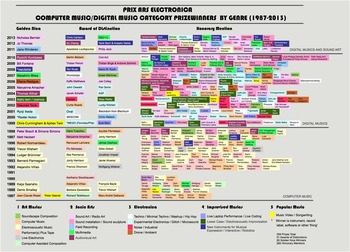
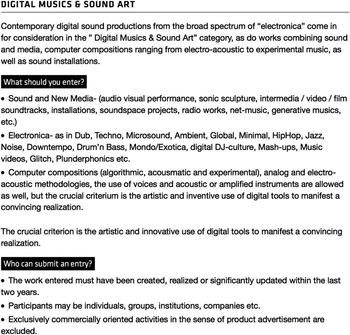
The shift in ideology at the festival is captured starkly in the image in Figure 1: a topological map of all 359 names that have been awarded in the music category since the award’s inception: 26 Golden Nicas, 51 Awards of Distinction, and 282 Honorary Mentions were awarded between 1987 and 2013. In the map, each work is listed by the name of the author, whilst every author is colour-coded by the genre of his or her work. Using the exhaustive database at the Prix Ars Electronica archive site, every single award-winning piece was listened to once and a genre label individually assigned. The attributions were derived from a mixture of personal knowledge, artists’ self-descriptions and the list of sub- and microgenres that are recognised by the organisation itself (see Figure 2). The meta-generic categories across the bottom attempt to capture large-scale, fuzzy assemblages – art musics, sonic arts, electronica, improvised and popular – whilst the genres themselves aspire to register on ‘equivalent’ scalar levels: ‘beneath’ the meta-categories, but ‘above’ the micro-level of genres such as ‘extreme’ computer music, splittercore, folktronica and so on. In order for a genre to be a genre in this system, at least two texts must be attributed to it, which sometimes meant bracketing two or more genres together (e.g. lower case/improvised music/electroacoustic improvisation), or denying a text its ‘specific’ genre and attributing to it a more broad one.
A topological map of all 359 names that have been awarded in the music category since the award’s inception, with each of the prizewinners colour-coded by genre. (colour online)

Digital Musics and Sound Art genre mandate from Ars Electronica website (www.aec.at/prix/en/kategorien/digital-music/) © Ars Electronica Linz.

The proliferation of scare quotes in the preceding should indicate the provisional and heuristic nature of this classificatory project, but suffice it to note for the time being the explosion of colour we see on the map following 1998. Between 1987 and 1998, 114 works were awarded in the broad category of ‘Computer Music’; beyond that, a mere 17 were. The multiplication of genres, work ontologies and sonic media that were ushered forth by the event of 1999 also continues apace beyond it, with field recording entering in 2000, drone and ambient entering in 2003, new musical instruments emerging in 2008 and robotics appearing in 2013. Various forms of improvisation also begin to appear, with lower case, electroacoustic improvisation, live coding and laptop music all making their mark. Sound art is the dominant post-98 genre, with 68 winning works, whilst a new shift can be discerned at around 2008 when new instruments for musical expression and robotics begin to scatter the map.
2.1.1. Analysis
Ostensibly, the pluralisation of genre categories that follows 1999 seems to suggest that, with the fresh genres and subgenres that were welcomed into the fray at this time, a new period of renewal and innovation began in Computer Music – now ‘Digital Musics’ – that continued to run for the first half of the 2000s. But is it right to read the superabundance of new genre names as a straightforward index of innovation, difference and modernity in music – and a lack of this quality as a symptom of aesthetic stasis? Many of the genres represented between 1999 and 2004 are subgenres of electronic dance music, a field that, at its height in the late 1980s and 1990s, was regularly credited with evidencing an extreme form of artistic modernism. The music critic Simon Reynolds gives some flavour of how this affected genre when, reflecting upon his early writing and the origins of his concept of the ‘hardcore continuum’ – a tradition that began in the early 1990s and continues to develop – he states:
They were all written – obviously – without knowledge of where the music would go next (although predictions and warnings get made now and then, some off-base and others on the money). Most of the time I’m just about keeping up with the music’s ceaseless forward drive. Often I’ll be using the genre terminology of a phase that’s already ending to describe something that – annoyingly – gets definitively named shortly after the piece ran. (Reynolds Reference Reynolds2013)
Reynolds’s words stand in stark contrast to the complaints of the 1996–99 Ars Electronica jury that computer music was becoming mired in ‘cliché’, ‘retrogression’, ‘mannerist’ tendencies and similar. Where in genres such as rhythm ’n’ blues the same qualities may be taken as an index of maturity or timelessness, albeit cast in positively valenced words such as ‘tradition’ and ‘classicism’, the genres that are deemed worthy of consideration at Ars are bound to an accelerated sense of time’s passage that finds its most complete expression in the artistic movements associated with the avant-garde (for further analysis of these temporalities, see Straw Reference Straw1991; Osborne Reference Osborne1995; Born Reference Born2005). Hence, the acquiring of stability and permanence is cast in strongly negative terms.
But if their mutual faith in innovation, morphology and the unceasing production of the new draws the two meta-genres of computer music and electronic dance music together to compete for the same prize at Ars Electronica, then other factors would seem to emphasise their distinction. Looked at comparatively, the differences actually become innumerable: spaces of presentation (concert hall vs club); forms of production (publicly subsidised institution vs commercial or personal studio) and reproduction (biography recordings on high-definition digital formats vs a range of release-types on many media including vinyl); work ontologies (concert performance vs CD album); formal structure (‘extensional’ development vs ‘intensional’ modulation, cf. Chester Reference Chester2000); not to mention the differences of class, ethnicity, gender and age. And while the modernity of electronic dance music seems to indicate alliance-with rather than difference-from computer music, things start to look different when we consider how its category names actually function within the dance music scene. For as well as indicating novelty, specialised terms for particular areas of culture act as gate-keeping devices to maintain boundaries and manufacture the high amounts of cultural capital that are needed to enter (McLeod Reference McLeod2001). As McLeod puts it, the ‘ever-changing subgenre names that become common parlance in electronic/dance music subcultures work in conjunction with slang and fashion to exclude outsiders who are not hip enough to keep up’ (McLeod Reference McLeod2001: 72). For McLeod, the commodity-character of such accelerated naming is therefore never far from view.
Electroacoustic and computer music are not without their own rarefied languages, of course, but they do not typically find expression at the level of the genre category name. Instead, we are more likely to find them elucidated in theoretical tracts such as Pierre Schaeffer’s Traité des Objets Musicaux (Reference Schaeffer1966), Denis Smalley’s writings on spectromorphology (Reference Smalley1997) and space form (Reference Smalley2007), or even in the mathematical discourse in which texts on digital signal processing are written. Genre categories themselves tend to be classificatory rather than aesthetic; bound to the medium, the categories of sound installation, performer plus tape, live electronics, electroacoustic music and computer music typically change little. The reasons for this stability concern scale and theoreticism. As a relatively specialised genre that finds its majority support in academic environments, electroacoustic and computer music is small in number and intellectual in orientation. As such, the community is ‘self-contained’, willing to publically discuss and debate terms in academic conferences, mailing lists, journals and seminar rooms, and come to a reasonable consensus over the terminologies and genre taxonomies of the form. The genre system that ensues from this is not entirely top-down and rational – it also contains more vague and casual geographic and institutional approximations like ‘the Montréal sound’ and ‘the Birmingham school’ – but compared with popular music categories, where terms can take hold in all manner of ways, it is undoubtedly less prone to imprecise and controversial coinages. The question concerning ‘genrefication’ in the two cultures is as much to do with the types of musical utterances that are germane to each community as it is to do with straightforward ‘innovation’. Where, in electroacoustic and computer music, novelties within the genres might be articulated in terms that describe types of form a piece exhibits (‘gestural’, ‘narrative’, ‘static’), in electronic dance music these primarily operate at the level of (what is called) genre: ‘acid’, ‘gabba’, ‘drum ’n’ bass’ and so on.
Finally, it is important to note that there is no necessary relationship between the explicit concept a category names and its capacity to be a genre. The names ‘circuit bending’, ‘black music’, ‘riot grrrrl’ and ‘spectralism’ all represent very different grouping conventions despite their clear purchase in musical discourse; indeed, one could go further and add to this list the use of record labels and even record stores as aesthetic descriptors – ‘the Mego sound’, ‘the Raster-Noton sound’, ‘the Volcanic Tongue aesthetic’ and so on. This is essentially the argument that Eric Drott (Reference Drott2013) makes in his call for genre to be reconsidered in art music. For Drott, what Dalhaus, Adorno, Croce and others had diagnosed as a ‘decline’ in genre as a concept in fact amounted to no more than a decline in a particular way of classifying musical texts; other types of classifications took hold and were used that were not necessarily granted ‘genre’ status. Later I will describe a non-positivist way of conceiving genre that, like Drott’s own formulation, draws on Actor-Network Theory to theorise groups and groupings of different scales.
2.2. Genre and historicity
As the preceding analysis illustrated, genres are systems of folk classifications. As such, there is no logic of scale, classification method, or titling that would work universally. Although things start to look clearer when narrowed down to individual ‘genre worlds’ (Frith Reference Frith1996; Frow Reference Frow2005) such as rock, art music, electronic dance music and so on, redundancy and imprecision within them abound. The analysis has so far emphasised ‘spatial’ concerns as they appear in the Ars Electronica genre map, looking comparatively at how different musical communities parse and hierarchise into genres and subgenres. Yet temporal considerations such as when and how genre names fall out of use, or what happens to old texts when new categories come into circulation, would need to be considered too.
Brackett (Reference Brackett2015: 195) calls the relationship between a text and the conventions of a genre at a particular moment in time its ‘legibility’. As he puts it, ‘the continued legibility of a genre is only possible as long as its conventions are cited, although genres that have become illegible can be understood through a reconstruction of the historical conditions of the genre’s emergence’. Looking across the near 30-year history of the festival in Figure 1, such issues appear to be most prevalent in the category of performer plus tape. Defined as a live performer synchronising to a fixed media composition reproduced over loudspeakers, this category was prominent in the first ten years of the prize’s history with nearly 30 awarded works adhering to its conventions. There may remain vestiges of the tradition in electroacoustic music today, but from the perspective of a digital arts festival it is clearly a ‘historical’ category (indeed, even at the time it was considered a suboptimal live form).Footnote 4 With the advent of real-time sound processing, the performer plus tape format gave way to the more responsive and intimate forms of interaction that fall under the umbrella of live electronics (indeed, this historical trajectory is one we see quite clearly in the visualisation of Figure 1). Following Brackett, we might argue that, with a change in electroacoustic music’s technological ecology, the genre of performer plus tape gradually became ‘illegible’, increasingly at variance with the expectations audiences bring to concerts of highly technologised musics.
A note of caution should be sounded here, though, for there is certainly nothing necessary to the process of illegibility, and therefore nothing that could stop a historical genre becoming legible again under new conditions. For example, an outgrowth of cultural nostalgia, obsolescence fetishism, and new research directions in historical musicology has seen the unlikely emergence of a ‘historically informed electronic music performance practice’ in groups such as the Lansdown Research Centre.
2.2.1. Institutional mediation
If the absence of historical categories in the festival’s own list illustrates drifting horizons of legibility between texts and audiences, then there is also a converse effect to be observed: new genres emerge that appear to retroactively reclassify previous texts. In 2005, John Oswald’s plunderphonics won an award of distinction. Coined by Oswald, the term describes his own compositional system of transforming existing recordings into a new work. Differently to hip-hop, musique concrète and other sampling-based genres, it is rigidly concept-led: the composer must resort to no other sound-generating methods in order to qualify for the label. Plunderphonics is rooted in a knowing and mischievous play with the ontological boundaries erected by copyright law, and the malleability of those boundaries from the perspective of digital signal processing. But shortly after Oswald was awarded the prize, something intriguing happened: the category of plunderphonics became an officially recognised genre in the Ars Electronica mandate (2005). From the outside, this performative intervention into the genre space of Ars may appear to vindicate modernist rubrics of exceptionalism – like all great art, plunderphonics birthed its own genre! But without denying plunderphonics the capacity to be a genre, cracks undoubtedly start to appear in its origin story under closer inspection. Did Oswald ‘invent’ the practice of plunderphonics, or did he give a name and theory to a set of extant practices lying on the margins of adjacent disciplines? Fiorenza by Mathias Fischer-Dieskau, an honorary work in 1988, conforms more or less exactly to the definition of Plunderphonics, as do many other works that do not make it into the Ars Electronica world. One might argue that it was not John Oswald at all, then, but Ars Electronica, who, by noticing these historical trajectories and including it amongst its categories, legitimised the term and raised it to genre status. Mixing ‘top-down’ and ‘bottom-up’ agencies, the genreification of plunderphonics relied on both creative practice and institutional validation.
Considering how the institution of Ars Electronica mediates the field it seeks to objectively praise raises the reflexive question of how the system of genres used in this article mediates the patterns that are under analysis. Earlier I stated that electronic music can be excessively promiscuous, participating in many different genres simultaneously. This principle of promiscuity is emphasised in Derrida’s famous ‘law of genre’:
[A] text cannot belong to no genre, it cannot be without or less a genre. Every text participates in one or several genres, there is no genreless text; there is always a genre and genres, yet such participation never amounts to belonging. (Derrida and Ronell Reference Derrida and Ronell1980: 65) (my italics)
Almost all the artists represented at Prix Ars Electronica evidence this genre promiscuity, but due to the labelling system of one genre per text, these fluidities are lost. In order to deal analytically with the problem of ‘participation’ over ‘belonging’, a more labile system is therefore necessary.
3. Actor-Network Theory and Genre
It should be clear by now that genre is a complex and contradictory concept. Brackett (Reference Brackett2005: 76) describes a mirage-like quality, where ‘close inspection of any text inevitably raises doubts as to [its] genre identity’, but also, ‘the more closely one describes a genre in terms of its stylistic components, the fewer the examples that actually seem to fit’. Faced with these difficulties, some writers have turned to Bruno Latour et al.’s Actor-Network Theory (ANT) to analyse how scenes and genres hold together (see Prior Reference Prior2008; Drott Reference Drott2013; Piekut Reference Piekut2014). The methodology has some merits relative to genre theory and music in general. ANT conceives of the social world as comprising clusters of agents whose mutual exchange of material and semiotic ‘properties’ draws them together into networks, which have capacities to endure, drift, bifurcate, or dissipate. Notoriously, so-called ‘non-humans’ are included amongst those agents that comprise the network, being able to act and produce effects.
In what follows, I draw on an applied version of ANT drawn from Latour and his collaborators’ recent experiments in data analysis and visualisation (Latour et al. 2012). This slimmed-down ANT should not be taken for anything more than a formal model for conceiving of the interrelations among complex groupings, in this case genresFootnote 5 – it is not an introduction to ANT. In fact, the qualitative interpretation I provide is more informed by mediation theory as it has been developed in relations to music, particularly in the work of Antoine Hennion, Tia DeNora and Georgina Born. Born’s ongoing analyses of the ‘large-scale social, cultural, economic and political forces that provide for [music’s] production, reproduction or transformation’ (Born 2010: 232) – what she calls the fourth ‘plane’ of social mediation – provides considerable interpretative depth to the somewhat bare conceptual framework offered by ANT.
Much of the work of an ANT analysis is concerned with sweeping away what Latour calls the ‘aggregate level’ (for instance, a large-scale concept such as ‘nature’ or ‘society’) and instead dealing only with the micro-level of individual entities (human and non-human) and their associations. As Latour et al. state (2012: 591), ‘there is more complexity in the elements than in the aggregates, or stated a bit more provocatively […] “The whole is always smaller than its parts”’. This metaphysical conception of structures – of entities as non-totalising networks of other entities, all connected by relations – becomes quite interesting when applied to a genre. For any categorisation – whether a tightly defined one (e.g. breakbeat) or a more loose, amorphous assemblage (e.g. rock) – can be seen as comprising a meshwork of human and non-human entities, all contributing something unique (though not equal) to the assemblage, yet none being essential to its functioning. And because the network privileges relations rather than identities, the same actor – for example, ‘Ryoji Ikeda’ or ‘white noise’ – can appear in glitch and audiovisual art without compromising the ‘integrity‘ of either assemblage. Somewhat counterintuitively, it is through the density and complexity of the network that the specificity of the ‘actor‘ – in this case a musical genreFootnote 6 – comes about (Latour et al. 2012: 593). This network view means that the notoriously untidy, overlapping quality of genres – so often the source of hand-wringing in discussions of musical aesthetics (cf. Landy 2006; Demers 2010) – is not scrubbed away but ontologised, and transformed into an inescapable condition. Applied to genre, ANT‘s network ontology can be considered a formalisation of Derrida‘s imperative of participation over belonging cited above.
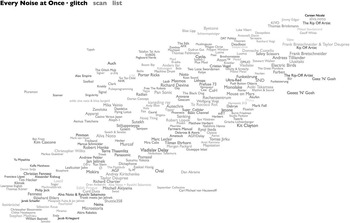
To a limited extent, this fusion can be observed in the types of maps evidenced in Figure 3. Glenn McDonald’s Every Noise at Once website offers an algorithmically generated, 2D scatterplot of the genre-space for an vast 1,374 genres, with the coordinates of each artist being based upon nebulous aesthetic criteria gleaned from audio feature extraction.Footnote 7 Yet the limit to such maps for our purposes is that they posit genres as assemblages of artists or texts alone, a formal bias that is reflected in much music information retrieval research (cf. Tzanetakis and Cook Reference Tzanetakis and Cook2002). This means that, contrary to the earlier proposition, the infinite density of the network would bring about the dissolution of the genre, not the specificity. The more artists, for example, minimal techno enrols, the more it would drift into larger-scale assemblages: techno, electronic dance music, western music and then just music. When other types of actors are included, we get a different picture. To take an example from film studies, we can say that the genre of the western is partly defined by the companies, distributors, picture houses, studios, crew, technologies of production, merchandise and advertising, audiences, and other actors that provide for it. Conceived visually, those with greater agency (studios, director) might be larger in size, whilst those with lesser agency (merchandise sellers) would be smaller, with the list of potential actors being theoretically infinite.
Screenshot of ‘glitch’ from McDonald’s Every Noise at Once website (used with permission).

3.1. Digital methods for genre analysis
The question that ANT leaves open to empirical inquiry is how it is that links amongst actors get made. In McDonald’s maps (which are not ANT analyses), the links are made by musical similarity, but in the example of the Western things become more complicated, with subsidy, social ties, employment contracts and other bonds being initiated. How do we discover such ties and make them available for analysis? For a film, one might take the end credits as a list of ‘key’ actors and create a scatterplot of the various agents, with the first in the list as the largest avatar and the last the smallest. Include the various technologies of production alongside actors, crew and studios, and you would have the basis of an ANT-style depiction of the film. One could conceive of a similar approach to individual musical texts, where the list of agents on the inner sleeve of a record is depicted as a network. Both, however, are small in scale, providing limited insight into genre formation.
The following uses the Internet as a database. Specifically, I analyse online hyperlinking practices between artists, labels, magazines, online publics – all the actors that appear on the web. Hyperlinks represent clear and available markers of social ties, musical collaborations, professional partnerships and institutional support relative to a given grouping. They do not tell the whole picture – far from it – but they provide us with some of the information necessary to begin to build up a picture of a scene or genre as it is performed online.
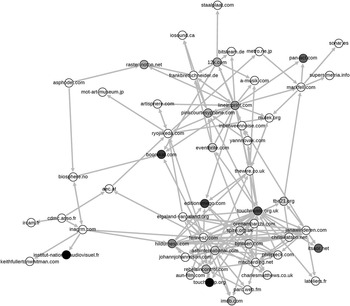
The method is quite simple. One starts with a list of URLs that represent about 10–20 key actors associated with the grouping one wants to represent: signature artists, record labels, stores, magazines, festivals and so on. The software, Richard Rogers’s ‘Issue Crawler’ (Reference Rogers2002), then crawls through the associated webpages and stores in a database any hyperlinks that direct the user to another destination on the web. It then analyses these outlinks and retains only those that appear two or more times in the results (for the sake of legibility, the map in Figure 6 displays only those that appear nine or more times). The results are then plotted in a 2D network displaying inlink and outlink patterns amongst the key nodes (webpages), with the relative x–y position of the nodes on the map indicating their relatedness, that is, how frequently links are exchanged between them. The darkness of the node corresponds to a mixture of inlinks received and outlinks made.
3.2. Microsound
The genre I analysed is microsound, one of the most significant areas of representation in Ars Electronica. A brief genealogy of the genre can illuminate some of the issues of promiscuity, addressivity and mediation highlighted in the preceding sections, before moving on to the analysis.
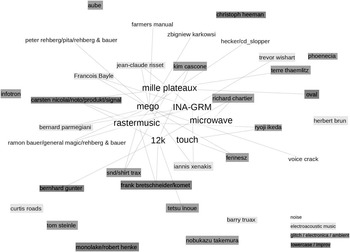
Many writers emphasise the difficulty of defining microsound (Cascone Reference Cascone2009; Demers Reference Demers2010), but in fact, the explicit meaning of the term is fairly exact. ‘Microsound’ describes a precisely delimited realm of audio – specifically, sounds lasting less than a tenth of a second (Roads Reference Roads2001: 86). The term was coined by Iannis Xenakis in Formalised Music (Reference Xenakis1992) and later taken up by Curtis Roads to describe an approach to digital composition that, to a great extent, was concerned with extending Xenakis’s early work in micromontage, granular synthesis and granular processing. At this point, microsound represented a critical concept and technique, one that is very much bound to the role of the computer in music. But Roads’s book did other things, too. For one, it presented a history of microsound composition, which had the effect of retroactively reshuffling the canon of electroacoustic art music to bring composers such as Stockhausen, Horacio Vaggione, Xenakis and Agostino Di Scipio together under the same concept. Perhaps at this stage we could call microsound a ‘style’ if we want to use that term – an approach to composition, but not a signifying category as such. Things changed in about 1999, when Kim Cascone discovered the term in a talk given by Roads and borrowed it as the title for the nascent mailing list he co-founded – .microsound was conceived as a forum for ‘discussion and exploration of a more general “digital aesthetic” manifesting across a wide variety of styles and disciplines – from academic computer music to post-industrial noise to experimental ambient and post-techno’ (Cascone et al. Reference Cascone, Mouat and Saylor1999). This crossover moment was important, since the discussions that took place on the list – amongst the first ‘digitally native’ genre communities – served to concretise a set of unvoiced connections across ‘art’ and ‘popular’ styles – between glitch and micromontage, ambient and minimalism, drone and electroacoustic art music (connections that can be seen in Figures 4 and 5).
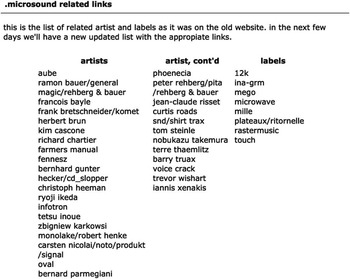
Links page at the www.microsound.org site. Image used courtesy of Eloy Anzola, John Saylor, Kim Cascone and the microsound community.

Visualisation of .microsound links page (Figure 2) showing label membership.

The list’s popularity, and the founding of labels such as Raster Noton, 12k, LINE and others (Figure 4) contributed to the tentative coalescence of microsound as a genre category. It aggregated a discursive community, a set of organological and stylistic regularities, a body of critical literature (such as Cascone Reference Cascone2000), and a descriptive label (see Figure 5). However, the evolution did not end there. With the work of Richard Chartier, Taylor Deupree, Janek Schaefer and the LINE label, microsound began to invade other territory: visual art, field recording, sound in the gallery and so on. Coupled with the burgeoning writing on sound art and sound studies that posited listening as a creative, intentional act, often using the barely perceptible sounds of microsound to dramatise this (Phillips Reference Phillips2006), these directions began to push microsound away from the concert hall- and sound recording-centred genre communities of art and popular music, and into the environment and the gallery. It is this nexus of avant-garde composition, DSP research, post-techno and sound art that microsound occupies today.
3.3. Analysis
Given the role it played in the formation of microsound as a genre, the starting point for the analysis in Figure 6 was the .microsound mailing list (Figure 4). The host website contains a links page with a list of signature artists and labels related to the genre. As Figure 4 shows, the page is outdated, with the large majority being dead links. In order to compile the list of starting seeds for the map in Figure 6, the list was updated for those artists and labels that are still active, and added to based upon developments since.
Issuecrawler results for microsound. Node spatialisation is created with Gephi Force Atlas algorithm.

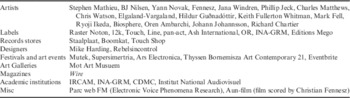
What we see in Figure 6 is hardly a visual representation of microsound as a genre – more a snapshot of a small number of actors associated with the genre at a particular moment in time. All the same, it is a broader picture than McDonald’s map of the related genre of glitch. Comparing the results of the crawl with the .microsound links page reveals that of the 35 actors originally listed – 6 labels and 29 artists – only nine appear in the resulting map. Five are labels (Raster Noton, 12k, Touch, Mego, INA-GRM) and four are artists (Christian Fennesz, Ryoji Ikeda, Mark Fell (SND) and Richard Chartier). More striking is the abundant number of institutions that appear as actors broadly associated with microsound, testifying at once to the genre’s profuse social mediation and to the strenuous cross-over efforts made by key artists and labels. These institutions include prestigious digital arts festivals such as Mutek, Superimetria and Ars Electronica, the Thyssen-Bournemisza Foundation, a private collection of experimental art, and internationally renowned academic research institutions INA-GRM and IRCAM (see Table 1). The profusion of small-scale independent and boutique art labels is juxtaposed with the French state-funded CDMC, an established label specialising in symphonic and chamber music, opera and music theatre as well as electroacoustic music. This heterogeneity is regularly linked discursively to microsound’s distinctive aesthetic genealogy, and is itself represented by links to composers Xenakis and Bernard Parmegiani in the original links list (Figure 4).
3.3.1. Aesthetic change
Microsound’s conceptual kinship with late modernist art has often been proclaimed discursively (see Demers Reference Demers2010: 79; Hofer Reference Hofer2014: 300), even if it was not always immediately evident empirically (see Figure 4). However, the presence of Tokyo’s Museum of Contemporary Art and the Thyssen Bornemisza Art Contemporary 21 Festival suggest that the aesthetic discourse is becoming self-fulfilling. Of course, the Ars Electronica website also enjoys a central presence amongst the actors (‘aec.at’, bottom left quadrant of Figure 6). Cross-referencing with Figure 1, we see that most of the artists and labels that appear in the network have received an honorary mention or full award since that transitional year of 1999. Indeed, the presence on the map of prestigious art music organisations such as IRCAM and INA-GRM, as well as new music centres such as CDMC, suggests that the earlier discussed ‘event’ of 1999, when bedroom computer music met the academy, continues to resound across the wider computer music scene. The outward links from INA-GRM to non-academic artists such as Keith Fullerton Whitman, Biosphere, Christian Fennesz and Hildur Guðnadóttir (‘hildurness.com’) show that, like at Ars Electronica in 1999, the aesthetic remit of the institution may be widening.
Returned actors from Figure 5 listed by category

3.3.2. Historicity
Using the web as a database of genre linkages has drawbacks. The web is a notoriously unstable resource when viewed as an archive or site of research. The historicity of webpages, and of the hyperlink networks in which they are enmeshed, is continually undermined by the rampant disregard for preservation that characterises the Internet, evidenced in its ever-flowing cycles of change, renewal and obsolescence. The all-important temporal profiles of genres – their capacities to drift, bifurcate, reach inertia, die or mutate – are therefore severely compromised by these methods. Instead, what is returned is a network of current activity, with the genealogical branches being cut short. For microsound, such omissions are devastating, because they contribute enormously to its self-understanding as a genre. The original list of links (Figure 4) illustrates this – despite the keen citing of Bernard Parmegiani, Herbert Brün and Iannis Xenakis (all now deceased), none of these actors appear in the resultant network. Now, one might argue that their absence is no different from that of, for example, General Magic, Infotron and Farmers Manual, all of whom were very active when the original list was compiled and have since disbanded, their web presences lying dormant. But this interpretation overlooks the distinct author function that the microsound practitioners mobilise when they cite these late twentieth-century avant-garde composers. Including Xenakis, Brün and Parmegiani in the microsound list performs the double function of paying tribute to the ‘founders’ of the genre and audaciously situating themselves as inheritors to them. The historical actors are therefore not ‘dead links’ in the way that the dormant microsound artists are; they are very much active, agential beings, their ‘function’ subtly transforming each time they are retroactively cited as precursors. But these links are clearly not being expressed in hyperlink form, being made sonically, visually and discursively.
The transformation and lack of historicity is also evident in the range of genre associations the microsound network seems to materialise. Whilst the map undoubtedly displays a lively and active social network, the extent to which that network would coalesce into ‘microsound’ in the reader’s mind, as opposed to ‘field recording’, ‘sound art’, ‘experimental electronica’, ‘ambient’, or even ‘Touch Records’, remains in question. This indecisiveness is, as already discussed, an imperative of genre, and something that can never be fully cleansed. But it begs the question of what results would be generated were we to map a more contemporary genre-network than microsound – one that expresses more of its material and semiotic links online.Footnote 8
4. Conclusion
The concept of genre occupies an awkward position in the popular discourse on electronic musics, seeming simultaneously irrelevant, as Kid 606 and Aphex Twin’s disavowals of genre proclaim; and very important, as the Prix Ars Electronica controversy demonstrated. In this article I have argued for an expanded conception of genre to the one that regulates these positions – one that includes the many mediations that contribute to a genre’s distinctiveness. Taking off from Neale’s observation that genres are ‘systems of expectations, conventions, and orientations that circulate between industry, text and subject’, and informed by Latour and Born’s work on mediation, I have shown that genre can be analysed through the varied relations between industry or production institution, musical object or work, and audience or public that inhere within them. The focus in this article has therefore been on the mediations that occupy Born’s ‘fourth plane’ of social mediation – namely, the large-scale institutional apparatuses that provide for music’s production and reproduction (Born Reference Born2010: 232). Taking the Prix Ars Electronica as both a field of relations and an institution that mediates those relations provided a means to consider the wider forces that bear on the production and consumption of electronic music. Similarly, looking at the diverse institutional ecology of microsound as it can be analysed on the web enriched the formal understanding of genre that is usually practised in musicology, and that drives contemporary music recommendation systems (Tzanetakis and Cook, Reference Tzanetakis and Cook2002).
Although social and institutional mediation has been the focus of this article, it is important to underline in closing the importance of formal characteristics in any consideration of genre. The contrasting institutional ecologies of individual genre worlds are essential components of an analysis; they bear on the economies of repetition and difference obtained within them, as well as the discourses and cultures of naming. However, genres always have a formal component, and it is usually these differences that ‘mark’ them in the historically contingent genre space. The virtue of the network ontology inherited from ANT is that it offers a means to conceptualise genres as non-positivist entities of variable scale whose members may participate in any adjacent network; furthermore, using Issue Crawler, we were able to render the human and non-human actors that participate in these genres available to direct analysis. This kind of genre theory is only just beginning, but a more complete treatment would need to reunite these principles with musical similarity. To put it in ANT terms, we could say that the types of links between actors would need to be multiplied beyond the social ties considered here. This multiplication would entail attending to other links that infiltrate genre, as well: genealogical paths across time, or affective bonds between texts and audience. Analysis of these more fragile and circuitous entities may ultimately require moving beyond the spatial networks of ANT, however: to the anthropology of time and temporality found in Gell (Reference Gell1992) and Born’s (Reference Born2005) work, for instance, or to sensory ethnographies of sound cultures analysed by Steven Feld (Reference Feld2012).
Acknowledgement
The research for this article was funded by the European Research Council’s Advanced Grants scheme, project number 249598, titled ‘Music, Digitization, Mediation: Towards Interdisciplinary Music Studies’ (2010–15), and directed by Professor Georgina Born.