Side A
Track 1: Władysław Szpilman's Awful Tape Deck
Of course he wasn't usually passionate about popular music, but if he listened to some piece, something that, for example, Władek had recorded on his tape deck (incidentally that tape deck sounded awful) then he listened with interest.Footnote 1
Władysław Szpilman's cassette deck sneaks into this account of his friendship with Witold Lutosławski. On the tenth anniversary of the avant-garde composer's death, Grzegorz Michalski is conducting interviews with his closest friends, colleagues, and relatives for Polish Radio. The interview with Halina Szpilman sheds light on post-war Warsaw's intellectual elite as well as the close relationship between Lutosławski and her husband, the composer and pianist most famous for his memoirs of survival – first of the Warsaw Ghetto and then, upon its liquidation, of the Second World War in hiding.Footnote 2 When she remembers the tape deck, the conversation has gravitated towards the influence and generosity of Lutosławski as a musical listener who is even swayed to listen to and value his friend's popular music treasures. Szpilman's reflection also shimmers with the residue of the mundane: the everyday act of sharing music among friends, here despite the low fidelity of Władysław's ‘awful tape deck’. The detail opens up a world of information. It suggests that listening at home was crucial for discussions of music aesthetics. It also casually tracks tape making in state socialist Poland: her husband – who certainly had access to a wealth of sound recordings as the director of Polish Radio's Music Department – makes his own tapes. In the transcript for print publication, Michalski almost draws attention to her offhand remark about the recorder by putting it in parenthesis. When I see the tape deck bracketed off on the page, I cannot help but wonder why its sound popped into her mind at this moment in the conversation.
Liner notes
Cassette tapes – stories about them as well as the stories they tell – are wound up with the power of the small package, the anecdote, the intimate personal relationship. The iconic mixtape, after all, is a story that is more than the sum of its parts. It is a projection of the coherent from the particular – ideally an ‘awesome set of ditties’Footnote 3 or, like the cento, ‘a poem made up of lines pulled from other poems’.Footnote 4 Many tape producers favour more, shorter tracks rather than longer swaths.Footnote 5 Likewise, cassette tapes’ value lies in their relative size compared with the reels of ¼ inch tape or the vinyl record.
The compact cassette was invented, patented, and introduced as a portable and mutable audio format in 1963 by the Phillips Corporation. The powerful portability of the standardized cassette was the result of a twenty-year project of protecting and parcelling tape spools begun under the auspices of the AEG on commission from the Reichspost in 1943. Motivated by a desire to match the duration of the long-playing record, tape's miniaturization depended on the development of strong thinner and narrower band and the associated increase in storage capacity. Smaller tape, in turn, enabled the cartridges to be more compact. This miniaturization hitches the cassette tape to the engineering impulse to make components smaller, though – consider its popular and close cousin the mini-cassette, patented 1967 by Phillips – it was almost immediately booted from its position as the most diminutive magnetic storage format.Footnote 6
We should also remember that the compact cassette's light-weight and durable plastic casing was crucial for the long lives tapes have lived under the seats of cars, as vessels for mailart, and in bins at flea markets. Like the musical genre of the miniature, the cassette is a little, bounded object, held at a distance from the world it inhabits. Considering its smallness in musicological terms connects the project of making a tape with a long history of musical messages in a bottle. As Joshua Walden writes of the ‘miniature’ in Western musical discourse: ‘the term implies a concise, often simply constructed work that portrays one recognizable intellectual concept or theme’.Footnote 7 Like the miniature, the cassette has also been closely associated with memory work, a topic that has particular resonance in the context of East Central Europe, and to which I will return.
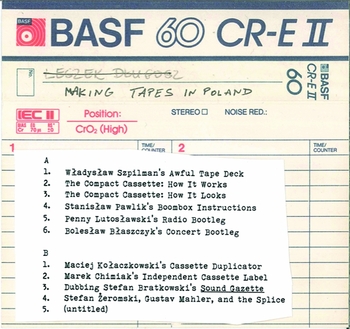
Cassettes are small and they present the particular, but they also percolate through historical materials in brief moments and anecdotes, as in Halina Szpilman's reflection, and resurface in ethnographic encounter, as I shall show. These momentary reflections confirm tapes’ existence as ‘things with secret lives’, to recall Susan Stewart's evocation of small things as they scale time.Footnote 8 The little stories of cassettes can emerge in ruptures, as in Halina Szpilman's latent disgust with her husband's tape deck, or in a rhythmic barrage, as in Nick Hornby's novel High Fidelity or Robin James's zine-like collection Cassette Mythos.Footnote 9 The form of this article (see Figure 1) takes its cue from the mixtape's form – a compilation of small stories to construct a larger one. The article explores tape's capacity to reveal a history of everyday musical and technological fluencies: people making tapes. My archival and fieldwork in Poland depends on close-knit interpersonal networks: out of this practice an intimate and local understanding of the cassette emerges. Listening to homemade tapes – a process that builds on ethnographic encounters and dwelling upon anecdotes such as Halina Szpilman's – I explore the work of crafting tapes and shaping histories that we can hear when we take the time to listen to these heavily edited and sedimented recordings. Read across the written and sonic archive, these little stories on tape and about tape offer a window into networked epistemologies of sound under state socialism. They also make clear that as waning and ephemeral as tapes might be, they live on not only materially – as in the heralded ‘cassette revival’ – but also as a mode of conceiving the sonic past: not as something to be listened to, but as a ribbon through time to be listened with.
My Mixtape. Original insert courtesy of Bychawska Family Archive.

The plastic compact cartridges’ cultural and historical importance was rooted in their ubiquity: their low production cost and standardized measurements combined with magnetic tape's repeatable rewrite-ability to make possible domestic or mobile listening environments (e.g. cars, boomboxes, the Walkman)Footnote 10 and user-driven, decentralized networks of creative exchange (what Peter Manuel influentially described as ‘cassette cultures’).Footnote 11 Herein lie two paradoxes. First, there is an overabundance of cassette stories and little scholarship on the cassette. The bulk of critical engagement with the medium and its logics occurred during the cassette's heyday as a preferred format.Footnote 12 Second, ethnographic experience drives home the fact that most people who will speak for hours of their lives with tape in elaborate, loving detail have long since disposed of their stashes. The contemporary ‘revival’ of the cassette in upper-class Western urban centres aside, there exists an alluring geographical and historical gap between the fantasy of the cassette's familiarity and its material fadeout. The world wide web of cassettes in the 1970s and 1980s facilitates the dual imagination of a shared experience with the medium and of a collective past. The easily mapped genealogies from (1) the portable Walkman to the pocketed smartphone and (2) cassette culture to digital music culture set historians and media scholars up for this kind of quick overwriting of historical data with cultural memory.Footnote 13
Track 2: The Compact Cassette: How It Works
There are two little wheels with a one-eighth inch wide tape (3.81 mm) in a small, plastic case. The tape player's sprockets push through the cartridge's internal windows. The tape itself moves at the speed of 1 7/8ths inch/second (4.76 cm/s). The dual-track recording capacity – inscribed in two directions – depends on the thickness of the tape . . . Philips introduced the name ‘cassette’, but the term ‘compact’ refers to the improbably small dimensions of the case: 10 x 6 x 1 cm.Footnote 14
No history of recording technology starts with tape: it always appears in the middle of things. In 1986 music critic and historian Mieczysław Kominek published the first Polish-language history of sound recording. Though his account of the cassette occupies only ten of the book's 312 pages, it is the first assessment of the tape in the Polish academy. Recalling the tape's arrival, Kominek writes about how it looks and how it works, noting technical specs with an engineer's precision. In his study, as in many histories focused on advancements in sound recording and electronic data storage, the compact cassette appears as an afterthought, a reduction of the reel-to-reel player, a packaging that holds in check the special features of tape that had been so musically generative (splicing, looping, tape delay) and purposefully compromises the reel-to-reel's hi-fi sound.Footnote 15 For Kominek, the signal-to-noise ratio and tape speed contributed to the fact that ‘the quality of sound recording and sound reproduction was not yet the highest’.Footnote 16 His division of tape's labours into recording and reproduction gives the slightest hint towards the power of circulation for this format.
Track 3: The Compact Cassette: How It Looks
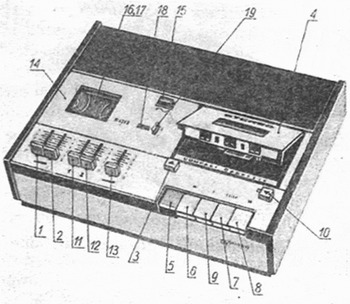
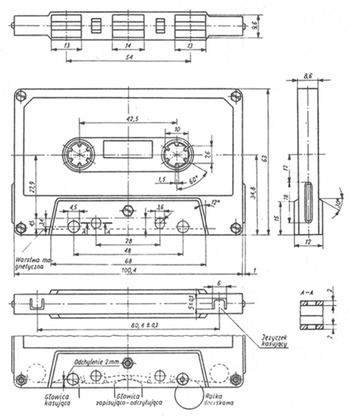
Other comprehensive takes on sound media from Poland introduce the compact cassette to a range of users. With his 1985 Cassette Decks through Questions and Answers, engineer Bolesław Urbański compiled a casual text for ‘amateur, home, office, and school use’.Footnote 17 Urbański's due diligence lays out the tools at the disposal of a range of cassette enthusiasts in the 1980s. On the one hand, his text is elementary. For example, he diagrams and explains in extensive prose the piano-key-style controls of a Polish-made portable deck (see Figure 2a). Urbański recommends hard manual pressure to start, pause, or stop recording. But some of Urbański's amateurs are ambitious hobbyists who aren't just looking to record tapes at home. They want to make them. He entertains the question, ‘How do you make a cassette?’, with a detailed diagram of the dimensions and focuses on the plastic tab upon which home-recording hinges and assembly instructions (see Figure 2b).
‘Cassette deck – deck (Unitra type M5318)’, Figure 8.6B. from Bolesław Urbański, Magnetofon w pytaniach i odpowiedziach (Warsaw: Wydawnictwo Naukowo-Technicze, 1985), 102.

‘Standardized measurements of a European cassette’, Figure 7.25. from Bolesław Urbański, Magnetofon w pytaniach i odpowiedziach (Warsaw: Wydawnictwo Naukowo-Technicze, 1985), 96.

Track 4: Stanisław Pawlik's Boombox Instructions
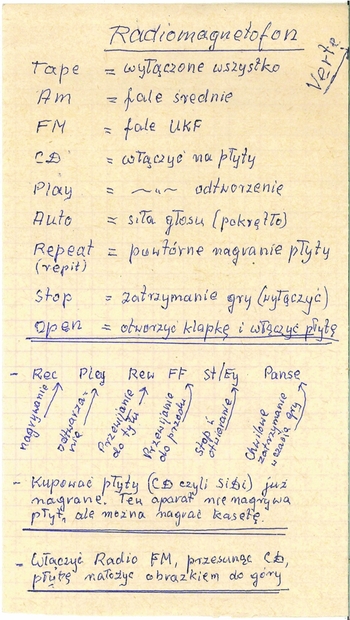
When Stanisław Pawlik moved to a nursing home over the course of the summer in 2014, the retired accountant took a couple of sets of clothes, his magnifying glass, his television, and his boombox, leaving most of his belongings in the 1.5-room block apartment in Warsaw's Mokotów district where he had lived with his wife for the last forty years of his life. Upon his death in May 2015 at the age of 94, his family began the process of finding good homes for his furniture, library, tie collection, and other valuables. My friends – his great-nieces – invited me to take a look at his CD collection. Though he was neither a trained musician nor particularly invested in collecting, he had saved most of the free CDs that came with Sunday and special editions of the right-wing Catholic newspaper Nasz Dziennik (Our Daily). I grabbed a couple of albums, all from the last twenty years, but it was the folded piece of paper on top of the heap of discs in that office that caught my attention. It was the key to listening to his tape deck (see Figure 3). Pawlik had carefully translated the function of each button on his radiomagnetofon – his boombox – into Polish.Footnote 18 Rather fastidious by personality, he sketched out a guide to make and hear tapes, listen to the radio, and play CDs. A few of his annotations are transliterations (e.g., ‘CD, or SiDi’) and he translates the tape terms in language sensitive to the slow and indeterminate process of moving backward or forward on tape. Pawlik clearly knows how tapes work; from the pamphlet it is obvious that this boombox is his first CD player. He includes a note to himself: ‘Buy CDs . . . that are already recorded. This machine does not record discs, but it can record tapes.’ For Pawlik, the boombox seems to have a mind of its own: a number of the instructions tell him how to get it to stop making sound: ‘Tape = turn everything off’, ‘Stop = stop play (turn off)’. Tripping over language and new technology, Pawlik offers a glimpse into the boundary between tape fluency and the digital unknown.
Stanisław Pawlik's boombox instructions. Courtesy of the family of Stanisław Pawlik.

Track 5: Penny Lutosławski's Radio Bootleg
We listen to your music on the radio, whenever it appears, which is quite often. I love your cello concerto . . . We have it on tape, snatched from a radio recording. I am afraid that it is totally illegal, but so attractive.Footnote 19
In a May 1981 thank you note to her husband's uncle, Penny Lutosławski writes of her daily life in Cornwall, exploring ways to reciprocate his financial gift through personal stories. At times her desire to connect verges on flattery, and she makes clear that she knows just how prominent a figure Uncle Witold is. At first read, it might be the suggestion of illicit musical trafficking that catches our attention in Penny's reference to Witold Lutosławski's Cello Concerto, a work inextricable from that magnetic Cold War discourse of musical dissent. Just before its premiere in 1970 by Mstislav Rostropovich, Aleksandr Solzhenitsyn had been awarded the Nobel Prize: a coincidence that placed artistic freedom at the centre of the work's immediate critical reception. Rostropovich himself repeatedly announced that he heard the roaring brass near the concerto's conclusion as ‘the whole Central Committee’ killing him, the lone soloist feebly resisting their power.Footnote 20
However, Penny's tape is illegal not because Lutosławski is subversive, whether in Poland or in England. She simply has not paid for the music she now owns. The mundane familiarity of Penny's offhand remark – snatching a track from the public ether of the radio so that you possess it for yourself – positions the cassette not as the successor to or competitor with older media, but as convergent and cooperative with the radio. Penny's tape is immediately connected, immediately amateur, and immediately disposable: this is music she can hear and acquire again. Unlike Pawlik, who struggled to intuit the CD's technics, Penny moves back and forth between media, revealing the power of a focus on tape to draw our attention away from innovation into everyday transgression.
Track 6. Bolesław Błaszczyk's Concert Bootleg
Every night there was me, in the corner, with my tape player.Footnote 21
In the summer of 2014, I sat with cellist Bolesław Błaszczyk at his home in a southern suburb of Warsaw conducting a series of feedback interviews as we listened to his tape collection. Bolek, a professional cellist and a part-time musicologist who has worked extensively to promote the music of Polish Radio's Experimental Studio, has generously made accessible his personal archive of cassettes to me on several occasions. He traces most of his tapes to his 1980s adolescence when, as an aspiring conservatory student and self-described ‘fan of all music’, he smuggled a ‘small Japanese tape player’ into nearly every concert he attended. ‘A Walkman?’, I asked. ‘Something like that’, he hazily replied.
Over the course of this visit, Bolesław (Bolek) was sharing with me some of the most memorable concerts, concerts whose tapes he has saved. Some of the recordings are now commercially available, others are, he proudly claimed, ‘probably the only evidence that they happened’. One tape took us into the ruins of a bombed-out church in downtown Warsaw on Żytnia Street for a concert under the auspices of a composers’ collective, the Independent Electroacoustic Music Studio. Błaszczyk and I listened together to a slow-paced and muffled improvisation. Or, I strained to hear a synthesizer's lower register as he dug through his many boxes of tapes, which we had spent the morning carrying out to a card table in his backyard. He grew restless with the Żytnia tape – long expanses of time went by when we could barely hear anything on his Sony boombox as cars drove by and the wind rustled the bushes along his fence. ‘Is it still going?’, he whispered, ‘let's listen to something else’. The loudest sound in my recording of this conversation is his finger pressing the stop button.
Side B
Track 1: Maciej Kołaczkowski's Cassette Duplicator
Device for the high-speed copying of cassette tapes COPYETTE 1&3
prod. Telex
USA. Tape deck, 1970s.
Gift of Mr. Maciej Kołaczkowski, Warsaw.Footnote 22
Warsaw's Museum of Technology and Industry is housed in one of the iconic buildings of socialist realism: the Palace of Culture and Science. Built 1952–5, it was modelled after seven skyscrapers in Moscow. In the sixty-plus years since its completion, it has served as the seat of major Polish cultural institutions. The Rolling Stones performed in the Communist Party's Congress Hall in 1967; in the 2010s the expansive square surrounding it served as the focal point of Warsaw's Pride. Housed in the Palace's southwest wing, this museum straddles the divide between naive stalinist triumphalism and unwieldy post-socialist transformation (as of this writing it is under threat of dissolution). The bulk of the permanent exhibition dates to the museum's founding shortly after the building's completion. Half of the second floor is devoted to the history of mining in Poland, for which Silesia's minerals and industry – only a part of Poland since 1945 – are considered central. The history of computing that buttresses it is limited to Soviet and Japanese innovations.
The large exhibition rooms on the third floor, however, contain a modest effort to update a museum otherwise frozen in time. A bounty of everyday technologies from private donors is laid out in display cases to account for life with machines after 1955. Among the Polish-made UNITRA hearing aids and radios and bright orange NEPTUN televisions is the single device that makes or plays back cassette tapes: an exemplar of Telex's COPYETTE 1&3, which simultaneously produces up to three copies of a master at sixteen times the original speed. As with the other objects scattered through the display cases, its cultural significance and place in the museum's narrative is left up to interpretation. Except there's a little note acknowledging its donor, Maciej Kołaczkowski, that serves as a clue. From his involvement in the 1968 student movement at the Warsaw University of Technology, Kołaczkowski was a part of the opposition to state socialism in Poland. After a decade of work as a technical assistant for the University's laboratories and classrooms, he proffered his skills to the opposition movement, for which he built and maintained audio-visual equipment.Footnote 23 This duplicator was probably one of his most valuable machines.
Liner notes
When the Polish Communist Party placed an embargo on paper during martial law (1981–3), the citizens who had joined the grassroots opposition to state socialism, known as ‘Solidarity’, turned to other media – radio, microfilm, and tape – to shape affective responses, argue politics, and organize political action as their movement was delegalized and pushed underground. A cassette culture emerged as the sounding component to the ‘second circulation’ (drugi obieg), a print discourse that circumvented state censorship. Like its Soviet analogue samizdat, the second circulation was not a simple channel of authentic ‘truth’ in the face of the twisted lies of the state.Footnote 24 It was a practice of dissemination that thrived on home reproduction, all the more so when people would sometimes literally intervene in their integrity: tear apart books into fragments, remix recordings into montages, and rewrite speeches in their own words. The cassette format's fungibility and plurality made it not only a convenient conduit for discussion, but also confirmed tape as the medium that – in form and substance – modelled the importance of dissent and revision in political discourse. The opposition took advantage of the renewable resource of cassette tapes to circumvent the scrutiny and vulnerability of the written word. Some made their own tapes; others formed cassette labels. Machines such as Kołaczkowski's were at the heart of this process. Recordists embraced the vulnerable materiality of these objects, which could not be traced to them, since the secret police (Służba Bezpiecieństwa) could not legally link a disembodied voice back to an individual.Footnote 25 And, a strong magnet could swiftly erase any confidential or vulnerable messages.
As an object to be given and duplicated or saved and rewound, the mixtape does work, but it also contains work. As one album art designer put it, ‘A tape could fit more information than a compact volume of the “underground” press.’Footnote 26 The B-side of this mixtape unpacks some of the labour behind the mixtapes of Polish martial law to think about how (not just why) they were made. How did – and do – these tapes sound? I focus on the noisiness of what Wolfgang Ernst pins down as the ‘microtemporal level’ and what Martin Daughtry evokes as recording's ‘scrim of ambient sounds’.Footnote 27 Such tape effects allow me to hear dysfunction and distraction as well as hands at work: lifting phonograph needles, pressing play, and more. I thus reposition myself vis-à-vis tape's time. If the little stories on side A folded the past into the present by listening with, the tracks on side B loop back in time again. I apply my knowledge from listening to and with tapes, to try and listen through the medium.
Track 2: Marek Chimiak's Independent Cassette Label
Were the tapes popular? People were already listening all the time: I imagine that even the Security Service would keep our tapes after they confiscated them and listen.Footnote 28
Any mixtape must be situated in the larger cultural practice of buying, playing, copying, hearing, and sharing tapes. In Poland, it was the ‘tape-recorder culture’ of late socialism that paved the way for the bootleg economy of martial law.Footnote 29 Founded in 1977 the Independent Publishing House – NOWa (Niezależna Oficyna Wydawnicza) – is typical of the larger-scale cassette operations. In 1982, five years after it began publishing literary journals, poetry, and monographs, Marek Chimiak, a production coordinator for print, initiated a series of cassettes, ‘NowaKaseta’. Through 1990, they produced thirty-nine albums, each of which has some musical content. In some cases the non-spoken content is reduced to the radio signals that function as intros and outros. Other albums are rereleases of popular guitar poetry albums by performers with sympathetic politics. These were issued with the hope that people could purchase them without funding the state.
Chimiak's network predominantly used equipment that was for sale on the Polish market.Footnote 30 NOWa's series benefited from the efforts of at least two hundred individuals, and by the mid-1980s they could invest in at least 1000 copies in the initial production run. To make tapes and move tapes through activist networks, journalists proposed topics, artists designed covers, engineers cut and edited sound, and then the materials went into circulation. City apartments hosted the production process. A messenger would pick up products twice a week, delivering the tapes to the apartments and stores where they would be sold under the table – or transporting them to other sites of duplication.
Track 3: Dubbing Stefan Bratkowski's Sound Gazette
Hello, my friend. I'll repeat what I always say: if a tape with this recording reaches your cassette player, remove or erase it. This is not for distribution. After a six-month break, the sixteenth Sound Gazette is, as always, one copy, made for my own pleasure and out of my own right. Because I cannot be silent when it is necessary to speak. And I speak, more or less, to a wall.Footnote 31
Each of Stefan Bratkowski's eighteen editions of the Sound Gazette (Gazeta Dźwiękowa, 1983–8) begins with a variation on this tongue-in-cheek disclaimer. In these formulaic riffs, the speaker, Bratkowski himself, makes room for irony before he launches into cutting political critiques. His gazette is an editorial monologue structured according to the sections of a newspaper: current events, culture, business, and local and international politics. In each edition the activist speaks in different registers, critical of actually existing socialism and analyzing the strategies and culture of the political action. Through most of the first side, a swift cadence strummed loudly on the guitar (provenance unknown) gives the news an edge, bulleting each item and pulling wandering minds back into Bratkowski's text. His programmes fill either 60- or 90-minute cassettes.
Bratkowski's introductory remarks drip with ironic self-awareness in both content and delivery. He plays with the notion that his master tape could have a long life out of his hands. Listening to the tapes, we can hear bootlegging techniques – best of all when they break down. One copy of the Sound Gazette has his disclaimer dubbed at a different speed than the musical intro, so that as a cheerful soprano cabaret voice cynically sings about the downfall of humanity in real time, Bratkowski's remarks rumble through, unintelligible, at one-quarter speed and multiple octaves below his anxious tenor's natural range. The work of duplication wears down, too.
Track 4: Stefan Żeromski, Gustav Mahler, and the Splice
The cassette archives allow us to hear dysfunction and distraction as well as hands at work: lifting phonograph needles, pressing play, and more. Take Janina Jankowska and Marek Mądrzejewski's report on the Polish actors’ boycott of the stage and screen.Footnote 32 The two-sided tape is a radioplay, made of at least fifty-nine discrete sound recordings that they, with helpers at Polish Radio, recombined and rerouted on tape. The two journalists, who had been fired for their sympathetic coverage of the Solidarity movement, present spliced scenes from clandestine performances during martial law. Stage dramaturgy is brought to life with the inclusion of footsteps, audience chuckles and murmurs, and creaking chairs. Recordings of spoken poetry derive their intimacy from microphones held near enough to catch percussive consonants and frantic breaths. The recordists and producers also position musical fragments between the featured texts.
The dramaturgical transitions reveal a musical listening on the part of the authors. For example, a musical remix guides – eases – the audience from a climactic scene in Stefan Żeromski's 1909 play The Rose to an anonymous reflective poem. The fragments modulate the plosive tension of an actor's militant cry against a despotic monarch (‘Enough!’) towards a meditation on waiting delivered in a hushed flow. In between, the editors place the first eleven and a half bars of the fourth movement of Mahler's First Symphony. It is perhaps unremarkable to hear this music as a release – Adorno wrote of it as ‘a totality of despair’ – that is followed by a decisive reckoning: a sustained lower-string pedal interrupts the ‘wild’ tear of the violins.Footnote 33 But I am hooked by the thwarted momentum of the dubbing technique here: the truncation happens a split-second late. The symphonic opening ends uncomfortably not only on formal or musical terms: I can hear the recordist struggle to lift the needle from the groove on their record player, first depressing it to slow the record and lower the pitch, and then releasing a tell-tale scratch as the contact with the spinning vinyl is lost.
Track 5: (untitled)
Again, they stood on the Umschlagplatz. / Our vows are no longer vows, and our prohibitions are no longer prohibitions, and our oaths are no longer oaths.
Many mixes grapple with the traumas of twentieth-century history that were muted in official histories. One such album, Never Say This is the Final Road for You, interpolates extracts of memoirs and histories of the Warsaw Ghetto Uprising (1943).Footnote 34 The 1985 montage takes its title from Hirsh Glick's ‘Partisan Song’, which is recited at the tape's end. The peripherals of this amped-up audiobook articulate Jewish culture in Poland as fragmented. Music gives voice to sacred ritual: the only sung material on this tape is a set of liturgical prayers recorded by early twentieth-century cantors from Eastern Europe.
Why this music? I suspect the tracks are taken from records at the Warsaw Public Library. At the very least, upon tracing one album's provenance at the Library to the mid-1950s, I can imagine it to be the source of the track, having heard many stories of music lovers travelling to the branch in the city centre over the course of my fieldwork.Footnote 35 In the 1980s one could, with permission, dub any record onto tape there, provided you had brought your own recordable cassette. My – incomplete – copy of this tape, purchased online, contains a haunting example of magnetic tape's ability to conjure time even as its magnetic coating degrades. Behind the grave narration of the gradual deportation of the Ghetto's population in Emanuel Ringelblum's account, I hear the music in the corresponding location on the ‘other’ side bleed across the tape.Footnote 36 Gershon Sirota's faint voice recites the Kol Nidre, the melodic formula that marks the beginning of Yom Kippur's service. The chant is so familiar – it flows through eastern European Jewish art music – but the tape holds it at a distance. The magnetic palimpsest draws me in as I strain to hear his proclamation. The tape unspools three temporalities: the cycle of liturgy, Ringelblum's detached eschatology, and, of course, my own present as I listen, rewind, fast forward, and pause.
Back cover
This mixtape is no nostalgic gimmick, no juvenile ‘token of love’.Footnote 37 Let us not confuse the cultural significance of tapes for ‘unofficial culture’ with their importance for ‘informal’ culture in the West.Footnote 38 Though twenty-first century Poland, too, is host to a myriad of new cassette labels and independent bazaars of analogue delight, I offer this tape – this article – to reposition the sonic remove of tape. Few of these stories were steeped in nostalgia either for the medium, its content, or its communities. The strain of memory and the difficulty of returns pervade the experiences of tape. The poignant and painful allure of rewinding together recalls the strain that Svetlana Boym ascribes yearning for the past. She writes that ‘nostalgia, like progress, is dependent on the modern conception of unrepeatable and irreversible time’.Footnote 39
Yet, across this mixtape's tracks, which I have purposefully laden with cultural specificity, my research associates express a degree of care for their past lives with tape. Perhaps they experience another kind of nostalgia: for a social movement's bygone promise, for a career in music ever elusive, or for another time or temporality. These pasts are particular and local, at the nexus of the social lives of the tapes’ makers and the social life of tape. The focus on tape in this issue, too, has foregrounded the format's biases: it is never neutral for the historian and/or ethnographer, even if pressing a button seems like a routine and easy move. We might finish this journey with tape by stressing an attitude of kindness and humanity towards the tape deck's naïvest and paradoxical function: rewind.