Nepal's cities are increasingly translocal spaces marked by mobility. The music of mobile populations brings sounds from rural areas (among others) into urban centres. Multiple soundscapes characterise the cities’ multiaccentual spaces.Footnote 1 With them come aural ways of knowing, sonic epistemologies or ‘acoustemologies’ and their concomitant structures of feeling.Footnote 2 For nearly twenty years now, nightclubs featuring folk music from Nepal's rural hills have added a particular form of rural sound to the night time soundscapes of Kathmandu and other such urban crossroads. Walking along the streets of the city centres and the areas near the long-distance bus parks of Kathmandu, Pokhara, Narayangadh and other urban areas, you can hear the distinctive beats of Nepali folk songs echoing out the windows and down the street, filling the urban canyons as if they were hill valleys. Throughout the history of movement between rural and urban areas in the Nepali-speaking areas of the subcontinent, these musical genres have created links between cities and the rural hills; thus their emotional associations with rural hill life are also a part of city life. Songs in the thematic genre of viraha – longing and the pain of separation – articulate lyrical and musical tropes that have come to characterise the experience of moving between hill villages, cities, and back again.
The growing presence of the rural in the urban is what Karl Marx refers to as ruralisation.Footnote 3 To Marx and his followers, ruralisation is often a synonym for regression or stagnation, a return to a lesser stage of the relations of production and concomitant feudal social relations. From this perspective, the rural is the site of all that is backward and needs to be jettisoned in order for society to progress. Based on Marxist concepts of socioeconomic evolution and development-oriented teleologies like those that Stacy Pigg and Saubhagya Shah have analyzed in the case of Nepal,Footnote 4 most accounts of ruralisation worldwide have focused on the problems that rural-urban migrants create in cities. Even Nepal's Maoist ideologue and former Prime Minister Baburam Bhattarai adopts a Soviet-inspired orientation in his plans for national development, calling specifically for a stop to the ruralisation of cities, and a concerted effort to urbanise the countryside.Footnote 5 With attention to the history of emotions and social relations expressed in rural-associated folk songs as they traverse boundaries separating rural and urban, I begin to rethink this negative assessment of ruralisation.
Folk Song in Migration History
Migration has long been an important part of livelihoods for many residents of the Himalayan foothills, and indeed, throughout South Asia. Dirk Kolff, in his study Naukar, Rajput, and Sepoy, describes a military labour market throughout the subcontinent from the fifteenth century to the nineteenth century. In the prevailing traditions of the time, men would leave their villages to seek employment, and attach themselves to the army of a regional raja. This was called naukari or service, a term that survives to this day in Nepali, most often referring to military or other service to the state.Footnote 6 After the British Indian Army began recruiting soldiers from Nepal, they located a training camp in the city of Lahore which led to Nepali military labour migrants being called lāhure in Nepali – one who goes to Lahore. These soldiers are known more widely by their British Army appellation: the Gurkhas.Footnote 7 This name comes from Gorkha, a widely-used name for Nepal until the 1930s. Now a district in Nepal, Gorkha was a small principality home to the Shah monarchy that united the Nepali state in the 18th century, through campaigns that themselves encouraged military labour migration.
These migration traditions, and their place within social structures and structures of feeling, are described and alluded to in songs and poetry, in particular in the viraha genre. The term viraha, most simply translated as emotional pain or longing, describes a thematic genre of song and poetry found throughout South Asia with songs about love and the pain of separation.Footnote 8 It is this theme of migration, separation, love and longing that marks a song as viraha. The two most common strands of viraha songs diverge along gendered lines: songs about men's migration for military service and trade or labour,Footnote 9 and songs about women's migration for marriage.Footnote 10 It is of course true that men migrate for reasons other than employment, marriage for instance. Women also migrate to find work. But the lyrical themes of viraha songs paint a consistent picture of migration narratives in which men venture out into the world to seek their fortunes, while women stay home and wait for their wandering sons, brothers and lovers – either to return from their wanderings, or to appear to take their wives or sisters back to their natal homes for festivals. For example, Kolff cites the ballad Visaladevarasa, composed in Old Marwari around 1450, in which a husband is going into naukari (here translated as “service as a courtier”, implying that he is going to serve a foreign king). Kolff comments, “as so often in Indian literature, the woman of the house tries to make her travel-loving husband change his mind”:
The themes, of women missing their menfolk and trying to convince them to stay home, of poverty, and of debt, run through viraha songs. The husbands always leave whether for military service, trade, or to become wandering ascetics, or some combination of these.Footnote 12 The tradition of viraha songs that express love and longing in the context of migration along these gendered lines provides a set of lyrical tropes on which improvising singers and writers of new folk songs draw, and thus influence the continuing character of migration songs today.
Nevertheless, both gendered categories of migration songs express emotions about longing for the home places in which they were born, a nostalgia that has more similarities than differences.Footnote 13 One significant similarity is that of an anticipated series of departures and returns, rather than a single journey that takes an individual away from home forever. Viraha songs are songs of memory and longing, but often set within the context of circular migration, a yearly cycle of ritual returns home (especially for women, whose return to their natal homes is expected at certain festivals), or at least a diasporic sensibility in which there is an intent to return home. This circular, rather than linear, trajectory of departures, intense seasons of longing, and returns, characterises Nepali viraha songs and the lives of those who sing and listen to them.
Lyrics, Music, and Emotion in a Hundred-Year-Old Migration Lament
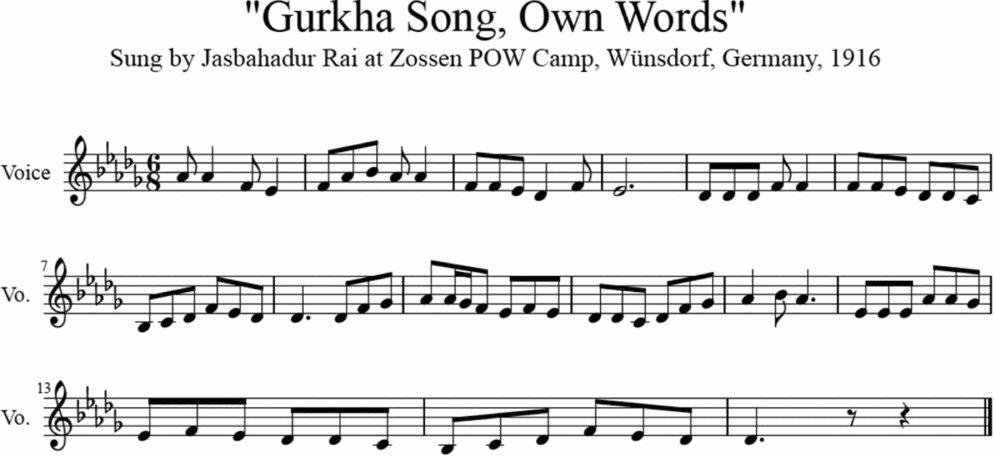
The oldest example of a migration song recording in the Nepali language, of which I am aware, comes from a German archive from the First World War.Footnote 14 It is part of “a collection of more than 2,500 audio-recordings of Allied prisoners of war done by the Royal Prussian Phonographic Commission between 29 December 1915 and 19 December 1918, including a large number of non-white colonial prisoners. The soldiers were asked to stand in front of the phonograph, and made to read out a text, or sing a song or tell a story”.Footnote 15 Carl Stumpf, one of the founders of the discipline of ethnomusicology, was an initiator of this project, which was framed as a linguistic study. Among the prisoners was a man named Jasbahadur Rai, born in 1893 or 1894 in the Indian district of Darjeeling. In the Zossen POW camp of Wünsdorf, on 6 June 1916, at 4.00 pm, he sang a song in Nepali for a research assistant for the project. The song now survives in a Wünsdorf archive, where it is labelled “Gurkha Song, Own Words”, (PK 308). Jasbahadur Rai died shortly after he sang this song, and was buried in Wünsdorf's graveyard of the Common Wealth.
The song he sang, transcribed below, heartbreakingly expresses his suffering and his wish to return home, and illustrates some of the themes that continue in viraha songs to this day. He addresses the song to the women he loves back home, apparently both wife and sisters, addressing them with terms of endearment and kinship terms “charī”, “didī” and “kanchhī”, but preceding these all with “sun-lāune”, “gold-wearing”. This could be understood as an implied criticism, reminding them that it is his sacrifice that has brought them their gold, and leading to the question that runs through many migration songs to this day: was it worth it? The majority of the song expresses his personal experiences, narrating how he has seen the world and suffered greatly. At the end, his implication that he has lost his faith in God seems to suggest that joining the British army and fighting in the First World War was most definitely not worth it.

There are two recordings, recorded on two separate cylinders. While a difference in pitch at the beginning of the second recording suggests that some time elapsed between the two, the description of how prisoners’ songs and testimonies were recorded also leads me to believe that there was not a break of more than a few minutes. I present them here as one song, but acknowledge a slight difference in thematic content between the two cylinders.
The first one focuses on telling how he got there and addressing the women he loves; in the last couplets, he says what he must have known to be his last goodbye to them, asking his “sun lāune charī” to bind her heart and be strong. The viraha aspects of love and longing are particularly highlighted in this first half, as are nostalgic memories of the hills of Hindustan and the mundane objects of everyday life, like the storage places for animals’ fodder, or the bowls made of leaves.
The second recording turns to his experiences in war and as a prisoner, admiring the fields and gardens of Europe while remembering the horror of fighting, expressing the frustrations and humiliations of the POW camp, and wishing explicitly to be sent home. Line 28 is the only line in which he breaks the poetic meter, in an iconic illustration of discomfort and embarrassment at being unable to communicate while imprisoned in Germany. Lines 29 and 30, the final couplet of the song, suggest that he has lost his faith. The first line of the couplet asks somewhat sarcastically what we can now call powerful after the suffering of the worlds’ hearts in the war (mentioned in line 18), questioning if God can actually be believed to have any power. The second line of the couplet turns to a metaphor, the pipal tree that is worshipped as God. Saying that it might as well be cut down for fodder implies that he has lost all faith.
In musical terms, what Jasbahadur Rai sang is a jhyāure song, defined as such by its poetic meter (chhanda, this particular one technically called Asāre Jhyāure), and by its six-beat rhythmic cycle, or tāl. Asāre Jhyāure poetic meter is associated with love songs of all varieties, tragic or happy.Footnote 24 Although Jasbahadur is singing alone without rhythmic accompaniment, the slow jhyāure tāl that would go along with this song, shown below with one possible pattern of bols for the mādal, is one often used with sad songs. This combination of poetic meter and tāl is common in slow, sad love songs. The melody used by Jasbahadur is a typical melody for this poetic meter.
An example of one rhythmic pattern in slow jhyāure tāl.

The melody of the first two couplets of Jasbahadur Rai's song.

Literary sources from the nineteenth and early twentieth centuries demonstrate the association of Asāre Jhyāure poetic meter with love.Footnote 25 So, we can make the informed assumption that this melody (based as it is on the same poetic meter) would likely have held similar associations for Jasbahadur Rai at the time when he recorded it.Footnote 26 Although he himself was from Darjeeling, this melody would sound at home in any number of places across the Nepali-speaking hill regions of the subcontinent. It is hard to know if the melody stemmed from his home in Darjeeling, or if he learned it from someone else in his regiment, from another area of the Himalayan foothills. The musical associations with the hills, combined with the lyrics, make this a song of love and ultimate sorrows, a nostalgic lament for a homeland the singer will never see again, mixed with anger at his predicament and the forces that have led him to an end far from home and those he loves. This poignant song blends an established pan-South-Asian tradition of viraha poetry with a poetic meter, melodic style, and tāl characteristic of Nepali-speaking hill areas. It, thus, serves as an excellent example of how poetics, narrative, and music intertwine to mediate the emotions surrounding a military labour migrant or lāhure’s experience. The song is also important as a rare audio example of one of the main genres circulating in an emergent Nepali-language public sphere at this time in history.
Rural Genres and Emotions in an Emergent Public Sphere
The experience of migration and longing as depicted in vernacular song genres began to become part of a broader experience connecting the urban and the rural, as songs and stories of migration and longing became part of a public sphere mediated not only through performance but also through print media, and later audio recording. Pratyoush Onta, Rhoderick Chalmers and Francesca Orsini have studied the rise of print capitalism in late nineteenth and early twentieth-century Banaras, and its role in creating Nepali and Hindi-language public spheres.Footnote 27 During this time, labour migration and travel for education led many young men from Nepal to Indian cities. In particular, the numbers of young men going to work and study in India's cities increased along with rising Gurkha military recruitment, and the growing number of elite families that sent their sons to be educated in British-style colleges in cities like Calcutta, Banaras, Darjeeling, and Dehra Dun.Footnote 28 As Chalmers has described, the emergent Nepali-language publishing industry in Banaras saw these young men as their market, and began printing literature that drew on both established urban conventions of moralistic writing,Footnote 29 as well as rural genres of poetry and song, including laharī literature that drew on jhyāure love songs like the one above; sawāi songs and poems describing events; and various forms of religious poetry, including some of the various folk bhajan song forms from the Nepali hills.Footnote 30 Their poetic meters identify them as song forms, even though no tune is noted for their performance. The poetic meters themselves indicate a range of possible tunes to which they could be sung. It is unlikely that entire booklets were actually used as songs, and more likely that some printed lyrics were taken up in song performance, in a process similar to that joining commercial folk song recordings and live folk song performance today.Footnote 31 The Banaras publishing industry built on the existing presence of rural song genres in urban space, embracing them as an important aspect of its production for an imagined community of Nepali speakers and readers. This then helped solidify the place of these rural genres in what Onta has called a proto-national literary consciousness.Footnote 32
The emotions expressed in the literature that drew on these rural song genres were many and varied, not limited to viraha. But the lahari love song literature had plenty of focus on longing both nostalgic and erotic.Footnote 33 In contrast to serious, moralistic writings, these songs and their printed booklets were considered a lower form of vernacular popular culture. Aimed at young men – soldiers and students – their mild erotic themes were enough for literary elites to condemn them as not worthy of notice. But by the 1930s their ubiquity was such that poet Laxmi Prasad Devkota could take the risk of foregoing the then dominant Sanskrit poetic meters to publish a folk-based story in verse (kanda kavyā) that was written in the same Asāre Jhyāure poetic meter of Jasbahadur Rai's song above. This verse novella, Muna Madan, called after the names of the two protagonists, combined a folk song and its story from the Newar ethnic group in the Kathmandu Valley with the poetic meter associated with the rural hills, and set it in a high-caste milieu of urban Kathmandu.Footnote 34 The result is a novella in jhyāure verse on a viraha theme, with rural and urban, cross-ethnic, cross-caste resonances in its story and sounds.
Michael Hutt discusses this elite literary turn toward rural genres in terms of nationalist impulses to differentiate Nepal from India.Footnote 35 Such impulses became more prominent as the twentieth century progressed, and other elite Nepali literary figures like Balkrishna Sama also embraced a more colloquial language and writing style. In the realm of music performance and the early recording industry, the world of the Rana courts appears to have remained focused on more classical performance styles up until the fall of the Rana regime in 1950. Musicologist Dhrubesh Chandra Regmi's study of music in the Rana courts emphasises classical performance, while also asserting that classical music in Nepal has continually been informed by folk genres, forms and styles.Footnote 36 A more in-depth examination of the relationship between folk and classical music in Rana-era court performance would require further research. One of the few existing examples is court performer Melawa Devi Gurung's earliest recording, Sawāri Mero Relaimā (My Rail Journey, recorded for His Master's Voice, Calcutta, in 1928), which is in rag Bhairavi and follows the sthāi-antarā form, embellished with the melodic runs called tān that are a signature part of classical vocal performance. Yet unsurprisingly, viraha is present here as well – Melawa Devi's song describes a journey away from the one she loves. In terms of emotion, viraha as a thematic genre unites the folk and the classical, the rural and the urban elite, in the expression of longing for home or for those who have gone far away from home.
Recording of Nepali music was conducted in Calcutta for many years. Then, after the fall of the Rana regime in 1950, state-run Radio Nepal and Ratna Recording had a monopoly on recording in Nepal until private music companies were allowed to record and market cassettes in 1983. In promoting the genres of ādhunik gīt (modern song) and lok gīt (folk song) both Radio Nepal and Ratna Recording turned away from classical (the mainstay of All-India Radio) and toward some of Nepal's vernacular musical genres. While ādhunik gīt mixed sonic indicators of rural life with aspects of classical raga music and western-inspired tonal harmonies,Footnote 37 lok gīt drew on existing genres and styles from rural Nepal.Footnote 38 Many songs of viraha were recorded in both the ādhunik and lok genres, as both value the aesthetic pleasures of longing.
Now, after nearly four decades of musical privatisation, the musical and emotional themes promoted during the years of state musical patronage remain popular in a thriving private music industry. As Stefan Fiol has noted for nearby Garwhal and its regional folk music industry,Footnote 39 the boundaries blur between worlds of urban studio production and nightclub performance on the one hand, and performance in rural areas on the other. Despite the geographic distance between rural hill villages and Kathmandu, the networks of musical circulation go along with those of circular migration, comprising a large and dynamic musical field. Instead of the global-pop-influenced ‘cultural grey-out’ feared by some elite commentators,Footnote 40 and against such narratives of cultural imperialism, this process of circulation that is happening now may perhaps be better described in terms of ruralisation. The words, sounds and sets of social relations valued in rural areas are re-territorialised in urban spaces and transnational networks, as people and music circulate. These aspects of the rural come to be part of those spaces. This process is a continuation of what was going on in still-colonial Banaras, when publishers began printing in Nepali for a market of migrant men, and when such men, fighting for their colonial overlords in a war that took them far into unknown lands, found the viraha songs to express their longing to return home to the people and places that they loved.Footnote 41
Viraha, Exchange, and the Cycle of Migration and Return
In this final section I turn to an ethnographic examination of how viraha works not only as a trope in songs but also in forming social ties through song performance, through networks that join urban and rural spaces. The musical world and the sonic geographies that I am examining are those of Nepali lok dohorī song, a subset of the lok gīt popularised by Radio Nepal and the private music industry. Lok dohorī includes folk songs sung solo and as conversational duets, based on various genres of Nepal's middle hills, primarily from the central and western regions of the country. Strongly associated with Nepal's rural hills, it has developed as a commercial genre in urban studios, concert stages, and nightclubs, and recordings and performances made in the city soon feed back into rural performance and listening practices, continuing an ongoing network of circulation. With dohorī restaurants – the urban venues for lok dohorī performance – in Nepal's major cities and in cities with large Nepali populations all over the world, this rural-urban, international network re-territorialises the sounds of Nepal's hills in new locales, referencing aspects of hill space in order to reassert its associated acoustemology, in terms of songs, their associated emotions, and concomitant social ties, extended across space and time.
Sound and Reciprocity in the Rural Hill Festival
Across the Himalayan foothills, festivals celebrating various holidays often involve music and dance. Loud drumming by multiple drums in unison (or not) serves to broadcast the location of such festivals, the sound echoing through the hills and ‘calling’ people to the village where the festival is occurring. At such festivals, groups coming in from further afield use loud drumming to announce their arrival as they walk along the trails at night toward the festival location. As more and more participants arrive, drum groups multiply, as do drummers within the drum groups. There is no electricity and thus no amplification beyond that provided by the hills and by sheer numbers of drummers, singers, and dancers wearing ankle bells. To participate in such a festival is to be immersed in sound, the near-pitch darkness at night requiring you to navigate based on your sense of hearing above others.
In 2007 I attended such a festival in Gorkha district, a celebration of kauḍā chuḍkā music and dance in lok dohorī singer Ganesh Gurung's home village of Lower Gyaja. This was a regular rural festival that took place each year at this particular new moon in June. As we arrived, my companions joined a group in performance, playing khaijadi drum, and improvising lyrics. I joined the line of women dancing, adjusting my steps to this particular regional version of kauḍā chuḍkā, and we wove in and out of the men's line, following drum cues to change our movements. A dohorī song from the radio was being repurposed as a kauḍā chuḍkā dance song, easily re-contextualised as it shared a four-beat tāl (rhythmic cycle). Its refrain went: “As long as the wind blows, siri siri, my love will not die, sweetheart, as long as there is water in the sea”.Footnote 42 In the couplets that singers both repeated from the original recording and improvised on their own, two lovers lamented their separation. With viraha songs like this one as well as songs of flirtation and politics, the festival continued for three days and nights, more groups joining every evening.
This festival was put on by the youth club of Lower Gyaja. The ‘youth club’ is an institution that has sprung up all over Nepal's rural hills over the past few decades. In this particular area of Gorkha and this Gurung village of Lower Gyaja, it has direct connections with the previous generation's specifically Gurung youth association, called rodhī. Traditionally organised by groups of girls, and attended by groups of boys, rodhī groups organise reciprocal labour exchange and provide designated houses for these boys and girls to gather and sing and dance all night. Through organised performances, festivals, pilgrimages and other activities, rodhī groups also facilitate formal exchange relationships between youth of different villages, and thus form ties that bind groups and individuals together across hills and across the years of their lives.Footnote 43 Note the gendered structure of girls being in charge of the stationary aspects of rodhī, while boys move around – this mirrors expectations for gendered behaviour later in life. As this primarily Gurung and Magar area of Gorkha had sent many young men into the British and Indian armies, and many more abroad to work in various jobs, the song themes of men's migration and women's waiting for their menfolk's return remained immediately salient in contemporary life.
For rodhīs or youth clubs, hosting a performance helps renew social ties, further establishes loving relationships, and brings honour to the hosts; hosting an entire festival does this on a grander scale. Guests from outside, like us, are obligated to make financial contributions in a public and ritual way. The greater the gift, the more honour both parties receive. Groups that attend are then obligated by strict reciprocity to host festivals in return, the anticipation of the reciprocal party nourishing the relationship between groups as it is “held in tension” until the reciprocal act occurs.Footnote 44 This anticipation also takes the form of longing, as love relationships develop between participants in the sung exchanges that characterise performances. Romances certainly occur, but a more generalised form of intensified friendship is also part of such exchanges. As one man who participated in rodhī in the 1990s put it, the boys and girls of different villages would develop ‘group love’ for each other. Living in different villages yet longing to see each other again, they would send gifts of berries, home-distilled alcohol and letters and notes, with individuals travelling between the villages. These gifts would be reciprocated in a few days or weeks, and meanwhile each group would enjoy the pleasures of longing and anticipation for the gifts as ‘tokens of love’, as part of the longer wait until they could see each other again.Footnote 45 As boys and girls grow up, the patterns of reciprocal expressions of love, and the associated pain of separation and anticipation for reunions among groups of youth from different villages, guide their experiences of other partings and reunions. In these ways, hosting and attending festivals of this nature are important and very public ways to establish and continually reciprocally renew social ties, love and honour, on individual and group levels. This pattern also situates songs of viraha within a larger emotional range of songs, associated with a rhythm of meetings and partings that characterises village life. For example, a song from a few years prior articulates this view:
 ho k
Urban Dohorī Restaurants as Rural Festival Spaces
Back in Kathmandu, Ganesh, Sriram, another one of our travelling companions, Prithvi Gurung, and female singers Muna Thapa Magar and Arati Gurung could be found each night on the stage of Dovan Restaurant and Bar. There they performed versions of kauḍā chuḍkā songs, along with other lok and dohorī songs. Restaurant patrons danced in front of the stage, made to look like a village house with its courtyard as the dance floor. The bass is turned all the way up, the lower tones of the mādal drums resonating through the bodies on the dance floor, spilling out the windows and echoing off the buildings across the street.
Dovan was conceived as a place for performing music from southern Gorkha and Tanahun, and decorated to resemble the space in which a village festival would be held. The original owner of Dovan, Ganja Singh Gurung, was a high-ranking officer in the Kathmandu police force. He had intended to name his restaurant Dovan Rodhī Club. However, the people at City Hall had prevented him from doing so, saying that rodhī, as a place where boys and girls spent the night together, was a site for indecent behaviour, and such venues would not be allowed to operate in Kathmandu city.Footnote 46 Since Dovan's opening in 1998, this rule has changed, and today many dohorī restaurants are known as “rodhī club” and even “rodhī bar”. Perhaps this is one example of ruralisation as positive: of a set of rural values coming to be part of an increasingly trans-local urban fabric, having overcome knee-jerk adverse reactions by demonstrating a demotic form of community's value to the larger, multi-ethnic community as a whole.
In dohorī restaurants, performers and waiting staff's attentive hosting, and patrons’ ways of tipping, resemble the honour-producing exchanges at the festival in Gyaja. Exchanges of dohorī song between performers and patrons are central to dohorī restaurants’ musical offerings. When groups of patrons and performers know each other, group-group exchanges outside the dohorī restaurant environment are common. Publicly in the dohorī restaurant space, tipping practices, in which patrons place bills in a basket onstage, recall outside guests’ financial contributions to a village festival. Performing the roles of village kinfolk or romantic interests to guests’ role of the returned migrant, those on stage welcome their guests as returned lāhures, with exuberant, cheerful songs of reunion as well as songs of the pain of separation and longing. In a dohorī restaurant it is common to hear both reunion songs and songs of parting within several minutes of each other. For example, Older Brother Lāhure (“Older brother lāhure, back home on leave, let's laugh and talk now that we have the good fortune to meet”, in fast jhyāure tāl); followed by Ramdi Bridge (“If I survive, I'll come down this road again; if I die, I'll have a rifle for a pillow”, in slow jhyāure tāl).
In these ways, the urban dohorī restaurant sonically and relationally reproduces a rural hill festival space, with an emphasis on love and honour in the ongoing stream of partings and reunions. As in the village festival, that space extends sonically past the immediate boundaries of a village or a restaurant. Using electronic technologies to reproduce the echoing, reverberant sounds of large numbers of drums resounding through hills and valleys, restaurants send their sounds out their open windows into the streets. Not only does this call people in, it announces that a festival is going on here, and you can come be a participant in its exchanges if you wish. The sound announces the presence of this particular hill-area blend of reciprocal social relations.
To come to a dohorī restaurant is to participate in these relations of love and honour, even if only by sitting there, immersed in the sound. Dohorī restaurants are often places where members of particular migrants’ regional and caste/ethnic associations meet, which further emphasizes their function as spaces for rural social relations reconfigured in urban areas. And, dohorī restaurants will hold special parties where they engage in exchanges with their surrounding communities. Dovan had special relationships with the police force; others made donations to hospitals or schools. Dovan often hosted groups from southern Gorkha and eastern Tanahun districts, strengthening the links between the owners and performers’ home villages and their new places of work and residence in Kathmandu. For example, in April 2007 they hosted a New Year's party at the Retired Policemen's Hall, with performers of kauḍā chuḍkā from the owner's village. These young men and women would also join the festivities in Gyaja at the next new moon, the same festival that I attended. The songs they sang continued to resonate with the familiar themes of meetings, partings, and the pain of separation in the viraha songs that have long circulated through migration and changing media forms.
Thus, from the perspective of rural-urban migrants, the aspects of the rural that they bring with them to the city are important expressions of social ties that help root them in relationships and communities that span locales. The patterns of exchange between different groups in one village, and between different villages, are extended through new social clubs and regional associations to link the rural and the urban. These patterns and the social ties they maintain are part and parcel of the acoustemology of place that dohorī restaurants re-territorialise through the sounds of the songs they offer onstage. The way they see it, far from bringing problems that hinder progress, these migrants are connecting the capital to its surrounding areas in a way that is long overdue. To hear and feel the beat of the mādal, pulsing from an upper-floor dohorī restaurant as you walk down the street in Kathmandu (or perhaps Aldershot, England, or Queens, New York), is to hear and feel something of the presence of these growing trans-local social ties, maintained over space and time in part through shared pleasure in songs of viraha, in an ongoing cycle of partings and reunions.