In the early 1920s, Jean-Marie Cessou, French Togo's Catholic primate, witnessed a great transformation as a variety of new religions that abstained from using medicine flooded the religious marketplace in southern Togo.Footnote 1 This religious transformation included the proliferation of both the Kunde healing cult, originating in the northern Ghanaian savannah, and Faith Tabernacle Congregation, a Philadelphia-based divine healing church.Footnote 2 Cessou, who wrote about the transformation in a Catholic periodical in the 1930s, described many similarities between these two healing-centered religions. Mistakenly, he claimed that Kunde and Faith Tabernacle were derived from Christian Science.Footnote 3 He noticed correctly, however, that both religious institutions were established locally in Lome by Togolese labor migrants, who seasonally traveled to Ghana to harvest cocoa.Footnote 4 He further noted that Faith Tabernacle was more popular among the literate Christian migrants, since English literacy was necessary to read Faith Tabernacle's literature.Footnote 5
This article argues – as Cessou observed – that Faith Tabernacle was a spiritual response of the same type as Kunde and other healing cults, becoming particularly popular among young, literate, Christian labor migrants. It emerged in the context of colonial capitalist expansion, widespread social unrest, and rampant witchcraft accusations, with the 1918–19 influenza pandemic being the major catalyst leading to the divine healing church's establishment.Footnote 6 Faith Tabernacle's extensive network developed in a non-linear fashion: the church did not solely spread from the first established branch in Winneba, but several networks were independently organized and only later integrated with the flagship branch. By 1926, when a division in Philadelphia led to the church's decline in colonial Ghana, Faith Tabernacle had garnered over 4,400 members in the country's religiously plural environment.
While recent studies have recounted the development of healing cults in southern Ghana (and to a lesser extent Togo) with great detail during the first quarter of the twentieth century, much less has been written about Faith Tabernacle in Ghana during this period.Footnote 7 This article seeks to provide a detailed account of Faith Tabernacle's expansion, departing from previous scholarly discussions of Faith Tabernacle in Ghana in three significant respects. First, this article takes the denomination – Faith Tabernacle Congregation – as the historical subject, considered from the time when the first congregation was formed in 1918 through to its zenith in 1926. Second, I incorporate a wide breadth of sources, including records from the Faith Tabernacle Congregation Archive in Philadelphia and Accra, as well as from the archives of several other churches founded by former Faith Tabernacle leaders and members, such as the First Century Gospel Church (in Philadelphia; Hamilton, New Jersey; and Accra), the Christ Apostolic Church (in Accra), and the Church of Pentecost (in Accra).Footnote 8 Oral histories were also collected from the children of the earliest Faith Tabernacle members in Ghana, as well as from the current Faith Tabernacle leadership in Philadelphia and Accra. Third, this article contextualizes the growth and development of Faith Tabernacle in Ghana within the political, economic, and religious milieu of southern Ghana during the 1910s and 1920s.
With respect to the religious environment in Ghana during the early twentieth century, this study is situated between two bodies of literature that rarely interact. The first considers the context and proliferation of witchcraft and healing cults during the colonial period, while the second seeks to make historical sense of the meteoric rise of Pentecostalism in Ghana (and Nigeria).Footnote 9 Scholars within these two fields have only briefly discussed the relationship between the two. For instance, Thomas McCaskie wrote that healing cults in Asante provided similar services to some churches, which were the principal competitors to these cults.Footnote 10 Meanwhile, John Peel noted similarities between the young men involved in Nigeria's Faith Tabernacle and those involved in the Atinga (Tigare in Ghana) healing cult.Footnote 11 As Ruth Marshall argues, Christianity and occult practices have participated in the same field of social practice in West Africa and have been produced by the same historical forces.Footnote 12
This religiously plural environment shared by Faith Tabernacle and several healing cults in Ghana during the first quarter of the twentieth century also included a few spiritual churches (sunsum sore), independent of any Euro-American affiliation, such as The Church of the Twelve Apostles (established 1914) and Musama Disco Christo Church (established 1922). These spiritual churches had similarities to Faith Tabernacle, such as robust healing practices as well as resource sharing between, and illness management by, church members as opposed to kin.Footnote 13 Yet Faith Tabernacle, unlike the spiritual churches, rigorously enforced tithing (members paying 10% of their income to the church), and shunned polygamy.Footnote 14
Uniquely, Faith Tabernacle was the predecessor to early Pentecostalism in Ghana; the first Pentecostal church – the British-based Apostolic Church – emerged from within the extensive Faith Tabernacle network. Like Faith Tabernacle, the Pentecostal churches practiced (a form of) divine healing, delivered the possessed from malevolent spirits, combated witchcraft, enforced monogamy, and tithed regularly. Unlike Faith Tabernacle, Pentecostals worshipped ecstatically and believed that Baptism in the Holy Spirit – a concept frequently discussed in the pages of Faith Tabernacle's literature – was only evidenced by speaking in tongues.
The establishment of Faith Tabernacle (and to a lesser extent the Apostolic Church) points to the importance of literacy, published material, and transnational correspondence in creating a unique set of opportunities and affiliations for Christians in colonial Ghana. This transnational correspondence enabled the establishment of a church with ties to the United States that was led by West Africans and not directly overseen by foreign missionaries. In Ghana, Faith Tabernacle was the religious equivalent of the (fairly secular) literary clubs that were active during the same period.Footnote 15 Primarily, Faith Tabernacle and the literary clubs consisted of newly educated but otherwise non-status-holding young men, who banded together to debate moral issues. Their texts, however, were different: literary clubs reflected on British fiction, while Faith Tabernacle discussed the Bible and Faith Tabernacle literature from Philadelphia.
FAITH TABERNACLE'S ORIGINS AND MISSION STRATEGY
Faith Tabernacle was established in 1897 by Jacob Thomas Wilhide, a leader in John Alexander Dowie's Christian Catholic Church, which was the largest divine healing church in the United States at the turn of the century.Footnote 16 The first Faith Tabernacle pastor was John Wesley Ankins, who worked in conjunction with Wilhide in Philadelphia but led a group that met separately.Footnote 17 Ankins's group, originally called Gospel Mission, was formally affiliated with the Christian Catholic Church until about 1899, when it cut ties with Dowie's church.Footnote 18 In February 1904, Gospel Mission purchased its first church building in Philadelphia at 2738–40 North 2nd Street, after which it changed its name from Gospel Mission to Faith Tabernacle Congregation.Footnote 19
Faith Tabernacle practiced and preached divine healing: trusting in God alone for all health needs and abstaining from all other forms of healing, whether spiritual or biomedical. This theology was expounded in the church's literature, particularly in their monthly periodical called Sword of the Spirit, first published in May 1901.Footnote 20 By 1903, Sword of the Spirit was encouraging its readers to become ‘home missionaries’, suggesting that they send in the names and addresses of interested friends to be put on the church's mailing list;Footnote 21 and by 1908 Faith Tabernacle had established a missionary department.Footnote 22 The objective of the church was not to send missionaries into other parts of the world, as many churches had done, but to send monthly supplies of Faith Tabernacle literature to followers around the world to distribute locally. In fact, in the ensuing years, Ambrose Clark – Faith Tabernacle's second presiding elder, who led the church from at least October 1917 – denied several requests to send missionaries from Philadelphia to Ghana.Footnote 23
The first pieces of Faith Tabernacle literature to reach colonial Ghana were sent in the first decade of the twentieth century to European or American mainline missionaries, who in turn distributed them to Ghanaians in their churches and schools. Some missionaries were divine healing proponents and, on occasion, their Christian bookshops sold materials written by divine healing advocates.Footnote 24 A European or American missionary, referred to as ‘brother’ in the article, most likely wrote the first testimony from Ghana, published in Sword of the Spirit in August 1906. The author described non-specific ‘blessings’ that resulted from reading the periodical and explained that he then distributed it among his friends. Footnote 25 Because other British and American evangelical literature only began to be imported to Ghana in bulk after 1914, Faith Tabernacle was one of the very first – if not the first – evangelical church to disseminate its literature in Ghana.Footnote 26
Many Ghanaian Christians came into contact with Faith Tabernacle literature through their church or church school, and found the message of divine healing attractive. Some wrote to the central branch in Philadelphia for more Swords, sermons, and tracts, and began evangelizing locally as the leadership in Philadelphia had suggested.Footnote 27 Before formal branches of Faith Tabernacle were established in 1918, the divine healing church functioned as a para-church organization: an extra-denominational Christian institution that distributed its literature and had followers within various denominations.
COCOA, SOCIAL UNREST, AND WITCHCRAFT
Faith Tabernacle spread rapidly within the socioeconomic context of the colonial cocoa industry. In 1896 or 1897, pioneering male farmers from several Akuapem towns, many of whom were affiliated with the Basel Mission, started buying forest land for cocoa plantations in various parts of Akyem Abuakwa, located west of Akuapem across the Densu River.Footnote 28 Quickly, however, the industry expanded beyond members of this denomination and region.Footnote 29 Nearly all the production was undertaken by local Ghanaian planters, who engineered the rapid growth of the cocoa industry along distinct capitalist lines.Footnote 30 By 1911, Ghana had become the world's largest cocoa producer, and by 1920 cocoa amounted to 83 per cent of Ghana's export earnings.Footnote 31 As the most lucrative industry in Ghana during the first quarter of the twentieth century, cocoa made many people wealthy.
Alongside producing a significant amount of wealth, the cocoa industry instigated rapid social change by altering the lineage-based subsistence economy. It strengthened individual male farmers but weakened matrilineal families, since money earned from cocoa farming was considered the property of individual farmers, not of the matrilineage, as was the case with other sorts of earnings.Footnote 32 Furthermore, many farmers were able to bypass the traditional inheritance system and bequeath their cocoa farms to their sons, not to their matrilineage.Footnote 33 This caused intense conflict with respect to the distribution of wealth and inherited property between conjugal families and matrilineages.
Many people who lived through that period remarked that ‘cocoa destroys kinship, and divides blood relations’.Footnote 34 This widespread social unrest within families provoked witchcraft accusations, which M. J. Field reported had increased considerably since the cocoa boom.Footnote 35 Witchcraft was believed to be affective and inherited within the matrilineage, representing what Peter Geschiere has termed, for another West African context, the ‘dark side of kinship’.Footnote 36 In and around this time, witchcraft was believed to be capable of burning down cocoa farms or causing a poor crop, in addition to provoking other woes such as sterility, impotence, and disease.Footnote 37 It was also particularly known for killing children. More generally, witchcraft in Ghana was symptomatic of a conflicted and unstable society.Footnote 38
The threat of witchcraft demanded extraordinary prophylaxis. Novel forms of therapy were introduced in southern Ghana by new healing cults such as Nana Tonga, Tigari, or the aforementioned Kunde. These cults functioned to locate and heal witches, not persecute and eliminate them through judicial ordeals, which were forms of ritual cleansing outlawed by colonial authorities. While healing cults in southern Ghana did not originate with the cocoa industry (the first one appeared in 1879), the social instability produced by that industry was conducive to the spread of these cults. Such instability was accompanied by a competitive ritual economy characterized by innovative forms of spiritual therapy.Footnote 39 These forms of spiritual therapy were not only accessed through healing cults but also through new forms of Christian healing, particularly within Faith Tabernacle.
Between 1906, when the first testimony from Ghana was published in Sword of the Spirit, and early 1918, Christians in Ghana were reading, discussing, and distributing Faith Tabernacle literature. But only one branch had been formed in 1918, before the influenza pandemic ravaged southern Ghana and catalyzed the rapid expansion of Faith Tabernacle.
THE TWO FAITH TABERNACLE NARRATIVES: WINNEBA AND ASAMANKESE
In Ghana, the first Faith Tabernacle congregation was established in Winneba sometime in the first half of 1918, before the influenza pandemic erupted in September. Two brothers, Joel Sackey Sam and Josephus Kobina Sam, were walking one morning towards the Muni Lagoon and found a copy of a Faith Tabernacle sermon on the ground, partly covered in mud. After becoming interested in the sermon's message, the two brothers began corresponding with Pastor Ambrose Clark in Philadelphia and established a branch in Winneba.Footnote 40 Joel Sackey Sam, assisted by his brother, became the leader of this flagship Faith Tabernacle branch in Ghana.Footnote 41 The two Sam brothers, who were formerly elders in the Wesleyan Mission, started their congregation initially with some of their family and a few members of their former church.Footnote 42 Not long after this Faith Tabernacle congregation was formed, the influenza pandemic erupted.
The 1918–19 influenza pandemic catalyzed the rapid spread of Faith Tabernacle in Ghana, partly because this virus resulted in extreme suffering in both Philadelphia and Ghana. In Philadelphia, the influenza virus produced the highest mortality rate of any city in Europe or North America: nearly 1 per cent of the population (almost 16,000 people) died between September and late December 1918.Footnote 43 Faith Tabernacle recorded the success of its congregation in the midst of this pandemic in the Sword of the Spirit. The headline of the October 1918 issue read ‘God's witnesses to divine healing: healed of Spanish influenza and pleuro-pneumonia’. Inside were testimonies given by two women, as well as a list of over fifty persons miraculously healed of influenza and accompanying pneumonia through their faith in God alone. Other healing testimonies from the 1918–19 influenza pandemic were recorded in the periodical the following year and continued until the late 1920s.Footnote 44 These healing testimonies circulated in Winneba as well as the various Christian circles throughout Ghana where Faith Tabernacle literature was read.
In colonial Ghana, the influenza pandemic caused the worst short-term demographic disaster in the twentieth century: approximately 100,000 Ghanaians died, mostly between October and December 1918.Footnote 45 No institutionalized form of therapy or religion in the country could successfully combat the disease. Colonial physicians in Ghana did not know what caused the pandemic, how to arrest the virus's progress, or how to treat its victims. Biomedical practitioners in Ghana were not only unprepared to treat the infected but their facilities were already severely understaffed due to the need for physicians in Europe to treat soldiers injured during the First World War. Akan healers, too, were reported to be ineffective.Footnote 46 The mainstream churches did not offer any form of spiritual protection against the virus. Most churches, in fact, were closed by government order.Footnote 47
Unlike the mainline churches, Faith Tabernacle responded proactively. At the peak of the pandemic in October and November, many people were brought from the nearby Winneba hospital to Faith Tabernacle's divine healing home, called ‘Faith Home’, which was a place for the sick to rest, be prayed for, and heal.Footnote 48 As with Philadelphia survivors recorded in Sword of the Spirit, many Ghanaian survivors testified to their miraculous healing from the virus without the use of any medication. The ability of the church to heal, in contrast to the hospital's inability to do so, looms large in the memories of the descendants of the Sam brothers in Winneba.Footnote 49
After the influenza pandemic struck Winneba, small congregations began to emerge on the outskirts of Winneba and later in various coastal towns.Footnote 50 Fante migrants from Winneba established branches as far away as Côte d'Ivoire and northern Nigeria.Footnote 51 However, a significant amount of the evangelizing in Ghana was done by a former Basel Mission elder from Asienimpon (outside Kumasi) named Kwadjo Nti, who spread Faith Tabernacle's doctrines and healing practices around all major ethnic regions of southern Ghana and into Togo from the flagship congregation in Winneba.Footnote 52 Between 1918 and 1926, Winneba functioned as Ghana's national headquarters, hosting annual meetings on the present site of the Sacred Heart Catholic Church, where local pastors were ordained and elders anointed.Footnote 53 Joel Sackey Sam was the final authority in Ghana and had the power to approve new pastors, endorse new branches, or merge existing branches.Footnote 54
Joel Sackey Sam, however, was not the only ordained Faith Tabernacle pastor with a significant following in Ghana. Peter Anim established a thriving branch of the church in the cocoa migrant town of Asamankese, in the heart of Akyem Abuakwa, and garnered nine other branches under his authority. Anim was arguably the second most powerful Faith Tabernacle pastor in Ghana during the 1920s.Footnote 55 He was originally from the adjoining towns of Anum and Boso on the eastern bank of the Volta River. He was schooled by and later employed in the service of the Basel Mission.Footnote 56 In 1917, while living in Boso, Anim obtained a copy of Sword of the Spirit. Impressed with the church's divine healing message, he became a subscriber. In 1920, his first wife died, after which he began to follow Faith Tabernacle teachings. In 1921, Anim contracted guinea worm and wrote to Ambrose Clark, who encouraged him to have faith and trust God for his healing. Anim was later healed of this parasitic infection, along with chronic stomach pain. After his healing, he withdrew from membership of the Basel Mission at Boso and settled in Asamankese, following a massive labor migration of Anum and Boso residents, who migrated to work in the cocoa industry from as early as 1907.Footnote 57
Anim's Faith Tabernacle branch became wildly successful in the first half of the 1920s. By 1921, he had begun evangelizing in Asamankese and was soon joined by several converts. A Basel minister's report from Asamankese two years later lamented that their members were joining Faith Tabernacle in droves.Footnote 58 In October 1923, Anim received a certificate of pastoral authority from Ambrose Clark, giving him the right to baptize and confirm appointments. Between 28 December 1923 and 2 January 1924, Anim attended the annual meeting of Faith Tabernacle pastors in Winneba in order to become more integrated into the larger network of churches.Footnote 59 In a letter to Ambrose Clark written in July 1924, he reported nearly 100 new members and another 122 recent baptisms in his Asamankese church, already with a substantial following.Footnote 60
THE FRAGMENTED EXPANSION OF THE FAITH TABERNACLE NETWORK
Faith Tabernacle's network did not solely grow out from the two nodes of Winneba and Asamankese. Its growth was much more fragmented, as Faith Tabernacle literature was being circulated among mainline churches in all regions of southern Ghana. Faith Tabernacle literature was distributed and circulated in Basel (Presbyterian) and Wesleyan (Methodist) communities primarily, but also among African Methodist Episcopal Zion, Baptist, Bremen (Evangelical Presbyterian), Catholic, and Church Missionary Society (Anglican) members.Footnote 61 Subsequently, many other branches emerged independently of Winneba and Asamankese, but were later incorporated into larger networks via various means.
Some branches emerged from evangelical campaigns led by Joel Sackey Sam or Peter Anim.Footnote 62 Some emerged through other individuals' direct exchange of letters with Ambrose Clark in Philadelphia. Clark, after receiving information of newly established branches, typically instructed Sam to visit these stations and establish his authority.Footnote 63 Other branches – such as Asamankese – would garner a network of their own and only later connect with Winneba through the annual pastors' meetings. Still other Faith Tabernacle networks, such as the one based in Keta that had 12 subordinate branches, were never fully integrated into the larger Winneba network.Footnote 64
While Ambrose Clark considered Sam the final authority for all Faith Tabernacle churches in Ghana, local pastors in Ghana had authority over the branches that they helped to establish. This authority included receiving one-third of their tithes, while the congregation kept one-third and the remaining third was sent to the international headquarters in Philadelphia.Footnote 65 These smaller networks often followed migration patterns, cutting across regional or ethnic divisions. For instance, Anim established the branch he led in Asamankese and also ones in Anum and Boso, where he had grown up, as well as in Kpessi (in Togo), a town 305 kilometers north-east of Anum.Footnote 66 Another example was Stephen Blekpe, who led Faith Tabernacle branches in the Anlo-Ewe towns of Keta, Woe, and Kpalime, and established branches as far east as Lome and Tsevie in Togo and as far west as Anyinam in Akyem Abuakwa, which was led by the successful cocoa farmer James Kwame Nkansah.Footnote 67 These trans-regional spheres of influence were recognized in Philadelphia. For example, Ambrose Clark once wrote to Blekpe in Keta not to interfere with ‘bodies of new members under the supervision of pastors of other branches’, referring specifically to the Ada branch, which Blekpe had recently visited under the authority of D. A. Thompson in Accra.Footnote 68
This fragmented, non-linear mode of expansion was very successful. By May 1920, Ambrose Clark reported a great revival in West Africa (Ghana and Nigeria), which included 15 or 20 branches, some with several hundred members. The majority of these branches were in Ghana, not Nigeria: Ghana's Faith Tabernacle membership was nearly four times larger than Nigeria's in the first half of the 1920s.Footnote 69 Ambrose Clark wrote that the Africans with whom he corresponded were receiving the ‘Full Gospel’ of salvation, and healing from diseases by the power of God alone. Many Ghanaian followers had their testimonies published in Sword of the Spirit. For instance, a Ghanaian in Kano, Nigeria, wrote in August 1920,
I don't know why our missionary here did not teach us the full gospel … They never did wondrous work here as our Lord give the power to the disciples. Should you bring your Divine Healing church out in Africa here and preach the full gospel to the people and healing the sick, many people shall believe in your Gospel than those churches who were teaching us here, because they never done miracle; they never heal the sick …Footnote 70
Faith Tabernacle's healing practices and theology strongly resonated with mainline Christians who were committed to their faith but had no ritual means of addressing their illnesses or misfortune. By the end of 1923, Ambrose Clark claimed to have distributed thousands of pieces of literature and was receiving up to 200 letters a day from Ghana and Nigeria.Footnote 71
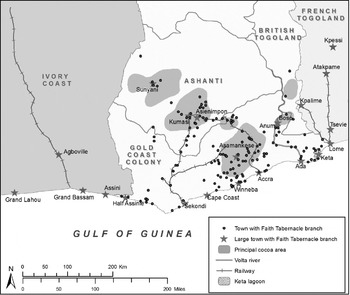
By early 1926, there were at least 177 Faith Tabernacle branches in Ghana, extending east into Togo and west into Côte d'Ivoire (see Fig. 1), with 115 leaders from these branches in correspondence with the headquarters in Philadelphia. Leaders reported congregations in 1925 as large as 600 (Half Assini) and 369 (Mangoase).Footnote 72 With a conservative estimate of 25 members per branch, there were approximately 4,425 Faith Tabernacle members in greater Ghana by 1926. By the mid-1920s, these 177 branches were organized into at least twelve districts: Accra, Akuapem, Akyem, Juaso, Keta, Kumasi, Saltpond, Sefwi, Sekondi, Togoland, Volta, and Winneba. But who exactly were these members?
Location of Faith Tabernacle branches in colonial Ghana, Côte d'Ivoire, and Togo between 1918 and 1926.

CHRISTIAN CAPITALISTS: CLERKS AND COCOA PRODUCERS IN THE COLONIAL ECONOMY
Faith Tabernacle was predominately a religion of migrant Christian capitalists. These migrant capitalists were involved in two primary economic sectors: colonial administration and foreign trade located along the coast and transportation routes, and cocoa production in the interior. These two major economic sectors corresponded with the two major centers (and networks) of Faith Tabernacle: Winneba on the coast and Asamankese in the intense cocoa-growing region of Akyem Abuakwa.
Nearly 45 per cent of the Faith Tabernacle branches were founded in coastal towns, along railway lines, and near major waterways such as the Keta Lagoon and the Volta River. In particular, Fante migrants, trained to read and write English by Wesleyan missionaries, worked for European trading firms such as Miller's Ltd., the Elder Dempster Steamship Company, Henry Werner and Company, and John Holt and Company.Footnote 73 Other Ghanaian Faith Tabernacle leaders worked in the colonial administration for the railway (in Ghana and Nigeria), sanitary, and treasury departments, spreading Faith Tabernacle along the coast and other transportation routes.Footnote 74
Most of these clerks were young men. For instance, John Jayne, a label clerk with the railways department and a Faith Tabernacle leader in the Opon Valley, wrote in April 1925 that his 14 newest members were ‘mostly storekeepers, traders and clerks averaging in age about 26’.Footnote 75 These young men were of the social category krakye (derived from the English word ‘clerk’): they were literate men trained in mission schools, who were part neither of the chiefly elites in charge of local administration nor of the highly educated and financially secure intelligentsia.Footnote 76
In addition to clerks employed by the colonial government and European firms in coastal towns and on transportation routes, Faith Tabernacle drew members from within the cocoa industry.Footnote 77 Branches in Ghana were found in the largest cocoa-producing regions, such as Akuapem and Akyem (34 branches), Asante (23 branches), Kwahu (7 branches), greater Sunyani (5 branches), and in and around Anum and Boso (4 branches). More than 40 per cent of the Faith Tabernacle branches were founded in cocoa-growing regions in the interior. Many of the Faith Tabernacle leaders, including Peter Anim and Kwadjo Nti, were schooled by the Basel Mission and could have worked either as clerks or farmers within the cocoa industry.Footnote 78 Others leaders, such as James Nkansah of Anyinam and W. A. Johnson of Mumford, were solely cocoa farmers.Footnote 79 One Faith Tabernacle leader in Agboville, Côte d'Ivoire, named J. C. Isaiah, owned his own cocoa-purchasing firm called Isaiah Brothers Ltd.Footnote 80
While a significant number of Faith Tabernacle members – and particularly leaders – were English-literate clerks and cocoa producers, the membership of the church expanded beyond this particular educated class. Many members were only literate in local languages, as shown by the large-scale translation enterprise taken up by many Faith Tabernacle leaders across southern Ghana. For example, one Faith Tabernacle leader tried (unsuccessfully) to mass print Faith Tabernacle literature in Twi by contacting presses in Basel and London.Footnote 81 Jacob R. Mensah, who led a congregation near Kumasi, translated Faith Tabernacle hymns into Twi for Joel Sackey Sam in Winneba.Footnote 82 Peter Anim translated over twenty Faith Tabernacle tracts into Twi for distribution in southern Ghana, while Samuel Benoa of Nyakrom translated four tracts.Footnote 83 Another branch leader asked Ambrose Clark to mail him an English dictionary so that he could translate hymns and Faith Tabernacle literature into Twi.Footnote 84 And in Keta, a member of Stephen K. Blekpe's congregation helped him translate Faith Tabernacle literature, presumably into Ewe.Footnote 85 Another significant reason for translating Faith Tabernacle literature into local languages was so it could be read aloud to non-literate members who did not know English.Footnote 86
Not only did Faith Tabernacle membership swell beyond the literate, educated class of its leaders but it also transcended categories of gender and age. While there were no female pastors, branch leaders, or correspondents, there were many women who were members of Faith Tabernacle in Ghana.Footnote 87 And children were brought into Faith Tabernacle – as in mainline churches – through the establishment of schools.Footnote 88 At its zenith in 1926, Faith Tabernacle had become a popular movement cutting across ethnic, gender, age, and education lines.
HEALING, WEALTH, AND PROTECTION: FAITH TABERNACLE'S SUCCESS IN A COMPETITIVE THERAPEUTIC MARKETPLACE
Faith Tabernacle became a significant denomination in Ghana's Christian community in only eight short years. During that time, it garnered approximately 4,425 members within 177 congregations. By 1926, the Basel Mission – the oldest church in Ghana, established nearly one hundred years earlier (in 1828) – claimed roughly 22,000 members in 260 congregations.Footnote 89 In comparison, Faith Tabernacle acquired 20 per cent of the Basel Mission's membership (as well as several of its pastors), worshipping in over 68 per cent of its congregations.
While many Faith Tabernacle members came from the mainline churches, significantly, the Philadelphia-based divine healing church competed with the new healing cults, as Cessou observed. Faith Tabernacle had two distinct advantages over those cults. First, while the church was able to redress illness and misfortune spiritually just as healing cults did, it took a different approach to managing witchcraft. Second, Faith Tabernacle was not legally suppressed by the colonial government as healing cults were.
Illness and witchcraft
Faith Tabernacle's success in combating illness, misfortune, and antisocial behavior is apparent from several testimonies written by Ghanaians in Sword of the Spirit during the 1920s. A man's dead daughter was brought back to life through prayer.Footnote 90 A man with stomach pains caused by Satan confessed his sins, asked for deliverance in the name of Jesus, and was healed within a few minutes.Footnote 91 A man with dysentery was healed by his pastor after acknowledging that ‘the Blood of Jesus Christ had washed away all man's sorrows and sicknesses’.Footnote 92 A Faith Tabernacle pastor exorcized evil spirits from two women and healed a man of paralysis.Footnote 93 A man displaying sinful behavior was delivered from the power of Satan.Footnote 94 An alcoholic and idolater was delivered from sinful behavior through Faith Tabernacle's message.Footnote 95
Faith Tabernacle was successful in combating not only illness, antisocial behavior, and misfortune but also witchcraft, one of the most prolific disorders in colonial Ghana during the 1920s. However, no references to witches or witchcraft exist in Sword of the Spirit testimonies. This omission, I believe, is due to two interrelated reasons. First, witchcraft was not mentioned because it was not a recognized afflicting agent within the Faith Tabernacle community in the United States. There were no published healing testimonies from witchcraft attacks by American members of the church. Possibly, Ghanaian correspondents did not write about witchcraft attacks because they were never featured in the periodical. Alternatively, Faith Tabernacle editors might have chosen to print only those testimonies with no mention of witchcraft; or, perhaps, discussions of witchcraft were rephrased.
Second, in colonial Ghana ‘evil spirits’ and ‘the Devil’ became a Christianized version of witchcraft, particularly manifest in oral and written accounts in English.Footnote 96 This process occurred both before and after the 1920s.Footnote 97 For instance, in 1881 the Basel missionary and linguist J. G. Christaller wrote that witches ‘stand in some agreement with the devil’.Footnote 98 An examination of Faith Tabernacle Ghana's minutes book from the late 1930s and early 1940s shows that characteristics of Satan had parallels in Akan witchcraft, such as his tendency to operate at night and the frequency with which he afflicted children.Footnote 99 Within the Ghanaian Faith Tabernacle community during the 1920s, discussion of evil spirits or the Devil probably operated as Anglicized accounts of witchcraft attacks.
In colonial Ghana, Faith Tabernacle protected its followers from witchcraft, demons, and the Devil. Unlike healing cults, however, the church was not concerned with the healing and reintegration of witches into the extended family and ultimately placating intra-familial conflict. Rather, Faith Tabernacle sought to make distinct religious and social divisions between individuals and their non-Christian families. These divisions extended into the economic sphere, where members were expected to give tithes to the church but not financially contribute to rituals associated with the matrilineage. For example, several Faith Tabernacle members in Dunkwa publicly quarreled with their non-church families because the members refused to contribute money towards purchasing alcoholic beverages for family funerals.Footnote 100 Faith Tabernacle therefore supported individual wealth attainment (within the conjugal family) to the detriment of the matrilineage, as well as providing spiritual forms of protection against witchcraft accusations often directed at individuals deemed affluent or greedy. Through these tenets, it became a highly appealing religious option for Ghanaian labor migrants who sought to retain control over and enjoy their wage earnings.
Legality
A second reason that Faith Tabernacle flourished was that, unlike healing cults, the church was not outlawed by the colonial government. The Aberewa cult, for example, was banned between 1912 and 1932, a period that encompassed Faith Tabernacle's proliferation in southern Ghana. Later, in 1939, Kunde was outlawed also.Footnote 101 The colonial government's attempt to protect the public by banning these movements (and others like them) led to heightened anxiety, which, in turn, increased demand for supernatural protection.Footnote 102 This political environment led to the popularity of Faith Tabernacle, which was never outlawed by the government for ritual activities aimed at ensuring members' health and wellbeing. Agreeing with the government, the mainline churches rigorously opposed healing cults but generally tolerated Faith Tabernacle and its members, since it was a Christian organization of American origin and missionaries originally circulated its literature.Footnote 103
But colonial political and religious authorities, such as Jean-Marie Cessou in Togo, confused Faith Tabernacle with healing cults.Footnote 104 Thus, because of the periodic outlawing of healing cults, Faith Tabernacle pastors were adamant about receiving their pastoral authority from Philadelphia in the form of a certificate, which was a necessary criterion to lead a congregation without missionaries present.Footnote 105 In Keta, for example, A. E. Fiagbedzi pleaded with Ambrose Clark to mail his pastoral authority as soon as possible, since the district commissioner needed documentation from him to recognize his branch as a church.Footnote 106 In Juaso, too, J. E. D. Wallace urged Ambrose Clark to send him his official pastoral certificate quickly, at the request of the district commissioner.Footnote 107 Finally, in Dunkwa, Joseph Addo claimed to be persecuted by local authorities, a situation that would be amended if he received his pastoral certificate.Footnote 108 These certificates of pastoral authority allowed Faith Tabernacle communities all over Ghana to perform their healing practices legally without colonial intervention, unlike many healing cults during the 1920s.Footnote 109
THE DECLINE OF FAITH TABERNACLE IN GHANA
Faith Tabernacle grew rapidly in colonial Ghana until a major division occurred in Philadelphia in late 1925. In October of that year, Ambrose Clark left Faith Tabernacle to form the First Century Gospel Church, also in Philadelphia.Footnote 110 While this fact is uncontested, there are two account of the events leading up to Clark's departure. The Faith Tabernacle version claims that Ambrose Clark committed adultery on several occasions and was replaced by George W. Foster as presiding elder.Footnote 111 In contrast, the First Century Gospel version argues that Ambrose Clark was on vacation when a secret meeting of Faith Tabernacle pastors was called by George W. Foster, who secretly took control of the church without Clark's knowledge.Footnote 112 Both versions concur that Pastor Clark was accused of adultery by the Faith Tabernacle board of elders and his leadership was revoked. As a result, Ambrose Clark, his family, and a large portion of the Faith Tabernacle congregation left to form the First Century Gospel Church.
The two churches fought over both local and West African branches. In the local courts, Ambrose Clark and the Faith Tabernacle leadership battled for the incoming mail addressed to ‘Pastor Clark of Faith Tabernacle’. The Philadelphia courts ruled in favor of Clark.Footnote 113 Faith Tabernacle mailed a circular to domestic and foreign branches of the church, explaining its version of the split to pastors in late October and congregants in early December.Footnote 114 By the time these letters arrived in Ghana, many of the Faith Tabernacle congregations had followed Clark and changed their name to First Century Gospel Church.
In late 1926, Clark wrote in his new monthly periodical, First Century Gospel, about his church's large following in Ghana.Footnote 115 This following included Joel Sackey Sam in Winneba, who, in joining First Century Gospel, destroyed the major Faith Tabernacle network, as Winneba was the central node. Most of the correspondence between Faith Tabernacle in Philadelphia and branches in Ghana dwindled rapidly thereafter.Footnote 116 The two exceptions were James Nkansah in Anyinam and Timothy Anti in Asienimpon, who continued to correspond with Philadelphia until the 1950s and 1960s, respectively.Footnote 117
CONCLUSION
Faith Tabernacle erupted on the religious scene in southern colonial Ghana – extending west into Côte d'Ivoire and east into Togo – between 1918 and 1926. It was established within the context of colonialism, the cocoa industry, and rampant witchcraft accusations, and its meteoric rise in Ghana was catalyzed by the 1918–19 influenza pandemic. It initially attracted literate Christian men working in the colonial capitalist economy. With no missionaries present, these men, located in major coastal towns, along transportation routes, and in the cocoa fields, created lines of written communication with the international headquarters in Philadelphia as well as with each other. Soon thereafter, women, children, and illiterates of all ages joined various Faith Tabernacle branches, making it a popular movement. The massive expansion of the divine healing church in southern Ghana resulted from an uncompromising evangelistic effort; Cessou described Faith Tabernacle members as aggressive evangelizers who mocked other pastors and priests, arguing that the mainstream churches were powerless (literally impotent) religions.Footnote 118
This history of Faith Tabernacle highlights, in several new ways, the power of literacy and the written word in colonial Ghana. First, as a Philadelphia-based church that sent texts but not missionaries, its branches in Ghana developed under African leadership.Footnote 119 The resulting correspondence and documentation exchanged between that leadership and church officials in the United States enabled Ghanaian branches of Faith Tabernacle to pass the colonial state's scrutiny at a time when officials were outlawing healing cults.
Second, as Karin Barber has argued, in colonial Africa the attainment of literacy was an avenue through which many people sought to improve their social status.Footnote 120 In Ghana, such efforts at self-improvement took place through the engagement of English texts by both secular literary societies and evangelical Christian churches such as Faith Tabernacle.Footnote 121 Unconcerned with secular notions of civilization, Faith Tabernacle strove to access the ‘Full Gospel’ as practiced by the Apostles of Jesus Christ, an enchanted Christianity that included healing of physical, social, and supernatural maladies. Whereas literary societies contributed to new forms of civic organization across sub-Saharan Africa, Faith Tabernacle became the seedbed of Pentecostalism in Ghana.
After Ambrose Clark's untimely departure in late 1925, many Faith Tabernacle branches, leaders, supporters, and affiliates – drawn at this time to the doctrine of Baptism in the Holy Spirit – formed the first Pentecostal churches in Ghana in the 1930s.Footnote 122 In 1924, a Faith Tabernacle member near Keta had asked Ambrose Clark about the ‘tongues movement’.Footnote 123 In 1925, another member reported Pentecostal groups in Agona and Fante.Footnote 124 By 1928, Peter Anim was reading the periodical of the Apostolic Faith and becoming interested in this American-based Pentecostal church.Footnote 125 By June 1930, he and his congregation had fully embraced the Pentecostal movement.Footnote 126 A year later, he was visited by missionaries from the British-based Apostolic Church and, in 1935, Anim and much of his substantial following joined this Pentecostal church.Footnote 127
The union between Anim and the Apostolic Church was short lived. By the middle of 1938, the Apostolic Church in Ghana had split over a theological issue. One side, led by Anim in Asamankese, abstained from all forms of medicine, while the other, led by the British missionary James McKeown in Winneba, incorporated biomedicine.Footnote 128 Nevertheless, the two major nodes of the Faith Tabernacle network in the 1920s had become the two major Pentecostal nodes in the 1930s, and Pentecostalism continued to advance in Ghana among former Faith Tabernacle leaders, congregants, and affiliates.Footnote 129
A focus on suffering and a ritual repertoire of Biblically based healing methods was maintained in the transition from Faith Tabernacle to Pentecostalism in Ghana. This healing-centered Christianity continued to thrive in the country after the 1930s. By the 1940s, the success of Faith Tabernacle's Pentecostal branches was so significant that healing cults such as Kunde – which became popular owing to the same social, political, and economic forces that led to the rise of Faith Tabernacle – began to wane in southern Ghana.Footnote 130 Beginning in the 1960s, spiritual healing practices became integrated into mainstream churches among Anglicans, Baptists, Catholics, Evangelical Presbyterians, Methodists, and Presbyterians.Footnote 131 At the turn of the twenty-first century, healing has remained a central practice within Ghanaian Christianity and a general feature of African Christianity, distinguishing it from other regional Christianities.Footnote 132 This process began systematically in Ghana with the Faith Tabernacle community in 1918.