INTRODUCTION
Parasitism in the form of the diseases Perkinsosis and brown ring disease (BRD) represent the main potential biotic factors affecting uncultured Ruditapes philippinarum and Ruditapes decussatus bivalve populations (Park & Choi, Reference Park and Choi2001; Leite et al., Reference Leite, Alfonso and Cancela2004; Paillard et al., Reference Paillard, Maes and Oubella2004; Villalba et al., Reference Villalba, Casas, Lopez and Carballal2005). Perkinsosis results from infection by Perkinsus spp., a genus of protozoan parasites that colonize the animal flesh whereas BRD is caused by marine bacteria such as Vibrio tapetis, by disrupting the inner shell. Both pathogens are known to interfere with the host energy balance and have been responsible for mass mortalities of clams. The presence of BRD in clam populations is influenced by environmental parameters, mainly temperature; elevated temperatures are known to adversely affect the replication of V. tapetis (Leite et al., Reference Leite, Alfonso and Cancela2004; Paillard et al., Reference Paillard, Maes and Oubella1994; Borrego et al., 1996; Castro et al., Reference Castro, Pujalte, Lopez-Cortes, Garay and Borrego2002; Ngo & Choi, Reference Ngo and Choi2004; Villalba et al., Reference Villalba, Reece, Ordas, Casas and Figueras2004, Reference Villalba, Casas, Lopez and Carballal2005; Park et al., Reference Park, Paillard, Le Chevalier and Choi2006a; Flye-Sainte-Marie et al., Reference Flye-Sainte-Marie, Pouvreau, Paillard and Jean2007).
Ruditapes decussatus is more resistant to infections than R. philippinarium, however, severe infections have been reported on northern parts of the Mediterranean and Adriatic coasts, in contrast to less severe infections associated with southern coasts of the Mediterranean (Park & Choi, Reference Park and Choi2001; Leite et al., Reference Leite, Alfonso and Cancela2004; Ngo et al., 2004; Ben Salah, Reference Ben Salah2005; Allam et al., Reference Allam, Paillard, Auffret and Ford2006; Lassalle et al., Reference Lassalle, Montaudouin, Soudant and Paillard2007; El Bour et al., Reference El Bour, Jaafar-kéfi, Hamrouni, Mahmoud, Dellali, Trigui-El-Menif and Aloui-Bejaoui2008). Most studies have only considered a single parasite or infectious source for one clam host and there are only few reports available documenting the co-occurrence of several microparasites in Ruditapes decussaus (Ngo et al., 2004; Lassalle et al., Reference Lassalle, Montaudouin, Soudant and Paillard2007).
From 1999 to 2002, mass mortalities were observed locally in natural populations of carpet clams in the North Lake of Tunis (Attia—El Hili et al., Reference El Hili, Ben Salah, Ayari and Ben Amor2007). This lake is mainly populated by carpet shell clams and constitutes the main production area of this economically significant species for Tunisia. During this period, Perkinsus parasites and Vibrio spp. were detected suggesting either one or both were responsible for the observed deaths. In this study, we report the results of five years of seasonal surveillance, beginning from January 2004 to June 2008, of both Perkinsosis and BRD infections in natural populations of R. decussatus collected from three surveillance sites in North Lake.
MATERIALS AND METHODS
Study site
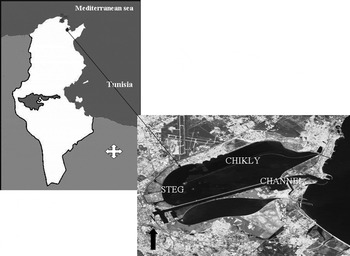
The North Lake of Tunis lagoon (a coastal sub-marine environment) is located in the western part of the Gulf of Tunis (southern Mediterranean Sea), between 36°45′ and 36°52′ north, 10°10′ and 10°20′ east, with a surface area of 2400 ha, (Figure 1).
Sampling sites location in the lagoon of North Lake of Tunis.

Prior to the 1980s sewage effluent and runoff from Tunis City drained directly into North Lake, causing dystrophic crisis resulting in mortalities of fish and shellfish (Belkhir et al., Reference Belkhir, Gharbi, Dridi, Amara, Ksouri and Hadj Ali Salem1985). The construction of a separation dam and a system of inlet and outlet gates improved the water circulation within North Lake, resulting in shorter residence time of water in the lake (from 17 to 24 days) (Ben Charrada, Reference Ben Charrada1992). Because of the economic and ecological importance of fisheries in the North Lake, several environmental monitoring stations, recording a variety of pollutants, mainly chemical and potentially toxic phytoplankton species, have been established (Armi et al., Reference Armi, Turki, Trabelsi and Ben Maiz2009).
Surveillance stations
A dike-like structure in North Lake divides the lagoon along an east–west line in order to improve water circulation. This is mainly achieved by the Kheirredine channel or gate in the east part of the lake. Consequently three surveillance stations were established in this area. Stations were located and maintained using a Global Positioning System (GPS; Garmin GPS 45). For surveillance, two internal (within the lake) stations were chosen: (i) Chikly (mean depth: 2.3 m) located centrally; and (ii) STEG (mean depth 2.5 m) in the south-eastern region, very close to a warm water outfall from the Thermal Electricity Central plant. A third surveillance station, the Channel station, was selected near the Gulf of Tunis. Channel station is a marine environment and the deepest area under surveillance (mean depth of 5 m).
For all sites, temperature (°C), salinity (psu) and dissolved oxygen (mg l−1) were measured in situ using a multi-parameter probe (type WTW).
Sample collection
More than 150 clams were randomly sampled at all sites twice a year (in January and June) from 2004 to 2008, as recommended by the guidelines of the International Aquatic Animal Health Code (OIE, 2001). Animal shell length was measured along its longest axis using Vernier callipers, to the nearest 0.5 mm. Live clams were processed as soon as received in the laboratory using the diagnostic algorithms for Perkinsosis, BRD and total bacteriological analyses. Dead or moribund clams were counted and removed prior to analysis.
Diagnostic algorithm for Perkinsosis
Clam samples were depurated in individual seawater tanks overnight (one sample per tank) to remove sediments in the guts and tissues before recording animal weight. For histological preparation, a transverse section was cut from the middle of the animal body and fixed with Davidson's solution. All sections were dehydrated in ethanol, embedded in paraffin sliced to 5 mm and stained with Harris' haematoxylin–eosin before examination under a light microscope. The prevalence (percentage of clams infected) and infection intensity of Perkinsus spp. were determined using the histological slides. From each sampling group a minimum of 35 individuals were analysed.
Diagnostic algorithm for BRD
Samples of 100 live clams from each station were collected and examined to detect external and internal BRD symptoms on their shells. Animal diagnosis was based on the external observation of brownish organic (conchiolin) deposits adhering to the internal surface of the valves according to the criteria of Paillard et al. (Reference Paillard, Maes and Oubella2004). Conchiolin deposits stages (CDS) range from microscopically observable brown spots on inner face of shell in earliest stage (CDS1), to a macroscopic thick brown deposit covering most of inner shell in the most advanced stage (CDS7). Prevalence of BRD in surveillance sites was determined for all clam shells collected. Scanning electronic microscopy (ESEM Type JEOL JSM-5400) was used to examine different shell fragments in the presence or absence of brown spots.
Bacterial enumeration
Total heterotrophic mesophyllic bacteria and Vibrionaceae colonies counts were determined by the plate counting agar method (PCA), using either Zobell agar (ZA) or Zobell mannitol agar (ZMA), respectively. Bacteria from the extrapallial fluid and flesh of clams were enumerated. The replicate plating method of Paillard et al. (Reference Paillard, Maes and Oubella2004) was used to isolate V. tapetis.
Statistical tests
A Pearson test was performed using the program XL-Stat to determine correlations between Perkinsosis and BRD prevalence in clams and the association of bacteriological or environmental variables.
RESULTS
Environmental conditions and sampling efforts
Due to the shallow depths in the lake (<3 m), water temperatures varied widely between the winter and summer periods. Temperature averages ranged between 10°C and 13°C in winter periods and 24°C in summer. Recorded salinities ranged from 39‰ to 40‰ for summer and were lower in winter (35‰). Oxygen averages fluctuated between 6 mg/l to 8 mg/l during winter periods and 8.4 mg/l to 14 mg/l during summer periods. Adult clams surveyed ranged from 228 mm to 340 mm for all sites.
Prevalence and infection intensity of Perkinsus spp.
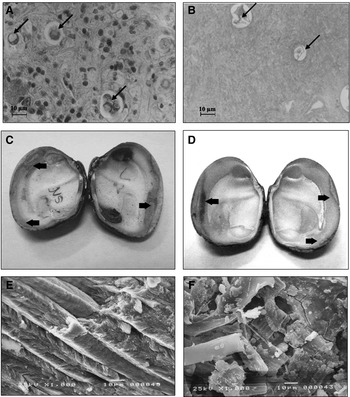
Prevalence and infection intensity of Perkinsus olseni (Apicomplexa protozoan) was determined from histological slides according to the scale developed by Ngo et al. (2004). Parasites were found and counted in all types of tissues; the mantle, gill filaments, digestive tubules and gonads (Figure 2A). In addition to Perkinsus spp., other parasites (metacercariae parasites) were observed, but in the mantle only, in animals collected from the three sites. No significant temporal differences among all sites were observed (Figure 2B).
(A, B) Histological sections of the mantle tissue of Ruditapes decussatus infected by Perkinsus olseni (A) and cysts of metacercaria (B) (scale bar = 10 µm); (C, D) view of inner side of shells, featuring brown ring disease symptoms and conchiolin deposits in the outer edge of shells; (E) scanning electon microscopy (SEM) observation of healthy shell compact and normal inner shell organization (normal periostracum lamina); (F) SEM of infested shells revealing disorganized periostracum in the presence of numerous bacteria.

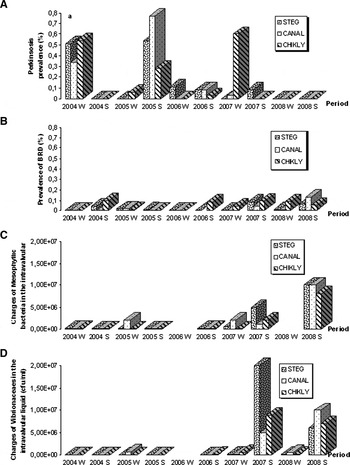
In winter periods, Perkinsosis infection was detected mainly in the external site (Channel station). Prevalence varied from 2% to 60% with the highest value found in the central zone of Chikly (Figure 3A). In summer periods, the frequency of Perkinsosis was lower and only detected at internal sites of North Lake (Chikly and STEG), with rates ranging from 2% to 8%.
Distribution of both prevalence of perkinsosis (A), brown ring disease (BRD) (B) and different bacterial charges (total mesophyllic (C) and Vibrionaceae (D)) quantified for all sites during the surveillance period. S, summer; W, winter.

Prevalence and BRD intensity
Brown ring disease symptoms were observed at least once during the surveillance period in all three sites as evidenced by the brownish organic conchiolin deposits present in the outer edges of shells of infested clams. Intensity of infection ranged from CDS4 to CDS6 of the Paillard classification scheme, indicating well-developed BRD (Figure 2C, D). SEM examination revealed disorganized periostracal lamina with numerous adherent bacteria compared to a healthy compact shell with no damages (Figure 2E, F).
Brown ring disease was detected more often in summer than winter sampling seasons although less frequently than Perkinsosis (detection varied from 40% to 60% of samples) resulting in lower disease prevalence (from 1% in Channel station to 10% in Chikly station; Figure 3B). Heterotrophic bacteria and Vibrionaceae counts indicated that there was little increase in viable bacterial numbers in summer periods during the surveillance period. Vibrionaceae were recovered consistently at higher numbers than heterotrophic bacteria, but both types of bacteria were positively correlated with disease (Pearson correlation coefficient = 0.453, P < 0.05). Clams feed primarily on sediments and can concentrate 104 to 106 colony forming units of bacteria, mainly Vibrio species which increase in summer periods (Figure 3C, D). This concentration reflects the negative impact of effluent discharge, an effect that is enhanced by poor water circulation, resulting in bacterial enrichment in clams in all lake zones. The geographical distribution of microbial disturbances showed preferential occurrence of BRD in summer mainly in the central zone contrary to Perkinsosis affecting clams in the external surveillance station within the channel. The most infested station during the period of time of the surveillance was the central area; this area was characterized by poor water circulation which likely contributed to increased bacterial infection. A negative correlation was observed between BRD and Perkinsosis (Pearson correlation coefficient = –0.360, P < 0.05), and a positive correlation was shown between BRD and total mesophyllic bacteria or Vibrionaceae counts (Pearson correlation coefficient = 0.251, P < 0.05).
DISCUSSION
Due to the increasing importance of the carpet shell clam to the Tunisian economy, zoosanitary surveys were conducted in a coastal area of Tunisia. To our knowledge, the work described here is the first systematic surveillance of microbiological conditions affecting the carpet shell clam, and leading to Perkinsosis and BRD diseases in the North Lake of Tunis.
Brown ring disease, a bacterial disease affecting clam shells, and Perkinsosis, caused by protozoan parasites, were documented in the three surveillance sites. Prevalence ranged from 2% to 60% for Perkinsosis and from 2% to 13% for BRD. Although these diseases appear to be mutually exclusive (negatively correlated), both diseases are capable of causing mass mortalities (Paillard et al., Reference Paillard, Maes and Oubella2004; Villalba et al., Reference Villalba, Reece, Ordas, Casas and Figueras2004, Reference Villalba, Casas, Lopez and Carballal2005). Both Lassalle et al. (Reference Lassalle, Montaudouin, Soudant and Paillard2007) and Fly-Sainte-Marie et al. (Reference Fly-Sainte-Marie, Soudant, Lambert, Le Goïc, Goncalvez, Travers and Paillard2009) highlighted lethal effects of diseases affecting haemocyte parameters, growth rate, condition index and reduction in reproductive output for both R. decussatus and R. philippinarum. Comparatively, Soudant et al. (Reference Soudant, Leite, Chu, Villaba, Cancela and Villaba2008) demonstrated that the combined effects of parasites and harmful algal blooms modify clam haemocytic characteristics more than each individual infection.
Our present data identified Perkinsus olseni infection in carpet shell clams capable of spreading to all types of tissues. Similar results were previously presented by El Hili et al. (Reference El Hili, Ben Salah, Ayari and Ben Amor2007) for naturally occurring populations of carpet shell clams from another northern Tunisian location (Lagoon of Bizerte) while others have shown this for other northern Mediterranean Sea coasts (Leite et al., Reference Leite, Alfonso and Cancela2004; Ngo & Choi, Reference Ngo and Choi2004).
Advanced BRD stages (CDS > 4) were observed and there was a positive correlation between BRD prevalence and heterotrophic Vibrionaceae counts. This confirmed previous results obtained for BRD occurring in both Manila and carpet shell clams in European areas (Paillard et al., Reference Paillard, Gausson, Nicolas, Le Pennec and Haras2006; Nolwenn-Trinkler et al., Reference Nolwenn-Trinkler, Sinquin, Querne and Paillard2010) and ‘BRD like diseases’ described for several local bivalves species in Tunisia by El Bour et al. (Reference El Bour, Jaafar-kéfi, Hamrouni, Mahmoud, Dellali, Trigui-El-Menif and Aloui-Bejaoui2008). Due to a high level of bacteria (mainly Vibrio species which are naturally resistant to haemolymph bactericidal activities) changes in haemocyte counts and metabolic activities under environmental conditions favourable for microbial parasitism often lead to an infectious state in the bivalve (Tuntiwaranuruk et al., Reference Tuntiwaranuruk, Chalermwat, Upathum, Kruatrachue and Azevedo2004; Allam et al., Reference Allam, Paillard, Auffret and Ford2006; Ciacci et al., Reference Ciacci, Citterio, Betti, Canonico, Roch and Canesi2009). The prevailing conditions found at the North Lake of Tunis (warm temperatures and high salinity) are predicted to be favourable for parasite infestation in clam populations. Salinity has previously been shown to be a prime environmental factor contributing to the spatial and temporal distribution of Perkinsus spp. (Park et al., 2006b).
Brown ring disease occurs at lower temperatures (Paillard et al., Reference Paillard, Maes and Oubella2004; Villalba et al., Reference Villalba, Casas, Lopez and Carballal2005; Dang & Montaudoin, 2009) unlike Perkinsosis, which is a ‘warm disease’ and its occurrence should be more frequent in the local conditions of the lagoon. Present data indicate greater prevalence of Perkinsosis in winter periods at the external surveillance site (exposed to traffic and water dynamics) and BRD in summer periods within the more internal part of the lake. In order to confirm this hypothesis, monthly surveys for parasites should be continued.
Other factors must also be considered to explain variation of spatial distribution and intensity of both diseases. Leite et al. (Reference Leite, Alfonso and Cancela2004) signalled that the density of clam populations, the transfer and presence of various species in the same location are factors influencing the spread of Perkinsosis. In a recent study, Fly-Sainte-Marie et al. (Reference Flye-Sainte-Marie, Jean, Ford and Paillard2008) noted the influence of sediment grains in natural habitats with respect to the control of BRD spread and infection intensity. Alternatively, Labreuche et al. (Reference Labreuche, Soudant, Goncalves, Lambert and Nicolas2006) and Samarin et al. (2007) highlighted that genetic internal molecular features and immunological resistance to pathogens should be considered as much more influencing factors in pathogen spreading within bivalve populations. The factors which play a significant role in Tunisia have yet to be fully determined.
ACKNOWLEDGEMENTS
The authors thank Mrs Leila Assila for her technical assistance. This work was supported by the INSTM/IFREMER–IUEM joint programme on health assessment of epizootic infections in Tunisian populations of bivalves. The Ministry of Agriculture (Tunis) is thanked for providing good working conditions during samples preparation.