Introduction
A number of countries in Europe and elsewhere have experienced long delays for access to elective care and have adopted policies designed to reduce them (Hurst and Siciliani, Reference Hurst and Siciliani2005). Typically these have involved setting targets or standards for maximum waiting times. In a recent article, Schaafsma (Reference Schaafsma2006) criticised this approach on the grounds that it did not embody an explicit principle that would justify any specific length of wait. He therefore proposed what appears to be a simple criterion: that waits should be reduced until the costs of doing so exceed the benefits. A similar criterion has been proposed by Hurst and Siciliani (Reference Hurst and Siciliani2003) who also defined an optimal waiting time where the costs and benefits of making further reductions were equal.
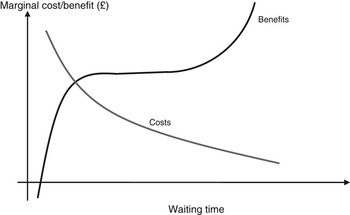
Following these authors, we assume that the marginal costs to the health system of making further reductions will tend to rise as waiting times approach zero as some capacity has to be held in reserve to deal with fluctuations in demand: see Figure 1. We also assume that marginal costs rise at an increasing rate as waiting times approach zero on the presumption that relatively low-cost methods of reducing waiting times (pooling consultants’ lists within specialties, etc.) are exhausted and further reductions require more significant investment in service redesign and capacity. On the benefits side (where, generally, benefits are considered as the inverse of the costs of waiting), we assume that waiting times reductions when waits are long produce high marginal benefits but at a decreasing rate to some point where marginal gains are more or less constant. At shorter waiting times, we also assume that there comes a point where further reductions produce decreasing marginal benefits as the personal costs to patients (e.g. of organising time off work at short notice) become more acute. We have also assumed that there could be a point where such trade-offs mean that the marginal benefit of very short waiting times becomes negative. No significance should be inferred from where the marginal cost and benefit curves cross in the figure – only that we presume they cross at some point. We also assume that the treatments themselves provide benefits that are equal to or in excess of the costs of provision and hence by implication, the queue is formed only of patients for whom this is true. In practice queues often contain patients who decide not to have treatment or who are found subsequently not to be fit for treatment. For simplicity, we omit these considerations here.
Stylised marginal costs and benefits associated with changes in waiting time.

In this article, we consider how this cost benefit approach could be applied and what it would mean in practice. To do so we draw on the experience of the English National Health Service (NHS) in setting targets for access to elective care but our prime concern is with the issues of principle that its application involves.
This article is in three sections: first it considers the benefits of shorter waits; second, the cost of reducing waiting times; and finally, draws some conclusions.
Benefits of shorter waits
Schaafsma defined the benefits of shorter waiting times as a reduction in the costs of waiting. Three broad approaches have been used to estimate the costs imposed by waiting for treatment: social accounting, clinical valuation and patient valuation. Each takes a different (though sometimes overlapping) perspective on which benefits should be taken into account and on how and by whom they should be estimated or valued.
The first approach, in principle at least, aims to take into account all the costs (i.e. negative benefits) of waiting and considers the consequences for patients, health and social care providers and employers. Studies by the Center for Spatial Economics in Canada (2006) and the Modernization Agency in England (2006) fall into this category. Neither is fully comprehensive but both provide evidence that waiting imposes considerable costs on all three groups. Some of these costs are fairly easily expressed in monetary terms (e.g. losses of employment time) but others are not.
The second approach focuses mainly on the health consequences of waiting in terms of risks of death, pain and restricted activity levels. Although the evidence is far from complete, nevertheless, a number of studies of particular conditions have provided evidence that reducing waiting benefits patient in a number of ways. These include: lower mortality risk (Oudhoff et al., Reference Oudhoff, Timmermans, Bijnen and van der Wal2004), lower risk of emergency admission while waiting (Sobolev et al., 2006), lower risk of complications during surgery (Rutledge et al., Reference Rutledge, Jones and Rege2001), fewer adverse post-operative events (Sobolev et al., Reference Sobolev, Levy and Kuramoto2006), increased chances of a better outcome (Garbuz et al., Reference Garbuz, Xu, Duncan, Masri and Sobolev2006), shorter periods waiting in pain or lack of function (Ackerman et al., Reference Ackerman, Graves, Wicks and Bennell2005), less risk of accidental injury occasioned by loss of function (de Coster et al., Reference de Coster, Dik and Bellan2007) and less need for social or other forms of support (Hirvonen et al., Reference Hirvonen, Blom and Tuominem2007). These costs are not usually expressed in monetary terms.
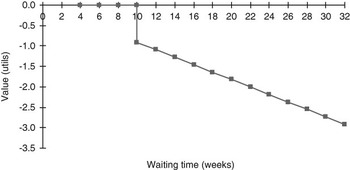
The third approach involves directly asking patients/the public, or inferring from their actual or hypothetical behaviour/choices, what value they place on shorter waiting times. This approach can produce a monetary estimate of the value of a waiting time reduction (Anderson et al., Reference Anderson, Black, Dunn, Alonso, Christian-Norregard, Folmer–Anderson and Bernth-Peterson1997; Bishai and Land, Reference Bishai and Land2000; Propper, Reference Propper2004). Alternatively, it may indicate how patients value reductions in waits in terms of other health goals. A discrete choice experiment with members of the public focused on the factors influencing patients’ choice of hospital (Burge et al., Reference Burge, Devlin, Appleby, Rohr and Grant2005). This found that when waits [from general practitioner (GP) referral to actual treatment] fell below 10 weeks, waiting time no longer influenced patients’ (hypothetical) choice; in essence, reductions below 10 weeks were valued at zero. Figure 2 shows that waiting is valued negatively in patients’ choice of hospital, but less so as waiting times reduce. However, reductions in waits below around 10 weeks are not valued at all.
Step change in value attached to reduce waiting times. Source: [11].

The choices people actually make also suggest that most are willing to accept waits of several weeks, particularly if they are offered a certain date for treatment (Birk and Henrriksen, Reference Birk and Henriksen2006). Studies of patient choice of hospital have found that in general patients are reluctant to travel to a more distant site for quicker treatment (Birk and Henriksen, Reference Birk and Henriksen2006). It might be expected that this would not be true of patients with life threatening conditions. A recent study of English cancer patients, however, found that the majority would not ‘pay’ in terms of travel costs, to reduce waiting times for treatment, although some would (Ipsos Mori, 2007).
All these approaches to the valuation of the benefits of waiting times reduction have something to recommend them. The English NHS is almost entirely funded from centrally imposed taxation. Other centrally funded programmes such as roads are allocated funding on the basis of social cost benefit studies and the same could be done for health. However, it would run against the grain of the principles of the English NHS to base allocation of resources on factors such as employment income. Since its foundation, it has aimed to provide care according to (health care) need, not the economic value of the person concerned. This consideration would not rule out a policy of eliminating waiting times based on economic and health benefits – if, for example, the Treasury decided to allocate funds specifically to do so. But it would not be compatible with the NHS’s basic principle that resources should be allocated on the basis of clinical need, if employment status was used to prioritise patients if waiting continued to be a feature of the system.
The second approach – clinical evaluation – fits the traditional NHS model in which the professional decides – albeit with the patient’s consent – what should be done and when. English NHS consultants have made little use of formal methods of patient prioritisation as developed in other countries (Gauld and Derrett, Reference Gauld and Derrett2000; Noseworthy and McGurran, 2000). There is no evidence to suggest that they take into account all the elements of the cost-benefit approach – although they may also take into account their patients’ circumstances – such as the number of their dependents as well as their clinical condition. However, there is little evidence of systematic prioritisation (McHugh et al., Reference McHugh, Campbell, Silman, Kay and Luker2008).
The third approach fits a model in which consumer sovereignty operates and in which, as the evidence suggests, patients’ valuation of reductions in waiting time varies. As Hurst and Siciliani (Reference Hurst and Siciliani2003) pointed out, in a competitive system with money following the patient, market forces – in the absence of externalities – should lead to the optimum wait being reached from the patient’s viewpoint. The patient (or the payer on their behalf) would seek out providers that could offer each patient’s preferred wait – in contrast to a system such as the NHS in which, at the time Hurst and Siciliani wrote their article, there were no incentives to encourage providers to respond in this way.
The three approaches will lead to different estimates of the benefits of reducing waiting times. Obviously, the social accounting approach will produce larger absolute costs of waiting (and hence larger potential benefits to be gained in reducing waiting times) as it takes into account a wider range of costs. For the same reason, if used as a means of prioritisation for treatment, it would rank patients differently to the second. The first and third approaches may produce similar rankings to the extent that willingness to pay is related to economic status. But the second and third approaches are unlikely to give similar results: there is a considerable body of research to suggest that professional and patient views diverge even in respect of clinical issues (Chard et al., Reference Chard, Dickson, Tallon and Dieppe2002; Pager and McCluskey, Reference Pager and McCluskey2004; Conner-Spady et al., Reference Conner-Spady, Estey, Arnett, Ness, McGurran, Bear and Noseworthy2005).
In the case of cataract surgery, for example, some patients may not wish to be treated even though by professional standards their sight is weak. Experience with cataract surgery in the English NHS has shown that the treatment threshold has declined dramatically as the number of operations has increased (Jaycock et al., Reference Jaycock, Johnston, Taltor, Adams, Tole, Gallowway, Canning and Sparrow2009). It is not clear that all of the additional operations benefit patients (Black et al., Reference Black, Browne, van der Meulen, Jamieson, Copley and Lewsey2009) and even if they do, the benefits they enjoy are likely to be lower than those treated at a higher level of impairment.
Thus, conflicts between criteria may arise either in terms of the priority rankings they produce or the value attached to reducing the costs of waiting. In the case of the English NHS there have been persistent complaints from hospital consultants that Government-set targets have compelled them to treat, in their judgement, patients with low levels of needs ahead of patients with higher levels. Although these centrally imposed targets did not reflect patients’ views in a direct sense, the Government could and did claim that they were justified because reducing wait was the main complaint patients’ had about the NHS and was a significant driver of dissatisfaction with the NHS overall (Mulligan and Appleby, Reference Mulligan and Appleby2001). The choice of an 18 weeks maximum waiting time from GP referral to treatment in hospital, set in 2004 (Department of Health, 2004) was claimed at the time to have been based on ‘patients’ views’ on what constituted a ‘reasonable’ wait, but no detailed evidence was published at the time justifying this choice.
The consultants’ claims that targets have distorted priorities have been hard to assess not least, because, as pointed out above, how they determine priorities is unclear. Our own research (Appleby et al., Reference Appleby, Boyle, Devlin, Harley, Harrison and Thorlby2005) suggested the pattern of hospital activity has been affected by the need to meet targets, but on the limited evidence available, it did not appear that ‘low value’ operations had pushed out higher value ones. This judgement was, however, based on the operations concerned, not the needs of the patients at the time of treatment or the likely scale of the benefits resulting from treatment, about which there is no systematic data. More recently, relative to the experience in Scotland, Propper et al. (Reference Propper, Sutton, Whitnall and Windmeijer2008) suggest that they could not conclude that the use of waiting time targets in the English NHS led to an increase in waiting times for urgent cases and in addition, that there was no statistical difference in trends between Scotland and England.
The potential for conflict between clinical and patient views seems set to increase. The introduction of patient choice of hospital, and the new financial mechanism, payment by results, that allows money to follow the patient means that the NHS now embodies some elements of consumer sovereignty into what has been for most of its 60 years a professionally dominated system. As a result conflicts between a professional and a user-orientated approach may become more apparent.
In some cases tensions between the two are easily handled. If patients are less keen to be treated more quickly than professionals may like, there is little difficulty: a delay can be agreed. But in a target-led regime such as the English NHS this is only acceptable if the centrally imposed targets do not penalise providers when such choices are made. In principle the rules governing the 18-week pathway (Department of Health, 2009) do allow patients to choose a longer care pathway and the resulting longer ‘wait’ does not count as an infringement of the target by the provider concerned. But complaints continue to be reported that patients are not being allowed to wait longer than 18 weeks for their chosen place of treatment: when queues reach the target maximum they sometimes find they are unable to express their choice through the computerised booking system (British Medical Association, 2009).
The reverse situation is more difficult. Patients not content with the speed the NHS offers treatment can opt out and use the private sector – if they can afford it. This has been the situation since the inception of the NHS in 1948 and around 10% of elective treatments, including some such as cosmetic surgery that the NHS does not routinely provide, are paid for privately.
In principle a ‘fast track’ could be created within the public system – for which individuals would have to pay a premium. If that were to be considered politically unacceptable, then one option could be a non-financial ‘charge’, for example, allowing patients to choose a shorter wait, but at the expense of not being given a firm date within the period specified. Although schemes such as this have been tried in some areas, they have not been generally adopted and they are likely to appeal only to a minority.
However, if the benefits patients attach to shorter waits vary with their health status and their personal situation, in some circumstances it may be possible to eliminate delay, as perceived by the patient, by appropriate prioritisation. Where prioritisation criteria are in use they are usually defined in clinical terms – for example, degrees of urgency (Valente et al., Reference Valente, Test, Tanfani, Porro, Santo, Santori, Torre and Ansaldo2009). If patients deemed to be non-urgent are also those who themselves attach little or no benefit to immediate treatment, then in principle the burden of delay may be eliminated through prioritisation alone, without any extra cost. But there is no general reason to expect this to be the case.
In practice, even where patients have freedom of choice they will be influenced by their consultant’s views on the urgency with which they should be treated. But there is no reason why they should always accept such advice. As a result, it is hard to see how a public system such as the NHS can resolve the conflict between patient and professional views where the former seeks more urgent treatment than the latter considers is appropriate – given the claims of other patients.
The scale of such conflicts clearly depends on what waiting times actually are. If waiting times can be reduced to days rather than weeks, then these issues of principle would be of minor importance. Whether it is feasible to reduce them to this extent, depends on the costs of reducing them. As we show in the next section, however, estimating these costs is not straightforward.
The costs of shortening waits
In much of the discussion of waiting time policy the assumption has been that waiting occurs because the health care system does not have sufficient resources to eliminate them, taking into account other claims on its budget. Recent experience within the English NHS suggests that this view is only partially correct.
From 2000 onwards, when new maximum waiting time targets were set for the English NHS, it has been assumed that more treatment capacity was required. Subsequently, when the 18-week target for referral to treatment was set in 2004, it was estimated that more diagnostic capacity was also needed as delays for diagnosis had been found to be very significant.
There is substantial evidence, however, that geographical and institutional variations in the rate of elective care work are considerable, and that these have both supply and demand side explanations. For example, NHS hospitals have typically scheduled admission of elective patients on particular days of the week leading to peaks of work at those times and at time of discharge. In between times there may be unused theatre or other capacity. In principle these variations can be reduced or even eliminated, and there is a substantial body of work devoted to this (NHS Institute for Innovation and Improvement 2008). Furthermore, decisions about operating theatre lists (and hence who and when to admit from the waiting list) will take into consideration length of operating time (in order to maximise theatre use), the need to provide ‘interesting’ or varied cases for training needs – or simply to meet the individual interests of consultants. In addition, measurement of actual patient pathways from referral to treatment revealed long unmeasured waits; for example, waiting for the results of diagnostic tests that stemmed from poor process management rather than lack of capacity. Improved process management may reduce rather than increase costs as it can lead to the elimination of unnecessary stages along the care pathway (Tey et al., Reference Tey, Grant, Harbison, Sutherland, Kearns and Sanders2007).
This can only be true of course if there were systematic inefficiencies in the management of elective care before attempts to reduce waiting times commenced. There is substantial evidence that this has been the case.
First, it is hard to find any statistical relationship between changes in waiting times and changes in activity (Harrison and Appleby, Reference Harrison and Appleby2009). In retrospect, it seems clear that the need for more capacity was overestimated by the Government in 2000 and that waiting times can be and have been reduced in other ways – including better management of the ‘production’ process, elimination of low-value operations, diversion of care away from hospitals, simple pooling of individual consultant lists within specialties in hospitals and, possibly, some degree of implicit rationing. This does not mean that no extra activity was required – it clearly was in some areas, such as ophthalmology and orthopaedics. But even here the main changes required to reduce waiting times to within the 18-week target have involved changes to the care pathway, which have been low cost (Tey et al., Reference Tey, Grant, Harbison, Sutherland, Kearns and Sanders2007) and may even have reduced costs overall.
Second, the NHS experience with cancer waiting times confirms the importance of changes in the organisation of care. From 1999 onwards a cancer fast track system was introduced for patients deemed to be urgent by their GP: these were to be seen within two weeks by a hospital consultation. In 2000 maximum referral to treatment times were set of nine weeks for fast track patients. This target was achieved within five years despite very slow progress initially. It did require some investment in diagnostics and some extra staff as the workload was rising during this period. But most of the changes required to meet the target were managerial in nature, comprising better scheduling of access to diagnostics, pathway redesign and simplification and improved patient monitoring systems (NHS Modernization Agency, 2005).
The cancer experience suggests that cost should not be an obstacle to further reductions in waiting times for other elective treatments much beyond the current 18-week target. Some parts of the NHS have in fact proposed more demanding targets (South West Strategic Health Authority, 2008).
However, Schaafsma argues that as waiting times are reduced the cost of treating patients rises as more capacity, some of which will be idle part of the time, has to be kept available to deal with variations in demand. The shorter the maximum wait the higher the level of spare capacity required to ensure that all patients are treated within the target. The result is the cost curve shown in Figure 1.
But variations in demand do not necessarily require substantial idle capacity; the issue is the extent and source of any variation and the ability to forecast and hence plan flexibly for any variation that does arise. For example, all hospitals experience seasonal variations where admissions peak and trough – most notably due to holiday periods. But these are, of course, entirely predictable and hospitals can profile their work and resources accordingly (Cook et al., Reference Cook, Michaels and Galland1997). Some resources, for example, theatres and other fixed costs cannot be varied in this way so demand variation will impose some costs, however, flexibly staffing levels can be modified.
In addition, when these measures are taken, there will remain some unforecastable variation. However, the scale of ‘natural variability’ arising from the flow of patients to hospital consultants from their GPs has attracted much less attention than variation due to hospitals’ own behaviour in scheduling their workloads. There is some evidence that referrals vary in ways which are hard to predict (Alessi, 2008, personal communication) but we are not aware of any systematic studies of this source of variation.
It is arguable that the extent of such variations may increase as it becomes easier to access care. In other words, as waiting times fall, patients may become more selective about when they are treated. They may be more inclined to choose to defer treatment if the date proposed clashes with another commitment. The findings on patient choice cited above suggest this is likely to occur, and, the shorter waiting times become, the harder it will be to plan to deal with such variation.
We assumed in Figure 1 that such variations will lead to cost increases as waiting times are further reduced. However, the scale of this effect currently seems small – of the order of a few percentage points (Hughes and McGuire, Reference Hughes and McGuire2003; Rule, 2008, personal communication).
There is, however, a more important cost hurdle to be considered. Schaafsma’s analysis ignores the costs of transition from one level of wait to another. Put simply, if maximum waits are to be reduced by a week within a given year, up to 2% extra activity – that is, one week’s activity – will be required in that year. The precise amount will depend upon a number of factors including (in particular) the shape of the distribution of actual waiting times. Even if maximum waits are long, typically only a few people experience them – hence rapid reduction in the maximum can be achieved with only small amounts of extra activity. Rapid reductions will require correspondingly more activity, once the scope for reducing waiting times through better management has been exhausted.
Extra expenditure may be required for a further reason. If waiting times fall, extra demand may be generated. A number of studies have identified a time elasticity of demand (Gravelle et al., Reference Gravelle, Dusheiko and Sutton2000). The extra demand may come from demand switching from the private sector or from those who would have gone to practitioners of complementary medicine operating outside the NHS, or from previously suppressed demand due to the existence of long waits. Whatever the source, shortening waiting times is likely to generate more patients and hence require more finance and more capacity.
For two reasons therefore, shortening maximum waits will have an opportunity cost within the health care system, which payers may not wish to meet given competing calls on their finite budgets.
The transition may pose more than a short run financial problem if extra capacity is required. Even a small increase in capacity may be costly to secure due to high-marginal costs – such as the length of time it takes to train more surgeons and other skilled staff.
As noted above, the English NHS decided that it did not have enough in-house capacity to meet the targets set in 2000 and could not increase its own supply quickly. In addition, although it was buying operations from the (relatively small in total size) private sector it judged that this also did not provide enough capacity. From 2002 the Department of Health embarked on a procurement programme, encouraging overseas companies to establish treatment centres by offering contracts under which they were paid irrespective of the number operations carried out. As these facilities have been underutilised, this proved an expensive approach. Furthermore, there is a prospect now that some contracts will have to be bought out as the need for extra capacity declines.
In fact, more capacity was created within the NHS/public health system. As a consequence in some parts of the NHS there is a prospect of overcapacity in the near future as consultant numbers were increased in the early part of the decade and activity in some areas substantially increased, precisely because there was a perceived need for a rapid rise in activity. But once created it may be expensive to disinvest in internal capacity when it is no longer needed. Given that these resources exist now and may not have a high opportunity cost because they are likely to be underutilised or even unemployed, there is an obvious case for employing them to carry out more activity. But whether the ex ante case would look strong if demand had been forecast accurately, is less clear.
If costs do vary widely between different geographical areas, then other issues arise. For example, if targets are to remain in place, the fact that marginal costs vary suggests that they should be determined locally rather than centrally. In addition, a national determined system such as Payment by Results (the prospective, activity-based fixed price reimbursement system) cannot reflect local variations in marginal costs either, further strengthening the case for local rather than national targets.
Concluding comment
Hurst and Siciliani (Reference Hurst and Siciliani2003: 45) concluded that “it is difficult to quantify … . The optimum waiting times because of the uncertainty about the benefit from the treatment, especially in a world with rapidly changing technology”. Here, we have argued that before measurement can be attempted, a decision must first be reached as to which measurements are relevant. Such a decision of principle must depend on the overall values which a given health system is intended to promote.
The case of the English NHS is particularly interesting because current policies are in some circumstances, mutually inconsistent. The central imposition of targets in 2000 could be justified by the urgent need to improve NHS performance (Stevens, Reference Stevens2004). There was no way at that time for its users to make their preferences felt directly. But with the creation of a market in elective care, the situation is now quite different. Average waiting times are much shorter and very long waits have been eliminated. Patients can now choose to be treated by any NHS provider and any accredited private provider as well. The value they place on quicker access can emerge from the choices they make. In some areas, geography will meant that little effective choice is available. In those areas a case for central targets remains. But where they should be set could be informed by consideration of the values that emerge where choice is available.
We have also shown that calculating the financial cost of achieving shorter waits is far from straightforward. In some circumstances it may be large – where extra capacity is created that subsequently proves to be redundant. In others it may small – where reducing waits requires virtually costless reorganisation of the way that care is delivered. That there is scope for making such costless reductions stems from the lack of effective competitive or other pressures to improve performance in the past.
Unless the measures required are in fact costless, in a publicly funded cash limited system, achieving shorter waiting times imposes an opportunity cost elsewhere in the care system. These are the true costs of shortening waiting times. In the final analysis a principled approach to reducing waiting times means ensuring that in doing so the resulting value exceeds what could be obtained in other parts of the health care system.