INTRODUCTION
A correct delineation of the boundaries among neighbouring fish populations is a prerequisite for the implementation of policies that ensure an efficient and sustainable management of the resources. Parasites have been widely used as biological tags as a source of information on the discreteness of their fish host stocks and this method has gained increased recognition as being applicable to the problems of fishery management (MacKenzie and Abaunza, Reference MacKenzie and Abaunza1998; MacKenzie, Reference MacKenzie2002). In Argentinean waters, parasites have been successfully used for discriminating stocks of several coastal fish species (Timi, Reference Timi2003, Reference Timi2007; Sardella and Timi, Reference Sardella and Timi2004; Timi et al. Reference Timi, Luque and Sardella2005, Reference Timi, Lanfranchi, Etchegoin and Cremonte2008, Reference Timi, Lanfranchi and Etchegoin2009; Braicovich and Timi, Reference Braicovich and Timi2008).
The Argentinean sandperch, Pseudopercis semifasciata (Cuvier, 1829) (Pinguipedidae) is a large and long-lived species, with males reaching 100 cm T L and 12 kg, whereas females grow up to 95 cm and 10 kg; the maximum recorded age for this species is 30 years (Elías and Burgos, Reference Elías and Burgos1988). It is distributed from 23°S in Brazil to 47°S in Argentina (Rosa and Rosa, Reference Rosa and Rosa1997; Cousseau and Perrotta, Reference Cousseau and Perrotta2004), inhabiting mainly rocky bottoms with caves and hard substrates, from shallow coastal waters to 80 m (González, Reference González2006). This species is exploited by bottom trawl and long-line commercial fisheries in the northern Patagonian coasts of Argentina, where is also targeted by sport anglers and represents a tourist attraction for recreational divers (Venerus et al. Reference Venerus, Machinandiarena, Ehrlich and Parma2005).
Despite some studies dealing with the systematics, morphology, development, diet and reproduction of this species carried out in Argentinean waters (González, Reference González1998, Reference González2006; Elías and Burgos, Reference Elías and Burgos1988; Elías and Rajoy, Reference Elías and Rajoy1992; Macchi et al. Reference Macchi, Elías and Burgos1995; Venerus et al. Reference Venerus, Machinandiarena, Ehrlich and Parma2005), there is little information about the stock composition along its distribution range in the Argentine Sea. At present, only Venerus et al. (Reference Venerus, Machinandiarena, Ehrlich and Parma2005), based on the abundance and distribution of P. semifasciata at early life-history stages, have proposed the existence of at least 3 offshore spawning grounds in Patagonian waters (between 42–43°S, 43–44°S, and 44–45°S), but no information is available in the northern (Bonaerense) region of the Argentine Sea.
The parasite fauna of the Argentinean sandperch has recently been recorded in waters off Rio de Janeiro (Brazil) by Luque et al. (Reference Luque, Felizardo and Tavares2008). However, in the Argentine Sea only the presence of the parasitic copepods Sarcotaces verrucosus Olsson, 1872 and Trifur tortuosus Wilson, 1922, has been reported for this host species (González and Tanzola, Reference González and Tanzola2000; Etchegoin et al. Reference Etchegoin, Lanfranchi and Timi2009), and their parasite communities remain almost unknown. The aim of this study is therefore 2-fold: (1) to characterize the parasite fauna of P. semifasciata in 3 zones of the Argentine sea, including 2 localities in the Bonaerense region and 1 in North Patagonian waters; and (2) to identify the existence of different stocks of Argentinean sandperch in these areas by using its parasites as biological tags.
MATERIALS AND METHODS
In total 100 specimens of P. semifasciata were examined for parasites. Only adult fish caught during spring were included in the analysis in order to minimize the possible influence of both host size and seasonality on the parasite burden. Fish were caught by commercial trawlers in 3 zones along the coast of the Argentine Sea, 2 of them off the coast of Buenos Aires Province (Bonaerense region) by the commercial fleet operating out of Mar del Plata: Villa Gesell (37°15′S, 57°23′W; n=20; October–November, 2007, VG hereafter) and the zone between Miramar and Necochea (38°03′S, 57°30′W–38°44′S, 58°44′W; n=30; November, 2007, MI hereafter), and a third in Patagonian waters, offshore from Península Valdes (42°00′–42°45′S; n=50; November, 2007, PV hereafter).
Fish were either kept fresh or deep frozen in plastic bags at −18°C until examination. After thawing each sandperch was measured for T L (cm). Parasites were recovered from the body surface, gills, branchial and body cavities and viscera (stomach, intestine, liver, gonads, and mesenteries) by stereoscopic microscopy.
Prevalence, mean abundance and mean intensity were calculated for each parasite species in each area following Bush et al. (Reference Bush, Lafferty, Lotz and Shostak1997). For those species with prevalences higher than 10% in a given zone (component species sensuBush et al. Reference Bush, Aho and Kennedy1990), the relationships between host size and abundances were analysed by Spearman's rank correlation coefficients.
Pseudopercis semifasciata displays sexual dimorphism, with males reaching a larger size than females, and probably developing differential behaviour, such as courtship and territoriality (Macchi et al. Reference Macchi, Elías and Burgos1995; Venerus et al. Reference Venerus, Machinandiarena, Ehrlich and Parma2005; González, Reference González2006). Therefore, to assess the potential effect of host sex on parasite communities the body size was compared between host sexes for the whole sample by means of a t-test, abundance of component species was compared between host sexes by mean of Mann-Whitney tests within each zone. The proportion of males and females was also compared among sampling zones by Chi-squared analyses (Zar, Reference Zar1984).
Chi-squared analyses and a posteriori multiple comparisons were also used to test for significant differences of prevalence between zones for those parasites identified as component species in at least one of the zones. Kruskal-Wallis and a posteriori Tukey tests for unequal samples were used to analyse the effects of locality on abundance of each of these parasite species (Zar, Reference Zar1984).
Parasite community composition was compared among sampling localities by means of a permutation-based one-way analysis of similarity, based on Bray-Curtis similarity coefficient (ANOSIM, Clarke, Reference Clarke1993). The statistical significance of the differences among zones was assessed after 10 000 permutations on fourth root transformed abundance data. Transformations were made in order to down-weight the importance of very abundant species so that the less dominant species played some roles in determining similarity among samples (Clarke and Gorley, Reference Clarke and Gorley2006). Similarity percentages (SIMPER, Clarke, Reference Clarke1993), based on the analysis of Bray-Curtis similarity matrices, were calculated within and between areas and used to determine which species characterized (‘typical species’ contributing substantially to the average similarity and doing it consistently by displaying a high ratio between that contribution and its standard deviation) and discriminated (‘discriminator species’ contributing largely to the average dissimilarity and displaying a high ratio between that contribution and its standard deviation) between parasite assemblages (Clarke and Gorley, Reference Clarke and Gorley2006). Similarity analyses were performed using the PRIMER package (V6, Clarke and Warwick, Reference Clarke and Warwick2001; Clarke and Gorley, Reference Clarke and Gorley2006).
A disciminant analysis, based on Mahalanobis distances, was also used to find differences between zones and to identify which parasite species were responsible for these differences. Analyses were computed on square root transformed data and performed using the Brodgar 1.8 package (Brodgar, 2000). Only component species were included in the analyses. Scolex polymorphus is a complex of larval cestode species (Chambers et al. Reference Chambers, Cribb and Malcolm2000) that can have different geographical distributions and cannot be used as reliable indicators of similarity among host populations (Braicovich and Timi, Reference Braicovich and Timi2008). Therefore this species, as well as others considered as accidental in P. semifasciata, were excluded from multivariate analyses.
RESULTS
General results
Mean host body lengths±S.D. from Villa Gesell (67·5±6·3 cm), Miramar (71·2±3·5 cm), and Península Valdes (67·2±7·2 cm) were significantly different between zones (H 2=12·25; P<0·01), with fish from MI being larger than those from PV (P<0·01).
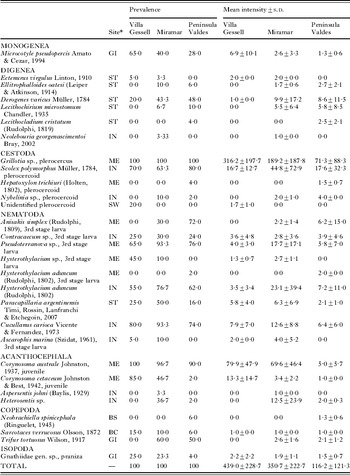
All sandperch were parasitized by at least 3 of 28 parasite species (Table 1). Hysterothylacium aduncum at larval (parasitizing mesenteries) and adult stage (found in stomach and intestines) were considered separately for further analyses. The maximum infracommunity species richness (15 parasite species) was found in only 1 fish. A total of 25 111 metazoan parasites were found in the overall sample, which determines a mean total abundance of 251·11 parasites per fish. The highest mean total abundance was observed for fish from VG and the lowest for samples from PV (Table 1, last row).
Taxonomic composition, microhabitat, prevalence and mean intensity of parasites of Pseudopercis semifasciata in three zones of the Argentine Sea
(The development stage is only indicated for non-adult species.)

* GI, gills; ST, stomach; IN, intestine; ME, mesenteries; SW, stomach wall; BC, body cavity; BS, body surface.
Parasite populations
Grillotia sp. was the most prevalent and abundant parasite in all 3 zones, representing 62% of all individual parasites found (72% in VG, 54% in MI and 61% in PV). High values of prevalence in all zones were also observed for Scolex polymorphus, Pseudoterranova sp., H. aduncum, Cucullanus carioca and Corynosoma australe, the latter reaching also high values of abundance in both Bonaerense zones. Other species were highly prevalent (prevalence >50%) in different zones: Microcotyle pseudopercis and Corynosoma cetaceum showed high prevalence in VG, Paracapillaria argentinensis in MI, Trifur tortuosus in both MI and PV, and Anisakis simplex s.l. in PV.
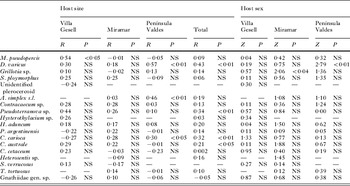
Most correlation analyses showed no relationships between parasite abundance and host size for component species and no repeatability in the significant relationships was found across localities (Table 2). Microcotyle pseudopercis (Rs: 0·54, 0·01<P<0·05) was the unique species displaying a higher abundance in larger fish from VG, whereas D. varicus (Rs: 0·59, P<0·01), A. simplex s.l. (Rs: 0·47, P<0·01) and C. carioca (Rs: 0·30, 0·01<P<0·05) showed significant positive relationships with fish size in PV.
Relationship between abundance and fish size or sex of selected species (those with prevalence >10%), parasites of Pseudopercis semifasciata in three zones of the Argentine Sea

R, Spearmann's rank correlation coefficient; P, probability; Z, Mann-Whitney statistics; NS, not significant; —, prevalence <10%.
Despite males being significantly larger than females in the whole sample (t 98: 3·98, P<0·01), no effect of host sex was observed for most parasite species across zones, only Grillotia sp. being more abundant in females from MI and D. varicus in males from PV (Table 2). The proportion of males and females did not vary among localities (χ 2: 0·69, P>0·05).
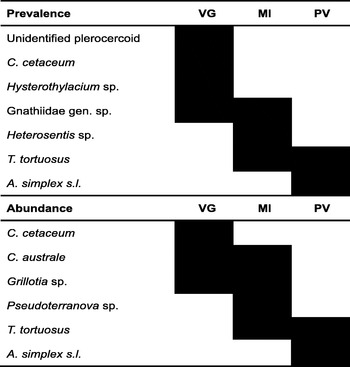
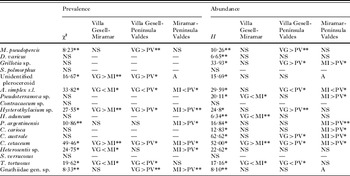
The differential distribution of parasites among hosts from different zones was corroborated with comparisons of prevalence and abundance of component species between areas (Table 3). Despite prevalence not being significantly different among zones for several parasites, most species varied significantly in terms of abundance, although a posteriori pairwise tests failed to find significant differences for D. varicus, unidentified plerocercoids, Heterosentis sp. and praniza larvae. Considering prevalence, the unidentified plerocercoids showed higher values in VG than in the other two zones, whereas Heterosentis sp. was an indicator of MI. A significantly decreasing gradient of prevalence was observed southwards for Hysterothylacium sp. and C. cetaceum, and the opposite trend for A. simplex s.l. Finally, T. tortuosus was an indicator for both southern zones and praniza larvae for Bonaerense waters (Fig. 1). Regarding the abundances, the lowest number of differing species occurred between VG and MI; abundances also differed significantly for some species with similar prevalence in all areas, indicating that Grillotia sp., Pseudoterranova sp. and C. australe can also be considered as indicators of fish stocks (Fig. 1).
Parasites of Pseudopercis semifasciata selected as biological tags in 3 zones off Argentina based on their (a) prevalence and (b) abundance. VG, Villa Gesell; MI, Miramar; PV, Península Valdes.

Comparisons of prevalence and abundance of selected parasite species of Pseudopercis semifasciata among three zones of the Argentine Sea

H, Kruskal-Wallis statistics; NS, not significant (P>0·05); A, absent in both zones;
* P<0·01; ** 0·01<P<0·05.
Parasite communities
Similarity-based multivariate analysis showed that fish from the 3 sampling localities differed significantly in their parasite species composition (Global R ANOSIM: 0·429, P<0·01), indicating that within-zone similarity exceeded among-zone similarity in parasite assemblage composition. Pairwise tests also showed that all zones were statistically distinguishable from each other with respect to parasite community structure (all P<0·01), indicating that all individual fish within a zone were more similar to one other than to any fish from another zone. The highest differences occurred between the most distant zones VG and PV (R ANOSIM: 0·429). The differences between MI and PV (R ANOSIM: 0·360) were also higher than those between VG and MI (R ANOSIM: 0·282).
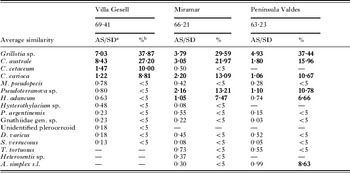
Similarity percentages (SIMPER) within localities showed that samples from VG were the most homogeneous in terms of parasite assemblage composition. However, in all zones both Grillotia sp. and C. australe were not only the main contributors to similarity (>50%) but they also did it consistently in inter-comparisons within localities, as shown by the rate between their contributions and standard deviations (Table 4). Cucullanus carioca was also important in contributing to similarity within all zones, whereas C. cetaceum was important for VG, Pseudoterranova sp. and H. aduncum for both MI and PV and A. simplex s.l. for PV.
Breakdown of average similarity of parasite infracommunities of Pseudopercis semifasciata within sampling localities into contributions from each species
(Species are ordered in decreasing contribution in Villa Gesell.)

a AS/DS, average contribution to the total average similarity/standard deviation.
b %, percentage of total similarity contributed by each species. Values for typical species in bold.
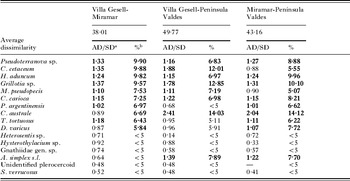
The highest average dissimilarity was observed between VG and PV, with both localities from the Bonaerense region, VG and MI, being the most similar (Table 5). Grillotia sp. and C. australe, despite being typical of all zones, were important and consistent discriminators between localities, especially for those comparisons involving Bonaerense vs Patagonian samples, in which they were the best discriminators. Other important discriminant species were C. carioca, M. pseudopercis, H. aduncum, P. argentinensis and D. varicus. On the other hand, some species that showed significant differences of prevalence and/or abundance among localities, namely Hysterothylacium sp., gnathiid pranizae, unidentified plerocercoids and Heterosentis sp., were not important contributors to dissimilarity.
Breakdown of average dissimilarity of parasite infracommunities of Pseudopercis semifasciata between sampling localities into contributions from each species
(Species ordered in decreasing contribution to Villa Gesell-Miramar comparison.)

a AS/DS, average contribution to the total average similarity/standard deviation.
b %, percentage of total similarity contributed by each species. Values for discriminator species in bold.
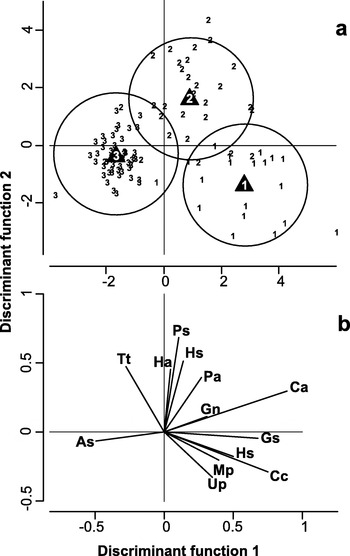
Similar results were obtained after a discriminant analysis. The first 2 discriminant variables explained 100% of the variance, contributing 71·86% (eigenvalue=3·261) and 28·14% (eigenvalue=1·277), respectively. A significant overall group effect was observed (Wilks' lambda=0·103, F (32, 164)=10·84, P<0·01).
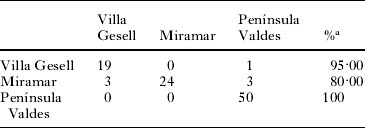
Individual fish were distributed mainly along the first axis, a pattern readily observed by representing the group means (Fig. 2a). Dimensionality tests for group separation showed that the zones were significantly separated in both dimensions (χ 2(15)=73·64, P<0·001) (Fig. 2a). Each host was classified correctly to the 3 zones with an accuracy of 93·00% (Table 6), while the maximum chance criterion (percentage of correctly classified samples relative to chance) was 50·0%.
(a) Sample scores of the first 2 discriminant functions for specimens of Pseudopercis semifasciata in 3 zones of the Argentine Sea. Numbers represent each fish, triangles represent group averages. Circles around group means represent the 90% tolerance regions (e.g. 90% of the observations in a group are expected to lie in this region). 1: Villa Gesell; 2: Miramar; 3: Península Valdes. (b) Lines represent canonical correlations between the first 2 discriminant functions and the parasites of P. semifasciata. As, Anisakis simplex s.l.; Ca, Corynosoma australe; Cc, Corynosoma cetaceum; Gn, Gnathiid praniza; Gs, Grillotia sp.; Ha, Hysterothylacium aduncum; Hs, Hysterothylacium sp.; Mp, Microcotyle pseudopercis; Pa, Paracapillaria argentinensis; Ps, Pseudoterranova sp.; Tt, Trifur tortuosus; Up, unidentified plerocercoid.

Discriminant analysis classification showing the numbers and percentages of fish classified in each zone
(Rows correspond to group memberships.)
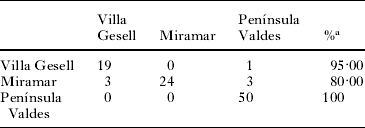
a %, percentage of correctly classified fish per zone.
The importance of component parasite species with respect to discrimination between groups, evaluated as the contribution of each variable to the total sum of Mahalanobis distances, showed that all species identified as markers (Fig. 2b) were related to their corresponding zone. In fact, the unidentified plerocercoids, Hysterothylacium sp. and C. cetaceum, were important in determining the position of samples from VG, whereas Heterosentis sp. and Pseudoterranova sp. were clearly related to fish from MI and A. simplex s.l. to PV. On the other hand, T. tortuosus was an indicator of both southern zones and praniza larvae, Grillotia sp. and C. australe contributed to the discrimination of sandperches from Bonaerense waters. However in the multivariate analysis, M. pseudopercis, P. argentinensis and H. aduncum also contributed significantly to the discrimination of samples among zones (their removal from the analyses resulted in a decrease of 18·1%, 8·5% and 1·8% of the total sum of Mahalanobis distances, respectively), the monogeneans being related to fish from VG and both nematode species to samples from MI. The remaining species, whose removal resulted in a decrease smaller than 1% of the total sum of Mahalanobis distances, were excluded from Fig. 2b.
DISCUSSION
Pseudopercis semifasciata harboured the highest species richness recorded for marine fishes in Argentinean waters, with 15 out of the 28 metazoan species being new host records. Scolex polymorphus is a complex of larval cestode species (Chambers et al. Reference Chambers, Cribb and Malcolm2000), therefore the species richness could be higher. On the other hand, Nybelinia sp. and Contracaecum sp. were only found in the gut content and could represent accidental infections instead of true parasites of sandperches.
The observed species richness was the same as reported for of P. semifasciata from Brazilian waters (Luque et al. Reference Luque, Felizardo and Tavares2008); however, when samples were discriminated by localities the maximum species richness was 23 species in both Miramar and Península Valdes. Both the large size and longevity of this host species could account for their high parasite species richness (Price and Clancy, Reference Price and Clancy1983; Guégan et al. Reference Guégan, Lambert, Lévêque, Combes and Euzet1992; Poulin, Reference Poulin2000).
However, parasite communities from Brazilian fish were different in terms of composition, with only approximately one third of their parasite species shared by fishes from both regions. They were characterized by the presence of species with low prevalence and abundance; in fact the mean total abundance was 15±12·1 parasites per fish (Luque et al. Reference Luque, Felizardo and Tavares2008). On the other hand, in the present study many parasite species showed high values of prevalence and abundance, at least in some of the sample zones, while the mean total abundance in all zones was one order of magnitude higher than in Brazil. The differences in parasite burden between Brazilian and Argentinean fish can be partly due to the fact that the former were much smaller than those herein examined (T L 38·7±t cm) (Luque et al. Reference Luque, Felizardo and Tavares2008). However, differences in the composition of their parasite assemblages, rather than in abundance, indicate that locality effects surpassed ontogenetic effects, suggesting the existence of a discrete stock in Brazilian waters.
On the other hand, differences in abundance and/or prevalence were more important than variations in composition when the 3 zones of the Argentine Sea were compared. These differences cannot be attributed to the variability in size of hosts among regions, since the abundance of most species did not vary with fish length. Furthermore, M. pseudopercis was significantly more abundant in VG than in PV, despite little variation in size of fish from both zones. D. varicus and C. carioca, which showed significant relationships with fish length in PV, showed similar abundances in all zones. Finally, A. simplex s.l., more abundant in larger fish from PV, displayed higher abundance than in both VG and MI, where fish were similar in size and larger, respectively.
Only 2 species showed different abundances between sexes in different zones, with the high abundance of D. varicus in males from PV being attributable to its relationship with host size in this zone. Furthermore, the similar proportion of both sexes in the 3 samples minimizes any possible effect of sex in comparisons between zones.
At the parasite population level, significant differences in both prevalence and abundance between zones for many parasite species demonstrate their potential for discriminating 3 discrete sandperch stocks, each having their own indicator species. Evidence supporting the existence of 3 different stocks was also obtained by both multivariate analyses. The parasite species that contributed most to the separation of the samples in the discriminant analysis agreed with those identified as potential biological markers in the analyses at population level, whereas some differences in the identity of indicator species were obtained by similarity analysis. However, the 3 approaches to identify biological markers, namely comparisons of prevalence/abundance, contributors to average dissimilarity and contributors to the total sum of Mahalanobis distances, were in agreement in identifying Grillotia sp., C. australe and C. cetaceum as indicators of fish populations from Bonaerense waters, mainly from its northern region, whereas Anisakis sp. was related to Patagonian waters.
Similar gradients in the composition of indicator species have been recorded for other fish populations in the Argentine Sea (Timi, Reference Timi2003; Sardella and Timi, Reference Sardella and Timi2004), being a consequence of the presence of latitudinal gradients in environmental (oceanographic) conditions in the study area, mainly related to water temperature (Timi, Reference Timi2007).
Latitudinal gradients in parasite distribution are common in the study area probably due to differential responses of individual species to environmental variation (Timi, Reference Timi2007). Furthermore, the oceanographic conditions along this gradient are not homogeneous, and have been identified as a primary cause of the differences in parasite burdens of the pinguipedid P. brasilianus, through their influence on parasite transmission, as well as on the distribution of all hosts involved in their life cycles (Timi et al. Reference Timi, Lanfranchi and Etchegoin2009). Indeed, the zones analysed in the present study are located in different coastal basins, which display contrasting oceanographic and biological characteristics. The zone of VG is greatly influenced by the discharge of the Río de la Plata and by the Rio de la Plata estuarine front (Martos, Reference Martos1989; Bakun and Parrish, Reference Bakun and Parrish1991; Guerrero and Piola, Reference Guerrero, Piola and Boschi1997, Guerrero et al. Reference Guerrero, Acha, Framinan and Lasta1997). On the other hand, samples from MI were caught at the north of the semi-enclosed coastal areas of El Rincón, which can generate their own oceanographic features. Finally, samples from PV came from the region affected by the tidal Northern Patagonian Frontal System (Sabatini and Martos, Reference Sabatini and Martos2002). All these locally modified waters create frontal zones that have been recognized as areas of high concentrations and shellfish and finfish stocks (Brunetti et al. Reference Brunetti, Ivanovic, Aubone, Rossi, Bezzi, Akselman and Boschi2000; Acha et al. Reference Acha, Mianzán, Guerrero, Favero and Bava2004; Bogazzi et al. Reference Bogazzi, Baldoni, Rivas, Martos, Reta, Orensanz, Lasta, Dell'Arciprete and Werner2005). They also provide reproductive grounds and zones of concentration for juveniles of several fish species by promoting retention of larvae (Guerrero and Piola, Reference Guerrero, Piola and Boschi1997; Piola and Rivas, Reference Piola, Rivas and Boschi1997).
Previous studies in these zones indicate that they harbour different fish populations, mainly of resident species, as has been assessed in some ichthyological studies as well as in some using parasites as biological tags (Timi, Reference Timi2007; Braicovich and Timi, Reference Braicovich and Timi2008; Timi et al. Reference Timi, Lanfranchi, Etchegoin and Cremonte2008, Reference Timi, Lanfranchi and Etchegoin2009). Therefore, the effect of the latitudinal/environmental gradient on parasite distributions is also enhanced by regional oceanographic processes acting as barriers for parasite dispersal, through the influence of physical conditions on both food webs and the availability of infective stages for trophically transmitted parasites (Pietrock and Marcogliese, Reference Pietrock and Marcogliese2003; Klimpel and Rükert, Reference Klimpel and Rükert2005).
Parasite species identified as biological markers of sandperch from the Bonaerense region of the Argentine Sea (Grillotia sp., C. australe, Hysterothylacium sp.), as well as for Patagonian waters (A. simplex s.l.), are trophically-transmitted larval stages and display very low host-specificity among fish species in this area (Timi, Reference Timi2007). They have been successfully used as biological tags for other host species in these regions, including demersal piscivorous species (Sardella and Timi, Reference Sardella and Timi2004; Timi et al. Reference Timi, Luque and Sardella2005; Braicovich and Timi, Reference Braicovich and Timi2008), benthic fishes preying on macroinvertebrates (Timi et al. Reference Timi, Lanfranchi, Etchegoin and Cremonte2008; Timi and Lanfranchi, Reference Timi and Lanfranchi2009) and pelagic species (Cremonte and Sardella, Reference Cremonte and Sardella1997; Timi, Reference Timi2003; Timi and Poulin, Reference Timi and Poulin2003). Their importance in parasite assemblages in terms of prevalence and abundance is the common pattern in the region, where the ecological component of parasite diversity appears to prevail over the phylogenetic one in the determination of parasite communities structure (Timi and Lanfranchi, Reference Timi and Lanfranchi2009). Therefore, the differential availability of these larval stages among localities allowed a clear discrimination of the 3 sandperch populations.
Differences in parasite communities between zones could be also enhanced by the relatively sedentary habits, limited dispersal and high site fidelity of adult P. semifasciata, and their association with rocky outcrops for spawning, which are isolated environments along the coastal region of the southwestern Atlantic, providing reduced spawning sites for this fish species (Venerus et al. Reference Venerus, Machinandiarena, Ehrlich and Parma2005).
Pseudopercis semifasciata is a long-lived and slow-growing species, with a low fecundity associated with a complex reproductive strategy, and has been classified as a typical k-strategist species, showing a limited capacity for supporting directed and intensive fishing effort (González, Reference González2006). Therefore, parasitological studies can be applied as reliable tools for the delineation of sandperch stocks along its distributional range, a prerequisite to ensure the long-term viability and sustainability of this resource.
The authors gratefully thank Dr Florencia Cremonte (CENPAT, Puerto Madryn, Argentina) for providing laboratory facilities, to Dr Jorge Etchegoin (Universidad Nacional de Mar del Plata, Mar del Plata, Argentina) for his assistance during sampling procedures, to ALPESCA, S.A. (Puerto Madryn) for kindly providing the samples of P. semifasciata from Península Valdes and to Dr Ken MacKenzie (University of Aberdeen, Scotland) for improving the English of an earlier version of the manuscript.
Financial support
Financial support was by grants from CONICET (PIP # 5996) and ANPCYT (PICT # 02199).