Introduction
It is well established that offspring of parents with bipolar disorder (BD) are at increased risk of developing psychiatric disorders and BD (Birmaher et al. Reference Birmaher, Axelson, Monk, Kalas, Goldstein, Hickey, Obreja, Ehmann, Iyengar, Shamseddeen, Kupfer and Brent2009, Reference Birmaher, Axelson, Goldstein, Monk, Kalas, Obreja, Hickey, Iyengar, Brent, Shamseddeen, Diler and Kupfer2010; Goldstein et al. Reference Goldstein, Shamseddeen, Axelson, Kalas, Monk, Brent, Kupfer and Birmaher2010). Like offspring of parents with BD (BO), offspring of parents with non-BD psychopathology (NBO) are at future risk of a range of non-BD disorders, but are at lower risk of future BD than offspring of parents with BD (Birmaher et al. Reference Birmaher, Axelson, Monk, Kalas, Goldstein, Hickey, Obreja, Ehmann, Iyengar, Shamseddeen, Kupfer and Brent2009). In order to understand the neural mechanisms of risk for BD, previous studies compared BO with healthy offspring of psychiatrically healthy parents (healthy controls; HC) (Singh et al. Reference Singh, Kelley, Howe, Reiss, Gotlib and Chang2014). Given that having a parent with BD not only confers risk for BD, but also confers risk for non-BD psychopathology, it is difficult to determine whether findings from previous studies in BO were due to risk in these offspring for BD specifically, or for other psychopathology in general.
Little is known regarding the neurophysiological processes that predispose to, or protect from, risk for BD v. risk for other psychiatric disorders in these offspring, however, given that no study has directly compared neurophysiological processes in BO, NBO and HC. Critically, studies examining these processes have potential to help identify biomarkers denoting which at-risk offspring are most likely to develop which specific psychiatric disorders in the future, and ultimately provide biological targets to guide early interventions for these individuals. Neuroimaging studies are appropriate as a way forward in this research field, as they can determine the extent to which BO and NBO show abnormal functioning in neural circuitries supporting information processing domains known to be aberrant in individuals with established BD. One such information processing domain is reward processing, as an increasing number of studies reported abnormally heightened reward sensitivity in individuals with BD (Alloy et al. Reference Alloy, Bender, Whitehouse, Wagner, Liu, Grant, Jager-Hyman, Molz, Choi, Harmon-Jones and Abramson2012; Ibanez et al. Reference Ibanez, Cetkovich, Petroni, Urquina, Baez, Gonzalez-Gadea, Kamienkowski, Torralva, Torrente, Strejilevich, Teitelbaum, Hurtado, Guex, Melloni, Lischinsky, Sigman and Manes2012; Mason et al. Reference Mason, O'Sullivan, Blackburn, Bentall and El-Deredy2012). Specifically, youth with BD, relative to healthy youth, show impaired reward learning (Gorrindo et al. Reference Gorrindo, Blair, Budhani, Dickstein, Pine and Leibenluft2005) and greater reward-related arousal (Ernst et al. Reference Ernst, Dickstein, Munson, Eshel, Pradella, Jazbec, Pine and Leibenluft2004; Rich et al. Reference Rich, Schmajuk, Perez-Edgar, Pine, Fox and Leibenluft2005).
Reward circuitry comprises a complex, highly-interconnected network of fronto-subcortical regions (Haber & Knutson, Reference Haber and Knutson2010; Russo & Nestler, Reference Russo and Nestler2013). The ventral striatum (VS) supports reward anticipation and prediction error (Schultz et al. Reference Schultz, Tremblay and Hollerman2000; Knutson et al. Reference Knutson, Adams, Fong and Hommer2001; Pagnoni et al. Reference Pagnoni, Zink, Montague and Berns2002; O'Doherty, Reference O'Doherty2004; Tanaka et al. Reference Tanaka, Doya, Okada, Ueda, Okamoto and Yamawaki2004), the pallidum encodes expected reward value (Tachibana & Hikosaka, Reference Tachibana and Hikosaka2012), the amygdala, stimulus-value associations (Baxter & Murray, Reference Baxter and Murray2002), and the putamen, action-specific value signals (FitzGerald et al. Reference FitzGerald, Friston and Dolan2012) and effort costs (Kurniawan et al. Reference Kurniawan, Seymour, Talmi, Yoshida, Chater and Dolan2010). Different prefrontal cortical (PFC) regions contribute differently to reward processing and decision-making (Rushworth et al. Reference Rushworth, Noonan, Boorman, Walton and Behrens2011). The ventromedial PFC (vmPFC) and the orbitofrontal cortex (OFC) encode reward values and compare values of different options (Boorman et al. Reference Boorman, Behrens, Woolrich and Rushworth2009). The ventrolateral PFC (vlPFC) encodes the value of choice/decision-making options and is important for credit assignment (Walton et al. Reference Walton, Behrens, Noonan and Rushworth2011). The frontal polar (FP) region encodes the value of a non-chosen option during decision-making (Boorman et al. Reference Boorman, Behrens, Woolrich and Rushworth2009), responds in situations of uncertainty (Yoshida & Ishii, Reference Yoshida and Ishii2006), and maintains possible behavioral choices (Koechlin & Hyafil, Reference Koechlin and Hyafil2007) and intentions (Burgess et al. Reference Burgess, Gilbert and Dumontheil2007) in memory for future use. The anterior cingulate cortex (ACC) is involved in cost–benefit decision-making (Walton et al. Reference Walton, Kennerley, Bannerman, Phillips and Rushworth2006; Croxson et al. Reference Croxson, Walton, O'Reilly, Behrens and Rushworth2009) and action–reward associations (Rushworth et al. Reference Rushworth, Noonan, Boorman, Walton and Behrens2011).
Neuroimaging studies report abnormal functioning in reward circuitry in individuals with BD during reward and loss expectation and processing, in particular, elevated activity in the vmPFC, OFC, vlPFC, FP and striatum (Bermpohl et al. Reference Bermpohl, Kahnt, Dalanay, Hgele, Sajonz, Wegner, Stoy, Adli, Krger, Wrase, Strhle, Bauer and Heinz2010; Nusslock et al. Reference Nusslock, Almeida, Forbes, Versace, Frank, Labarbara, Klein and Phillips2012; Cardoso de Almeida & Phillips, Reference Cardoso de Almeida and Phillips2013; Caseras et al. Reference Caseras, Lawrence, Murphy, Wise and Phillips2013; Chase et al. Reference Chase, Nusslock, Almeida, Forbes, Labarbara and Phillips2013; Phillips & Kupfer, Reference Phillips and Kupfer2013; Singh et al. Reference Singh, Chang, Kelley, Cui, Sherdell, Howe, Gotlib and Reiss2013) and reduced negative VS–vlPFC functional connectivity (Trost et al. Reference Trost, Diekhof, Zvonik, Lewandowski, Usher, Keil, Zilles, Falkai, Dechent and Gruber2014). Findings in individuals with other, non-BD, disorders indicate different patterns of abnormal reward circuitry functioning, including abnormally reduced or altered VS and ACC activity in individuals with major depressive disorders (e.g. Kumar et al. Reference Kumar, Waiter, Ahearn, Milders, Reid and Steele2008; Chase et al. Reference Chase, Nusslock, Almeida, Forbes, Labarbara and Phillips2013; Greenberg et al. Reference Greenberg, Chase, Almeida, Stiffler, Zevallos, Aslam, Deckersbach, Weyandt, Cooper, Toups, Carmody, Kurian, Peltier, Adams, McInnis, Oquendo, McGrath, Fava, Weissman, Parsey, Trivedi and Phillips2015), abnormally reduced striatal activation in individuals with post-traumatic stress disorder (Elman et al. Reference Elman, Lowen, Frederick, Chi, Becerra and Pitman2009), and increased striatal activation (Guyer et al. Reference Guyer, Choate, Detloff, Benson, Nelson, Perez-Edgar, Fox, Pine and Ernst2012) and striatal–ACC negative functional connectivity in individuals with anxiety disorders (Cremers et al. Reference Cremers, Veer, Spinhoven, Rombouts and Roelofs2014).
Only one previous study compared neural underpinnings of reward processing in BO v. HC (Singh et al. Reference Singh, Kelley, Howe, Reiss, Gotlib and Chang2014). This study showed elevated vlPFC activity and altered vlPFC–ACC functional connectivity during reward processing in healthy BO v. HC (Singh et al. Reference Singh, Kelley, Howe, Reiss, Gotlib and Chang2014). No study to date compared reward circuitry functioning in BO and NBO who have not as yet developed BD, and HC. In the present study, we thus aimed to identify the effect of familial genetic risk for BD on activation and functional connectivity in reward circuitry by comparing these neural measures in BO v. NBO v. HC during a number-guessing reward task (Forbes et al. Reference Forbes, Brown, Kimak, Ferrell, Manuck and Hariri2009). By including NBO, we were able to control for the impact of risk for non-BD psychopathology upon neuroimaging measures in BO, and for any potential effects on neuroimaging measures in BO of their living with parents with co-morbid non-BD psychopathology. We thereby aimed to address the limitation of previous studies that did not include NBO as a comparison group. Choice of regions in reward circuitry was determined from previous neuroimaging findings (Schultz et al. Reference Schultz, Tremblay and Hollerman2000; Knutson et al. Reference Knutson, Adams, Fong and Hommer2001; Baxter & Murray, Reference Baxter and Murray2002; Pagnoni et al. Reference Pagnoni, Zink, Montague and Berns2002; O'Doherty, Reference O'Doherty2004; Tanaka et al. Reference Tanaka, Doya, Okada, Ueda, Okamoto and Yamawaki2004; Yoshida & Ishii, Reference Yoshida and Ishii2006; Walton et al. Reference Walton, Kennerley, Bannerman, Phillips and Rushworth2006, Reference Walton, Behrens, Noonan and Rushworth2011; Burgess et al. Reference Burgess, Gilbert and Dumontheil2007; Koechlin & Hyafil, Reference Koechlin and Hyafil2007; Boorman et al. Reference Boorman, Behrens, Woolrich and Rushworth2009; Croxson et al. Reference Croxson, Walton, O'Reilly, Behrens and Rushworth2009; Haber & Knutson, Reference Haber and Knutson2010; Kurniawan et al. Reference Kurniawan, Seymour, Talmi, Yoshida, Chater and Dolan2010; Rushworth et al. Reference Rushworth, Noonan, Boorman, Walton and Behrens2011; FitzGerald et al. Reference FitzGerald, Friston and Dolan2012; Tachibana & Hikosaka, Reference Tachibana and Hikosaka2012; Russo & Nestler, Reference Russo and Nestler2013). BO and NBO included youth with and without current non-BD psychopathology, some of whom were treated with psychotropic medications. This allowed us to identify the extent to which trait-level neuroimaging markers of risk for, or resilience against, BD were evident in all BO, regardless of the presence of current psychopathology or psychotropic medication.
Based on the above neuroimaging findings in adults and youth with BD, we hypothesized the following:
-
(1) Given previous findings showing abnormally elevated fronto-striatal activity in individuals with BD (Bermpohl et al. Reference Bermpohl, Kahnt, Dalanay, Hgele, Sajonz, Wegner, Stoy, Adli, Krger, Wrase, Strhle, Bauer and Heinz2010; Nusslock et al. Reference Nusslock, Almeida, Forbes, Versace, Frank, Labarbara, Klein and Phillips2012; Caseras et al. Reference Caseras, Lawrence, Murphy, Wise and Phillips2013; Chase et al. Reference Chase, Nusslock, Almeida, Forbes, Labarbara and Phillips2013; Singh et al. Reference Singh, Chang, Kelley, Cui, Sherdell, Howe, Gotlib and Reiss2013), and abnormally elevated PFC activation in BO v. HC (Singh et al. Reference Singh, Kelley, Howe, Reiss, Gotlib and Chang2014), we hypothesized greater prefrontal activation to reward in both healthy BO and in BO with non-BD psychopathology than either NBO or HC, representing increased risk for, or resilience against, development of future BD in BO.
-
(2) Given a key role of the VS in reward processing (e.g. Schultz et al. Reference Schultz, Tremblay and Hollerman2000; Knutson et al. Reference Knutson, Adams, Fong and Hommer2001; Pagnoni et al. Reference Pagnoni, Zink, Montague and Berns2002; O'Doherty, Reference O'Doherty2004), and previous findings showing altered functional connectivity between the VS and anterioventral PFC in individuals with BD v. HC (Trost et al. Reference Trost, Diekhof, Zvonik, Lewandowski, Usher, Keil, Zilles, Falkai, Dechent and Gruber2014), we hypothesized that BO, but not NBO, would show significantly altered functional connectivity between these regions during reward processing compared with HC.
-
(3) This differential pattern of reward circuitry functioning between BO and other participants would be present in BO with and without current psychiatric diagnoses and in both medicated and unmedicated BO.
We also noted, however, that if patterns of abnormal reward circuitry functioning, relative to HC, were comparable in healthy BO and NBO and BO and NBO with non-BD psychopathology, these neuroimaging findings may represent markers of increased risk for, or resilience against, future development of more severe psychopathology in general, rather than BD specifically, in both BO and NBO.
Method
The Bipolar Offspring Study (BIOS) is an ongoing longitudinal study examining psychiatric symptomatology in youth offspring of parents with BD (Birmaher et al. Reference Birmaher, Axelson, Monk, Kalas, Goldstein, Hickey, Obreja, Ehmann, Iyengar, Shamseddeen, Kupfer and Brent2009) and functioning in neural circuitries underlying information processing domains implicated in the pathogenesis of BD, including reward circuitry. The study was approved by the Institutional Review Board of the University of Pittsburgh. Prior to study participation, parents/guardians provided written informed consent, and children provided written informed assent. Participants received monetary compensation for their participation.
Participants
Three groups of participants aged 7–17 years (matched in age) who were not affected with BD took part in this study: youth offspring of parent(s) with BD (BO; n = 35), youth offspring of parent(s) with non-BD psychopathology (NBO; n = 37) and psychiatrically healthy youth offspring of psychiatrically healthy parents (HC; n = 25) without family history of any psychiatric disorders (including first-degree relatives). Importantly, both parents with BD and parents with non-BD psychopathology had a range of non-BD psychiatric diagnoses. This allowed us to control in BO for risk for future non-BD psychopathology, and for any potential effects of living with parents with a range of co-morbid non-BD psychopathology. A total of 24 HC were recruited from the healthy comparison youth group of the Longitudinal Assessment of Manic Symptoms (LAMS) study (Findling et al. Reference Findling, Youngstrom, Fristad, Birmaher, Kowatch, Arnold, Frazier, Axelson, Ryan, Demeter, Gill, Fields, Depew, Kennedy, Marsh, Rowles and Horwitz2010; Horwitz et al. Reference Horwitz, Demeter, Pagano, Youngstrom, Fristad, Arnold, Birmaher, Gill, Axelson, Kowatch, Frazier and Findling2010) at the University of Pittsburgh Medical Center/Western Psychiatric Institute and Clinic, a parallel study examining neural circuitry functioning in youth with behavioral and emotional dysregulation. One HC was recruited from the BIOS (Birmaher et al. Reference Birmaher, Axelson, Monk, Kalas, Goldstein, Hickey, Obreja, Ehmann, Iyengar, Shamseddeen, Kupfer and Brent2009). Most BO and NBO were recruited from the BIOS, with the exception of two BO and five NBO, who were recruited from the LAMS.
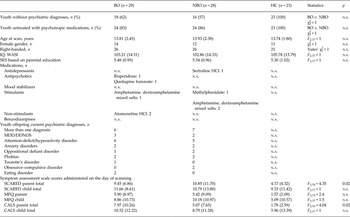
Exclusion criteria for all participants were: systemic medical illness, neurological disorders, head trauma, alcohol or illicit substance use, standard exclusion criteria for magnetic resonance imaging (MRI) research (metal in the head or body, claustrophobia, etc.), intelligence quotient (IQ) < 70 (using the Weschler Abbreviated Scale of Intelligence; Wechsler, Reference Wechsler1999), unable to read and write in standard English, and corrected far visual acuity worse than 20/40 on the Snellen visual acuity test. In all, six BO, nine NBO and two HC were excluded from data analysis due to inability to complete the scanning session or due to excessive motion in the scanner (translation ⩾4 mm in any direction). The total numbers of participants with usable functional MRI (fMRI) data were: 29 BO, 28 NBO and 23 HC. In all, 11 BO and 12 NBO had current non-BD psychopathology, and five BO and four NBO were taking one class of psychotropic medications (Table 1). Given ethical concerns with stopping medication for research participation, participants were permitted to use prescribed medication(s) before, and on the day of, scanning.
Demographic and clinical variables

Data are given as mean (standard deviation) unless otherwise indicated.
BO, Youth offspring of parents with bipolar disorder; NBO, youth offspring of parents with non-bipolar psychopathology; HC, healthy offspring of psychiatrically healthy parents; n.s., not significant; IQ, intelligence quotient; WASI, Weschler Abbreviated Scale of Intelligence; SES, socio-economic status; n.a., not applicable; MDD, major depressive disorder; DDNOS, dissociative disorder, not otherwise specified; SCARED, Self-Report for Childhood Anxiety Related Emotional Disorders; MFQ, Mood and Feelings Questionnaire; CALS, The Children's Affective Lability Scale.
Assessment procedures
Parental psychopathology was ascertained by a trained clinician using the Structural Clinical Interview for DSM-IV (SCID-I; First et al. Reference First, Spitzer, Gibbon and Williams2002) for BIOS youth, and using detailed clinical assessment for LAMS youth. Another trained clinician, blind to the parent's condition, interviewed the parents about their children, and also interviewed their children, using the Kiddie Schedule for Affective Disorders and Schizophrenia-Present and Lifetime version (KSADS-PL; Kaufman et al. Reference Kaufman, Birmaher, Brent, Rao, Flynn, Moreci, Williamson and Ryan1997). All cases were supervised by a ‘blind’ child psychiatrist who was responsible for the ultimate parental and children diagnoses. Inter-rater reliability for all psychiatric diagnoses ascertained through the KSADS was > 0.8.
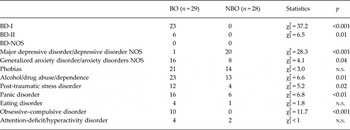
On the day of scanning, parents/guardians of youth participants completed: the Parent Version of the General Behavior Inventory (Youngstrom et al. Reference Youngstrom, Frazier, Demeter, Calabrese and Findling2008), to assess the severity of behavioral and emotional dysregulation in their offspring during the last 6 months (only parents of BO and NBO completed this questionnaire); the Self-Report for Childhood Anxiety Related Emotional Disorders, parent version (SCARED-P), to assess offspring anxiety over last 2 weeks (Birmaher et al. Reference Birmaher, Khetarpal, Brent, Cully, Balach, Kaufman and Neer1997); the Children's Affective Lability Scale, parent version (CALS-P; Gerson et al. Reference Gerson, Gerring, Freund, Joshi, Capozzoli, Brady and Denckla1996); the Mood and Feelings Questionnaire, parent version (MFQ-P), to assess the severity of depression during the last 2 weeks (Angold et al. Reference Angold, Prendergast, Cox, Harrington, Simonoff and Rutter1995); and a questionnaire to assess sociodemographic status represented by parental education (Hollingshead, Reference Hollingshead1975). Youth participants completed child report versions of affective symptomatology scales: the CALS-C, SCARED-C and MFQ-C. All participants completed medication forms that documented psychotropic medications used that day, during the last 24 h, and those used on regular basis; drug/alcohol/pregnancy screens; the Edinburgh Handedness Inventory (Oldfield, Reference Oldfield1971) and the Snellen visual acuity test. Table 1 reports demographic and clinical variables. Online Supplementary Table S1 reports demographic and clinical variables for youth without psychopathology and youth untreated with psychotropic medications. Table 2 reports lifetime psychiatric diagnoses in parents.
Lifetime psychiatric diagnoses in parents

BO, Youth offspring of parents with bipolar disorder; NBO, youth offspring of parents with non-bipolar psychopathology; BD, bipolar disorder; NOS, not otherwise specified; n.s., not significant.
Reward task
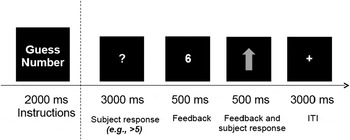
Participants were scanned while performing a number-guessing reward task (Forbes et al. Reference Forbes, Brown, Kimak, Ferrell, Manuck and Hariri2009) that reliably activates frontostriatal reward circuitry, and has been used previously in neuroimaging studies of adults and youth with mood disorders (Forbes et al. Reference Forbes, Brown, Kimak, Ferrell, Manuck and Hariri2009; Bebko et al. Reference Bebko, Bertocci, Fournier, Hinze, Bonar, Almeida, Perlman, Versace, Schirda, Travis, Gill, Demeter, Diwadkar, Ciuffetelli, Rodriguez, Olino, Forbes, Sunshine, Holland, Kowatch, Birmaher, Axelson, Horwitz, Arnold, Fristad, Youngstrom, Findling and Phillips2014). The task required participants to guess whether the upcoming number was smaller or greater than 5. Participants were told that they would receive $1 if they were correct and lose $0.50 if they were incorrect, and that they could win up to $10 in the game. If a participant correctly guessed the number, a green upward arrow appeared (Fig. 1). If an incorrect guess were made, a red downward arrow appeared. There were fifteen 7-s win trials, fifteen 7-s loss trials, and eighteen 6-s control trials. Control trials did not involve any guessing (and, consequently, no winning or losing) and required pressing a button when an asterisk appeared on the screen. Further in the text, we refer to win and loss trials as decision-making trials and control trials as non-decision-making trials. Please note that decision-making trials included a decision component (when participants decided which button to press) and a reward component (when participants received feedback about winning or losing on that specific trial). Non-decision-making trials did not include either of these decision and reward components. Win and loss trial comprised a 3-s guessing period when participants decided whether the upcoming number was greater/lower than 5. The actual number was then presented for 500 ms, followed by a 500 ms green upward arrow (for positive feedback) or a 500 ms red downward arrow (for negative feedback), and then a 3000 ms inter-stimulus interval fixation cross. Outcome was fixed for all participants so that each participant won $10. Previous studies using this task showed that participants were unaware of the fixed outcome of the task and believed that their performance was due to chance (Forbes et al. Reference Forbes, Brown, Kimak, Ferrell, Manuck and Hariri2009).
Example of a win trial in the reward task. An upward arrow shows that a subject correctly guessed that the number was greater than 5. ITI, Inter-trial interval.

fMRI data acquisition and analysis
fMRI data were acquired using a Siemens MAGNETOM TrioTim 3 T MR system. A high-resolution structural image (1 × 1 × 1 mm3) was acquired using MPRAGE [repetition time (TR) = 2300 ms, echo time (TE) = 3.93 ms, field of view (FOV) = 256, flip angle (FA) = 9°, 192 slices]. Functional data were collected using a gradient-echo, echo-planar sequence (voxel size: 3.2 × 3.2 × 3.1 mm3, TR = 2000 ms, TE = 28 ms, FOV = 205, FA = 90°, 38 slices). These data comprised 178 volumes (TRs). Field maps were collected at the 4 × 4 × 4 mm resolution using a gradient echo sequence (TR = 488 ms, TE1 = 4.92 ms, TE2 = 7.38 ms, FOV = 256, FA = 60°, 32 slices).
Data preprocessing and analyses were done using FSL5.0.2 (http://www.fmrib.ox.ac.uk/fsl). Preprocessing included motion correction with MCFLIRT (Jenkinson et al. Reference Jenkinson, Bannister, Brady and Smith2002), non-brain removal using BET (Smith, Reference Smith2002), fieldmap-based echoplanar imaging (EPI) unwarping using PRELUDE + FUGUE (Jenkinson, Reference Jenkinson2003), spatial smoothing with a Gaussian kernel of full width at half maximum (FWHM) 6 mm, grand-mean intensity normalization of the entire four-dimensional dataset by a single multiplicative factor, high-pass temporal filtering (Gaussian-weighted least-squares straight line fitting, with sigma = 50.0 s). A field map image was prepared using the fsl_prepare_fieldmap script. The high-resolution structural images were segmented to separate white matter, gray matter and cerebrospinal fluid (CSF). The white matter and CSF masks were then co-registered with functional images, and their timecourses were extracted from the preprocessed functional data for further analyses. Motion outliers (time points where the fMRI signal was corrupted due to subject motion) were identified using the fsl_motion_outliers script (http://fsl.fmrib.ox.ac.uk/fsl/fslwiki/FSLMotionOutliers). A confound matrix from this analysis was then combined with the white matter and CSF time courses and used as a confound variable of no interest in the first-level analyses.
Co-registration was carried out using FLIRT (FMRIB's Linear Image Registration Tool; Jenkinson & Smith, Reference Jenkinson and Smith2001; Jenkinson et al. Reference Jenkinson, Bannister, Brady and Smith2002) and FNIRT (FMRIB's Non-linear Image Registration Tool; Andersson et al. Reference Andersson, Jenkinson and Smith2007). Blood oxygen level-dependent (BOLD) images were registered to the high-resolution structural images using FLIRT; the high-resolution images were registered to the Montreal Neurological Institute (MNI) 152_T1_2 mm template, as in previous neuroimaging studies of youth with age ranges comparable with that in the present study (Burgund et al. Reference Burgund, Kang, Kelly, Buckner, Snyder, Petersen and Schlaggar2002; Kang et al. Reference Kang, Burgund, Lugar, Petersen and Schlaggar2003; Olsavsky et al. Reference Olsavsky, Brotman, Rutenberg, Muhrer, Deveney, Fromm, Towbin, Pine and Leibenluft2012; Singh et al. Reference Singh, Chang, Kelley, Cui, Sherdell, Howe, Gotlib and Reiss2013, Reference Singh, Kelley, Howe, Reiss, Gotlib and Chang2014; Bebko et al. Reference Bebko, Bertocci, Fournier, Hinze, Bonar, Almeida, Perlman, Versace, Schirda, Travis, Gill, Demeter, Diwadkar, Ciuffetelli, Rodriguez, Olino, Forbes, Sunshine, Holland, Kowatch, Birmaher, Axelson, Horwitz, Arnold, Fristad, Youngstrom, Findling and Phillips2014), using FNIRT, and the two resulting transformations were concatenated and applied to the original BOLD image to transform it to MNI space. The registration quality was checked for each subject. In rare cases FNIRT was substituted with FLIRT to obtain a better-quality registration.
A first-level general linear model analysis was implemented using FEAT (FMRI Expert Analysis Tool, v6.0). The model included four regressors (win, loss and control trials, and instructions). The magnitude of activation was examined for each of these conditions and to the win-control, loss-control, and win-loss contrasts. All group-level analyses were conducted using FLAME1 (FMRIB's local analysis of mixed effects). Gender, age, IQ and presence/absence of psychopathology were used as covariates in the group-level analyses in order to factor out the effects of these variables. Multiple comparisons correction (p-corrected < 0.05) was performed using Gaussian random field theory. Significant clusters of activation were determined by thresholding Z-statistic images in the reward circuitry mask at z > 3.09 (uncorrected voxel-wise p < 0.001) and a family-wise error-corrected cluster significance threshold of p < 0.05 (Worsley, Reference Worsley, Jezzard, Matthews and Smith2001).
Hypothesis 1 testing
Activity in the reward circuitry region of interest (ROI)
Brain activation in the reward circuitry ROI was analysed using a 3 (group: BO/NBO/HC) × 2 (condition: win-control/loss-control) analysis of variance (ANOVA) where win-control and loss-control were the contrast images from the first-level analysis. The reward circuitry ROI mask was the anatomical mask used in a previous study (Bebko et al. Reference Bebko, Bertocci, Fournier, Hinze, Bonar, Almeida, Perlman, Versace, Schirda, Travis, Gill, Demeter, Diwadkar, Ciuffetelli, Rodriguez, Olino, Forbes, Sunshine, Holland, Kowatch, Birmaher, Axelson, Horwitz, Arnold, Fristad, Youngstrom, Findling and Phillips2014) that examined reward circuitry function in emotionally dysregulated youth, using the same reward task. The mask included key neural regions implicated in reward processing: the bilateral dorsal ACC (Brodmann area 24/32), medial and lateral FP (Brodmann area 10), OFC (Brodmann area 11), vlPFC (Brodmann area 47) and VS (spherical ROIs with radius of 8 mm centered: (±9, 9, –8).
Hypothesis 2 testing
Functional connectivity between bilateral VS and the reward circuitry mask
Functional connectivity was examined using psychophysiological interaction (PPI) analysis (Friston et al. Reference Friston, Buechel, Fink, Morris, Rolls and Dolan1997) in FEAT. The bilateral VS served as a seed region and the reward circuitry mask served as a target region. The PPI first-level analysis model included four psychological regressors (win, loss and control trials, and instructions), one physiological regressor – a mean time course extracted from the seed region, and three interaction terms between the physiological and win, loss and control regressors. To parallel the activation analysis, the group-level connectivity analysis was conducted using a 3 (group) × 2 (condition) ANOVA.
Post-hoc tests
To determine the direction of the between- or within-group effects, post-hoc t tests of activation and connectivity values (parameter estimates extracted from the significant activation and connectivity clusters) were conducted using SPSS and Bonferroni corrected to control for multiple t tests.
Hypothesis 3 testing
Here, we examined the effect of diagnosis and medications on activation and connectivity in the brain regions identified in the previous analyses. For this purpose, we first extracted activation and connectivity values from the significant clusters using the Featquery tool in FSL. Then, we conducted two 3 × 2 ANOVAs, using SPSS, on: (1) participants without diagnoses; (2) unmedicated participants.
Ethical standards
All procedures contributing to this work comply with the ethical standards of the University of Pittsburgh Institutional Review Board and with the Helsinki Declaration of 1975, as revised in 2008.
Results
Behavioral data
There were no between-group differences in decision-making reaction time across all trials or across reward and loss trials separately.
Neuroimaging
Hypothesis 1
Activation
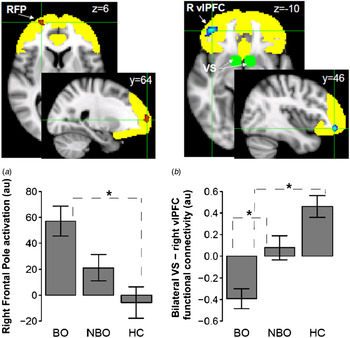
A 3 (group: BO/NBO/HC) × 2 (condition: win-control/loss-control) ANOVA revealed main effects of group (Fig. 2a ) and condition (online Supplementary Table S2), but no group × condition interaction, on brain activation. A main effect of group was found in the right FP [RFP; nvox = 66, z-max = 4.0 (24, 64, 6), p-corrected < 0.05]. Follow-up t tests conducted on RFP activation values revealed that activation was significantly greater in BO than HC (t 50 = 3.7, p < 0.001), and just missed significance in BO v. NBO (t 55 = 2.3, p = 0.02), using a Bonferroni-corrected statistical threshold of p = 0.05/3 (p = 0.017) for between-group tests. NBO did not differ from BO.
A main effect of group on activation in the right frontal pole (RFP; 24, 64, 6; shown in red) (a) and functional connectivity between the bilateral ventral striatum (VS; centered 8 mm around ±9, 9, −8; shown in green) and the right ventrolateral prefrontal cortex (R vlPFC; 40, 46, −10; shown in blue) (b) for decision-making trials (i.e. win and loss trials) v. non-decision-making trials (i.e. control trials). The reward circuitry region of interest mask is shown in yellow. Values are means, with standard errors represented by vertical bars. * Significant t test results. au, Arbitrary units; BO, offspring of parents with bipolar disorder; NBO, offspring of parents with psychiatric disorders other than bipolar disorder; HC, healthy offspring of psychiatrically healthy parents.

Hypothesis 2
Connectivity
The PPI analyses conducted with the bilateral VS as a seed region and the reward circuitry mask as a target region revealed a main effect of group (Fig. 2b ), but no main effect of condition or group x condition interaction, on functional connectivity. A main effect of group was found in the right vlPFC [nvox = 96, z-max = 4.7 (40, 46, −10), p-corrected < 0.05]. Follow-up t tests revealed that functional connectivity between the bilateral VS and right vlPFC was significantly more negative, reflecting the fact that VS–right vlPFC connectivity was more positive for control than for win and loss trials, in BO than NBO (t55 = −3.3, p = 0.002) and in BO than HC (t 50 = −6.2, p < 0.001), using a Bonferroni-corrected threshold of p = 0.017, as above.
Hypothesis 3
Activation and connectivity
The results of RFP activation and bilateral VS–right vlPFC connectivity analyses in unmedicated participants and those without psychopathology were consistent with the results of the full-sample analyses testing hypotheses 1 and 2. There was a significant effect of group on RFP activation (participants without psychopathology: F 2,54 = 11.1, p < 0.001; unmedicated participants: F 2,68 = 7.3, p = 0.001; online Supplementary Fig. S1), and on bilateral VS–right vlPFC functional connectivity (participants without psychopathology: F 2,54 = 14.4, p < 0.001; unmedicated participants: F 2,68 = 16.1, p < 0.001; online Supplementary Fig. S2).
The results of post-hoc comparisons paralleled main findings from hypotheses 1 and 2. RFP activation was significantly greater in BO than in HC (participants without psychopathology: t 39 = 4.3, p < 0.001; unmedicated participants: t 45 = 3.4, p = 0.001) and was also significantly greater in NBO than in HC (participants without psychopathology: t 37 = 2.9, p = 0.006; unmedicated participants: t 45 = 2.5, p = 0.01). Bilateral VS–right vlPFC functional connectivity was significantly more negative in BO v. NBO (participants without medications: t 46 = −3.3, p = 0.002; the comparison just missed significance in BO and NBO without psychopathology: t 32 = −2.6, p = 0.02); and in BO v. HC (participants without psychopathology: t 39 = −5.8, p < 0.001; unmedicated participants: t 45 = −6.0, p < 0.001).
Exploratory analyses
Across all participants, RFP activation positively correlated with CALS-P (r = 0.34, p = 0.002) and MFQ-P (r = 0.23, p = 0.047). In BO, RFP activation positively correlated with CALS-P (r = 0.37, p < 0.05).
Discussion
The goal of the present study was to determine the extent to which alterations in reward circuitry function characterized at-risk youth offspring of parents with BD (BO) relative to offspring of non-bipolar parents (NBO) and youth offspring of psychiatrically healthy parents (HC). The main findings supported all three hypotheses. RFP activation for decision-making (win and loss) trials, relative to non-decision making (control) trials, was significantly greater in BO than in HC, but did not differ significantly for BO v. NBO, or for NBO v. HC. Bilateral VS–right vlPFC functional connectivity was significantly more negative in BO than in NBO and HC, reflecting a pattern of greater positive connectivity to control than either win or loss trials in BO than other groups. These patterns of activation and functional connectivity remained for umedicated participants and those without psychopathology, supporting our third hypothesis. These findings suggest that while elevated RFP activation may reflect risk for, or resilience against, future development of worsening psychopathology in general, abnormally decreased bilateral VS–right vlPFC functional connectivity to win or loss v. control trials may reflect risk for, or resilience against, future development of BD specifically, in BO.
The FP is involved in decision-making and prospective memory by supporting the maintenance of delayed intentions and representations (Burgess et al. Reference Burgess, Gilbert and Dumontheil2007; Koechlin & Hyafil, Reference Koechlin and Hyafil2007) and integrating outcomes of previous trials (Ramnani & Owen, Reference Ramnani and Owen2004) for potential use in future trials. The magnitude of FP activation positively correlated with the amount of uncertainty remaining between multiple choices (Yoshida & Ishii, Reference Yoshida and Ishii2006), and tracked unchosen options (Boorman et al. Reference Boorman, Behrens, Woolrich and Rushworth2009). A recent study of adolescents with BD demonstrated significantly greater activation in the right frontal cortex (x = 11, y = 55, z = 14) during reward anticipation in those with BD v. HC (Singh et al. Reference Singh, Chang, Kelley, Cui, Sherdell, Howe, Gotlib and Reiss2013). In our study, abnormally elevated RFP activation during decision-making trials in BO suggests that they may have experienced abnormal levels of uncertainty during these trials, and maintained non-chosen option-outcome contingencies in memory to predict (i.e. make more certain) response-outcome mapping for future trials. Furthermore, similar patterns of significantly elevated RFP activation during decision-making trials were present in unmedicated BO and NBO v. HC, and in BO and NBO without psychopathology v. HC. Given that BO were not different from NBO in their RFP activation, abnormally elevated RFP activation may represent a vulnerability marker for future development of, or resilience against, future worsening of psychopathology in general, but not BD specifically.
The VS supports reward anticipation, reward evaluation and prediction error (Schultz et al. Reference Schultz, Tremblay and Hollerman2000; Knutson et al. Reference Knutson, Adams, Fong and Hommer2001; Pagnoni et al. Reference Pagnoni, Zink, Montague and Berns2002; O'Doherty, Reference O'Doherty2004; Tanaka et al. Reference Tanaka, Doya, Okada, Ueda, Okamoto and Yamawaki2004). The vlPFC is implicated in learning the value of different options and formation of associations between visual stimuli and reward values (Rushworth et al. Reference Rushworth, Noonan, Boorman, Walton and Behrens2011). Functional interaction between the PFC and VS influences guided behavior and may be modulated by the environment (Del Arco & Mora, Reference Del Arco and Mora2009). In HC, an increase in bilateral VS activation was associated with an increase in right vlPFC activation during decision-making (win, loss) v. non-decision-making (control) trials, highlighting a positive relationship between encoding stimulus–outcome associations and reward evaluation. In BO, an increase in bilateral VS activation was associated with decrease in right vlPFC activation, and vice versa, during decision-making v. non-decision-making trials. Such an inverse relationship between activation in the bilateral VS and right vlPFC may suggest that in BO, evaluation of reward and loss encoded by the vlPFC may be inhibited by the formation of associations between reward values and corresponding visual stimuli in the VS, and vice versa.
Given that BO not only differed from HC, but also differed from NBO on the direction of VS–vlPFC functional connectivity, and that this pattern remained significant even for unmedicated participants and those without psychopathology, a pattern of aberrant negative bilateral VS–right vlPFC functional connectivity during decision-making trials may reflect a vulnerability marker for, or resilience against, BD, rather than for psychopathology in general. Because the between-group differences in functional connectivity were independent of the fact that BO, NBO and HC did not differ significantly in magnitude of activation in these regions, our findings may provide further support for dysfunctional coupling between the vlPFC and subcortical regions during emotionally-salient processing as a pathophysiological process underlying vulnerability to, or protection against, future BD (Altshuler et al. Reference Altshuler, Bookheimer, Townsend, Proenza, Sabb, Mintz and Cohen2008; Phillips & Swartz, Reference Phillips and Swartz2014).
Exploratory analyses showed that greater RFP activation was associated with higher mood dysregulation scores (CALS-P) and higher MFQ across all participants, and with higher CALS-P in BO. Higher RFP activation during decision-making trials may thus be a precursor for the development of mood dysregulation and depression. Future studies need to examine these exploratory findings.
The fact that the findings remained significant even after approximately 40% of participants were removed for comparisons of healthy BO v. healthy NBO v. HC suggests that the pattern of findings was robust, at least with regard to the general BO and NBO populations. Given that only a small number of youth were taking medications, there was insufficient statistical power to directly compare unmedicated BO v. medicated BO v. unmedicated NBO v. medicated NBO. Further studies should compare larger samples of medicated and unmedicated BO and NBO, and BO and NBO with and without current diagnoses. Additionally, future studies can also directly compare youth with established BD, and genetically and symptomatically at-risk youth, to determine the degree of similarity between neural measures of risk status and neural measures of BD.
In summary, our findings demonstrate, for the first time, that youth offspring, as yet unaffected with BD, of parents with BD exhibit altered patterns of frontal activation and vlPFC–striatal functional connectivity that distinguish these youth from youth offspring of parents unaffected with BD. These activation and connectivity differences remained significant for participants without current psychopathology and medication history and may represent neurobiological markers conferring either risk for, or protection against, BD in youth. Future, longitudinal follow-up studies in youth at-risk for BD should aim to distinguish between these two possibilities, by determining the extent to which abnormal patterns of reward circuitry functioning predict, or protect against, the development of BD, and the development/worsening of affective pathology in general.
Supplementary material
For supplementary material accompanying this paper visit http://dx.doi.org/10.1017/S003329171500166X
Acknowledgements
This work was supported by grants from the National Institutes of Health: R01 MH060952-12S1 to B.B., D.A. and M.L.P. (multiple principal investigators); R01 MH073953 to B.B. and M.L.P. (multiple principal investigators); K01 MH104348 to A.M.; and Pittsburgh Foundation to M.L.P. The authors thank the families for participating in this research study.
The authors report no financial relationships with commercial interests. M.L.P. was supported by R01MH100041, U01 MH092221, R01 MH073953 and R01 MH060952. B.B. has or will receive royalties for publications from Random House, Inc. (New Hope for Children and Teens with Bipolar Disorder) and Lippincott Williams & Wilkins (Treating Child and Adolescent Depression). T.R.G. has received research support from the National Institute of Mental Health, National Institute on Drug Abuse, National Institute of Child Health and Human Development, The Fine Foundation, The Ryan Licht Sang Foundation and The Pittsburgh Foundation, and royalties from Guilford Press. B.I.G is supported by a New Investigator Award from the Canadian Institutes for Health Research. Other authors report no biomedical financial interests or potential conflicts of interest.
Declaration of Interest
None.