Introduction
In the last decade, a relevant corpus of literature has flourished focusing on the emergence of ‘flexible and secure’ labour market arrangements (Wilthagen, Reference Wilthagen1998, Reference Wilthagen, Bredgaard and Larsen2005; Madsen, Reference Madsen, Sarfati and Bonoli2002; Bekker and Wilthagen, Reference Bekker and Wilthagen2008). According to this literature, flexicurity in its narrow sense emerges from the combination of three major ingredients: diffusion of flexible job contracts (which entails less job security), generous social protection schemes for the unemployed (income security) and effective activation measures in order to promote employment security.
This article deals with the above-mentioned strand of literature. The first aim is substantive, consisting of the analysis and the evaluation of recent labour market reforms in Italy with particular reference to the possible emergence of a flexicurity model. The second goal is to contribute to the debate on labour market development and flexicurity by enriching and refining the analytical tools. More specifically, we argue that the traditional ‘lenses’ focusing on the ‘insiders’/’outsiders’ divide are inadequate to grasp the ongoing changes in the Italian labour market.Footnote 1 This leads us to identify a third category of workers, which we call ‘mid-siders’. Moreover, we introduce the concept of ‘selective flexicurity’, referring to the fact that flexibility and security measures may be applied differently across the various categories of workers, as in the case of Italian employment policy.
The article is structured as follows. First we discuss the conceptual background of our research, providing an analytical as well as empirical clarification of the insiders, the outsiders and, especially, the ‘mid-siders’ in the Italian labour market. We then briefly illustrate the historical configuration of Italian employment policy: that is, the status quo before flexicurity reforms. We continue by analysing the changes that occurred during the period 1992–2007, particularly focusing both on the steps taken towards a more flexible and secure model and recent labour market trends. We then deal with the outcomes of the peculiar Italian ‘flexicurity mix’, highlighting the uneven effects exerted on its highly segmented labour market with special attention to the ever-more relevant ‘mid-siders’ cluster. Finally, we draw out the empirical conclusions, present the analytical implications of our findings and provide some suggestions for future research.
Beyond in- and out-: the ‘mid-siders’ in the Italian labour market
Since the late 1970s, the processes of economic transformation, slower economic growth, the low level of employment and the rise of unemployment have represented the major challenges in the Italian labour market. After some attempts – in the 1980s and the early 1990s – to tackle such a multi-faceted crisis, mostly relying on the so-called ‘labour reduction route’, the overall picture rapidly changed in the mid-1990s when, facing a sharp decrease in employment, two-digit unemployment rates and a dramatic fiscal crisis, Italian employment policy made a U-turn (Ferrera and Gualmini, Reference Ferrera and Gualmini2004; Graziano, Reference Graziano2004a). Two major reforms were adopted – in 1997 and 2003 – which modified the traditional employment policy mix and deeply transformed the rules that had been set up in the period of Keynesian macro-economic policy and late industrialisation of the country (from the 1950s to the 1970s).
In accordance with the recommendations of the major supranational (EU) and international organisations (OECD), both reforms were aimed at channelling into the national employment policies some elements of the so-called ‘flexicurity strategy’ (Viebrock and Clasen, Reference Viebrock and Clasen2009). In particular, the flexibilisation of the Italian labour market has been pursued, and this has increased pressure on pre-existing arrangements for unemployment protection and active labour market policies (ALMPs).
In this article, we aim to understand if, and to what extent, the flexibilisation of the labour market has been accompanied by a similar development of the other two major ingredients or ‘pillars’ of the flexicurity strategy: social protection (that is, compensation benefits for the unemployed) and AMLPs (such as activation measures, life-long learning programmes and the like). In fact, if these are crucial elements for the emergence of a flexible and secure labour market, this is particularly true in a country belonging to a Southern European welfare regime that has traditionally presented great variation in the levels of job, income and employment security across the different groups in the labour market. This was due to the interplay between labour market segmentation and the fragmentation and underdevelopment in comparative terms of the income maintenance system for the unemployed. Let us take a closer look at such an arrangement.
The international literature has depicted Italy as an example of the conservative–corporatist welfare regime (Esping-Andersen, Reference Esping-Andersen1990, Reference Esping-Andersen1999) or, adopting other conceptual lenses, as an emblematic case of the Southern European model of welfare (Ferrera, Reference Ferrera1996). Moreover, the Italian labour market has traditionally displayed a pattern of employment based on the predominance of full-time and permanent job contracts, ‘rigid’ labour regulation – with a high level of job protection and strong barriers for those entering the labour market – and low public expenditure on activation measures (Ferrera and Gualmini, Reference Ferrera and Gualmini2004). The combination of these factors, it has often been acknowledged, has entailed a wide gap between the ‘insiders’ and the ‘outsiders’ in terms of access to both employment and social provisions.
In fact, in the Italian labour market we can identify two social groups which have traditionally enjoyed different levels of protection against the various social risks, especially unemployment risk.
The first group (the ‘insiders’) included public employees and workers employed in medium–large and unionised firms, who were in a condition of cumulative advantages: they benefited from a high level of job protection and stability, and they were also entitled to generous income-replacement benefits in case of unemployment. By contrast, the so-called ‘outsiders’ tended to suffer from cumulative disadvantages: they were generally excluded from regular employment and they could not rely on any kind of income protection due to the predominance of work-based social protection schemes and the lack of a last-resort safety-net scheme (for example, a guaranteed minimum income).
In order to analyse the recent changes along both the flexibility and security dimensions, it seems therefore crucial to pay attention to the different groups in the labour market. However, our contention is that focusing only on the ‘insiders’ and the ‘outsiders’ runs the risk of missing a major part of the story. In fact, as recently suggested by Ferrera (Reference Ferrera2006), when looking at the interaction of the labour market and social protection arrangements, there is evidence of a third category of workers that do not have access to the same (high) level of protection as the insiders, but, on the other hand, are employed and can be entitled (to a certain extent and with not negligible variations) to some contributory unemployment benefits. We call these workers ‘mid-siders’. More precisely, this cluster may be divided into two sub-groups: workers employed in micro and small firms, which have traditionally enjoyed a lower level of job protection and much less generous unemployment benefits than the insiders; and the heterogeneous world of ‘atypical workers’ – residual until the end of the 1980s – that has considerably expanded in the last two decades.Footnote 2
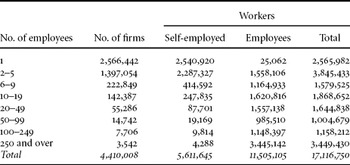
Though the ‘mid-siders’ category is rather composite, for analytical purposes it is relevant to distinguish it from the ‘insiders’ and the ‘outsiders’ categories. With reference to the first sub-group, we have already mentioned that the ‘mid-siders’ are relatively underprivileged, as they enjoy much less (if any) job security as well as income security in case of unemployment. To be sure, the numerical relevance of these workers in the Italian case supports the adoption of a new analytical category; in fact, workers employed in micro and small firms constitute a large share of total employment (see Table 1). Even more important is to differentiate the ‘mid-siders’ from the ‘outsiders’ conceptually. The rationale behind this lies mostly (but not only) in some features of South European countries, and especially Italy. We refer in particular to the fact that in these countries a sizeable part of the population has traditionally been either inactive or irregularly employed. In Italy, this is easily acknowledged considering the low total activity rate – 62.7 per cent in 2006 versus an EU-15 average of over 71 per cent, and the gap is wider for women (54.8 per cent versus 64.2 per cent) and young people (32.5 per cent versus 47.9 per cent) – and the high incidence of the ‘informal economy’, which is estimated to account for a significant share of GDP: 26.2 per cent in 2003 (Schneider, Reference Schneider2005: 611). For our purposes, this means that a considerable proportion of the population is excluded from regular employment, poorly represented (Baglioni et al., Reference Baglioni, della Porta and Graziano2008) and, consequently, has neither job security nor income protection. As may be easily understood, this group – known as ‘outsiders’ – has little in common with the ‘mid-siders’ illustrated above.
Firms size and employment in Italy (private sector), 2006

Source: ISTAT online database.
A tripartite picture of the labour market – in lieu of the usual ‘insiders/outsiders’ bi-partition – was already proposed by Will Hutton (Reference Hutton1995) in his interpretation of the British case at the end of the Thatcher age. The idea of a ‘thirty, thirty, forty society’ (Hutton, Reference Hutton1995: 105) suggested in fact that, after more than a decade of ‘conservative supremacy’, in Britain around 30 per cent of the population were disadvantaged (being either unemployed or inactive), another 30 per cent were insecure and marginalised because of poor/insecure jobs (part-timers, temporary workers, casual workers, self-employed) that restricted access to adequate social protection, while the privileged constituted the remaining 40 per cent. Our ‘mid-siders’ category clearly recalls the insecure and marginalised category identified by Hutton in the British case and – along with the ‘insiders’ and ‘outsiders’ categories – can be particularly useful for a more comprehensive understanding of employment policy and labour market developments in Italy.
The traditional Italian employment policy mix
In order to illustrate the peculiar arrangement of Italian labour market policies, we have to focus on: the institutional configuration and the level of protection provided by the unemployment protection system (income security); labour market regulations, with a particular reference to hiring rules and employment protection legislation (job security); and active measures (employment security). As for the first point, it is useful to illustrate the Italian system of unemployment benefits in comparison with other European countries. In fact, in most EU members states a three-pillar model prevails, and it is characterised by: a first contributory/insurance pillar, providing earnings-related benefits with a maximum duration; a ‘specific’ second social assistance pillar, for those unemployed who either do not fulfil contributions requirements to be entitled to first-pillar benefits or are no longer entitled to ordinary benefit; and a third ‘general’ social assistance pillar, operating as a safety net through the guarantee of a minimum income (Ferrera, Reference Ferrera2004; ISFOL, 2004).
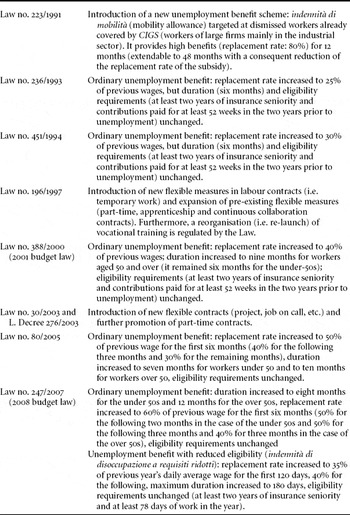
By contrast, in Italy protection against unemployment has traditionally relied on first-pillar schemes and some special programmes providing ‘wage-replacement benefits’ in case of temporary working-time reduction without definitive dismissal (Cassa integrazione guadagni ordinaria e straordinaria – CIGO and CIGS, see below), whereas comprehensive second- and third-pillar schemes for the most disadvantaged groups have never been set up. As to contributory schemes, the ordinary unemployment benefit (UB) (Indennità ordinaria di disoccupazione) has been introduced in 1919 for blue-collar workers and subsequently extended to all other categories of dependent workers. This scheme has always been financed through social contributions, and benefits have traditionally been very low, though varying significantly across economic sectors. In the industrial sector, the unemployment subsidy was calculated as a percentage of previous earnings only after 1988, and the replacement rate has been extremely modest until recently: 7.5 per cent at the end of the 1980s, 30 per cent one decade later (see Table 3). Eligibility conditions for UB have remained unchanged, and as a result have become rather tight from a comparative perspective; in fact, the requirements are at least two years of insurance and 52 weekly contributions in the two years before the onset of unemployment.
However, in order to cover seasonal workers (especially in the tourism sector), who could hardly get entitlement to ordinary UB because of its contributory requirements, in 1988 a new benefit was set up: the ‘UB with reduced eligibility’ – UBR (Indennità ordinaria di disoccupazione con requisiti ridotti) – characterised by looser qualifying conditions (at least two years of insurance seniority and a minimum of 78 working days in the year of unemployment) and lower benefits. The latter were in fact calculated taking into account the actual days of employment (with a ceiling of 156 days per year), and they are paid in a lump sum during the year following the onset of unemployment. This peculiar feature greatly reduces the effectiveness of this scheme in replacing the income of workers losing their job.
The special CIGO and CIGS schemes provided generous wage replacement – 80 per cent of final wage – in case of (partial or total) working-time reduction without definitive dismissal. However, the coverage of these schemes is limited to about 40 per cent of dependent workers (Geroldi, Reference Geroldi, Onofri and Giannini2005), mostly employed in large firms in the industrial sector, while employees of small firms and most service activities are excluded. Moreover, the provision of these benefits is conditional upon a bargaining process between the government, the unions and employers.
The high level of income protection for the ‘insiders’ – that is, workers in central and unionised sectors of the economy, employed in medium and large firms – was also reinforced by the rigid regulatory framework that structured a ‘guaranteed’ labour market (high job security). The public monopoly on placement services on the one hand, and the restrictive rules for individual dismissals on the other, left employers little discretionary power in hiring and dismissing workers. In particular, in 1966 individual dismissal was restricted by law to well-justified cases, and in 1970 Article 18 of the Workers StatuteFootnote 3 prescribed that, in firms with more than 15 workers, employers were obliged to re-integrate fired workers if the Court declared dismissal illegitimate. These arrangements favoured job stability, which was also the consequence of the extensive use of permanent contracts, while flexible, temporary and part-time jobs have been virtually unknown until very recently.
Therefore, labour market rules and the organisation of the income protection system in case of unemployment were supporting the privileged condition of the ‘insiders’, who could rely both on a high level of job security and a generous – though baroque and even redundant – system of ‘shock absorbers’ for income replacement in case of unemployment/temporary working time reduction (Gualmini, Reference Gualmini1998).
The other side of the coin, however, was represented by the underprivileged situation of workers employed in the great number of micro-small and medium firms – the ‘mid-siders’ – and, above all, those who did not accede to regular employment – the ‘outsiders’. As to the first group, Italy represents a peculiar case, if compared with other European countries, since micro and small firms have traditionally been very important. In the private sector, micro and small firms (with fewer than ten employees) represent 94 per cent of the total and employ about 2.8 million workers – that is, 24 per cent of the total (see Table 1); firms with fewer than 20 employees account for 98 per cent of firms and 38 per cent of employees. The crucial point is that most of these workers did not have access to the same level of job security as the insiders – mainly because Article 18 of the Workers Statute does not apply to firms with fewer than 15 workers – nor were they entitled to the generous benefits provided by CIGO and CIGS.
Finally, the ‘outsiders’ suffered from the lack of a universal social assistance minimum income scheme and the low resources invested in active labour market policies. Both these factors were in fact particularly detrimental to the most disadvantaged groups in the labour market: traditionally, young people, women and the long-term unemployed. The extensive yet uneven reliance on passive labour market policies has historically corresponded to low expenditure on ALMPs, which have long remained very marginal in the Italian employment policy menu (Graziano, Reference Graziano2009). Moreover, as noted above, from the end of World War II until the 1990s, the State retained the monopoly over job placement services, which has resulted in less-effective services for matching labour demand and supply (Ichino, Reference Ichino1982). In spite of these shortcomings, between the late 1950s and the early 1970s the good economic and employment performance – as well as the crucial role of the family as a redistributive agency for its most disadvantaged members – largely hid the ineffectiveness of both the national system against unemployment and badly tailored labour market policies (Jessoula and Alti, Reference Jessoula, Alti and Palier2010).
The overall picture started to change in the late 1970s, when the pace of economic growth slowed down, employment rates first stabilised and then declined, unemployment increased and, above all, long-term unemployment grew significantly. After the 1979 second oil crisis, all labour market indicators showed an acute ‘welfare without work syndrome’: the unemployment rate increased from 7.4 per cent in 1980 to 9.7 per cent in 1989, and the employment rate slightly decreased from 54.0 per cent (1983) to 53.3 per cent (1989).
Employment policy reforms in the 1990s and 2000s
Facing mounting unemployment, the first labour market measure adopted in the 1990s followed the ‘passive policy’ route that had characterised the previous decade. Introduced in 1991, the indennità di mobilità (mobility allowance) is an unemployment protection scheme for those dismissed workers already covered by CIGS (workers of industrial firms with more than 15 employees and large-scale retail companies). Coverage is therefore limited to fewer than 40 per cent of dependent workers and benefits are generous (the replacement rate is 80 per cent) and provided for 12 months, although they can be extended to 48 months (depending on the age of the worker and the territorial area) with a consequent reduction of the amount. As already mentioned, the introduction of this new instrument followed the traditional path characterised by reliance on passive labour market policies and reduction of job supply – also further increasing the fragmentation and the segmentation of the protection in case of unemployment (see also Lodovici and Semenza, Reference Samek Lodovici and Semenza2008). In fact, the ‘mobility allowance’ has rarely been used to facilitate the transition of workers from one job to another, being more often employed as an instrument for early retirement (Geroldi, Reference Geroldi, Onofri and Giannini2005).
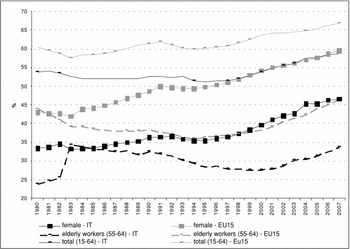
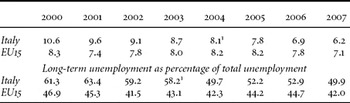
After the adoption of this policy measure, however, employment indicators radically worsened due to the economic – and fiscal – crisis that affected Italy in the first half of the 1990s. The employment rate, which was 52.6 per cent in 1990, declined to 51.2 per cent in 1995 (Figure 1), and the gap with other European countries widened: this was particularly true for women and older workers, whose employment rates in 1995 were 14 and 8 percentage points below the EU-15 average respectively. Meanwhile, the unemployment rate remained steadily over 11 per cent, and long-term unemployment amounted to over 60 per cent of total unemployment (Table 2).
Employment rates: total, female and older workers (55–64): Italy and EU15, 1980–2007
Source: OECD online employment database.

Unemployment rates (aged 15–64), total and long-term, Italy and EU15, 1990–1999

Note:1 Break in series.
Source: OECD online employment database.
In order to tackle such a severe crisis, in the subsequent years some important interventions in labour market policy were adopted, contributing to a (partial) reshaping of the model that had been consolidated in the post-war decades. Until the mid-1990s, in order to achieve the goal of joining the European Economic and Monetary Union (EMU) – and therefore complying with the budgetary constraints imposed by the Maastricht Treaty – the need for fiscal recovery and currency stability largely drove policy choices (cf. Ferrera and Gualmini, Reference Ferrera and Gualmini2004). Employment policy has mostly been aimed at curbing labour costs, mainly through wage restraint policies introduced by two subsequent social pacts, signed by the ‘technocratic’ governments (led by Amato and Ciampi) and the social partners. The 1992 ‘Amato Protocol’ and the subsequent 1993 ‘Ciampi Protocol’ were in fact crucial in reducing inflation by eliminating the automatic wage indexation system called scala mobile.
In the second half of the 1990s, however, while still pursuing wage moderation, the policy repertoire was enriched by introducing some innovative measures more closely targeted at re-launching employment: flexibility, privatisation and activation – together with decentralisation – became the new employment policy keywords, and some steps were also taken on the side of income security (Graziano, Reference Graziano2004b).
Flexibility and privatisation
The cabinet led by Romano Prodi, and the subsequent centre-left and centre-right governments, pursued flexibility and privatisation by radically changing the rules for entering the labour market and job placement, modernising the system of matching labour demand and supply, and also by introducing several new flexible job contracts – with lower labour and firing costs than ‘typical’ full-time, permanent jobs. The most important policy measures were adopted in 1997, 2001 and 2003.
Law 196/97 known as the ‘Treu Package’ (‘Measures for the promotion of employment’) innovated a number of aspects of employment policy. First, a gradual process of deregulation was prompted through the provision of so-called ‘atypical’, flexible contracts. In particular, the legislation introduced ‘temporary agency work’ contracts and measures aimed at increasing part-time jobs. Second, the traditional predominance of passive policies was limited, moving towards a more ‘equilibrated policy mix’ (Graziano, Reference Graziano2007) through the development of ALMP aimed at facilitating labour insertion especially of young people and disadvantaged groups. Third, the public monopoly on placement services was ended by allowing private temporary work agencies to operate fully. This policy innovation represented a fundamental change in Italian employment policy, as it relied on the acknowledgment that private actors and market mechanisms could contribute to improved labour market performance (Jessoula and Alti, Reference Jessoula, Alti and Palier2010).
Between 2001 and 2006, the centre-right governments, led by Berlusconi, proceeded further along the flexibility path inaugurated by the previous coalition. In 2001, Legislative Decree 368 implemented the 1999 EU Directive on the framework agreement on fixed-term employment (1999/70/EC), and regulated fixed-term contracts, also removing some rigidities that had hitherto characterised – and limited – the use of temporary contracts in Italy. Two years later, Law 30/2003 (known as ‘Biagi Law’) and the subsequent Legislative Decree 276/2003 gave systematic regulation to the existing ‘atypical’ contracts and introduced new ones (job on call, job sharing and so on), with the twofold aim of favouring the employment of ‘disadvantaged categories’ (among them older workers, young people and women) and fighting irregular work.
Activation, professional training and learning: opening a new path
For the ALMP component of the flexicurity strategy, the mid-to-late 1990s represented a critical watershed. The most relevant measures were introduced in 1997 by the ‘Treu package’ that, as mentioned, abolished the public monopoly on intermediation between labour demand and supply, and by Legislative Decree 469/97 that encouraged activation measures, also transferring to regional and provincial administrations the competences on ALMPs and job placement through a system of territorial employment centres (Servizi per l'Impiego, SPI).
A few years later, the above-mentioned Law 30/2003 and Legislative Decree 276/2003 made some progress by enabling the creation of employment agencies: that is, accredited private firms authorised to engage in activities such as staff leasing and job placement, personnel recruitment and selection, and support for worker redeployment and outplacement. As for life-long learning, the reforms have proceeded along two parallel tracks. On the one hand, training-based contracts mainly aimed at facilitating the entry of young people into the labour market have been introduced: Law 30/2003 regulated the apprenticeship contract, which is now the only contractual arrangements with a training purpose. On the other hand, specific measures have been adopted for the continuous training of both workers and unemployed. In this regard, Law 30/2003 followed the policy track opened by the Treu reform by establishing that authorised temporary work agencies must transfer to bilateral funds 4 per cent of the wage paid to temporary agency workers hired on fixed-term contracts. These resources are to be used to finance training and re-training courses – with the aim of increasing the effectiveness of placement services and support employment growth – as well as specific social security measures to protect temporary agency workers’ incomes.
Income protection: a stepwise incremental upgrading of existing schemes
Turning to the social security side, the measures introduced during the 1990s mostly followed the traditional Italian labour market policy path. Several proposals for a comprehensive reform of the ‘social shock absorbers’ have been put forward, but none of them has been approved or implemented. Adopted reforms have usually privileged an incremental approach, extending the duration and increasing the generosity (in terms of replacement rate) of pre-existing schemes, though leaving the eligibility criteria unchanged (see Table 3). In particular, ordinary unemployment benefit (UB) has been subject to a number of revisions. The first, in 1993 (Law 236/1993), increased the benefit from 7.5 to 25 per cent of previous wages, but did not modify the duration (six months) or the eligibility requirements. The latest amendment was made with the 2008 budget law (Law 247/2007), which extended the duration of benefits to eight months (12 months for workers aged 50 and over) and increased the amount to 60 per cent of the previous average daily wage for the first six months. Also the ‘UB with reduced eligibility’ (UBR) was modified by the 2008 budget law: the maximum reference period to calculate benefits was extended from 156 to 180 days per year, and the replacement rate was graduated (between 35 and 40 per cent of average yearly based daily wage).
Major changes in employment policy regulation and unemployment benefits, 1990–2008

In sum, over the past years, Italian employment policy has undergone a significant policy change, which has concerned – to different degrees – all the dimensions of the flexicurity strategy: flexibility, employment security through ALMP and professional training, and income security. The next section aims to analyse the effects of these measures in such a segmented labour market, with special attention to the ‘mid-siders’ cluster.
Flexibility and security, for whom?
Since the second half of the 1990s, labour market indicators have displayed a positive trend in Italy. Both employment (see Figure 1) and unemployment rates have significantly improved, and particularly the latter has sharply decreased (Table 4). In 2007, the unemployment rate in Italy was 6.2 per cent,Footnote 4 substantially lower than the EU-15 average (7.1 per cent) and the major continental countries such as France (8.0 per cent) and Germany (8.7 per cent).5 Also impressive has been the fall in unemployment of young people (aged 15–24), from 30.3 per cent in 1995 to 20.3 per cent in 2007. In addition, long-term unemployment has fallen (Table 4), and its proportion of total unemployment has shrunk from 61.3 per cent to 49.9 per cent between 2000 and 2007.
Unemployment rates (aged 15–64), total and long-term, Italy and EU15, 2000–2007

Note: 1break in series.
Source: OECD online employment database.
Labour market participation increased slightly (from 58.3 per cent in 1993 to 62.5 per cent in 2007), although this did not enable Italy to catch up with other European countries that experienced a similar trend in the same period; between 1993 and 2007 the difference in the rate between Italy and the EU-15 remained roughly the same: around 10 per cent. This situation is partly due to Italy's poor performance as far as the employment of women and older workers (aged 55–64) is concerned. In Italy in 2007, the female employment rate (46.6 per cent) was one of the lowest in Europe, about 13 percentage points below the EU-15 average (59.7 per cent). The situation was similar for older workers: an employment rate of 33.8 per cent in Italy compared to 44.4 per cent in the EU (see Figure 1).
Selective flexibility: ‘atypical’ jobs for the new entrants the labour market
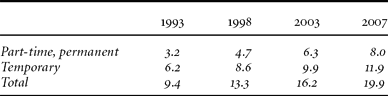
The figures also substantially confirm the growing relevance of atypical jobs over the last decade, the major contribution of the latter to the growth of employment, and the concentration of flexible contracts among the young. Since the early 1990s, flexible employment has almost doubled, accounting for about 20 per cent of total employment in 2007 (Table 5). It should also be noted that temporary employment – given its intrinsic nature, characterised by frequent periods of non-work – tends to be underestimated. Therefore, taking into account not just those employed in the reference week but also the unemployed if previously employed with a fixed-term contract, the population involved in temporary work rises from 2.8 million to around 3.7 million, that is about 30 per cent more (Ministero del Lavoro, della Salute e delle Politiche Sociali, 2008). Moreover, in the period 1995–2001 more than 60 per cent of the new job contracts were ‘atypical’ (Ministero del Welfare, 2001), and in 2006 more than half the increase in employment took the form of ‘non-standard’ contracts (CNEL, 2007).
Incidence of ‘atypical’, flexible contracts over total employment
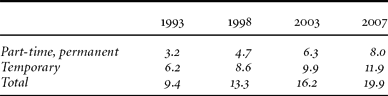
It has to be noted, however, that flexible jobs are unevenly distributed across the different cohorts: the incidence of fixed-term jobs, for example, varies from 42.3 per cent of total employment for those aged 15–24 to 12.2 per cent in the 35–49 age group and 6.4 per cent for those over 50 years of age.
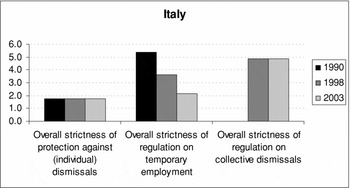
This means that flexibilisation of the Italian labour market has been pursued through the provision of ‘atypical employment’ for those entering the labour market or, more generally, for the younger generations. By contrast, rules for (both individual and collective) dismissals of workers hired with traditional standard contracts have not been modified, as captured by the striking continuity in ‘standard’ employment protection legislation (EPL) indexes (see Figure 2).
Employment protection legislation index, Italy, 1990–2003.
Source: OECD online labour market programmes database.

The growth of flexible working arrangements, which entail a lower level of ‘job protection’ for a growing share of workers, makes the other two pillars of the flexicurity strategy – income security and ALMP – more salient. And this is particularly true in a country like Italy, where the traditional bias towards job protection had historically counterbalanced the weaknesses and the gaps in ‘employment security’ (through effective ALMP) and ‘income security’ (through income protection in case of unemployment).
Selective income protection: from segmentation to polarisation
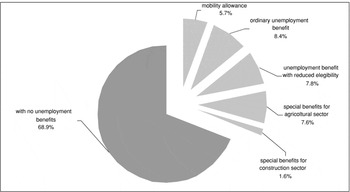
On the side of income security, given the lack of a comprehensive reform of the unemployment compensation system and the incremental upgrading of UB and UBR benefits illustrated above, segmentation does persist or, more precisely, it seems to have turned into polarisation. According to the data provided by the National Institute of Social Security (INPS) at the end of 2006, the recipients of ordinary unemployment benefit (excluding the agricultural sector) amounted to about 140,000 out of a total of almost 1.7 million unemployed (that is, 8.4 per cent; CNEL, 2007); even more important, taking into account all ordinary and special benefits, about 69 per cent of the unemployed had no income protection in case of unemployment (see Figure 3).
Unemployment benefits recipients (annual stock), Italy, 2006.
Source: Authors’ calculations, data from Ministero del Lavoro (2008).

Therefore, the policy innovations over the past two decades have not contributed to substantially reducing the traditional gap between the ‘insiders’ and the ‘outsiders’. Nevertheless, the reforms have modified the relative condition of the ‘mid-siders’, and this seems to be a crucial point to be made when considering the combination of flexibility and security for the various social groups. In fact, only a portion of ‘mid-siders’, namely those workers employed with permanent contracts in small firms, have benefited from the upgrading of work-based, contributory unemployment benefits since the 1990s; though still excluded from CIGS and the mobility allowance, in case of dismissals these workers are now entitled to more generous unemployment benefits than in the past, in terms of both duration and replacement rate (cf. Table 3).
By contrast, for most atypical workers – the other group within the ‘mid-siders’ cluster – the protection of income in case of unemployment is much weaker (if any). So-called project workers (labelled as co-co-co and co-co-pro workersFootnote 6) are in the most critical condition; in fact, although they actually work as dependent workers, they are formally self-employed and, as a consequence, not entitled to any kind of unemployment benefit. In 2008, project workers were estimated to number between 400,000 and 1 million (Ministero del Lavoro, della Salute e delle Politiche Sociali, 2008): that is, 2–4 per cent of the working population. Other categories, such as part-time, fixed-term and temporary agency workers (representing altogether around 20 per cent of total employment; cf. Table 5), despite being formally covered in case of unemployment, are likely to meet insurmountable obstacles in accessing ordinary unemployment benefits due to the strict eligibility requirements (see Table 3) and the existence of minimum thresholds for contributionsFootnote 7 (cf. Madama and Sacchi, Reference Madama and Sacchi2007). These workers may have a better chance of accessing the UB with reduced eligibility, as only 78 days of work in the previous year are required in order to be entitled to such benefits (plus two years insurance seniority, see Table 3).Footnote 8 Nevertheless, this does not fill the gap with respect to the ‘insiders’ because UBR is much lower than ordinary UB and, even more important, benefits are not paid at the moment of job loss, but as a lump sum transferred during the year following the onset of unemployment. Therefore, many months may elapse before the benefit is actually paid, and this undermines the effectiveness of such provision in supporting the income of ‘atypical’ workers in periods of unemployment.
If access to full contributory benefits thus seems unlikely for ‘atypical’ workers in Italy, their condition is further exacerbated by the lack of both a social assistance unemployment benefit and a universal last resort social safety net: that is, a means-tested minimum income scheme for all those in need (Ferrera, Reference Ferrera2005). In the second half of the 1990s, the Prodi government actually set up an experimental ‘Minimum Insertion Income’ (MII, Decree 237/98), which was designed as a non-categorical, means-tested measure, addressed to everyone under a pre-defined poverty threshold. However, the pilot scheme of a fully fledged social assistance pillar – that may have broken the traditional contributory approach in unemployment protection – was aborted in 2002 when the social pact (‘Pact for Italy’) between the centre-right Berlusconi government and the two more moderate unions (Cisl and Uil) implicitly put an end to the MII experiment (see Ferrera, Reference Ferrera2005; Jessoula and Alti, Reference Jessoula, Alti and Palier2010). As a consequence, there is still a dramatic gap between Italy and other EU countries with reference to social assistance programmes, which is confirmed by data on expenditure levels: in 2006, public social expenditure for the ‘housing and social exclusion’ function was 0.1 per cent of GDP in Italy compared to an EU-15 average of 0.9 per cent (EUROSTAT data).
From passive policies to activation . . . and back
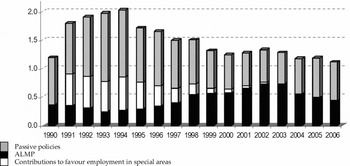
Turning to activation and promotion of employment: in the 1990s, some (first) steps forward were taken, and the resources directed at ALMPs increased between 1993 and 2003. Nonetheless, Italian expenditure is still low if compared with other European countries: 0.43 per cent of GDP in 2006, versus 1.74 per cent in Denmark, 0.97 per cent in France and 0.9 per cent in Germany. Furthermore, since 2003 there is evidence of a declining trend in expenditure on ALMPs (Figure 4) and an increase in resources dedicated to passive measures (0.68 per cent of GDP in 2006), which suggests a (partial) return to the traditional pattern of predominance of compensatory measures for the unemployed, with no overall increase in employment policy public expenditure. This is particularly detrimental for the outsiders and the ‘mid-siders’ on atypical contracts, as these groups, being exposed to recurrent periods of unemployment, are in great need of effective and efficient (re-)insertion programmes.
Expenditure on labour market policies by type, Italy, 1990–2006.
Source: Ministero del Lavoro (2008: 42).

In addition, although the devolution of responsibility to regions and the ‘regulated liberalisation’ of job placement services have represented key steps in the rationalisation of Italian employment policy, some challenges have still to be dealt with, especially with regard to the implementation of these reforms (Sestito and Pirrone, Reference Sestito and Pirrone2006). In fact, the effectiveness of employment services centres (SPI) differs significantly over the country: if a large share of SPI (about 80 per cent) do offer individual counselling services in order to provide tailored assistance to the unemployed, only four out of ten monitor progress and verify compliance (Ministero del Lavoro, della Salute e delle Politiche Sociali, 2008).
On the issue of life-long learning, despite the increasing importance accorded to continuous training, a study by the National Statistical Office (ISTAT, 2007) has pointed out that the provision of life-long learning programmes has so far been very limited. In 2006, participation in life-long learning programmes among those aged 25–64 comprised 6.1 per cent of the population against an EU-15 average of 11.1 per cent. Also, considering employed people only, the Italian situation is not in line with EU standards: 6.1 per cent involved compared to 12.1 per cent in the EU-15, whereas for the unemployed the rate is slightly higher (6.7 per cent), though still significantly below the EU-15 average (9.7 per cent) (Ministero del Lavoro, della Salute e delle Politiche Sociali, 2008).
Conclusions
From the analysis presented in previous sections, we may draw two major conclusions. The first is substantive, concerning the development of Italian employment policy; the second discusses some implications for further analysis and research.
Since the early 1990s, employment policy reforms in Italy have affected the three pillars of the ‘flexicurity strategy’, but the interventions adopted have not been adequately balanced across the three dimensions (job flexibility, income security and employment security) and, even more important, they have been characterised by a high degree of selectivity. In fact, first, flexibility has been pursued to a much greater extent than (social) security and the development of ALMPs and learning programmes. Second, flexibilisation has been introduced for new entrants to the labour market, while employment protection legislation for the insiders has not been changed. This implies that two different patterns of employment are emerging in the national labour market: the first for the ‘insiders’, based on permanent contracts and a still high level of job protection; the second for ‘newcomers’ entering the labour market with ‘atypical’, mainly short-term, contracts and virtually no job protection. This holds even more true since transition from flexible contracts to permanent jobs has proven to be quite difficult: the Ministry of Labour estimates that 70.5 per cent of those employed on temporary contracts in 2006 were still on fixed-term jobs one year laterFootnote 9 (Ministero del Lavoro, della Salute e delle Politiche Sociali, 2008). Third, selectivity has also characterised the few measures adopted to strengthen social security for the unemployed: in fact, improvements have mostly regarded the work-based contributory schemes, whereas dedicated social assistance schemes and minimum income protection have registered no progress. These developments are even more striking if we consider that the effectiveness of employment services still needs to be increased and life-long learning needs to be improved. Therefore, it seems that Italian policy-makers have favoured an overall strategy that, for the above-mentioned reasons, may be labelled as ‘selective flexicurity’. What are the consequences of this approach in a segmented labour market, with particular reference to the three groups identified above?
In a nutshell, segmentation seems to be leaning towards a new form of ‘tripartition’. The paradox whereby the ‘insiders’ continue to enjoy a high degree of job security as well as strong income protection in case of unemployment is still in place, while other developments have modified the conditions of the other two groups. Due to the stepwise upgrading of contributory UB and UBR, workers employed with typical contracts in small/medium firms – that is, a substantial portion of the ‘mid-siders’ – have improved their position, which is currently more similar to that of the ‘insiders’. By contrast, at the bottom of the ladder we find the ‘mid-siders’ on atypical jobs and the ‘outsiders’ whose situation displays some similarities: they tend to be in (very) low-paid jobs; they have no job protection and consequently they often experience periods of unemployment; and they are usually not entitled to benefits aimed at either replacing income or reducing poverty. Moreover, transitions between the two groups have become more frequent as the ‘outsiders’ have benefited from the growth of employment in the last years; that is, about 3 million since 1997. Nevertheless, these similarities must not be overestimated as the degree of ‘inclusion’ of the two groups is actually quite different; the ‘mid-siders’ are in fact employed in the formal economy, while the ‘outsiders’ are either inactive or they work in the informal sector. Hence, (at least) some ‘mid-siders’ are formally entitled to income maintenance benefits, although it is actually very difficult for them to fulfil the eligibility requirements, while the ‘outsiders’ generally have nothing to rely on.
Also, it is important to stress that even in the 2008–9 economic crisis things have not significantly changed. In fact, although the government seems to have acknowledged the risks for social cohesion that recent employment trends may bring in the light of the shortcomings of Italian employment policy (the employment rate has fallen from 59.2 per cent to 57.0 per cent, unemployment has increased from 6.7 per cent to 8.6 per cent in the period June 2008–December 2009), the Berlusconi IV cabinet has for now refused to exploit the severe recession (–5.0 per cent GDP growth in 2009) in order to put forward an encompassing reform of the unemployment protection system (Jessoula, Reference Jessoula, Giuliani and Jones2010).
The government has in fact favoured a strategy that relies on existing programmes to tackle the social consequences of the employment crisis. More precisely, this approach aims to allow firms temporarily to reduce the employed labour force without definitive dismissal while compensating workers in case of working-time reduction. This has been pursued through two measures: the extension of wage replacement benefit schemes (CIGO and CIGS) to sectors/firms not covered, and the extension of UB and UBR to cover temporary suspension from work.
It is certainly too early to provide a comprehensive account of the government's action in the field; however, it seems that, if such a strategy may be partly effective in the short run because it avoids massive lay-offs, it presents some major weaknesses. First, including temporary (for the period 2009–2011) and marginal adjustments of existing schemes only, it does not help to overcome the Italian deficiencies illustrated above; second, as eligibility requirements for UB/UBR have not changed and significant discretion is left to the social partners for the activation of CIGO/CIGS as well as the decision on which workers must be protected, the measures adopted may not be sufficient to provide income maintenance to the ‘mid-siders’ on ‘atypical’ contracts. The latter point is particularly important as data show that the ‘flexible mid-siders’ – rather than being protected through the emergency measures – are the first ‘victims’ of the crisis: employment reduction has in fact been particularly high among fixed-term workers and other ‘atypical’ workers, as well as part-timers (about 400,000 ‘flexible’ jobs lost in 2009, cf. Jessoula, Reference Jessoula, Giuliani and Jones2010). Moreover, the only innovative measure introduced in 2009 consisted of the provision of a lump-sum compensation benefit for those project workers whose contracts terminated in late 2008 and/or early 2009. However, the amount is extremely low and, above all, eligibility conditions are tight, so that only a minority of project workers are actually (poorly) protected.
Finally, we want to conclude by discussing the consequences of our analysis. The first point is that flexicurity measures may be pursued differently for different categories of workers, thus contributing to increase labour market segmentation, as in the Italian case. The second point is that, as we have illustrated, the concept of ‘mid-siders’ has proven to be quite fruitful in the analysis of Italian employment policy, whereas an analysis based on the traditional ‘insiders–outsiders’ divide would have missed a relevant (if not the whole) part of the story. Our contention, then, is that this concept may be able to ‘travel’ across countries and may be successfully applied to the study of employment policy reforms in other cases. In fact, there is evidence of workers who are similar to the Italian ‘mid-siders’: such as those on mini/midi-jobs in Germany, the dependent (that is, ‘fake’) self-employed in Greece and Poland, as well as the ‘insecure and marginalised’ workers identified by Hutton (Reference Hutton1995) in Britain.
Moreover, a focus on the ‘mid-siders’ may be promising for two other reasons. From a policy analysis perspective, the measures needed to build up a flexible and secure labour market for the ‘mid-siders’ may be substantially different from those required to improve security for the ‘outsiders’. From a political science perspective, the political dynamics behind policy changes affecting the ‘mid-siders’ still need to be investigated; for example, what accounts for the differential upgrading of unemployment benefits for the two groups of ‘mid-siders’ in Italy, and/or in other European countries? Clearly, there seems to be much room for ‘fresh’ and fertile research.
The research has been conducted under the auspices of the Network of Excellence “Recwowe”, whose members we would like to thank for comments on previous draft of the paper.