Introduction Peanut's importance in the world, and some peculiarities of its biology
Peanut, also commonly known as groundnut (Arachis hypogaea), is a major food crop, grown throughout the tropics and sub-tropics. World annual production is about 38 million tonnes. Like so many other crops, it has become most important in regions of the world far from its original home. Peanut is particularly important in Asia, which accounts for 64% of the world production, and where it provides a similar number of calories to soya. In Africa, which accounts for 26% of the world production, peanut has a key role as providing protein, energy and iron; amazingly, on this continent, its production exceeds that of all other grain legumes put together. In the USA, largely due to the research efforts of Dr George Washington Carver, peanut became an important crop in the South. The USA now accounts for some 6% of the world production. South America currently produces only 3% of the world production, but it is there that the genus Arachis is endemic, and cultivated peanut originally arose (production Statistics from 2008 (FAOSTAT, 2008)).
The first written reference to peanut seems to have been published in 1535 by Gonzalo Hernández de Oviedo y Valdés in his chronicles of his travels in the Americas. He wrote that maní (peanut) ‘is very common with the Indians’, and, in words that ooze the historical context of colonization, that ‘Christians take little comfort in them, being eaten mostly by lowly men and boys and slaves and by people who do not pardon their taste for anything’. Over 200 years later, peanut was given its scientific name by Linnaeus, in his Species Plantarum of 1753. It was the first of its genus described, and thus became the genus' type species. The species epithet hypogaea refers to the character that perhaps mostly calls attention to this remarkable plant. It is geocarpic, that is, its fruits develop below the ground. Geocarpy is rare among flowering plants, but it is important to note that it is not unique. It is present in a wide array of species, from monocots (Meney et al., Reference Meney, Pate and Dixon1990) to other legumes (e.g. subterranean clover Trifolium subterraneum L. and bambara groundnut Voandzeia subterranean L.). However, these genera and species are phylogenetically scattered, and geocarpy seems to have developed many times by convergent evolution, in some cases, apparently in response to arid environments (Barker, Reference Barker2005). Accordingly, it is an adaptation to heat and drought that are key to peanut's success as a crop plant in many regions of its cultivation.
The flowers of Arachis species appear superficially similar to other Papilionoid legumes; however, there are intriguing differences that relate to geocarpy. The ovary is not enclosed by the petals, but is at the base of what appears to be the flower stalk. In fact, this ‘stalk’ is a hollow structure named a hypanthium, through which runs the style. The hypanthium is typically 1–2 cm long, but in some species may be up to 15 cm. After fertilization, the embryo undergoes only a very few cell divisions and then becomes quiescent. Then, the intercalary meristem of the ovary begins to elongate forming a ‘peg’ structure with the ovary just behind the lignified tip. This peg grows downwards and penetrates the soil, where embryo development resumes and the pod is formed (Smith, Reference Smith1950). In A. hypogaea, the pods develop only a centimetre or two below the soil surface, but in wild species, they develop much further down. In A. hypogaea, the seeds in the pods develop side by side in much the same way as pea seeds. However, in wild species, the development of an intercalary meristem between the (typically two) seeds draws out the pod between the seeds into a long thread-like isthmus. This creates a space between the seeds and, when they germinate, the competition between the seedlings is reduced (Krapovickas and Gregory, Reference Krapovickas and Gregory1994).
The position of the genus Arachis within the legumes
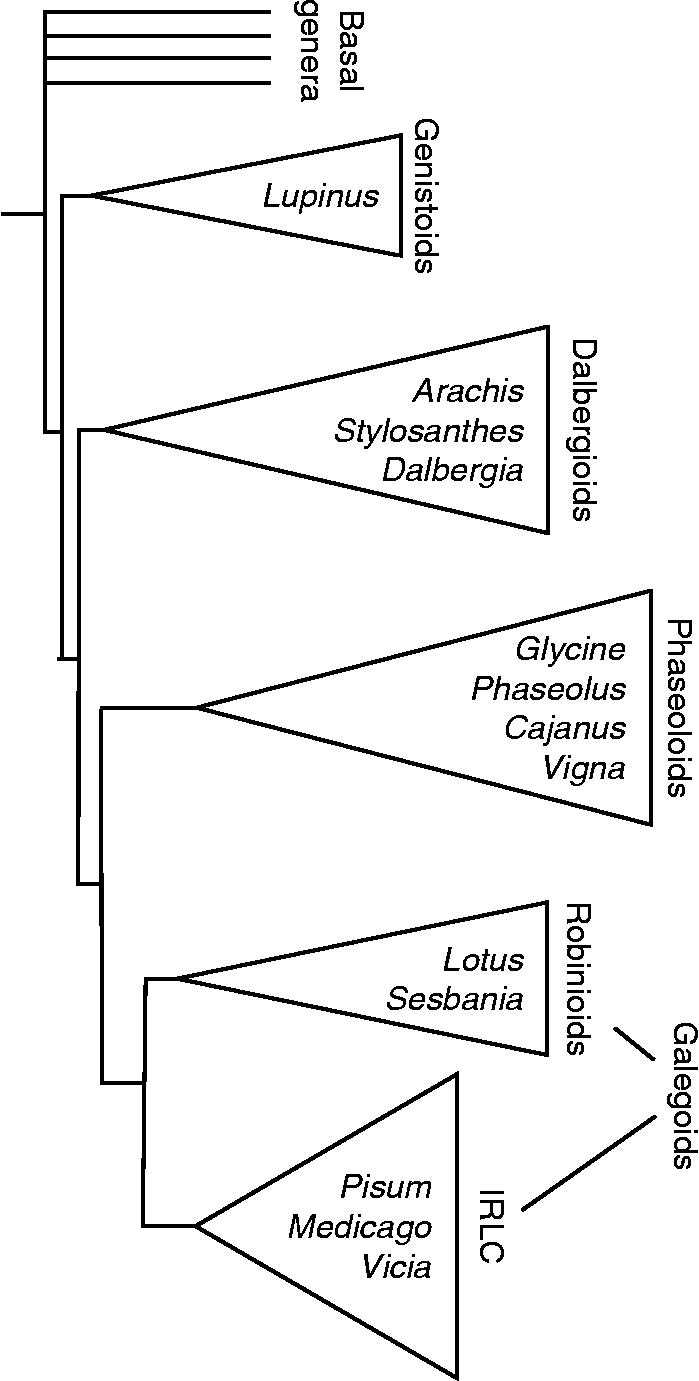
The legume family (Fabaceae or Leguminosae) is divided into three very large subfamilies, Mimosoideae, Caesalpinioideae and Papilionoideae. Almost all economically important legumes fall within two sub-clades of the Papilionoideae that diverged from each other some 50 Myr ago, the Phaseoloids and Galegoids (Fig. 1; Wojciechowski et al., Reference Wojciechowski, Lavin and Sanderson2004; Lewis et al., Reference Lewis, Schrire, Muackinder and Lock2005).
A tree representation of the phylogeny of the Papilionoids with triangles representing the major clades, and the two subclades of the Galegoids; the Robinioids and the IRLC (plastid DNA inverted repeat lacking clade). Names of some notable genera are placed within the triangles. Note that Arachis, which is a member of the Dalbergioids, represents a more basally diverged clade than the Phaseoloid or Galegoid legumes. The figure is from Bertioli et al. (Reference Bertioli, Moretzsohn, Madsen, Sandal, Leal-Bertioli, Guimarães, Hougaard, Fredslund, Schauser, Nielsen, Sato, Tabata, Cannon and Stougaard2009) and is a simplified and stylized phylogeny based on a tree in Wojciechowski et al. (Reference Wojciechowski, Lavin and Sanderson2004).

The Phaseoloids, also known as the ‘warm season’, ‘tropical’ or ‘millettioid’ clade, is a pan-tropical group with a base chromosome number of 1n = 11 or 12. This clade includes bean (Phaseolus vulgaris), cowpea (Vigna unguiculata), soya (Glycine max) and pigeon pea (Cajanus cajan).
The Galegoids, also known as the ‘cool season’, ‘temperate’ or ‘Hologalegina’ clade, include over 4800 species with their centre of distribution in Europe and the Mediterranean and make up the vast majority of legumes distributed in temperate regions of the world. This clade includes clover (Trifolium ssp.), pea (Pisum sativum), lentil (Lens culinaris), field bean (Vicia faba), chickpea (Cicer arietinum) and alfalfa (Medicago sativa).
However, Arachis falls in a different Papilionoid clade, the Dalbergioids. This clade is more basal in its divergence than the phaseoloids and galegoids (Fig. 1). The Dalbergioids are predominantly New World and tropical and have an ancestral chromosome number of 1n = 10. All species of Arachis are geocarpic, but none of the species in its sister genus Stylosanthes have this trait. In this way, geocarpy taxonomically clearly defines the genus Arachis. Also, most unusually among flowering plant genera, the most significant characters that separate the species of the genus are not above ground, but below, the fruits, rhizomatous stems, root systems and hypocotyls (Krapovickas and Gregory, Reference Krapovickas and Gregory1994).
Because of geocarpy, an individual plant within the genus Arachis can usually disperse its seed only about 1 m/year. Plausible agents of distribution over longer distances are water and in some special cases, humans. The species also show a predominance of autogamous and asexual reproduction, and a steady evolutionary drift that leads to noticeable incompatibilities between different collections of the same species. These factors are fundamental to the biology and taxonomy of the genus, and make it more complex than most.
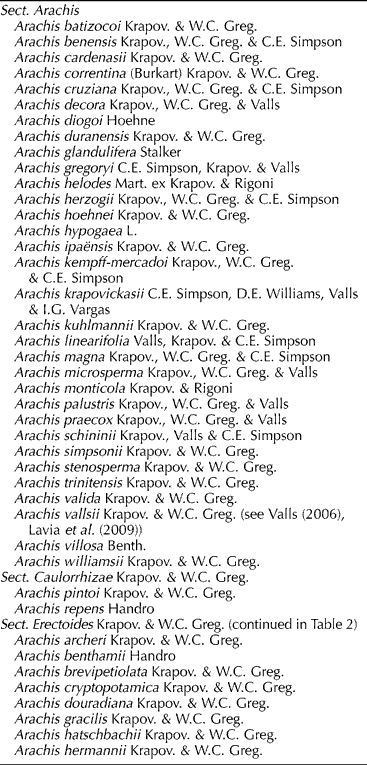
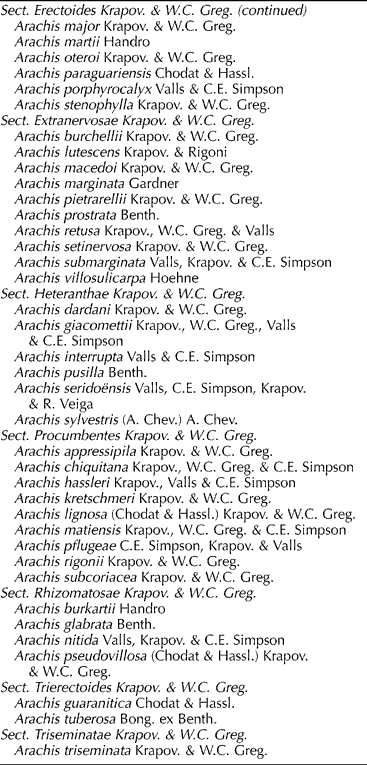
By mid-20th century, some 10–15 species had been described, but among these, there were numerous confusions. At this point began the work of a group of researchers based within the Americas, who with systemic collections, extensive experimental crosses, morphological observations and cytogenetics would produce the first broad treatment of the genus. Their landmark monograph recognized 69 species, it was published in Spanish, and recently has been translated into English (Table 1; Krapovickas and Gregory, Reference Krapovickas and Gregory1994; Krapovickas and Gregory, Reference Krapovickas and Gregory2007). Subsequently, 11 new species have been described (Table 1; Valls and Simpson, Reference Valls and Simpson2005), also around ten more have been collected in the last decade but still have to be formally described.
Described sections and species of the genus Arachis part 1 (synonyms not listed)

Based on: Krapovickas and Gregory (Reference Krapovickas and Gregory1994), Valls and Simpson (Reference Valls and Simpson2005), and Lavia (Reference Lavia, Ortiz and Fernández2009).
Described sections and species of the genus Arachis part 2 (synonyms not listed)

Based on: Krapovickas and Gregory (Reference Krapovickas and Gregory1994), Valls and Simpson (Reference Valls and Simpson2005), and Lavia (Reference Lavia, Ortiz and Fernández2009).
The distribution and ecology of the genus
The genus is distributed within a large region of South America, which extends from the eastern foothills of the Andes Mountains in Bolivia and northern Argentina to the Atlantic coast in Brazil and from the southern limit of the Amazonian rainforest towards the northern coast of La Plata River in Uruguay (Fig. 2; Krapovickas and Gregory, Reference Krapovickas and Gregory1994). Within this area, the species may either have extended ranges or be limited to only one collection site. The distribution areas of the species may overlap, but sympatric populations are rarely observed. Some of the species are composed of populations scattered throughout the entire species range, but others occur in a few small populations often separated by long distances. Reflecting the geocarpic habit, each population usually has tens to hundreds of individuals, arranged in patches of different sizes or with a more or less regular distribution.
Geographic distribution of all the species in the genus Arachis (delimitated by dashed line) and the distribution of the species in the section Arachis (delimitated by darker grey area). The discontinuous section Arachis area on the coast of Brazil is of Arachis stenosperma. This distribution is almost certainly not natural. This species was cultivated for food by native peoples, and it is believed that plants in this region are descendants of plants that persisted and spread in the wild after escaping from cultivation.

Arachis species are adapted to a wide variety of habitats. They can be found in the xerophytic forests, in temporarily flooded areas, in grasslands and in open patches of the sub-tropical rainforest. Soil preferences are diverse ranging from rock outcrops, layers of laterite pebble, heavy soils, poorly drained areas to well drained sandy soils. They grow spontaneously from sea level on the Atlantic coast in Brazil and Uruguay to around 1450 m in the Andes Mountains of Northwestern Argentina. In spite of the ample range of ecological preferences displayed by the wild species, the genus as a whole is mainly associated with the savannah-like Cerrado biogeographical region as defined by Cabrera and Willink (Reference Cabrera and Willink1973).
According to the distribution of ancestral characters, it has been proposed that the genus originally evolved in an area that divides the Parana and Paraguay River basins in Mato Grosso do Sul State (Brazil) and northern Paraguay (Krapovickas and Gregory (Reference Krapovickas and Gregory1994)). However, the major centre of morphological, cytogenetic and genetic variation for the genus is around the Brazilian and Bolivian pantanal (Gregory et al., Reference Gregory, Krapovickas, Gregory, Summerfield and Bunting1980; Fernández and Krapovickas, Reference Fernández and Krapovickas1994; Lavia, Reference Lavia1999).
The infrageneric taxonomy of Arachis
Based on morphology, cross-compatibility, viability of the hybrids, geographic distribution and cytogenetics, the Arachis species have been arranged in nine taxonomic sections: Trierectoides, Erectoides, Procumbentes, Rhizomatosae, Heteranthae, Caulorrhizae, Extranervosae, Triseminatae and Arachis (Krapovickas and Gregory, Reference Krapovickas and Gregory1994; Fernández and Krapovickas, Reference Fernández and Krapovickas1994; Lavia, Reference Lavia1999; Valls and Simpson, Reference Valls and Simpson2005). Among these, the section Trierectoides is considered to have the most ancestral characters, such as tuberous hypocotyls or roots, trifoliated leaves and vaginated stipules, the last two of these characters resembling those present in the genus Stylosanthes. On the other hand, the section Arachis is considered to be the most diverse and derived, harbouring both annual and perennial species and different chromosome numbers, ploidy levels and karyotype structures. Between these two sections, species that belong to sections Erectoides and Procumbentes seem to be the most related to those within the section Arachis. Some of the members of sections Rhizomatosae, Heteranthae and Caulorrhizae may produce hybrids with the most derived sections, but others show a strong genetic isolation. Sections Extranervosae and Triseminatae are the most isolated sections, and their evolutionary position has to be determined (Krapovickas and Gregory, Reference Krapovickas and Gregory1994). Recent phylogenies of rDNA sequences that use Stylosanthes as outgroups generally support the grouping of the species within the sections, but do not support Trierectoides as the most primitive. They suggest that sections Extranervosae, Heteranthae and Triseminatae are most primitive, section Arachis is the most derived, and that sections Caulorrhizae, Erectoides, Procumbentes, Rhizomatosae and Trierectoides are intermediate in position (Wang et al., Reference Wang, Wang, Tang, Chen, Cui, Zhang and Yu2010; Bechara et al., Reference Bechara, Moretzsohn, Palmieri, Monteiro, Bacci Júnior, Valls, Lopes and Gimenes2010).
The species relationships within the botanical section Arachis, and the most probable ancestors of cultivated peanut
Among the nine different sections, the type section Arachis has received particular attention because it contains the cultivated peanut and its putative wild progenitors. In accordance with its status as the most evolutionarily derived section, geographically it is the most widely distributed (Fig. 2). It extends in an east–west direction between the Chapada dos Parecis in the central west of Mato Grosso State (Brazil) and the northern edge of the Chacoan region. From this latitudinal central axis, in the east, the species extend towards the northeast along the Tocantins River (central Brazil) and southward along the Paraguay–Paraná and Uruguay River Basins (Paraguay, Argentina and Uruguay) reaching the northern shore of La Plata River. In the west, they are found towards the northwest along the Mamoré and Guaporé Rivers in north Bolivia and towards the southwest along the Parapetí, Pilcomayo, Bermejo, San Francisco and Juramento River Basins in southern Bolivia and northern Argentina. In its centre, the section Arachis overlaps with sections Procumbentes, Erectoides and Trierectoides, towards the southeast with section Rhizomatosae, and from the centre towards the northwest with section Extranervosae. It has parapatric distribution with sections Caulorrhizae and Heteranthae at the northwest edge of its distribution. Section Triseminatae is the only one with a completely separate distribution from the Arachis section area (Krapovickas and Gregory, Reference Krapovickas and Gregory1994).
The chromosomes of the section Arachis species are small and mostly metacentric. In spite of this, analyses of karyotypes do provide valuable information. Diploid species with 2n = 20 have been assigned to three different genomes, A, B and D. The species with the A genome are characterized by a small pair of chromosomes with allocyclic condensation, ‘the A chromosomes’ after Husted (Reference Husted1936) (Smartt et al., Reference Smartt, Gregory and Gregory1978). The remaining species with symmetric karyotypes but without A chromosomes have been considered members of the B genome (Smartt et al., Reference Smartt, Gregory and Gregory1978; Smartt and Stalker, Reference Smartt, Stalker, Pattee and Young1982; but also see later in manuscript). The only species with an asymmetric karyotype (Arachis glandulifera) is classified as having the D genome (Stalker, Reference Stalker1991). Diploid species with 2n = 18 are not well characterized, and their genome constitution still has to be determined (Lavia, Reference Lavia1996, Reference Lavia1998; Peñaloza and Valls, Reference Peñaloza, Valls, Veiga, Bovi, Betti and Voltan1997). Cultivated peanut and the wild Arachis monticola are allopolyploid species (2n = 40) and have an AABB genome constitution (Husted, Reference Husted1936; Smartt et al., Reference Smartt, Gregory and Gregory1978; Fernández and Krapovickas, Reference Fernández and Krapovickas1994). Analysis using molecular markers corroborates the division of the section into two main groups consisting of the A and B genomes, with the D genome and the three 2n = 18 species being closely related to the B genome species (Halward et al., Reference Halward, Stalker, Larue and Kochert1992; Moretzsohn et al., Reference Moretzsohn, Hopkins, Mitchell, Kresovich, Valls and Ferreira2004; Milla et al., Reference Milla, Isleib and Stalker2005; Tallury et al., Reference Tallury, Hilu, Milla, Friend, Alsaghir, Stalker and Quandt2005; Bravo et al., Reference Bravo, Hoshino, Angelici, Lopes and Gimenes2006; Gimenes et al., Reference Gimenes, Hoshino, Barbosa, Palmieri and Lopes2007; Cunha et al., Reference Cunha, Nobile, Hoshino, Moretzsohn, Lopes and Gimenes2008; Tang et al., Reference Tang, Zhuang, Gao, He, Han, Shan, Jiang and Li2008). Further supporting these main divisions within the sections, for diploids, there is a remarkable correlation between the presence of A chromosomes and perennial growth habit. All A genome species are perennials, except Arachis duranensis and Arachis schininii. Indeed, it has been commented that without the tetraploid AABB genomes to unify them, the A and B genome species could have been placed into two distinct sections.
Because the A and B genomes are closely related to the genomic components of cultivated peanut, the fine structure of the relationships of the species with these genomes is worth considering more closely.
For the A genome species, three different karyotype subgroups could be established on the basis of the number of rDNA loci and chromosomes with centromeric heterochromatin (Robledo et al., Reference Robledo, Lavia and Seijo2009). Within this scheme, the A genome of A. hypogaea falls into the same subgroup as A. duranensis, Arachis villosa, A. schininii and Arachis correntina. Concerning molecular studies, the placement of diploid and tetraploid species in the same study is problematic, because the latter should occupy not one, but two, positions within a tree of relationships. In spite of this, A. hypogaea often falls closely to A. duranensis, which, in turn, is most closely associated with A. villosa, Arachis stenosperma and Arachis diogoi (Moretzsohn et al., Reference Moretzsohn, Hopkins, Mitchell, Kresovich, Valls and Ferreira2004; Milla et al., Reference Milla, Isleib and Stalker2005; Bravo et al., Reference Bravo, Hoshino, Angelici, Lopes and Gimenes2006; Cunha et al., Reference Cunha, Nobile, Hoshino, Moretzsohn, Lopes and Gimenes2008; Tang et al., Reference Tang, Zhuang, Gao, He, Han, Shan, Jiang and Li2008; Koppolu et al., Reference Koppolu, Upadhyaya, Dwivedi, Hoisington and Varshney2010).
The species included within the B genome are more diverse in their karyotype formulas (Fernández and Krapovickas, Reference Fernández and Krapovickas1994) and karyotype structure (Seijo et al., Reference Seijo, Lavia, Fernández, Krapovickas, Ducasse and Moscone2004). The analysis of heterochromatin distribution and rDNA loci mapping by FISH demonstrated that these species can be arranged into three different groups. Species included in each group have a strong genetic isolation with those included in the other groups. On this basis, the B genome sensu lato or, as they may be better termed the ‘non-A genome’ taxa, were segregated into three different genomes: B sensu stricto, F and K (Seijo et al., Reference Seijo, Lavia, Fernández, Krapovickas, Ducasse and Moscone2004; Robledo and Seijo, Reference Robledo and Seijo2010). The B genome s.s. is deprived of centromeric heterochromatin and consists of the B component of A. hypogaea, Arachis ipaënsis, Arachis magna, Arachis gregoryi, Arachis valida, and Arachis williamsii. The other two genomes have centromeric bands on most of the chromosomes, but differ in the amount and distribution of heterochromatin. The molecular data provide strong support for the division of the B genome s.s. from the other non-A genomes. Often, A. hypogaea is associated with A. ipaënsis, but also to A. magna, A. williamsii, A. gregoryi and A. valida (Moretzsohn et al., Reference Moretzsohn, Hopkins, Mitchell, Kresovich, Valls and Ferreira2004; Milla et al., Reference Milla, Isleib and Stalker2005; Tallury et al., Reference Tallury, Hilu, Milla, Friend, Alsaghir, Stalker and Quandt2005; Bravo et al., Reference Bravo, Hoshino, Angelici, Lopes and Gimenes2006). The other group usually contains Arachis batizocoi, Arachis benensis and Arachis cruziana. The only study that included Arachis krapovickasii grouped it to these later three species (Moretzsohn et al., Reference Moretzsohn, Hopkins, Mitchell, Kresovich, Valls and Ferreira2004).
The exact genetic origin of cultivated peanut has long interested plant taxonomists, geneticists and breeders. Initially, a different origin for each subspecies (see below) was advanced based on the morphological variability and their partial reproductive isolation (Singh and Moss, Reference Singh and Moss1982; Lu and Pickersgill, Reference Lu and Pickersgill1993). However, most authors now support the hypothesis that A. hypogaea is an allotetraploid derived from just two wild diploid species, and indeed probably between very few individuals of these diploid species. This is supported by the very limited genetic variability among landraces and commercial cultivars of A. hypogaea, and from its molecular cytogenetics (Halward et al., Reference Halward, Stalker, Larue and Kochert1991; Kochert et al., Reference Kochert, Stalker, Gimenes, Galgaro, Lopes and Moore1996; Raina et al., Reference Raina, Rani, Kojima, Ogihara, Singh and Devarumath2001; Seijo et al., Reference Seijo, Lavia, Fernández, Krapovickas, Ducasse and Moscone2004, Reference Seijo, Lavia, Fernández, Krapovickas, Ducasse, Bertioli and Moscone2007; Milla et al., Reference Milla, Isleib and Stalker2005). It is also apparent that the wild tetraploid A. monticola is very closely related to A. hypogaea; indeed, they most probably share the same origin and are the same biological species. They have very high crossability, cytogenetically the species are indistinguishable, and molecular studies show they are very closely related. They could not be differentiated based on isozymes (Lu and Pickersgill, Reference Lu and Pickersgill1993), random amplified polymorphic DNA (RAPD; Hilu and Stalker, Reference Hilu and Stalker1995; Cunha et al., Reference Cunha, Nobile, Hoshino, Moretzsohn, Lopes and Gimenes2008) and some microsatellite markers (Gimenes et al., Reference Gimenes, Hoshino, Barbosa, Palmieri and Lopes2007; Koppolu et al., Reference Koppolu, Upadhyaya, Dwivedi, Hoisington and Varshney2010). However, various studies, based on amplified fragment length polymorphism (AFLP), microsatellite and sequence-related amplified polymorphism markers, have shown that A. monticola does have enough genetic divergence to form a separate group (Gimenes et al., Reference Gimenes, Lopes and Valls2002; Moretzsohn et al., Reference Moretzsohn, Hopkins, Mitchell, Kresovich, Valls and Ferreira2004; Milla et al., Reference Milla, Isleib and Stalker2005; Bravo et al., Reference Bravo, Hoshino, Angelici, Lopes and Gimenes2006; Ren et al., Reference Ren, Huang, Liao, Zhang and Jiang2010).
Based on the evidence cited above, on whole genome in situ hybridization and on biogeographic information (Fig. 3; also see below), it is currently accepted that A. duranensis (AA genome) and A. ipaënsis (BB genome) are the most probable ancestors of A. monticola and A. hypogaea (Fernández and Krapovickas, Reference Fernández and Krapovickas1994; Kochert et al., Reference Kochert, Stalker, Gimenes, Galgaro, Lopes and Moore1996; Seijo et al., Reference Seijo, Lavia, Fernández, Krapovickas, Ducasse and Moscone2004; Seijo et al., Reference Seijo, Lavia, Fernández, Krapovickas, Ducasse, Bertioli and Moscone2007). These species, either by hybridization followed by chromosome duplication or by fusion of unreduced gametes, produced an AABB genome individual, probably A. monticola or a similar wild tetraploid. This event may have occurred in the wild, or spontaneously when the two diploids were cultivated in close proximity by ancient inhabitants of South America. Morphologically diverse landraces of peanut could then have arisen by artificial selection of the polyploid in different agroecological environments by ancient South American itinerant farmers (Krapovickas, Reference Krapovickas2004).
(A) Geographic distribution of the putative wild progenitors of peanut and the major centre of variability of Arachis hypogaea var. hypogaea (adapted from Seijo et al. (Reference Seijo, Lavia, Fernández, Krapovickas, Ducasse and Moscone2004)). (B) Somatic metaphases of A. hypogaea after 4-6-diamidino-2-phenylindole (DAPI) staining showing half of the chromosomes with heterochromatic bands. (C) Same metaphase after double genomic in situ hybridization using total DNA probes from Arachis ipaensis (red) and Arachis duranensis (green) (B and C from Seijo et al. (Reference Seijo, Lavia, Fernández, Krapovickas, Ducasse, Bertioli and Moscone2007)). (D) Idiograms of A. hypogaea/A. monticola and their most probable wild ancestors (A. duranensis and A. ipaensis) showing the distribution of 5S (green) and 18S–25S (red) rDNA loci, and the DAPI-enhanced heterochromatic bands (white) (adapted from Seijo et al. (Reference Seijo, Lavia, Fernández, Krapovickas, Ducasse and Moscone2004)).

As for the geographical origin, archaeological studies indicate the presence of A. hypogaea in the Huarmey Valley in Peru (5000 year BP) (Bonavia, Reference Bonavia1982) and of pod samples that strongly resemble those of wild species, in the Casma Valley also in Peru (3500 and 3800 year BP). These locations are perfect for the preservation of archaeological specimens because of their dry climates, but are far from the present day natural distribution of wild Arachis. This strongly suggests that ancient peoples were cultivating Arachis in northwest Peru, and it is even possible that these sites were the location of origin of A. hypogaea (Simpson and Faries, Reference Simpson and Faries2001). However, it seems more likely that this occurred in moister environments where there are more abundant populations of bees that could serve as agents for cross pollination. The morphological variability of the landraces, the distributions of the putative A and B genome donors and the location of A. monticola place the most likely location origin of the domesticated peanut in northern Argentina and southern Bolivia, in a transition area between the Tucumano-Bolivian forest and the Chaco lowlands (Fig. 3; Gregory et al., Reference Gregory, Krapovickas, Gregory, Summerfield and Bunting1980; Krapovickas and Gregory, Reference Krapovickas and Gregory1994).
The genetic behaviour of peanut
From genetic maps, it is apparent that the order of molecular markers in the A and B genomes is mostly co-linear with only a few major rearrangements that distinguish them (Burow et al., Reference Burow, Simpson, Starr and Paterson2001; Moretzsohn et al., Reference Moretzsohn, Barbosa, Alves-Freitas, Teixeira, Leal-Bertioli, Guimarães, Pereira, Lopes, Cavallari, Valls, Bertioli and Gimenes2009). This emphasizes the similarity of the two genome components. However, the A and B genomes must have important differences because cultivated peanut is an allotetraploid that is well diploidized genetically; almost all chromosome pairing during meiosis is bivalent, and no large chromosome rearrangements between the A and B genome components seem to have occurred after the formation of the tetraploid species (Smartt, Reference Smartt and Smartt1990; Seijo et al., Reference Seijo, Lavia, Fernández, Krapovickas, Ducasse, Bertioli and Moscone2007). The nature of the differences between the genomes that prevent efficient pairing in meiosis is unknown, but recent studies may have some bearing on this. In situ hybridization analysis performed with genomic DNA of wild species onto the chromosomes of A. hypogaea suggests that genome differentiation in Arachis section may have been accompanied by rapid divergence in the content of the repetitive elements (Seijo et al., Reference Seijo, Lavia, Fernández, Krapovickas, Ducasse, Bertioli and Moscone2007). A closer analysis of the abundance, distribution and evolution of one Ty3-gypsy element, called FIDEL, on the A and B genomes supports this (Nielen et al., Reference Nielen, Campos-Fonseca, Leal-Bertioli, Guimarães, Seijo, Town, Cook, Arrial and Bertioli2010).
Variation within cultivated peanut
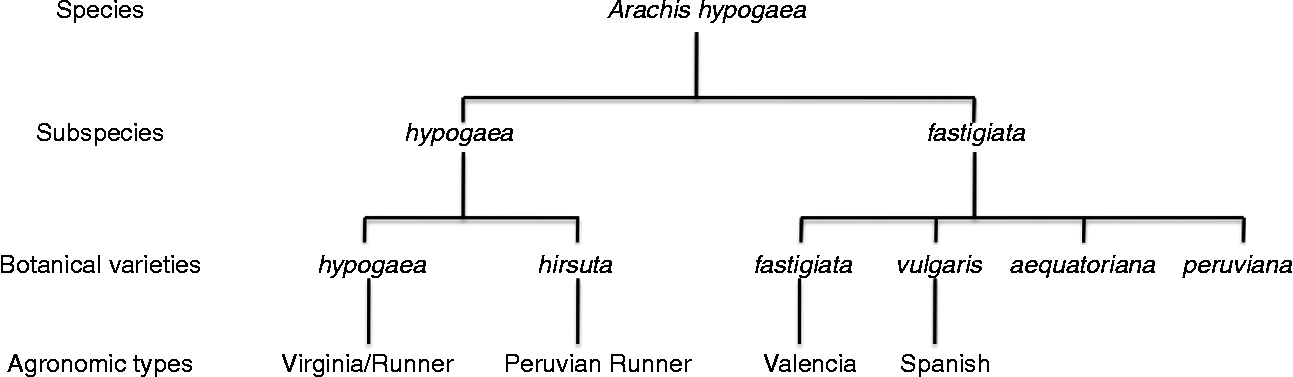
It was perhaps Charles Darwin who first noted that domesticated species accumulate a remarkable amount of variation in a short time. Peanut follows this pattern, and considering its very recent origin, it exhibits a remarkable amount of morphological variability. Based on this, two subspecies were recognized, hypogaea and fastigiata. These, in turn, have two (hypogaea and hirsuta) and four (fastigiata, vulgaris, aequatoriana and peruviana) botanical varieties, respectively (Fig. 4; Krapovickas and Gregory, Reference Krapovickas and Gregory1994).
The taxonomic arrangement of subspecies and botanical varieties of Arachis hypogaea, and their equivalence to agronomic types. It should be noted that many modern cultivars are of mixed parentage and are not good representatives of the botanical varieties.

The type variety (A. hypogaea subsp. hypogaea var. hypogaea) has a long cycle, no flowers on the central stem, and regularly alternating vegetative and reproductive side stems. It is widely present as landraces along the tributaries to the South of the Amazon River in Brazil and Bolivia. The modern agricultural types ‘Virginia’ or ‘Runner’ exemplify this type. Also classified within subsp. hypogaea, but with more hirsute leaflets and even longer cycle, is the variety hirsuta Köhler (Peruvian Runner). Nowadays, this variety is concentrated in the coastal regions of Peru, from where it extends to Central America and Mexico, Asia and Madagascar. The variability of this variety found in the Old World even suggests the possibility of pre-Colombian contacts.
The subspecies fastigiata Waldron has a shorter cycle, flowers on the central stem and reproductive and vegetative stems distributed in a disorganized way. The variety vulgaris C. Harz has its distribution centred on the basin of the river Uruguay. Usually, the fruits are two seeded, and the varieties correspond to the agricultural type known as ‘Spanish’. The variety fastigiata has fruits with more than two seeds and a smooth pericarp; this variety corresponds to the agricultural type ‘Valencia’; centres of diversity are in Paraguay, and Central and North-Eastern Brazil extending to Peru. The other two varieties aequatoriana Krapov. and W.C. Gregory (Ecuador and North of Peru) and peruviana Krapov. and W.C. Gregory (Peru, North East of Bolivia and the Brazilian State of Acre) have fruits with more than two seeds, heavy reticulation of the pericarp and very restricted distributions.
Initially, the very limited DNA polymorphism present in A. hypogaea limited the information that could be gained from molecular studies. The first studies were based on isozymes and proteins (Krishna and Mitra, Reference Krishna and Mitra1988; Grieshammer and Wynne, Reference Grieshammer and Wynne1990; Lu and Pickersgill, Reference Lu and Pickersgill1993), followed by restriction fragment length polymorphism – RFLPs (Kochert et al., Reference Kochert, Halward, Branch and Simpson1991, Reference Kochert, Stalker, Gimenes, Galgaro, Lopes and Moore1996; Paik-Ro et al., Reference Paik-Ro, Smith and Knauft1992), RAPDs (Halward et al., Reference Halward, Stalker, Larue and Kochert1991; Reference Halward, Stalker, Larue and Kochert1992; Hilu and Stalker, Reference Hilu and Stalker1995; Subramanian et al., Reference Subramanian, Gurtu and Nigam2000; Dwivedi et al., Reference Dwivedi, Gurtu, Chandra, Yuejin and Nigam2001) and AFLPs (He and Prakash, Reference He and Prakash1997, Reference He and Prakash2001; Gimenes et al., Reference Gimenes, Lopes and Valls2002; Herselman, Reference Herselman2003; Milla et al., Reference Milla, Isleib and Stalker2005; Tallury et al., Reference Tallury, Hilu, Milla, Friend, Alsaghir, Stalker and Quandt2005). None of these marker systems were very informative in cultivated germplasm. Higher levels of polymorphism were observed with microsatellites, in particular with longer TC motif repeats (Moretzsohn et al., Reference Moretzsohn, Leoi, Proite, Guimarães, Leal-Bertioli, Gimenes, Martins, Valls, Grattapaglia and Bertioli2005). Over the last few years, many new microsatellite markers have been developed, and this has enabled the detection of moderate levels of genetic variation in A. hypogaea accessions and even intra-variety polymorphism (Krishna et al., Reference Krishna, Zhang, Burow, Pittman, Delikostadinov, Lu and Puppala2004; Barkley et al., Reference Barkley, Dean, Pittman, Wang, Holbrook and Pederson2007; Tang et al., Reference Tang, Gao, He, Han, Shan, Zhong, Zhou, Jiang, Li and Zhuang2007; Varshney et al., Reference Varshney, Mahendar, Aruna, Nigam, Neelima, Vadez and Hoisington2009c). These studies have shown the grouping of accessions according to the varieties they belong to (Jiang et al., Reference Jiang, Liao, Ren, Lei, Mace, Fu and Crouch2007; Kottapalli et al., Reference Kottapalli, Burow, Burow, Burke and Puppala2007). In general, two main groups were observed, joining accessions of A. hypogaea ssp. fastigiata ‘fastigiata’ (Valencia type) and fastigiata ‘vulgaris’ (Spanish type) in one group, and hypogaea ‘hypogaea’ (Virginia and Runner types) and hypogaea ‘hirsuta’ (Peruvian runner) in a second group. These results corroborated the current taxonomic status of these subspecies and varieties. Exceptions to these results may be explained by the erroneous use of modern cultivars or breeding lines to represent the varieties. Frequently, these cultivars/lines have different varieties in their pedigrees and do not represent the varieties as well as landraces do. However, in contrast, studies that included fastigiata ‘aequatoriana’ and, especially, fastigiata ‘peruviana’ accessions raised questions on the current classification of these varieties (He and Prakash, Reference He and Prakash2001; Raina et al., Reference Raina, Rani, Kojima, Ogihara, Singh and Devarumath2001; Ferguson et al., Reference Ferguson, Bramel and Chandra2004a; Tallury et al., Reference Tallury, Hilu, Milla, Friend, Alsaghir, Stalker and Quandt2005; Freitas et al., Reference Freitas, Moretzsohn and Valls2007; Cuc et al., Reference Cuc, Mace, Crouch, Quang, Long and Varshney2008). Most of them have shown that accessions of these varieties have greater similarity to subspecies hypogaea rather than to subspecies fastigiata, to which they are currently thought to belong; the exception being the study of Moretzsohn et al., Reference Moretzsohn, Hopkins, Mitchell, Kresovich, Valls and Ferreira2004. However, only a small number of fastigiata ‘aequatoriana’ and fastigiata ‘peruviana’ accessions were included in these studies, and we consider that more investigation is required to reach firm conclusions.
Landraces
South America's history, past and present, is of a tapestry of peoples living in very different environments and circumstances, of displacements, and migrations. Over much of the region, where the climate is suitable, this history is intrinsically tied to the evolution and maintenance of diverse landraces and types of peanut. The changes that were initiated some 500 years ago with the discovery of the Americas by Europeans have steadily increased in impact and speed to the present day. Now South America has some of the largest urban centres in the World and some isolated communities that have never been in contact with the modern World. Many landraces must have been lost during these changes, but many survived. Numerous landraces are grown by South Americans of mixed descent, sometimes using cultivation methods such as companion planting with cassava, that were obviously used by pre-Colombian native peoples. Recently, a very interesting description of 62 distinct landraces in Bolivia has been published (Krapovickas et al., Reference Krapovickas, Vanni, Pietrarelli, Williams and Simpson2009). Almost all of these landraces are endemic to the country.
Many landraces are cultivated by more isolated communities and remain poorly characterized or unknown to science. These landraces are of particular interest because they may have new valuable characteristics. However, they are also vulnerable to extinction during the social upheavals that seem inevitable when native and modern societies meet. Below we shall give a brief description of two such cases.
Williams (Reference Williams, Pickersgill and Lock1996) described the very interesting cultivation of landraces by native farmers in Eastern Bolivia. They plant in very unusual conditions, the beaches, or sandbanks of rivers that are exposed for a rather short period during the dry season. Under this cropping system, the plants suffer strong selection pressure for uniform germination and a very short cycle, because they must produce seed before the water rises again and inundates the growing area.
Another very interesting case has been coming to light recently of the Kayabi Indians who live in the Xingu Indigenous Park in the Central West of Brazil. The park was officially created in 1961 and covers 30,000 km2, almost the size of Belgium. It is located in a transition area between biomes, with the Cerrado to the South and the Amazon to the North. Indians from a number of distinct ethnic groups originally inhabited the park, and some others, including the Kayabi, were transferred there. Now there are 14 villages of the Kayabi living in the Park, and peanut is important to them both as a food and culturally. Some villages cultivate only two or three types of peanut, but others many more, some 60 types being recognized by the Indians themselves. The types are morphologically very diverse, and their combinations of unusual characters make them unique. Some types are very large and have a very long cycle, and some have extremely large seeds. Some types have very tough pods, and others have thin pods. Seeds are purple, brown, red or white, some types having a uniform colour, others being partly coloured and partly white (Fig. 5).
A selection of cultivated peanuts and their wild relatives. The groups of pods and seeds are, starting from top left and going clockwise: Of107, Of128 and Of111, three types of cultivated peanut (Arachis hypogaea) kindly given to Fábio de Oliveira Freitas by the Kayabi South American Indians; Arachis cardenasii, Arachis stenosperma and Arachis duranensis are the three wild diploid species. Note that the long thread-like isthmus, which separates the seeds in the pods, has broken during harvesting; Arachis hypogaea var. fastigiata cv. Tatu, a popular cultivar of peanut in Brazil.

The peanuts are cultivated in a slash and burn system. Within an area of forest, the smaller vegetation is cut in May/June. This is then left during the dry season, and the area is cleared by burning in August, just before the start of the rains. Areas with more fertile black soils are chosen, and are cultivated for several years. The different types of peanut have cycles of different lengths, and planting is programmed such that all the peanuts can be collected together. At the beginning of the season, women select the seeds and men do the planting. At the end of the season, women harvest the plants simply by pulling them from the ground. The larger runner-type plants come loose after a series of pulls starting at one edge of the plant and working over to the other edge. After harvesting, the peanuts are dried and stored all mixed together, in pod, in enormous baskets (Fig. 6). Peanuts are taken from these baskets for consumption starting at the top, and those left at the bottom are used for seed at the beginning of the next season.
A Kayabi man next to the large baskets used to store peanuts.

Thirty samples of this material were analyzed from two Kayabi villages using microsatellite markers along with a selection of other cultivated and wild accessions. With the exception of one pair, all Kayabi samples could be distinguished, and the samples formed three deep-rooted clades within the dendrogram, reflecting their genetic distinctness. Of particular interest was an accession that, although not wild in phenotype in any obvious way, grouped closest to the wild tetraploid A. monticola. Amazingly, this accession had been described by the Indians as the most ancient of the peanuts, and was known to them as ‘peanut of the field’ (Freitas et al., Reference Freitas, Moretzsohn and Valls2007). We hope that this story serves to illustrate the diversity of peanut landraces that still awaits discovery by science, and that it also provides a glimpse of how traditional knowledge may enhance our understanding of germplasm.
Germplasm banks
Important collections of germplasm are held at ICRISAT, India; the USDA-ARS, USA; INTA, Argentina; PROINPA, Bolivia; EMBRAPA–Cenargen, Brazil; IBONE, Argentina and Texas A&M, USA. The first four collections mentioned concentrate on cultivated peanut, and the latter three collections focus more on wilds. Structured core collections of cultivated peanut have been assembled of 1704 and 831 accessions, and mini-cores of 184 and 112 accessions at ICRISAT and USDA-ARS, respectively (Holbrook et al., Reference Holbrook, Anderson and Pittman1993; Varshney et al., Reference Varshney, Close, Singh, Hoisington and Cook2009b). These cores and mini-cores are an efficient way to access greater diversity in breeding programmes, and are being widely used. There are numerous other collections of peanut germplasm maintained around the world, most of them being focused on cultivated peanut at institutions that have, or are linked to, breeding programmes.
The use of wild germplasm in peanut breeding
As a consequence of having duplicated genomes, the tetraploid that gave rise to A. hypogaea would have been isolated from sharing genes with its wild relatives. Therefore, a strong genetic bottleneck was created at the origin of the tetraploid species. In spite of this, the variation that has accumulated in peanut during artificial selection over thousands of years of domestication provides a rich material for breeding for many traits. This is the case, for example, with seed and pod characteristics and growth habit. However, for other characteristics such as disease and pest resistance, the narrow genetic base presents clear limitations to crop improvement. There are also good theoretical reasons to believe that genetic limits for more complex traits such as yield and drought tolerance can be overcome by broadening the genetic base of the crop. For these reasons, for many years, peanut breeders have been interested in the introduction of new alleles from wild species.
The transfer of genes from wild species by crossing has faced three fundamental problems: fertility barriers caused by species incompatibilites and ploidy differences; linkage drag of desirable wild alleles with ones that confer agronomically unadapted traits; and difficulties in confirming hybrid identities and tracking introgressed segments. Together, these problems are considerable, but as the knowledge base, and tools available improve, the ability to overcome them also improves. As outlined earlier in this manuscript, research over the last few years has provided a much better understanding of the origin of cultivated peanut and the relationships of the species that are closely related to its A and B genome components. This has effectively expanded the secondary gene pool. Furthermore, considerable effort has been invested in the creation of the tools needed for hybrid identification, tracking of introgressed segments and for the genetic analysis necessary to understand linkage drag. The number of molecular markers, in particular microsatellite markers, has increased enormously over the last few years. Microsatellites are currently the markers of choice for peanut since they are co-dominant, highly polymorphic, transferable among related species, PCR-based and work easily in the tetraploid. Now more than 3000 markers are available (Hopkins et al., Reference Hopkins, Casa, Wang, Mitchell, Dean, Kochert and Kresovich1999; Palmieri et al., Reference Palmieri, Hoshino, Bravo, Lopes and Gimenes2002, Reference Palmieri, Bechara, Curi, Gimenes and Lopes2005; He et al., Reference He, Meng, Newman, Gao, Pittman and Prakash2003, Reference He, Meng, Gao, Guo, Gao, Newman, Pittman and Prakash2005; Moretzsohn et al., Reference Moretzsohn, Hopkins, Mitchell, Kresovich, Valls and Ferreira2004, Reference Moretzsohn, Leoi, Proite, Guimarães, Leal-Bertioli, Gimenes, Martins, Valls, Grattapaglia and Bertioli2005, Reference Moretzsohn, Barbosa, Alves-Freitas, Teixeira, Leal-Bertioli, Guimarães, Pereira, Lopes, Cavallari, Valls, Bertioli and Gimenes2009; Ferguson et al., Reference Ferguson, Burow, Schulze, Bramel, Paterson, Kresovich and Mitchell2004b; Bravo et al., Reference Bravo, Hoshino, Angelici, Lopes and Gimenes2006; Budiman et al., Reference Budiman, Jones, Citek, Warek, Bedell and Knapp2006; Martins et al., Reference Martins, de Sousa, Proite, Guimarães, Moretzsohn and Bertioli2006; Gimenes et al., Reference Gimenes, Hoshino, Barbosa, Palmieri and Lopes2007; Proite et al., Reference Proite, Leal-Bertioli, Bertioli, Moretzsohn, da Silva, Martins and Guimarães2007; Wang et al., Reference Wang, Yang, Chen, Yu, Liu, Tang and Xu2007; Cuc et al., Reference Cuc, Mace, Crouch, Quang, Long and Varshney2008; Guo et al., Reference Guo, Chen, Dang, Scully, Liang, Holbrook, Yu and Culbreath2008; Liang et al., Reference Liang, Chen, Hong, Liu, Zhou, Li and Guo2009; Moretzsohn MC, de Macedo SE, Leal-Bertioli SCM, Guimarães PM and Bertioli DJ, unpublished data). Furthermore, reference genetic maps, both in diploid A and B and in tetraploid genomes, have been created enabling the comparison of different peanut maps, and even allowing the alignment of maps with other legume species (Hougaard et al., Reference Hougaard, Madsen, Sandal, Moretzsohn, Fredslund, Schauser, Nielsen, Rohde, Sato, Tabata, Bertioli and Stougaard2008; Bertioli et al., Reference Bertioli, Moretzsohn, Madsen, Sandal, Leal-Bertioli, Guimarães, Hougaard, Fredslund, Schauser, Nielsen, Sato, Tabata, Cannon and Stougaard2009; Leal-Bertioli et al., Reference Leal-Bertioli, José, Alves-Freitas, Moretzsohn, Guimarães, Nielen, Vidigal, Pereira, Pike, Fávero, Parniske, Varshney and Bertioli2009; Moretzsohn et al., Reference Moretzsohn, Barbosa, Alves-Freitas, Teixeira, Leal-Bertioli, Guimarães, Pereira, Lopes, Cavallari, Valls, Bertioli and Gimenes2009; Varshney et al., Reference Varshney, Bertioli, Moretzsohn, Vadez, Krishnamurthy, Aruna, Nigam, Moss, Seetha, Ravi, He, Knapp and Hoisington2009a).
A number of methods have been used for the introgression of wild genes in cultivated peanut, with variable success, but here we shall cover two methods that have resulted in well-characterized introgressions: the hexaploid and tetraploid routes.
The hexaploid route was used by Stalker et al. (Reference Stalker, Wynne and Company1979) who generated a triploid hybrid from a cross between the tetraploid A. hypogaea and the diploid A. cardenasii. The resulting hybrid was colchicine treated to create a hexaploid plant, and after five generations of selfing, all plants were tetraploid (Stalker et al., Reference Stalker, Wynne and Company1979). Selected lines were released with resistance to multiple disease resistances (Stalker and Beute, Reference Stalker and Beute1993; Reddy et al., Reference Reddy, Nigam, Moss, Singh, Subrahmanyam, McDonald and Reddy1996). These lines were characterized using RFLP and RAPD markers, and this showed that introgression was widespread (Garcia et al., Reference Garcia, Stalker and Kochert1995). Furthermore, markers linked to root-knot nematode resistance were identified (Garcia et al., Reference Garcia, Stalker, Shroeder and Kochert1996). Recently, more details on the genetics of fungal disease resistances of these lines have been obtained. A population derived from a cross of the peanut cultivar TAG24 with one of the lines (GPBD 4) was used for the identification of quantitative trait loci (QTLs) for rust and late leaf spot resistance (Khedikar et al., Reference Khedikar, Gowda, Sarvamangala, Patgar, Upadhyaya and Varshney2010).
The tetraploid route was first used by Simpson (Reference Simpson1993) to create a wild-derived tetraploid. Firstly, an A genome hybrid was made by crossing A. cardenasii with A. diogoi. Then, the B genome s.l. species A. batizocoi was crossed with the A genome hybrid to create a sterile AB hybrid. This was treated with colchicine to double the chromosome number and restore fertility. This tetraploid [A. batizocoi × (A. cardenasii × A. diogoi)]4x was registered as TxAG-6 (Simpson et al., Reference Simpson, Starr, Nelson, Woodard and Smith1993). Because of the method used to produce it and its genetic behaviour, this hybrid is usually referred to as an amphidiploid. Hybrids between cultivated peanut and TxAG-6 have low fertility, but a BC-1 population and the first tetraploid map of peanut were developed from it using the peanut cultivar Florunner as the recurrent parent (Burow et al., Reference Burow, Simpson, Starr and Paterson2001). TxAG-6 has very strong nematode resistance, but also presents very strong linkage drag to low yield. RFLP markers linked to nematode resistance were used to substantially break this linkage in the development of the nematode-resistant variety NemaTAM (Church et al., Reference Church, Simpson, Burow, Paterson and Starr2000; Simpson et al., Reference Simpson, Starr, Church, Burow and Paterson2003). Recently, a detailed study by Nagy et al. (Reference Nagy, Chu, Guo, Khanal, Tang, Li, Dong, Timper, Taylor, Holbrook, Beilinson, Nielsen, Stalker and Knapp2010) used microsatellite and resistance gene analogue markers, and diploid and tetraploid mapping populations to show that the introgressed chromosome segment displayed strongly suppressed recombination with cultivated peanut, and spanned an amazing one-third to one-half of an entire chromosome. Numerous co-dominant DNA markers were identified within the segment, opening up the perspective of finer mapping of the resistance gene and of shortening the introgressed segment by marker-assisted selection. A set of introgression lines from TxAG-6 that cover other parts of the genome are in the final phase of development, and are being characterized by RFLP and microsatellite markers (Dr Mark Burow, Texas A&M University, pers. commun.). These lines have great potential to serve as donors of other valuable wild genes.
Recently, also using the tetraploid route, introgression work has been done using a synthetic amphidiploid produced from the proposed ancestors of cultivated peanut, (A. ipaënsis × A. duranensis)4x (Fávero et al., Reference Fávero, Simpson, Valls and Vello2006). Using the cultivar Fleur 11 as the recurrent parent and the amphidiploid as donor, BC1 plants were used to construct a microsatellite-based genetic map. To confirm linkage order, the map was aligned with diploid reference maps (Bertioli et al., Reference Bertioli, Moretzsohn, Madsen, Sandal, Leal-Bertioli, Guimarães, Hougaard, Fredslund, Schauser, Nielsen, Sato, Tabata, Cannon and Stougaard2009; Moretzsohn et al., Reference Moretzsohn, Barbosa, Alves-Freitas, Teixeira, Leal-Bertioli, Guimarães, Pereira, Lopes, Cavallari, Valls, Bertioli and Gimenes2009) and, using the genotyping information, a subset of BC1 s was selected for further backcrossing. The progeny plants were again genotyped, and a set of 59 BC2 plants that represented the entire donor genome were again selected for backcrossing. In the BC2F1 plants, segment lengths ranged between 2.3 and 46.9 cM (mean of 24.5 cM), and the percentage of the recurrent background ranged between 62 and 94% (Foncéka et al., Reference Foncéka, Hodo-Abalo, Rivallan, Faye, Sall, Ndoye, Fávero, Bertioli, Glaszmann, Courtois and Rami2009). In work that has run in parallel, lines have been developed using a different recurrent parent, IAC-Runner 886 (a selection of Florunner), and the same amphidiploid donor. Using a combination of genotyping and phenotyping, 12 lines have been selected at BC1F3 that combine agronomically adapted phenotypes with resistance to late leaf spot (Leal-Bertioli, Reference Leal-Bertioli2010; Leal-Bertioli SCM, Moretzsohn MC, Guimarães PM and Bertioli DJ, unpublished results). These results are promising, but it is evident that the disease resistances of this amphidiploid are not as strong as in some other wild species. Recently, we have been exploring the potential of A. stenosperma, from which amphidiploids have been obtained (Santos SP, Leal-Bertioli SCM, Moretzsohn MC and Bertioli DJ, unpublished results). A. stenosperma has strong resistances against rust, leaf spots and root-knot nematodes (Proite et al., Reference Proite, Carneiro, Falcão, Gomes, Leal-Bertioli, Guimarães and Bertioli2008; Leal-Bertioli et al., Reference Leal-Bertioli, de Farias, Silva, Guimarães, Brasileiro, Bertioli and de Araujo2010). Apart from segregation distortion, genetically it behaves in an apparently normal way when crossed with A. duranensis, and QTLs for resistance against late leaf spot have been identified (Leal-Bertioli et al., Reference Leal-Bertioli, José, Alves-Freitas, Moretzsohn, Guimarães, Nielen, Vidigal, Pereira, Pike, Fávero, Parniske, Varshney and Bertioli2009). Presently, we are gathering phenotypic and genotypic data from hybrids between cultivated peanut and these new amphidiploids. Further analysis will reveal their potential.
Conclusions
The genus Arachis has a unique biology and unusually complex taxonomy. In spite of this, the overall view of the relationships of the species within the genus, while by no means completely defined, has a firm basis and is consistent and well organized. Cultivated peanut is a very important food crop throughout the tropics and sub-tropics. Because of its allotetraploid origin, it has a very narrow genetic base, and this presents fundamental limitations for the improvement of the crop. In contrast, during evolution, wild species have adapted to diverse ecological niches, and have diverse alleles with potential for use in improvement of the peanut crop. To date, various difficulties, both biological and technical, have led to this resource being underutilized. Our improved understanding of the species relationships within the genus, and improved tools for genetic and genomic studies will enable more efficient use of the genetic resources available.
Acknowledgements
D.J.B. and J.F.M.V. thank CNPq for their fellowship grants.