This article presents robust evidence that countries exhibiting competitive elections make significantly fewer fiscal transfers to insolvent banks and intervene more rapidly in these banks. These countries also experience a much smaller decline in growth as a consequence of financial crisis, although they are no less likely to experience crisis. These results, together with the theoretical analysis that supports the econometric specifications, inform an enduring puzzle in political economy: the apparent lack of a systematic influence of elections on public policy. The results also shed light on a narrower question: what explains wide variation in the policy response of countries to crisis?
Surprisingly, because the introduction of competitive elections would appear to be a fundamental institutional change in a country, the evidence is not particularly robust that democracies grow faster, secure property rights more effectively, nor offer higher quality public goods, such as universal, high-quality education. Mulligan, Gil, and Sala-i-Martin present evidence that democracies, despite giving greater influence to average, poorer citizens, adopt less redistributive fiscal policies.1
Mulligan, Gil, and Sala-i-Martin 2004.
In the crisis literature, some argue, such as Rodrik, that institutions of conflict management moderate the effects of crisis.3
Rodrik 1999.
Alesina and Drazen 1991.
Satyanath 2006.
Two related explanations developed below explain why electoral competition may have limited effects on political incentives to cater to special interests at the expense of society broadly. First, as is well known, though not typically taken into account in the democracy and crisis literature, democracies vary widely in the extent to which they exhibit political market imperfections that disrupt electoral accountability. These include the extent to which voters are informed about the actions of politicians and the extent to which politicians can make credible preelectoral promises to voters.6
See Keefer and Khemani 2005, for a review
Second, these imperfections vary by policy. Education outcomes are difficult for voters to observe and to attribute to political action. In contrast, voters can easily observe the fulfillment of promises of patronage appointments. Government responsibility for crisis falls somewhere in the middle: government policies that contribute to crisis are difficult to observe, but crisis itself has large and visible effects. The relative performance of democracies and nondemocracies therefore depends on both the character of electoral competition and of the policies at issue. The evidence below—showing that electoral accountability exerts a significant effect on postcrisis policies, such as bailouts, but an insignificant effect on the probability of experiencing a crisis, which is related to policies such as prudential regulation—demonstrates this within the context of a single sector.
The analysis below extends a simple Barro-Ferejohn-style model to highlight the role of credibility and information problems in electoral accountability. The extension here adds three elements not present in earlier analyses: the dependence of incumbent pecuniary rents on deals with special interests, positive costs to citizens of expelling incumbents, and multiple incumbent veto players. Though straightforward, the framework offers a parsimonious explanation of why electoral accountability operates in the context of financial crises but may not operate for other policies—indeed, why electoral accountability might affect the response to crisis but not the probability of crisis itself.
The Literature on Democracy, Special Interests, and Crisis
Government susceptibility to the demands of narrow interest groups is a key feature shaping financial-sector policymaking and the analysis in this article. A substantial literature examines the sources of special interest influence on elected governments, including information asymmetries7
Grossman and Helpman 1996.
Persson and Tabellini 2000.
Keefer and Vlaicu 2005.
The focus on interest groups is standard in most analyses of crisis. Frieden shows that differences in the internal cohesion of economic sectors and in their reliance on specific assets explain the different responses of Latin American countries to the debt crisis of the 1980s.11
Frieden 1991.
Calomiris and White 1994.
Romer and Weingast 1991.
Hutchcroft 1998.
The foregoing work, in contrast to the analysis in this research, does not ask why the influence of interest groups might yield different or worse policy outcomes in some countries rather than others. Haggard, however, conjectures that democracies in East Asia (South Korea and Thailand) recovered more quickly from their crises than did Indonesia because citizens in the more democratic countries could more easily sanction malfeasant governments.15
Haggard 2000, 222.
Satyanath argues the contrary: because political checks and balances limited their ability to choose financial-sector regulators, heads of democratic governments in East Asia were less informed about crisis and less able to rein in regulator-approved rent-seeking.16
Satyanath 2006.
Other crisis analyses focus on conflicts between large social interests. Implicit in Alesina and Drazen's work is the conclusion that multiple veto players—political checks and balances—inefficiently delay country responses to crisis.17
Alesina and Drazen 1991.
Rodrik 1999.
Empirical evidence is mixed on these points. Rodrik finds some evidence that aggregate measures encompassing checks and balances hasten growth recoveries from shocks.19
Ibid.
Montinola 2003.
Remmer 1991.
Elections, Checks and Balances, and Special Interest Influence on Legislation
The simple model below asks how citizens can hold politicians accountable even when they are poorly informed and politicians cannot make credible preelectoral promises to voters—two characteristics of policies related to financial crisis.22
Feijen and Perotti 2005 take a different tack, analyzing the effect of special interest competition on financial-sector instability.
Ferejohn 1986.
If special interests and veto players could not make credible agreements, one would only see policies favoring special interests if special interests and veto players could simultaneously authorize, fully accrue, and exchange rents. Such spot transactions are rarely or never observed in practice since rents from policy favors almost always take time to materialize.
The order of play in the policy game is the following: voters set a performance threshold for incumbent veto players; incumbent veto players observe exogenous factors that influence their ability to meet the performance threshold. These exogenous factors might be the extent to which banks take advantage of loose prudential regulation or exogenous economic shocks that plunge risky borrowers into delinquency. For convenience, here they are called economic shocks. Politicians then choose policy; citizens observe the costs of the policy, but not the policy itself or the economic shocks; and elections are held.
Government is composed of n veto players who set a policy q ∈ [0, 1], where q is a normalized subset of the real line assumed closed, bounded, and connected. Without loss of generality, q = 0 is the policy most preferred by citizens; special interests most prefer the policy given by q = 1. The policy favors to special interests are then simply q, the distance of the policies from citizens' preferred outcome, 0.
Special interests earn rents, π(q), from any policy, q. Rent-seeking profits are greatest at the most preferred policy of special interests, q = 1, and πq > 0. The costs to citizens of the policy q are, for simplicity, a function of the policy itself and a random parameter (economic shock), δ, distributed over [−d,d] with density function f (δ) and set equal to π(q − δ): the more negative the shock, the more costly the policy for citizens. Politicians observe δ prior to setting q. Citizens observe π but not q or δ. Citizen information constraints are consistent with the characteristics of financial-sector policy, where citizens are poorly informed about the respective contribution to crisis of government regulatory policies prior to crisis and economic shocks. Satyanath shows that information asymmetries within government can also affect policy outcomes, specifically those related to banking crises; the analysis in this article abstracts from this issue.25
See Satyanath 2006. In a model with a single veto player, but also employing retrospective voting rules, Rosendorff 2004 finds that democracy not only reduces rents directly, by making incumbents easier to expel, as in Prediction (1) below, but also indirectly, by giving incumbents greater incentives to reduce these information asymmetries.
Attention here is focused on the effect only of elections and the number of veto players, so a simple institutional setting is assumed. As described by Lizzeri and Persico, veto players are chosen in n simultaneous, not necessarily fair elections in a single, national electoral district.26
Lizzeri and Persico 2001.
Politicians maximize their pecuniary and nonpecuniary rents from holding office. As in Besley and Coate, the pecuniary rents that politicians extract directly enhance their utility and play no role in their electoral chances.27
Besley and Coate 2001. Since politician promises are not credible, they have no incentive to use rents to convey their type or the content of their electoral promises to voters, as in Grossman and Helpman 1996.
Grindle 2000, 65, 113.
Ibid.
For simplicity, nonpecuniary rents are independent of the number of veto players. This follows immediately for ego rents that come from the power to veto legislation, since veto power does not decline in the number of veto players. However, the results below require only that they decline less than proportionally as the number of veto players increases. That is, results hold as long as the nonpecuniary benefits of being, for example, one of 435 members of the U.S. House of Representatives are more than one-fourth (100/435) as large as those of being one of 100 U.S. senators.31
Three pieces of anecdotal evidence suggest that this is so. Senators and representatives enjoy equal access to many perks of office (for example, immunity from criminal prosecution when Congress is in session). As measured by campaign contributions, House members seem to enjoy more than one-fourth the influence over policymaking as senators (for example, House majority leader J. Dennis Hastert received $2.4 million in the 1999–2000 campaign cycle, Senate majority leader Bill Frist $5.8 million). House staffs appear to be more than one-fourth as large as Senate staffs. (Most congressional Web sites do not list staff, but two that did in 2006 were Representative Edward Case from Hawaii, with eight nonclerical staff in his Washington office, and Senator Barbara Boxer from California, with twenty-one).
Because challengers cannot credibly promise to do a better job than incumbents, elections discipline incumbents only if citizens can coordinate on a performance threshold, π, prior to the elections. Citizens replace incumbents if they experience welfare losses above π; otherwise, they retain incumbents. In contrast to other models in this vein, citizens confront a cost, m, of expelling incumbents from office. As elections become entirely free and competitive, m goes to 0; where incumbents prohibit electoral competition, however, m rises to reflect the higher costs that citizens must incur if they use extra-institutional means of removing nonperforming incumbents.
Incumbents observe the performance threshold and must determine whether to meet it after observing the shock. If they choose to remain in office, they must therefore choose q such that π(q − δ) ≤ π. Since they prefer as many rents as possible, incumbents who choose to meet the threshold at all will choose to meet it exactly, setting π(q − δ) = π and earning rents given by (α/n)π + R. If incumbents choose not to meet the voter threshold, they are thrown out of office no matter how far above the threshold their rents are. They therefore choose the maximum level of rents, given by q = 1, earning (α/n)π(1) (plus rents from a private career, assumed to be 0). Incumbents therefore abide by the performance threshold set by voters when, setting q such that π(q − δ) = π,

recalling that the shock, δ, affects citizen costs but not the rents earned by incumbents.
It is well known that in equilibrium, if incumbents abide by the performance threshold, voters reelect them; if incumbents choose maximum rents, voters expel them.32
Ferejohn 1986.
In finding the performance threshold, π, citizens take into account that the more negative is the shock, δ, the more that incumbents will have to reduce q to meet any given performance threshold. For a given threshold and a sufficiently large shock, incumbents forego reelection and choose q = 1. Citizens confront a trade-off between how often incumbents choose to meet the threshold and citizen welfare when they choose to meet it. If citizens fix too strict a performance threshold (with a low π), their welfare will be high when incumbents meet the threshold, but incumbents will more often choose not to, since even a mild shock makes it worthwhile to forego reelection.
A unique performance threshold, π, that fulfills condition (1) therefore depends on the existence of a unique shock threshold, δ, for any value of π. Appendix 1 presents the proof that a unique δ exists. The performance threshold that corresponds to δ is then easy to find by noting that it must meet condition (2):33
Similar to Persson and Tabellini 2000, chap. 4.

The first part of condition (2) states that the performance threshold must be set such that at policy q, the policy at which the incumbents are just indifferent between seeking and foregoing reelection, (α/n)π(q) + R = (α/n)π(1), and the incumbents can just meet the performance threshold given a shock equal to the threshold δ, π(q − δ) = π. Voters have an incentive to expel the incumbents if they fail to meet the threshold. The second part of condition (2) indicates that for shocks more negative than δ, there is no policy q that both satisfies the performance threshold and gives incumbents an incentive to seek reelection. Substituting the solution for δ from Appendix 1 into π(q − δ) = π from condition (2) then solves for the performance threshold.
Two key predictions emerge from this analysis and are tested below. Appendix 2 demonstrates that the predictions persist even if players can bargain over rent shares.
Prediction 1: A decline in expulsion costs, m (freer elections), reduces rents.
For sufficiently high expulsion costs, m, condition (2) is never satisfied: a performance threshold sufficiently generous to satisfy (α/n)π(q) + R = (α/n)π(1) and persuade incumbents to pursue reelection leaves too few gains to voters to make it worth their while to expel the incumbent should the incumbent not meet the threshold (the condition π(1) − π ≥ m is violated). At this corner solution, incumbents always pursue maximum rents and are always expelled. It follows immediately from this that rents fall for sufficiently large declines in m, a result that persists in the more complex case in which actors bargain over rent shares (Appendix 2). Large differences in m are built into the empirical work below: countries either have or do not have free and competitive elections.
Electoral accountability is less likely to hold when voters cannot observe the welfare effects of the policy in question, or observe them only with a lag. An example makes this easy to see in the context of prudential regulation of banks, discussed in more detail below. Voters observe the welfare effects of weak prudential regulation only when it precipitates a financial crisis. Assume that rents from weak prudential regulation are π(1) every year. If weak prudential regulation q = 1 leads immediately to crisis, then governments will impose prudential regulation q < 1 as long as it meets the condition (α/n)π(q) + R = (α/n)π(1). However, if q = 1 leads to crisis only with a constant 20 percent probability every year (simplifying, since crisis risk surely increases over time), the expected rents from lax regulation rise to

. Governments will be willing to impose only regulation that meets the condition

, implying a lower (more permissive) q. This level of lax regulation will prevail even in countries with low costs m of expelling incumbents.
Prediction 2: An increase in the number of veto players, n, reduces rents.
The larger is the number of veto players, the lower is rent-seeking. This follows immediately after multiplying equilibrium condition (2) by n/α and differentiating with respect to n to yield [∂π(q)]/(∂n) = −(1/α)R < 0. The value of leaving office—of pursuing maximum rents, q = 1—falls as the number of veto players rises. Nonpecuniary rents per veto player remain unchanged, however (though, to reiterate, it is only necessary that they fall more slowly than the number of veto players rises). The value of holding office therefore rises relative to the value of leaving office. This allows voters to tighten the performance threshold and demand a lower q as a condition of retaining the veto players in office. Again, Appendix 2 demonstrates that this result persists even when rent shares are endogenous and are affected by the number of veto players.34
Rasmusen and Ramseyer 1994 point to another possible offsetting effect of the number of veto players. In their argument, special interests make payoffs to the minimum number of legislators needed to secure their privileges. Legislators compete for these payoffs, such that as the number of legislators increases, total bribes fall and total privileges to special interests increase. However, Rasmusen and Ramseyer conclude, consistent with the logic in the main text, that legislators rationally respond to this coordination problem by banning bribery.
This prediction contrasts with arguments developed by Alesina and Drazen or Tsebelis, that checks and balances increase delay in response to crisis; by Satyanath, that checks increase information asymmetries; by MacIntyre, that too few veto players undermine the credibility of reforms in the face of crisis and too many delay reforms altogether; and by Powell and Whitten, whose argument implies that divided control of government clouds voters' ability to hold the executive accountable for bad outcomes.35
These predictions are not mutually exclusive; if they all hold, it is possible that the number of veto players would have no observed effect on rents, exactly as observed below.Using Financial Crises to Examine the Effects of Electoral Accountability
In the past twenty years, more than forty countries have experienced banking crises, triggering losses sometimes exceeding 50 percent of national income. Government policies play a large role in influencing whether crises will occur and in allocating the costs of crisis. The model predicts that elections may not affect the first type of policies but should exert strong effects on the second. This section presents a brief overview of how both types of policies affect outcomes in the financial sector. It also makes clear that, consistent with the assumptions of the model, financial-sector policies are difficult for citizens to observe directly and are rarely the subject of credible preelectoral promises by political competitors. However, once crises occur, voters can coordinate on ex post voting rules such as those described above.
Prior to crises, bankers invest deposits in high-risk loans or use bank deposits for private purposes or consumption by bank insiders. When high-risk loans stop returning interest and principal payments to the lender, banks cannot pay off holders of bank liabilities, including depositors, unless they attract new deposits. Of course, even if all of the loans were low risk, a bank crisis could nevertheless occur if the country sustained a severe economic shock that undermined the ability of borrowers to repay. Such shocks are controlled for in the empirical work below.
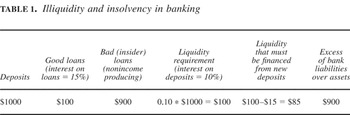
Table 1 presents a snapshot of an insolvent bank or banking system that is ripe for crisis. The bank has taken $1,000 in deposits and given 90 percent of them to insiders, who pay no interest. The other 10 percent of deposits have been committed to low-risk, income-generating loans. The bank will owe $100 in interest in the next period, but will collect only $15 from the good loans it has made. It must attract $85 in deposits to make up the difference. A bank crisis transpires when imprudent bankers cannot attract sufficient new deposits to finance these interest obligations. If depositors think this might occur, they rush to empty their accounts and create a run on the banking system.
Illiquidity and insolvency in banking

Governments can limit the potential for crisis through strict prudential regulation of bank portfolios. However, as the discussion of Prediction (1) makes clear, government incentives to do so are weak given the often long time lags between weak regulation and crisis, and the rarity of crisis: crisis occurs in fewer than 1 percent of the country-years in the database used for this research. The incentives of all governments, elected or nonelected, to pursue strict prudential regulation are therefore low.
Once crisis occurs, however, a much different picture emerges. Citizens now observe welfare effects, though not the relative contribution of policy and exogenous shocks. The political consequences for how governments deal with insolvent banks then diverge sharply across regime types. Two of these, forbearance and fiscal transfers to insolvent banks, are at the center of the empirical tests below. A government regulator can allow imprudent behavior to continue in insolvent banks by forbearing from intervening in them. Governments can also encourage imprudence if they make fiscal transfers to banks to preserve their liquidity (supplying the $85 indicated in Table 1 that are needed to pay off the current obligations to liability holders) or even by recapitalizing them (by infusing $900 to cover the shortfall of assets relative to liabilities indicated in Table 1).
Forbearance closely matches the policies q in the earlier analysis. It has a direct effect on citizen welfare (it allows imprudent bankers to extend and continue their risky activities), but citizens cannot observe it. The fiscal costs of bailouts are also likely to be an element of q. They are often off-budget and difficult to observe, and the impact of transfers—as with forbearance—is not felt by citizens until the economic effects of crisis are revealed in the form of currency devaluation, inflation, tax increases, a drastic fall in access to credit, and recession (all of which can be considered π in the analysis above).36
If fiscal costs were observable by citizens, then a simple, full information model is a more appropriate conceptual framework; such a model generates immediately the two key predictions here.
The foregoing framework is useful for analyzing policy responses to financial crisis for two additional reasons that are explored below. First, although there are arguments to the contrary, forbearance and fiscal transfers actually do serve private interests at the expense of public. Second, special interests tend to have homogeneous preferences in the case of these policies: cross-country differences in responses are not likely to be caused by heterogeneous distributions of interest groups, as Mulligan, Gil, and Sala-i-Martin 2004 argue (this possibility is tested empirically, as well).
Do Bank Bailouts Serve Public or Private Interests?
Governments have three policy choices when confronted with bank insolvencies. The first two are equivalent to bankruptcy and bank closure. From the Table 1 example, government could repossess $900 of assets from delinquent borrowers, forcing this narrow group to bear the costs of crisis; or waive the bank's obligation to return $900 of deposits, obliging a generally small group of depositors who control most of the deposits to bear the costs of crisis. Government's third choice is a $900 bailout.
The premise of this analysis is that the fiscal transfers implied by the third choice benefit special interests at the expense of citizens generally. However, bailouts could benefit the public if bank crises are precipitated by exogenous shocks that undermine the balance sheets of prudent banks. The closure of prudent banks severs the close relationship between borrowers and bankers. High-quality borrowers lose access to capital, because they cannot quickly forge close relationships with other financial institutions. Forbearance and fiscal transfers to keep banks open then serve the public interest.37
See Dewatripont and Tirole 1994.
The public interest logic implies that the larger is the insolvency problem, the more credit relationships are at risk and the greater should be government bailouts. Information on the magnitude of bank insolvency (the excess of liabilities over assets) is available for a handful of crisis countries. In these cases, there is no correlation between the magnitude of insolvency and the size of fiscal transfers.38
In Chile, the assets of insolvent institutions (one measure of the magnitude of crisis) amounted to approximately 22 percent of GDP, but bailout costs were twice as high, 41 percent. In Colombia, assets amounted to 8 percent of GDP, but the fiscal costs of resolving the crisis were lower, at 5 percent. Deposits in insolvent institutions (a second measure of crisis magnitude) were approximately 5 percent of GDP in Uruguay, where bailout costs were 7 percent of GDP; however, deposits in insolvent institutions amounted to 9 percent of GDP in Malaysia in 1985, where the bailout was only 4.7 percent of GDP. The asset and deposit information are from Caprio and Klingebiel 1997.
Rosas 2002.
Are Bank Bailouts the Product of a Struggle Between Interest Groups, or Between Interest Groups and the Public Interest?
In some countries the financial sector comprises large and small banks, prudent and imprudent banks, and banks and nonbank financial institutions. These institutions often do not have convergent interests. Prudent financial institutions and competitors of defaulting borrowers might resist bailouts of imprudent and insolvent institutions, for example. Nevertheless, even heterogeneous financial interests often prefer the same policy responses to crisis. Romer and Weingast document that both solvent and insolvent savings and loans opposed increased funding for regulatory agencies, the first because they feared those resources would be funded through taxes on all savings and loans; the second because they knew better funded regulators would intervene more aggressively in their institutions.40
Romer and Weingast 1991.
In any case, competing interests are simply not present in most of the countries analyzed in this article. These countries do not exhibit the degree of dispersion of bank size that is evident in the United States; most countries do not have highly developed nonbank financial institutions, and even when they do, these do not register strong opposition to financial-sector bailouts financed by taxpayers (indeed, they are often also the recipients of these bailouts). Finally, even if competing special interests were a significant phenomenon, their presence would bias the tests below toward rejecting the institutional predictions examined in this article.
Explaining Fiscal Transfers and Forbearance: Data and Empirical Specification
The central hypothesis tested in this article is that fiscal transfers to special interests (insolvent banks, their borrowers, and their creditors) should decline as the costs of removing political decision makers from office falls and that political checks and balances reduce incentives to cater to special interests, offsetting the effect that checks have in delaying government response to crisis. These predictions are tested using ordinary least squares (OLS) estimation of: transfersi = β0 + XiB + εi. The correlates X include both political and nonpolitical determinants of fiscal transfers. The model also predicts that forbearance should be less likely in the event of crisis. This is tested using a probit estimation of forbearancei = β0 + XiB + εi.
Fiscal transfers are taken from Honohan and Klingebiel, who collected data on government responses to financial crisis for forty crises in thirty-five countries since 1975.41
Honohan and Klingebiel 2003.
Ibid.
Political variables are taken from the 2000 release of the Database of Political Institutions (DPI).43
Beck et al. 2001.
The number of veto players is captured by the variable checks from DPI. In presidential systems, checks is the sum of 1 (if EIEC is greater than 4, to distinguish elected and unelected presidents), 1 (for the president), 1 for each legislative chamber, and 1 if the first government party is closer in political orientation (left, right, or center) to the first opposition party than to the party of the president. If the legislature is closed list (voters must vote for parties and cannot register candidate preferences) and the president's party has a majority in parliament, the legislature is not counted as a check. Similarly, if the legislature is not competitively elected, the presumption is that the president entirely controls policy and again the legislature is not counted as a check. The process is the same in parliamentary systems, except that checks counts 1 for the prime minister and adds the number of parties in the governing coalition; the number is reduced by 1 if there is a closed list and the prime minister's party is in the coalition.
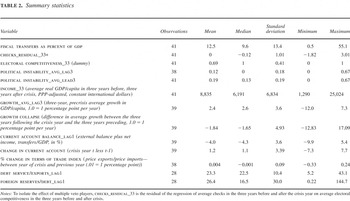
By construction, in its raw form the DPI checks variable simultaneously captures whether countries have competitive elections and the number of veto players. To isolate the latter effect, the empirical analysis below employs the residual of the regression of the checks variable on the competitive elections variable (the variation in the number of veto players independent of variation in electoral competitiveness). As the Table 2 data summary indicates, countries exhibit significant variation with respect to this residual, or “pure” checks and balances, with a standard deviation of one veto player, compared to 1.6 in the raw variable.44
Most of the regressions below control for elections; in those cases, this transformation is redundant. In some estimations, however, this is not the case, so for consistency of presentation the checks residual is used throughout.
Summary statistics

The theory assumes that special interests, unlike citizens, can make credible agreements with politicians. This assumption is unlikely to hold if there is substantial political instability before a crisis, however: special interest representatives and politicians do not have the opportunity to build up personalized reputations if the identity of political decision makers shifts frequently. If special interests cannot credibly promise to share the profits that they earn because of policy q, politicians have no reason to make such agreements; rent-seeking q should therefore fall.45
This is similar to Frederiksson and Svensson 2003, who argue that political instability reduces the returns to lobbyists of buying policy favors from incumbents. It contrasts with Acemoglu and Robinson 2001, where the lack of credibility between special interests and veto players leads governments to pursue less efficient subsidy modalities that mitigate the commitment problem (for example, by encouraging entry into the subsidized industry).
For any period t, political instability is the fraction of veto players in period t-1 who are no longer veto players in period t (for example, because a party dropped out of a coalition government or a government changed hands). political instability takes a value of either 0 or 1 in countries where there are no elections (the single veto player is an autocrat who is either removed from office or not). In democratic governments, it can be any fraction from 0 to 1, depending on the share of veto players who are replaced.
Bank crises can be precipitated by shocks that drive down the value of bank assets relative to bank liabilities. To control for these, X variously includes movements in the terms of trade and the current account balance, and the ratio of international reserves to debt. The effect of these shocks on fiscal transfers is ambiguous because the exogenous component of these shocks (the component unaffected by government policy) may or may not be observed by voters. If the exogenous component is unobserved, the analysis predicts that these shocks should drive up the fiscal costs of crisis (because politicians realize that they cannot achieve the performance threshold while retaining sufficient rents to make reelection worthwhile). If it is observed, these shocks should have no effect on the transfers. The variables capturing economic shocks are all lagged one year, because one expects these to precipitate crisis.
In some specifications, per capita income and short-run economic growth are included as controls. Both variables generate spurious downward bias in the election coefficient. Income is strongly associated with the presence of competitive elections. Growth, in the short periods around financial crisis, is heavily influenced by the rapid changes in private-sector lending activity typically attributed to pre- and postcrisis changes in the financial sector.
Government policies related to financial crisis unfold over a number of years; the exact timing of specific decisions is not known. Political and economic correlates are therefore measured over a number of different time periods. The core estimates use a three-year window before and/or after crisis becomes publicly known where, following convention, the first year of an insolvency crisis is when the crisis first comes to public attention.46
See, for example, Honohan and Klingebiel 2003.
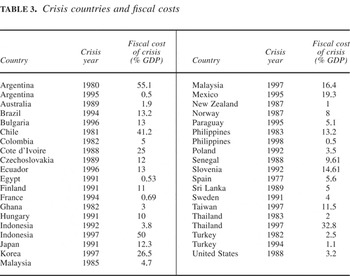
Crisis countries and fiscal costs

Elections, Checks and Balances, and Government Response to Financial Crisis
The foregoing logic motivates a series of tests. The core test is whether electoral competitiveness drives up the fiscal costs of crisis. Complementary tests look at forbearance; at whether the time to the next election affects these two policies; at the effects of crisis on political instability and the effects of elections on the growth recovery from crisis; at the effect of elections on the probability of crisis; and at numerous alternative explanations for the results, including the possibility of omitted variable bias.
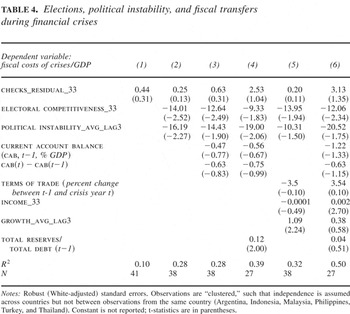
Table 4 documents the main findings of this research. Electoral competitiveness has a strong negative effect on the fiscal costs of crisis, consistent with the first prediction: a shift from noncompetitive to competitive elections reduces fiscal transfers to insolvent institutions of more than 14–22 percentage points of GDP. The offsetting influences of multiple veto players yield no net effect of checks and balances on the government response to financial crisis. The electoral effect persists in the presence of income controls in columns (5) and (6), although the correlation between the two variables is greater than 0.40; and in substantially smaller samples, in columns (4) and (6). However, consistent with the earlier discussion of offsetting effects, in no specification does the number of veto players exercise an independent influence on policy responses to crisis. Coefficient estimates in Table 4 are reasonably stable and significant or nearly significant, if one uses four other timing assumptions: a two-year window on either side of the crisis year; a four-year window; a three-year window before the crisis year; or a three-year window afterwards.
Elections, political instability, and fiscal transfers during financial crises

The final four columns of Table 4 take a variety of macroeconomic variables into account. None of these—current account reserves, terms of trade shocks, economic growth and income, debt service and total debt burden, and government spending as a fraction of GDP—exert a significant influence on the variables of interest. However, the effect of a change in current account balance (but not of terms of trade or other shocks) turns out to differ dramatically across regime types. Interacting the change in current account balance with the elections variable in specification four reveals that a 1 percent of GDP decline in the current account balance is associated with a 3 percent of GDP increase in the fiscal payouts to banks in nondemocracies, but an insignificant decrease in the fiscal payouts in countries with competitive elections (not reported).47
The magnitude and significance of the interaction fall significantly when three nondemocracies, Chile, Argentina, and Egypt, are omitted. The interaction of checks and current account changes is also highly significant.
The logic above assumes that politicians and special interests can make credible agreements; if they cannot, neither has an incentive to undertake the rent-seeking agreements that lead to financial crisis. Political instability should disrupt the personal connection between politician and special interest. Consistent with this, a one standard deviation increase in political instability in the three years prior to the crisis year is associated with a reduction in the fiscal costs of crisis of between 1.7 and 3.2 percentage points of GDP.
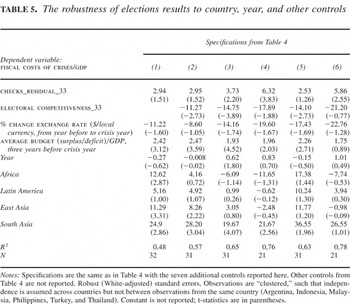
Results in Table 5 demonstrate that estimates are also robust to controls for four additional omitted effects that might account for the large magnitudes reported in Table 4. Two are exogenous to country-level decision making, region dummies, and a year variable. Unobserved regional effects might include contagion effects if international financial markets punish all countries in a region for one country's crisis. Unobserved year effects might include the possibility that citizens judge their governments' response to crisis according to how other governments respond to similar crises at the same time; at the same time, crises in some countries could precipitate worse crises in others.
The robustness of elections results to country, year, and other controls

The other two controls are the percentage change in exchange rate from the year before to the year of the crisis and the average budget deficit as a fraction of GDP in the three years preceding crisis. These proxy for the budget and other economic constraints that might limit political flexibility in responding to crisis. However, both are clearly endogenous: they are influenced by the same underlying political forces that dictate how a country responds to a bank crisis. Indeed, if budget balance were a measure of the exogenous budget constraints confronting governments, then the fiscal costs of crisis and the precrisis budget deficit should be significant predictors of the postcrisis budget deficit; instead, they are entirely insignificant. The introduction of these variables might therefore lead to spurious changes in the significance and estimated coefficients of the checks and elections variables.
Controlling for four regional dummy variables (for East Asia, Africa, Latin America, and South Asia), currency devaluation, and for the year of crisis, leads to no substantive change in the estimates in Table 4: several of the regional dummies are frequently significant; currency devaluation is not; the year of the crisis is not; the significance of the elections variable is even greater; and checks and balances continue to exert no effect on fiscal costs. Average budget balance is significantly and positively associated with the fiscal costs of crisis. Nevertheless, the elections coefficient remains large and significant in all cases except the last (where the budget variable is also insignificant). However, the estimated coefficient of the checks variable rises substantially and is positive and significant in three of six cases where budget balance is included. The instability of the estimates in Table 5 and the evidence that budget balance does not behave like an exogenous constraint on government behavior suggest that these results are likely due to multicolinearity.
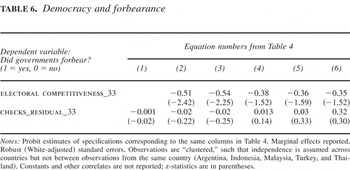
Table 6 examines whether political variables influence political incentives to forbear in the treatment of insolvent banks. Less precision in the measurement of forbearance makes the test more difficult. Nevertheless, electoral competitiveness is strongly statistically significant in two of five specifications and borderline significant in the remaining three. More compelling, in view of measurement error and small sample sizes, is the large magnitude of the effects. Even in the borderline cases, countries that lack competitive elections are 35 percent more likely to forbear than countries that have them. Forbearance is an explicit measure of delay in responding to crisis, which is sometimes argued to be greatest in the presence of political checks and balances. In none of these specifications do checks and balances predict policy outcomes, however.
Democracy and forbearance

Results are robust to modified versions of the robustness tests undertaken for the fiscal cost estimations earlier. In particular, even controlling for regional dummies, year variables, exchange rate movements, and budget deficits, the estimated effects of competitive elections on forbearance are significantly negative and those of checks and balances insignificant.48
The probit estimations fail to converge when continent, year, and economic controls are simultaneously added. One robustness check was therefore to control first for year, East Asia, and Latin America; another, for year, currency movements, and budget deficits. The estimation procedure converged in the majority of these cases.
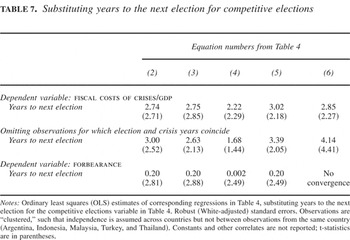
Table 7 presents estimates in which the number of years between the crisis year and the next election is taken as the measure of the costs of removing incumbents, m. The longer this period is, the more likely it is that incumbents manipulate election dates to avoid electoral accountability. In addition, the earlier analysis demonstrates that in order to hold politicians accountable for bad performance, voters must coordinate on a performance threshold. Coordination is more costly when a long time period separates incidents of bad performance from elections. The results are substantively and statistically significant: the closer the elections, the lower the fiscal costs of crisis, and the less likely governments are to forbear. Every additional year adds approximately 2.5 percentage points of GDP to the size of the fiscal transfers made to special interests.
Substituting years to the next election for competitive elections

Endogeneity is a naturally a concern with this variable. However, the most likely source of endogeneity is that crisis itself may precipitate elections, which in turn is most likely to be true for countries that hold elections in the same year as crisis. Estimates in the second row of Table 7 omit the eighteen countries for which elections and crisis coincided. Results remain largely significant and the estimated magnitude of the election effect is essentially unchanged.49
This cannot be replicated for the forbearance regressions, since the maximum likelihood estimations do not converge when the eighteen observations are omitted.
Supporting Evidence: Does Democratic Accountability Explain Differences in Welfare Outcomes Induced by Financial Crisis?
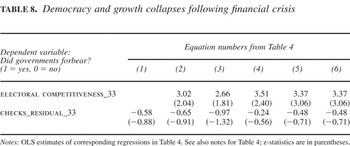
If financial-sector policies, q, are worse for citizens when competitive elections are absent, observable welfare, π, should also be lower. One proxy for welfare changes is growth. In fact, countries that make the largest transfers to insolvent banks (q) experience the largest growth collapses (π), with each percentage point increase in transfers associated with a 0.23 percentage point decline in growth (where a growth collapse is the fall in economic growth rates in the three years subsequent to the crisis year compared to the three years prior). Using the same specifications as in Tables 4 and 6, Table 8 demonstrates that growth collapses associated with financial crisis are indeed much larger in countries lacking competitive elections. As before, political checks and balances have no effect.
Democracy and growth collapses following financial crisis

Hicken, Satyanath, and Sergenti have related findings, showing that growth recoveries from currency crises are accelerated when the winning coalition (a qualitative measure of electoral competitiveness from Bueno de Mesquita) is larger, but are unaffected by political checks and balances.50
Rodrik presents an alternative explanation for growth collapses, arguing that they are lower in countries with better institutions for managing conflict, measured with aggregate indicators.51Rodrik 1999.
Hicken, Satyanath, and Sergenti 2005.
Supporting Evidence: Do Fiscal Transfers Precipitate the Expulsion of Incumbents?
On those occasions when negative shocks are sufficiently large, (δ < δ), the performance threshold set by voters will be too high and politicians will choose not to meet it. Instead, they will maximize rents (make large fiscal transfers) and be expelled from office. Though apparently intuitive, on reflection it is not obvious that large fiscal transfers should precipitate expulsion. If transfers are not necessary to serve the public interest, why would governments make them at the cost of being expelled from office? If the transfers are necessary, why then would voters subsequently expel politicians from office? The earlier analysis answers these questions by arguing that, following large shocks that are unobservable to voters, politicians realize that they cannot meet the voter performance threshold at any reasonable cost and pursue maximum rents, foregoing reelection. If this logic is correct, unobserved shocks should drive both high fiscal transfers and postcrisis political instability, creating an association between them.
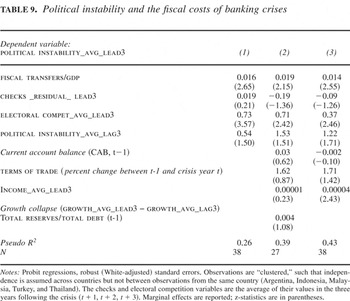
Probit estimates of regressions of the form instabilityi = α0 + ZiA + εi are reported in Table 9, relating ex post political instability to fiscal transfers. The specifications in Table 9 take into account observable determinants of the performance threshold set by citizens, which also affect transfers. These include competitive elections, because the heart of the earlier analysis is that the performance threshold for expulsion rises with higher costs of expulsion. Table 9 estimates control as well for the same observable shocks as in Tables 3 and 4, presumed to be observable by both citizens and politicians and therefore affecting the fiscal costs of crisis but not influencing instability. They also take into account precrisis political instability, which has an additional effect here of controlling for unobserved, time-invariant features of countries that might make them prone to instability.
Political instability and the fiscal costs of banking crises

All of the regressions in Table 9 demonstrate a large, positive association between fiscal transfers and instability, with a 1 percentage point increase in fiscal costs increasing the probability of government turnover by between 1.4 and 1.9 percentage points. These results are also significant when one assesses political stability over two-year or four-year windows. In addition, the results demonstrate a significant positive association between elections and the expulsion of incumbents following crisis. This is consistent with the arguments here, but contrasts with the ambiguous association among instability, democracy, and debt crises that other researchers have found.53
It is possible that the Table 7 results emerge from politician mistakes: politicians who overestimate the voter's performance threshold and make large transfers are then thrown out of office. Other politicians underestimate it, make small transfers, and remain in office. Even here, though, politician tendency to error may be related to elections: in countries with a longer history of competitive elections, politicians may be more practiced at estimating voter thresholds and make fewer mistakes.
Supporting Evidence: Selection Effects and the Probability of Crisis
The results in Tables 4 and 6 could be driven by the possibility that precrisis financial policies are different in democracies and autocracies, affecting the probability that they experience crises or the nature of those crises and, as a consequence, their policy response once crisis occurs. However, the earlier discussion emphasizes that precrisis policies should not differ markedly between elected and nonelected governments. Both have similarly low incentives to regulate prudentially because of the low probability that poor regulation will precipitate crisis in any given year.
Nevertheless, a majority of crisis countries are democracies and the odds that a democracy experienced a crisis from 1975–2000 were twice as high as those for a nondemocracy.54
In a sample with 3,900 country-year observations.
Alternative Explanations for the Effect of Regime Type on Fiscal Transfers
Other explanations for the permeability of governments to special interests range from variations across countries in the composition of interest groups, to the political and electoral institutions of democracies, to the dynamics of political competition. The results reported above are robust to controls for each of these. In addition, results are robust to using instrumental variables to control for unobserved effects that might determine both whether countries have competitive elections and whether they are predisposed to make bailouts to insolvent banks.
The Structure of Economic Interests
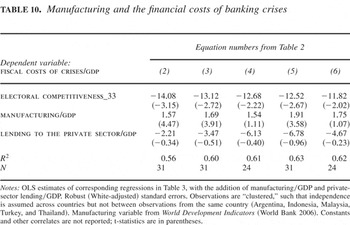
The distribution of economic interests could explain the results above if interests opposed to bailouts were simply more influential in the sample democracies. Data limitations are severe in identifying such interests, but two key sectors relevant to financial-sector policy can be roughly quantified: manufacturers, who benefit from abundant credit flows under lax prudential regulation and suffer from credit downturns during crisis; and financial interests themselves. The results in Table 4 might emerge simply because these sectors might happen to be underrepresented in democracies. Adding manufacturing value-added and lending to the private sector by deposit-taking institutions, both as a fraction of national income, to the specifications in Table 4 has no effect on results, however. As Table 10 reports, competitive elections continue to be strongly negatively associated with fiscal transfers. The size of the financial sector is significantly larger in democratic-crisis countries but is not associated with the fiscal costs of financial crisis. Manufacturing, however, though almost identical across democracies and nondemocracies in the sample, is significantly associated with high fiscal costs.
Manufacturing and the financial costs of banking crises

Other Social Cleavages
The political costs of financial crisis could vary depending on whether a country is large or small in population, whether it is primarily urban or rural, by whether its population is disproportionately young or old, or whether the country is ethnically or linguistically fragmented. These same variables might drive political instability, elections, and checks and balances. None is a significant predictor of fiscal transfers, nor do they change the pattern of results observed in Table 4 (not reported). The elections variable is similarly robust to these controls in explaining forbearance and growth collapses in the specifications of Tables 6 and 8.
Political Market Imperfections
Not only policies, but also democracies, vary in the extent to which they are plagued by political market imperfections. The results found here could be simply explained if the small sample of democracies here exhibited fewer information asymmetries and more political credibility than the average democracy. One can test directly for this using controls for citizen information and credibility. These have no effect on the election coefficient, however, providing no support for this alternative hypothesis.
Researchers have used newspaper circulation to argue that citizen information is associated with lower corruption.55
Adserà, Boix, and Payne 2003.
Keefer and Vlaicu argue that whether or not politicians can make credible promises should result in a specific pattern of policies.56
Keefer and Vlaicu 2005.
Keefer forthcoming.
Electoral Institutions and Special Interests
Finally, the democracies in the sample here may simply be nonrepresentative of democracies generally with respect to institutions that affect incentives to cater to special interests. Rosenbluth and Schaap argue that politicians in electoral systems with plurality voting and single member districts are more likely to impose the costs of banking regulation on banks rather than on citizens at large than politicians in proportional systems with many seats per district and low vote thresholds.58
Rosenbluth and Schaap 2003.
It turns out that most of the democratic systems (seventeen of twenty-three) in the crisis sample in Table 2 are nonmajoritarian and predicted to exhibit greater transfers to special interests. In fact, consistent with predictions by Rosenbluth and Schaap, the nonmajoritarian democracies exhibit significantly larger fiscal costs in the event of banking crises: 11 percent of GDP compared to 4 percent for majoritarian democracies. Since most of the democracies are nonmajoritarian and relatively favorable to special interests, the sample is biased against finding that democracies are less friendly to special interests. Unsurprisingly, therefore, controlling for majoritarian in the regressions in Table 4 has little effect on the elections results. The majoritarian effect is also large and significant, providing systematic evidence over a large number of countries in support of the predictions of Rosenbluth and Schaap (not reported).
Endogeneity
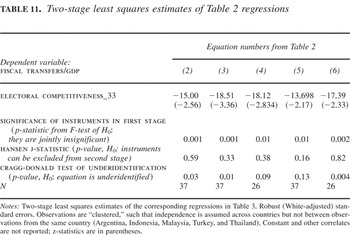
The fact that the results above are robust to controls for numerous political, economic, social, and demographic characteristics that are likely to be related to unobserved effects, argues strongly against the proposition that they are driven by the spurious influence of omitted variables. Direct tests also reject endogeneity as the source of the results in Tables 4 and 6, as seen in Table 11, which reports the results of two-stage least squares estimates of the Table 4 regressions.
Two-stage least squares estimates of Table 2 regressions

The specifications in Table 11 use four instruments frequently employed to control for the potential endogeneity of institutions. Three dichotomous variables indicating English, German, or Scandinavian legal origin directly speak to the institutional origins of a country and should not influence political decision making during banking crises. The length of a country's coastline captures the extent to which maritime access changes elite incentives to allow democracy, for example by lowering the cost of trade and thereby increasing the payoffs to investment by citizens, which citizens will only undertake if their economic rights are secured through democracy, as in Acemoglu, Johnson, and Robinson.59
Acemoglu, Johnson, and Robinson 2002.
The instruments are significant in the first-stage equation explaining competitive elections (other frequently used instruments for institutions, such as settler mortality and latitude, are insignificant). They satisfy the Cragg-Donald test of underidentification and they robustly satisfy the (admittedly weak) test of the exclusion restriction. In all cases, the elections results are at least as significant and of the same magnitude as in Table 4 and the checks residual is everywhere insignificant.60
Instruments are not available to identify the checks variable separately. Results are unchanged when the checks variable is omitted.
Conclusions
This article contributes a robust new empirical result to the literature on regime effects on policy and crisis: although no less likely to experience crisis in the first place, competitively elected governments handle financial crises much differently, imposing significantly fewer costs on citizens, but political checks and balances have no effect. The findings advance the analysis of regime effects in several ways.
First, political checks and balances explicitly demonstrate that regime effects differ depending on the characteristics of the policies under consideration and the extent to which they are exposed to political market imperfections such as lack of information or credibility. Financial crises provide voters with information and coordination opportunities that are sufficient to at least partially offset the information and credibility problems connected with financial-sector regulation. Second, and again consistent with the information requirements of accountability, democracies are not less likely than nondemocracies to experience crisis. The expected lag between prudential regulation and crisis is sufficiently long that electoral incentives make it difficult to impose ex post (postcrisis) electoral accountability on elected leaders.
Third, unlike much of the earlier work in the democracy and crisis literatures, the empirical results in this research disaggregate and use objective indicators of democratic political institutions. This reveals a marked difference in the effects of political institutions that earlier indicators had masked: electoral competitiveness constrains political decision makers' tendencies to cater to special interests in the context of financial market regulation; political checks and balances do not. Fourth, the analysis shifts the focus of comparison of regime types away from whether they affect the interaction of broad social interests and toward the idea that regime types affect the influence of narrow special interests on policymaking.
These results suggest that future research revisit the issue of democratic performance in areas such as growth, spending, and education. Based on the findings here, the lack of sharp differences with nondemocracies might be traceable either to political-market imperfections in the democracies or to the characteristics of the policies and policy outcomes themselves.
Appendix 1: Proving the Existence of a Unique Shock Threshold,
Recalling that the shock is random with density function f (δ) distributed over [−d, d], the expected costs to citizens of adopting a particular threshold shock, δ, given π, are

Citizens will not bother to replace incumbents if the costs of doing so, m, are greater than the rents they can save by threatening to replace them. That is, they replace incumbents only if [π(1) − π] ≥ m. Citizens therefore minimize their expected costs, condition (4), subject to [π(1) − π] ≥ m. Assuming that the solution is interior and the constraint is not binding, minimization yields the first-order condition

The left-hand side of condition (4) falls in δ for π′′ > 0—when the costs to voters rise at a rate increasing in q. Therefore, as long as the right-hand side is increasing in δ (as when, for example, the distribution is uniform), a unique δ solves condition (4).61
Condition (4) has a natural interpretation: the right-hand side of the equation is like a hazard rate, the probability that the effects of policy are more negative relative to the range of possible policy effects that are more benign than δ. The numerator of the left-hand side reflects the effect of a change in δ on the costs born by voters when incumbents seek reelection; the denominator reflects the change in costs imposed on citizens when an increased δ leads incumbents to prefer not to seek reelection.
Appendix 2: The Effect on Rents of Veto Player Numbers, n, and Costs of Voting, m, if Rent Shares Are Endogenous
Once veto players and special interests can bargain over α, they adjust rental shares to take into account the number of veto players, n, and the costs of expelling incumbents, m. The extent of this adjustment depends on the respective bargaining power of veto players and special interests, however. Two polar cases are examined here: veto players have all the bargaining power, or special interests have all the bargaining power, such that one or the other can make take-it-or-leave-it offers. In both cases, rental shares are, indeed, adjusted, but in all relevant circumstances the adjustment is not enough to change the predictions that an increase in n and a reduction in m reduce rents.
Veto Players Enjoy All the Bargaining Power
If veto players have all of the bargaining power—if they can make a take-it-or-leave-it offer to special interests—then veto players set α such that special interest rents, (1 − α)π, are just equal to the opportunity costs of the special interests of pursuing the rents and condition (4) is satisfied. That is, if the opportunity cost of special interests is W, then the performance threshold for rents must satisfy condition (4) in the text and, in addition, (1 − α)π ≥ W. Of course, veto players will set α such that this equation is satisfied exactly, (1 − α)π = W. As one expects, the greater is the opportunity cost of special interests and the lower are equilibrium rents, the more generous are veto players toward them (the lower is α).
Do reductions in m still reduce rents?
Given that veto players can adjust α, one first can ask whether a reduction in the costs, m, of expelling veto players reduces rents. Recall that reductions in m are only relevant when the constraint π(1) − π = m is binding. It follows immediately, however, that as long as the constraint binds, total rents are independent of rent shares. Bargaining over rent shares in this case does not influence at all the prediction that higher costs of expulsion, m, increase total rents.
Do increases in n still reduce rents?
One can also ask how the number of veto players influences total rents. In equilibrium, substituting α = 1 − (W/π) into condition (4), one can rewrite the condition as (1 − W/π)(1/n)π(q) + R = (1 − W/π)(1/n)π(1). Multiplying through by n and differentiating with respect to n, yields ∂π/∂n = −R(1 − π(1)W/π2)−1. Rents fall as the number of veto players rises as long as π(1)W < π2, falling faster as π(1)W/π2 approaches 1.
Under what conditions is π(1)W < π2? Note that in equilibrium, π = π(1) − (n/α)R and α = 1 − W/π. Substituting and rearranging, one can solve explicitly for π as the solution to the quadratic equation, π2 + π(−W − π(1)) + π(1)W + nR = 0. As usual, there are two possible solutions, given by

For real solutions, W and π(1) must be large enough relative to n and R so that (W + π(1))2 − 4(π(1)W + nR) is positive, yielding two positive solutions to π, π1 > π2, where

However, since for real solutions (W + π(1))2 > 4(π(1)W + nR), it must be the case that (W + π(1))2/4 > Wπ(1), with the difference between the two increasing the larger are nR, W, and π(1). For the first solution π1, therefore, it is always the case that π12 > Wπ(1), such that rents always fall as the number of veto players rises, as predicted. For the second solution, it may be that π22 > Wπ(1); even here, though, for nR, W, and π(1) are sufficiently large, an increase in the number of veto players reduces rents.
In most cases, therefore, even when veto players can increase their total share of rents to take into account their diminishing individual shares as their number rises, they still prefer to reduce total rents. This is intuitive. In most cases, veto players cannot increase their share enough to offset the fall in pecuniary rents relative to nonpecuniary rents without depriving special interests of an incentive to participate; this limitation is greater when nonpecuniary rents are larger and the relative importance of pecuniary to nonpecuniary rents is lower.
Special Interests Have All of the Bargaining Power
If special interests have all of the bargaining power and can make take-it-or-leave-it offers, they set α to maximize their rents subject to condition (2) being met (assuming for simplicity that the opportunity cost W = 0). Condition (2) is met when π = π(1) − (n/α)R. Special interests therefore set α to maximize their share of the rents, (1 − α)(π(1) − (n/α)R), yielding

: as the number of veto players and the nonpecuniary gains to holding office increase, special interests offer a larger share of rents to the veto players.
Do reductions in m still reduce rents?
Given that special interests can adjust α, one first can ask whether a reduction in the costs, m, of expelling veto players reduces rents. It is clear that total rents are not influenced by bargaining over α, however, since reductions in m are only relevant when the constraint π(1) − π = m is binding. The performance threshold when m is binding is independent of the rent share, α.
Do increases in n still reduce rents?
Bargaining plays a bigger role in the effect of the number of veto players on total rents. However, even after special interests adjust α to the number of veto players, rents still drop as n increases. To see this, substitute

into condition (2), multiply by n, and differentiate with respect to n, yielding ∂π/∂n = π − ½(π(1)/n) < 0.
The intuition is again straightforward. Special interests use increases in α to persuade veto players to approve more than offsetting increases in total rents. Their ability to do this is limited, however, since the larger the rents that veto players approve, the greater the probability that they will be expelled from office and lose nonpecuniary rents. To offset the loss of nonpecuniary rents, special interests would have to reduce their own pecuniary rents by even more, with the amount increasing the larger is n.