There is renewed interest in having better information on the relative clinical effectiveness and cost-effectiveness of alternative treatments to ensure that care is effective and provides good value in the context of routine clinical practice (Reference Tunis, Stryer and Clancy42;Reference Wilensky47). Very few evidence-based clinical pathways have been evaluated in a rigorous prospective controlled study to demonstrate their effectiveness (Reference Dy, Garg and Nyberg16;Reference Panella, Marchisio and Di Stanislao33;Reference Renholm, Leino-Kilpi and Suominen36). Most evaluations have focused on only one outcome of interest, typically resource utilization rather than patient outcomes (Reference Dy, Garg and Nyberg16;Reference Panella, Marchisio and Di Stanislao33;Reference Renholm, Leino-Kilpi and Suominen36). A systematic review of clinical pathway evaluations, published in 2007, concluded that most study designs were of poor quality. The review found adjustment for confounding and statistical rigor to be lacking and concluded caution should be exercised when interpreting results (Reference El Baz, Middel and van Dijk17). These limitations undoubtedly inhibited the uptake of these new pathways by both administrators and physicians as both groups are trained to weigh evidence in decision making.
Total hip replacements (THR) and total knee replacements (TKR) have, for the past 4 decades, been the most successful interventions for the treatment of severe osteoarthritis of the hip and knee (Reference Berry, Harmsen, Cabanela and Morrey7;Reference Jain, Higgins and Ozumba24). The demand for THR and TKR procedures is growing (10), and existing public healthcare resources are already unable to meet the need. Given these increasing demands plus variations in both pre- and postoperative care for THR and TKR (Reference Dixon, Shaw and Dieppe14;Reference Lingard, Berven and Katz27;Reference Macario, Horne and Goodman28;Reference Panella, Marchisio and Di Stanislao33;Reference Rissanen, Aro, Sintonen, Slatis and Paavolainen37;39) that inhibit system optimization, both the need and an opportunity for system improvement for THR and TKR in Alberta was perceived. In response to these opportunities for improvement, the Alberta Orthopaedic Society created a Working Group to analyze arthroplasty care in Alberta and to develop an improved, evidence-based new clinical pathway (NCP) for arthroplasty care. That NCP aimed to facilitate the delivery of services in a timely and cost-effective manner while achieving the highest quality of care for each patient (Reference Darer, Pronovost and Bass13). It specifically set out all healthcare decisions and services in a logical progressive sequence that were illustrated in a process map (flow chart). Completed in 2004, the NCP offered an avenue to enhance optimal delivery across the full continuum of care from referral through to successful rehabilitation at home.
A pragmatic randomized controlled trial study design was therefore used to evaluate the NCP described above. The study was specifically designed to compare the NCP for THR and TKR with the standard of care (SOC) for these procedures. The purpose of this article is to describe the study design and execution, as it represents a model for testing a NCP from both clinical and decision-making perspectives that puts patient outcomes at the center of the evaluation. The study outcomes will be published separately.
METHODS
Development of the New Clinical Pathway
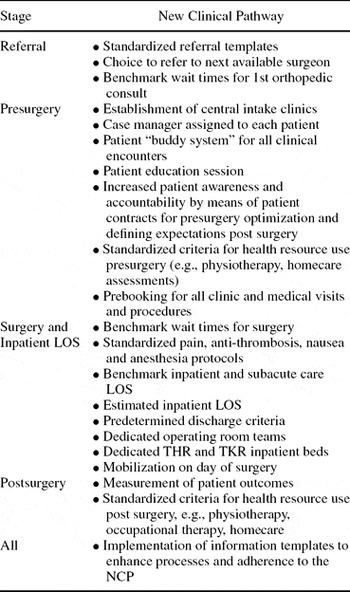
Clinical pathways differ from treatment practice guidelines in that they are used by multidisciplinary teams and focus on the quality, coordination, and efficiency of care while guidelines are typically developed as algorithms for specific treatment decision making (2). The project to develop a NCP for THR and TKR involved a partnership of the provincial government agency that funds healthcare, regional health authorities (RHA) and decision makers, orthopedic surgeons, general practitioners, other healthcare physicians, and allied health professionals. The NCP included the entire continuum of care from patient referral to an orthopedic surgeon to post THR or TKR recovery. Table 1 highlights the major areas of change in the NCP for each stage of the continuum of care.
Major Areas of Change in Each Stage of the New Clinical Pathway for TKR and THR
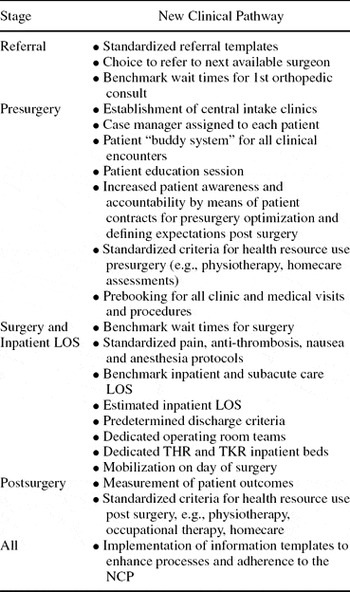
LOS, length of stay; THR, total hip replacement; TKR, total knee replacement.
Participating orthopedic surgeons and hospital and clinic staff were trained in the NCP. Orthopedic surgeons, anesthetists, and family physicians provided care to patients in both study arms. However, other healthcare providers and clinic staff were assigned to one of the two study arms, working in either dedicated or nondedicated facilities. Clinic staff and nonphysician healthcare providers who were working in the NCP were required to enter into contractual agreements that prevented them from providing care to patients in the SOC group. Recruitment was scheduled for a 12-month period concluding in April 2006. The partners recognized that their commitment to the NCP was imperative for its success. They agreed that a rigorous evaluation of the NCP was essential for informed decision making about whether and how it would become the new standard of care in Alberta.
Overview of the Evaluation Study Design
The NCP developed through the Alberta Hip and Knee Replacement Project was evaluated using a pragmatic randomized controlled study design. The evaluation compared the NCP with the SOC to THR and TKR in Alberta using the six dimensions of quality identified within the Alberta Quality Matrix for Health (AQMH), as described later in this study.
The pragmatic study design was selected as a rigorous approach to produce high quality evidence suitable for informing decisions between relevant interventions in real clinical practice (Reference Glasgow, Magid, Beck, Ritzwoller and Estabrooks21;Reference McMahon31;Reference Tunis, Stryer and Clancy42). As such, the study included a diverse population of study participants with few exclusion criteria who were recruited from heterogeneous practice settings with data collected on a broad range of health outcomes. The goal was to recruit a participant sample that was representative of patients seeking primary hip or knee replacement in Alberta.
The randomized and prospective aspects of the design reduced selection bias and increased scientific rigor of the study (Reference Ernst and Canter18;Reference Macpherson30;Reference Roland and Torgerson38;Reference Schwartz and Lellouch40). It also ensured patients were allocated fairly to the NCP, recognizing that those in the NCP had an opportunity for faster access to surgery. At the time of the study's inception, there was no province-wide mechanism for prioritizing patients based on disease severity. Consequently, priority for surgery was not a selection criterion of the study.
A Scientific Committee, whose members included provincial, national, and international experts, was responsible for overseeing the study design, procedures, and progress and for interpreting the study findings.
Study Setting
At the time of the evaluation, healthcare services in Alberta were managed by nine RHAs and were delivered in hospitals, community health centers, and continuing care facilities, and through public health programs and home care (3). The NCP was evaluated in three of the nine RHAs, including Capital Health Authority, Calgary Health Region, and David Thompson Regional Heath Authority using dedicated central intake clinics offering multidisciplinary care teams, hospitals, postoperative care facilities, and community settings such as rehabilitation care. Unpublished administrative records from Alberta Health and Wellness indicate 80 percent of THRs and TKRs performed annually in Alberta occur in these three RHAs, which include the major urban centers of Edmonton and Calgary and the smaller urban centre of Red Deer.
Study Population
Participants were identified in the clinical offices of twenty orthopedic surgeons practicing within the participating RHAs. Orthopedic surgeons who focused predominantly on THR or TKR rather than other orthopedic surgeries were chosen by their RHA to participate in the study.
Ideally, the study would have included only patients whose referrals were received by orthopedic surgeons within the 12-month study time frame (study inception to 2006). The investigators and project partners, however, considered it unethical to exclude patients who were on provincial waiting lists. As a result, there were three patient categories for the study: (i) all patients currently on the orthopedic surgeons waiting lists for THR and TKR surgery; (ii) potential THR and TKR patients who were on waiting lists for their first orthopedic consultations; and (iii) new referrals received by orthopedic surgeons within the study time frame.
Patients were screened for eligibility to participate. There were minimal exclusion criteria: (i) already had THR or TKR surgery date booked within three months of recruitment; (ii) were not residents of Alberta, as they could not be followed within the Alberta administrative databases; (iii) were not referred for degenerative hip or knee disease; (iv) required hip resurfacing, partial knee replacement, or revision surgery; or (v) were under 18 years of age.
Data Collection Methods
Eligible patients were mailed a package that included an information sheet describing the study, a consent form and the baseline patient questionnaire. Eligible patients were invited to complete the baseline questionnaire and consent form and return it by means of a prepaid mailed envelope to the research coordinating center. After receipt of these documents, patients were randomized into the study. To avoid the delays incurred with mailing documents, some participating surgeons arranged information session meetings that eligible patients were invited to attend to learn about the study and if willing, consented to participate directly following the session.
Data for the study were collected prospectively using the following three methods:
Patient Self-completed Questionnaires. All patients completed a questionnaire at baseline covering patient demographics, medication use, health-related quality of life (HRQoL) issues, comorbidities, satisfaction acceptability levels, and adverse events. Patients who underwent THR or TKR within the study time frame also completed a questionnaire 3 months and 12 months after surgery.
Administrative Databases. Health resource utilization during the study period, regardless of surgery status, admissions and readmissions to hospital, and date of death were derived from administrative data obtained from the RHAs and Alberta Health and Wellness.
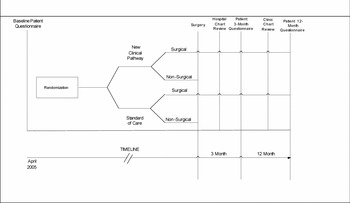
Patient Charts. Trained medical analysts reviewed patient charts from the central intake clinics and from the hospitals where the surgery was performed. Data collected from the charts were related to compliance with the NCP, waiting times, efficiency measures, and adverse events. Figure 1 illustrates the data collection process and timeliness for data capture.
Data collection time line.

Stratified Randomization and Allocation
Patients were randomized to receive treatment in either the NCP or SOC. Computer-generated randomization tables were used to randomly allocate patients to the two study arms. Randomization tables in permuted blocks of four were stratified by orthopedic surgeon, joint type (hip or knee), and patient category (1, 2, or 3). Six randomization tables were prepared for each of the twenty orthopedic surgeons participating in the study. A research coordinator randomized all patients who returned consent forms and baseline questionnaires and assigned each patient a unique study identification number. The coordinator provided the central intake clinic with contact information for all patients randomized to the NCP. Clinic staff then contacted each of these patients to schedule an appointment for an assessment by the clinic multidisciplinary team. Patients randomized to the SOC were informed by letter from the coordinator that they would be contacted by their orthopedic surgeon to book dates for a consultation and surgery if needed.
Outcome Measures
Evaluation outcome measures were based upon the six dimensions of the AQMH: acceptability, accessibility, appropriateness, effectiveness, efficiency, and safety. Developed by the Health Quality Council of Alberta, the AQMH is a framework that offers a common language, understanding and approach related to quality in health care (22). The dimensions are interrelated and the AQMH provides a window on patient perception of quality in each dimension when interacting with a health system.
The six dimensions are defined within the AQMH as follows:
• Acceptability: Health services are respectful and responsive to user needs, preferences, and expectations.
• Accessibility: Health services are obtained in the most suitable setting in a reasonable time and distance.
• Appropriateness: Health services are relevant to user needs and are based on accepted or evidence based practice from the patient and healthcare provider points of view.
• Effectiveness: Health services are provided based on scientific knowledge to achieve desired outcomes.
• Efficiency: Resources are used optimally in achieving desired outcomes.
• Safety: Risks are mitigated to avoid unintended or harmful results.
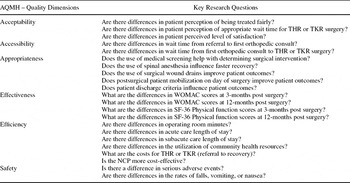
Table 2 summarizes the research questions and data variables used to measure each of the dimensions.
AQMH: Quality Dimensions and Key Research Questions for Modeling the New Clinical Pathway Compared to the Existing Standard of Care

AQMH, Alberta Quality Matrix for Health; THR, total hip replacement; TKR, total knee replacement; WOMAC, Western Ontario and McMaster Universities Osteoarthritis Index; NCP, new clinical pathway.
The primary study outcome was effectiveness, as measured by the Western Ontario and McMaster Universities Osteoarthritis Index (WOMAC) scores (Reference Bellamy, Buchanan, Goldsmith, Campbell and Stitt6) and the Medical Outcomes Study 36-item Short Form (SF-36), specifically the Physical Function (PF) score component. The WOMAC is a disease-specific measure of health-related quality of life and the SF-36 is a generic measure of health status or health-related quality of life (Reference Aaronson, Acquadro and Alonso1). Outcomes for both scores were measured as differences at 3 months and 12 months after surgery.
Data Management
All data were collected and maintained by the Alberta Bone and Joint Health Institute. Trained analysts were responsible for coding, cleaning, and validating all data variables.
Safety Review
A Safety Review Committee reviewed possible adverse events that were recorded for patients enrolled in the trial who had THR or TKR within the study time frame. The role of the Safety Review Committee was to review the information related to the event, then classify each adverse event and determine by consensus the likelihood the event was definite. For each adverse event review, the Scientific Committee was blinded to the study arm, as well as all indentifying information of the patients and healthcare providers. Adverse event data were collected from clinic and hospital charts, administrative databases, and patient follow-up questionnaires. Safety Review Committee members were blinded to patient and physician identity as well as the study arm.
Data Analysis Plans
Analysis plans were developed to address the study's objectives, using both qualitative and quantitative methods. Qualitative methods included a patient satisfaction survey and patient interviews. Quantitative methods included descriptive tables, unadjusted tests of effects, and multivariate regression models to account for baseline patient characteristics.
Covariate information was collected. Overall patient comorbidity was estimated by calculating a Chronic Disease Score (CDS), based on prescription medication use (Reference Clark, Von Korff, Saunders, Baluch and Simon11). Cumulative analgesic exposure was estimated by the Anatomical Therapeutic Code / Defined Daily Dose methodology described by the World Health Organization (Reference Wertheimer45;46).
Sample Size
To ensure a thorough evaluation of the NCP, the Alberta provincial health ministry requested a total of 1,200 (combined THR and TKR) surgeries be performed using the NCP and provided funding for these surgeries. A priori, the study was planned to continue until 1,200 procedures had been performed in the NCP. Within the study time frame, a total of 3,434 patients were enrolled in the study. Of 1,722 patients randomized to receive the NCP, 1,066 received surgery, and of 1,712 patients randomized to receive SOC, 504 received surgery. This sample size provided good statistical power to detect clinically meaningful effects on the effectiveness outcomes of patients who received surgery. Using published standard deviations for changes (Reference Cushnaghan, Bennett and Reading12;Reference Macdonald, Charron and Bourne29) and an alpha level of 0.05, our sample size provides at least 85 percent power to detect differences between our trial arms in changes from baseline in the SF-36 PF, and at least 99 percent power to detect differences between the study groups in changes from baseline on the WOMAC overall score.
Ethical Approvals and Patient Consent
The study received ethical approval from the University of Calgary Ethics Review Board (Study ID 17951), the University of Alberta Ethics Review Board (Study ID 5660) and the College of Physicians and Surgeons of Alberta Ethics Review Board (Study ID REC-1376). The trial was registered with clinicaltrials.gov (NCT00277186). All patients were required to provide written consent to participate in the study.
RESULTS
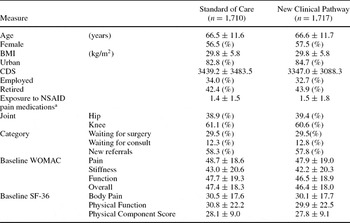
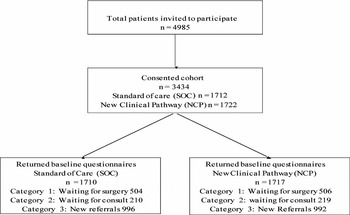
Of the 4,985 patients invited to participate, 69 percent of patients consented. A total of 3,434 patients were randomized: 1,712 to SOC and 1,722 to the NCP. Figure 2 illustrates the flow of these patients. The baseline characteristics of patients in the two study arms were similar (Table 3). The mean age was 66.5 ± 11.6 years in the SOC and 66.6 ± 11.7 years in the NCP. Of the patients randomized to SOC, 56.5 percent were women versus 57.5 percent of patients randomized to the NCP. There were no significant baseline differences in WOMAC or SF-36 scores between the two groups. Patients were predominantly from urban areas (82.8 percent in the SOC; 84.7 percent in the NCP) and approximately one third were employed (34.0 percent in the SOC; 32.7 percent in the NCP). More patients were identified as knee patients versus hip patients at the time of randomization (61.1 percent in the SOC; 60.6 in the NCP), and a 58.3 percent of patients in the SOC and 57.8 percent of patients in the NCP were in Category 1 (already on TKR or THR waiting list) at the time of randomization. Exposure to NSAID pain medications relative to a defined daily dose, and patient comorbidity status were similar for the two groups. There were fewer than 2.1 percent missing data for any of the baseline measures. The results of these baseline characteristics demonstrate that similar groups were recruited, which is essential for the comparative analysis.
Baseline Characteristics for Standard of Care and New Clinical Pathway Patients Who Did or Did Not Receive Surgery within the Study Time Frame

BMI, body mass index; CDS, Chronic Disease Score; WOMAC, Western Ontario and McMaster Osteoarthritis Universities Index; SF-36, Short Form 36; NSAID, nonsteroidal anti-inflammatory drug.
aNSAID exposure relative to the defined daily dose
Study flow diagram.

DISCUSSION
This pragmatic trial used randomized patient allocation to assess the comparative effectiveness of a new evidence-based clinical pathway and the standard of care for patients requiring THR and TKR surgeries. The investigators believe this evaluation is the first study to use a randomized pragmatic trial design with a large sample size (n = 3,434 patients) to compare alternative care delivery approaches. This study serves as a potential model for health technology assessment of clinical pathways based on comparative effectiveness.
There is renewed interest in having better information on the relative clinical effectiveness and cost-effectiveness of alternative treatments to ensure that care is effective and provides good value in the context of routine clinical practice (Reference Tunis, Stryer and Clancy42;Reference Wilensky47). Governments and other payers are requesting information they can use to base healthcare decisions on “real-world” outcomes, recognizing there are many factors, such as treatment compliance of both providers and patients, that may have a significant impact on patient outcomes and are not captured in traditional explanatory randomized controlled trials (Reference Teutsch, Berger and Weinstein41). This type of “real-world” study has of late been encouraged in the United States and Canada with the objective of improving the evidence base for making decisions about healthcare coverage (Reference Freemantle, Blonde and Bolinder19;Reference Garrison, Neumann, Erickson, Marshall and Mullins20;Reference Teutsch, Berger and Weinstein41;Reference Wilensky47). The safety and efficacy of new treatments are best addressed with randomized controlled trials (RCTs). However, pragmatic or practical clinical trials are designed for determining effectiveness and for analyzing cost-effectiveness using comparative data on healthcare resource utilization (Reference Glasgow, Magid, Beck, Ritzwoller and Estabrooks21;Reference McMahon31). The features of pragmatic clinical trials are that they select clinically relevant alternative interventions to compare, include a diverse population of study participants with few exclusion criteria, recruit participants from heterogeneous practice settings, and collect data on a broad range of health outcomes (Reference Tunis, Stryer and Clancy42).
Applying a randomized, controlled, and pragmatic study design to compare the NCP to the SOC for THR and TKR resulted in findings aimed at informing decisions between relevant interventions in practice within a rigorous framework. The randomized controlled design of this study, which randomized patients only after receipt of completed baseline patient questionnaires, reduced bias and provided strong scientific rigor. The pragmatic design applied few exclusion criteria, increasing the ability to generalize the findings to the broader Canadian THR and TKR patient population. The generalizability of the study population is supported by the 2006 Canadian Joint Replacement Registry Report (10), which reported similar mean age, gender, and body mass index (BMI) distributions. In addition, the demographic characteristics of our patient sample are similar to those reported internationally in arthroplasty registries (4;25;32). The large sample size provided sufficient power to detect clinically important differences between the study groups. This study is one of only a few that collected data on a broad range of health outcomes, including quality-of-life information related to THR and TKR using both disease-specific and generic measures.
Using a randomized pragmatic trial design to examine the effect of clinical pathways on health system and patient outcomes in THR and TKR surgeries is novel. Most studies use nonrandomized study designs. With a nonrandomized study design, it is difficult to differentiate the effects of NCP from secular or temporal trends, especially in an area such as THR and TKR where new prostheses and new surgical approaches are rapidly expanding. The majority of studies describe the implementation of a clinical pathway for THR or TKR surgeries using historical controls with a retrospective before-after study design (Reference Brunenberg, van Steyn and Sluimer9;Reference Healy, Ayers and Iorio23;Reference Lin, Su and Lin26;Reference Pearson, Kleefield, Soukop, Cook and Lee34;Reference Pennington, Jones and McIntyre35;Reference Vanhaecht, Sermeus and Tuerlinckx43;Reference Walter, Bass, Bock and Markel44). A study by Dowsey et al. (Reference Dowsey, Kilgour, Santamaria and Choong15) reported the results of a RCT to determine the effectiveness of clinical pathways for improving patient outcomes and decreasing length of hospital stay, but did not include health measures to compare patient reported outcomes such as disease-specific or generic quality of life. This study collected data on a broad range of health outcomes, including quality-of-life information related to THR and TKR using both disease-specific and generic measures.
This study did, of course, have several limitations. For example, pragmatic trials have a high degree of complexity and only measure broad aspects of health-related quality of life. They show composite effects and cannot necessarily determine contributions of component parts to patient outcomes. These features result in an inability to determine which precise components of the NCP are most influential on patient outcomes.
Although offering good insight to support decisions about alternative interventions, there are additional considerations required for the appropriate reporting and analysis of results from a pragmatic trial to evaluate for potential bias (Reference Ernst and Canter18;Reference Macpherson30;Reference Roland and Torgerson38;Reference Schwartz and Lellouch40) Efforts to improve the reporting of pragmatic trials have resulted in an extension of the CONSORT (Consolidated Standards of Reporting Trials) statement (Reference Boutron, Moher, Altman, Schulz and Ravaud8;Reference Glasgow, Magid, Beck, Ritzwoller and Estabrooks21;Reference Zwarenstein, Treweek and Gagnier48).
It is also important to discuss possible sources of bias in this study. Approximately 31 percent of the 4,985 patients invited to participate in the study did not consent. The patients who declined to participate had already received surgery, were on the waiting list for consult or surgery for joint procedures other than the ones of interest, were unwilling to undergo surgery within the next 12 months, were no longer living in Alberta, were on multiple surgeon lists, refused study participation, or cited personal reasons. Because the demographic information of nonparticipants could not be obtained without their consent, it is unclear if nonparticipants were different from participants. As previously mentioned, only Category 3 patients had not yet received care or had not been waiting in the current system—ideally the study would have recruited only these patients. However, exclusion of Category 1 and Category 2 patients was considered unethical.
Neither patients nor surgeons could be blinded to group allocation. The absence of patient blinding may reduce the internal validity of findings, but increases external validity. To avoid surgeon practice bias, randomization was stratified by surgeon whereby surgeons managed care and performed surgery on both NCP and SOC patients, preventing blinded assessment by surgeons. Such contamination is considered a study limitation, but it is likely to bias only study outcomes over which the surgeon had direct control, such as operating minutes, rather than patient reported outcome end points.
Although the study's baseline characteristics were similar to those reported by national registries, the degree to which the results can be generalized nationally remains unclear. Generalizability within Alberta is also uncertain even though the study was carried out in health jurisdictions that account for more than 80 percent of all THR and TKR surgeries performed annually in the province. However, these health jurisdictions include two major urban centers and only one smaller urban centre, raising questions about whether the results can be generalized to the smaller rural areas of Alberta.
This study generated important knowledge in areas related to the design, feasibility, management, and dissemination of pragmatic research to evaluate clinical care pathways. Overall, the study demonstrated clearly the need for and benefit of a well-constructed evaluation to coincide with implementing a NCP. There was a high degree of participation from multiple teams of care providers and administrators in three different cities, with a high degree of compliance with the protocol from all involved. In particular, these facts validated the view that collaboration among project partners is critical to success. This type of “real-world” research, which requires “real-time” results, is only attainable with the participation of all stakeholders, including those who administer and deliver healthcare services and those who consume them.
The study had excellent study retention with limited missing or invalid data, including the primary end point, a noteworthy achievement given the limited data that were available electronically. Electronic data were restricted to information obtained from administrative databases only. As a result, manual reviews of hospital and physician office charts were required. Collection, entry, and cleaning of these data were highly resource intensive, substantially increasing the costs of the evaluation. These challenges illustrated the value of electronic data capture as an efficient enabler of clinical pathway evaluation and a necessity for the ongoing evaluation of key performance indicators to monitor the performance of, and adherence to, clinical pathways over time.
Policy Implications
Clinical pathways adopt a comprehensive and systematic approach to streamline and standardize the management of health care. Clinical pathway flow charts can be used to document the decisions to be made and care to be provided to patients in a logical, progressive sequence of steps. The primary goal of clinical pathways is to facilitate the delivery of care in a timely and cost-effective manner while achieving the highest quality of care for the patient. The development and implementation of a clinical pathway is a lengthy and expensive endeavor. Therefore, it is especially important to evaluate its impact to avoid inappropriate use of healthcare resources and ensure there are no adverse effects.
This evaluation of the Alberta Hip and Knee Replacement Project demonstrated the feasibility, to ascertain the comparative effectiveness of an alternative approach to delivery of THR and TKR in Alberta. The study used a pragmatic clinical study design that combines the benefits of rigorous methodology while addressing relevant policy questions in the context of routine clinical practice. The data obtained in the study addressed each of the health quality dimensions in the Alberta Quality Matrix for Health (22). This pragmatic approach demonstrates how clinical pathways can be effectively evaluated and is considered a model for future health technology assessments.
CONTACT REFERENCES
Katherine L. Gooch, MAppEpi (katherine.gooch@sbcglobal.net), PhD Candidate, School of Public Health, Curtin University of Technology; Advisor, Research, Douglas Smith, PhD (douglas.smith@organomicsinc.com), Director, Design, Alberta Bone and Joint Health Institute, Suite 400, 3280 Hospital Drive NW, Calgary, Alberta T2N 4Z6, Canada
Tracy Wasylak, BN, MSc (Tracy.Wasylak@albertahealthservices.ca), Vice-President, South Health Campus, Alberta Health Services, Calgary Health Region, 6154-10301 Southport Lane SW, Calgary, Alberta T2W 1S7, Canada
Peter D. Faris, PhD (faris@ucalgary.ca), Adjunct Assistant Professor, Department of Community Health Sciences, University of Calgary; Director, Analysis, Deborah A. Marshall, PhD (damarsha@ucalgary.ca), Canada Research Chair, Associate Professor, Department of Community Health Sciences, University of Calgary; Director, Health Technology Assessment, Hoa Khong, MD, MPH (hkhong@albertaboneandjoint.com), Senior Analyst, Julie E. Hibbert, MSc (hibbert.Julie@gmail.com), Robyn D. Parker, BSc (rparker@albertaboneandjoint.com), Program Coordinator, Analysis & Measurement, Alberta Bone and Joint Health Institute, Suite 400, 3280 Hospital Drive NW, Calgary, Alberta T2N 4Z6, Canada
Ronald F. Zernicke, PhD, DSc (zernicke@umich.edu), Professor, Department of Orthopaedic Surgery, Department of Biomedical Engineering, Division of Kinesiology Director, Bone & Joint Injury Prevention & Rehabilitation Center, University of Michigan, 24 Frank Lloyd Wright Drive, Lobby A, Ann Arbor, Michigan 48105
Lauren Beaupré, PT, PhD (lauren.beaupre@capitalhealth.ca), Assistant Professor, Departments of Physical Therapy and Surgery, University of Alberta; Orthopaedic Research, Department of Surgery, Alberta Health Services, 1F1 WMC, Edmonton, Alberta T6G 2B7, Canada
Timothy Pearce, MD, FRCSC (tpearce@caortho.ca)
D. W. C. Johnston, MD, FRCSC (bill.johnston@capitalhealth.ca), Acting Chief, Department of Surgery, Alberta Health Services, 1F1 WMC, Edmonton, Alberta T6G 2B7, Canada
Cyril B. Frank, MD, FRCSC (cfrank@ucalgary.ca), Faculty of Kinesiology, Faculty of Medicine, Surgery, University of Calgary; Executive Director, Alberta Bone and Joint Health Institute, Suite 400, 3280 Hospital Drive NW, Calgary, Alberta T2N 4Z6, Canada