Medical-transport–associated infection (MTAI) is “any infection acquired as a direct effect of exposure in a medical transport setting.”Reference Schaps, Joiner and Anderson1 Many aspects of MTAI have been well established, including variable emergency medical services (EMS) personnel hygiene, frequent environmental contamination of emergency vehicles with potential pathogens, and disinfection nonadherence.Reference Bledsoe, Sweeney, Berkeley, Cole, Forred and Johnson2–Reference Vikke, Vittinghus and Giebner7 For example, potential pathogens, such as methicillin-resistant Staphylococcus aureus (MRSA) and vancomycin-resistant Enterococcus (VRE), have been identified in the medical transport environment.Reference Vikke, Giebner and Kolmos6 In fact, VRE is present in 1.61% of samples collected from EMS provider hands.Reference Teter, Millin and Bissell5 In addition, MRSA has been identified in 100% of samples collected from oxygen cylinders on the ambulance and 96% of oxygen cylinders present in one EMS agency’s storage area.Reference Gibson3 However, an association between exposure to the medical transport setting and the development of infection or colonization has not yet been demonstrated.Reference Schaps, Joiner and Anderson1,Reference Bledsoe, Sweeney, Berkeley, Cole, Forred and Johnson2,Reference O’Hara, Reed and Afshinnekoo4,Reference Vikke, Vittinghus and Giebner7
The presence of potential pathogens in the medical transport environment coupled with the healthcare activities performed during transport create the potential for spread. The medical care provided during transport depends on necessity. At a minimum, EMS personnel will record a set of vital signs, which typically include blood pressure, pulse rate, oxygen saturation, and respiratory rate, utilizing the equipment stored in the ambulance. Depending on the reason for transport, EMS providers measure the vital signs several times and may perform invasive procedures such as placement of peripheral intravenous catheters and endotracheal intubation. Although EMS providers use gloves during most transports, they have been observed using gloves as an alternative to hand hygiene and performing hand hygiene more often after patient transport than before to protect themselves from pathogens.Reference Emanuelsson, Karlsson, Castrèn and Lindström8,Reference Khan9 The presence of potential pathogens coupled with the healthcare activities performed during patient transport create the possibility of pathogen spread.
Many patients are exposed to the medical transport environment due to their interactions with the healthcare system. Specifically, the US Centers for Disease Control and Prevention (CDC) stated that there were 14.5 transports to the emergency department (ED) per 100 population in the United States in 2017.Reference Rui and Kang10 Thus, developing a better understanding of MTAI is imperative. It is important to identify instances of MTAI to reduce the theoretical burden it places on patients and the healthcare system. This retrospective cohort study is the first step toward understanding MTAI so that interventions may be created to address it.
The goal of this investigation was to determine whether ambulance exposure is associated with the development of MRSA or VRE, clinically important pathogens previously identified in the ambulance environment.
Materials and methods
We performed a retrospective cohort study including all patients presenting to an academic medical center ED in Durham, North Carolina, from January 1, 2016, through December 31, 2019. This period was selected because it was the period after International Statistical Classification of Diseases, 10th Revision (ICD-10) codes were implemented at the study site and before the discovery of SARS-CoV-2 in the United States. Over this period, 321,229 patients were treated in the ED; the bulk of ambulance-transported patients arrived via 911-dispatched, third-party service agencies. The local institutional review board determined the study protocol to be exempt from review, and they also waived the consent requirement due to its retrospective nature.
The study population consisted of adult patients aged ≥18 years who presented to the ED from a nonhealthcare location and were discharged to a nonhealthcare location without being admitted to the hospital. These inclusion criteria were required to limit confounding caused by other healthcare exposures. Of these patients, only patients presenting with a principal diagnosis of chest pain (as charted by the ICD-10 codes R07.89 and R07.9) were included to limit infectious reasons for ED presentation and to create a more homogenous cohort to limit the variability and confounding that inclusion of multiple diagnoses could introduce to the study. The patient’s first ED visit of the study period was included for analysis and all subsequent ED visits were removed. Patients with any prior history of infection or colonization with MRSA or VRE were not considered for the analysis.
The cohort was created with sequential steps. First, all ED encounters from January 1, 2016, through December 31, 2019, were extracted directly from the electronic medical record (EMR) using a query function. These encounters were then stratified by method of transportation to ED (ambulance or private vehicle). A patient was considered exposed to an ambulance if they were transported via helicopter or ground-transport ambulance. Patients that arrived at the ED in a law enforcement vehicle were excluded from the study because they represent exposure to an environment that cannot be categorized as used purely for medical transport or as a private vehicle. A patient was considered unexposed to an ambulance if it was documented in the medical record that they arrived in a private vehicle.
Patient demographic and comorbidity data were extracted from the EMR using the Duke Enterprise Data Unified Content Explorer (DEDUCE). DEDUCE is a web-based query tool that allows users to extract the data of >3.4 million patients spanning 37 years from the local EMR. These data are refreshed daily and include >1.6 billion laboratory results, demographic information, and socioeconomic data elements based on US Census data. The collected patient comorbidities must have been present before the ED encounter to be included in the data set.
Patient infectious outcome data were initially extracted from the EMR using DEDUCE as described above and were then confirmed by manual chart review to ensure data quality and integrity. Additionally, to ensure ambulance exposure variable integrity, we conducted manual chart review on a random sample of 2% of the cohort. We found 100% agreement between our chart review and the extracted data set for the ambulance exposure variable. The ambulance exposure, demographic and comorbidity, and outcome data sets were then merged based on patient medical record number (MRN) to complete the final analysis data set.
The primary outcome was evidence of bacterial colonization or infection with the multidrug-resistant organisms (MDROs) MRSA or VRE within 30 days after the ED encounter. This outcome was selected because prior studies have shown that MRSA and VRE have been found in the medical transport environment.Reference Gibson3,Reference Teter, Millin and Bissell5 A patient was determined to have newfound MRSA or VRE colonization or infection if they had a positive culture or positive PCR test between 2 and 30 days after the ED visit with no prior positive result on either test. Other outcomes of interest were MRSA infection or colonization alone and VRE infection or colonization alone.
Study participants were stratified into 2 groups based on whether they were exposed to the medical transport environment or not exposed. All statistical work was performed using SAS version 9.4 software (SAS Institute, Cary, NC), and an α of .05 was selected a priori as the threshold for statistical significance. Descriptive statistics were generated for demographic information and patient comorbidities. Initially, the 30-day prevalence of MRSA or VRE was compared between groups using the Fisher exact test because some expected values for cells were <5.Reference Bland11 The 30-day MRSA or VRE incidence was also compared between groups using univariate logistic regression where ambulance exposure was the independent variable. Because the outcome of interest occurred in <0.5% of the cohort, the odds ratio (OR) derived from logistic regression was chosen as a reasonable approximation of the relative risk (RR).Reference Hosmer12 The 30-day prevalence values of MRSA and VRE alone were compared between the exposed and unexposed groups using the Fisher exact test because some expected values for cells were <5.Reference Bland11 Univariate logistic regressions were also performed for MRSA and VRE alone.
Since randomization was not possible due to the retrospective nature of the study, propensity score matching was performed. Propensity scores were developed using multivariable logistic regression with ambulance exposure as the dependent variable.Reference Haukoos and Lewis13 All demographic and comorbidity variables with standard difference >0.10 between the exposed and unexposed cohort were included as covariates in the model to reduce the effects of confounding. We considered the following covariates: patient age on the day of the ED encounter, smoking status, history of myocardial infarction (MI), congestive heart failure (CHF), peripheral vascular disease (PVD), cerebrovascular disease (CVD), dementia, diabetes mellitus (DM), and chronic kidney disease (CKD). Greedy nearest neighbor matching was performed with a caliper size of 0.15 with the goal of bringing the standard difference of each variable of importance among the exposed and unexposed group below the important threshold of 0.10 to ensure appropriate matching.Reference Stuart14 The propensity score match was initially performed in a 1:1 ratio. Then, the cohort of remaining unmatched and unexposed patients was sampled and matched to the cohort of exposed patients based on the propensity-score–matching parameters mentioned above. Not all exposed patients were able to get 2 matching unexposed patients due to low sample size.
Initially, a Fisher exact test was performed on the propensity-score–matched cohort to evaluate whether there was a significant association between ambulance exposure and 30-day MRSA or VRE prevalence. The effect size of ambulance exposure on 30-day MRSA or VRE incidence was then estimated by performing a univariate logistic regression on the propensity-score–matched data. Fisher exact tests and univariate logistic regressions were also performed for MRSA and VRE incidence alone.
Finally, multivariable logistic regression was performed on both the unmatched and propensity-score–matched data. The following variables were included in the multivariable model after being deemed to be influential a priori: sex, smoking status, race, DM, chronic obstructive pulmonary disease (COPD), paralysis, CKD, and HIV/AIDS. The same multivariable logistic regression models were created for MRSA and VRE 30-day prevalence separately.
Results
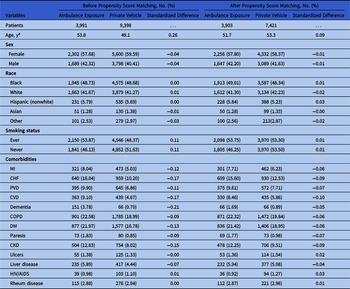
In total, 321,229 patients were treated at the ED during the study period. Among them, 13,389 patients met inclusion criteria, including 3,991 in the ambulance exposure group (cases) and 9,398 in the unexposed group (controls). After propensity score matching, there were 11,324 total patients: 3,903 exposed case patients and 7,421 unexposed control patients. Characteristics of patients in the exposed and unexposed groups before and after propensity score matching, along with their standard differences, are presented in Table 1. After propensity score matching, the standard difference for all variables was 0.10 or below demonstrating that propensity score matching had been performed successfully.Reference Stuart14
Characteristics of Cohort Stratified by Exposure and Propensity Score Matching

Note. MI, myocardial infarction; CHF, congestive heart failure; PVD, CVD, COPD, chronic obstructive pulmonary disease; DM, diabetes mellitus; CKD, chronic kidney disease; HIV/AIDS, human immunodeficiency virus/acquired immunodeficiency syndrome.
a Values presented are medians.
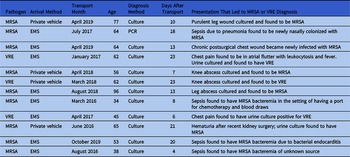
Moreover, 12 (0.11%) patients were found to be newly infected or colonized within 30 days of exposure: 3 (0.03%) with VRE and 9 (0.08%) with MRSA. Of the 3 patients with VRE, all were found to be infected after positive cultures. Of the 9 patients with MRSA, one was found to be nasally colonized by PCR after presenting in sepsis secondary to pneumonia, and the other 8 were found to be infected after positive cultures. Characteristics of the MRSA- or VRE-positive patients are listed in Table 2.
Characteristics of Patients Found to Have New MRSA or VRE Within 30 Days of Exposure

Note. Note. MRSA, methicillin-resistant Staphylococcus aureus; VRE, vancomycin-resistant Enterococcus; EMS, emergency medical services.
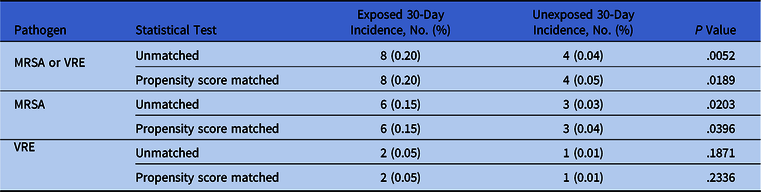
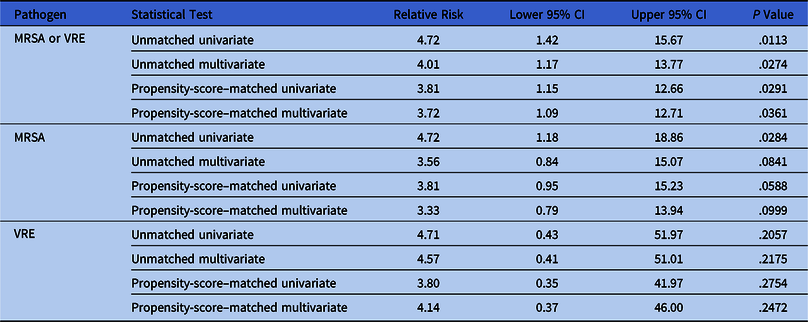
Before propensity score matching, we performed a preliminary analysis to examine whether there were raw associations between ambulance exposure and 30-day prevalence of MRSA or VRE. Specifically, the 30-day prevalence of MRSA or VRE was significantly higher in the unmatched ambulance exposure group than in the unexposed group (0.20% vs 0.04%; P = .0052). The 30-day prevalence of MRSA alone was also statistically significant, whereas that of VRE was not (Table 3). Results of the univariate logistic regression before propensity score matching showed that the estimated RR for developing MRSA or VRE within 30-days of exposure to the ambulance was 4.72 (95% confidence interval [CI], 1.42–15.67; P = .0113). This result was also statistically significant for MRSA alone but not for VRE alone (Table 4).
Association Between Ambulance Exposure and Development of MRSA or VRE Infection or Colonization Within 30 days of Ambulance Transporta

Note. MRSA, methicillin-resistant Staphylococcus aureus; VRE, vancomycin-resistant Enterococcus.
a P values were generated using the Fisher exact test.
Logistic Regression Models Evaluating Effect Size of the Relationship Between Ambulance Exposure and the Development of MRSA or VRE Infection or Colonization Within 30 Days of Ambulance Transport

Note. MRSA, methicillin-resistant Staphylococcus aureus; VRE, vancomycin-resistant Enterococcus; CI, confidence interval.
After propensity score matching, patients exposed to the ambulance were more likely to have MRSA or VRE infection or colonization than those who were unexposed: 30-day prevalence, 0.20% versus 0.05% (unadjusted RR, 3.81; 95% CI, 1.09–12.7; P = .0189). In particular, this association was driven by the incidence of MRSA (Table 3). Univariate logistic regressions performed for 30-day MRSA and VRE incidence alone were not significant (Table 4).
Finally, multivariable logistic regressions were performed on both the unmatched and the propensity-score matched cohorts. The adjusted RRs estimated using multivariate logistic regressions of the data before and after propensity score matching were 4.01 (95% CI, 1.17–13.77; P = .0274) and 3.72 (95% CI, 1.09–12.71; P = .0361), respectively. The results for the same multivariate logistic regression models for MRSA and VRE alone were not statistically significant (Table 4).
Discussion
Many patients are exposed to the medical transport environment.Reference Rui and Kang10 Thus, it is important to understand the impact of this exposure on subsequent risk of healthcare-associated infection (HAI). Our study, which included a large cohort with stringent inclusion criteria, demonstrated that exposure to the medical transport environment was associated with ˜4 times higher risk of developing MRSA or VRE within 30 days compared to transport to the ED in a private vehicle.
To our knowledge, our study represents the first controlled and matched analysis to evaluate the impact of ambulance exposure on the development of MDROs. Until this point, the study of the infectious outcomes of patients transported in ambulances has been limited. Alter and MerlinReference Alter and Merlin15 published the only other study to report infectious outcomes of patients transported by ambulance in 2011; these investigators presented the raw and uncontrolled odds of HAI among inpatients who were transported to the hospital by ambulance compared to those who were not. Their study stratified the patient cohort by a binary ambulance exposure variable; 3.2% of patients transported by ambulance and 2.3% of patients with non-ambulance exposures developed HAI (OR, 1.42; 95% CI, 1.28–1.57).Reference Alter and Merlin15 Our study built on this work by controlling for confounders with strict inclusion criteria and propensity score matching and by performing rigorous statistical analyses that compared adjusted and unadjusted infectious outcomes between groups.
Our finding that patients transported by ambulance have a higher likelihood of developing MRSA or VRE is plausible in the context of prior behavioral and microbial studies. The medical transport environment is a location where patient care occurs and has many of the exposures that brick-and-mortar facilities have. Like brick-and-mortar facilities, ambulances care for sick patients with MDRO infection or colonization and rely on healthcare workers that have been proven to have a higher rate of MRSA colonization than the public.Reference Orellana, Hoet and Bell16–Reference Ro, Shin, Noh and Cho19 Patients and EMS personnel have therefore been shown to bring potential pathogens into the medical transport environment. The pathogens introduced to the environment, which include VRE and MRSA, remain in the environment due to variability in EMS personnel hygiene and decontamination behaviors.Reference Bledsoe, Sweeney, Berkeley, Cole, Forred and Johnson2–Reference Vikke, Vittinghus and Giebner7 If these pathogens are introduced to the patient during medical care, then patient infection or colonization is possible. Our study is the first to show that the last step in this potential chain of pathogen transmission is possible by discovering an association between patient ambulance exposure and the development of MDROs.
Our study has several limitations. Strict inclusion criteria likely reduced the generalizability of our findings, but they allowed the benefit of controlling for confounding. We were unable to account for all confounders due to the retrospective study design. We were able to reduce confounding by exposure to healthcare settings by including only patients presenting from a nonhealthcare location and being discharged to a nonhealthcare location without being admitted to the hospital. However, confounders, such as prior exposure to antimicrobial agents, exposure to other healthcare facilities, location of employment, and other exposures known to increase the risk of infection or colonization with MRSA or VRE, were not able to be accounted for due to the inherent limitations of a retrospective chart review. For this reason, our study must be regarded as a first step, and future prospective studies should be conducted.
Additionally, our study may have limited generalizability due to the small number of outcomes and the fact that all data were generated from a single ED in a single academic medical center. The potential for a type II error associated with the already small cohort size and the fact that the outcomes were rare may have been further exacerbated after propensity score matching.
It is also known that EMS agencies vary greatly in their personnel, management, equipment, and funding. These results represent outcomes from the EMS agencies associated with one ED and should be interpreted as the first step in the study of the incidence of MTAI. Furthermore, our study focused on only 2 of the several pathogens that have been identified in the medical transport environment. Future projects should aim to evaluate the impacts of other pathogens to further understand the extent of colonization and infection during ambulance transport. The study is further limited by the inherent bias of a retrospective analysis. If performed prospectively, all patients could have been tested for the pathogens of interest and the sensitivity for the outcomes would have increased. This limitation could lead to higher probability of a type II error.
In addition, the data we analyzed were recorded before SARS-CoV-2 was discovered in the United States. EMS disinfection and PPE practices have changed due to the emergence of this pathogen which could theoretically impact the results we have generated. Our approach and results should be considered pilot data to be further validated in subsequent studies.
Looking forward, more research should be undertaken to advance the study of MTAI. Prospective studies must be conducted to move from a relationship of association closer to causation. It is also important to characterize the medical transport environment through observational studies that evaluate which equipment and surfaces are considered ‘high-touch’ to effectively tailor future interventions aimed at reducing the infectious and economic impacts of MTAI. In the meantime, our findings should be important to leaders of EMS agencies globally because these agencies would likely benefit from a review of their decontamination procedures and an evaluation of adherence.
Our results represent the first step to evaluating the true burden of MTAI so that we may eventually be able to devise targeted interventions to reduce it.
Acknowledgments
We thank Dr Nicholas A. Turner of the Duke Division of Infectious Diseases for his assistance with exposure definition and database procurement. We also thank our colleagues in the Duke Division of Emergency Medicine and the Duke Center for Antimicrobial Stewardship and Infection Prevention for their support. We hope to expand this partnership moving forward to continue to address MTAI.
Financial support
No specific funding was provided for this study.
Conflicts of interest
D.J.A. has received grants from the Agency for Healthcare Research and Quality (AHRQ), the Centers for Disease Control and Prevention (CDC), and the National Institutes of Health (NIH)/National Institute of Allergy and Infectious Diseases (NIAID) as well as royalties for authorship from UpToDate Online. D.S. and A.G. have no funding to report.