Introduction
An EF4 tornado with hailstones struck the northern part of Yancheng City, Jiangsu Province, China at 2:30pm on June 23, 2016. This tornado was one of the largest natural disasters to strike mainland China in half a century. The affected area was approximately 17,000 km2 and more than 1.6 million people were affected, in which the Funing and Sheyang districts were almost destroyed by the tornado. Official records reported that 99 people died and 846 were injured, including 152 critically.Reference Lyu, Wang, Cheng and Shen1 Immediately after the tornado, a large number of casualties were sent to the Fourth Affiliated Hospital of Nantong University (Yancheng, China) by car and ambulance. This hospital is located approximately 50 kilometers away from the disaster area and was not affected by the tornado; it served as the largest back-up hospital in the aftermath of the disaster.
It is known that chest injuries cause one of every four trauma deaths, and respiratory failure is the most common complication associated with chest injuries.Reference LoCicero and Mattox2,Reference Veysi, Nikolaou, Paliobeis, Efstathopoulos and Giannoudis3 Nevertheless, there are very few reports on the epidemiology of chest injuries resulting from major tornadoes. To better understand the chest injuries after the tornado, authors analyzed the injury patterns, therapy for respiratory failure, surgical procedures, and short-term outcomes in chest-injured patients referred to a back-up hospital.
Patients and Methods
The present study retrospectively investigated the medical records of 144 patients admitted to the Fourth Affiliated Hospital of Nantong University with tornado-related injuries during the first three days after the 2016 Jiangsu tornado. Descriptive statistics were used to analyze the demographics, causes of injury, the injury patterns, treatments, hospital stays, and prognosis of patients after the tornado. An electronic database with information on tornado-related injuries from patients admitted to the hospital from June 23 through 25, 2016 was produced based on patient files available at the hospital. The research variables were discussed with the medical and statistical experts. A data entry manual was developed; the quality of the data entry process was checked by researchers. Injury diagnoses were attributed following the International Classification of Diseases (ICD)-10 (version 2010). All injuries were classified with respect to the Abbreviated Injury Scale (AIS) 2005 and according to their severity. The severity index ranges from one to six, with one being a minor injury and six being maximal injury.Reference Gennarelli and Wodzin4 Of the 144 patients, 68 (47.2%) were diagnosed with a major chest injury for further evaluation or surgery. These patients were examined by two thoracic surgeons. The diagnosis of superficial trauma, comprising lacerations and contusions, was made from the physical examination. Rib fractures, pneumothorax, hemothorax, and mediastinal injury were diagnosed from chest radiographs, computed tomography (CT) scans, or magnetic resonance imaging (MRI). The diagnosis of acute respiratory failure (ARF) was made by a partial pressure of oxygen (PaO2)<60mmHg and/or a partial pressure of carbon dioxide (PaCO2)>50mmHg in blood gas analysis.
All data collected via medical records were entered into an Access database and converted into Excel files (version 2016 for Windows; Microsoft Inc.; Redmond, Washington USA). Descriptive statistics were calculated for all numerical variables, including the means and standard deviations; percentages were calculated for all categorical variables. Excel software was used for the statistical analysis.
The study protocol was approved by the Ethics Committee of The Fourth Affiliated Hospital of Nantong University. Due to the retrospective nature of the study, informed consent was waived.
Results
Profile of Chest Injuries
Of the 68 patients, 41 (60.3%) were female and 27 (39.7%) were male. The average age of the injured patients was 57.1 years (range two years to 89 years). Twenty-eight (41.2%) patients were aged 60 years or older. Twenty-two patients (32.4%) had isolated thoracic injuries, and 46 patients (67.6%) suffered from polytrauma. The mean AIS of the victims with chest injuries was calculated as 2.85 (SD = 0.76). There were 16 patients (23.5%) with minor to moderate chest injuries (thoracic AIS = 1, thoracic AIS = 2); 43 patients (63.2%) with serious chest injuries (thoracic AIS = 3); eight patients (11.8%) with severe injuries (thoracic AIS = 4); and one patient with critical chest injuries (thoracic AIS = 5). The most common cause of chest injury was flying/falling bricks and wood (24 cases; 35.3%), followed by falling/tripping during escape (19 cases; 27.9%), collapses of walls or roof (16 cases; 23.5%), and picked up/blown by tornado (nine cases; 13.2%).
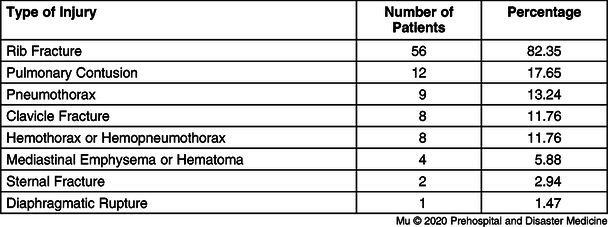
Rib fracture was the most common chest injury and was noted in 56 patients (82.4%), including multiple rib fractures (24 patients). Pulmonary contusion was the next most frequent injury, occurring in 12 patients (17.7%). Twenty-one patients suffered intrathoracic damage, including pneumothorax (nine), hemothorax or hemopneumothorax (eight), and mediastinal emphysema or hematoma (four). Chest drainage was performed in 11 patients within the first 12 hours. One patient underwent a thoracotomy due to massive thoracic hemorrhage. One patient was diagnosed with a diaphragmatic rupture and underwent urgent laparotomy and repair of the diaphragm. The profiles of the chest injuries are listed in Table 1.
Profile of Chest Injuries in 68 Patients after Tornado, China

Note: It was noted that 58 patients (85.29%) had more than one type of chest injury.
Management of Acute Respiratory Failure
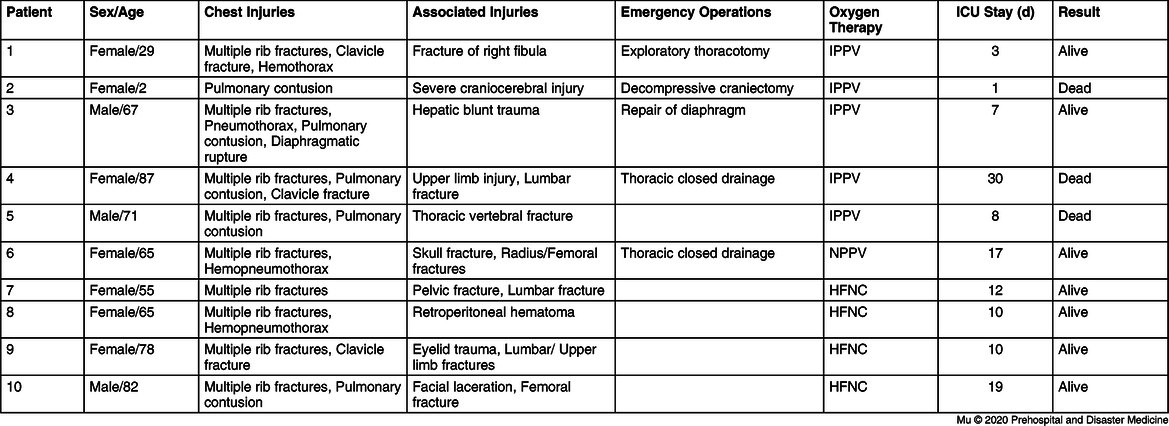
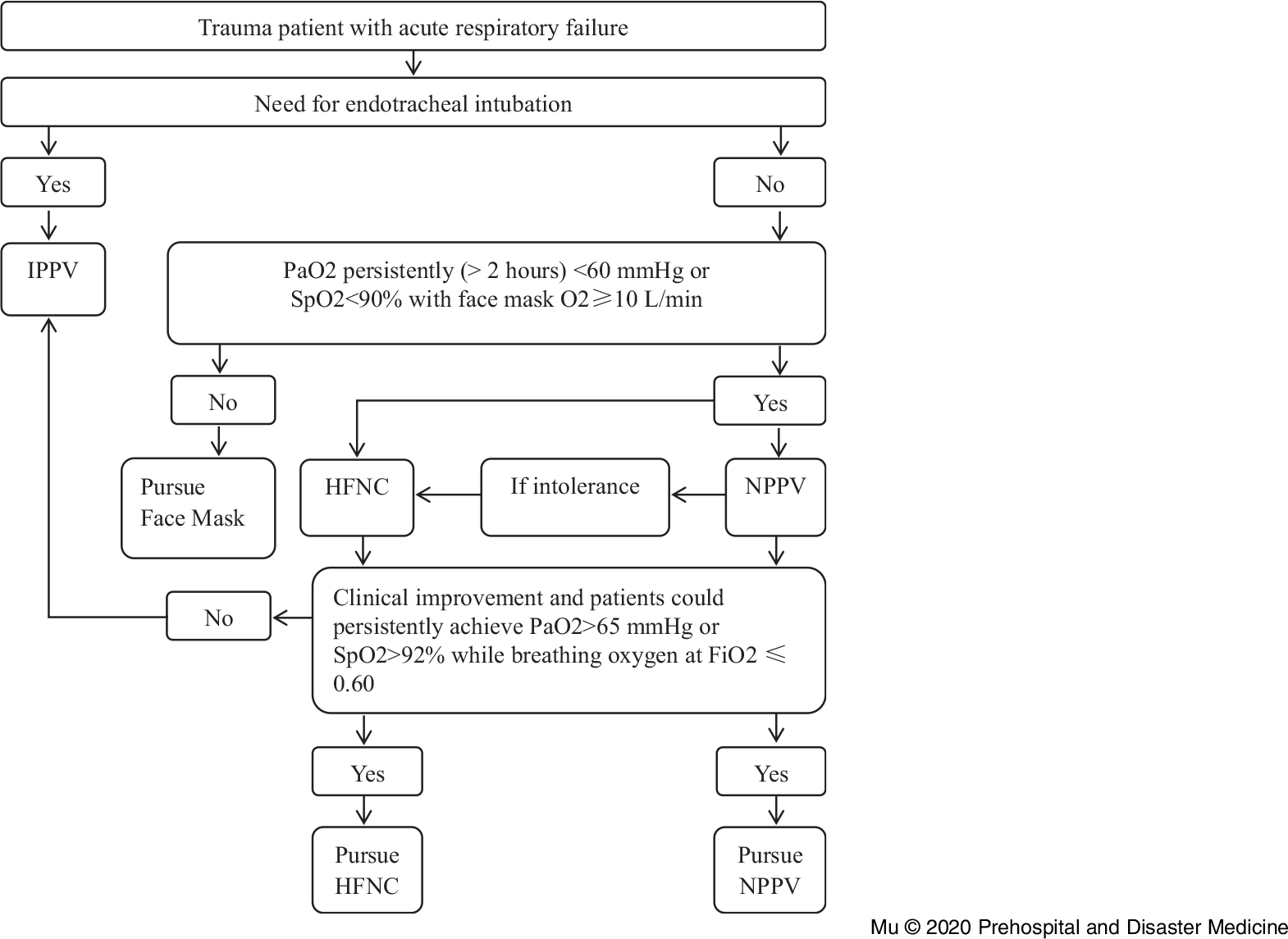
Ten patients with severe chest injuries were admitted to the intensive care unit (ICU; Table 2). All subjects with ARF were managed according to protocol (Figure 1). Five of them required intubation and ventilation. The first was a 29-year-old woman. She was injured by a collapsed house and was sent directly from the scene to the emergency department (ED). Multiple rib fractures and a hemothorax were noted. A chest tube was inserted and a massive blood transfusion was given. Massive bleeding with approximately 1800mL in the chest bottle was noted upon arrival to the ICU. A thoracotomy was performed immediately. She was successfully weaned from ventilation after surgery and was discharged from the ICU three days later. The second patient was a 2-year-old girl who was injured by a collapsing wall. Loss of consciousness was noted at the scene. She was transferred to the ED after endotracheal intubation in a field hospital. The Glasgow Coma Scale was E2V1M2. Brain CT revealed a brain contusion, subarachnoid hemorrhage, and diffuse brain swelling. A decompressive craniectomy was performed immediately. However, she died of brain herniation 20 hours later. The third patient presenting with hypoxemia was a 67-year-old man. A chest CT revealed multiple rib fractures, pneumothorax, and diaphragmatic rupture. Urgent laparotomy and repair of the diaphragm were undertaken, and blunt hepatic trauma was noted. He was discharged from the ICU seven days later. Another two elderly patients with multiple rib fractures and pulmonary contusions needed intubation and mechanical ventilation for severe hypoxemia. These two patients developed acute respiratory distress syndrome (ARDS) and serious complications during their hospitalization. One died of pneumonia and septic shock on day eight, and the other died of multiple organ dysfunction syndrome (MODS) on day 30.
Details of 10 Patients Admitted to the Intensive Care Unit

Abbreviations: HFNC, high-flow nasal cannula; IPPV, invasive positive-pressure ventilation; NPPV, noninvasive positive pressure ventilation.
Oxygen Therapy Protocol of Patients with Acute Respiratory Failure Used in ICU.

A 65-year-old woman was diagnosed with multiple rib fractures and hemopneumothorax. Chest tube drainage was performed, and pain management was administered. Subsequently, she was treated with noninvasive positive pressure ventilation (NPPV) for moderate hypoxemia. The PaO2/fraction of inspired oxygen (FiO2) ratio gradually increased, and she was successfully weaned from NPPV eight days later.
There were four patients with mild or moderate hypoxemia treated with high-flow nasal cannula (HFNC). A 55-year-old woman was diagnosed with multiple rib fractures, a pelvic fracture, and lumbar fracture. She presented with breathlessness and hypoxemia at the ED. The PaO2/FiO2 ratio further deteriorated despite the delivery of a maximal dose of oxygen via a nonrebreathing face mask. A trial of NPPV was not tolerated. The patient was treated using HFNC at a flow rate of 50L/minute, with an FiO2 of 0.8; continuous analgesia was administered. The PaO2/FiO2 ratio increased gradually, and HFNC was replaced by oxygen delivery through a nasal cannula on day 12. A 65-year-old man was thrown by the wind. Multiple rib fractures and hemopneumothorax were noted. The treating clinicians did not insert a chest drain due to the small size of the hemopneumothorax only seen on CT. A HFNC was introduced at a flow rate of 40L/minute and an FiO2 of 0.8; NPPV was not used due to abdominal distention caused by a retroperitoneal hematoma. The PaO2/FiO2 ratio gradually increased, and HFNC was discontinued on day 10. A 78-year-old woman with a history of emphysema was diagnosed with multiple rib fractures and a clavicle fracture. Moderate hypoxemia was noted when she was transferred to the ED; she was treated with HFNC due to an intolerance to NPPV. The PaO2/FiO2 ratio gradually increased, and she was discharged from the ICU on day 10. An 82-year-old man injured by a collapsing wall was diagnosed with multiple rib fractures, pulmonary contusions, and facial lacerations. The combination of injuries weakened the patient’s ability to clear secretions, and impaired ventilation and oxygen exchange. Treatment with HFNC was introduced at a flow rate of 40L/minute with an FiO2 of 0.6. Hypoxemia slowly resolved, and HFNC was discontinued on day 19.
The median hospital stay for 68 patients with chest injuries was 24.88 (SD = 11.5) days (range one to 65): 22.1% of patients were hospitalized for one to 14 days, 44.1% were hospitalized for 15-28 days, and 33.8% were hospitalized for more than 28 days. The median ICU stay was 11.7 (SD = 8.5) days (range one to 30). Three patients died during hospitalization. The hospital mortality was 4.41%.
Discussion
The Jiangsu tornado was one of the deadliest tornadoes to occur in China in half a century. The severity of the tornado caused a large number of tornado-related deaths in China.Reference Deng, Lv, Xue, Kang, Dong and Zhang5,Reference Jia and Pan6 After the tornado, a large number of patients were sent to the hospital within a short period of time, placing great demands on medical resources. Injuries to the thorax during the tornado were common and presented a major challenge to the emergency medical staff.
In the present study, of the 144 trauma patients treated in this hospital, 68 patients (47.2%) sustained chest injuries, compatible with reports by Millie, et al from the 1998 tornado disaster in rural Georgia (USA).Reference Millie, Senkowski, Stuart, Davis, Ochsner and Boyd7 Chest injury is also associated with high morbidity.Reference Brown, Archer, Kruger and Mallonee8,Reference Daley, Brown and Archer9 Brown, et alReference Brown, Archer, Kruger and Mallonee8 reported that 18.0% of all trauma deaths involve a chest injury, making it second only to multiple injuries and head injuries in the Oklahoma (USA) tornado in 1999. Rib fractures were the most frequent pathology observed in 82.4% of patients, and pulmonary contusion was the second most frequent pathology observed in 33.3% of patients. The incidence of rib fractures in the current study was much higher than in previous studies.Reference Millie, Senkowski, Stuart, Davis, Ochsner and Boyd7-Reference Niederkrotenthaler, Parker and Ovalle10 The reason can be attributed to a higher proportion of elderly patients who are prone to fractures due to osteoporosis and the loss of muscle mass. Bulger, et alReference Bulger, Arneson, Mock and Jurkovich11 compared patients who were at least 65 years old to a matched cohort of 18-to-64-year-olds who sustained chest trauma with rib fractures. The elderly group had twice the mortality and thoracic morbidity. The risk of pneumonia and respiratory failure increases with age from as young as 45 years and particularly over the age of 65 years.Reference Battle, Hutchings and Evans12-Reference Ng, Seethala and Yang14 This is likely associated with increased comorbidities and the loss of physical reserves that is observed in the elderly.Reference Bergeron, Lavoie and Clas15
In previous reports, 84.0% to 94.0% of rib fracture patients had significant associated injuries.Reference Sirmali16,Reference Karadayi, Nadir, Sahin, Celik, Arslan and Kaptanoglu17 The most common associated thoracic injuries are pneumothorax, hemothorax, and pulmonary contusion.Reference Karadayi, Nadir, Sahin, Celik, Arslan and Kaptanoglu17,Reference Novakov18 In the present study, pneumothorax developed in eight patients (13.2%), followed by hemothorax or hemopneumothorax (11.8%). Consequently, the majority of these patients had to be treated with tube thoracostomy. It is vital to identify the presence of a major pneumothorax and/or hemothorax as an urgent chest tube may be required to decompress the pleura and improve lung inflation.Reference Roberts, Leigh-Smith and Faris19
Patients with multiple rib fractures or a flail segment have been shown to have a higher incidence of underlying lung injury.Reference Battle and Evans20 The combination of chest wall and lung injury significantly reduces pulmonary function, resulting in a higher incidence of patients requiring respiratory support and a long length of stay in the ICU,Reference Amital, Shitrit and Fox21 as demonstrated in this study. Respiratory function should be supported with oxygen therapy to treat hypoxia and reduce the work of breathing. The amount and type of oxygen therapy needs be selected according to the respiratory status and injury severity of the patient.
Mechanical ventilation is an essential means of life support for patients with respiratory failure caused by chest trauma. The choice of mechanical ventilation depends on the type of injury and the requirements for further surgery.Reference Richter and Ragaller22 In present study, five of ten patients with severe chest injuries were treated with invasive positive-pressure ventilation (IPPV). However, mechanical ventilation was a double-edged sword, and there were many complications while saving lives, including ventilator-induced lung injury (VILI) and ventilator-associated pneumonia (VAP).Reference Rico, Cheng, Gestring and Piotrowski23 Ventilation in patients after chest trauma is challenging because of the difficulty in achieving a balance between sufficient ventilation and the avoidance of further harm to the lungs. The magnitude, location, and type of lung or chest injury require a gradually adapted therapy tailored to individual patient needs.
Noninvasive positive pressure ventilation has been increasingly used to manage ARF of various etiologies, such as exacerbations of chronic obstructive pulmonary disease (COPD), cardiogenic pulmonary edema, or chest trauma.Reference Duggal, Perez, Golan, Tremblay and Sinuff24 Gonzalo Hernandez, et alReference Hernandez, Fernandez and Lopez-Reina25 reported that noninvasive mechanical ventilation can reduce intubation compared with the oxygen mask in severe thoracic trauma-related hypoxemia. However, its use should be restricted to patients without pneumothorax or mediastinal emphysema, severe abdominal distention, or maxillofacial injury.Reference Carron, Freo, Zorzi and Ori26 In addition, NPPV failure has been experienced often because of mask intolerance or inadequate cooperation.Reference Carron, Freo, Zorzi and Ori26 In this study, two of three patients with moderate hypoxemia could not tolerate NPPV and were then treated with HFNC.
In recent years, HFNC as a new respiratory support therapy has been introduced, and HFNC can deliver up to 100% humidified and heated, blended gas at flow rates of up to 60L/minute into the nares. This HFNC therapy can reduce the work of breathing by decreasing oxygen demands, improving the expectoration of secretions, and recruiting alveoli by supplying a small amount of positive end expiratory pressure.Reference Nishimura27 Previous studies demonstrated that HFNC therapy was well-tolerated and useful for early oxygenation during acute hypoxemic respiratory failure.Reference Papazian, Corley and Hess28-Reference Simon, Braune, Frings, Wiontzek, Klose and Kluge30 However, there were no previously published clinical studies evaluating its efficacy and tolerability in the management of chest trauma-related hypoxemia. In reviewing four cases of chest trauma treated with HFNC, it was found that HFNC could be an effective therapy to patients with chest injuries, and it may be a useful alternative to NPPV in victims with mask intolerance. Nevertheless, whether HFNC could reduce the requirement for both invasive and noninvasive ventilation of patients with thoracic injury needs to be confirmed by further clinical research.
Study Limitations
The current study has some limitations that are worth noting. This was a single hospital study, but didn’t include persons treated in local hospital affected by the tornado. Therefore, it is not representative of the total casualties in tornado. In the study, most epidemiological data of patients rely on the medical records, but detailed medical records of small proportion of hospitalized patients were often incomplete, especially during chaotic disaster conditions. In addition, though the data analysis has been undertaken by a single individual, the patient files were originally registered by many different doctors. This type of data is very inclined to individual variation and clinical interpretation bias which is difficult to avoid. Finally, case numbers for ARF were small, resulting in limited statistical power.
Conclusion
Chest trauma was a common type of injury and presented a major challenge in emergency medical support during the Jiangsu tornado. Most patients (67.6%) with chest injuries suffer from multiple injury; the most frequent thoracic injuries were fracture of the ribs and pulmonary contusion. Severe chest trauma is usually associated with a high incidence of respiratory support requirements and a long length of stay in the ICU. The clinical assessment must be accurate and repeated regularly to determine the needs of the patient. Early initiation of appropriate oxygen therapy, which includes IPPV, NPPV, or HFNC, is vital to restore normal respiratory function and save lives. Going forward, HFNC might be an effective and well-tolerated therapeutic addition to the management of ARF in chest trauma. Therefore, there are many lessons to be learned from the Jiangsu tornado experience that could be used to improve all levels of performance in future tornado management.
Authors’ Contributions
Mu and Lu contributed equally to the work and should be considered co-first authors. Mu, Lu, and Deng contributed substantially to study conception and design. Mu, Chen, He, and Sun contributed to data acquisition. Lu, Li, and Hou contributed to data analysis and interpretation. Mu drafted the article. Mu, Lu, Li, Chen, and Deng critically revised the manuscript for important intellectual content. All authors read and approved the final manuscript.
Acknowledgments
The authors thank all participating staff at The Fourth Affiliated Hospital of Nantong University for their assistance.
Conflicts of interest
This study was supported by the Medical Technology Development Project of Yancheng City, China (YK2017008). The authors declare that they have no competing interests.