Introduction
Adult nematodes of the genus Spiroxys Schneider, 1866 are parasitic in the alimentary canal (mainly stomach) of amphibians and reptiles. So far, 17 species have been recorded from all zoogeographic regions of the world (Hasegawa et al., Reference Hasegawa, Miyata and Doi1998). Eleven of these were recorded in non-marine turtles (Hasegawa et al., Reference Hasegawa, Miyata and Doi1998). Most records of Spiroxys species are attributed to chelonians of the suborder Cryptodira with a predominantly Holarctic–Oriental distribution (Berry, Reference Berry1985). Only two species, Spiroxys chelodinae Berry, Reference Berry1985 and an unidentified species (see Berry, Reference Berry1985) have been recorded in pleurodiran turtles.
A study of helminths in two species of Madagascan pleurodiran turtles, Pelusios castanoides Hewitt, 1931 and Pelomedusa subrufa (Lacépède 1788), resulted in the discovery of a number of nematodes of the genus Spiroxys (see Hedrick, Reference Hedrick1935), the characteristics of which did not correspond with those of previously recorded species. Here, the specimens are described as a new species, Spiroxys ankarafantsika, sp. nov.
Materials and methods
Samples from two species of freshwater turtles, Pelomedusa subrufa and Pelusios castanoides (Pelomedusidae) inhabiting the Ankarafantsika National Park, Madagascar, were analysed for helminths. Stomach flushing (Legler, Reference Legler1997; Fields et al., Reference Fields, Simpson, Manning and Rose2000; Kuchling, Reference Kuchling2004) was used as a technique to obtain nematodes contained inside the stomach. Nematodes were fixed in hot 70% ethanol and sent to the laboratory where they were then mounted in lactophenol and studied under the microscope. Given in micrometres, measurements are for the holotype male and allotype female, followed in parentheses by mean ± SD and then by the range.
Spiroxys ankarafantsika, sp. nov
Type host. Pelusios castanoides (Testudinata: Pelomedusidae).
Site. Stomach.
Type locality. Temporary pond (16°18′41.1″S, 46°49′21.4″E) behind the Durrell Wildlife Conservation Trust captive breeding facilities for chelonians, Forestry Station, Ankarafantsika National Park.
Type material. Twenty-two specimens (11 males, 11 females). Type specimens deposited in The Natural History Museum, London (HOLOTYPE 2007.4.3.1 ♂; ALLOTYPE 2007.4.3.2 ♀) and Department of Zoology, University of Valencia (Paratypes nos SAPS 1–SAPS 7; SAPC 1–SAPC13).
Other host. Pelomedusa subrufa (Testudinata: Pelomedusidae).
Etymology. The name of the new species refers to the locality (Ankarafantsika National Park) where the hosts live.
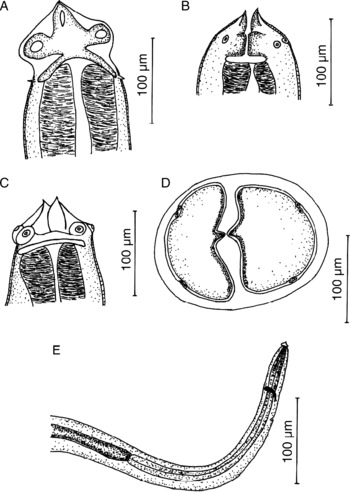
Description. Medium-sized, stout worms. Cuticle striated transversely. Collar smooth. Cephalic end with two trilobed pseudolabia, each with dorsal, ventral and middle lobes; median lobe large, projecting anteriorly, with one apical tooth (fig. 1A, B, C); dorsal and ventral lobes small, equal, and without teeth or projections: each pseudolabium with two large double papillae (fig. 1D). Deirides just behind cephalic end, projecting as minute cervical spines (fig. 1A). Oesophagus thickened posteriorly and divided by indistinct junction into anterior muscular, posterior glandular portions (fig. 1E). Nerve ring in anterior portion of oesophagus. Excretory pore slightly posterior to nerve ring.
Spiroxys ankarafantsika n. sp. (A) ♀ anterior end, lateral view; (B) ♂ anterior end, dorsal view; (C) ♂ anterior end, median view; (D) ♀ anterior end en face; (E) ♂ anterior portion, lateral view. Scale bars = 100 μm.

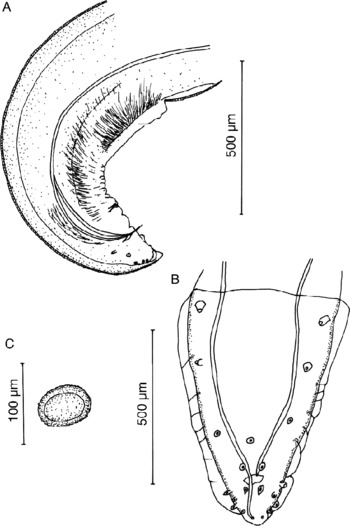
Male (holotype and 10 paratypes). Length 13,400 (17,780 ± 4211; 10,200–22,000); greatest width 380 (474 ± 133; 240–700). Pseudolabium 60 (56 ± 8; 42–64) long, 96 (100 ± 15; 78–120) wide. Nerve ring and excretory pore 480 (561 ± 64; 464–640) and 640 (692 ± 63; 640–768), respectively, from anterior extremity. Oesophagus 2300 (2628 ± 442; 2040–3200) long, greatest width 128 (120 ± 26; 80–160) near posterior end. Caudal papillae 10 pairs: 4 precloacal and 6 postcloacal; the pairs immediately anterior and immediately posterior to cloaca, are subventral; in addition 1 unpaired median papilla anterior to pre-anal ventral pair of papillae (fig. 2B). Caudal alae thick, forming a vesicular swelling. Ventral precloacal pseudo-sucker with muscles well developed (fig. 2A). Spicules subequal, pointed distally; right spicule 1280 (1841 ± 281; 1280–2088) long, left spicule 1360 (1802 ± 293; 1360–2160). Simple, small gubernaculum present. Tail conical, 160 (142 ± 21; 120–168) long.
Spiroxys ankarafantsika n. sp. (A) ♂ tail, lateral view; (B) ♂ tail, ventral view; (C) egg. (A) and (B) scale bars = 500 μm; (C) scale bar = 100 μm.

Female (allotype and 10 paratypes). Length 17,800 (24,560 ± 5180; 17,800–32,000); greatest width 520 (692 ± 184; 500–1020). Pseudolabium 64 (70 ± 10; 52–86) long, 116 (127 ± 17; 108–152) wide. Nerve ring and excretory pore 492 (559 ± 95; 400–720) and 687 (860 ± 283; 600–1536), respectively, from anterior extremity. Oesophagus 2540 (2989 ± 447; 2400–3800) long, greatest width 144 (157 ± 22; 128–200) near posterior end. Vulva flat, at 14,512 (12,033 ± 3194; 9000–18,000) from anterior extremity. Vagina directed anteriorly and joining to both uteri, 677 (900 ± 239; 640–1144) long. Tail conical, 280 (310 ± 69; 208–440) long. Eggs elliptical or sub-elliptical, with thin shell, containing embryos in early cleavage (fig. 2C), 71 (67 ± 5; 52–74) by 54 (52 ± 4; 44–60) (n = 50).
Discussion
Berry (Reference Berry1985) separated the species of the genus Spiroxys into two groups, depending on the presence or absence of teeth or spines on the pseudolabia or collar. Due to our specimens' lack of pseudolabial teeth (except the median tooth on each median lobe), they belong to group 2. This group contains three species: S. annulatus Baylis & Daubney 1922; S. transversalata Belous 1963; and S. chelodinae Berry, Reference Berry1985. However, since S. transversalata lacks even the median tooth of the median lobe, we suggest that a third group of species of Spiroxys (see Berry, Reference Berry1985; Hasegawa et al., Reference Hasegawa, Miyata and Doi1998) be considered, of which S. transversalata is the only representative, on the basis of its lack of pseudolabial spines or teeth.
Spiroxys annulatus differs from our specimens in having a pronounced constriction at the base of the pseudolabia (see Berry, Reference Berry1985). The species the most similar to S. ankarafantsika, sp. nov. is, therefore, S. chelodinae. However, the following characteristics differentiate it from the proposed new species: (1) deirides absent (S. chelodinae) versus deirides present as spine-like projections (S. ankarafantsika); (2) spicules inflated at the anterior end versus spicules non-inflated; (3) oesophagus with differentiated muscular and glandular portions versus oesophagus with indistinct junction; (4) gubernaculum with tubes through which the spicules pass versus gubernaculum without tubes.
Besides these morphological differences, S. chelodinae has only been recorded from Australian chelonians (Berry, Reference Berry1985; Ferguson & Smales, Reference Ferguson and Smales1998), whereas our specimens have been found in Madagascar. In fact this is the second record of a species of the genus Spiroxys in the Ethiopian region (Berry, Reference Berry1985; Roca et al., Reference Roca, García and Montesinos2007). It is due to these morphological and zoogeographical differences that a new species, S. ankarafantsika, sp. nov. is proposed for the specimens described here from the type host Pelusios castanoides, but also found in Pelomedusa subrufa – both of which belong to the family Pelomedusidae, suborder Pleurodira (Ernst & Barbour, Reference Ernst and Barbour1989).
The nematode species S. chelodinae and S. ankarafantsika, sp. nov. are the only representatives of the genus Spiroxys found in pleurodiran turtles. Other species recorded in freshwater turtles occur widely in Cryptodira and have been recorded in 13 genera of the cryptodire families (Berry, Reference Berry1985). This supports the hypothesis that Spiroxys spp. probably originated in the Holarctic or Oriental Regions from non-marine chelonians of the suborder Cryptodira (Berry, Reference Berry1985; Ferguson & Smales, Reference Ferguson and Smales1998). Although Roca et al. (Reference Roca, García and Montesinos2007) suggested that S. ankarafantsika probably originated from Palaearctic Bataguridae (Cryptodira), an alternative hypothesis is offered: S. chelodinae and S. ankarafantsika could have originated as an initial form from a common cryptodire ancestor before the separation of Gondwanaland and Laurasia 120–100 mya (Pough et al., Reference Pough, Heiser and McFarland1990; Ferguson & Smales, Reference Ferguson and Smales1998). Allopatric speciation, after fragmentation of Gondwanaland, probably originated both species in Australian and Ethiopian regions.
Acknowledgements
We would like to thank the Durrell Wildlife Conservation Trust (DWCT) for offering us this opportunity and funding our research, ANGAP and the Malagasy Government for kindly providing permission to conduct this research in Ankarafantsika NP, and our research assistants Randriamahita, Randriamitsiry and Merline. We would also thank Mikaella Lock for reviewing and commenting on the manuscript.