Significant outcomes
-
Self-diagnosed burnout was best modelled categorically in our sample.
-
The bimodal data were not likely due to current working status or differences in depression symptomatology between participants, but reflected subsets of participants with and without a previous diagnosis of a mental health condition.
-
A previous diagnosis of a mental illness from a mental health professional, and therefore potentially a psychological vulnerability factor, may impact on the severity and phenotype of subsequent burnout.
Limitations
-
Participants in the burnout group were not assessed for comorbid psychiatric diagnoses which may have influenced their symptom reporting.
-
Participants’ mental illness diagnostic history was based on self-report, with the accuracy of such self-reported data potentially hindered by several factors.
-
Participants in the depression group were assigned by a clinician-based depression diagnosis, rather than by the administration of a standardised diagnostic interview.
Introduction
The lay population readily resonate with the term ‘burnout’, and individuals frequently make such a self-diagnosis. The burnout problem has worsened since the commencement of the COVID-19 pandemic (e.g. Aubusson, Reference Aubusson2021; Hartley, Reference Hartley2020; Lufkin, Reference Lufkin2020), with flow-on effects of the pandemic in the occupational context (e.g. mistreatment by employers and customers during the pandemic) having led many to consider quitting their jobs and citing burnout as the main reason behind this (Chirico and Leiter, Reference Chirico and Leiter2022). The impact of the pandemic on reported burnout rates is particularly evident in the healthcare sector, where factors such as excessive workloads and night shifts, the high emotional demands of treating patients, and exposure to traumatic events have had demonstrable adverse impacts on healthcare workers’ mental health (Chirico and Leiter, Reference Chirico and Leiter2022; Chirico et al., Reference Chirico, Afolabi, Ilesanmi, Nucera, Ferrari, Sacco, Szarpak, Crescenzo, Magnavita and Leiter2021).
Despite burnout’s widespread recognition as a syndrome in the occupational context, its clinical status (i.e. whether it is or is not a psychological disorder) is currently ambiguous (Nadon et al., Reference Nadon, De Beer and Morin2022). Typically in medicine, diseases – which usually have characteristic symptoms with known biological or physiological causes (Peterson and Keeley, Reference Peterson and Keeley2014) – can be diagnosed using relevant laboratory tests. In psychiatry, the underlying causes or physiology behind a set of symptoms is usually not clear; thus, objective laboratory tests are not available to make clear-cut diagnoses. Thus, psychiatrists generally work to diagnose and treat psychological disorders (rather than diseases) that, in most cases, are clusters of signs and symptoms that disrupt normal functioning and which have been afforded ‘clinical’ status (Cooper, Reference Cooper2004). Whether a psychological syndrome should be afforded clinical status is usually influenced by level of severity or related dysfunction and/or by the presence of categorical features. A categorical diagnostic approach allows assignment of case status (i.e. a disorder is present as against absent) and is the DSM-5 classificatory model, such that a person must meet a certain number of diagnostic criteria to be assigned a particular diagnosis. Currently, burnout remains absent from DSM-5, while it is listed in ICD-11 as an ‘occupational phenomenon’ made up of three symptoms: feelings of energy depletion and exhaustion; increased mental distance from one’s job, or feelings of negativism or cynicism related to one’s job; and a sense of ineffectiveness and lack of accomplishment. Importantly, ICD-11 lists burnout as a ‘factor influencing health status’ rather than a mental disorder. The World Health Organization’s stance on the diagnostic status of burnout in the ICD has hence been judged as ambivalent, because while it has included burnout in its manual of disorders, it has also explicitly stated that burnout should not be considered as an illness (Schaufeli et al., Reference Schaufeli, Desart and De Witte2020).
The ICD-11 burnout definition is based on the most widely used measure of burnout, the Maslach Burnout Inventory (MBI) (Maslach and Jackson, Reference Maslach and Jackson1981; Maslach et al., Reference Maslach, Jackson and Leiter2016). The MBI defines the syndrome by three symptom constructs: (i) emotional exhaustion, (ii) depersonalisation (i.e. empathy loss and detachment from service recipients) or cynicism (i.e. indifference towards work in general), and (iii) decreased personal accomplishment/efficacy, with each represented by a respective subscale in the MBI. The adaption of the MBI’s burnout definition in the ICD has been labelled as confusing (Schaufeli et al., Reference Schaufeli, Desart and De Witte2020), as it could be interpreted as suggesting that the MBI be used to assist in diagnosing burnout, despite the MBI authors’ instructions to avoid using the measure to as a diagnostic tool to assign burnout caseness (Maslach et al., Reference Maslach, Jackson and Leiter2016; Maslach and Leiter, Reference Maslach and Leiter2021). By contrast, others have suggested that an individual should be considered as clinically burned out if they return a high score on the exhaustion MBI subscale in conjunction with a high score on either of the two remaining subscales (Chirico et al., Reference Chirico, Nucera and Leiter2022).
Ambiguity as to burnout’s clinical status is exacerbated by its overlap with several formally diagnosable mental disorders. For example, there has been ongoing debate as to whether burnout is synonymous with depression (see Bianchi et al., Reference Bianchi, Schonfeld and Laurent2015 for a review), while others have suggested it may be better conceptualised as an adjustment disorder with a ‘depressed mood’ specifier (Felton, Reference Felton1998; Chirico, Reference Chirico2017). Indeed, because burnout, depression, and adjustment disorder ‘overlap considerably’ (Chirico, Reference Chirico2016, p. 55), some have recommended that clinicians pursue diagnoses of the formally classifiable disorders (i.e. depression or an adjustment disorder) in patients presenting with burnout symptoms, so that they can then implement disorder-specific treatment (Hemmeter, Reference Hemmeter and Bährer-Kohler2013; Kaschka et al., Reference Kaschka, Korczak and Broich2011). However, for those experiencing burnout symptoms, not being able to receive a formal diagnosis of burnout can lead to frustration as sufferers ’struggle to be recognised as ill and not just lazy’ (Engebretsen, Reference Engebretsen2018; Engebretsen and Bjorbækmo, Reference Engebretsen and Bjorbækmo2019). Furthermore, worsening of symptoms has been reported when sufferers perceive that their complaints of burnout are not taken seriously by their doctor (Engebretsen and Bjorbækmo, Reference Engebretsen and Bjorbækmo2019). Determining the clinical status of burnout for such individuals is evidently pertinent.
In contrast to the MBI burnout model, our studies (Tavella et al., Reference Tavella, Hadzi-Pavlovic and Parker2020; Tavella et al., Reference Tavella, Hadzi-Pavlovic and Parker2021; Tavella and Parker, Reference Tavella and Parker2020) suggest a broader set of burnout symptoms (including cognitive impairment, social withdrawal, and insularity), and several concomitant or consequential psychological symptoms, including anxiety, irritability, and depression. We captured these symptoms in a preliminary 34-item measure (Tavella et al., Reference Tavella, Hadzi-Pavlovic and Parker2021) subsequently labelled the Sydney Burnout Measure (SBM). In light of a ‘top-down’ approach being inappropriate (there being no accepted burnout definition or diagnostic criteria among practitioners, and no clinically validated cut-offs of existing burnout measures to determine burnout cases versus non-cases), our development studies employed a ‘bottom-up’ approach (i.e. studying those who self-identified as having burnout) so as to construct a definition of burnout based on the perspectives of the lay population – a patient-centred approach. Burnout self-diagnosis has been used in previous studies to examine burnout symptoms and correlates (Brady et al., Reference Brady, Ni, Carlasare, Shanafelt, Sinsky, Linzer, Stillman and Trockel2022; Olson et al., Reference Olson, Sinsky, Rinne, Long, Vender, Mukherjee, Bennick and Linzer2019; Pick and Leiter, Reference Pick and Leiter1991; Rohland et al., Reference Rohland, Kruse and Rohrer2004; Sinsky et al., Reference Sinsky, Brown, Stillman and Linzer2021), with such studies finding that burnout self-diagnosis corresponds with scores indicative of burnout on the emotional exhaustion subscale of the MBI.
It would be expected that participants would vary in symptom affirmation and severity, leading to variation in SBM scores. The question explored here is whether any such variation reflects burnout being a dimensional construct (presumably simply varying by severity) or whether a categorical model is operative. In the latter, possible sub-categories might comprise sub-groups or ‘burning out’ versus ‘burnt out’ phases (and therefore potentially ‘sub-clinical/sub-syndromal’ versus ‘clinical’ sub-groups, respectively).
The MBI positions burnout as a dimensional rather than a categorical construct, with the degree of one’s burnout lying on a continuum and there being ‘no definitive score (on the MBI) that ‘proves’ a person is ‘burned out’’ (Maslach et al., Reference Maslach, Jackson and Leiter2016). By contrast, Schonfeld and Bianchi (Reference Schonfeld and Bianchi2016) have argued that burnout should only be considered as the ‘end stage’ of such a continuum, because at this stage ‘the sufferer, drained, experiences an adaptive breakdown’ (p. 31). The latter authors have further argued that, when considered only as an ‘end-stage’ state, burnout cannot be differentiated from depression (Bianchi et al., Reference Bianchi, Schonfeld and Laurent2014), an argument of significance considering the ongoing debate as to whether burnout and depression are synonymous, as previously noted.
A categorical model for burnout measure scores could also be artefactually generated if some study members have an alternative psychiatric disorder or state (especially depression). It was therefore deemed important to examine – if our current analyses rejected a dimensional model – whether any categorical difference could reflect sample members having depression as against burnout.
One method to determine whether a dimensional or a categorical model best fits a dataset is mixture modelling (Kendell, Reference Kendell1989; McLachlan and Peel, Reference McLachlan and Peel2000), which examines whether scores measuring or quantifying a construct show (respectively) a single distribution or one or more points of rarity in their distribution. The current study utilised this analytic strategy.
Methods
Participants
There were two groups of participants in the current study: a burnout group and a depression group. All participants provided informed consent before participating. The burnout group was that used in our previous study (Tavella et al., Reference Tavella, Hadzi-Pavlovic and Parker2021) and comprised of 622 participants who were recruited via an advertisement on the Black Dog Institute website. Individuals could participate in this group if they were fluent in written and spoken English, aged 18–65, and self-identified as currently experiencing ‘burnout’.
The depression group was initially comprised of 92 patients with a clinician-diagnosed depressive disorder. All had been diagnosed with a mood disorder by a psychiatrist or clinical psychologist and had experienced major depressive episodes. Any patient with a clinically diagnosed depression was ineligible to participate if they self-reported also experiencing burnout or were judged by their clinician as currently experiencing burnout.
Participants in the depression group were required to complete a questionnaire assessing multiple depressive symptoms, including ones corresponding to DSM-5 Criterion A symptoms of a major depressive episode (MDE; see Table 1 of the supplementary material). DSM-5 Criterion A for MDE requires individuals to experience five or more of the symptoms listed (including at least one being depressed mood or diminished interest or pleasure in activities). Two participants in the depression group did not affirm at least five of the necessary DSM-5 Criterion A MDE symptoms and were therefore excluded, leaving a total of 90 participants in the depression group.
Procedure
Burnout group
As previously detailed in describing the development of the SBM (Tavella et al., Reference Tavella, Hadzi-Pavlovic and Parker2021), burnout participants anonymously completed a 137-item questionnaire listing potential symptoms of burnout and rated each symptom as ‘distinctly, ‘moderately,’ ‘slightly’, or ‘not at all’ present (coded 3, 2, 1, and 0, respectively). Items were derived from previous burnout measures, a detailed review of the burnout literature, and the clinical experience of the last author (GP). In addition, items from four depression measures were adapted and included. Bifactor and factor analyses were undertaken, allowing the item set to be reduced to 34 items after deleting low loading and duplicate items. The bifactor analysis of these items generated a general factor and five uncorrelated specific factors (i.e. cognitive dysfunction, empathy loss, exhaustion, reduced work performance, and social withdrawal), with refined analyses suggesting that burnout was potentially best measured by a single factor comprising all 34 items, so generating the final 34-item SBM (see Table 2 of the supplementary material).
Additional questions asked participants whether they had ever stopped working due to their burnout, whether they had sought help for their burnout (and what strategies they had used), and whether they had ever been diagnosed with depression or another mental illness from a mental health professional.
Depression group
The depression group completed an identical 137-item questionnaire to the burnout group, apart from the word ‘burnout’ being replaced with ‘depression’ or ‘depressive episodes’ throughout the questionnaire. For example, the instruction ‘Please tick the degree to which the following features are present during your burnout state’ for the burnout group was replaced by ‘Please tick the degree to which the following features are present during your depressive episodes.’ Responses to the questionnaire by the depression group were included to evaluate which items were likely capturing symptoms of depression rather than burnout.
Statistical Analyses
Distributions of total SBM scores from the burnout group (which can range from 0 to 102) were examined via mixture modelling (McLachlan and Peel, Reference McLachlan and Peel2000). Specifically, multiple normal mixture models were fitted using the expectation-maximisation (EM) algorithm, in which the number of component mixtures k was varied (where k = 1, 2, 3 etc; k = 1 was taken to represent a 1-class/unimodal dimensional sample, k = 2 represented bimodal categorical differentiation, k = 3 represented trimodal categorical differentiation, and so on). Bootstrapped likelihood ratio tests (BLRTs, with number of bootstraps B set to 1000) were then used to test which mixture model (i.e. a model with k = 1, 2, 3 etc. components) provided the best fit to the data. Each test compared a model with k components to a model with k + 1 components. The null hypothesis being tested in each BLRT was that the model fit of the k + 1-component model was not superior to the k-component model, with λ representing the test statistic for each BLRT. Mixture analyses were conducted in RStudio using the mixtools package (Benaglia et al., Reference Benaglia, Chauveau, Hunter and Young2010), while all other analyses (e.g. Student’s t-test, chi-squared tests, odds ratio analyses; as will be described shortly) were conducted in SPSS Version 26 (IBM Corp., 2019).
Results
Examining the distribution of SBM scores
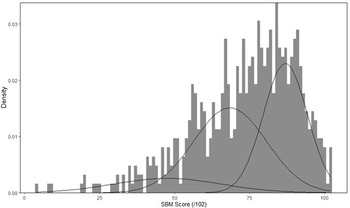
For the whole burnout group (n = 622), the initial mixture analysis identified a trimodal distribution (see Fig. 1) of scores as best fitting the data (λ = 15.6, p = 0.02), with mean scores for each class being 47.6 (SD = 18.0), 68.4 (SD = 12.2) and 86.8 (SD = 7.4), and the percentages of the total sample belonging to each class being 11.6%, 46.0%, and 42.4%, respectively (72, 286, and 264 participants in each respective class).
Trimodal distribution of SBM scores for whole burnout cohort (n = 622).

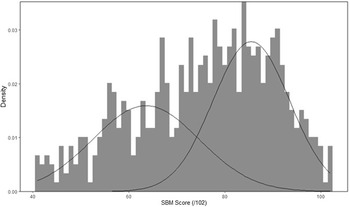
Fig. 1 plot suggested that the first class was dominated by those who reported few symptoms and therefore potentially lacked syndromal status. To correct against a third non-clinical class being so derived, all participants scoring less than 40 were excluded, and the mixture analysis was repeated on the remainder (hereafter referred to as the ‘reduced burnout cohort’; n = 596).
As graphed in Fig. 2, a bimodal distribution in scores was superior (λ = 59.2, p < 0.001), suggesting a categorical rather than a dimensional difference existing across scores. The mean SBM score for Class 1 was 63.6 (SD = 11.1), with 44.3% (264 participants) of the sample belonging to this class, while the mean SBM score for Class 2 was 85.5 (SD = 8.0), with 55.7% (332 participants) of the sample belonging to this class.
Bimodal distribution of SBM scores for reduced burnout cohort (n = 596).

Examining for differences between classes
Participants in the reduced burnout cohort were allocated to Class 1 or Class 2 based on the posterior probabilities of class membership computed for each participant, and class differences on potentially salient study variables were examined (see Table 3 of supplementary material). Student’s t-test and chi-squared tests revealed no significant differences in demographic variables other than age, with those in Class 1 being older, and employment status, with more participants in Class 1 being employed (either full- or part-time). Those in Class 2 were more likely to report having stopped working due to their burnout and having been previously diagnosed with (i) depression or (ii) any mental disorder (including depression) by a mental health professional. Class 2 members were also more likely to report having consulted a general practitioner or mental health professional, taken an antidepressant or other medication, and having presented at hospital because of burnout symptoms.
The finding that those in the lower scoring class (Class 1) less frequently reported having stopped work due to their burnout and having sought medical assistance (consulting a general practitioner or mental health professional, taking medication, going to hospital) for management of their burnout symptoms could suggest those participants were still ‘burning out’ as opposed to being ‘burnt out’, with the latter state reflected by being unable to maintain occupational functioning and requiring medical assistance, and potentially being captured by Class 2 membership. To examine this new hypothesis, a mixture analysis was undertaken on only those participants from the reduced burnout cohort who reported having stopped working due to burnout (n = 248). A bimodal solution remained superior (λ = 40.2, p < 0.001), with mean class scores being 70.2 (SD = 12.4) and 88.4 (SD = 6.3) and with 50.0% of the sample belonging to each class. This result argued against bimodality in scores for the reduced burnout cohort being solely due to ‘working’ and ‘not working’ subsets.
The influence of depression
As noted, a risk to the recruitment method (accepting those with self-diagnosed burnout) is that some participants in the burnout group (especially those in Class 2 who reported higher SBM scores) may have instead had a depressive disorder that they interpreted as burnout. To explore this possibility, rates of reporting the 37 depression symptom items included in our initial 137-item questionnaire (Tavella et al., Reference Tavella, Hadzi-Pavlovic and Parker2021) were compared between Class 1 and Class 2 members of the reduced burnout cohort (n = 596) by examining each item whether the odds of responding ‘moderately’ or ‘distinctly’ versus ‘not at all’ or ’slightly’ differed between classes. To test if the ratio of these odds differed from 1, a log-linear model (Hall and Bird, Reference Hall and Bird1986) was estimated in SPSS GENLOG (see Table 4 of the supplementary material). Class 2 members more often rated all but two (’I feel fatigued’ and ‘I lose weight even though I am not dieting’) of the items as ‘moderately’ or ‘distinctly’ compared to Class 1 members, indicating that those in the higher scoring class were more likely to rate symptoms of depression more commonly and/or more severely.
Seven such depression items are included in the final 34-item SBM measure (see Table 2 of the supplementary material). To assess whether bimodality in scores was driven by the SBM’s depression items creating a ‘depressive’ sub-group, those seven items were removed and a mixture analysis was run on a shorter 27-item version of the measure in the reduced burnout cohort. A bimodal solution (Fig. 3) remained superior (λ = 59.2, p < 0.001). A z-test was used to compare the effect size (Cohen’s d) of the difference between the two class means in the bimodal solution for the 34-item measure (d = 2.3) with the corresponding effect size for the 27-item version of the measure (d = 2.6), which was not significant (z = 1.8, p = 0.08). Furthermore, z-tests showed that there was not a significant change in the standardised distributions for Class 1 (z = 0.05, p = 0.96) or Class 2 (z = 0.05, p = 0.96) between the bimodal solutions generated for the 34-item and 27-item versions of the measure and that there were no significant differences between the bimodal solutions for either version of measure indicated that the original bimodality in scores on the 34-item version did not appear to be driven solely by the seven depression items.
Bimodal distribution of scores on the 27-item version of the SBM after removing depression items from the measure (from the reduced burnout cohort, n = 596).

To further explore the possibility that bimodality in total SBM scores was driven by some participants having a depressive disorder, data from the group of participants with clinically diagnosed depression were examined. Specifically, mean scores on each of the 34 items from the 137-item questionnaire that were included in the SBM were calculated for the depressed group and ranked from highest to lowest (with a higher mean indicating that item was more often affirmed by the depressed group and/or rated more severely). The 10 highest SBM items so scored by the clinically depressed sample were removed from the measure, leading to a 24-item version of the measure (see Table 2 of the supplementary material). A mixture analysis was undertaken of data from this 24-item version of the measure in the reduced burnout cohort (n = 596). A bimodal solution (Fig. 4) remained superior (λ = 45.1, p < 0.001), and the effect size of the difference between the two class means in the bimodal solution for the 34-item measure (d = 2.3) was not significantly different from the corresponding effect size for the 24-item version of the measure (d = 2.6; z = 1.7, p = 0.09). Furthermore, z-tests showed that there was not a significant change in the standardised distributions for Class 1 (z = 0.15, p = 0.88) or Class 2 (z = 0.24, p = 0.81) members between the bimodal solutions generated for the 34-item and 24-item versions of the measure. Thus, the bimodality in scores for the reduced burnout cohort on the full 34-item version of the SBM did not appear to be driven by those symptoms in the measure most often reported and/or experienced more severely by those with a clinically diagnosed depression. Taken together, the analyses of the 27-item and 24-item versions of the SBM argue against bimodality in the 34-item measure having resulted from differing burnout and depression sub-groups.
Bimodal distribution of scores on the 24-item version of the SBM (from the reduced burnout cohort, n = 596) after removing 10 items from the measure most often affirmed by the depressed group.

The impact of mental illness history
As reported earlier, members of the higher scoring class (Class 2) in the reduced burnout cohort more frequently reported having been previously diagnosed with depression and/or any other mental illness by a mental health professional. Such results could indicate that bimodal SBM scores could reflect two sub-populations of those with and those without a history of mental ill health. To explore this possibility, another mixture analysis was undertaken on SBM data from only those participants from the reduced burnout cohort who reported no previous depression diagnosis (n = 217). A bimodal solution (Fig. 5) remained superior in this subset (λ = 15.2, p = 0.03), with mean class scores being 51.5 (SD = 6.6; 19.0% of the sample) and 77.4 (SD = 10.9; 81.0% of the sample), respectively. Thus, after excluding those with a history of diagnosed depression, bimodality in SBM scores remained.
Bimodal distribution of SBM scores for those who reported no history of depression (from the reduced burnout cohort, n = 217).

A final mixture analysis was undertaken on SBM data from only those participants in the reduced burnout cohort who reported no history of any mental illness (including depression) diagnosed by a mental health professional (n = 188). A unimodal distribution (Fig. 6) emerged as the superior solution (i.e. the test for superiority of the bimodal distribution was not significant; λ = 10.4, p = 0.13). Thus, scores on the SBM were unimodal when analyses evaluated only those individuals lacking a history of any diagnosed mental disorder. To check that the resulting unimodal distribution was not an artefact of having reduced the sample size from 596 to 188 participants (after excluding those with a diagnosis history of mental illness) and therefore the power to reject the null hypothesis (that a unimodal fit to the data was superior), mixture analyses testing whether a unimodal or bimodal model was superior were run on 100 random samples of 188 participants from the reduced burnout cohort. The null hypothesis of a unimodal fit to the data being superior was rejected in 94/100 samples, which suggested that the superior unimodal distribution computed after excluding those with a diagnosis history of mental illness was likely not artefactual.
Unimodal distribution of SBM scores for those who reported no history of mental illness (from the reduced burnout cohort, n = 188).

Discussion
The objective of the current study was to examine whether scores on the SBM were dimensional (and presumably quantifying severity) or captured sub-categories, and, if the latter was demonstrated, to pursue potential explanations.
Several study limitations are acknowledged. First, our burnout sample comprised those who self-identified as experiencing burnout, reflecting our objective of constructing a ‘bottom-up’ definition of the syndrome from the perspectives of members of the lay community who readily identify with the burnout label. However, such sampling allows that a proportion of participants may have had an alternate primary diagnosis that influenced their symptom reporting, such as depression. Future studies would benefit from submitting participants with self-identified burnout to a standardised diagnostic interview to identify those who also met diagnostic criteria for other mental or physical illnesses concurrently and then examining how such concurrent illness influences study results. Another limitation was reliance on self-reports of participants’ mental illness diagnostic history. The accuracy of such self-reported data can be hindered by several factors, including the individual’s health literacy and length of time since diagnosis (Smith et al., Reference Smith, Chu, Smith, Amoroso, Boyko, Hooper, Gackstetter and Ryan2008), and therefore should be interpreted with caution. Finally, participants in our depression group were assigned by a clinician-based depression diagnosis, rather than by the administration of a standardised diagnostic interview.
Turning to results, the initial mixture analysis indicated three classes. One comprised those with very low SBM scores and which we have interpreted as perhaps capturing a sub-syndromal class. After removing those scoring less than 40, a bimodal distribution of SBM scores was evident, indicating that the measure captured two sub-groups. Subsequent analyses revealed several factors that differed between the classes, with three candidate explanations for the bimodality explored in more detail. First, it was deemed possible that participants in Class 1 – who had lower scores on the SBM and were less likely to report having to both stop work and seek medical assistance due to burnout – may have been still ‘burning out’ as opposed to being completely ‘burnt out’. Assuming that those who are able to continue working belong to the former ‘burning out’ group, examining whether bimodality in SBM scores was driven by subsets of participants who had and had not stopped working due to their burnout was deemed potentially informative. However, when an additional mixture analysis was undertaken analysing data from only those who reported they had stopped working due to burnout, the distribution of SBM scores remained bimodal, indicating that the bimodality of scores for the reduced burnout cohort was not solely due to the ‘working’ versus ‘not working’ subsets.
It is conceded that whether an individual has or has not stopped working due to burnout is unlikely to be the sole indicator of those burning out and those burnt out (respectively) if such a categorical distinction exists. For instance, a study (Leiter and Maslach, Reference Leiter and Maslach2016) using latent profile analysis has indicated that five burnout ‘profiles’ that may help to distinguish between those who are completely burnt out (as conceptualised by the MBI) versus only ‘on the pathway there’ (Maslach and Leiter, Reference Maslach and Leiter2021). Specifically, scores on the MBI indicated that the profiles of ‘engagement’ (low levels of exhaustion, inefficacy and cynicism) and ‘burnout’ (high levels of exhaustion, inefficacy and cynicism) were opposite endpoints on the burnout spectrum, while the intermediate profiles of ‘overextended’ (high levels of exhaustion only), ‘ineffective’ (high levels of profession inefficacy only), and ‘disengaged’ (high levels of cynicism only) could indicate those who are still in the burning out phase. Other potentially indicative factors (e.g. physiological differences between those burning out versus burnt out, responsiveness to specific interventions) should be examined in future studies. Studies incorporating a longitudinal design might be of benefit, as markers of the transition from ‘burning out’ to ‘burnt out’ stages or states could be better identified. If studies confirm such distinct stages exist, further research would then be required to determine whether those in the ‘burnt out’ stage should be afforded clinical status.
Another potential explanation of bimodal SBM scores was that the sample may have comprised ‘burnout’ and ‘depression’ sub-groups. Somewhat supporting this hypothesis was the finding that those in Class 2 – those with more severe burnout symptomatology as quantified by SBM scores – had significantly greater odds of reporting all but two of the depression items included in the initial questionnaire (Tavella et al., Reference Tavella, Hadzi-Pavlovic and Parker2021) as being experienced to a moderate or distinct degree during their burnout episodes. Such a finding aligns with Bianchi et al. (Reference Bianchi, Schonfeld and Laurent2014)’s view that burnout’s differentiation from depression becomes less apparent when considering only severe cases of burnout and could indicate that less severe burnout could transition into a clinical depression as burnout symptoms become more severe. The postulate that burnout can lead to depression has been supported in previous studies (Armon et al., Reference Armon, Melamed, Toker, Berliner and Shapira2014; Hakanen and Schaufeli, Reference Hakanen and Schaufeli2012). However, other studies have suggested the reverse scenario, in which depression can lead to subsequent burnout (Campbell et al., Reference Campbell, Prochazka, Yamashita and Gopal2010). The current literature on the burnout-depression overlap has evidently returned inconsistent findings (Bianchi et al., Reference Bianchi, Schonfeld and Laurent2015). More research is therefore required to determine whether burnout is its own clinical entity or a type of or precursor to depression, or alternatively, whether it might be better positioned as an adjustment disorder with the ‘depressed mood’ specifier, as has been previously suggested (Felton, Reference Felton1998; Chirico, Reference Chirico2017). Longitudinal studies would again assist here, so to evaluate whether there are clear points of transition from a burnout syndrome to a formally diagnosable depressive or adjustment disorder.
Irrespective of such nuances, when the depression items included in the SBM were removed from the measure, bimodality in scores remained, indicating that depression items were not driving the bimodal distribution. Furthermore, when those items in the SBM most often affirmed as symptoms of depression by those in the clinical depression group were removed from the measure, bimodality in scores on remaining SBM items was again evident. Thus, the categorical distinction in scores on the SBM found in the current study was not due solely to differences in depression symptomatology between participants. If bimodality of SBM scores reflected such interactions, we would anticipate unimodal SBM scores to have been generated when depression items were removed from the analysis.
Our exploratory analyses identified that those in the higher scoring class (Class 2) from the reduced burnout cohort were significantly more likely to have reported receiving a previous diagnosis of both depression and of any mental disorder (including depression) from a mental health professional. When participants who reported a history of depression were excluded from the analysis, a bimodal distribution remained, but when those reporting a history of any mental disorder (including depression) were removed, a unimodal distribution of SBM scores was superior. Thus, the inclusion of subsets of participants with and without a mental illness history appears to, at least in part, explain the bimodality of SBM scores in the reduced burnout cohort.
Such a finding could suggest that individuals with a psychological vulnerability (such that they have had previous mental health disorders) may develop a differing clinical presentation of burnout (and one which is more likely to require professional assistance for managing their symptoms and for them to take time off work due to their burnout) compared to those identifying as burnt out but who do not have a history of mental illness. Of course, this interpretation is speculative and requires further investigation in future studies and does not of necessity suggest either presentation of burnout (in those with or without a history of mental illness) should be elevated to disorder (or disease) status. Rather, at this stage, we suggest that the current results may be informative to employers and clinicians when assessing burnout risk and other likely correlates of any burnout syndrome identified in patients/employees, as well as indicate the likelihood that such individuals will require additional support to overcome their symptoms.
The findings also have theoretical implications. Namely, traditional models of burnout weigh the influence of environmental (i.e. work) stressors on triggering burnout, such as the job demands-resources (JD-R) model (Demerouti et al., Reference Demerouti, Bakker, Nachreiner and Schaufeli2001) and the areas of work-life (AW) model (Leiter and Maslach, Reference Leiter and Maslach2003). Newer models – such as a diathesis-stress model (Geuens et al., Reference Geuens, Franck, Verheyen, De Schepper, Roes, Vandevijvere, Geurden and Van Bogaert2021; Nixdorf et al., Reference Nixdorf, Beckmann and Nixdorf2020; Tavella et al., Reference Tavella, Hadzi-Pavlovic and Parker2020) – argue that personal factors can predispose an individual to develop burnout. However, the personal factors most often examined in past studies are usually demographic (e.g. age; Ahola et al., Reference Ahola, Honkonen, Virtanen, Aromaa and Lönnqvist2008) and personality (Swider and Zimmerman, Reference Swider and Zimmerman2010; Bakker et al., Reference Bakker, Van Der Zee, Lewig and Dollard2006; Tavella et al., Reference Tavella, Hadzi-Pavlovic and Parker2020) variables, while studies considering whether a psychiatric or medical history is a vulnerability factor for burnout are scarce (Aydemir and Icelli, Reference Aydemir, Icelli and Bährer-Kohler2013). Future studies are therefore needed to explore the impact of a mental illness history on subsequent burnout risk and phenotype, and how it might act as a pre-dispositional factor.
In conclusion, results from this study found evidence of a categorical distinction in SBM scores, suggesting sub-categories of self-identified burnout syndromes experienced by the lay population may exist. Three potential explanations of such differences were pursued, with results indicating that a previous diagnosis of mental illness from a mental health professional, and therefore potentially a psychological vulnerability factor, was the most likely determinant of the bimodal data. While our study did not consider multiple other explanations for possible determinants of the bimodality, they allow several refined hypotheses to be pursued in future studies, which would ideally (i) be longitudinal, (ii) variably include and exclude those with preceding mental health disorders and at-risk personality styles, (iii) evaluate specific markers and predictors of an ‘end-stage’ burnout as against a presumably milder ‘burning out’ syndrome in those with no previous or comorbid mental health disorder, and (iv) investigate whether a previous mental illness diagnosis (or only certain such illnesses) impacts on burnout phenotype.
Supplementary material
To view supplementary material for this article, please visit https://doi.org/10.1017/neu.2022.25
Acknowledgements
The authors would like to thank the Black Dog Institute for assisting with recruitment.
Author contributions
Gabriela Tavella and Gordon Parker were involved in the design, data collection, and data analyses for the study. Michael Spoelma and Dusan Hadzi-Pavlovic were involved in the data analyses. Adam Bayes, Artin Jebejian, Vijaya Manicavasagar, and Peter Walker were involved in data collection for the study. Gabriela Tavella wrote the first draft of the manuscript, which was then critically reviewed by all authors. All authors approved the final version of the manuscript.
Financial support
This work was supported by the Australian National Health and Medical Research Council (NHMRC; grant number GNT1176689). The contents of the published material are solely the responsibility of the individual authors and do not reflect the views of the NHMRC.
Conflict of interest
None.
Ethical statement
The authors assert that all procedures contributing to this work comply with the ethical standards of the relevant national and institutional committees on human experimentation and with the Helsinki Declaration of 1975, as revised in 2008.