The impact of familial commitments on the ability of an individual to work has become an increasing focus of employment policy and practice over the past 50 years (Hogg and Harker Reference Hogg and Harker1992). Changes in the nature of the workforce, primarily the increased number of women seeking work, have altered the assumptions underlying the existing “separate spheres” model of work–life balance, which was reliant on the presence of women in the home (Barnett Reference Barnett1999; Office for National Statistics 2013).Footnote 1 Despite the prominence of these ideas, existing scholarship finds that the majority of employees of both sexes have little access to family-friendly (FF) working practices designed to adjust occupational norms to these changes (Budd and Mumford Reference Budd and Mumford2006). Occupationally, politics is no exception to this rule, and Marian Sawer notes that “it is only in the last twenty years that there has been real discussion, let alone action, on how public life might be changed to accommodate family responsibilities. Prior to this, women's family responsibilities were construed as insuperable barriers to equal participation in public life” (2000, 369).
Globally, there are few examples of political institutions that formally commit themselves to FF working practices (Dahlerup Reference Dahlerup1988; Ross Reference Ross2002).Footnote 2 Crucially, such a lack of commitment is likely to have gendered implications: women are still more likely than men to be responsible for child care and other domestic duties, thus increasing the tension between their working and domestic lives (Kan, Sullivan, and Gershuny Reference Kan, Sullivan and Gershuny2011). Scholars of political recruitment have noted the ways in which such responsibilities are likely to affect the political ambitions and recruitment of women to legislatures, even if, crucially, this is based on perceptions of incompatibility as opposed to an actual inability to combine the two (Lawless Reference Lawless2012; Lawless and Fox Reference Lawless and Fox2005; Norris and Lovenduski Reference Norris and Lovenduski1995). The introduction of FF working practices by political institutions may disrupt these norms, providing greater compatibility for both sexes between pursuing politics as a career and traditional caring roles and can be seen as part of a broader move toward gender sensitivity and wider equality in political life.Footnote 3 Existing analyses have suggested that newly formed institutions that have adopted FF working practices have seen women feel more “at home” in these spaces than in their older equivalents (Mackay and McAllister Reference Mackay and McAllister2012, 731). However, we know little of whether sitting politicians feel that FF practices are working and actually affecting their lived experience of being a politician. Additionally, if they are seen to be successful, we know nothing of whether this is equally true of all legislators regardless of sex, age, parental status, or other confounding factors.
In this article, we provide the first findings of this kind to the gender and politics literature. We focus on the FF practices in place in two “new” legislatures, the Welsh Assembly and the Scottish Parliament, 15 years after their initial implementation. We combine primary survey data and interviews of sitting politicians in the two legislatures to assess whether legislators perceive that the implementation of FF policies has been successful. Following this, we offer four explanations as to how these perceptions might differ among politicians, dependent on (1) whether they are parents, (2) their sex, (3) their age, and (4) the proximity of their constituency to the legislature in which they sit. We then model the relative impact of these variables and develop findings that underline the importance of FF policies beyond those focused on parents and children. We close with a number of recommendations and directions for future comparative research.
FAMILY-FRIENDLY WORKING PRACTICES AND POLITICS
Recent scholarly work has considered the extent to which political legislatures are institutionally sexist, either in their formal or informal workings (Kenny Reference Kenny2013; Krook and Mackay Reference Krook and Mackay2011; Lovenduski Reference Lovenduski2005, Reference Lovenduski2012a, Reference Lovenduski2012b; Puwar Reference Puwar2004).Footnote 4 A feminist institutionalist theory has emerged over the past decade that seeks to explain institutional norms and change by placing a feminist lens over institutional theory at large (Kenny Reference Kenny2013). However, little scholarship explicitly refers to FF working practices in this context. Rather, the focus is often on the broader difficulties, perceived and actual, of combining the duties of an elected political occupation with family obligations and caring duties (Cheng and Tavits Reference Cheng and Tavits2011; Lawless Reference Lawless2012; Norris and Lovenduski Reference Norris and Lovenduski1995). This is often related to further issues of political representation and access. For example, in evidence to a recent U.K. House of Commons inquiry into sitting hours at Westminster (the area of London where Parliament meets), Childs notes,
Importantly, advocating family friendly hours is not about MPs [members of Parliament] working less when they are in Westminster, but rationalizing their work in ways that rebalance work/family life, so as to both improve the conditions of current MPs, and to signal that the House is open to a diverse group of Members, not just those who either do not have caring responsibilities or who have that care undertaken by others. (House of Commons Procedure Committee 2012)
It is notable that “family-friendly” is a phrase often used interchangeably with “woman-friendly” (Ross Reference Ross2002).Footnote 5 Clearly, individual men can struggle as much as women to combine their political duties with family life. However, this focus on the situation of women reflects an inherent assumption based on long-standing traditional gender roles that when a man is involved in elected politics, there will be a woman taking care of domestic matters (Lyon and Woodward Reference Lyon and Woodward2004; Mackay Reference Mackay2001). Therefore, these policies and practices have been framed as a means of correcting this historical injustice (Sawer Reference Sawer2000). Ballington (Reference Ballington2009) introduces the idea of a “gender sensitive” parliament, pointing out that the “operational culture” of a parliament is an important element of this, and notes that this can include changes to the sitting hours of the legislature in addition to the introduction of child care facilities within the legislature. Thus, sex and parenthood are pivotal delineations in the consideration of the workings of FF practices and policies.
The lack of academic attention given to the subject is likely attributable to the fact that FF practices are the exception rather than the rule in political institutions, leaving scholars with only a small number of cases to examine.Footnote 6 Although we struggled to find a reliable source detailing the global extent of FF practices in political institutions, we did find mention of specific instances of them. For example, the Swedish parliament (the Riksdag) opened a day care facility for the children of parliamentarians in 1999 (Engstrom Reference Engstrom2009). Similarly, the U.K. Parliament at Westminster has a crèche where MPs can leave their children during the working day.Footnote 7 The broad focus on sitting hours and child care provisions reflects the main pressures on legislators with family responsibilities—those of time and caring resources, similar to those seen in other high-level professions (Fagan Reference Fagan2001).
Restrictions on sitting hours could be seen to make a legislature more family friendly by allowing politicians to return home at a time closer to traditional (“nine-to-five”) jobs, as opposed to being forced to remain within the legislature in case of a late-night vote. However, these restrictions may also have an adverse effect on those politicians whose constituencies are a long distance from the location of the legislature in which they sit. In countries such as the United Kingdom or United States, countries with strong traditions of constituency-based service from politicians (Fenno Reference Fenno1978; Searing Reference Searing1985), contemporary politicians are expected to return to their constituencies, wherever they may be, on an almost weekly basis (Norton Reference Norton1994). The argument espoused in the United Kingdom, for example, is that “people who live in constituencies that are a long distance away from London…desire to work longer hours but for a shorter week” (House of Commons Procedure Committee 2012). Put simply, these politicians would prefer to work longer, “non-family-friendly” hours but be able to return to their constituency earlier in the week. Clearly, the location of a legislator's constituency might affect his or her perceptions of the effectiveness of FF practices such as alterations to sitting hours.
We can locate the present study, and potential future research into FF working practices within broader bodies of research, by highlighting the ways in which this is a topic of clear relevance to scholars of gender and politics. First, FF working practices clearly affect and shape institutional norms, increasingly studied by feminist institutionalist scholars (Mackay, Kenny, and Chappell Reference Mackay, Kenny and Chappell2010). We can understand the introduction of FF practices from multiple institutionalist perspectives. Within a framework of feminist historical institutionalism, we consider how these formal institutional changes either persist or disappear over time, why this occurs, and how these shifts play out in a gendered way and with gendered effects (Waylen Reference Waylen2009). Additionally, drawing on poststructural and discursive institutionalist ideas of nonformal institutions, we can better appreciate the relationship between formal institutional frameworks such as the legal commitment to FF working practices and the nonformal “rules of the game” that also shape the lives of actors within these spaces, such as the general acceptance of certain working hours or compromises between work and family (Bacchi and Rönnblom Reference Bacchi and Rönnblom2014; Chappell and Waylen Reference Chappell and Waylen2014; Hay Reference Hay2005; Mackay, Kenny, and Chappell Reference Mackay, Kenny and Chappell2010; Moon Reference Moon2013). That is, do formal institutional changes necessarily result in the changing of broader social, nonformal institutions that they are arguably brought in to mediate and alter? (Raymond et al. Reference Raymond, Weldon, Kelly, Arriaga and Clark2014). If not, how can we best understand the persistence of existing nonformal institutions that are often detrimental to gender equality, broadly defined?
Second, FF working practices are likely to affect the dynamics of supply and demand highlighted by multiple scholars over the past two decades, in addition to the broader climate in which these dynamics exist (Krook Reference Krook2009; Norris and Lovenduski Reference Norris and Lovenduski1995). Third, building on the recent work by Campbell and Childs, it could be argued that FF working practices may help rectify representational imbalances brought about by existing discriminatory norms, and therefore they can be related to arguments from justice (Campbell and Childs Reference Campbell and Childs2014; Phillips Reference Phillips1995). Additionally, as Sawer notes, others have suggested that a more consensual style of politics could arise as a result of including more women who develop such a style as a result of caring for their families (2000, 365). Despite broadly supporting these arguments, and the overall idea that FF working practices are arguably of obvious interest to gender and politics scholars, the present article will not outline them in greater detail. Our intention here, for the first time, is to examine sitting legislators' perceptions of FF policies in two new legislatures. Our findings will inform how gender and politics scholars could study FF policies in future research.
THE WELSH ASSEMBLY AND THE SCOTTISH PARLIAMENT: THE RECOGNITION OF EQUALITY IN INSTITUTIONAL DESIGN
Fifteen years ago, the devolved legislatures of Scotland and Wales both opened their doors for the first time and saw record numbers of women elected to public office. Located in Holyrood, Edinburgh, and Cardiff, South Wales, respectively, the so-called family-friendly working practices of the new institutions were perceived to treat gender as a core consideration of institutional design, with gender equality “in with the bricks” (Chaney, Mackay, and McAllister Reference Chaney, Mackay and McAllister2007, 53). A core plank of the “new politics” heralded by the establishment of the institutions was a series of measures designed to embed gender equality into the design of the legislatures themselves, including “the creation of equalities machinery (equal opportunities committees in the legislatures and equality units in government), the introduction of family-friendly sitting hours, commitments to ‘mainstream’ equality, including gender equality in policy making, and new legal responsibilities to promote equality of opportunity (including the powerful statutory equality duty in Wales)” (Mackay and McAllister Reference Mackay and McAllister2012, 734). The Welsh statutory equality duty came about as the result of significant lobbying on the part of various women's groups as well as other equality movements (Chaney Reference Chaney2004). Similarly, in Scotland, the Equal Opportunities Committee was founded to monitor the implementation of “measures to make parliamentary arrangements equally attractive to men and women” (Arter Reference Arter2004, 126) and to mainstream equality concerns into the workings of Parliament (Forman Reference Forman2002).
Table 1 outlines examples of the types of policies pursued in the new devolved legislatures. How do these policies compare with those seen elsewhere in the United Kingdom, in both the public and private sectors? Under the Employment Act 2002, parents have the right to request flexible working hours following a period of uninterrupted service with an employer. Existing evidence suggests that this is taken up more widely by public sector employees and that larger employers are better able to accommodate such arrangements than smaller organizations.Footnote 8 However, it should be noted that the most common form of flexible working is part-time work, something that will affect the earnings of the employee involved. This is distinct from the kind of arrangements undertaken by the devolved legislatures, such as a three-day legislative week, which will not reduce the take-home pay of politicians. Flexible working around school term dates does happen in other U.K. industries, but it is not mandated as in the case of the devolved legislatures. As in the case of the other policies offered by the Scottish Parliament and Welsh Assembly, such as carer's policies or salary sacrifice for child care vouchers, many of these are provided at the discretion of the employer, although employees do have certain rights to flexible working for family reasons under the terms of the Employment Act 2002 and the Human Rights Act 1998. However, the devolved legislatures are unusual in offering these proactively rather than reactively.
Key family-friendly policies implemented by the legislatures

Much research has suggested that the equality-aware nature of the institutions has allowed women to feel “at home” and to pursue a legislative agenda that foregrounds women's issues in a way that may not be possible in an older, traditional legislature (Chaney, Mackay, and McAllister Reference Chaney, Mackay and McAllister2007; Mackay and McAllister Reference Mackay and McAllister2012; McAllister Reference McAllister2000). Valentina Bold quotes Susan Stewart, who recalls,
A lot of the MSPs, when they were taking their oath, had their children in the gallery, so it had a less formal feel to it than the parliament we were all used to: Westminster. Right from the start it signalled, “This is a family-friendly parliament. It's going to be a parliament that represents all Scotland and both men and women.” (Bold Reference Bold and McCracken-Flesher2007, 209)
It is clear that a predetermined effort was made to make the new legislatures more hospitable to women and other traditionally underrepresented groups who might have been deterred by the seemingly hostile nature of Westminster politics, the sole previously existing option for ambitious Scottish and Welsh politicians looking to enter a national-level legislature (Lovenduski Reference Lovenduski2005). The question remains as to whether the implementation of these FF practices has been successful. One method of assessing this is to look at the numbers of women present in both legislatures across their 15-year existence. Based on this, the evidence is mixed, with initial gains in the numbers of women giving way to slight drops in the past five years (Mackay and McAllister Reference Mackay and McAllister2012). However, although this might suggest that more women could be coming forward to stand for office in the devolved legislatures, it obscures the importance of candidate selection procedures and other confounding measures in ensuring that more women were elected in both Scotland and Wales (Kenny Reference Kenny2013; Russell, Mackay, and McAllister Reference Russell, Mackay and McAllister2002).
The devolved institutions differ in the ways in which the scope of their power is defined. The Scottish Parliament is able to legislate in any area that is not listed as a “reserved matter” in Schedule 5 of the Government of Scotland Act 1998. Conversely, the Welsh Assembly has been given 20 broad policy “subjects” on which it is able to legislate, with any areas not listed within these subjects being nondevolved areas. By way of example, neither legislature is able to legislate on foreign policy, constitutional arrangements, or immigration, these areas being controlled by Westminster. However, both bodies can legislate on, for example, education, health care provision, and transport policy. A further consideration is the increase in the legislative powers afforded to both devolved legislatures by the Westminster parliament. The initial powers of both legislatures were laid out in parliamentary legislation in 1998, with the areas that both bodies were able to legislate on detailed within. In both the Scottish and Welsh cases, these powers of legislation increased following the initial implementation of the act, resulting in these legislatures having greater political influence in a broad sense.Footnote 9 The impact of these changes may well have affected both legislatures' commitment and ability to ensure that FF practices are implemented in the intended way. This is something we consider throughout our analysis.
To understand differences in legislators' perceptions of the success of FF practices in the devolved assemblies, we hypothesize four key influences. First, we expect satisfaction to vary by status of parenthood. That is, legislators who have children of dependent age and those who do not may hold different perceptions of the effectiveness of FF working practices. From existing evidence, a comparison of the percentage of members with children across the Welsh Assembly, Scottish Parliament, and the House of Commons suggests that a lower percentage of women are parents than men in the House of Commons compared with the two “new” legislatures (Campbell and Childs Reference Campbell and Childs2014). On the surface level, this implies that the devolved legislatures are more hospitable environments for mothers relative to Westminster, where this is true of their male colleagues (however, overall, a higher percentage of women at Westminster are mothers compared with their Scottish counterparts). Yet these figures offer little insight into the actual lived experiences of parents in either institution and provide us with no idea as to whether legislators feel that FF working practices make it easier to combine parenthood and politics. We directly address this issue using our survey of legislators in this article.
Second, for the reasons noted earlier, we expect satisfaction to differ along the lines of sex: women legislators may hold different perceptions of the effectiveness of FF working practices as their male colleagues. Third, we hypothesize that older legislators are more likely to view any legislative equality measures as successful and effective given the long-standing problems in older institutions at both the local and national levels. Finally, we expect the location of a legislator's constituency to affect his or her satisfaction with FF working practices. Legislators may hold different perceptions of the effectiveness of FF working practices regardless of the distance between the legislature and their constituency.
DATA AND METHODS
Our main data source is an individual-level dataset that includes all members of the Welsh Assembly and Scottish Parliament (n = 188). The data were collected using both primary and secondary sources. First, we conducted a survey of sitting politicians in both legislatures. The survey consisted of 32 items that broadly addressed issues relating to the experiences of the legislators while holding elected office in addition to personal and demographic-focused questions. All legislators were sent a paper survey in the mail in addition to being given the option of completing an online version. The response rate was 34%.Footnote 10 This is comparable with other similar length surveys of political elites, which have response rates of around 36% (Maestas, Neeley, and Richardson Reference Maestas, Neeley and Richardson2003).
Our responses are broadly representative of the two legislatures, in terms of both sex and party affiliation.Footnote 11 Women represent 44.7% of our sample.Footnote 12 Combined, the full population of both legislatures includes 38% women and 2.1% members from minority ethnic backgrounds; 58% of the combined legislature membership is made up of parents of children of all ages. We could not find data on the average age of Welsh Assembly members (AMs), but the average age of members of the Scottish Parliament (MSPs) is 50 years. Considering the partisan makeup of our sample, 40% of respondents are from the Labour Party compared with 35.6% across the two institutions, while 16.9% of the sample are from the Conservative Party compared with 15.4%. Moreover, 45.9% of our sample from the Scottish Parliament is affiliated with the Scottish National Party, compared with 53.9% in the actual Parliament, while 21.4% of Welsh Assembly respondents were from Plaid Cymru compared with 18.3% in the actual Assembly.Footnote 13
Second, we utilized various online sources such as official and personal web sites to collect data on the parental status of all members of the devolved legislatures, specifically, whether they had children and, if so, how many. We also collated and then merged aggregate data, including electoral information and sociodemographic data through the census, with the individual dataset. To gain a deeper insight into legislators' experiences and perceptions of FF policies, we also supplemented the quantitative data with information from eight anonymous semistructured interviews with legislators in the two institutions conducted either in person or by telephone depending on their availability.Footnote 14
KEY VARIABLES
In our survey of legislators, we asked the following question on the implementation of FF policies, which is the focus of this article: “Do you agree that devolved assemblies have successfully implemented FF working hours?” This is measured across five categories on an ordinal scale from strongly disagree to strongly agree.Footnote 15 As noted earlier, we seek to explain the differences in legislators' perceptions of the success of FF practices in the devolved assemblies through four key factors. Both sex and age 60-plus are binary variables derived from the survey responses. Parenthood is also a binary variable and simply indicates whether the legislator has children of dependent age or not. Put simply, the variable is a useful measure of how feasible it is to combine the caring duties associated with children with the professional obligations of an elected political position. It is also derived from survey responses and supplemented by online information through personal and party websites. Finally, we consider the effect of constituency location on legislator satisfaction with FF working practices.Footnote 16 Here we derive a variable that takes account of the vast differences in distance. Using Wales as an example, we took the observed distance of each Assembly member and subtracted the median distance in Wales. This created an individual distance measure where a positive value specifies longer travel than the median Assembly member, while a negative value indicates a shorter travel distance. We did the same for Scotland.
Our examination of sitting politicians' perceptions of FF practices across the two legislatures takes place in two parts. First, we provide a descriptive overview of the survey data and supplement these findings with semistructured interviews of legislators. Second, we use an ordinal logistic regression model to assess which of the hypothesized influences explain the variation in legislators' experiences of FF working practices in the two institutions. The problems associated with a small sample size compromise our ability to address other possible influences or control for other factors, but we are keen to emphasize that future research could develop this. However, for the purposes of the present study, we only test the relationships for the key predictors hypothesized earlier.
ARE FAMILY-FRIENDLY WORKING PRACTICES EFFECTIVE?
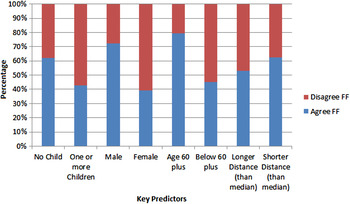
Figure 1 provides a descriptive overview of legislators' assessment of the effectiveness of FF practices by parenthood (having children of dependent age), sex, age 60 and older, and the distance (above and below the median distance) from a legislator's constituency to the legislature. The descriptive statistics are derived from our sample of legislators.
Descriptive overview of legislators' satisfaction with the implementation of family-friendly practices across the devolved legislatures (N = 64)

Does Having Children of Dependent Age Influence Legislators' Evaluation of the Effectiveness of Family-Friendly Practices?
Although there is little comparable research focused on political institutions, it stands to reason that having children of caring age (under 18) will affect individual-level opinions regarding the effectiveness of the FF working practices in place within a legislature. Parents are more likely not only to be aware of such practices than nonparents but also to seek and feel the benefit of their successful implementation or otherwise. Figure 1 provides some support for the contention that parents view the effectiveness of FF policies differently from their colleagues without children. Among our sample respondents from both legislatures, 62% of childless legislators agreed that FF working hours had been successfully implemented compared to just over 42% of those with children of dependent age. These sentiments were reflected in our interviews. One Labour woman legislator said that “in terms of being able to get home to do what I want to do, and family life and all that sort of thing, it's quite difficult to combine politics with that. It's just become a way of life. I always try to keep a Sunday free for the children and things, but you quite often have things that encroach on a Sunday, which is inevitable I suppose.” In terms of whether they thought they had gotten the balance between work and family about right, a Labour woman AM responded, “Yes, because I have no dependent children.”
There was a sense among our interviewees that recent increases in the powers of both legislatures had resulted in a weakening of the commitment to FF working hours.Footnote 17 In addition to the foregoing, a Liberal Democrat male legislator noted that “at the very beginning we had a standing order that all meetings had to be finished by 6 o'clock… but [FF working hours] are getting more difficult to hold onto, because now it's a law-making body. It means if you're passing through a law, you cannot necessarily stop at 6 o'clock. So it is showing, you know, a bit of a strain, the family-friendly hours because of that.” Another male Liberal Democrat legislator concurred with this: “FF working hours have really taken a bit of a back seat to the reality of managing a law-making assembly with only 60 members which means we have to put huge amounts of time into it. So, you know, it's a problem.” This raises the possibility that the initial impact of the FF practices may be under threat. In a sense, the broad success and increased power of the new legislatures have put their unique ability to commit to FF working practices under threat. This further brings into question whether, globally, institutions that initially seem “family-friendly,” particularly “woman-friendly,” will remain so.Footnote 18
Does Sex Affect Legislators' Perceptions of the Effectiveness of Family-Friendly Policies?
Focusing on parenthood alone obscures the existence of caring duties that occur outside of the parent–child relationship, duties that are, more often than not, borne by women (Mackay Reference Mackay2001). Addressing whether men and women report differing levels of satisfaction with FF working practices ensures that any specifically gendered patterns of response are not lost in our analysis. Figure 1 suggests that women sitting politicians across both legislatures were less likely than men to express agreement that FF practices had been successfully implemented. Of those who felt that FF policies had been implemented effectively, less than 30% were women, while 63% of those legislators who disagreed were women. In total, more than 60% of all the women respondents in our sample expressed dissatisfaction with the effectiveness FF practices. Our interviews provide a mixed bag of evidence regarding sexed perceptions of FF practices. For example, one male legislator said, “I think we all have to make compromises if we're going to do this type of job … Providing your family are prepared to compromise, that's fine. It's where you have problems where the family won't. Politics is a bit like show business. Marriages and relationships can suffer as a result of that.” A similar note of acceptance, of emphasizing the importance of individual-level decisions regarding the FF nature of the job, was struck by a woman MSP, who said that “it's up to each individual how much time and effort they put into their work, in this job, as in any other job. So, I'm not sure there's much the institution itself could do to change.” In contrast, another woman MSP explicitly highlighted gendered social roles in this context, stating, “No, I'm a woman. I feel guilty all the time.” Combining the descriptive statistics with this interview material raises the possibility that women are less likely to be satisfied with FF practices than their male colleagues, but they are perhaps unwilling to voice this or, indeed, do not perceive it in the gendered terms that appear more stark across the statistical findings.
Are Older Legislators More Likely to Perceive that Family-Friendly Policies Have Been More Effective than Younger Colleagues?
Older legislators (those 60 and older) are hypothesized to perceive the implementation of FF policies and practices as being more effective than younger colleagues. This partly reflects the political experiences faced by this cohort, seeking election and being involved in representative local party politics in an era when the established traditional culture of a legislature was not questioned and there was an inbuilt expectation for women in particular to combine the duties of political and family life. This is borne out by our sample: more than 60% of those 60 and older had previously been a local councillor, with one respondent having been a Westminster MP and a local councillor. Additionally, this cohort is less likely to still have dependent children and is likely to view legislature changes as being more than adequate given the work–life issues they faced when they were younger. The descriptive findings from the sample largely match our expectations. Of those who agreed that FF practices had been implemented effectively, 51% were 60 and older. Less than 20% disagreed. Of all those legislators age 60 and older, just shy of 80% perceived that the introduction of FF practices across the two legislatures had been successful. One female MSP interviewee reflected, “The fact that we have voting at 5 o'clock makes it a much more family-friendly institution and people that in the main, although there are exceptions, can get home for an evening with their family.”
Does the Distance between the Legislature and a Legislator's Constituency Affect Perceptions of the Effectiveness of Family-Friendly Policies?
Finally, we consider the effect of constituency location on legislator satisfaction with FF working practices. Across both legislatures, there are differences between those who travel longer and shorter distances. From our overall sample, 46% of those who agreed that FF practices had been successfully implemented had a longer distance to travel than the median legislator travel distance. But 56% of those who disagreed lived a longer distance away from the legislature. Of those legislators in the sample who commuted larger distances to either of the two legislatures, just above half (53.1%) believed that FF policies had been effective. However, unsurprisingly given the different geographies of Wales and Scotland, there are differences between the two legislatures. In terms of whether the Scottish Parliament had successfully implemented FF working hours, 72.2% of MSPs who lived longer distances than median distance from the legislature still agreed compared with just 28.6% of their Welsh counterparts. This is most likely a product of the three-day week that the Scottish Parliament operates. As noted earlier, debates surrounding the sitting hours of legislatures often focus on the fact that long sitting hours packed into fewer days are perhaps more convenient for those who live further from the legislature than for those who live close by (House of Commons Procedure Committee 2012). In 2012, the Scottish Parliament introduced such a three-day week.Footnote 19
Despite the Welsh Assembly operating a similar system (three days of sitting with Mondays reserved for committee sessions), AMs who travel longer distances than the median were less satisfied with FF provisions and stressed that their legislature is less sympathetic to work–life balance than their Scottish colleagues in similar situations. Such sentiments were clear in our interviews, with one woman AM whose constituency was in North Wales stating that “family friendly is a term used and not understood…it's family friendly in the sense that you can work a long batch on Tuesday and know you can definitely go back to the constituency on Thursday. I think it's termed as being FF, but actually FF is only FF for those who live close to the Assembly.” Similarly, a male AM based in South Wales agreed that “most of us, apart from the North Wales Members are able to go back to our families at nights: that helps. North Wales members are down here, what, two or three nights a week—that isn't so family friendly.” Despite their overall greater satisfaction, the MSPs we interviewed highlighted similar issues as their Welsh counterparts. One woman MSP elected from a constituency in West Scotland noted that “in theory I can go home every night. My colleagues in Aberdeen couldn't do that and my colleagues in Skye certainly couldn't do that.”
The source of this cross-legislature variation in satisfaction is unclear. It is potentially, again, a reflection of recent shifts in the Welsh Assembly's role, with AMs likely to have to put in extra hours now that the Assembly has greater legislative powers and a resultant decline in adherence to FF working practices. Additionally, but harder to measure and unaddressed in our research design, this may relate to institutional culture and the way that AMs with distant constituencies are treated relative to their colleagues in similar positions in the Scottish Parliament. Such a line of enquiry may prove fruitful for future research.
Modeling Legislator Satisfaction with Family-Friendly Practices
Building on the descriptive findings, we employ an ordinal logistic regression model to test whether the hypothesized relationships outlined earlier explain the variation in satisfaction with FF working practices. For the purposes of model parsimony, we include four predictor variables: parenthood, sex, age 60 and older, and distance from constituency to legislature. We also include a dummy variable for Scotland on the expectation that there will be no significant differences in satisfaction with FF working practices between members of the two legislatures. Given our small sample size (and statistical issues such as a lack of power) and availability of data, we focus solely on these variables and do not include additional controls or any interaction effects. Despite these limitations, the model provides a great deal of insight into the relative impact of our key variables of interest.
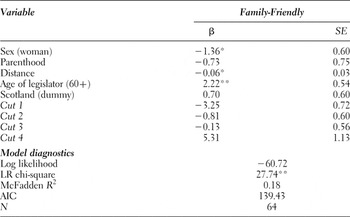
Table 2 contains the results of the ordinal logistic regression analysis. Three of the four key variables perform largely as expected, with coefficients statistically significant and properly signed. First, sex is clearly important. Women legislators are significantly less likely to be satisfied with the implementation FF working hours than men. This holds when other variables are included and is significant at the 95% confidence level. Second, those legislators age 60 and older are significantly more likely—at the 99% confidence level—to agree that FF practices have been successfully implemented than younger colleagues. Indeed, older legislators are 9.2 times more likely to strongly agree with the FF policies—compared with the other four categories combined, holding all the other variables in the model constant—than those below the age of 60. Third, as hypothesized, those legislators who have a greater distance to travel to the legislature than the median MSP or AM are significantly less likely to be satisfied with the FF practices, even when the other variables are included in the model. In line with our expectations, the Scotland dummy variable is insignificant. So while sex, being an older politician, and having a closer commuting distance to the legislature are all significant determinants of legislator satisfaction with FF practices, parenthood, measuring whether the legislator has children of dependent age, is not. This finding appears to be robust. There is no significant bivariate relationship, and the variable is not significant if the overall sample is split by legislature (Wales and Scotland). Moreover, there is no evidence of multicollinearity.Footnote 20 Although we present this ordinal logistic model with the caveats outlined earlier, this suggests that variation in legislator satisfaction with FF practice is not as dependent on the experiences of parents as might have been assumed.Footnote 21 It is clear that nonprofessional responsibilities outside of being a parent need to be considered in discussions of FF working practices.
Ordinal logistic regression: Key predictors of legislators' perceptions of the implementation of family-friendly practices

*p < .05; **p < .01.
CONCLUSION
This article has presented an original investigation of legislator satisfaction with FF working practices. Adopting a mixed-methods approach, we offer preliminary descriptive evidence of the ways in which legislator experiences of, and satisfaction with, FF working practices differ dependent on whether they have children of dependent age, their sex, age, and the distance between their constituency and the legislature in which they sit. We modeled the relative impact of these four variables and tested whether these hypothesized relationships held on legislator satisfaction with the efforts made by their institutions to implement FF working hours. Our findings suggest significant divisions along the lines of sex, age of legislator, and legislature-constituency distance. Conversely, we found no evidence that being a parent with children of dependent age matters, implying that FF practices need to move beyond focusing on the parent–child care relationship and address broader issues relating to gendered divisions of care and domestic labor as well as spatial variations in this.
Methodologically, this acknowledgment that FF practice means different things to different people could be reflected in its empirical treatment. For instance, there is no clear consensus on how to measure FF practice as it contains multiple facets that are either unrecorded or not integrated into a single convenient database. Thus, for future research, we would advocate combining as many possible sources of information about FF practices to estimate an underlying (or latent) unobserved variable for more in-depth evaluation. Put simply, thinking about FF practice as a latent concept might allow for less rigid categorization of such practices on the part of researchers and provide a more rounded understanding of their influences on outcomes.Footnote 22 Additionally, conceptualizing the FF practices as mediators of dependent variables such as employee satisfaction or work–life balance might provide greater insight into their overall impact. Finally, undertaking a greater number of interviews than we were able to as part of the present study would allow for more understanding of the phenomenal aspects of combining family life and political life.
We hope that our findings will result in similar research taking place around the globe. From the present study, we have identified a number of issues that scholars should consider in future assessments of FF working practices implemented in a legislature, old or new. First, the level of commitment to FF working practices should be addressed in much more depth. Is this piecemeal, such as the installation of a crèche, or is it part of a broader commitment to equality by the institution, such as the statutory equality duty of the Welsh Assembly? Research from nonpolitical occupations has shown that an overall shift in organizational culture in favor of FF practice is contingent on a wider sense of entitlement by those benefiting from FF policies and changes to broader organizational priorities (Lewis Reference Lewis1997). Second, is the commitment under possible threat from changes to the powers and function of the legislature in question or, indeed, the political context in which it exists? For example, a recent crèche installed in the Houses of Parliament in the United Kingdom has come under fire as being an unnecessary extravagance at a time of economic austerity.Footnote 23 Third, as we demonstrated earlier, parents and children should constitute a part, but not all, of the focus of FF working practices. It is crucial that FF practices do not isolate certain groups, either by sex, the nature of their caring duties, or their geographic location. It is easy to anticipate the difficulties, for example, in implementing FF policies in an institution representing a significantly larger geographic unit than the ones addressed in the present study, such as the European Parliament.
We have shown that although effective in some cases, FF practices as seen in the devolved legislatures of Scotland and Wales have not eliminated the sense of compromise faced by many politicians—compromise between work and leisure, between occupational and domestic obligations, and between different areas of the country. Scholars and practitioners alike should consider ways in which to develop new solutions to reduce these limiting factors. Finally, future research in gender and politics should consider the role of FF practices in shaping the political context. For example, are women more likely to become political candidates for legislatures where FF working practices are in place? (Lawless Reference Lawless2012; Lawless and Fox Reference Lawless and Fox2010). Similarly, are women politicians in legislatures with FF practice emboldened to pursue more transformative types of substantive representation? We should also consider how the presence of FF working practices may affect political parties' candidate selection processes, arguably removing long-held traditional rationales regarding women's inability to combine domestic and political life (Childs and Cowley Reference Childs and Cowley2011; Norris and Lovenduski Reference Norris and Lovenduski1995). On a related note, in light of our findings, scholars might consider the extent to which any FF policies or practices change underlying nonformal institutional norms—are any changes merely surface level? (Raymond et al. Reference Raymond, Weldon, Kelly, Arriaga and Clark2014). Such an inquiry would fit well with discursive or poststructural institutionalist analysis of nonformal institutions. To what extent do implicit expectations regarding politicians (lack of) work–life balance persist as a nonformal institution within political life despite formal interventions, and how are these affected by further formal institutional changes such as increases in the lawmaking powers it holds? (Bacchi and Rönnblom Reference Bacchi and Rönnblom2014; Moon Reference Moon2013). These are all questions of interest to scholars of gender and politics and more broadly to those interested in the effective functioning of democratic institutions.
SUPPLEMENTARY MATERIAL
To view supplementary material for this article, please visit http://dx.doi.org/10.1017/S1743923X16000040