Introduction
Taenia is one of the largest cestode genera, containing nearly 50 species (Hoberg, Reference Hoberg2006; Lavikainen et al., Reference Lavikainen, Haukisalmi, Lehtinen, Henttonen, Oksanen and Meri2008; Rossin et al., Reference Rossin, Timi and Hoberg2010; Haukisalmi et al., Reference Haukisalmi, Lavikainen, Laaksonen and Meri2011). Species of Taenia require terrestrial carnivorous and herbivorous mammals to perpetuate their life cycles. Typically, members of the order Carnivora act as definitive hosts, and their prey belonging to the orders Rodentia, Lagomorpha or Cetartiodactyla as intermediate hosts (Hoberg, Reference Hoberg2006). Adult tapeworms inhabit the small intestine of definitive hosts, and their mature segments containing numerous eggs are released into the environment. Eggs ingested by intermediate hosts develop into cystic larvae in various internal organs.
Humans serve as definitive hosts specifically for Taenia solium, Taenia saginata and Taenia asiatica after consuming raw meat or viscera contaminated with metacestode larvae (cysticerci) of these species (Hoberg et al., Reference Hoberg, Alkire, de Queiroz and Jones2001; Hoberg, Reference Hoberg2006). Beef is a source of T. saginata infection, while pork and pig viscera are responsible for T. solium and T. asiatica infections, respectively. It thus appears that food habit is the most important factor for the occurrence of human taeniasis.
Bovine cysticercosis due to larval T. saginata causes hygienic and economic concerns, especially in developing countries. Although taeniasis produces only mild clinical symptoms in humans (Flisser et al., Reference Flisser, Correa, Avilla, Marvilla and Murrell2005), bovine cysticercosis inflicts serious damage on the cattle industry. Economic losses are mainly due to condemnation of cattle, downgrading of infected carcasses and hindering the export of live cattle and beef (Yoder et al., Reference Yoder, Ebel, Hancock and Combs1994; Giesecke, Reference Giesecke1997).
In Ethiopia, bovine cysticercosis frequently occurs in domestic cattle and its prevalence has ranged from 2 to 26% in various regions (Kumar & Tadesse, Reference Kumar and Tadesse2011). This range seems to be underestimated because visual inspection alone is insensitive for detection of cystic lesions. The high endemicity of both bovine cysticercosis and human taeniasis is caused mainly by human-related factors, such as a strong tradition of eating raw beef, inadequate sanitation and low availability of anthelmintics (Kumar & Tadesse, Reference Kumar and Tadesse2011). Cattle are mainly raised under extensive husbandry, keeping a high population density in highland areas. The grazing lands are contaminated by excreta from humans, and also from domestic and wild carnivores.
Bovine cysticercosis is generally believed to be caused exclusively by T. saginata. Nevertheless, in Africa, the species abundance of Taenia (Loos-Frank, Reference Loos-Frank2000) and old reports on bovine cysticerci armed with rostellar hooks (Graber, Reference Graber1978) suggest that other causative species are involved. In this study, cysticerci collected from Ethiopian cattle were identified by a molecular method to clarify aetiological agents of bovine cysticercosis.
Materials and methods
During 2010–2012, cysticerci were collected from 41 cattle slaughtered at abattoirs in the cities of Haramaya, Dire Dawa, Jijiga and Addis Ababa in Ethiopia. All parasite samples were found through visual inspection followed by multiple incisions according to Meat Inspection Regulation by the Government of Ethiopia (Ministry of Agriculture, 1972), and then kept in 70% ethanol until DNA extraction.
Genomic DNA was extracted from a cut piece of each cysticercus by QIAamp DNA mini kit (Qiagen, Germany), and used as a template for polymerase chain reaction (PCR). A part of the mitochondrial cytochrome c oxidase subunit 1 (cox1) gene was amplified by PCR using the universal primer set of JB3 and JB4.5 (Bowles & McManus, Reference Bowles and McManus1994). The PCR mixture solution was prepared in a 25 μl volume containing 1 μl template DNA, 200 μm of each deoxynucleoside triphosphate (dNTP), 0.2 μm of each primer, 0.5 U of hot-start Ex-Taq polymerase (TaKaRa, Japan) and the manufacturer-supplied reaction buffer. A three-step thermal process consisting of 94°C for 30 s, 50°C for 30 s and 72°C for 30 s was repeated for 35 times to amplify the short fragment of cox1 (approximately 400 bp in length). Direct sequencing of the PCR products was done as reported previously (Hailemariam et al., Reference Hailemariam, Nakao, Menkir, Lavikainen, Yanagida, Okamoto and Ito2012).
A single cysticercus from each of 41 cattle was subjected to the PCR-based DNA sequencing. The resultant sequences were compared with previously published cox1 sequence data of Taenia (Bowles & McManus, Reference Bowles and McManus1994; Gasser et al., Reference Gasser, Zhu and McManus1999; Zhang et al., Reference Zhang, Hu, Jones, Allsopp, Beveridge, Schindler and Gasser2007; Lavikainen et al., Reference Lavikainen, Haukisalmi, Lehtinen, Henttonen, Oksanen and Meri2008, Reference Lavikainen, Laaksonen, Beckmen, Oksanen, Isomursu and Meri2011; Jia et al., Reference Jia, Yan, Guo, Zhu, Wang, Shi, Chen, Zhan, Zhang, Fu, Littlewood and Cai2010; Liu et al., Reference Liu, Lin, Li, Liu, Liu, Yuan, Song, Zhao, Zhang and Zhu2011). A neighbour-joining (NJ) method (Saitou & Nei, Reference Saitou and Nei1987) using the MEGA5 software (Tamura et al., Reference Tamura, Peterson, Peterson, Stecher, Nei and Kumar2011) was applied for this comparison. The unrooted NJ tree was constructed from Kimura's two-parameter distances (Kimura, Reference Kimura1980) with a gamma shape parameter (α = 0.5).
After the molecular screening, an unidentified cysticercus was cleared in glycerin, and the invaginated scolex was squashed softly to examine the number and morphology of rostellar hooks.
Results and discussion
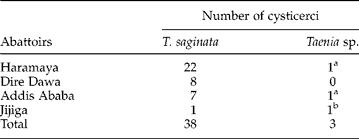
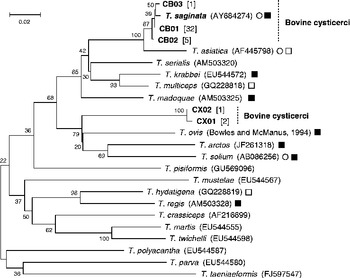
A total of 396 nucleotide sites in the mitochondrial cox1 gene were determined for each cysticercus. Based on the nucleotide sequences, 38 (92.7%) out of 41 cysticerci were classified as T. saginata, but the others (7.3%) were unidentified (table 1). As shown in fig. 1, the isolates of T. saginata were classified into three cox1 haplotypes (CB01, CB02 and CB03). The pairwise divergences of the three haplotypes ranged from 0.003 to 0.005. One synonymous and two non-synonymous substitutions occurred among these haplotypes. As compared with the reference mitochondrial DNA (mtDNA) sequence of T. saginata (GenBank RefSeq NC_009938), these substitutions occurred in the nucleotide positions 7, 61 and 96 (the positions were counted from the first nucleotide of the 5′ terminus). As far as observed in nucleotide databases, these haplotypes did not have any obvious correlation with host adaptation or area of distribution. In contrast, the unidentified three isolates showed the hitherto unknown sequences of Taenia sp., which is distantly related to T. solium, T. arctos and T. ovis (fig. 1). These isolates were divided into two cox1 haplotypes (CX01 and CX02). Only one synonymous substitution was present between them. Nucleotide sequences of these five haplotypes were deposited into DDBJ/EMBL/GenBank databases under the accession numbers AB713904–AB713908.
Molecular identification of bovine cysticerci based on the nucleotide sequences of the mitochondrial cox1 gene.

a Collected from muscle.
b Collected from liver.
An unrooted neighbour-joining tree of Taenia tapeworms based on the mitochondrial cox1 sequences. Values on the tree nodes are bootstrap proportions (%) in 1000 replicates. A scale bar (divergence of 0.02) is shown. A reference sequence of T. saginata and five sequences of the bovine cysticerci (the haplotypes CB01–03 and CX01–02) are marked bold face. The numbers of isolates detected for each haplotype are shown in square brackets. Database accession numbers are given in parentheses for the previously published sequences. Open circles (O) indicate taxa infecting humans as definitive hosts. Open squares (□) and closed squares (■) denote taxa infecting members of the Cetartiodactyla (pigs and ruminants) as intermediate hosts, and closed squares especially show that skeletal muscles are typical sites for cysticerci.

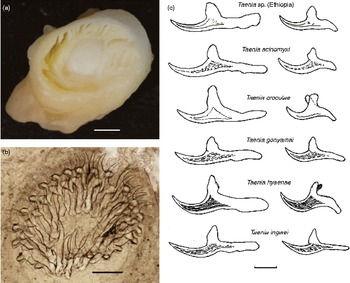
Two of the three unknown cysticerci were found as fully developed larvae from skeletal muscles (fig. 2a). The cysts were yellow-white, oval (3–4 mm in diameter) and contained a single, monocephalic cysticercus each. One of them could be used for morphological examination. Its scolex was deeply invaginated and armed with two rows of hooks (fig. 2b). The rostellar hooks were 41 in number (20 large and 21 small hooks). The length of the large and small hooks ranged from 202 to 205 μm and from 133 to 138 μm, respectively. However, morphological identification of species could not be completed.
(colour online) Morphological features of unidentified Taenia sp. to show (a) the cysticercus in the shoulder muscle of cattle, scale bar = 1 mm; (b) rostellar hooks, scale bar = 100 μm; (c) large and small rostellar hooks for comparison with five African species of Taenia after Baer (Reference Baer1926), Mettrick (Reference Mettrick1963) and Ortlepp (Reference Ortlepp1938), scale bar = 50 μm.

A DNA barcoding system based on the short DNA sequences of mitochondrial cox1 gene has been demonstrated to be useful for the taxonomic classification of Taenia (Lavikainen et al., Reference Lavikainen, Haukisalmi, Lehtinen, Henttonen, Oksanen and Meri2008; Galimberti et al., Reference Galimberti, Romano, Genchi, Paoloni, Vercillo, Bizzarri, Sassera, Bandi, Genchi, Ragni and Casiraghi2012). The DNA taxonomy, however, has not been applied to the surveys of bovine cysticercosis in African countries. Moreover, most members of Taenia in African wildlife have not been subjected to molecular taxonomy. A significant shortage of cox1 profiles makes it difficult to conduct the molecular diagnosis of Taenia in African countries.
The unidentified Taenia sp. discovered in cattle in the present study probably represents a spill-out from a wildlife cycle. As far as we know, seven African Taenia species infect wild ruminants as monocephalic cysticerci (Loos-Frank, Reference Loos-Frank2000; Jones & Pybus, Reference Jones, Pybus, Samuel, Pybus and Kocan2001). These are T. crocutae, T. gonyamai, T. hyaenae, T. madoquae, T. olngojinei, T. regis and T. simbae. In addition, larval stages and intermediate hosts are unknown for T. acinomyxi, T. dinniki and T. ingwei infecting large African carnivores (Loos-Frank, Reference Loos-Frank2000; Jones & Pybus, Reference Jones, Pybus, Samuel, Pybus and Kocan2001). Among these ten endemic species, T. madoquae and T. regis are negligible because their cox1 sequences are quite different from those of the unidentified species. Three species, T. dinniki, T. olngojinei and T. simbae, can also be excluded because their rostellar hooks are obviously longer (Loos-Frank, Reference Loos-Frank2000). In addition, the cysticerci of T. olngojinei are located only in the sacral epidural space of typical intermediate hosts, antelopes of the Alcelaphinae, but not in the muscles or liver (Jones & Pybus, Reference Jones, Pybus, Samuel, Pybus and Kocan2001). The remaining five species could be considered as candidates for the unidentified species of the present study. As shown in fig. 2c, rostellar hooks of the unidentified species differ in shape from those of the five species. However, due to considerable variation reported in hook morphology (Verster, Reference Verster1969), none of these species could be reliably excluded.
Cysticerci of only one African species, T. hyaenae, have previously been reported in cattle (Jones & Pybus, Reference Jones, Pybus, Samuel, Pybus and Kocan2001). Graber (Reference Graber1978) proved first that not only T. saginata causes bovine cysticercosis in Ethiopia. Armed cysticerci were found among naturally infected zebu cattle in south Sidamo, southern Ethiopia (Graber, Reference Graber1978). These infections also seem to occur sporadically in cattle in other African countries. The highest local prevalence reached 10% in Eritrea and Somalia (reviewed by Graber, Reference Graber1978). On the basis of the hook morphology, the causative agent has been treated as T. hyaenae, but there is still the possibility that it may represent a distinct species.
Questionnaire surveys revealed that human taeniasis is highly prevalent in the rural parts of Ethiopia (Abunna et al., Reference Abunna, Tilahun, Megersa and Regassa2007; Regassa et al., Reference Regassa, Abunna, Mulugeta and Megersa2009). Taeniasis saginata is common in Ethiopia due to the tradition of eating raw ‘kurt’ or undercooked (semi-raw) ‘kitifo’ beef. The prevalence was higher in Christians than in Muslims because raw meat consumption is uncommon among Muslims. It has been generally believed that the endemic Taenia species of African wildlife do not pose a risk to human health, except that they cause an aesthetic problem to the meat market (Jones & Pybus, Reference Jones, Pybus, Samuel, Pybus and Kocan2001). However, the strong habit of eating raw beef leads us to speculate that zoonotic infections with wildlife Taenia could be in hiding among the patients of taeniasis saginata. In African countries, expelled tapeworms after anthelmintic treatments should be subjected to morphological identification for species. The improvement of molecular taxonomy in African Taenia is also an important subject. The mtDNA sequence information of definitely identified adult tapeworms is absolutely needed to diagnose their larval stage.
Acknowledgements
The authors wish to thank Moges Eriso, Alebachew Tilahun and Takele Nesibu for their help in collecting parasite samples. This study was supported by the Japan Society for the Promotion of Science (JSPS) (Grants-in-Aid for Scientific Research: A.I., grant numbers 21256003, 24256002; M.O., grant numbers 21406009, 24406011; JSPS-Asia/Africa Scientific Platform Fund: A.I., years 2006–2011); and Ministry of Education, Japan (MEXT) (Special Coordination Fund for Promoting Science and Technology: A.I., years 2010–2012).