Introduction
Saffron (Crocus sativus L.) is the most precious and expensive spice in the world (Hussain et al., Reference Hussain, Illahi, Iqbal, Jehaangir and Talib2019), belongs to family Iridaceae that comprises around 160 recognized species. This biological diversity is spread over Western Europe and North-western Africa to Western China with reported centre of species diversity on the Balkan Peninsula and Turkey (Mathew, Reference Mathew1982). The origin of saffron is a little obscure with two possible sites, one in Greece in the Mediterranean region and other in the Turkey-Iran-India. Its cultivation has long been concentrated on a broad belt of Eurasia, bounded by the Mediterranean Sea in the Southwest, to Kashmir and China in the Northeast. Saffron is currently being exclusively cultivated in Iran, India, Greece, Spain, Italy, Turkey, France, Switzerland, Israel, Pakistan, Afghanistan and recently in Australia (Tasmania) (Nehvi et al., Reference Nehvi, Wani, Dar, Makhdoomi, Allie and Mir2006). Iran is the main producer accounting for more than 90% of world saffron production (430 tonnes/year, Statistica, 2020) followed by Jammu and Kashmir, India (second largest) contributing 5% to the global market. Similarly, the countries of the Mediterranean basin like Greece, Morocco, Spain, Italy and Turkey also produce saffron but to a very lesser extent (Gresta et al., Reference Gresta, Lombardo, Siracusa and Ruberto2008; Lage and Cantrell, Reference Lage and Cantrell2009). UT of J&K State India has a long history of cultivating saffron as low volume and high-value culinary spice under temperate conditions (Naseer et al., Reference Naseer, Nehvi, Nagoo, Samad, Iqbal and Dar2018) and its cultivation is mostly confined to Pampore, Budgam, Srinagar and Kistwar areas of Jammu and Kashmir (Sameer et al., Reference Sameer, Bashir, Nehvi, Iqbal, Naseer, Nagoo and Dar2018; Mir et al., Reference Mir, Mansoor, Alyemeni, Wijaya and Ahmad2021) and its intensive cultivation around Pampore region of Kashmir valley reportedly dates back to 500 BC (Qadri et al., Reference Qadri, Iqbal, Nehvi and Arshid2012).
Saffron-the king of spices (Cardone et al., Reference Cardone, Castronuovo, Perniola, Cicco, Molina, Morata, Nebauer and Candido2021) thrives well under cool to cold winter conditions and its specific niches are characterized having autumn–winter–spring precipitation and warm summer with low rainfall (Yasmin et al., Reference Yasmin, Iqbal, Sethi, Nehvi and Samad2018). It is a triploid and sterile plant (with haploid chromosome number, n = 8), which is exclusively propagated by vegetative means through corms and it survives underground during the summer drought (period of dormancy) by means of these compact corms (Fernández, Reference Fernández2004; Petersen et al., Reference Petersen, Seberg, Thorsoe, Jorgensen and Mathew2008; Agayev et al., Reference Agayev, Fernandez and Zarifi2009; Khan et al., Reference Khan, Alie, Dar, Hassan, Lone, Dar, Qureshi, Dar, Gulzar, Ali, Mushtaq and Amin2022; Nehvi et al., Reference Nehvi, Dar, Elai, Khan, Iqbal, Mir, Gautam and Sameera2022). With the onset of autumn, the above-ground growth commences and flowers emerge through sprouts. The ontogenesis of Kashmir saffron is spread over six developmental stages – 1st May to 25th June (corm dormancy), 26th June to 25th August (flower ontogenesis), 26th August to 30th September (bud sprouting), 1st October to 10th November (flowering), 11th Nov to 31st March (vegetative) and 1st April to 30th April (plant senescence) (Nehvi et al., Reference Nehvi, Dar, Elai, Khan, Iqbal, Mir, Gautam and Sameera2022).
The saffron flower consists of the dried dark red ‘stigmas’ approximately weighing about 6 mg. The number of flowers per plant is one of the most important traits contributing directly to saffron production (Singh et al., Reference Singh, Manibhushan, Chandra and Bhakta2015). Like most plant derivatives, saffron (dried stigmas of C. sativus L. flowers) contains a differential level of bioactive molecules, predominant among them are Crocin, Crocetin and Safranal (Aung et al., Reference Aung, Wang and Ni2007; Spinelli et al., Reference Spinelli, Biancolillo, Battaglia, Foschi, Amoresano and Maggi2023). Crocin is a principle component for colouring pigment (Pfander and Schurtenberger, Reference Pfander and Schurtenberger1982; Tsimidou and Tsatsaroni, Reference Tsimidou and Tsatsaroni1993; Yasmin et al., Reference Yasmin, Iqbal, Sethi, Nehvi and Samad2018) and picrocrocin imparts bitterness while the distinct flavour is inherently due to Safranal (deglycosylated form of picrocrocin) (Nehvi et al., Reference Nehvi, Dhar, Sheikh, Iqbal and John2018; Hussain et al., Reference Hussain, Illahi, Iqbal, Jehaangir and Talib2019). From ancient times, the stigmas of saffron, C. sativus L. have been widely used as spice, colourant, and medicines to fight disease, especially in the Middle East and Southeast Asia (Iqbal et al., Reference Iqbal, Samad, Aihaz, Nehvi, Ali, Dar and Lone2012; Bagur et al., Reference Bagur, Salinas, Monreal, Chaouqi, Llorens, Martínez-Tomé and Alonso2018; Cardone et al., Reference Cardone, Castronuovo, Perniola, Cicco, Molina, Morata, Nebauer and Candido2021) and has a long utilization history as a potent component of traditional medical systems (Abdullah, Reference Abdullah2002; Premkumar et al., Reference Premkumar, Thirunavukkarasu, Abraham, Santhiya and Ramesh2006; Gutheil et al., Reference Gutheil, Reed, Ray, Anant and Dhar2012; Kim et al., Reference Kim, Lee, Kim, Park and Lee2014; Khan et al., Reference Khan, Rauf, Qureshi, Aljohani, Khan and Muhammad2021). Moreover the major components of saffron are believed to characterize saffron as an anticancer medicinal herb (Abdullah, Reference Abdullah2002; Irfan et al., Reference Irfan, Naseer, Butt, Rashid, Dar, Ali, Khan and Qureshi2020), lowering blood pressure (Soeda, et al., Reference Soeda, Aritake, Urade, Sato and Shoyama2016) and to be used in the treatment for wounds, fractures and joint pain etc.
Several years of studies have demonstrated that differences in saffron morphology and quality can be due to environmental effects, postharvest processing of stigmas and basal genetic variation (Agayev et al., Reference Agayev, Shakib, Soheilivand and Fathi2006; Ghaffari and Bagheri, Reference Ghaffari and Bagheri2009; Nehvi et al., Reference Nehvi, Khan, Lone, Maqhdoomi, Wani, Yousuf and Yasmin2009; Fluch et al., Reference Fluch, Hohl, Stierschneider, Kopecky and Kaar2010; Siracusa et al., Reference Siracusa, Gresta, Avola, Albertini, Raggi, Marconi and Ruberto2013; Babaei et al., Reference Babaei, Talebi, Bahar and Zeinali2014). Preservation and characterization of the C. sativus ecotypes are important strategies to defend and promote the biodiversity of this crop (Fernández, et al., Reference Fernández, Santana, Guardiola, Molina, Heslop-Harrison, Borbely and De-Los-Mozos-Pascual2011). Therefore, developing a distinctive descriptor profile to explore an existing saffron biodiversity is an essential component for delineating the uniqueness of global and niche-specific saffron germplasm and for the genetic improvement of saffron.
In order to use the germplasm collection for the potential genetic improvement of saffron through clonal selection from the available germplasm, the study primarily helped in mapping out the available genetic variability over a spatial range. Additionally, the creation of varieties from the identified germplasm that have high yielding potential and quality will increase saffron production and productivity, lowering the cost of expensive imports and enhancing the socioeconomic status of those involved in the production, processing and value chain of this significant commercial crop.
Materials and methods
The experimental facility and set-up for per-se evaluation and generating unique saffron descriptor data were carried out at Advanced Saffron Research Station for Saffron & Seed Spices (ARSSSS), Sher-e-Kashmir University of Agricultural Sciences and Technology, Kashmir at Dussu, Pampore with geophysical coordinates of 34.1°N latitude, 74.89°E longitude and at an altitude of 1650 m a.m.s.l. A survey-based exploration trip was conducted during Kharif, in 2019, for the collection of saffron germplasm from the traditional primitive cultivation sites across saffron-growing areas of Kashmir valley. The geographical distribution of collected landraces ranged from Pulwama (86 accessions), Doda (21 accessions), Budgam (35 accessions) and Srinagar (26 accessions) from the districts Jammu & Kashmir categorized as indigenous collections (IC) which also included 80 saffron collections from ARSSSS, SKUAST-K. The origin of all saffron germplasm lines is presented in the table (Table-S1) and the details of check varieties are given in the table (Table-S2). Exotic lines of saffron were also procured from ITAPA, Spain and MSE Netherlands (11 and 13 accessions), respectively. The total set of 272 saffron germplasm clones including eight checks were laid out in an augmented block design during Kharif, 2019 in a plot size of 1 m × 1 m. Recommended crop geometry for saffron was adopted keeping row-to-row and plant-to-plant spacing of 20 cm and 10 cm, respectively. All the recommended agronomic and crop protection practices of SKUAST-K were used to raise a good crop. The data on investigated traits was observed from 10 plants per plot except in case of flowering which was recorded on whole plot basis.
Observations on floral traits like number of buds/corm (NBPC), number of sprouted buds per corm (NSBpC), number of days from sowing to 50% sprouting (NDSFFF), number of days from sowing to 50% flowering (NDSSFF), presence of leaves at flowering (PLF), cataphylls colour (CC), perianth length (cm) – with tube (PLWT), tepal shape (TS), tepal apex shape (TAS), uniformity of colour pattern of tepals (inner surface) (UCPIT), uniformity of colour pattern of tepals (outer surface) (UCPOT), background colour of inner tepals (BCIT), background colour of outer tepals (BCOT), veining pattern of inner tepals (VPIT) and veining pattern of outer tepals (VPOT) were included in the study. These observations were recorded from two days opened flowers. Whole flowers were manually picked daily early in the morning in the first hours after sunrise and before the flower had wholly opened. Immediately after flower picking, stigmas were separated by hand and dried in a forced-air oven at 30 °C for 24 h. Number of flowers per corm was counted manually whereas data generation on fresh weight, dry weight of stigmas, stamens, tepals, whole flowers and daughter corms was carried out by using a digital weighing balance. Dry weight of all flower parts was measured after drying samples at low temperature (40 ± 3 °C for 24 h) in a forced air oven. Stigma, style and pistil lengths were measured using a meter scale (cm).
The leaf length was measured from the base of the plant to the tip of the leaf using a metric scale (Selim et al., Reference Selim, Kamel, Alghamdi and Jurado2020). The number of leaves per plant was counted and averaged over the 10 plants. Moreover, the leaf tip shape, location of hairs on leaf and leaf lamina thickness (mm) were also recorded. At the end of the crop cycle i.e. during the senescence phase, the corms were moved out from the soil and respective corm attributes were recorded on corm length (g) corm diameter (cm), corm tunic (coat) texture and aspect, corm tunic colour corm tunic persistence and shape of naked corms. Digital vernier callipers were used to measure the diameter of daughter corms (Hameed et al., Reference Hameed, Akram, Saleem, Ashraf, Ahmed, Ali, Alsahli and Alyemeni2021), where-as the floral and corm colour characters were observed through RHS colour chart. Data generated on descriptive characters was populated and analysed for frequency distribution pattern and classification on the basis of representative distinctive features. The consolidated data on quantitative characters was pre-processed for presence of outliers and analysed using specified libraries of R (v.4.2.1) for augmented block design experiments.
Results
Characterization analysis
Descriptive data of different morphological traits recorded from a collection of 272 germplasm lines revealed significant differences and range of distribution in their frequency phenotype classes (Fig. 1). Based on the occurrence and type of tepal shape among the 272 germplasm accessions the observed frequency distribution varied from obovate (61%), linear (7%), oblanceolate (29%), and elliptical (3%), while as on the basis of apex of tepals, these were classified into obtuse (62%) followed by acuminate (13%), rounded (12%) and acute (13%). The uniformity of colour pattern of tepals (outer and inner surface, UCPOT and UCPIT) was observed to be absent in most of the genotypes (96%) and present in few genotypes (4%). The classified contrast phenotypes based on background colour of inner tepals surface varied from light violet (44%), dark violet (24%) and violet (18%) and purplish in 14% genotypes (Table-S3). On the contrary colour distinct genotypes revealed a different frequency groups based on the background of outer petals that varied as light violet (41%), dark violet (25%), violet (21%) and purplish (13%).
Descriptor-based frequency distribution pattern of saffron germplasm panel.

Discontinuous pattern of veining in case of inner petals was recorded in 66% of accessions. This veining was more marked at the base of inner petals in 17% of genotypes, while 14% have marked main veins and only 3% of genotypes were uniformly veined. Similarly, based on the veining pattern of outer petals, discontinuous veining was observed in 67% of genotypes and 15% genotypes have outer petals more marked at base, while 14% have main veins marked and 4% as uniformly veined. Colour of the floral tube throat (CFTT) was violet (73%), and with purple ring in (27%) of genotypes, respectively. Likewise, the pubescence of the floral tube throat (PFTT) was predominantly glabrous (97%) and pubescent (3%) observed in very few genotypes. The colour of the stigma was observed to be either dark red (41%) and red (59%).
The colour of foliage varied from light green to dark green. Among 272 genotypes, 42% were green and 43% dark green, respectively whereas 15% of them were light green. Maximum number of genotypes have no emergence of leaves i.e. remained absent (85%) during the flowering onset and only few of the genotypes (15%) have leaves i.e. present during flowering time. The colour of the cataphyll was predominantly white (88%). However, other types including brownish (6%), light yellow (1%) and greenish 5% were also observed in fewer genotypes.
The collected saffron germplasm accessions revealed highly significant and marked variations for corm tunic texture trait. The proportional distribution of the genotypes under the specified frequency groups varied from smooth and splitting texture types (56%), papery and splitting type (23%), interwoven fibres (9%) and wholly parallel fibrous texture in 12% of genotypes, respectively. The corm tunic colour also differed significantly with 73% accessions possessing brown tunic, 13% accessions with dark brown. In total 5% of genotypes have light yellow whereas 9% of genotypes exhibited yellow colour of corm tunics. The genotypes also represented a wide variation for corm shape characters with 47% as flattened globose, 9% sub-globose and 29% elongated ovoid. Flattened and ovoid shapes were found in 11% and 4% of accessions, respectively, however, six corms were without any defined shape. The saffron corms also varied greatly in their colour as brownish (17), light yellow (8), white (237) and greenish (10).
Genetic variability analysis
The analysis of variance revealed significant differences for all the traits except NDSFFF, NDSSFF and LL indicating sufficient variability among all the genotypes. Similarly, the checks exhibited significant differences for all the traits except NFpC. Significant differences were also found in the comparison for treatment vs check for most traits, except for NDSFFF, NDSSFF,PLWT, OTW, ITL, FWOPPP and LL (Table-S4). The genotypic coefficient of variation measures the extent of variability among the genotypes for observed traits which is attributed to inherent basal genetic differences. The coefficient of variation remained low i.e. (<10) in case of DWOPPP (mg), FWOPPP (mg), ITW (cm), LL (cm), NFpC, OTL (cm), PLWT (cm), STML (cm), STYL (cm), WSTG (mg) and PL (cm), while as medium (10–20) in the case of AWBCPP, CD (Cm), NBPC and NLMS characters. The traits ANDCPP, TNL, NSBpC and IWC(g) showed a high coefficient of variation (>30), contrary to it very low or no variation was observed in FWOFPP (mg), ITL (cm), NDSFFF (d), NDSSFF (d) and OTW (cm) (Figure-S1).
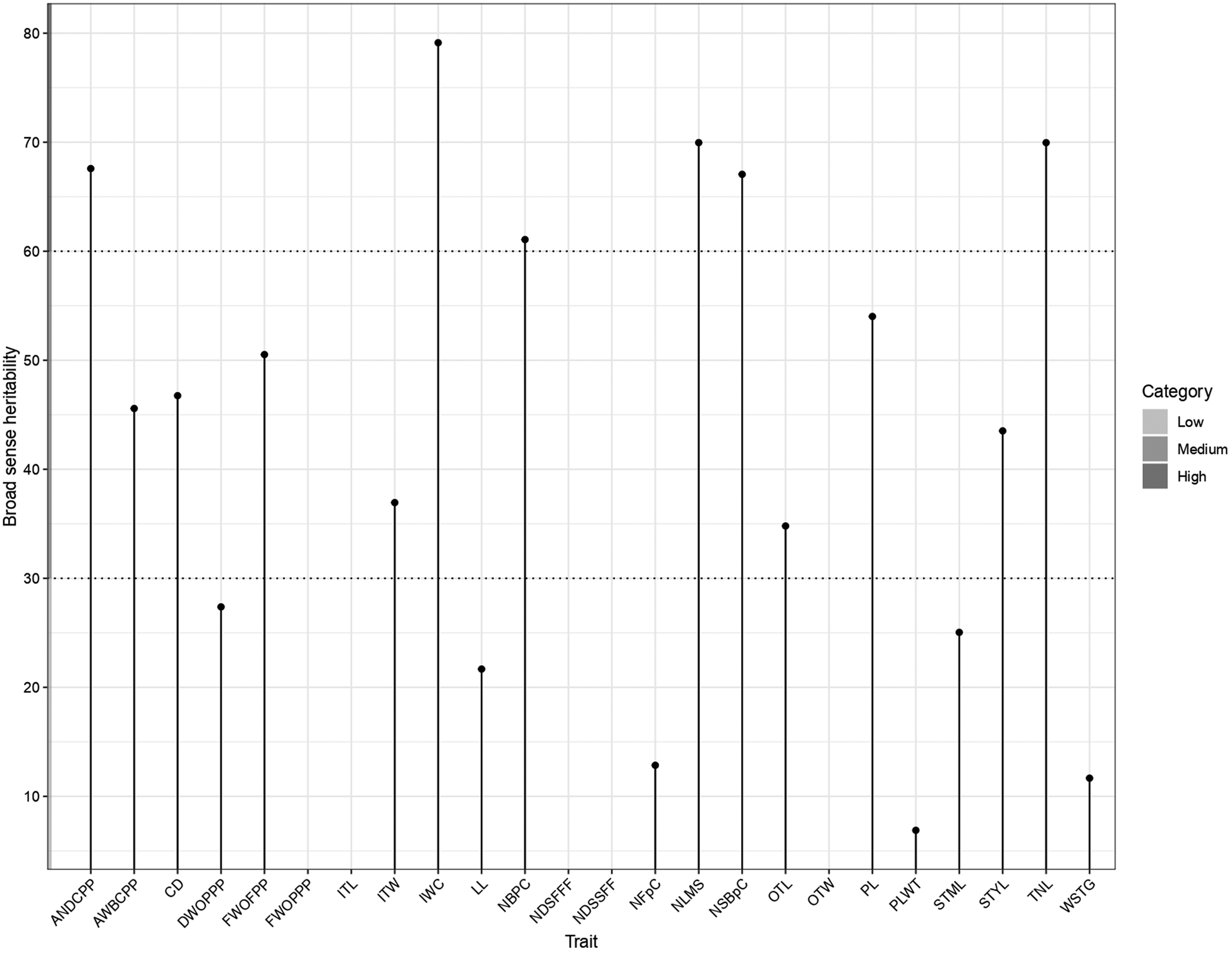
Traits like DWOPPP (mg), ITW (cm), LL (cm), NFpC, OTL (cm), PLWT(cm) and WSTG (mg) exhibited low broad-sense heritability (10–30) whereas in case of AWBCPP, CD (cm), PL (cm), STYL (cm), FWOPPP(mg) STML (cm), the heritability (bs) remained medium (30–60). High (>60) heritability estimates were observed for ANDCPP, IWC(g), NBPC, NLMS, NSBpC and TNL whereas, very little or no heritability was found for FWOFPP (mg), ITL (cm), NDSFFF(d), NDSSFF (d) and OTW (cm) traits (Fig. 2).
Heritability estimates of Agromorphological traits in Saffron.

Genetic advance was observed low (<10) in case of DWOPPP(mg), LL (cm), NFpC, PLWT (cm), STML (cm) and WSTG (mg) and medium (10–20) for AWBCPP, CD (cm), FWOPPP (mg), ITW (cm), OTL (cm), PL (cm) and STYL (cm) traits. Likewise, high genetic advance (>20) was observed for ANDCPP, IWC (g), NBPC, NLMS, NSBpC and TNL. In contrast, a very low or negligible genetic advance was observed in FWOFPP (mg), ITL (cm), NDSFFF, (d); NDSSFF (d) and OTW (cm) traits (Figure-S2).
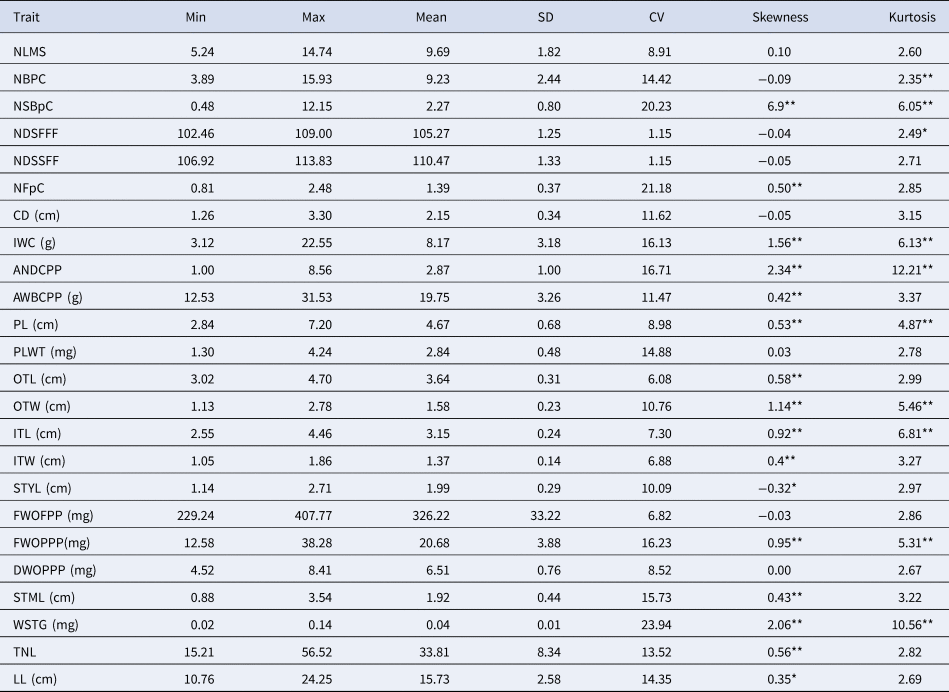
The observed traits among 272 saffron germplasm accessions were analysed for phenotype distribution pattern and reported as values of skewness (Table 1). In general skewness in data describes its symmetrical distribution pattern viz a viz with respect to its dispersion from the mean. The present data exhibited a normal skewness within the range of ±2 as a maximum number of traits had skewness values that ranged from −0.004 to 1.14 as normally distributed traits except IWC(1.56), WSTG (2.06), ANDCPP (2.34) and NSBpC (6.9). The positive skewness for NLMS, NFpC, IWC (g), AWBCPP, PL (cm), PLWT (cm), OTL (cm), OTW (cm), ITL (cm), ITW (cm), FWOPPP (mg), STML (cm), WSTG (mg), and TNL, LL (cm) traits indicated a dominant and complementary gene action, While NBPC, NDSFFF (d), NDSSFF (d), CD (cm), STYL (cm), FWOFPP (mg) and DWOPPP (mg) showed negative skewness and exhibited dominant and duplicate gene action. The negative skewness with leptokurtosis distribution indicated the presence of low phenotypic variability for these traits among saffron germplasm accessions. Kurtosis of <0 indicates the flatness of the curve (platykurtic) and if it is >0 then it indicates the peakness of a curve (leptokurtic) (Kanavi et al., Reference Kanavi, Somu, Marappa and Koler2020). All the traits exhibited leptokurtic (positive kurtosis) that indicated fewer number of genes are governing these phenotypic traits in saffron except ANDCPP and WSTG which revealed more peaks and likely to be highly leptokurtic.
Descriptive statistics of 24 traits among 272 genotypes of saffron

NLMS, no. of leaves in main sprout; NBPC, no. of buds/corm; NSBpC, number of sprouted buds per corm; NDSFFF, number of days from sowing to 50% sprouting (d); NDSSFF, number of days to 50% flowering (d); NFpC, number of flowers per corm; CD, corm diameter (Cm); IWC, initial weight of corms (g); ANDCPP, average number of daughter corms per plant; AWBCPP, average weight of daughter corms per plant; PL, pistal length (cm); PLWT, parianth length with tube (cm); OTL, outer tepal length (cm); OTW, outer tepal width (cm); ITL, inner tepal length (cm); ITW, inner tepal width (cm); STYL, style length (cm); FWOFPP, fresh weight of flowers per plant (mg); FWOPPP, fresh weight of pistals per plant (mg); DWOPPP, dry weight of pistals per plants (mg); STML, stigma length (cm); WSTG, weight of stigma (mg); TNL, total no. of leaves; LL, leaf length (cm).
Based on similarity and dissimilarity indice's heatmap plot was generated to represent the overall phenotypic diversity present in the available saffron germplasm with respect to different quantitative traits. The contrasting colour hue and their intensities as depicted in the plot are determined by the respective trait phenotypic value of the genotype and its range of distinction across the 272 germplasm panel. As evident from the plot traits like TNL, FWOPPP and AWBCPP revealed highly significant variability as compared to other traits like NLMS, NBpC and IWC. Phenotypic traits like NSBPC, CD, ANDCPP, PL, PWLT, STYL, QWOPP and STML revealed a marginally very low range of variability. It was further observed that germplasm accessions exhibited insignificant or nearly no variation for PL, OTW and ITL, OTL, OTW, ITL, ITW and WSTG as indicated by mono-chromatic colour bands across the germplasm panel in the heat map (Fig. 3).
Heat map for phenotypic diversity based on similarity and dissimilarity indice's.

Principal component analysis (PCA)
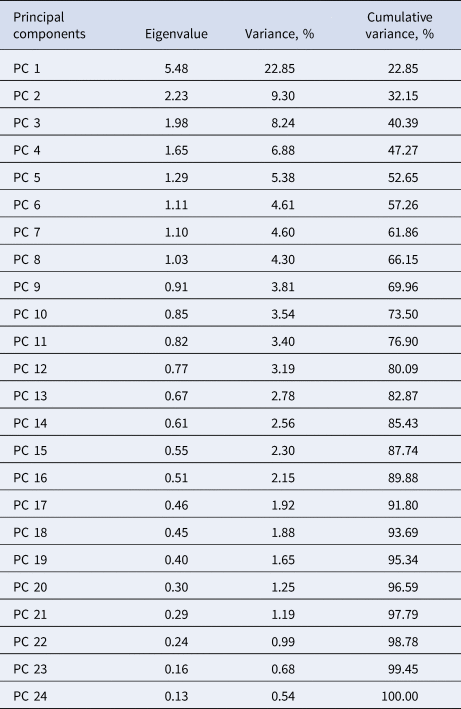
The principal component scores (PC scores) obtained after analysis of consolidated dataset are presented in Table 2. The relative contribution of each component to the total variance represents the eigenvalue. The sum of all eigenvalues is equal to number of variables. Principal components with eigenvalues of more than one and that explain at least 5% variation in the data should be considered (Brejda et al., Reference Brejda, Moorman, Karlen and Dao2000). Principal component analysis (PCA) revealed that the first eight component characters had an eigenvalue greater than one with a contributory cumulative variance of 66.15% to the total variance. The remaining 16 components contributed 33.85% of the total variation present among the set of 272 genotypes of saffron. The eigenvalues for yield attributing traits for significant PCs ranged from 5.48 (PC1) to 1.03 (PC8). The first component presented a positive strong loading from all the studied traits.
Principal component analysis of the 24 traits among 272 genotypes of saffron

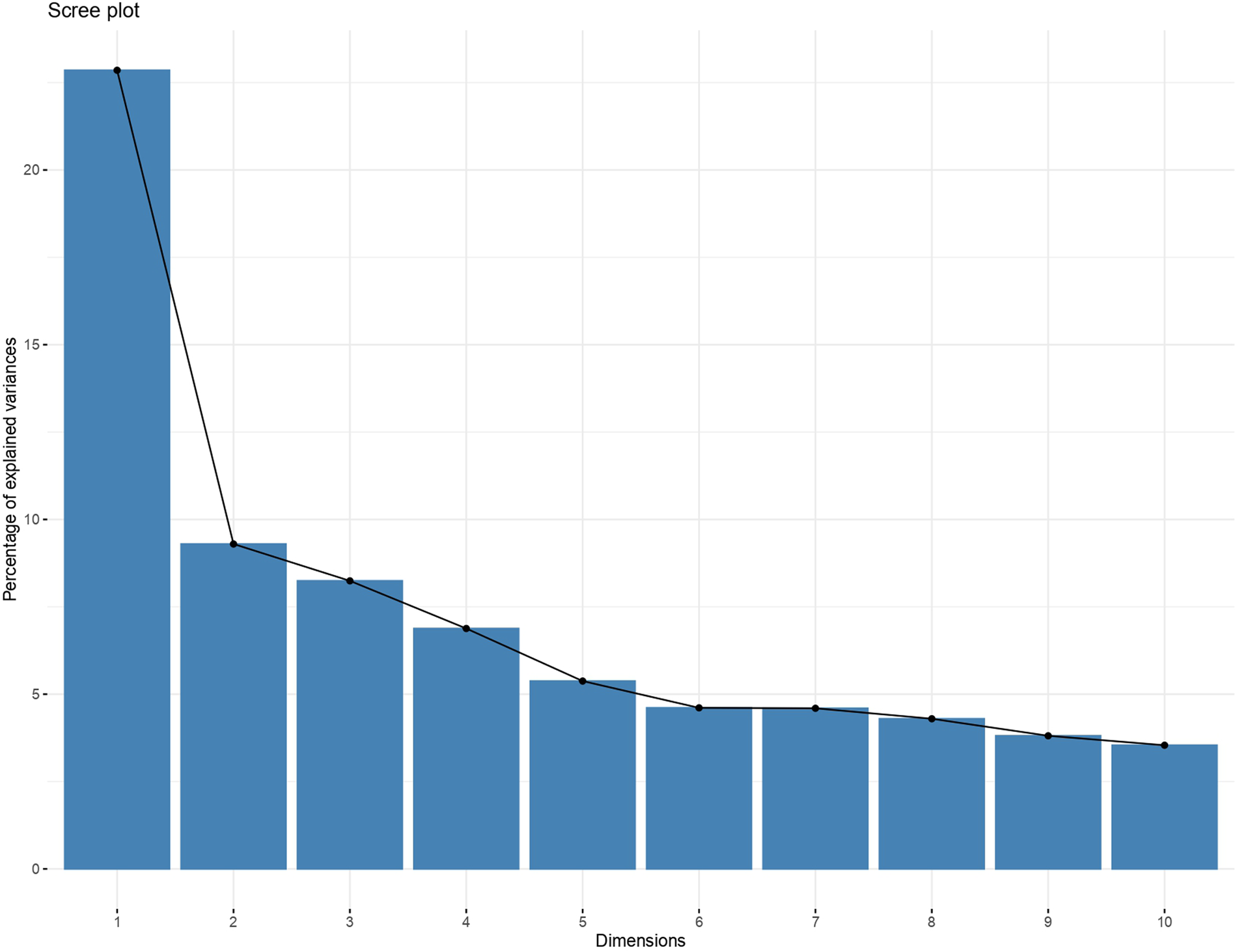
The scree plot displays the number of the principal component vs its corresponding eigenvalue. The principal component 1 showed 22.85% variability with eigenvalue of 5.48 which then decreased gradually. PC1 explained the maximum variation as evident from the scree plot with relatively lower contributions to the explained variation from other successive principal components with maximum variation observed by PC1 followed by PC2, PC3, PC4 and PC5 (Fig. 4).
Scree plot showing explained percentage variation by each PC.

Factor loading of principal components
Factor loadings or component loadings are correlation coefficients between original variables and factors obtained. It indicates the scale of contribution of every origin variable with which each principal component is associated. Component matrix revealed that principal component 1 showed high positive loading for STML (0.731). In the principal component 2, the highest positive loadings were observed for OTW (0.402), ITL (0.327) and OTL (0.274), whereas among the principal component 3, the maximum positive loadings were revealed in FWOFPP(0.646), followed by DWOPPP(0.505). Likewise, the ITW(0.380) and IWC(0.342) in principal component 4 and FWOPPP (0.512) and TNL (0.294) in principal component five revealed maximum positive loadings, which indicates maximum variability has been reflected because these characters in their respective principal components. As a result, the first five principal components that explained about 50% of the total variation can be concluded to differentiate the rest of the germplasm saffron lines on the basis of morphological and yield attributing traits (Table-S5). The contribution of the first two principal components to the total variability is maximum (21.8%), which were plotted to indicate the relationship between them. Genotypes SRS saf 231, SRS saf 17, SRS saf 180, SRS saf 103, SRS saf 102, SRS saf 8, SRS saf 77, SRS saf 37, SRS saf 11, SRS saf 97, SRS saf 32, SRS saf 243, SRS saf 18, SRS saf 78, SRS saf 215 and SRS saf 11 clustered towards the effective side of cluster I. Germplasm lines as SRS saf 159, SRS saf 14, SRS saf 49, SRS saf 104, SRS saf 3, SRS saf 138, SRS saf 191, SRS saf 235, SRS saf 125, SRS saf 67, SRS saf 83, SRS saf 38 and SRS saf 3 clustered towards the effective side of cluster II. The potential accessions of saffron for yield and yield attributing traits are presented in the table (Table-S6)
Correlation of morphological, yield and yield attributing traits
The data pertaining to correlation of morphological, yield and yield-attributing traits of saffron accessions indicated that the highest significant positive correlation was found between FWOFPP and DWOPPP (0.953), whereas, the lowest positive but significant correlation was found between CD and ANDCPP(0.121). However, the highest negative but significant correlation was found between CD and PL(−0.143) and the lowest but significant correlation was found between CD and PL(−0.124).
Likewise, NLMS revealed a significant positive correlation with NFpC (0.130). The STYL had a significant positive correlation with PL (0.538) and STML(0.207). The DWOPPP had a significant positive correlation with STML(0.630).STML had a significant positive correlation with TNL(0.124). From the correlation, it can be concluded that there is a scope for selection of traits like PL, FWOFPP, FWOPPP DWOPPP and STML that directly or indirectly contribute to yield (Table-S7).
Discussion
Genetic variations are the basic tools to develop new cultivars with better traits for yield and quality in saffron (Ali et al., Reference Ali, Nehvi, Arshid, Naseer, Nagoo, Dar and Iqbal2018) and as such efficient utilization of such material is possible only when information regarding heritable and non-heritable components such as phenotypic and genotypic coefficient of variation and heritability estimates during selection could be deduced to understand the genetic make-up of material under improvement. In this pursuit, efforts were made to characterize the collected germplasm from indigenous and exotic sources and to identify cultivars with high-yielding potential in order to increase the production of saffron. The analysis of variance revealed highly significant mean squares attributable to germplasm for all morphological, yield and yield-attributing traits in saffron except NDSFFF, NDSSFF and LL. Similarly, mean squares attributable to ‘treatment vs check entries’ were also significant for all the traits except NDSFFF, NDSSFF, PLWT, OTW, ITL, FWOPPP and LL. These results indicate sufficient variability among all the genotypes. Earlier reports by several workers from Jammu and Kashmir have documented a lot of genetic variability available in the temporal sub-populations of saffron and thus offers a tremendous scope for its improvement (Zargar, Reference Zargar1999, Reference Zargar2002; Nehvi et al., Reference Nehvi, Agarwal, Verma, Dar, Mir, Nabi and Allie2004, Reference Nehvi, Wani, Dar, Makhdoomi, Allie and Mir2006). The results of this study confirmed that there is tremendous scope for improvement in the production of saffron due to the presence of good variability with respect to morphological traits, yield and yield attributing traits and these findings are in agreement with Singh et al. (Reference Singh, Manibhushan, Chandra and Bhakta2015) and they further revealed that the selection of suitable corms is the easiest and most effective way to improve its productivity of desired quality right now to fulfill growing demand of saffron cultivar of desired trait.
The genotypic coefficient of variation was recorded low in DWOPPP(mg), FWOPPP(mg), ITW (cm), LL (cm), NFpC, OTL (cm), PLWT (cm), STML (cm), STYL (cm), WSTG (mg) and PL (cm), while as medium in AWBCPP, CD (Cm), NBPC and NLMS characters. However, ANDCPP, TNL, NSBpC and IWC(g) traits showed a high coefficient of variation. A greater magnitude of phenotypic variance than the corresponding genotypic variance associated with a high values of PCV than GCV has been reported by Nehvi et al. (Reference Nehvi, Wani, Dar, Makhdoomi, Allie and Mir2006) and Irfan et al. (Reference Irfan, Rashid, Nasseer, Bhat, Rasool, Khan and Rashid2022). Similar results of high magnitude of GCV were recorded for the corm per plant (30.4423), spike per plant (28.7050), cormels per plant (26.6465), weight of cormels per plant 26.3044, rachis length (17.4461), and spike length (15.3777) in Gladiolus (Verma et al., Reference Verma, Saddam, Mahawer, Poonam, Bairwa and Kumar2023). The components of phenotypic and genotypic variability revealed that all attributes had a wide range of variability. Similar findings were reported by Gohill (Reference Gohill1999), Latto and Dhar (Reference Latto and Dhar1999), Zargar (Reference Zargar1999) and Makhdoomi et al. (Reference Makhdoomi, Nehvi and Wani2010), which indicated that corms with bigger size and weight can bear more number of daughter corms with proper size and weight and thereby can bear flowers in next cropping season. So, by considering these findings it is concluded that there is plenty of scope for saffron genetic improvement by unraveling potential genetic diversity and selecting superior genotypes from heterogeneous saffron populations.
Heritability in a broad sense was observed as high (>60) in the case of ANDCPP, IWC(g), NBPC, NLMS, NSBpC and TNL, while as low were exhibited in traits like DWOPPP(mg), ITW(cm), LL (cm), NFpC, OTL (cm), PLWT(cm) and WSTG (mg). Contrary medium broad-sense heritability (10–30) was observed in AWBCPP, CD (cm), PL (cm), STYL (cm), FWOPPP(mg) and STML (cm) traits. The results are in general agreement with the findings of Nehvi et al. (Reference Nehvi, Wani, Dar, Makhdoomi, Allie and Mir2006) for fresh flower weight, fresh perianth weight and stigma length. Similarly high heritability estimates (>60) were observed for plant height, number of flowers corm−1, fresh pistil weight, pistil length, stigma length, number of daughter corms mother−1 corm, average weight of daughter corms mother−1 corm, and number of radical leaves plant−1 (Sheikh et al., Reference Sheikh, Makhdoomi, Ali, Nehvi, Lone, Zaffar and Iqbal2014). Similarly high heritability estimates were recorded in spike length (99.95%), plant height (99.86%) and days for first floret opening (99.77%) in Gladiolus (Vinutha et al., Reference Vinutha, Sateesh, Seetharamu, Satish, Pavan Kumar, Mahesh, Waseem and Thilak2023). The results of the current study revealed that there was a significant variability for flower attributing traits and are in agreement with results of Baghalian et al. (Reference Baghalian, Sheshtamand and Jamshidi2010). The traits that showed high heritability coupled with high genetic advance could be used for genetic improvement of traits.
The present data exhibited a normal skewness within the range of ±2 as a maximum number of traits had skewness values that ranged from −0.004 to 1.14 as normally distributed traits except IWC(1.56), WSTG (2.06), ANDCPP (2.34) and NSBpC (6.9). Some traits showed leptokurtic distribution which indicated the presence of low phenotypic variability. Most of the traits showed positive kurtosis and leptokurtic in nature. The similarity and dissimilarity of indice's heatmap which the phenotypic diversity of traits revealed that TNL, FWOPPP and AWBCPP showed highly significant variability as compared to other traits like NLMS, NBpC and IWC, however traits NSBPC, CD, ANDCPP, PL, PWLT, STYL, QWOPP and STML revealed marginally very low range of variability.
The principal component analysis has revealed that the first eight component characters had an eigenvalue greater than one with a cumulative variance of 66.15% to the total variance whereas the remaining 16 components contributed 33.85% of total variation present in a set of 272 genotypes of saffron. Moreover, the PCI explained a maximum variation of 22.85% with eigenvalue of 5.48. Similar results were observed by Irfan et al. (Reference Irfan, Naseer, Butt, Rashid, Dar, Ali, Khan and Qureshi2020) whereby PC1 and PC2 captured 68.527% of total variation in a set of 140 saffron (C. sativus L.) germplasm lines by exhibiting that the leaf length, number of leaves corm−1 line−1, number of flowers corm−1 line−1, total flower weight corm−1, big corm index and fresh pistil weight show maximum contribution towards yield. Factor loadings have indicated that the PC1 showed high positive loading for STML(0.731) and likewise, the highest positive loadings were observed for OTW(0.402), ITL (0.327) and OTL(0.274) in the principal component 2. The findings clearly show that the first five principal components, which accounted for around 50% of the overall variation, may be used to distinguish the other germplasm saffron lines based on morphological and yield-related parameters. The results are in general agreement with the findings of Torricelli et al. (Reference Torricelli, Yousefi, Albertini, Venanzoni and Hosseinzadeh2019) whereby principal component analysis (PCA) was worked out to summarize all the variability among the saffron accessions by using averages of data recorded per accession. The first three components (PC1, PC2 and PC3) of the PCA accounted for 46.15%, 26.82% and 12.03% of the total variation, respectively (85.00% of total variation). Genetic variability is extremely useful in determining the extent of genetic diversity for different traits in a population, thereby implying the considerable scope for improvement.
The details of of potential accessions are given in Table-S5. The promising accessions viz., SRS-Saf-175, SRS-Saf-23, SRS-Saf-163, SRS-Saf-190, SRS-Saf-101, SRS-Saf-135, SRS-Saf-155, SRS-Saf-210 and SRS-Saf-243 originated from different places, which will be useful for recollection and taken up for on-farm conservation practices. From the results, it is clear that the performance of exotic varieties is at par with indigenous varieties.
The possibility of saffron improvement through clonal selection from the available germplasm resources is suggested by the findings of the current investigation. The saffron breeding programme could use the elite genotypes that have been identified based on saffron yield and corm attributes in order to develop new saffron varieties. The current study concluded by highlighting the value of C. sativus ecotypes as a priceless source of biodiversity, their improvement as a critical component of a sustainable development strategy, and their potential for growers to diversify their agricultural production.
Supplementary material
The supplementary material for this article can be found at https://doi.org/10.1017/S1479262123000886.
Acknowledgements
The authors acknowledge the financial support provided by the Plant Protection Varieties & Farmers Right Act. Pusa New Delhi (PPV & FRA), India and JKST & IC, DST, Bemina, Srinagar, J&K, India that has facilitated the exploration, collection and characterization of saffron.