Introduction
As healthcare delivery shifts more toward outpatient settings, including clinics, infusion centers, home care, hemodialysis clinics, office-based and ambulatory surgery centers (ASCs), it is critical to establish standardized guidance for healthcare personnel, practices, and equipment processing to mitigate risks of infection and promote safe care. An aging adult population with chronic medical conditions, increased complexity of pediatric patients, evolving procedural technologies, and growing focus on cost reduction strategies have driven expansion of the ambulatory footprint.
Reference Weir, Ormsby, Vaughan-Malloy and Chandonnet1
Distinctions between inpatient hospital and ambulatory care environments, protocols, infection surveillance, resources, and operational workflows, are important to recognize, as these differences inform unique approaches to infection prevention and control (IPC) practices and reporting requirements. Gaps in evidence and professional society guidance on IPC implementation, as well as nuances of regulatory standards within ambulatory spaces pose vulnerabilities for variability in practices, lapses in event monitoring, and missed prevention opportunities. Ambulatory IPC programs are frequently under-resourced, further undermining efforts to reduce infectious harms, improve system efficiency, safety, and financial impact.
Reference Talbot, Baliga and Crapanzano-Sigafoos2
This article highlights current high priority challenges, key questions, and research directions unique to ambulatory IPC.
Regulatory guidance and readiness
As part of The Joint Commission (TJC) Hospital Accreditation Process, surveyors assess locations that bill for services under a hospital’s provider number, which includes inpatient departments, outpatient and inpatient locations performing moderate sedation and anesthesia, and complex outpatient care.
3
Some outpatient settings are licensed at the facility and provider levels, maintain voluntary accreditation, and are certified by the Centers for Medicare and Medicaid Services (CMS); however, other outpatient settings may be only licensed at the provider level and subject to less standardized regulatory oversight.
4
Regarding ASCs, while licensing is required by nearly all states for operation, only some states require a Certificate of Need.
5
Accreditation is largely voluntary for ambulatory care sites. Among ambulatory facilities that seek voluntary TJC accreditation, IPC related problems remain the most frequently cited noncompliance with TJC standards.
Reference Braun, Chitavi and Perkins6
In 2017, 39 of the 845 (4.6%) ambulatory clinics and ASCs assessed by TJC were noted to have breaches, including sterilization of reusable devices, device reprocessing, disinfection, and infection prevention infrastructure.
Reference Braun, Chitavi and Perkins6
Similarly, in a pilot assessment of 68 ASCs, 48 had at least one lapse in infection prevention, including hand hygiene/personal protective equipment (19%), injection safety (28%), reprocessing (28%), environmental cleaning (19%), and blood glucose monitoring (46%).
Reference Schaefer, Jhung and Dahl7
Among reports of outbreaks to public health departments, 330 of 4,182 (8%) occurred in outpatient settings and >50% were due to infection prevention breaches, including device reprocessing, injection safety, medication preparation, and environment of care.
Reference Penna, Shrivastwa, Strid, Perz and Hunter8
High patient turnover, lack of written infection prevention policies and procedures, difficulty interpreting manufacturer’s instruction for use (mIFU), and lack of on-site expertise lead to lapses in the ambulatory setting. Further, insufficient or poorly designed reprocessing areas in the outpatient settings can lead to environment contamination and disrupt proper dirty-to-clean workflow.
Reference Bringhurst9
These limitations may lead to errors in instrument reprocessing and increase risk of infection transmission.
Joint Commission standard IC.01.01.01 highlights the importance of ambulatory infection prevention, stating that ambulatory care centers assign one or more people responsibility for infection prevention oversight, including performing a risk assessment of individual facilities.
3
Further, the CMS Conditions for Coverage also highlight the need for an infection control program for ASCs.
10
Larger, complex ambulatory care centers may require investment in more IPC staff training and competency.
Reference Braun, Chitavi and Perkins6
Healthcare-associated infection (HAI) events
While most healthcare occurs outside acute care hospitals, reporting requirements for healthcare-associated infections (HAIs) such as central line-associated bloodstream infection (CLABSI) and catheter-associated urinary tract infections (CAUTI) to CMS via the National Healthcare Safety Network (NHSN) are focused on inpatient settings and dialysis facilities. Patients maintain central venous catheters (CVCs) in homes, oncology centers, outpatient infusion centers, and hemodialysis facilities, use indwelling urinary catheters in the home, and even require mechanical ventilation at home. HAIs also occur in these settings. These infections can be highly morbid: patients presenting to hospitals with CLABSI have an 11% in-hospital mortality.
Reference Oladapo-Shittu, Cosgrove and Rock11
For example, in some hospitals, more patients may present to the hospital with CLABSI than develop CLABSI in the hospital.
Reference Oladapo-Shittu, Cosgrove and Rock11–Reference Oladapo-Shittu, Hannum and Salinas13
However, the frequency of community-onset HAIs is unknown.
Unlike in acute or long-term care facilities, there is no NHSN module for HAIs in ambulatory or home health, with the exception of ASCs and hemodialysis facilities.
14,15
Even in the case of ASCs, the surgical site infection (SSI) outpatient procedure component of NHSN is voluntary for most states, and does not apply to many ASCs (such as those affiliated with academic medical systems). There is not a requirement that other community locations submit data or decrease HAI rates as part of value-based purchasing, and many facilities, practices, centers, or organizations are not accredited by TJC. Meanwhile, HAI surveillance in community-based settings takes a substantial amount of time, effort, and expertise, especially as HAIs are typically diagnosed and treated in settings other than the community-based healthcare organization (eg, hospitals).
Reference Hannum, Oladapo-Shittu and Salinas16
There are few incentives for community-based organizations to perform HAI surveillance.
Few HAI definitions are validated for community-based healthcare settings, with the exception of CLABSI in home infusion therapy.
Reference Keller, Hannum and Weems17
Furthermore, organizations have few opportunities to compare their HAI data with others.
Reference Hannum, Oladapo-Shittu and Marsteller18,19
Validating and implementing community HAI definitions and dashboards is an important step. While criteria for pediatric ambulatory CLABSI have been extrapolated from the Children’s Hospitals’ Solutions for Patient Safety (SPS) definition of CLABSI for the inpatient population, pediatric-specific data remains limited. The largest multicenter study on pediatric ambulatory CLABSIs found that 15% of pediatric CLABSIs occurred in the ambulatory setting.
Reference Rinke, Heo and Saiman20
We cannot effectively target infection prevention efforts without established HAI definitions or additional studies evaluating the incidence, epidemiology, and risk factors for these infections.
Developing denominators, and a way to measure these denominators, is also key. Approaches to measuring device days rely on documenting line placement and removal. However, if a patient has a urinary catheter removed at an unaffiliated urology clinic, this removal is often not documented in a standard location in a shared medical record system. Alternative approaches to developing a denominator, such as counting the number of patients receiving treatment on one day, may be easier to implement.
15
There are multiple opportunities to learn more about ambulatory HAIs. We need to develop, validate, and implement HAI definitions in ambulatory settings to monitor HAI rates proactively to have actionable data to guide improvement.
High-level disinfection (HLD) and sterilization
The shift in care from inpatient to ambulatory settings includes a shift in complex procedures that were once limited to inpatient and now performed in ASCs or office-based settings. Robust HLD and sterilization processes are essential to assuring that pathogens are not transmitted through the reusable semi-critical and critical instruments used in these procedures. Failures in ambulatory instrument processing and associated infections are presumably underreported due to the resources required to investigate suspected transmission events, lack of standardized surveillance, and publication bias.
Reference Shenoy, Weber and McMullen21
Significant challenges exist with achieving current instrument processing standards in ambulatory settings, including inadequate physical space, insufficient training and education of personnel, and increasingly complex modern medical devices which are difficult to clean and disinfect effectively.
Reference Bringhurst9
Construction planning for instrument processing areas requires consideration of dedicated workspaces for receiving, cleaning, and decontamination; preparation; HLD/sterilization; and storage. Staff engaged in the complex protocols of HLD and sterilization are often pulled from other disciplines within the practice, and require training, education, and competency. Many endoscopy-associated outbreaks have been reported with a common finding being that personnel were skipping essential steps or performing them improperly.
Reference Ofstead, Smart, Hurst and Lamb22
Finally, modern medical devices, especially flexible endoscopes, include advanced design features such as long narrow channels, heat-sensitive components, and accessories that can harbor high levels of bioburden and create challenges for disinfection processes. These problems are compounded by the relatively limited IPC support for consultation, training, and auditing in ambulatory spaces.
Centralization of ambulatory instrument processing may address some of these issues by optimizing physical space, assuring standardized processes, and including the presence of trained and certified personnel.
Reference Shenoy, Weber and McMullen21
However, the implementation of a centralized structure is complex, requiring substantial financial, regulatory, staffing, and logistical considerations. A decentralized structure may be more operationally feasible, but risks introducing variability into processes and increases risk of failures, particularly in the absence of oversight by sterile processing experts. Alternatively, ambulatory sites could transition to single use devices when those options are available and the cost in environmental harm is considered. Working through these issues requires strong collaboration between departments and a significant investment of time and expertise from IPC teams.
Communicable disease transmission and detection
Declining vaccination rates, diminished public health infrastructure, and ease of global travel contribute to the growing risk of communicable diseases. Most patients with infectious symptoms initially present to a clinic or urgent care, which usually occurs during the peak communicable period and before pathogen identification. Symptom screening may not be consistently performed, leading to variable implementation of standard and transmission-based precautions. Additionally, the turnaround time of microbiological testing is much greater in the clinic setting, further delaying identification and awareness of infectious exposures.
If a contagious pathogen is identified in a timely manner, ambulatory exposure tracking often requires a labor-intensive manual review that may span several healthcare settings and electronic health record systems. Relatively short clinic visits and high patient volumes also make surveillance and evaluation of outcome measures challenging. Infection prevention efforts are further complicated by a limited number and high turnover rate of trained ambulatory staff and inconsistent resources, including supply of personal protective equipment for frontline healthcare workers.
Discussion
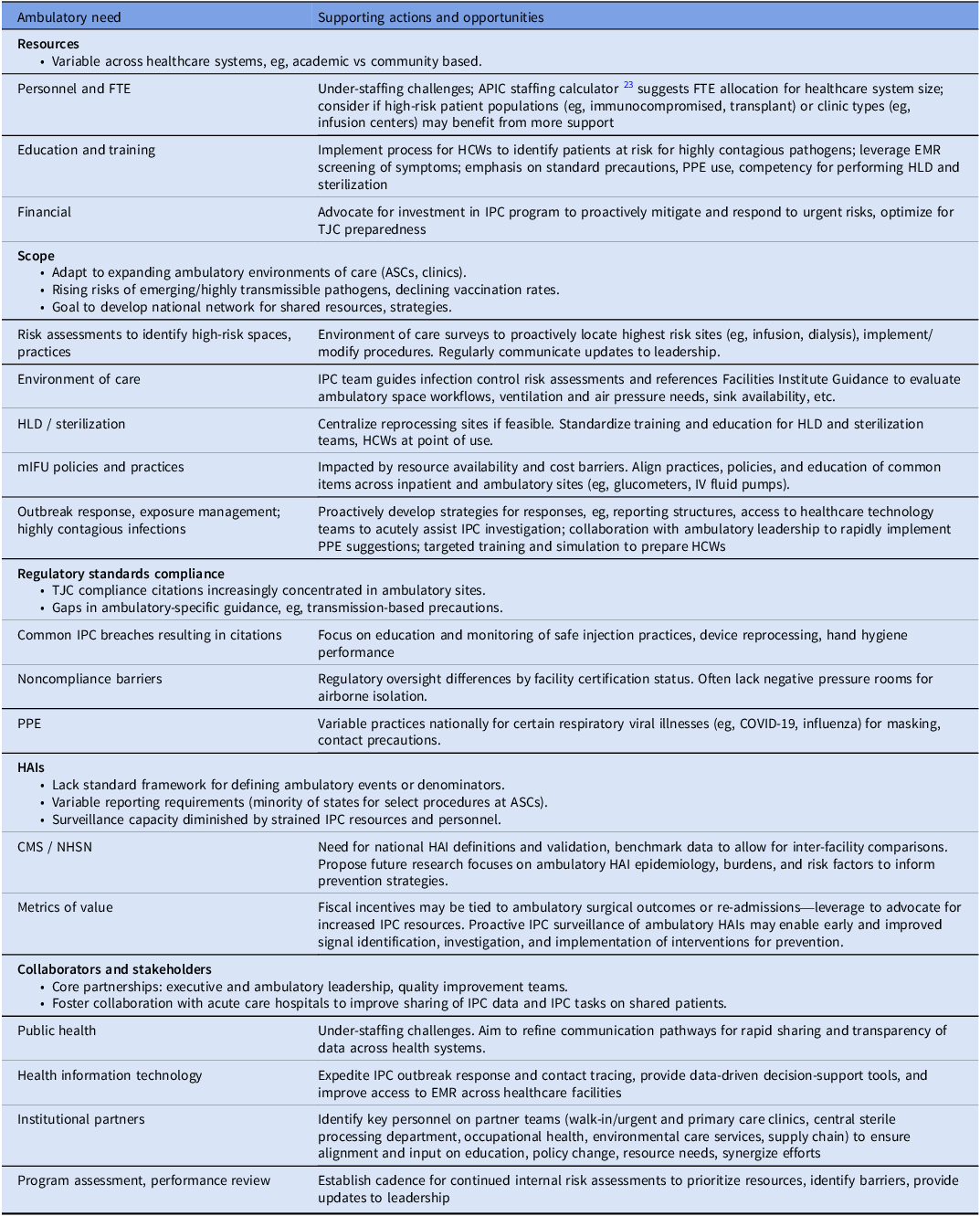
Additional resources and infrastructure for ambulatory IPC programs are essential as healthcare delivery expands across more outpatient facilities. Guidance on ambulatory best practices should be tailored to the unique features of clinic and procedural spaces, which are distinct from inpatient resources and workflows. Table 1 provides a template for building and maintaining a successful ambulatory IPC program.
Table 1.
Blueprint for a successful ambulatory IPC program
Table 1 Long description
A table with two columns and multiple rows detailing the needs and supporting actions for ambulatory infection prevention and control (IPC) programs. The columns are labeled 'Ambulatory need' and 'Supporting actions and opportunities'. The table includes various categories such as Resources, Personnel and FTE, Education and training, Financial, Scope, Risk assessments, Environment of care, HLD/sterilization, mIFU policies and practices, Outbreak response, Regulatory standards compliance, Common IPC breaches resulting in citations, Noncompliance barriers, PPE, HAIs, CMS/NHSN, Metrics of value, Collaborators and stakeholders, Public health, Health information technology, Institutional partners, and Program assessment, performance review. Each row provides specific details under these categories, outlining the challenges and recommended actions for improving IPC in ambulatory settings.
Risk assessments are key to guiding these practices given limited established guidance across multiple ambulatory domains, and offer opportunities to assess proactively for potential vulnerability points. Collaboration with operational partners is also critical to ensure feasibility of scaling and integrating recommendations into practice.
More research is needed to determine evidence-based practices of greatest benefit for ambulatory IPC initiatives, including infection risk mitigation (eg, isolation, safe injection practices), defining and monitoring HAI events, outbreak response strategies, as well as centralizing HLD and sterilization pathways. The latter theme includes device reprocessing, which is particularly critical pertaining to challenges of several ambulatory facility types in adhering to regulatory compliance standards. With respect to regulatory preparedness and TJC oversight, the current facility landscape variability in terms of licensure and accreditation, along with gaps in standardized guidance and under-resourcing of IPC staff, render these spaces vulnerable to lapses in IP practices.
Now is the time to expand awareness, invest in resources and research efforts to promote infection prevention in the evolving ambulatory space.






 You have
Access
Introduction
As healthcare delivery shifts more toward outpatient settings, including clinics, infusion centers, home care, hemodialysis clinics, office-based and ambulatory surgery centers (ASCs), it is critical to establish standardized guidance for healthcare personnel, practices, and equipment processing to mitigate risks of infection and promote safe care. An aging adult population with chronic medical conditions, increased complexity of pediatric patients, evolving procedural technologies, and growing focus on cost reduction strategies have driven expansion of the ambulatory footprint. Reference Weir, Ormsby, Vaughan-Malloy and Chandonnet1
Distinctions between inpatient hospital and ambulatory care environments, protocols, infection surveillance, resources, and operational workflows, are important to recognize, as these differences inform unique approaches to infection prevention and control (IPC) practices and reporting requirements. Gaps in evidence and professional society guidance on IPC implementation, as well as nuances of regulatory standards within ambulatory spaces pose vulnerabilities for variability in practices, lapses in event monitoring, and missed prevention opportunities. Ambulatory IPC programs are frequently under-resourced, further undermining efforts to reduce infectious harms, improve system efficiency, safety, and financial impact. Reference Talbot, Baliga and Crapanzano-Sigafoos2
This article highlights current high priority challenges, key questions, and research directions unique to ambulatory IPC.
Regulatory guidance and readiness
As part of The Joint Commission (TJC) Hospital Accreditation Process, surveyors assess locations that bill for services under a hospital’s provider number, which includes inpatient departments, outpatient and inpatient locations performing moderate sedation and anesthesia, and complex outpatient care. 3 Some outpatient settings are licensed at the facility and provider levels, maintain voluntary accreditation, and are certified by the Centers for Medicare and Medicaid Services (CMS); however, other outpatient settings may be only licensed at the provider level and subject to less standardized regulatory oversight. 4 Regarding ASCs, while licensing is required by nearly all states for operation, only some states require a Certificate of Need. 5
Accreditation is largely voluntary for ambulatory care sites. Among ambulatory facilities that seek voluntary TJC accreditation, IPC related problems remain the most frequently cited noncompliance with TJC standards. Reference Braun, Chitavi and Perkins6 In 2017, 39 of the 845 (4.6%) ambulatory clinics and ASCs assessed by TJC were noted to have breaches, including sterilization of reusable devices, device reprocessing, disinfection, and infection prevention infrastructure. Reference Braun, Chitavi and Perkins6 Similarly, in a pilot assessment of 68 ASCs, 48 had at least one lapse in infection prevention, including hand hygiene/personal protective equipment (19%), injection safety (28%), reprocessing (28%), environmental cleaning (19%), and blood glucose monitoring (46%). Reference Schaefer, Jhung and Dahl7 Among reports of outbreaks to public health departments, 330 of 4,182 (8%) occurred in outpatient settings and >50% were due to infection prevention breaches, including device reprocessing, injection safety, medication preparation, and environment of care. Reference Penna, Shrivastwa, Strid, Perz and Hunter8
High patient turnover, lack of written infection prevention policies and procedures, difficulty interpreting manufacturer’s instruction for use (mIFU), and lack of on-site expertise lead to lapses in the ambulatory setting. Further, insufficient or poorly designed reprocessing areas in the outpatient settings can lead to environment contamination and disrupt proper dirty-to-clean workflow. Reference Bringhurst9 These limitations may lead to errors in instrument reprocessing and increase risk of infection transmission.
Joint Commission standard IC.01.01.01 highlights the importance of ambulatory infection prevention, stating that ambulatory care centers assign one or more people responsibility for infection prevention oversight, including performing a risk assessment of individual facilities. 3 Further, the CMS Conditions for Coverage also highlight the need for an infection control program for ASCs. 10 Larger, complex ambulatory care centers may require investment in more IPC staff training and competency. Reference Braun, Chitavi and Perkins6
Healthcare-associated infection (HAI) events
While most healthcare occurs outside acute care hospitals, reporting requirements for healthcare-associated infections (HAIs) such as central line-associated bloodstream infection (CLABSI) and catheter-associated urinary tract infections (CAUTI) to CMS via the National Healthcare Safety Network (NHSN) are focused on inpatient settings and dialysis facilities. Patients maintain central venous catheters (CVCs) in homes, oncology centers, outpatient infusion centers, and hemodialysis facilities, use indwelling urinary catheters in the home, and even require mechanical ventilation at home. HAIs also occur in these settings. These infections can be highly morbid: patients presenting to hospitals with CLABSI have an 11% in-hospital mortality. Reference Oladapo-Shittu, Cosgrove and Rock11 For example, in some hospitals, more patients may present to the hospital with CLABSI than develop CLABSI in the hospital. Reference Oladapo-Shittu, Cosgrove and Rock11–Reference Oladapo-Shittu, Hannum and Salinas13 However, the frequency of community-onset HAIs is unknown.
Unlike in acute or long-term care facilities, there is no NHSN module for HAIs in ambulatory or home health, with the exception of ASCs and hemodialysis facilities. 14,15 Even in the case of ASCs, the surgical site infection (SSI) outpatient procedure component of NHSN is voluntary for most states, and does not apply to many ASCs (such as those affiliated with academic medical systems). There is not a requirement that other community locations submit data or decrease HAI rates as part of value-based purchasing, and many facilities, practices, centers, or organizations are not accredited by TJC. Meanwhile, HAI surveillance in community-based settings takes a substantial amount of time, effort, and expertise, especially as HAIs are typically diagnosed and treated in settings other than the community-based healthcare organization (eg, hospitals). Reference Hannum, Oladapo-Shittu and Salinas16 There are few incentives for community-based organizations to perform HAI surveillance.
Few HAI definitions are validated for community-based healthcare settings, with the exception of CLABSI in home infusion therapy. Reference Keller, Hannum and Weems17 Furthermore, organizations have few opportunities to compare their HAI data with others. Reference Hannum, Oladapo-Shittu and Marsteller18,19 Validating and implementing community HAI definitions and dashboards is an important step. While criteria for pediatric ambulatory CLABSI have been extrapolated from the Children’s Hospitals’ Solutions for Patient Safety (SPS) definition of CLABSI for the inpatient population, pediatric-specific data remains limited. The largest multicenter study on pediatric ambulatory CLABSIs found that 15% of pediatric CLABSIs occurred in the ambulatory setting. Reference Rinke, Heo and Saiman20 We cannot effectively target infection prevention efforts without established HAI definitions or additional studies evaluating the incidence, epidemiology, and risk factors for these infections.
Developing denominators, and a way to measure these denominators, is also key. Approaches to measuring device days rely on documenting line placement and removal. However, if a patient has a urinary catheter removed at an unaffiliated urology clinic, this removal is often not documented in a standard location in a shared medical record system. Alternative approaches to developing a denominator, such as counting the number of patients receiving treatment on one day, may be easier to implement. 15
There are multiple opportunities to learn more about ambulatory HAIs. We need to develop, validate, and implement HAI definitions in ambulatory settings to monitor HAI rates proactively to have actionable data to guide improvement.
High-level disinfection (HLD) and sterilization
The shift in care from inpatient to ambulatory settings includes a shift in complex procedures that were once limited to inpatient and now performed in ASCs or office-based settings. Robust HLD and sterilization processes are essential to assuring that pathogens are not transmitted through the reusable semi-critical and critical instruments used in these procedures. Failures in ambulatory instrument processing and associated infections are presumably underreported due to the resources required to investigate suspected transmission events, lack of standardized surveillance, and publication bias. Reference Shenoy, Weber and McMullen21
Significant challenges exist with achieving current instrument processing standards in ambulatory settings, including inadequate physical space, insufficient training and education of personnel, and increasingly complex modern medical devices which are difficult to clean and disinfect effectively. Reference Bringhurst9 Construction planning for instrument processing areas requires consideration of dedicated workspaces for receiving, cleaning, and decontamination; preparation; HLD/sterilization; and storage. Staff engaged in the complex protocols of HLD and sterilization are often pulled from other disciplines within the practice, and require training, education, and competency. Many endoscopy-associated outbreaks have been reported with a common finding being that personnel were skipping essential steps or performing them improperly. Reference Ofstead, Smart, Hurst and Lamb22 Finally, modern medical devices, especially flexible endoscopes, include advanced design features such as long narrow channels, heat-sensitive components, and accessories that can harbor high levels of bioburden and create challenges for disinfection processes. These problems are compounded by the relatively limited IPC support for consultation, training, and auditing in ambulatory spaces.
Centralization of ambulatory instrument processing may address some of these issues by optimizing physical space, assuring standardized processes, and including the presence of trained and certified personnel. Reference Shenoy, Weber and McMullen21 However, the implementation of a centralized structure is complex, requiring substantial financial, regulatory, staffing, and logistical considerations. A decentralized structure may be more operationally feasible, but risks introducing variability into processes and increases risk of failures, particularly in the absence of oversight by sterile processing experts. Alternatively, ambulatory sites could transition to single use devices when those options are available and the cost in environmental harm is considered. Working through these issues requires strong collaboration between departments and a significant investment of time and expertise from IPC teams.
Communicable disease transmission and detection
Declining vaccination rates, diminished public health infrastructure, and ease of global travel contribute to the growing risk of communicable diseases. Most patients with infectious symptoms initially present to a clinic or urgent care, which usually occurs during the peak communicable period and before pathogen identification. Symptom screening may not be consistently performed, leading to variable implementation of standard and transmission-based precautions. Additionally, the turnaround time of microbiological testing is much greater in the clinic setting, further delaying identification and awareness of infectious exposures.
If a contagious pathogen is identified in a timely manner, ambulatory exposure tracking often requires a labor-intensive manual review that may span several healthcare settings and electronic health record systems. Relatively short clinic visits and high patient volumes also make surveillance and evaluation of outcome measures challenging. Infection prevention efforts are further complicated by a limited number and high turnover rate of trained ambulatory staff and inconsistent resources, including supply of personal protective equipment for frontline healthcare workers.
Discussion
Additional resources and infrastructure for ambulatory IPC programs are essential as healthcare delivery expands across more outpatient facilities. Guidance on ambulatory best practices should be tailored to the unique features of clinic and procedural spaces, which are distinct from inpatient resources and workflows. Table 1 provides a template for building and maintaining a successful ambulatory IPC program.
Blueprint for a successful ambulatory IPC program
Table 1 Long description
A table with two columns and multiple rows detailing the needs and supporting actions for ambulatory infection prevention and control (IPC) programs. The columns are labeled 'Ambulatory need' and 'Supporting actions and opportunities'. The table includes various categories such as Resources, Personnel and FTE, Education and training, Financial, Scope, Risk assessments, Environment of care, HLD/sterilization, mIFU policies and practices, Outbreak response, Regulatory standards compliance, Common IPC breaches resulting in citations, Noncompliance barriers, PPE, HAIs, CMS/NHSN, Metrics of value, Collaborators and stakeholders, Public health, Health information technology, Institutional partners, and Program assessment, performance review. Each row provides specific details under these categories, outlining the challenges and recommended actions for improving IPC in ambulatory settings.
APIC, Association for Professionals in Infection Control and Epidemiology; FTE, full-time equivalent; HCW, healthcare worker; EMR, electronic medical record; PPE, personal protective equipment.
Risk assessments are key to guiding these practices given limited established guidance across multiple ambulatory domains, and offer opportunities to assess proactively for potential vulnerability points. Collaboration with operational partners is also critical to ensure feasibility of scaling and integrating recommendations into practice.
More research is needed to determine evidence-based practices of greatest benefit for ambulatory IPC initiatives, including infection risk mitigation (eg, isolation, safe injection practices), defining and monitoring HAI events, outbreak response strategies, as well as centralizing HLD and sterilization pathways. The latter theme includes device reprocessing, which is particularly critical pertaining to challenges of several ambulatory facility types in adhering to regulatory compliance standards. With respect to regulatory preparedness and TJC oversight, the current facility landscape variability in terms of licensure and accreditation, along with gaps in standardized guidance and under-resourcing of IPC staff, render these spaces vulnerable to lapses in IP practices.
Now is the time to expand awareness, invest in resources and research efforts to promote infection prevention in the evolving ambulatory space.
Acknowledgements
The authors thank the ambulatory infection prevention interest group established by the Society for Healthcare Epidemiology of America (SHEA) to expand opportunities for collaboration among ambulatory IPC teams. The authors thank Kristy Weinshel, MBA, for organizational support of this manuscript and of the ambulatory IPC interest group in SHEA.
Financial support
The authors received no financial support for this research.
Competing interests
All authors report no conflicts of interest relevant to this article.