Introduction
Seed tolerance of high salinity is an important trait for species of coastal zones and other saline sites. The ability to germinate at ocean water salinity levels is characteristic of relatively few euhalophytic species, and generally salinity inhibits germination of both glycophytes and halophytes (Baskin and Baskin, Reference Baskin and Baskin1998). For seeds that are unable to germinate at high salinity, it is essential to survive during exposure and maintain the ability to germinate later, when salinity may decrease due to various environmental events. Woodell (Reference Woodell1985) distinguished three types of coastal plant seeds and made an attempt to explain this by different habitat conditions. Germination of type 1 seeds is inversely proportional to salinity, and exposure to sea water (half-diluted or higher concentration) inhibits germination after subsequent transfer to fresh water. Germination of type 2 seeds is strongly inhibited by sea water, but after transferring seeds to fresh water, germination recovers to levels obtained when seeds are germinated in fresh water from the start. Germination of type 3 seeds is variable in sea water, but is enhanced when transferred to fresh water (Woodell, Reference Woodell1985).
Apart from salinity tolerance, a more universal feature of most coastal species is seed dormancy (Baskin and Baskin, Reference Baskin and Baskin1998). Storage of imbibed seeds at low temperatures (cold stratification) is often used to break seed dormancy for practical purposes, and it effectively simulates natural conditions during the cold season. Hence, the degree of dormancy release following stratification or treatment with exogenous gibberellic acid (GA3) is a clue to determine the seed dormancy type and associated characteristics (Nikolaeva et al., Reference Nikolaeva, Rasumova and Gladkova1985; Baskin and Baskin, Reference Baskin and Baskin1998).
Species selected for the present study represented three different habitats: periodically inundated coastal meadows [Triglochin maritima L. ( Juncaginaceae), T. palustre L. ( Juncaginaceae)]; beach and dune slacks [Juncus balticus Willd. ( Juncaceae)]; and foredunes [Linaria loeselii Schweigg. (Scrophulariaceae), Anthyllis maritima Schweigg. (Fabaceae) and L. vulgaris Mill. (Scrophulariaceae)]. The initial hypothesis was that plants growing in sites more frequently or constantly exposed to sea water will have salinity-tolerant seeds. Seeds were expected to be dormant, since dormancy is characteristic of most coastal plants of temperate climates (Baskin and Baskin, Reference Baskin and Baskin1998). Therefore, the aim of this research was to compare the response of seeds of various coastal species to elevated salinity, as well as to determine seed dormancy type.
Materials and methods
Seeds of six species were collected: T. maritima (August 2005, near Liepaja Lake); T. palustre and L. vulgaris (September 2006, on the coast of the Baltic Sea in Liepene); L. loeselii (September 2006, near the estuary of River Irbe); A. maritima (August 2005, on the coast of the Baltic Sea in Pape); and J. balticus (August 2006, near the estuary of the River Lielupe). Seeds were stored dry at 2–3°C before germination experiments were carried out in 2006–2007; however, germination was also assessed shortly after collecting. Water permeability of seed coats was determined by weighing seeds before and after imbibition, and calculating water content as follows: [(weight of imbibed seeds − weight of air dry seeds)/weight of air dry seeds] × 100 (Hsiao and Vidaver, Reference Hsiao and Vidaver1970). Seeds were germinated in Petri dishes on top of two layers of filter paper moistened with distilled water or with 25, 50, 100, 200 or 400 mM NaCl solutions. To test germination recovery after exposure of seeds to NaCl solutions, ungerminated seeds were rinsed with distilled water at the end of the germination period, re-imbibed for 0.5 h and germinated on filter paper moistened with distilled water. Germination was carried out at 20–25°C with a 16-h photoperiod (Narva luminofluor 58 W fluorescent tubes, average photon flux density of 53 ± 2 μmol m− 2 s− 1). Germinated seeds were counted every second day for 14 d, except those of J. balticus and A. maritima, for which the germination time was 7 d. Seeds were considered germinated when the radicle length was 1 mm. To reduce water evaporation, each Petri dish was wrapped in clear plastic film. The effect of cold stratification on seed dormancy was tested by storing fully imbibed seeds at 2–3°C for 1 and 2 months. Seeds were also imbibed (without stratification) in 3 × 10− 5 M or 10− 4 M solutions of GA3 and germinated on filter paper moistened with the same solution. Seeds of A. maritima were mechanically scarified (germination percentages in the results are for scarified seeds). Statistical analysis (ANOVA and multiple range tests using 95% Scheffe interval) was performed using Statgraphics Plus for Windows 4.1 (Statistical Graphics Corp., Herndon, Virginia, USA).
Results
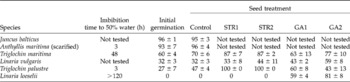
Intact seeds of A. maritima failed to imbibe, while scarified A. maritima seeds reached 50% water content after 3 h of imbibition. Water content in seeds of L. loeselii did not exceed 16.7% after 120 h of imbibition. Seeds of T. palustre reached 50% water content after 3 h, and those of T. maritima reached 50% after 48 h of imbibition. Seeds of J. balticus, A. maritima and T. maritima germinated to 95 ± 3%, 96 ± 4% and 70 ± 6%, respectively, and those of T. palustre and L. vulgaris to 47 ± 4% and 32 ± 3%, respectively. No seeds of L. loeselii germinated in control conditions (Table 1).
Seed germination characteristics of six coastal plant species of the Baltic region: imbibition time necessary for seed water content to reach 50%; initial seed germination (%±SE) in control conditions (imbibed in distilled water, no pre-treatment) within a week after collection; seed germination (%±SE) in control conditions after dry storage at 2–3°C, after 1 month of stratification at 2–3°C (STR1), after 2 months of stratification at 2–3°C (STR2) and germination of seeds imbibed in 3×10⁻⁵ M (GA1) or 10−4 M (GA2) gibberellic acid solutions. Seeds of A. maritima were scarified prior to imbibition and germination. At the time of germination experiment, seeds of A. maritima were 7 months old, those of T. maritima 13 months old, those of J. balticus and T. palustre 1 month old, those of L. loeselii and L. vulgaris 1.5 weeks old

Cold stratification significantly increased germination percentage of T. palustre seeds to 100% and those of T. maritima to 87 ± 2%; however, cold stratification had no significant effect on germination of seeds of L. vulgaris or L. loeselii. Treatment with GA3 had no significant effect on germination of the seeds of T. maritima, T. palustre or L. vulgaris. In contrast, germination percentage of L. loeselii seeds increased up to 59 ± 4% and 81 ± 8% after treatment with 3 × 10− 5 M and 10− 4 M GA3, respectively (Table 1).
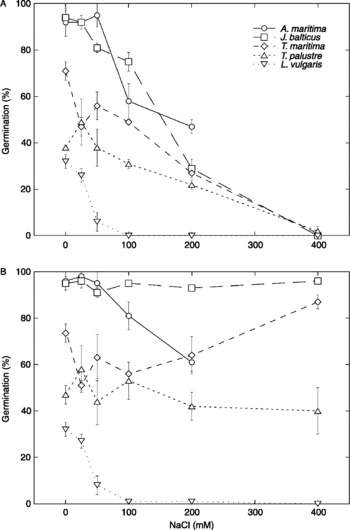
Sodium chloride inhibited germination (Fig. 1A). Seeds of L. vulgaris were significantly inhibited (6 ± 4%) at 50 mM NaCl. Increasing the NaCl concentration to 100 mM led to significant decreases in germination percentages of J. balticus and A. maritima seeds (75 ± 3% and 59 ± 7%, respectively). Germination of T. maritima seeds significantly decreased (to 27 ± 2%) at 200 mM NaCl. A 400 mM NaCl solution significantly decreased germination of T. palustre to 2 ± 2%. After rinsing seeds with distilled water (Fig. 1B), full germination recovery was observed in J. balticus, T. maritima and T. palustre seeds (i.e. germination percentage after rinsing reached that of control), irrespective of the previous NaCl concentration in which they were incubated. However, subsequent to 200 mM NaCl treatment, seed germination of A. maritima after rinsing remained significantly lower than that of the control, and seeds of L. vulgaris did not recover from incubation in NaCl concentrations of ≥ 50 mM.
Effect of NaCl on the germination of Anthyllis maritima, Juncus balticus, Triglochin maritima, T. palustre and Linaria vulgaris seeds: (A) before rinsing with distilled water and (B) after rinsing (number of germinated seeds includes seeds germinated before rinsing). Vertical bars denote standard error. Each point on the graph represents an independent data point. At the time of the germination experiment, seeds of A. maritima were 7 months old, those of T. maritima 13 months old, those of J. balticus and T. palustre 1 month old and those of L. vulgaris 1.5 weeks old.

Discussion
Failure of A. maritima seeds to imbibe indicates the presence of physical dormancy (Nikolaeva et al., Reference Nikolaeva, Rasumova and Gladkova1985; Baskin and Baskin, Reference Baskin and Baskin2004). As germination percentages of L. loeselii, L. vulgaris and T. palustre were much lower than 90–95%, seeds were considered dormant. In the case of L. loeselii, slow imbibition and the resulting restricted water supply to the embryo can be associated with seed dormancy (Nikolaeva et al., Reference Nikolaeva, Rasumova and Gladkova1985). T. maritima germination was lower than 80%, so some seeds of T. maritima were regarded as dormant. Seeds of J. balticus were considered to be non-dormant. Seeds of both Triglochin species have linear axile (LA) embryos without endosperm. Specific information on L. loeselii and J. balticus was not available but, in general, Linaria sp. and Juncus sp. have LA embryos or curved embryos (some Linaria species) with abundant endosperm. Anthyllis sp. have bent foliate axile embryos surrounded with perisperm (Nikolaeva et al., Reference Nikolaeva, Rasumova and Gladkova1985; Juan et al., Reference Juan, Pastor and Fernandez1999). No reports of morphological dormancy in these species and genera were available (Nikolaeva et al., Reference Nikolaeva, Rasumova and Gladkova1985). Masuda et al. (Reference Masuda, Maki and Yahara1999) considered afterripening necessary for germination of T. maritima seeds, but their reported germination percentages without moist chilling were extremely low (0–2%). In contrast, the present research showed that seeds collected in September (considered ripe) and germinated 6 d after collection germinated to relatively high percentages (Table 1).
GA3 application substantially increased germination of L. loeselii seeds, and cold stratification that of T. palustre seeds. Thus, seeds of L. loeselii and T. palustre have non-deep physiological dormancy. Dormancy of L. vulgaris appeared to be physiological, but was difficult to fully characterize from the present results. T. maritima seeds are probably physiologically dormant, which was supported by increased germination following stratification, as well as by previous research (Masuda et al., Reference Masuda, Maki and Yahara1999). Seeds of both Triglochin species were insensitive to GA3, which agrees with the results for T. maritima obtained by Khan and Ungar (Reference Khan and Ungar2001). Deep physiological dormancy in several Linaria species has been noted by Nikolaeva et al. (Reference Nikolaeva, Rasumova and Gladkova1985).
The species exhibited different tolerances to salinity, as shown by the ability to germinate in saline conditions, as well as the recovery of germination after washing and re-imbibing in fresh water (Fig. 1). The response to salinity and germination recovery patterns allow classification of L. vulgaris and A. maritima seeds as type 1 (least salinity-tolerant), and those of J. balticus, T. maritima and T. palustre seeds as type 2 (intermediate salinity tolerance) (Woodell, Reference Woodell1985). Therefore, among these five species, these results suggested that seeds germinating in dunes may be less salinity-tolerant than seeds of species growing in habitats periodically inundated with sea water. When distinguishing the three types of seeds based on germination response to salinity, Woodell (Reference Woodell1985) made a connection between seed type and salinity level in plant habitat. However, Baskin and Baskin (Reference Baskin and Baskin1998) remarked that there is no consistency in values of salt concentrations that reduce seed germination of different halophytic plants to 10% of control; thus, seed salinity tolerance of a particular species cannot be directly linked to only the salinity level in its habitat, but should be linked also to environmental conditions at the time of germination. Conditions that influence germination, such as temperature, water availability and salinity, vary seasonally. If the favourable season for germination coincides with the period of lowest salinity, seeds would not require a particular salinity tolerance to germinate, even in a habitat exposed to sea water. Therefore, it is important to find out when seeds of a particular species germinate in natural conditions, and the salinity level in the habitat at that time.
Interestingly, although cold stratification did not significantly increase seed germination of L. vulgaris at 0 mM NaCl, germination increased to 36 ± 6% and 6 ± 1% at 50 mM and 100 mM NaCl, respectively, after 1 month of cold stratification. Also, after 1 month of cold stratification 1 ± 1% of seeds germinated when rinsed after being incubated at 400 mM NaCl (data not shown). This indicates a relative increase of salinity tolerance after cold stratification and probably a degree of dormancy release, a phenomenon previously observed in seeds of other species (Baskin and Baskin, Reference Baskin and Baskin1998). Sharma and Kumar (Reference Sharma and Kumar1999) showed that chilling Brassica juncea seeds alleviated salinity stress, and this effect was accompanied by changes in soluble sugar and mineral contents in the seeds. Whether such increases in salinity tolerance or decreased salinity in the seasonal environment allows L. vulgaris and other non-halophytes to establish themselves in coastal areas remains to be determined. Interaction between salinity and cold stratification treatment was observed in previous experiments with T. maritima seeds (unpublished results). Therefore, further research is needed to determine the ecological significance and physiological mechanisms involved in this interaction.
In conclusion, the hypothesis that degree of natural exposure of seeds to salinity can be linked to seed salinity tolerance was confirmed for five out of six plant species examined in this study. Also, five of six species can be characterized by innate seed dormancy, with a rather unexpected exception for J. balticus. Further research is required for a deeper understanding of seed germination characteristics of these and other coastal species of the Baltic region.
Acknowledgements
This research was funded by the University of Latvia under the terms of the project ‘Biological basis of conservation of rare and endangered species of Latvia: coastal zone’ (LU 23). We would also like to thank the referees for considerable help in improving the quality of the manuscript.