Introduction
Dementia is one of the great challenges of our society, with early diagnosis and alternatives to pharmacological treatment methods prioritized by national government strategies across Europe (Republique Francaise, 2008; Department of Health, 2009; Ministry of Social Affairs and Health, 2013). In order to fulfill these, performance in basic activities of daily living (ADLs) is an important area to understand further.
Being less able to perform basic ADLs, including bathing, continence, dressing, feeding, toileting, and transfer (Katz et al., Reference Katz, Ford, Moskowitz, Jackson and Jaffe1963), may reduce quality of life (QoL) in dementia (Beerens et al., Reference Beerens, Zwakhalen, Verbeek, Ruwaard and Hamers2013), since the need for assistance in these activities makes people with dementia (PwD) dependent on informal (family) or formal (professional) care. Consequently, not only is the PwD directly affected by the symptoms, but relatives, such as spouses or partners, who play an important role in the day-to-day management of the disease, may experience stress both as a result of the need for help with ADLs and the PwD’ more dependent or challenging behavior (Lee et al., Reference Lee, McKeith, Mosimann, Ghosh-Nodyal and Thomas2013). However, little research attention has been paid to the extent to which ADL impact varies across the different stages of dementia. One study suggested that basic ADL performance deteriorated predominantly during the later stages of dementia (Pocnet et al., Reference Pocnet, Rossier, Antonietti and von Gunten2013). In the absence of comparable literature that investigates each stage of dementia separately (Ostbye et al., Reference Ostbye, Tyas, McDowell and Koval1997; Galasko et al., Reference Galasko2005), understanding how individual ADL performance varies across the course of the degenerative disease is important as the basis for developing non-pharmacological interventions that are specific to each dementia stage, with different foci. Interventions that assist community-dwelling PwD to retain their independence and which help alleviate carer stress could be beneficial and may also reduce care costs by delaying long-term care admission.
In order to understand fully the extent to which basic ADL performance impacts on QoL, it is helpful to compare its effect to those of depression and neuropsychiatric behavior. The latter are both reported to impact negatively on QoL, that is, higher symptoms of depression and neuropsychiatric behavior are associated with reduced QoL in dementia (Hoe et al., Reference Hoe, Hancock, Livingston and Orrell2006; Buckley et al., Reference Buckley2012). This knowledge can then also be employed in non-pharmacological interventions highlighting the relative effect of interventions addressing ADL performance upon QoL in comparison to those focused upon depressive or neuropsychiatric symptoms.
To elucidate further the factors impacting on QoL, the present study compares data from eight European nations: England, Estonia, Finland, France, Germany, Netherlands, Spain, and Sweden. It has two primary objectives. The first is to determine whether there are any differences in the performance of six ADL tasks across the stages of mild, moderate, and severe dementia. The second is to explore different factors, including ADL performance, impacting on QoL, taking account of both stage of dementia and country of residence. For the first objective, it is expected that the mild dementia group displays the fewest difficulties, yet it is unknown for which ADLs the fewest difficulties are experienced. For the second objective, it is hypothesized that daily functioning contributes more to QoL the further the disease progresses.
Methods
Context
This study uses data from a larger European project (RightTimePlaceCare; the RightTimePlaceCare Consortium partners and their affiliations are listed in Appendix 1) looking at transition from community living to care home residence of PwD, considered to be at the margins of care. Detailed descriptions of the project's recruitment and data collection protocol are provided by Verbeek et al. (Reference Verbeek2012). The project comprised a baseline and a three-month follow-up assessment, albeit for the purpose of this study, only the baseline data were used. The sample comprised two groups of PwD, 65 years or older, in two care settings: (1) either recently admitted to a care home within the previous three months; or (2) living in the community in receipt of home care but deemed at risk of admission to a care home within the following six months.
Participants
This study focuses on one of the care settings, namely PwD living in the community and receiving home care. PwD in this group could be expected to benefit particularly from interventions based on their performance on individual ADLs and tailored to each stage of dementia, thus helping them to remain at home and independent for longer. Additional inclusion criteria were: a diagnosis of dementia; a Standardized Mini-Mental State Examination (S-MMSE) score of 24 or below; and an informal caregiver visiting at least twice a month or living with the PwD. Ethical approval was obtained by each country individually in accordance with national requirements. Country-specific written informed consent was gained prior to participation.
Materials
The questionnaire contained a number of standardized measures relating to cognitive functioning, QoL, functional ability, depressive symptomatology, and psychopathology. Cognitive status of the PwD was assessed using the S-MMSE (Folstein et al., Reference Folstein, Folstein and McHugh1975). Total scores for this measure range from 0 to 30, with lower scores indicating lower cognitive functioning. PwD also completed the Quality of Life in Alzheimer's Disease (QoL-AD-PwD; Logsdon et al., Reference Logsdon, Gibbons, McCurry and Terri1999), a 13-item measure which rates domains of QoL, including mood, social relationships, financial situation, and overall QoL, and can achieve a score from 13 to 52. A higher score indicates better QoL. Informal carers completed a number of proxy measures on behalf of the PwD, including QoL (QoL-AD-C) and the Katz ADL scale (Katz et al., Reference Katz, Ford, Moskowitz, Jackson and Jaffe1963), whereby each of the six ADLs is rated as independent or as partially or fully dependent. In using a dichotomous scoring system, “1” and “0” indicate independence and dependence, respectively. The items bathing, dressing, and feeding received a score of “0” only for full dependence, whereas toileting, transfer, and continence received a score of “0” for either partial or full dependence. A higher total score with a maximum of six represents greater independence. For this study, requiring no help, partial, or full support were analyzed separately for each ADL. Psychopathology was assessed by the Neuropsychiatric Inventory Questionnaire (NPI-Q) scale (Kaufer et al., Reference Kaufer2000). NPI-Q surveys 12 domains: agitation/aggression, delusions, hallucinations, depression, euphoria, aberrant motor behavior, apathy, irritability, disinhibition, anxiety, sleep, and eating. It is administered as a structured interview with a knowledgeable informant who can report the patient's neuropsychiatric symptoms. NPI-Q is a simplified clinical version of the Neuropsychiatric Inventory (NPI), with two scores reported for each domain: (1) presence of symptoms; and (2) severity on a 0–3 scale (0 = none, 1 = mild, 2 = moderate, 3 = severe). The total score ranges from 0 to 36, with higher scores indicating the presence of more (severe) neuropsychiatric symptoms. Depressive symptomatology was rated using the Cornell Scale for Depression in Dementia (CSDD; range 0 to 38; Alexopoulus et al., Reference Alexopoulus, Abrams, Young and Shamoian1988) with higher scores indicating more depressive symptoms. Background characteristics of age, gender, and dementia type were also collected.
Procedure
Organizations involved in the delivery of community care services provided assistance in the recruitment of eligible individuals. Face to face interviews were conducted with PwD and informal carers acting as proxies using structured questionnaires. Interviewers who were qualified or experienced in health and social care received training in the administration of the questionnaire based on a working manual designed to standardize operating procedures. Interviews lasted approximately 2 h and were carried out at a location convenient to participants, generally their current place of residence.
Analysis plan
Statistical analyses were performed using SPSS 20 software. Stages of dementia were defined based on S-MMSE scores of 24 to 20 (mild), 19 to 10 (moderate), and 9 to 0 (severe), using previously published literature as a guide to appropriate categorization (Tombaugh and McIntyre, Reference Tombaugh and McIntyre1992; NICE, 2006). Demographic characteristics and number of ADL impairments were evaluated using frequency distributions, and Analysis of Variance (ANOVA) was carried out to compare means between the three stages of dementia. Where significant ANOVA results were obtained, post hoc analyses (Tukey's HSD test) were employed to identify which groups differed significantly from each other. In view of a large number of missing or incomplete QoL-AD-PwD measures, particularly in the more advanced stages of dementia, observed also in other studies (Crespo et al., Reference Crespo, Hornillos and Gomez2013), the QoL-AD-C was employed as the primary outcome measure of QoL. Pearson correlation analyses were used to assess the relationship between (1) all six ADLs and the S-MMSE; and (2) QoL-AD-C and ADL tasks at each stage of dementia and across each of the eight countries and for all countries combined. All significant variables were then entered into multiple regression models for each stage of dementia and each country. Alternatively, if only one variable was found to significantly correlate with QoL-AD-C, a single regression analysis was performed. For daily activity performance, only ADLTotal was employed due to the collinearity of individual ADL items. However, if ADLTotal was found to be not significantly related to QoL, the individual ADL that explained the largest variations in QoL was chosen for the regression model.
Results
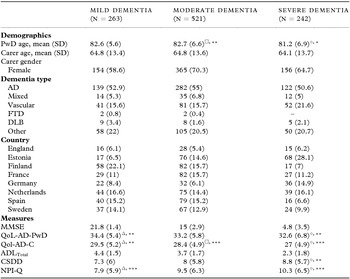
Participant characteristics and mean values of measures are shown in Table 1. Of the 1,223 participants, 197 were excluded due to missing S-MMSE and QoL-AD-C scores. The total sample included 1,026 dyads of PwD and their informal carers. Participant characteristics such as carer age, gender, and dementia type did not significantly vary between dementia stages, with the exception of PwD age. Both PwD and proxy reports of QoL were significantly higher in the mild stages of dementia, and CSDD and NPI-Q scores differed significantly between dementia stages.
Participant characteristics and test scores

Notes: All values are given in N (%) for demographics and in mean (SD) for measures, unless otherwise stated.
∆ = significantly different between mild and moderate dementia; ○ = significantly different between mild and severe dementia; □ = significantly different between moderate and severe dementia.
*p ≤ 0.05; **p ≤ 0.01; ***p ≤ 0.001.
AD = Alzheimer's disease; ADLTotal = activities of daily living total score; DLB = dementia with Lewy bodies; FTD = frontotemporal dementia; PwD = people with dementia; MMSE = Mini-Mental State Examination; QoL-AD-PwD = Quality of Life in Alzheimer's Disease completed by PwD; Qol-AD-C = Quality of Life in Alzheimer's Disease completed by informal carers on behalf of the PwD; CSDD = Cornell Scale for Depression in Dementia; NPI-Q = Neuropsychiatric Inventory Questionnaire.
Daily activity performance
Figure 1 shows the level of impairment for each ADL across mild, moderate, and severe dementia for the total sample. It emerged that the ability to perform ADLs deteriorated differently for each activity, whereby bathing and dressing became more impaired with dementia progression, albeit with high levels of impairment apparent even in mild dementia. In contrast, toileting, transfer, and feeding remained relatively preserved throughout the stages of dementia. Continence was more or less equally impaired regardless of the dementia group, with most of those in the mild dementia group requiring no or only some assistance.
ADL impairments across different stages of dementia for all European countries.

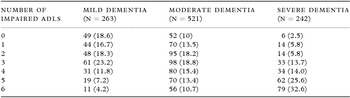
The number of impairments in ADLs varied between dementia stages (see Table 2). In the mild dementia group, the majority of PwD required no assistance, or assistance with one or two activities. In the moderate group, few PwD required no assistance, with similar numbers of PwD at both extremes of abilities – unable to complete all six activities or having no need for assistance. As expected, PwD in the severe category had the highest numbers of impairments, with very few requiring no assistance. All activities were significantly related to the S-MMSE (rBathing = –0.296, p < 0.01; rDressing = –0.328, p < 0.01; rToileting = –0.383, p < 0.01; rTransfer = –0.286, p < 0.01; rContinence = –0.253, p < 0.01; rFeeding = –0.431, p < 0.01; rADLTotal = 0.431, p < 0.01), in that reduced levels of dependency were associated with higher cognitive functioning.
Number of impaired ADLs across different stages of dementia

Notes: All values are N (%).
Impairment is measured as partially or fully impaired.
ADLs = activities of daily living.
QoL and ADLs across countries and dementia stages
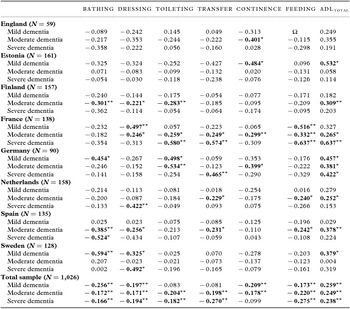
Table 3 shows the associations between QoL-AD-C and ADL performance across the three dementia stages and across the eight countries. Despite there being no distinct pattern of association between individual ADL items and stage of dementia when viewed by country, there were a number of statistically significant associations for the sample as a whole. Considering the countries separately, at the mild dementia stage, none or only few daily activities correlated with QoL-AD-C, in contrast to the total sample. In some countries ADLs were related to QoL in the mild stage, but not moderate or severe stages (Estonia); in others this significant relationship was only evident in the moderate but not the severe stage (England and Finland); and some showed variations across the dementia stages (Netherlands, Spain, and Sweden). Whilst in France and Germany ADLs were associated with QoL at each stage, these associations were more evident in the mild and moderate stages. Across all stages and countries, where statistically significant relationships between individual ADLs and QoL were negative, higher ADL dependency was associated with reduced QoL; where statistically significant relationships between ADLTotal and QoL were positive, a higher ADLTotal score, indicating greater independence, was associated with better QoL.
Pearson correlations between QoL-AD-C and ADLs across countries and different stages of dementia

Notes: Values in bold indicate significant correlations.
*p < 0.05; **p < 0.01.
Ω = could not be computed as all participants in this group required no assistance with feeding.
Qol-AD-C = Quality of Life in Alzheimer's Disease completed by informal carers on behalf of the PwD; ADLs = activities of daily living; ADLTotal = activities of daily living total score.
Factors impacting on QoL
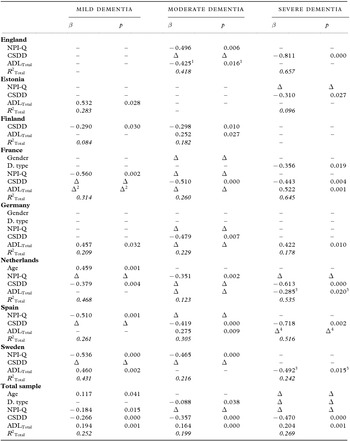
Table 4 shows the results of the multiple or, where appropriate, single regression analyses. Both across the different stages of dementia and across different countries, the degrees to which individual variables explained QoL varied from 8.4% (Finnish mild dementia group) to 65.7% (English severe dementia group). These variations were not related to the stage of dementia, as high and low R 2 values were apparent at each stage. Variance in the QoL of the mild dementia group in England, the moderate dementia group in Estonia, and the severe dementia group in Finland was not significantly explained by any of the variables. In the main, ADL performance explained a significant amount of QoL, with the ability to perform ADLs associated with a higher QoL score. In those instances where one ADL or ADLTotal were excluded from the multiple regression models, separate single regression analyses revealed their significant contribution to QoL for the French mild dementia group (R 2 Feeding = 0.266, p < 0.01; β = –0.516, p < 0.01), the Dutch moderate dementia group (R 2 ADLTotal = 0.063, p < 0.01; β = 0.252, p < 0.05), and the Spanish severe dementia group (R 2 Bathing = 0.274, p < 0.01; β = –0.524, p < 0.05). Again, this shows that better ADL performance is associated with improved QoL.
Multiple regression analyses of the factors determining QoL by stage of dementia and country

Notes: “–” = not entered into regression model as not significantly correlated.
∆ = entered into regression model but excluded by SPSS.
D. type = dementia type.
1Continence; 2Feeding; 3Dressing;4Bathing.
QoL = quality of life; CSDD = Cornell Scale for Depression in Dementia; NPI-Q = Neuropsychiatric Inventory Questionnaire; ADLTotal = activities of daily living total score.
Discussion
This would appear to be the first study using international data to indicate that QoL of PwD, according to proxy ratings, is related to different factors at each stage of dementia – mild, moderate, and severe. In addition, this study provides a detailed assessment of individual basic ADL performance across different stages of dementia. Looking first at the ability to perform ADLs in the total sample, it emerged that three of the six ADLs, namely toileting, transfer, and feeding, were predominantly intact in the mild stages, with deterioration reported in the more advanced stages. This performance pattern had been anticipated for all ADLs, yet is consistent with reports of a general hierarchy in ADL loss (Reisberg et al., Reference Reisberg1984). In contrast, bathing, dressing, and continence were impaired to a greater extent in the early stages of dementia. This is supported by previous evidence on mild and moderate dementia (Ostbye et al., Reference Ostbye, Tyas, McDowell and Koval1997), although the authors did not provide a detailed cognitive classification for both groups, so a direct comparison of findings is not possible. Considering a casemix of both moderate and severe dementia, Galasko et al. (Reference Galasko2005) suggested that, of the assessed ADLs, bathing and dressing, as opposed to toileting, were largely impaired. Furthermore, contrary to the present study, PwD were impaired to a greater extent on the task of feeding, and required similar levels of assistance with this ADL as with bathing and dressing. In view of the existing evidence, basic ADL performance appears to deteriorate differently for each activity and stage of dementia. The paucity of literature makes it difficult to detect a specific pattern of deterioration, which underlines the importance for understanding the causes of performance variations.
Given the impact of general cognitive functioning (S-MMSE) on everyday task performance, in addition to the contribution of physical and sensory impairment (Seidel et al., Reference Seidel, Brayne and Jagger2011) and the environment (Pizzi et al., Reference Pizzi2013), one explanation for these variations could be that different cognitive areas are associated with performance on different basic ADLs, rather than all activities. Although many studies have explored the relationship between cognitive functions, such as different forms of memory or executive functioning (Earnst et al., Reference Earnst2001; Razani et al., Reference Razani, Casas, Wong, Lu, Alessi and Josephson2007), and instrumental ADLs (IADLs; Lawton and Brody, Reference Lawton and Brody1969), including household tasks, laundry, meal preparation, finance and medication management, shopping, telephoning, and transport, little or no attention has been paid to the cognitive underpinnings of basic ADLs as evaluated here. At most, cognitive function has been assessed in relation to overall ADL performance (Bronnick et al., Reference Bronnick, Ehrt, De Deyn, Wesnes, Tekin and Aarsland2006), which provided some indication, yet no detailed evaluation of the cognitive foundations of individual activities. The focus on IADLs as opposed to ADLs may be due to the complexity of the former, with finance management and meal preparation considered to be more intricate tasks supported by a variety of cognitive functions. Comparing the task of finance management (IADL) with toileting (ADL) for example, it becomes clear that the ability to count money and deal with bank statements requires more cognitive input in the form of attention and specific memory systems. By contrast, toileting is likely, though as yet unconfirmed, to rely less on these cognitive systems but instead involves others to a greater extent, which presumably deteriorate at later stages of the disease.
Support for this assumption is provided in the performance decline of certain basic ADLs, including toileting, transfer, and feeding, predominantly during the later stages. Work by Reisberg and colleagues supports the notion of the hierarchy of ADL loss from normal aging to dementia (Reisberg et al., Reference Reisberg1984; Auer and Reisberg, Reference Auer and Reisberg1997; Sclan and Reisberg, Reference Sclan and Reisberg1992). Furthermore, findings by LaPlante (Reference LaPlante2010) on non-institutionalized younger adults with a disability support the findings of this study in a non-dementia population, in that bathing and dressing were slightly more impaired than transfer, toileting, and feeding. Although no detailed information is provided on their cognitive profile, it could be assumed that toileting, transfer, and feeding, in particular, rely on cognitive systems that deteriorate only during moderate and severe dementia. Potential candidates could be procedural memory, which is responsible for remembering action movements and skills, or semantic memory, which stores semantic information such as word comprehension (Nestor et al., Reference Nestor, Fryer and Hodges2006; Beaunieux et al., Reference Beaunieux, Eustache, Busson, de la Sayette, Viader and Desgranges2009). By contrast, bathing, dressing, and continence are reported to be problematic even in mild dementia. In line with this argument, it could be that these three ADLs rely to a similar extent on those cognitive areas that are supporting IADLs. Consequently, their performance declines earlier, as is the case with IADL compared to basic ADL performance (Mioshi et al., Reference Mioshi, Kipps, Dawson, Mitchell, Graham and Hodges2007). Research is warranted to investigate the cognitive underpinnings of ADL performance to further expand on findings obtained for IADLs.
With ADL performance varying markedly between activities and dementia stages, it was important to consider their individual impact on QoL across mild, moderate, and severe dementia. Contrary to the stated hypothesis, the number of ADLs that were associated with QoL did not, in most countries, increase from mild to severe dementia. In particular, no coherent pattern of association emerged, which makes it difficult to provide possible explanations for these variations. Variations could possibly be the result of cultural differences in perceptions of symptomatology. Furthermore, and congruent with previous evidence, ADL performance, depression, and neuropsychiatric behavior impacted differentially on QoL (Andersen et al., Reference Andersen, Wittrup-Jensen, Lolk, Andersen and Kragh-Sorensen2004; Beerens et al., Reference Beerens, Zwakhalen, Verbeek, Ruwaard and Hamers2013). It is of note that these relationships were with proxy reports of QoL, because PwD reports showed little association with other measures. Although the QoL-AD is a reliable and valid measure of QoL in dementia generally (Thorgrimsen et al., Reference Thorgrimsen2003; Hoe et al., Reference Hoe, Hancock, Livingston and Orrell2006), PwD reports of QoL, particularly in the severe stage, are significantly related to lower levels of awareness (Conde-Sala et al., Reference Conde-Sala2014). This supports the fact that proxy reports in this study were found to correlate to a greater extent with measures, as PwD may have limited ability to judge their QoL, or rely less upon external comparators.
Limitations
There are a number of potential limitations to the study. First, this study focused solely on a group of PwD living in the community in receipt of home care and did not include those recently admitted to a residential or nursing home. Whilst this could be regarded as a partial sample, the purpose was to focus on the group of PwD that could benefit from non-pharmacological interventions designed to support them at home for as long as possible. Second, when the sample was split by dementia stage and country, some groups were relatively small compared to others within a country which may have reduced the comparability of factors influencing QoL within different countries. However, the overall sample size was large enough to provide sufficient statistical power to show significant differences. Third, there is a possibility that national samples may not be representative since the study design deliberately did not use random case selection and were from only certain regions within countries, although a minimum of three different care organizations from each country were included for recruitment to ensure variation. Additionally, the range of health and social care services may vary between countries (Knapp et al., Reference Knapp, Comas-Herrera, Somani and Banerjee2007), which could differentially influence the levels of impairment of included participants. Fourth, the QoL-AD and the CSDD measure shared similar questions on mood, energy, and physical complaints, which may explain why depression was predictive of QoL (Beerens et al., Reference Beerens2014). Lastly, performance on ADL tasks was not observed directly but reported by proxy. Thus, data on the need to use verbal or visual prompting to complete an ADL without assistance could not be captured, which is a limitation of the Katz ADL scale with PwD. However, the majority of literature on ADL performance also employs indirect daily activity reports, particularly for basic ADLs (Mioshi et al., Reference Mioshi, Kipps, Dawson, Mitchell, Graham and Hodges2007; Pocnet et al., Reference Pocnet, Rossier, Antonietti and von Gunten2013).
Conclusion
This study has examined how community-living people at different stages of dementia require assistance with individual basic ADLs and how this impacts on QoL in eight European countries. It thus provides a detailed contribution to a previously sparse literature. In concordance with recent international policy guidelines to promote independence in dementia and a rising interest in how non-pharmacological interventions can help maintain everyday functional independence for as long as possible (Creighton et al., Reference Creighton, van der Ploeg and O’Connor2013), this information can contribute to shaping interventions to help PwD remain at home for as long as possible and maintain a good QoL. Importantly, when developing such interventions, country-specific variations may need to be considered. Some European countries have only recently implemented national dementia strategies, and structures and content of services vary greatly, which may suggest that countries need to address issues of independence and well-being in dementia in the light of these. Given the policy priority of dementia care, the field of research addressed by these findings offers considerable potential.
Conflict of interest
None.
Description of author's roles
C.M.G. and C.S. were involved in UK data collection and C.M.G. performed statistical analyses and drafted the paper. C.S., M.S., S.K., A.R.G., M.S., H.V., A.Z., and D.C. commented on versions of the paper and approved the final draft.
Acknowledgments
The RightTimePlaceCare study is supported by a grant from the European Commission within the 7th framework program (project 242153).