


Anorexia nervosa is a psychiatric disorder characterised by the refusal of an individual to maintain a minimum normal body weight, often to the point of starvation. In both the DSM–IV and ICD–10 classification systems (World Health Organization, 1992; American Psychiatric Association, 1994), the core feature is an intense fear of gaining weight. Anorexia nervosa has been viewed as a culturally bound disorder, rare or absent except in Western cultures, where there is a pervasive pressure to diet to obtain a socially desirable weight and/or shape (British Medical Association & Board of Science and Education, 2000).
There are reasons to question this view. First, there are historical descriptions of cases of self-starvation without weight concern in cultures in which there was no emphasis on slimness (Reference BemporadBemporad, 1996). Second, cross-cultural comparison has suggested that anorexia nervosa does not necessarily follow the accepted Western form (Reference Lee, Ho and HsuLee et al, 1993; Reference LeeLee, 1996). Despite these reports, we are not aware of any systematic examination of anorexia nervosa in a sub-Saharan African population. We therefore aimed to determine whether there were any cases of anorexia nervosa among female students at two secondary schools in north-east Ghana. We predicted that anorexia might take a different form in a non-Western culture, and therefore our aims were to identify any young women who were underweight to a clinically significant extent as a result of self-starvation, and to record the attitudes and beliefs associated with this self-starvation.
METHOD
Study sample and measurement
We conducted a cross-sectional study to determine the presence of anorexia nervosa among female students attending two secondary schools in rural north-eastern Ghana between August 1999 to February 2000. One school was a small technical day school with around 200 students (of whom 68 were female). Meals were not provided by the school, therefore access to food was limited by family resources. The other was a girls’ boarding school with around 600 pupils. The pupils at this school were provided with four meals a day, so access to food was not a problem. The two schools were funded and administered through the Ghanaian Education Service. The students were expected to contribute fees. The schools did not have a prevailing religious ethos, and staff and students included both Christians and Muslims.
All female students who gave informed consent were measured for height and weight and their body mass index (BMI) was calculated. Any student with a BMI ≤ 19 kg/m2 underwent further assessment for anorexia nervosa. The acceptable range for a healthy BMI is generally considered to be 20–24.9 kg/m2 (Reference TrusswellTrusswell, 1999). The ICD–10 diagnostic criteria for anorexia nervosa specify a BMI of less than 17.5 kg/m2 or 15% less than expected. In order to maximise sensitivity of screening, a BMI of 19 or less was chosen as the threshold to trigger further assessment. All participants in this category were asked to nominate a friend of normal weight (BMI >19 kg/m2) and these young women served as a comparison group, undergoing the same assessments for anorexia, bulimia and depression (because several students nominated the same friend or a low-weight friend who was already in the sample group, this group was smaller than the low-BMI group). A similar technique has been used previously in a study of the families of patients with anorexia nervosa and cystic fibrosis (Reference Blair, Freeman and CullBlair et al, 1995).
The assessment consisted of a clinical examination of both mental and physical state, supplemented by three structured assessment scales (see below). The mental state examination included a detailed assessment of cognitions, beliefs and behaviours surrounding eating. Physical assessment included background medical information. A symptom checklist was used to screen for physical illness. A full physical examination was made of all participants with a BMI ≤19 kg/m2. Referral to the local hospital was advised in a number of cases (e.g. for suspected schisto-somiasis). Although they had to pay for investigation and treatment, participants benefited because they did not have to pay for an initial medical consultation. Individuals with gastrointestinal symptoms were offered treatment for worms and giar-diasis (as per local medical practice). All participants reporting symptoms were followed up to ensure their symptoms had resolved.
All participants also completed two standard measures of eating attitudes and behaviour: the 40-item version of the Eating Attitudes Test (EAT; Reference Garner and GarfinkelGarner & Garfinkel, 1979) and the Bulimic Investigatory Test, Edinburgh (BITE; Reference Henderson and FreemanHenderson & Freeman, 1987). The Eating Attitudes Test has been validated in a West African population (Reference Oyewumi and KazarianOyewumi & Kazarian, 1992b ). The study was conducted in English, the official language of instruction in Ghana but not the first language of most of the students. The schools covered a wide geographical area with several different languages. To ensure understanding, the scales were administered as structured interviews, despite being designed as self-report questionnaires (e.g. most of the students were unfamiliar with terms such as ‘binge’ and ‘diet’). Depressive disorders were screened for using the mood module from the PRIME–MD (Reference Spitzer, Williams and KroenkeSpitzer et al, 1994).
All assessments were conducted by D.B., who has training in both mental state examination and tropical paediatrics. The study was granted ethical approval by the Northeast Ghana District Medical Officer and was approved by the head teachers of the participating schools.
Analysis
We first described the participants with very low weight (BMI <17.5 kg/m2, the ICD–10 cut-off point for anorexia nervosa). We then compared scores on the eating attitudes and behaviour scales across the groups with very low weight (BMI <17.5 kg/m2), low weight (BMI 17.5–19 kg/m2) and normal weight (BMI >19 kg/m2). As the data were not normally distributed, non-parametric statistical techniques were used.
RESULTS
There were 668 young women attending the two schools. They all consented to participate, but one student (BMI=17.5 kg/m2) withdrew after the screening stage. The median age was 18 years (range 15–25). The median BMI was 21.1 kg/m2 (range 15.9–33.8). Of the 668 young women, 100 (15%) had a BMI ≤19 kg/m2 and of this group a further 29 (4.3%) had a BMI <17.5 kg/m2 (Fig. 1). In 19 of these 29, physical illness – in particular malaria – might have been a partial explanation for their low weight. However, in 10 of the 29, even after detailed clinical assessment, morbid self-starvation was the only detectable cause for their low weight. These individuals all attributed their food restriction to religious fasting. They expressed ‘anorexia-like’ attitudes of self-control, enjoying feeling hungry, denial of hunger, self-punishment and religious motivations to explain their food restriction (Table 1). They also showed perfectionist traits in striving for high academic standards and moral asceticism. These young women described a sense of control and achievement from self-induced starvation, while struggling with other aspects of their life that seemed beyond their control, such as pressure to do well at school. One participant with a BMI of 17.24 kg/m2 and an EAT score of 33 scored highly in the items relating to self-control around food, although she felt there was little she could do about her parents’ separation and arguments over money. Another, with a BMI of 17.47 kg/m2 and an EAT score of 18, described a sense of self-control and enjoyment of feeling hungry through self-starvation, while feeling powerless about family arguments over money. The attitudes and behaviours were different from those expressed by their peers. No one displayed a desire to be thin or a morbid fear of fatness. None reported amenorrhoea.
Study profile.

Main cognitions associated with food restriction in 10 participants
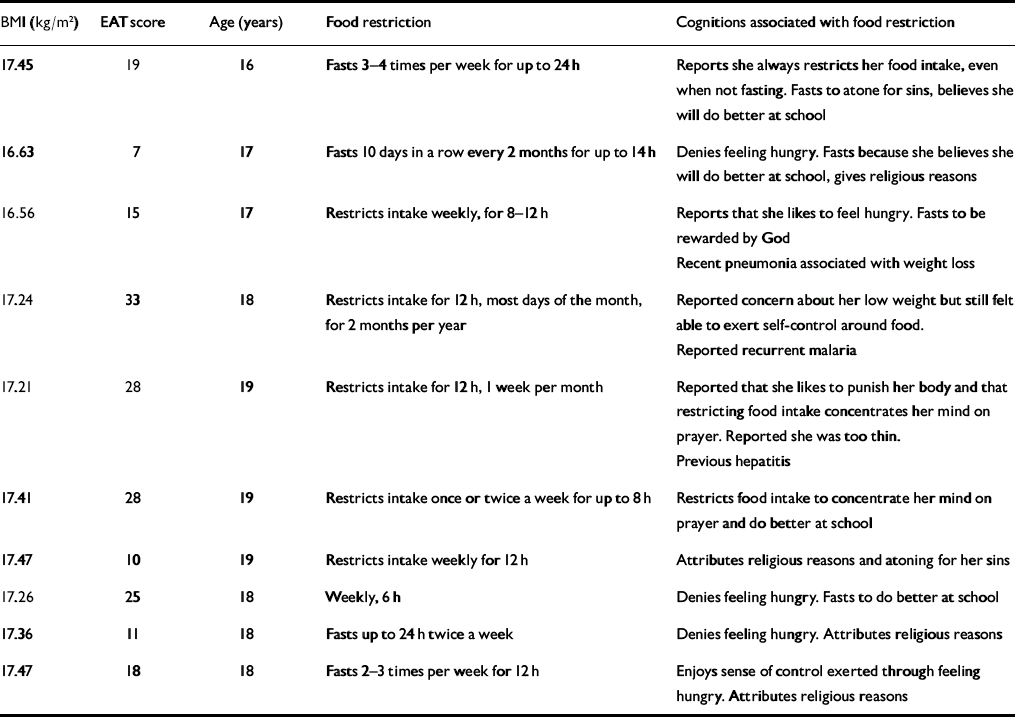
| BMI (kg/m2) | EAT score | Age (years) | Food restriction | Cognitions associated with food restriction |
|---|---|---|---|---|
| 17.45 | 19 | 16 | Fasts 3-4 times per week for up to 24 h | Reports she always restricts her food intake, even when not fasting. Fasts to atone for sins, believes she will do better at school |
| 16.63 | 7 | 17 | Fasts 10 days in a row every 2 months for up to 14 h | Denies feeling hungry. Fasts because she believes she will do better at school, gives religious reasons |
| 16.56 | 15 | 17 | Restricts intake weekly, for 8-12 h | Reports that she likes to feel hungry. Fasts to be rewarded by God |
| Recent pneumonia associated with weight loss | ||||
| 17.24 | 33 | 18 | Restricts intake for 12 h, most days of the month, for 2 months per year | Reported concern about her low weight but still felt able to exert self-control around food. |
| Reported recurrent malaria | ||||
| 17.21 | 28 | 19 | Restricts intake for 12 h, 1 week per month | Reported that she likes to punish her body and that restricting food intake concentrates her mind on prayer. Reported she was too thin. |
| Previous hepatitis | ||||
| 17.41 | 28 | 19 | Restricts intake once or twice a week for up to 8 h | Restricts food intake to concentrate her mind on prayer and do better at school |
| 17.47 | 10 | 19 | Restricts intake weekly for 12 h | Attributes religious reasons and atoning for her sins |
| 17.26 | 25 | 18 | Weekly, 6 h | Denies feeling hungry. Fasts to do better at school |
| 17.36 | 11 | 18 | Fasts up to 24 h twice a week | Denies feeling hungry. Attributes religious reasons |
| 17.47 | 18 | 18 | Fasts 2-3 times per week for 12 h | Enjoys sense of control exerted through feeling hungry. Attributes religious reasons |
Religious fasting was reported commonly by the participants at interview, and in moderation this seemed to be a benign and culturally accepted activity. The schools discouraged such fasting. Participants who reported fasting identified their religion as either Christianity or Islam. The Christian churches included Catholic, Pentecostal and a number of Evangelical churches. Seventy-two of the 184 (39%) participants interviewed identified themselves as Christian and reported occasional fasting (mostly during Lent and a period in October). In addition, 13 of the 184 (7%) identified themselves as Christian and reported fasting once a week (usually just for a few hours), and 23 of the 184 (12%) reported fasting at least twice a week. Three participants reported fasting for a week at a time every 3–4 weeks (generally eating a small meal once a day). Twenty of the 184 (11%) participants identified themselves as Muslim and reported fasting during Ramadan only. In addition, 6 (3%) described themselves as Muslim and reported fasting at least twice a week.
Eating Attitudes Test
The EAT was used as a measure of anorexia-like behaviour. A score above 30 is considered suggestive of disordered eating. The results showed no statistical difference between the three groups (BMI <17.5 kg/m2, BMI 17.5–19.0 kg/m2 and BMI >19 kg/m2; P=0.3) when the median total scores for the EAT were compared (Table 2). However, participants with a BMI <17.5 kg/m2 scored significantly higher on the ‘oral control’ sub-scale (P<0.005). There was no difference between the three groups on the other sub-scales, ‘anorexic attitude’, ‘bulimia and food preoccupation’ and ‘dieting’; this was in keeping with the findings on clinical examination.
Comparison of age and median scores on the Eating Attitudes Test and the Bulimic Investigatory Test, Edinburgh (BITE) in the three weight ranges

| Body mass index (kg/m2) | χ2 | d.f. | P 2 | |||
|---|---|---|---|---|---|---|
| < 17.51 (n=29) | 17.5-19 (n=70) | > 19 (n=85) | ||||
| Age, years: median | 17 | 17 | 17 | |||
| Eating Attitudes Test score: median (95% CI) | 17 (11-21) | 14 (13-16) | 14 (12-17) | 2.2 | 2 | 0.3 |
| Anorexic attitude | 7 (6-9) | 7 (7-8) | 7 (6-8) | 3.5 | 2 | 0.2 |
| Bulimia and food preoccupation | 0 (0-0) | 0 (0-0) | 0 (0-0) | 3.5 | 2 | 0.2 |
| Oral control | 6 (4-9) | 3 (3-4) | 3 (1-3) | 16.4 | 2 | < 0.0005 |
| Dieting | 2 (1-3) | 1 (1-3) | 3 (1-3) | 4.6 | 2 | 0.1 |
| BITE score: median (95% CI) | 6 (4-8) | 6 (5-6) | 8 (6-10) | 10.6 | 2 | 0.005 |
| Bulimia symptoms | 4 (3-6) | 4 (3-5) | 5 (4-6) | 4.3 | 2 | 0.1 |
| Bulimia severity | 2 (0-3) | 2 (2-2) | 3 (2-4) | 13.6 | 2 | 0.001 |
Bulimic Investigatory Test, Edinburgh
The BITE was used as a measure of bulimic symptoms. No participant scored above the cut-off point of 25 for the total score on the bulimia scale. Three young women of normal weight reported being distressed by episodes of overeating without any associated purging behaviour. None of the three participants met the criteria for bulimia nervosa.
Case descriptions
Case 1
One student described only ever eating a small quantity of food and fasting for the whole day, three or four times a week. She believed that by fasting she would atone for her sins and God would help her in her studies. She was 16 years old and had a BMI of 17.45 kg/m2, an EAT score of 19 and BITE scores of 8 and 6 (bulimia symptoms and severity, respectively).
Case 2
This young woman reported that she frequently felt pressured to eat by other people and that other people felt that she was too thin. She scored highly on the items relating to self-control. She would restrict her food intake for 12 h daily, one week every month. She reported that she liked to punish her body and that restricting her food intake concentrated her mind on prayer. She had no symptoms of depression but reported feeling under pressure from her father to perform well at school. She was 19 years old and had a BMI of 17.21 kg/m2, an EAT score of 28 and BITE scores of 1 and 2 (bulimia symptoms and severity, respectively).
Medical assessment
When the 29 participants whose BMI was below 17.5 kg/m2 were examined in more detail, physical illness (particularly malaria) might have contributed to the low weight in 19 cases. Five of the 10 young women we considered to have a primary eating disorder had recently been treated for malaria. However, physical illness did not account for the distinct ideas and beliefs motivating their self-starvation. Malaria is endemic during the wet season, and everyone participating in the study (n=668) had received treatment for it at some point.
Among the 10 low-weight young women who reported food restriction, one (BMI 17.41 kg/m2, EAT score 28) required treatment for worms. However, she reported restricting her food intake once or twice a week. Another (BMI 16.56 kg/m2, EAT score 15) reported recent pneumonia, malaria and had worms. Physical illness did not account for her attitude towards restricting her food intake. She reported frequent food restriction and that she enjoyed the sense of feeling hungry.
DISCUSSION
We found that 10 out of 668 female students (1.5%, 95% CI 0.6–2.4) in two Ghanaian secondary schools were pathologically underweight. The only clinical explanation was morbid self-starvation. According to ICD–10 and DSM–IV diagnostic classification schemes these girls would not be classed as having anorexia nervosa, as they had neither a morbid fear of fatness nor a pervasive need to be slim. Rather, they reported a desire to exert self-control through deliberate self-starvation. Control of self and others is now widely accepted as a central psychological mechanism of ‘Western’ anorexia nervosa and many cases of anorexia in Western patients present in this way. The underweight students all expressed themes of achieving a sense of control through self-starvation as a way of achieving perfectionist moral and academic standards. A number were striving to achieve a sense of self-control through self-starvation, while describing a low sense of self-efficacy over academic pressures and family conflicts.
Our findings suggest that beliefs associated with anorexia nervosa may differ between cultures. Although none of the individuals in these potential cases exhibited weight concern, they all showed other features of anorexia nervosa. Additionally, all 10 individuals viewed their resulting low weight positively. Their beliefs were also different from those of their peers, many of whom also reported religious fasting to varying degrees.
We wish to emphasise that our findings do not suggest that religious fasting equates to anorexia nervosa, but rather that it may be a risk factor similar to dieting, which has been established as a risk factor for anorexia nervosa (Reference Patton, Selzer and CoffeyPatton et al, 1990). Dieting is common and in most cases does not lead to anorexic behaviour. Similarly, most of the religious fasting appeared to be a benign activity and did not appear to be linked to anorexia-like attitudes and behaviours.
Neither the EAT nor the BITE assessments were predictive of the 10 students who reported self-imposed dietary restriction.
In none of the 10 potential cases of anorexia nervosa was the condition severe. However, these young women reported deliberately restricting their food intake and viewing the resulting state positively. Anorexia-like conditions clearly exist in a spectrum of severity. None of the participants reported amenorrhoea. A large Canadian community study reported that amenorrhoea in anorexia nervosa suggests hypothalamic dysfunction but has low sensitivity in case definition (Reference Garfinkel, Lin and GoeringGarfinkel et al, 1996).
Physical illness might have been a partial explanation of the low weight in many of our cases. One shortcoming of the study is that none of the participants was screened for HIV infection or tuberculosis; although this could potentially explain the low weight, one would expect to have observed other stigmata of disease on detailed physical examination. It is estimated that 1% of pregnant women tested positive for HIV in the Bolgatanga area in the year 2000 (National AIDS/SDI Control Programme, Disease Control Unit, 2001). Neither condition would explain the distinct obsessional ideas of self-control and restricted dietary intake. Previous research has shown that eating disorders are likely to be an aetiological factor in contracting tuberculosis, rather than vice versa (Reference SzaboSzabo, 1998).
Physical illness in the young woman with the BMI of 16.56 kg/m2 did not account for her attitude towards restricting her food intake, particularly her enjoyment of the sense of feeling hungry. It is difficult to determine in a cross-sectional assessment, but this individual's low weight might have predisposed her to contracting physical illness. Furthermore, the relationship between anorexia nervosa and physical illness remains poorly understood. It has been suggested that viral, bacterial or parasitic illness might trigger the onset of severe restrictive anorexia nervosa in biologically vulnerable people, possibly maintained by abnormal behavioural or neuroendocrine responses. The proposed mechanisms are speculative and clearly this is an area requiring further investigation (Reference Park, Lawrie and FreemanPark et al, 1995).
Asceticism and anorexia nervosa have long been linked, particularly in the historical context of the extreme fasting of saints such as Catherine of Siena (Reference RamplingRampling, 1985). There are a small number of case reports examining the relationship between religion and eating disorders. Morgan et al (Reference Morgan, Marsden and Lacey2000) described a contemporary series of case reports in which the religious beliefs and the eating disorder pathology were linked. Bhadrinath (Reference Bhadrinath1990) reported the cases of three Asian adolescents with anorexia nervosa whose symptoms became more severe during the Muslim fasting month of Ramadan. There are other case reports of women with anorexia nervosa who have used religious motifs of asceticism relating to food and the body to express the personal meaning of their self-starvation. Banks (Reference Banks1997) described the case of ‘Jane’ who viewed her self-starvation as ‘fasting’, which often coincided with the Christian Church calendar. She frequently fasted for 24 h on Saturday before taking communion on Sundays. The temporal relationship of the fasting behaviour with the Christian calendar was similar to that reported by the Ghanaian students.
The findings of this study need to be viewed within the context of growing cross-cultural research into eating disorders. There does appear to be some evidence that the cultural context can influence the development of disordered eating, for example the study by Becker et al (Reference Becker, Burwell and Herzog2002), which reported an increase in disordered eating and behaviours among ethnic Fijian girls following the introduction of television. However, other studies – particularly those from Asian cultures – have reported that weight concern is frequently absent (Reference Khandelwal and SaxenaKhandelwal & Saxena, 1990; Reference Lee, Ho and HsuLee et al, 1993; Reference LeeLee, 1996). Weight concern in anorexia nervosa becomes more common as the degree of Westernisation increases (Reference Lee, Ho and HsuLee et al, 1993).
We believe that our study is unique, as it is the only one to our knowledge involving detailed individual assessment of all the participants drawn from an African population. Previous African studies (Oyewumi & Kazarian, Reference Oyewumi and Kazarian1992a ,Reference Oyewumi and Kazarian b ; Reference Szabo and HollandsSzabo & Hollands, 1997; Reference Le Grange, Telch and TibbsLe Grange et al, 1998; Reference Wassenaar, le Grange and WinshipWassenaar et al, 2000) have failed to assess individually those who scored highly on measures of disordered eating with the application of diagnostic criteria. Our study suggests that the high rates of disordered eating previously reported may be unrelated to anorexia nervosa and may relate to obesity.
Limitations of the study
Approximately a third of the female population attend secondary school in northern Ghana. This creates a bias towards higher social classes being included in this study. However, the aim was to determine whether cases of anorexia existed in a rural Ghanaian setting, not to conduct a prevalence study.
The anorexia and bulimia scales were administered as interviews to ensure comprehension, although they have not been validated in this way. This is unlikely to have biased the results, as in all potential cases of anorexia the participants were interviewed clinically in addition to the structured assessment. Another potential limitation is that the study was conducted in English, the official language of instruction in Ghana but not the first language of most of the students. The assessments were conducted on one occasion only, and it is possible that the students who reported self-starvation might not have been entirely open about their beliefs or reasons for fasting. However, the questionnaires asked about body image in many different ways, so it is likely that this would have identified weight concern. The BMI cut-off value used is one chosen for Western adult populations and may not be appropriate for northern Ghana or younger girls. There is controversy about the best measure of anthropometric indices in adolescence; BMI for age or height for age might be more appropriate (Reference Onis and HabichtOnis & Habicht, 1996). The nomination of a ‘best friend’ of normal weight might have introduced some bias to the comparison group. Finally, the interviews were conducted by a single interviewer who was not masked to the participants’ weight status (D.B.)
Implications of our findings
The findings of our study suggest that anorexia nervosa may take different forms in different cultures. We wish to make the case that the 10 young women in our study who had self-starvation as the only detectable cause of their low weight had a form of anorexia nervosa without weight concern. Studies examining eating disorders in developing countries have assumed that the psychopathology of anorexia nervosa follows the recognised ‘Western’ form. We wish to suggest that a unifying theme of the diverse cultural presentations of this disorder is morbid self-starvation, which may be driven in many ways. Morbid self-starvation may be the core feature of anorexia nervosa, with the attribution for the self-starvation behaviour varying between cultures.
Clinical Implications and Limitations
CLINICAL IMPLICATIONS
-
▪ The psychopathology of anorexia nervosa may vary in different cultural contexts. Diagnostic criteria with weight concern as the core psychopathological feature may be culturally biased.
-
▪ The Eating AttitudesTest was not a valid screening instrument in this population, although measures of ‘oral control’ might have more validity in a cross-cultural setting.
-
▪ This is the first reported study to evaluate systematically a sub-Saharan African population for eating disorder psychopathology using detailed clinical assessment and exclusion of physical illness; it emphasises the importance of individual assessment.
LIMITATIONS
-
▪ The sample might have been biased towards the inclusion of higher social classes, because only a third of the female population in Ghana attend secondary school.
-
▪ The study was conducted in English, which was not the first language of most of the students.
-
▪ The cut-off value for body mass index was one chosen for Western adult populations and might not have been appropriate to this sample.
Acknowledgement
The authors thank Dr Bruce Wedgwood-Oppenheim for his assistance in Ghana.




eLetters
No eLetters have been published for this article.