Implications
This study provides new information on the polymorphism of three quantitative trait loci (QTL) in Modicana dairy cow. The investigated QTL are usually associated with variation in milk fat content and fatty acid (FA) composition; however, this study does not confirm the findings obtained with other breeds. Our results suggest that the effect of the genetic polymorphism on these milk traits may depend by the genetic background and the feeding system. In particular, the high amount of pasture seemed to resize the stearoyl-CoA desaturase (SCD) polymorphism effects because of the different FAs composition of the diet.
Introduction
Modicana is an endangered Italian cattle breed, traditionally reared in Sicily for milk, that is mainly addressed to the production of typical ‘pasta filata’ Ragusano cheese labelled with a Protected Designation of Origin. As other ancient local breeds, Modicana deserves to be preserved as cultural heritage but also for its economic, social and environmental role. European Union policy supports the conservation of local populations taking into account that, as compared to cosmopolitan breeds, their products are often characterized by a higher sensorial, nutritive and technological properties arising from the feeding system. Traditionally, Modicana is reared according to an extensive (EX) system, which is essentially based on pasture with no, or limited supplementation of concentrate during the grazing season; however, semi-intensive (SI) farming is also used. Similarly to the EX, the SI feeding system is based on forage, but the time spent on pasture is lower and level of concentrate supplementation is higher than the EX system.
It has been widely demonstrated that milk quality traits, including fat content and FAs composition, can be strongly affected by feeding (Chilliard et al., Reference Chilliard, Glasser, Ferlay, Bernard, Rouel and Doreau2007). In particular, pasture-based diets are known to confer characteristic aroma, colour and biologically active and healthy molecules to dairy products. Even if feeding remains the main tool to manipulate milk FA profile, an increasing number of evidences is highlighting the potential of genetic polymorphism at some loci to affect milk yield and composition. Among these, acyl-CoA:diacylglycerol acyltransferase 1 (DGAT1) g.10433-10434AA>GC (Grisart et al., Reference Grisart, Coppieters, Farnir, Karim, Ford, Berzi, Cambisano, Mni, Reid, Simon, Spelman, Georges and Snell2002), ATP binding cassette, subfamily G, member 2 (ABCG2) g.62569A>C (Cohen-Zinder et al., Reference Cohen-Zinder, Seroussi, Larkin, Loor, Evertsvan der Wind, Lee, Drackley, Band, Hernandez, Shani, Lewin, Weller and Ron2005) and SCD g.10329C>T (Macciotta et al., Reference Macciotta, Mele, Conte, Serra, Cassandro, Dal Zotto, Cappio Borlino, Pagnacco and Secchiari2008) have been widely studied in different breeds but not in Modicana. Acyl-CoA:diacylglycerol acyltransferase 1 is a key enzyme in triglycerides synthesis (Schennink et al., 2008), ABCG2 seems to be involved in the transport of the cholesterol into milk, whereas SCD catalyzes the addition of a double bond in Δ9 position in FAs. These polymorphisms, responsible for the observed variation of QTL, can be defined as quantitative trait nucleotides (QTN). In addition, it has been observed that genes of QTL can be up/down regulated depending on the production environment (Lillehammer et al., Reference Lillehammer, Hayes, Meuwissen and Goddard2009).
Modicana cattle breed has been scarcely investigated for its genetic polymorphism, except for milk protein genes (Ceriotti et al., Reference Ceriotti, Marletta, Caroli and Erhardt2004) and melanocortin 1 receptor which is one of the main genes implicated in the determination of the coat colour in mammals (Guastella et al., Reference Guastella, Sorbolini, Zuccaro, Pintus, Bordonaro, Marletta and Macciotta2011), whereas no information is available on the polymorphism of DGAT1, SCD and ABCG2 for this breed.
In the light of above, the aim of this research was to describe, for the first time in Modicana, the polymorphism of three QTN (DGAT1, SCD and ABCG2) involved in lipid metabolism and to evaluate the effect of the polymorphism on milk quality traits and FA composition in two traditional feeding systems characterized by a different use of pasture (8 v. 2 h/day). We hypothesized that milk yield and quality could differ among cows carrying different alleles at these loci when reared in different feeding systems. Therefore, the interaction between genetic polymorphism and feeding systems was investigated.
Material and methods
The experiment was conducted from October 2014 to June 2015 in two Modicana dairy cow farms located in the province of Ragusa (Southern of Italy) and characterized by two different feeding systems (respectively, SI and EX). In the SI farm ( 36°56ʹ47ʹʹ N and 14°41ʹ50ʹʹ E; 639 m above sea level), the diet consisted of stall feeding (hay and concentrate) and 2 h of daily grazing. In the EX farm (36°52ʹ53ʹʹ N and 14°33ʹ51ʹʹ E; 308 m above sea level), feeding consisted primarily on pasture (8 h/day). Malva neglecta, Chrysanthemum coronarium, Calendula arvensis and Carduus spp. dominated the botanical composition of pasture. A total of 165 individual blood samples were collected in 10 ml vacutainer tubes (K3-EDTA), specifically 96 from SI and 69 from EX. Sampling was carried out to avoid animals closely related to each other, according to the information obtained by farmers and genealogical data.
Genetic characterization
Genomic DNA was extracted from white blood cells using the EUROGOLD DNA Blood Mini Kit, following the protocol provided by the manufacturer (EuroClone S.p.A., Pero (MI), Italy). The concentration was measured by using the NanoDrop 1000 Spectrotometer, and brought to 30 to 50 ng/μl. Genotypes at ABCG2, DGAT1 and SCD loci have been determined using different PCR-RFLP and aCRS PCR-RFLP methods. Each investigated polymorphism causes an amino acid substitution in the protein sequence (Supplementary Table S1). Amplifications were performed in a 30-μl reaction volume for 35 cycles using a GenAmp PCR System 9700 (Applied Biosystems, Foster City, CA, USA) thermal cycler according to Komisarek and Dorynek (Reference Komisarek and Dorynek2009) and Komisarek et al. (Reference Komisarek, Michalak and Walendowska2011). Primers pairs, temperature of annealing, size of the amplicons (bp), restriction endonuclease and restriction patterns are reported in the Supplementary Table S2. In order to confirm the results of the PCR-RFLP methods, fragments of 292, 378 and 333 bp were sequenced in a subsample of 14 cows with different ABCG2, DGAT1 and SCD genotypes. Polymerase chain reactions were performed by using the same primer pairs and conditions as the PCR-RFLP protocols. Amplicons were purified using the Wizard® SV Gel and PCR Clean-Up System (Promega Corporation, Madison, WI, USA) and then eluted in 20 μl of pure water. The PCR products obtained by using ddNTPs triphosphate labelled with fluorophores (BigDye Terminator, Applied Biosystems) were purified in the CENTRES-SEP COLUMNS (Princeton Separation, Inc.) and then sequenced on an ABI PRISM 3130 Genetic Analyser equipped with Sequencing Analysis software (Applied Biosystems). The output sequences were compared with the respective reference sequences (GenBank Acc. Num. AJ871176, AY065621 and AY241932 to ABCG2, DGAT1 and SCD1, respectively) by the alignment with the software CLUSTALX 1.8 (Thompson et al., Reference Thompson, Higgins and Gibson1994). Departure from Hardy–Weinberg genetic equilibrium was evaluated by χ 2 test.
Animal and experimental design of the feeding trial
According to the observed polymorphism, which is detailed later in the ‘Results’ section, SCD was the only locus that allowed the creation of groups with a balanced presence of genotypes (TT, TC and CC) in the two farms. Therefore, three experimental groups were formed only on the basis of the genotypes at SCD locus. A total of 47 cows, 24 from SI and 23 from EX, at their third or fourth lactation, homogeneous for days of lactation (75.3±20.1 and 88.7±31.3 days for SI and EX, respectively) and milk yield (10.1±1.3 and 9.0±1.8 kg/day for SI and EX, respectively) were selected. Within each farm, the SCD genotypes were distributed as follows:
- SI: TT, 13 cows; TC, 4 cows; CC, 7 cows; and
- EX: TT, 9 cows; TC, 8 cows; CC, 6 cows.
All the selected individuals had the AA genotype for the ABCG2 locus and the GC/GC (p. 232AA) genotype for the DGAT1 locus. Feeding management in the two farms was performed as follows: SI cows were fed 5 kg of vetch and oats hay, 5 kg of a commercial concentrate (chemical composition is reported in the Supplementary Table S3) and grazed 2 h/day on natural pasture; EX cows were fed 5 kg of vetch and oats hay and grazed 8 h/day on natural pasture.
Data collection and analytical determinations
Monthly, individual milk yield was recorded and individual milk samples, consisting of proportional volumes from the morning and evening milk, were collected. Fat, protein and lactose were determined using an automated Fourier transform IR absorption spectrophotometric analyser (Combi-foss 6000; Foss Electric, Hillerød, Denmark). Fat was extracted from 50 ml of individual milk according to Luna et al. (Reference Luna, Juàrez and De La Fuenta2005) and 25 mg of lipid was converted to fatty acid methyl esters (FAME) by base-catalyzed transesterification (Christie, Reference Christie1982), using 0.5 ml of sodium methoxide in methanol 0.5 N and 1 ml of hexane. Nonadecanoic acid was used as an internal standard at concentration of 1 mg/ml. Fatty acid methyl esters were analyzed in duplicate on a Trace Thermo Finnigan GC equipped with a flame ionization detector and a 100 m×0.25 mm i.d. fused-silica capillary column (SP-2560; Supelco, Inc., Bellefonte, PA, USA). Helium was the carrier gas at a constant flow of 1 ml/min. Total FAME profile in a 1 µl sample volume at a split ratio of 1 : 80 was determined using the following GC conditions: the oven temperature was programmed at 50°C and held for 4 min, then increased to 120°C at 10°C/min, held for 1 min, then increased up to 180°C at 5°C/min, held for 18 min, then increased up to 200°C at 2°C/min, held for 15 min and then increased up to 230°C at 2°C/min, held for 19 min. The injector and detector temperatures were at 270°C and 300°C, respectively. Fatty acid methyl esters identification was based on the retention time comparison with commercially available standard mixture of FAME (Nu-Chek Prep Inc., Elysian, MN, USA; Larodan Fine Chemicals, Malmo, Sweden). Response factors to FID were calculated for individual FA with respect to the internal standard and intra-assay CV for each FA were calculated by using a reference standard butter (CRM 164; Community Bureau of Reference, Brussels, Belgium) and individual milk sample (Supplementary Table S4), detection threshold of FA was 0.001 mg/g FA. Fatty acids were expressed as g/100 g of total FAs.
Statistical analysis
Individual data for milk yield and composition (fat, protein, lactose, FA profile) were analyzed using the GLM procedure for repeated measures of SPSS (SPSS for Windows; SPSS Inc., Chicago, IL, USA). The analysis included the main effect of SCD genotype, feeding system, period and the interaction genotype×feeding system. The individual cow was included as a random factor. The following model was adopted:
 $$Y_{{ijkl}} {\rm {\equals} }\mu {\rm {\plus}}F_{i} {\rm {\plus} }G_{j} {\rm {\plus} }I_{k} \left( F \right){\rm {\plus}}\left( {F{\rm {\times}}G} \right)_{{ij}} {\rm {\plus}}e_{{ijkl}} $$
where Y ijkl is the observation; μ is the overall mean; F i the fixed effect of feeding system (i=EX; SI); G j the fixed effect of SCD genotype (j=TT; TC; CC); I k (F) is the random effect of the individual cow nested with the feeding system; (F×G) ij is the interaction between feeding system and SCD genotype; e ijkl is the residual error.
Pre-experimental data of milk yield were used as covariates for milk production and gross composition. When the covariance was not significant (P>0.05), it was removed from the statistical model. Differences between means were tested by LSD. The individual cow was considered as the experimental units and significance was declared when P⩽0.05.
Results
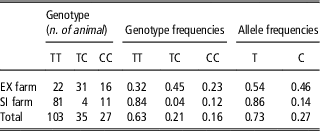
In the whole sample of 165 Modicana cows, three DGAT1 (Table 1) and three SCD (Table 2) genotypes were found, whereas ABCG2 locus was found to be monomorphic for the allele A (p.582Y). The genotypes g.10433-10434GC>GC and g.10329TT were the most frequent in DGAT1 and SCD (0.83 and 0.63, respectively). Furthermore, the distribution of the genotypes in the two farms was very uneven; for instance, g.10433-10434AA>AA genotype was not detected in the EX farm. Deviation from Hardy–Weinberg equilibrium was observed only in SCD locus (χ 2=35.19; P⩽0.001). The sequence analysis conducted on a representative sample of the different genotypes confirmed the results obtained by PCR-RFLP and aCRS PCR-RFLP methods and showed no new mutation in the analyzed exonic regions of 292, 378 and 333 bp of ABCG2, DGAT1 and SCD genes, respectively.
Genotype, genotype frequencies and allele frequencies at the DGAT1 locus in 165 Modicana cows

EX=extensive; SI=semi-intensive.
GC/GC, GC/AA and AA/AA genotype corresponded to p.232AA, p.232AK and p.232KK phenotype, respectively. Genotype, genotype frequencies and allele frequencies at the SCD locus in 165 Modicana cows

EX=extensive; SI=semi-intensive.
TT, TC and CC genotype corresponded to p.293VV, p.293AV and p.293AA phenotype, respectively.
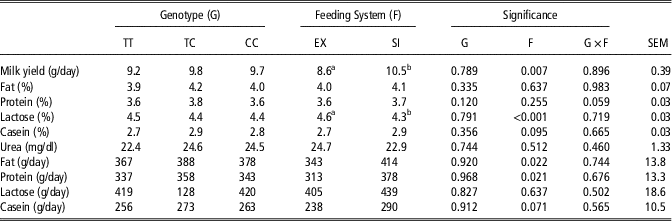
Table 3 reports the main effects of SCD genotype and feeding system on milk yield and gross composition. No significant differences in milk yield, fat, protein, lactose, casein and urea were associated to SCD genotype. Feeding system affected milk yield, significantly higher in SI farm, and lactose, significantly higher in EX farm. No significant genotype×feeding system interaction was observed for milk yield and composition.
Effects of SCD genotype and feeding system on milk yield and quality traits in Modicana cow

EX=extensive system; SI=semi-intensive system.
TT, TC and CC genotype corresponded to p.293VV, p.293AV, p.293AA phenotype, respectively.
a,bValues within a row with different superscripts differ significantly at P⩽0.05.
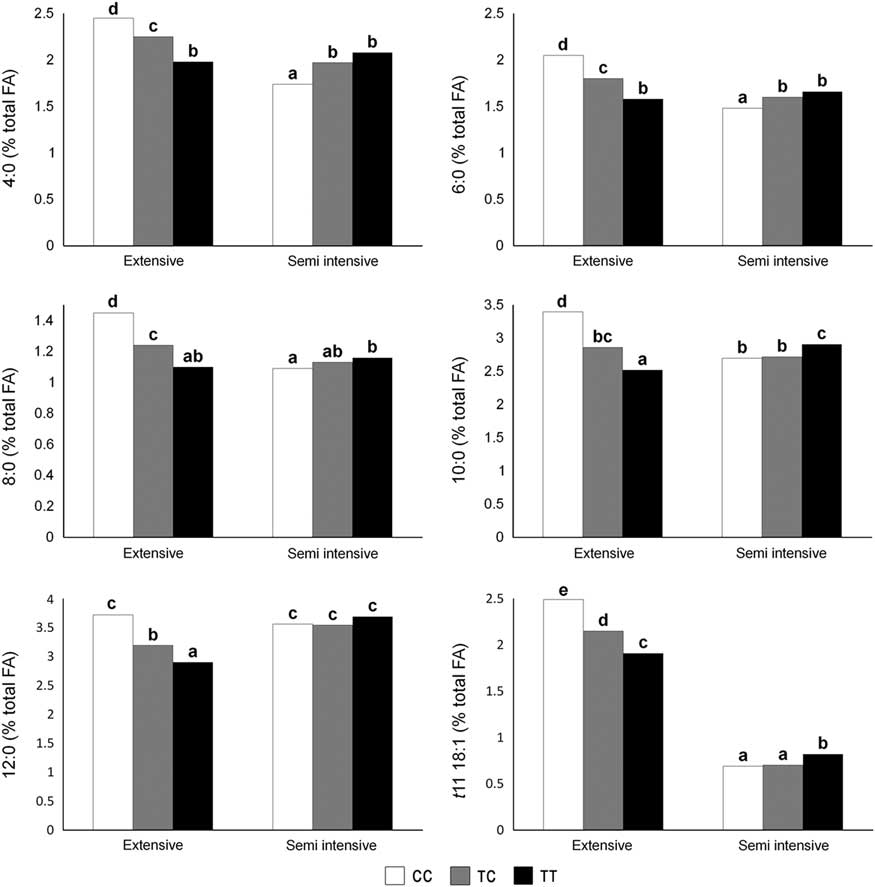
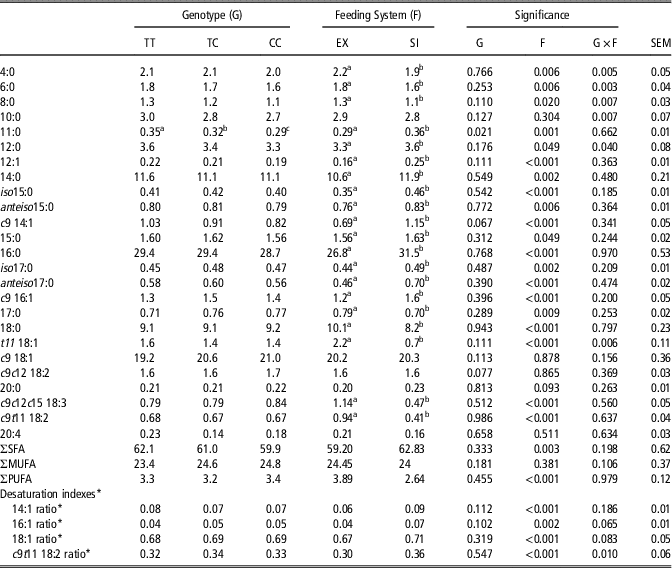
Table 4 reports the main effects of SCD genotype and feeding system on FAs profile. On average, the polymorphism at SCD locus did not affect FA composition. Only the percentage of 11:0 was higher when the g.10329C allele was present at homozygous or heterozygous status. On the contrary, the feeding system affected almost all the FAs. Specifically, short chain FAs (4:0÷8:0), 18:0, t11 18:1, c9-c12-c15 18:3 (ALA), c9-t11 18:2 (RA) were higher, whereas medium chain FAs (12:0÷16:0), most of the odd and branched chain FAs (OBCFAs), and sum of monounsaturated FAs (MUFA) were lower in EX v. SI. A significant interaction between SCD genotype and feeding system was found for 4:0, 6:0, 8:0, 10:0, 12:0 and t11 18:1 (Figure 1). In particular, within the EX system, the three genotypes showed significant different values for 4:0÷12:0 and t11 18, decreasing from g.10329CC to g.10329TT with intermediate values in g.10329TC cows. The opposite was found in the SI farm, where g.10329TT genotype showed significantly higher percentage (P⩽0.05) for 4:0, 6:0, 8:0, 10:0 and t11 18:1 as compared to the g.10329CC group. Proportion of 4:0 and 6:0 were significantly higher in TC than CC cows; moreover, 8:0 did not show significant differences between the homozygous groups, whereas 10:0 and t11 18:1 were lower in TC in comparison with TT. The percentage of 12:0 was not significantly affected by genotypes in cows reared in the SI system.
Interacting effect of the feeding system (extensive and semi intensive) and of the genotype at SCD locus (CC, TC and TT) on milk fatty acids (FA) in Modicana cow milk. a-eDifferent superscript letters indicate differences (P⩽0.05) between values tested by LSD.

Effects of SCD genotype and feeding system on milk fatty acid composition (g/100 g total fatty acids) in Modicana cow

EX=extensive system; SI=semi-intensive system; SFA: saturated fatty acids; MUFA=monounsaturated fatty acids; PUFA=polyunsaturated fatty acids.
TT, TC and CC genotype corresponded to p.293VV, p.293AV and p.293AA phenotype, respectively.
*Desaturation index calculated as reported by Kelsey et al., Reference Kelsey, Corl, Collier and Bauman2003 is the ratio between c9- fatty acid and the sum of its saturated homologous plus the c9 fatty acids (e.g. c9 14:1/(14:0+c9 14:1)).
a,bValues within a row with different superscripts differ significantly at P⩽0.05.
Discussion
The sample of 165 Modicana cows was monomorphic for the wild allele ABCG2A. Similar results are observed in many breeds all over the world when the mutation that determines the variant p.581S has not been found, as in the case of Bos indicus breeds, or when the phenotype p.581YY is largely predominant (Komisarek and Dorynek, Reference Komisarek and Dorynek2009; Sharma et al., Reference Sharma, Tiwari, Pal Singh, Sharma, Kumar, Sharma and Verma2016), with the rare exceptions of two Turkey indigenous cattle breeds (Ates et al., Reference Ates, Hosturk, Akis, Gursel, Yardibi and Öztabak2014).
At the DGAT1 locus the GC allele (g.10433-10434GC), coding for Alanine in position 232, is the most frequent in this sample of Modicana (91%) and the homozygous phenotype (p.232 AA) is largely predominant (82%) with quite similar frequencies in the two farms. This finding is consistent with several studies reporting p.232A as the predominant variant in a wide range of Bos taurus breeds (Kaupe et al., Reference Kaupe, Winter, Fries and Erhardt2004; Näslund et al., Reference Näslund, Fikse, Pielberg and Lundén2008; Scotti et al., Reference Scotti, Fontanesi, Schiavini, La Mattina, Bagnato and Russo2010 for a review). Only in Holstein cattle, bred worldwide, a more balanced distribution between the two alleles has been described, even if a wide range of variability across countries is also evident (Scotti et al., Reference Scotti, Fontanesi, Schiavini, La Mattina, Bagnato and Russo2010). The genotype associated to the Lysine amino acid (p.232 KK), extremely rare in the Modicana, was found at low frequencies in the SI, whereas it was absent in the EX farm. As regards the low frequency of this variant, Gautier et al. (Reference Gautier, Capitan, Fritz, Eggen, Boichard and Druet2007) and Conte et al. (Reference Conte, Mele, Chessa, Castiglioni, Serra, Pagnacco and Secchiari2010) suggested that the frequency of the p.232K lately increased, particularly in Holstein breed, due to the intensive selection in favour of fat content.
A more balanced distribution of the genetic variability was observed at SCD gene. After the first study of Taniguchi et al. (Reference Taniguchi, Utsugi, Oyama, Mannen, Kobayashi, Tanabe, Ogino and Tsuji2004) on Japanese Black cattle, the genetic polymorphism at SCD locus has been investigated in many dairy, beef and dual-purpose cattle breeds in different countries. At this locus, the comparison with the literature is quite difficult because of the different nomenclature used by the authors to describe the genetic variability at different level. In particular, the here investigated polymorphism can be defined as g.10329 C>T (according to the genomic sequence), c.C878T (taking into account the coding sequence) and p.A293V (at the protein level). Allele frequencies showed a wide range of variation in the breeds. Variant p.293A (allele g.10329C) was found to be largely predominant in Jersey (Moioli et al., Reference Moioli, Contarini, Avalli, Catillo, Orrù, De Matteis, Masoero and Napolitano2007), in Italian Brown (Milanesi et al., Reference Milanesi, Nicoloso and Crepaldi2008) and in local cattle breeds from South America (Carvajal et al., Reference Carvajal, Huircan, Dezamour, Subiabre, Kerr, Morales and Ungerfeld2016). It was more frequent also in Valdostana (Moioli et al., Reference Moioli, Contarini, Avalli, Catillo, Orrù, De Matteis, Masoero and Napolitano2007) and in Italian Holsteins (Macciotta et al., Reference Macciotta, Mele, Conte, Serra, Cassandro, Dal Zotto, Cappio Borlino, Pagnacco and Secchiari2008) as in Japanese Black cattle (Taniguchi et al., Reference Taniguchi, Utsugi, Oyama, Mannen, Kobayashi, Tanabe, Ogino and Tsuji2004) and in Montbeliard farmed in Chile (Carvajal et al., Reference Carvajal, Huircan, Dezamour, Subiabre, Kerr, Morales and Ungerfeld2016) but with more balanced frequencies. In Modicana, g.10329T, coding for Valine in position 293, was found to be the predominant allele as in Podolica and in Red Pied analyzed by Milanesi et al. (Reference Milanesi, Nicoloso and Crepaldi2008) and in Piedmontese (Moioli et al., Reference Moioli, Contarini, Avalli, Catillo, Orrù, De Matteis, Masoero and Napolitano2007). The observed frequencies of SCD may reflect the different selection objectives followed in different breeds and countries to improve the milk composition (Gautier et al., Reference Gautier, Capitan, Fritz, Eggen, Boichard and Druet2007). Finally, it is noteworthy that the result of the available studies are often conflicting, leading to the different identification of the ancestral allele which is g.10329C (p.293 A) for many authors, g.10329T (p.293V) for Taniguchi et al. (Reference Taniguchi, Utsugi, Oyama, Mannen, Kobayashi, Tanabe, Ogino and Tsuji2004). In addition, the substitution effect of the alleles is not consistent in the different studies; it could be supposed that this is related to the presence of other genes located in BTA 26, such as ELOVL3 (ELOVL FA elongase 3), LIPA (lipase A, lysosomal acid type) and PLCE1 (phospholipase C epsilon 1) that are differently involved in the metabolism of lipids (Ogorevc et al., Reference Ogorevc, Kunej, Razpet and Dovc2009).
The principal aim of this study was to investigate the effect of genotype, at three ABCG2, DGAT1 and SCD loci, the effect of feeding system and their interaction on milk yield and composition in Modicana cow. According to the literature, ABCG2 seems to be involved in the transport of the cholesterol into milk (Cohen-Zinder et al., Reference Cohen-Zinder, Seroussi, Larkin, Loor, Evertsvan der Wind, Lee, Drackley, Band, Hernandez, Shani, Lewin, Weller and Ron2005). The polymorphism p.Y581S was associated to variation of milk yield, fat and protein percentages in different breeds (Cohen-Zinder et al., Reference Cohen-Zinder, Seroussi, Larkin, Loor, Evertsvan der Wind, Lee, Drackley, Band, Hernandez, Shani, Lewin, Weller and Ron2005; Mousavizadeh et al., Reference Mousavizadeh, Salehi, Aminafshar, Sayyadnejad and Nazemshirazi2013). The ancestral allele A (p.581Y), the most frequent in all the breeds, was significantly associated with decreased milk yield and increased milk fat and protein percentage (Cohen-Zinder et al., Reference Cohen-Zinder, Seroussi, Larkin, Loor, Evertsvan der Wind, Lee, Drackley, Band, Hernandez, Shani, Lewin, Weller and Ron2005; Lillehammer et al., Reference Lillehammer, Hayes, Meuwissen and Goddard2009). Regarding DGAT1, the polymorphism p.K232A is associated with an evident effect on milk FA composition. Schennink et al. (Reference Schennink, Heck, Bovenhuis, Visker, van Valenberg and van Arendonk2008) found significant effects on 14:0, 16:0 and long chain FA desaturation indexes. In addition, Juhlin et al. (Reference Juhlin, Fikse, Pickova and Lunden2012) found a significant DGAT1 genotype effect on 16:0 and RA. Duchemin et al. (Reference Duchemin, Bovenhuis, Stoop, Bouwman, van Arendonk and Visker2013) reported DGAT1 polymorphism was associated to most of the FAs and unsaturation indexes.
Unfortunately, the absence of variability observed for ABCG2 gene in the considered population (165 cows) and the unbalanced distribution of the three genotypes found at DGAT1 locus did not allow the formation of feeding groups with similar numerosity in the two farms. Consequently, the feeding study was conducted with animals that differed only for SCD genotype. Stearoyl-CoA desaturase enzyme catalyzes the addition of a double bond in Δ9 position in FAs. Its activity can be estimated by using desaturation indexes calculated by expressing each product as a proportion of the precursor plus the product itself (Feng et al., Reference Feng, Salter, Parr and Garnsworthy2007). As Schennink et al. (Reference Schennink, Heck, Bovenhuis, Visker, van Valenberg and van Arendonk2008) reported that DGAT1 and SCD polymorphism do not explain the same part of genetic variability on desaturation index, we decided to include in our feeding trial only cows characterized by the GC/GC genotype at the DGAT1 locus. In principle, this choice allowed us to minimize the confounding effects that could have interfered in evaluating the role of the SCD on milk traits and FA composition.
In our experimental conditions FAs none of the unsaturation indexes, calculated as reported by Kelsey et al. (Reference Kelsey, Corl, Collier and Bauman2003), were significantly affected by the SCD genotype. Desaturation of 14:0 is considered the most important index, due to the fact that the presence of c9 14:1 in milk only arises from the desaturation activity in the mammary gland, whereas products and precursors of the other FA pairs can originate from the diet or from the mobilization of body fat (Garnsworthy et al., Reference Garnsworthy, Feng, Lock and Royal2010). In addition, desaturation index of 14:0 has the highest heritability (0.38) compared with the others (Garnsworthy et al., Reference Garnsworthy, Feng, Lock and Royal2010). Although according to the literature 14:0 desaturation index is the most influenced by this locus, contrasting results are reported. A positive correlation between the C allele, coding for Alanine, in SCD and this index has been reported by Schennink et al. (Reference Schennink, Heck, Bovenhuis, Visker, van Valenberg and van Arendonk2008), and Duchemin et al. (Reference Duchemin, Bovenhuis, Stoop, Bouwman, van Arendonk and Visker2013) on Holsein cattle and by Kgwatalala et al. (Reference Kgwatalala, Ibeagha-Awemu, Mustafa and Zhao2009) in Jersey cattle. On the contrary, Conte et al. (Reference Conte, Mele, Chessa, Castiglioni, Serra, Pagnacco and Secchiari2010) found higher 14:0-desaturation index in the TT genotype, coding for Valine, in Brown cattle. Regarding the relationship between the genotype at the SCD locus and the desaturation index of other FA, Schennink et al. (Reference Schennink, Heck, Bovenhuis, Visker, van Valenberg and van Arendonk2008) report a lower index for 10:0 and 12:0 and higher index for 16:0 and RA in the cows homozygous for the p.293V phenotype. The same trend was found by Duchemin et al. (Reference Duchemin, Bovenhuis, Stoop, Bouwman, van Arendonk and Visker2013).
Conflicting findings reported in literature could be explained by the fact that the effect of polymorphism can differ across different populations, breeds because of specific genetic backgrounds and diet. Relatively small samples, with relatively large sampling errors, different analytical methods and statistical approaches, as well as the presence of other polymorphisms able to affect the investigate trait, can be cause of contradictory outcomes (Marchitelli et al., Reference Marchitelli, Contarini, De Matteis, Crisà, Pariset, Scatà, Catillo, Napolitano and Moioli2013).
Recently, Cecchinato et al. (Reference Cecchinato, Ribeca, Maurmayr, Penasa, De Marchi, Macciotta, Mele, Secchiari, Pagnacco and Bittante2012) found the SCD g.10329T allele (p.293V) relevantly associated with an increase in fat percentage in cow milk. However, the same group carried out a wide association study to evaluate the effect of the polymorphism of 37 candidate genes on the detailed FAs profile in Brown Swiss bovine milk but SCD did not result a relevant gene in terms of association with FAs composition. The only exception was represented by 22:0 and c9 20:1 that were higher in milk fat of cows carrying g.10329T allele (Pegolo et al., Reference Pegolo, Cecchinato, Mele, Conte, Schiavon and Bittante2016).
As expected, on average animals reared in the SI system showed a higher milk yield and protein content as compared to EX. Lactose resulted higher in animals reared in the extensive system. It is known that, among milk constituent, lactose fluctuations are minimal and mostly depend on the healthy status of the udder. Generally, mastitis has been negatively related with the concentration of lactose in milk; however, in the present trial no evidence of clinical mastitis was observed. Rather, it could be speculated that the higher percentage of lactose found in the EX milk in comparison with SI could depend on the different intake of minerals between the two feeding systems. In particular, McDowell (Reference McDowell1996) reviewed that pasture often does not satisfy the mineral requirements of grazing cattle, which are inversely related with milk lactose. Surprisingly, fat was not affected by the feeding system. In fact, the low use of concentrate in the extensive than in the SI system should have resulted in a fat increase, due to both the higher fibre content in the diet and the lower milk yield that usually result in a concentration effect on fat. The lower percentage of saturated fatty acids as well as the higher proportion of MUFA, polyunsaturated fatty acids (PUFA) and RA found in EX milk was an expected result due the longer time spent on pasture by EX in comparison with SI cows (Elgersma, Reference Elgersma2015). Feeding system affected also OBCFAs that, except for 17:0, were lower in milk from extensive system. It is known that OBCFAs in ruminant milk and meat mainly arise from rumen microflora. As reviewed by Vlaeminck et al. (Reference Vlaeminck, Fievez, Cabrita, Fonseca and Dewhurst2006), OBCFAs are usually found in greater quantity in the products of animal raised in a feeding system characterized by a high forage:concentrate ratio (F:C). However, the response in terms of FA composition to the variation of F:C ratio is variable, likely due to changes in the rumen fermentations that lead to a different availability of OBCFAs precursors. In addition, similarly to our result, Cozma et al. (Reference Cozma, Martin, Ciri, Verdier-Metz, Agabriel and Ferlay2017) found a lower proportion OBCFAs in cow milk during the grazing season in comparison with the winter diet, mainly based on hay and concentrate. Authors ascribed the causes of this result to the inhibitory effect of PUFA, provided in high amount by pasture, on the activity of rumen bacteria.
In our experimental conditions, we found a significant interaction between SCD genotype and feeding system on 4:0 to 12:0 FAs and on t11 18:1. In particular, we found that in the extensive system, where pasture was the main available feed, all these FAs had an evident decreasing trend from g.10329CC (p.293AA) to g.10329TT (p.293VV) cows, with intermediate values for the heterozygous cows. No similar findings have been reported in literature on 4:0 to 12:0, as effect of SCD; on the contrary, Duchemin et al. (Reference Duchemin, Bovenhuis, Stoop, Bouwman, van Arendonk and Visker2013) found significant lower levels of 8:0, 10:0 and 12:0 in p.293VV cows, similarly to Schennink et al. (Reference Schennink, Heck, Bovenhuis, Visker, van Valenberg and van Arendonk2008) for 10:0 and 12:0. Duchemin et al. (Reference Duchemin, Bovenhuis, Stoop, Bouwman, van Arendonk and Visker2013) studied the effects of season on milk fat composition in different SCD genotypes. The differences between seasons reported by these authors, with pasture being available only during summer, could be assimilated to the differences between the two feeding systems used in our experimental conditions. They found a significant SCD genotype by season interaction for t11 18:1 that, coherently with our results, was negatively associated to p.293V variant. This effect of SCD on t11 18:1 was significantly more evident during summer, concurrently with pasture availability. The authors suggest that this interaction could be due to scaling of genotype effect, rather than to re-ranking.
In conclusion, a feeding trial was conducted on Modicana dairy cows homogeneous for genotypes at the DGAT1 and ABCG2 loci but with three different genotype at the SCD locus. Cows were reared in two traditional EX and SI feeding systems, characterized by a different use of pasture (8h v. 2 h/day). The feeding system has proved to be the parameter that has most influenced milk production and composition. Our results do not confirm what reported in literature as regard the effect of the SCD polymorphism (g.10329C>T, p.A293V) on milk FA composition. Moreover, our results suggest that when the interaction between SCD genotypes and feeding systems on the milk FAs composition was considered, percentage of 4:0, 6:0, 8:0, 10:0, 12:0 and t11 18:1 gradually decreased from g.10329CC to heterozygous to g.10329TT genotype in the milk from cows reared in the extensive system. The same trend was not found in the SI system. This finding might be explained assuming that the feeding system, and in particular the use of high amount of pasture, could have resized the SCD polymorphism effects due to the different FAs composition present in the diet.
Acknowledgements
The research was funded by the Italian Ministry of Education, University and Research MIUR (CUP: PON02_00451_3133441) P.O.N. Project – PROFOOD: ‘Valorizzazione delle produzioni lattiero-casearie siciliane, mediante applicazioni biomolecolari, chimiche e nutrigenomiche’ and by the University of Catania, Piano della Ricerca 2016-2018, linea di intervento 2 ‘dotazione ordinaria – prog. N.4 sist. Agroal. – genetica e alimentazione’.
Declaration of interest
The authors declare no conflicts of interest.
Ethics statement
All the animals were reared under real commercial farm conditions. Therefore, no pain, suffering, distress and lasting harm was caused to the animals involved in the present study. Blood samples used for the analysis of genetic polymorphisms were collected by authorized personnel during the periodic veterinary control.
Software and data repository resources
The authors declare that none of the data or model in the present paper are deposited in an official repository.
Supplementary material
To view supplementary material for this article, please visit https://doi.org/10.1017/S1751731118002604