During World War II, New York and Connecticut established offices in Washington, primarily to lobby for war contracts, but also to represent the states’ views with regard to federal economic policies and programs. These early Washington lobbying offices were the first of many. In time, the majority of states established such offices. In the fall of 2010, there were twenty-eight such offices, and governors—acting through membership associations such as the National Governors Association and the Democratic and Republican Governors Associations and individual lobbying operations—are powerful lobbying forces in Washington.Footnote 1
Information on these offices is virtually nonexistent. Most records wrongly indicate that state lobbying offices in Washington were not established until many years later.Footnote 2 For example, a 1988 Governing article lists California as the first state to establish a Washington office, in 1967; this source also lists the date of origin for the New York office at 1969 and the Connecticut office at 1972.Footnote 3 A 1992 memo from the Connecticut General Assembly’s Office of Legislative Research on the history of the state’s own Washington office incorrectly notes that it was established in 1978.Footnote 4 Writing in 1995, David Walker bemoaned the need for federal lobbying offices that he noted had developed since the 1960s, stating that “more than three decades ago … states needed no lobbying operations in Washington; their congressional delegations were enough.”Footnote 5 The records of the Advisory Commission on Intergovernmental Relations, located in the National Archives, refer only once to any state lobbying office during the 1940s—the organization’s 1968 annual report notes that the office in New York was established in 1943—and that reference is hidden amid much other material.Footnote 6 Jon Teaford’s well-regarded history of American state government mentions these offices only once, in his discussion of governors’ lobbying efforts in Washington in the 1970s.Footnote 7
The lack of information—and misinformation—on state lobbying offices is unfortunate. Much of the literature on federalism during the Depression and war years focuses on the evolution that took place during this period—how intergovernmental relations became more prominent and federal regulation more commonplace, how intergovernmental transfers increased. The existing literature tells us little about the actions states took to maximize their opportunities.Footnote 8 This study is designed to illuminate these early efforts. In addition, if these offices themselves are virtually unknown in the literature, the reasons behind their creation are certainly unexplored. Do they reflect the forces that lead other types of organized interests to establish lobbying offices? In answering these questions, this article also contributes to the literature on how interests mobilize to influence policy. As Tichenor and Harris point out, there is much less research on interest organizations before World War II than after, and there is “value to bringing both history and theory to bear on the study of interest groups.”Footnote 9
We use records from the Connecticut and New York State Archives to investigate the activities of these previously unexplored offices, augmenting these materials with economic and political data to investigate why these two states would be the first to establish lobbying operations in Washington. As these offices are interest organizations, we seek to learn whether the creation of these state lobbying offices was influenced by the forces that typically motivate the establishment of an interest organization. We draw from the literature on interest group formation as well as theories of cooperative federalism to understand how the changes of the 1930s and early 1940s created an environment that made it beneficial for governors to establish federal lobbying operations. We also utilize the literature on interest group entrepreneurs to help us understand why Connecticut governor Robert Hurley and New York governor Herbert H. Lehman were the first to establish offices.Footnote 10
These lobbying offices were not the only mechanism that states used to lobby. Governors formed regional associations during this time to lobby collectively, and certainly governors lobbied directly for policies and appropriations that would favor their states. Officials from state agencies lobbied as well. But these branch offices marked the beginning of what has become a well-established lobbying structure and Washington institution. These offices represented the first time that governors invested both state funds and political capital in a long-term lobbying effort. (Indeed, the New York State office in Washington has been a long-term effort; it has existed without interruption to this day.) A Washington lobbying office is a signal that a governor sees the need for ongoing advocacy that extends beyond a single contract or initiative. Other states could and did lobby without hanging a shingle in Washington—but those that did hang a shingle began a tradition.
The archival materials related to the New York and Connecticut offices lend themselves very well to a historical case study. By analyzing the records of these offices, and using other data about the politics and economy of these states, we can learn how the first formal state-federal lobbying operations were established in the early 1940s. In addition to learning more about these cases, the record of these two offices offers some useful insights about why states establish them.
In this article, we first present the relevant theoretical literature on interest group creation and cooperative federalism. We then discuss the factors that influenced the establishment of state lobbying offices. Cooperative federalism in the 1930s provided new opportunities for all states to seek assistance from the federal government. Obviously, not all states pursued these opportunities via state lobbying offices. We argue that three additional factors—the states’ professionalization and capacity; the industrial bases in these states; and the entrepreneurial roles of their governors—led New York and Connecticut to establish offices at a time when federal war contracts were plentiful. We conclude by making some comparisons to contemporary state lobbying offices in Washington, and discussing what this investigation of early state lobbying offices tells us about the mobilization of organized interests. We also discuss avenues for future research.
EXPLAINING THE CREATION OF A LOBBYING ORGANIZATION
In order to discern what led to the creation of state lobbying offices in Washington, we must understand the relevant theories of organized interests. There are many interests that might gain substantially from organized lobbying efforts and yet do not undertake them.Footnote 11 More recent research has helped to explain what factors influence the establishment of organized interests. Considerable scholarship indicates that the context or broader environment in which interests operate is a crucial factor in whether interest groups are established.Footnote 12
In Washington, the federal government defines that broader context. In their examination of registered lobbying organizations in the late 1990s, Beth L. Leech et al. find that interest groups mobilize in Washington when the government becomes active in the issue areas that are important to them: “Government activity acts as a magnet, pulling groups of all kinds to become active.” Furthermore, the breadth of government activities has a larger effect on the growth of interest groups than increases in government spending.Footnote 13 As the number of organized interests increases, groups will carve out a lobbying domain that is distinct from other organizations; interests are sensitive to competition from other groups, and most do not have large, overlapping portfolios.Footnote 14
One example of Leech et al.’s claim is the history of lobbying by public official associations. A number of scholars have investigated the politics of associations such as the U.S. Conference of Mayors, the National Association of Counties, and the Governors’ Conference (today the National Governors Association), though these works focus on membership organizations rather than individual state or city lobbying efforts.Footnote 15 Arnold and Plant explain that the line between policy and administration became blurred during the FDR administration and through the 1950s, and federal lobbying by public officials grew as the policy-making process became more diffuse.Footnote 16 According to Donald Haider, the period from the New Deal to the early 1960s was the first phase of lobbying activity by government official associations, when cities had the most powerful voice—but their power spurred their counterparts to lobby more actively.Footnote 17 Samuel Beer articulates a compelling theory that changes in public-sector politics, and specifically the growing role of professionalized bureaucrats in policymaking and administration, led to the development of a thriving intergovernmental lobby in Washington during this era.Footnote 18
Although most interest groups literature does not intersect with the considerable literature on the emergence of cooperative federalism and its effects on states, the two bodies of work are quite complementary. David Walker articulates the growth of the federal government’s involvement in state activities over the course of the nation’s history. Walker identifies many causes for this, but a key factor woven through each of them is the development of fiscal federalism.Footnote 19 Bowman agrees, speculating that “[se]vere, prolonged economic disruptions … might greatly accelerate centralization.”Footnote 20 John Aubrey Douglass remarks that “if the Depression and the exigencies of the war mark the birth of a new era of federalism, the postwar period brought an equally important emergency of state government as an influence on economic development.”Footnote 21 A number of temporary federal relief programs were created during the Depression, and twenty-nine permanent grant programs were created during the New Deal (79).Footnote 22 These programs constitute just the sort of government activity that Leech et al. found to mobilize interest groups. The federal government distributed funds to a broad variety of constituencies in what Walker calls the “‘concert of interests’ strategy,” which he describes as “efforts by the national government to encourage various sectors of the economy in order to further its development and to assist national defense.”Footnote 23 Walker’s and Beer’s analyses of the effects of the explosion of intergovernmental interactions describes the same causal process that Leech et al. identify in their study of interest group activity across many interest areas. Scholars of both interest groups and federalism identify federal spending and increased government regulation as a catalyst for the birth of new interest groups.
Finally, Robert Salisbury’s exchange theory of interest groups provides another crucial piece of the puzzle in explaining interest group establishment, asserting that the actions of an individual organizer are the crucial factor in interest group creation. Salisbury asserts that interest groups are organized by entrepreneurs who provide a set of benefits for the interest groups in exchange for compensation of some sort. He argues that latent interests—groups that have interests but have not organized to express them—have no such entrepreneur. Using the agriculture lobby from the late nineteenth to mid-twentieth century as evidence, he theorizes that the entrepreneur’s past experiences shape his or her vision for the organization.Footnote 24 Jack L. Walker also stressed the role of a patron in interest group mobilization, arguing that many organized interests would not exist without the financial or institutional support from a patron, who might be an individual, government agency, foundation, or other institution.Footnote 25
Salisbury’s later work links institutional lobbying to the leadership of the institution. He provides several reasons why institutions such as corporations or governments might enter the political arena rather than expend the resources on perquisites for the organization’s leaders. Institutions might enter the policy arena based on the personal convictions of their leaders. They might enter because they have organization leaders who achieved their positions because of their activity in certain policy arenas, and these leaders are inclined to continue to act in these arenas. Institutional leaders are also likely to find the policy investment beneficial to organization interests, as institutions are large and complex, and are likely to be affected by policy decisions on a variety of fronts.Footnote 26 As we will explain, exchange theory helps illuminate how the characteristics and interests of the governors of New York and Connecticut influenced the opening of these states’ lobbying offices in Washington.
Drawing from this literature on organized interests, we make four arguments regarding what factors influenced the governors of New York and Connecticut to establish lobbying offices in Washington. We embrace the comprehensive view espoused by Bowman: “[Federalism] is influenced and molded by societal conditions, economic trends, and political events.”Footnote 27 Our first argument stems from the literature on the role of government activity on interest groups as well as the literature on cooperative federalism. Linking these two, we posit that the cooperative federalism that emerged in the 1930s played a foundational role in the development of state lobbying efforts. This argument helps explain why any state would lobby Washington; our next three seek to explain why New York and Connecticut in particular established offices. Our second argument builds on economic incentive theory. New York’s and Connecticut’s industrial bases made them particularly able to capitalize on the availability of federal defense spending, and Washington lobbying offices—which could help facilitate contracts—would make particular sense for highly industrialized states. Our third argument links the establishment of the offices to the existence of highly professionalized governments in each state. The professionalism and capacity of the state governments both maximized the benefits of the offices and helped lower the political costs. Our fourth argument focuses on the governor as interest group entrepreneur. The earlier experiences of the governors of these two states made them especially likely to recognize and pursue the potential benefits of Washington representation.
New York and Connecticut were not the only states with a stake in federal policymaking and appropriations. Undoubtedly, the other forty-six states could have benefitted from a Washington office, even if those offices would have pursued benefits other than war contracts. But problems come with many possible solutions, and institutional circumstances lead political actors to pursue different paths.Footnote 28 The previous intergovernmental experiences of the governors of New York and Connecticut made them particularly well situated to recognize the benefits that could come with full-time representation in Washington, and they saw opportunities in their states’ economic structures that a Washington office could maximize. And so it appears that New York and Connecticut were the first to pursue a major, full-time presence in the nation’s capital.
THE ESTABLISHMENT OF THE NEW YORK AND CONNECTICUT STATE OFFICES IN WASHINGTON
The growing role of the federal government during the Depression gave states a reason to seek benefits from Washington. World War II provided similar opportunities for states to facilitate business’s procurement of war contracts. Most states established state war councils to help coordinate the wartime industrial conversion process. Motivations were patriotic—the second annual report of the New York State Division of Commerce was titled “New York Industry Produces for Victory”—and economic.Footnote 29 Although the New York and Connecticut lobbying offices were not procurement offices, the New York Division of Commerce and the Connecticut War Industries Commission (and later the state’s Development Commission) provided fitting organizational homes for each state’s branch in Washington.
Governor Herbert Lehman established a Washington office under the Division of Commerce shortly after establishing the State Division of Commerce in May 1941, directing the office to act as a liaison between the state and federal governments.Footnote 30 The office was funded by the New York State War Council; it had been approved by the state legislature earlier in 1941. According to a news report on New York’s Washington office, the state was the first to establish such an office.Footnote 31 The state had staff in Washington in 1941, although it did not sign a lease for office space until January 1, 1942.Footnote 32 According to the Division of Commerce 1942 annual report, the two professional staff members first worked to “obtain information and expedite various types of applications,” but over time their work broadened, and most focused on helping businesses pursue war contracts. During 1942, representatives from five hundred businesses visited New York’s Washington office to seek assistance, and hundreds of other businesses contacted the Washington office via telegrams, phone calls, and correspondence. In addition to assisting with the procurement of war contracts for particular firms, the office engaged in more general efforts to support the New York economy: “negotiations for the more adequate use of facilities of small industries; efforts to develop federal policies which would utilize idle manpower and facilities in New York City; and efforts to clarify and improve federal directives restricting the placement of war work in areas with a shortage of labor. Also, the Washington office assisted in increasing the use of the Barge Canal to relieve the petroleum products emergency in the East.”Footnote 33 As the war progressed, the office turned to activities relating to reconversion and broader business policy issues, communicating with federal officials regarding administrative procedures and bills in Congress.Footnote 34
Connecticut was quick on the heels of New York in establishing its own Washington lobbying office. In the years before World War II, Connecticut was a heavily industrialized state that was struggling with “industrial stagnation.” When the war began, organized labor urged Governor Robert Hurley to seek support from state and federal agencies in placing defense plants in Connecticut. Entry into World War II put an immediate focus on industrial production; the day after Pearl Harbor, Hurley announced a four-part plan for wartime employment called the Compact for Victory, associating the search for jobs with victory in the war. Raw materials were needed for war production, causing shortages and a shutdown of work in nonwar production. Connecticut’s situation was such that “at least 1500 of its factories have no war work and may be forced to close their doors for lack of raw materials.”Footnote 35 Within a month of Pearl Harbor, Governor Hurley had diverted approximately $9,000 from the governor’s contingency fund to a new organization called the Connecticut War Industries Commission (WIC).Footnote 36
Governor Hurley was especially concerned about the economic health of smaller firms in the state.Footnote 37 On June 15, 1942, Bernard Lee opened the state’s Washington office with a volunteer director and a paid stenographer. Operating as a branch of the WIC, its goal was to assist Connecticut manufacturers in obtaining prime contracts. In turn, the manufacturers were asked to cooperate by giving subcontracts to other plants, particularly small industries.Footnote 38 An office report added that it had “been instrumental in the rehabilitation of small industries.” The same report details the accomplishments of the WIC, shared between the Connecticut headquarters and the Washington branch office: 396 phone calls and 306 applications for assistance with “1st, plant reconversion, 2nd, resumption of operation of plants formerly practically closed down for want of business, 3rd, increased production in the war effort, etc., resulting in the calling back to work many thousands of employees.” The salesmen and sales engineers who sought contracts from the federal government used this office as their headquarters in Washington, as Governor Hurley appointed fifteen salesmen who oversaw prime contracts as “dollar-a-year men” to work in Washington alongside the WIC’s employees.Footnote 39 By October 18, 1942, the Hartford Courant reported that the committee had taken credit for over $1 million in orders for war materials.Footnote 40 According to the commission, this meant that Connecticut had the “largest per capita volume of war contracts,” 4.5 percent of the national total.Footnote 41
According to a September 1, 1942, Hartford Courant article, Governor Lehman learned of Connecticut’s office after meeting with Governor Hurley at the Governors’ Conference annual summer meeting in Asheville, North Carolina. Hurley’s executive secretary, John F. Robinson subsequently wrote to Governor Lehman to describe efforts of the Washington office and the two paid staff members and business representatives, who kept “in close contact with the various procurement agencies of the federal government as well as the purchasing commissions of the United Nations’ governments.”Footnote 42 Bernard Lee later used the existence of the New York office—which according to Lee now had ten paid staff members, although there is no other record of this—to argue in the media that Connecticut needed a larger Washington office to compete, saying that he hoped “‘Governor Hurley can see his way to clear to enlarge the scope’ of the present Connecticut organization.”Footnote 43 Lee’s efforts to frame his office as smaller than New York’s demonstrates the existence of state competition for contracts. Even states reaping large numbers of war contracts were still working to protect their turf.
These fledgling offices needed continued support from successive governors, which is often difficult to get. While many offices remain open during gubernatorial transitions, there is evidence that elections lead to the closing of these offices.Footnote 44 In the case of Connecticut, Robert Hurley was a one-term governor. He lost his 1942 reelection bid to Republican Raymond Baldwin, a former governor who had lost to Hurley in 1940. In the election, Republican campaigners had criticized Hurley’s establishment of the Washington office, and Baldwin closed it when he took office.Footnote 45 In the election, Republican campaigners had “heartily condemned” Hurley’s establishment of the Washington office, and Baldwin “abolished both the commission and the Washington office as unnecessary.”Footnote 46 The office staff campaigned for it to remain, however, and argued that it had shown considerable success. The office was not closed, but in July 1943, the Hartford Courant reported that the War Industries Commission was receiving about 75 percent less funding under Governor Baldwin. Commission director Harvey Hooke stated, “Many requests for aid … are going unanswered … because of lack of funds. …We are carrying on in a greatly reduced way, but we can not cope. …The need for the type of assistance we give is greater now than ever before. Several of the larger manufacturers in the southern parts of the state who have had war contracts cancelled recently have asked us for aid, but we are unable to do much for them with the staff we now have available.”Footnote 47 The Washington office was closed soon after, when the entire WIC was dissolved on June 30, 1943.Footnote 48 However, the offices, employees, and mission were transferred to the Connecticut Development Commission under a new War Industries division.
On March 1, 1944, Governor Baldwin announced that a new Washington office would be established at a new address.Footnote 49 This office opened on April 1, 1944, meaning that Connecticut was without a Washington branch office for nine months.Footnote 50 The Connecticut Development Commission provided this explanation: “Because of the fact that many of the current problems with which the Development Commission deals are vitally affected by the programs and plans of the Federal Government, and because Federal Government operations are subject to frequent changes and revisions, the Commission decided that it would operate more effectively in behalf of the people of Connecticut if it could maintain contacts in Washington through a branch office.” To explain his reversal of actions, Governor Baldwin said, “It is felt in many quarters that these … proposals are among the most important thus far advanced in connection with preparing Connecticut to meet the future situation.”Footnote 51
These closings and reopenings presaged a pattern that has continued to the present day. It is easy to criticize an incumbent’s Washington office as a waste of state funds, duplicative of the state’s congressional representation, and furthering the governor’s political goals rather than the state’s interests. New governors often do not see the benefits of the office immediately, and often have a distaste for their predecessors’ operations—especially if they were political opponents. They may thus close an office, and then as they become aware of the federal issues that arise, some of these governors open their own office in Washington. Alternatively, a governor might close the office during an economic downturn in order to show that he or she is sharing in cutbacks, and then a successor might open an office when staff funds become more available.Footnote 52 The actions of Hurley’s and Lehman’s successors demonstrate how this continuity (New York) or discontinuity (Connecticut) occurred with the offices in the early 1940s.
Governor Lehman established New York’s Washington office at the end of his tenure as governor, and Governor Thomas E. Dewey enlarged the office when his term began in 1943. While it is impossible to know the precise amount of federal funds that went to New York companies through war contracts due to the efforts of the Washington office, or the size of the impact that the office had on federal policymaking, it appeared the office had an effect on both. Between June 1940 and November 1942, New York’s war contracts per capita were $667, versus a national average of $749, and well below the level of even other less industrialized states.Footnote 53 During 1943, however, New York caught up; war contracts awarded to the state totaled almost $7 billion, and between June 1940 and the end of 1943 the state was awarded 10.1 percent of the national total.Footnote 54 As the war effort declined, the New York office transitioned to other activities.
THE FACTORS THAT LEAD TO ESTABLISHING AN OFFICE
Why would any governor establish a federal lobbying office during this era, and why in particular would New York and Connecticut be the states to do so? To answer these questions, we must not only interpret the written records regarding the offices themselves, but also situate these two states among their counterparts. We believe that their efforts to seek federal funds and influence federal policy reflects the increased number of government contracts that were available for industries in these states in the burgeoning era of cooperative federalism; the professionalization and capacity of the two state governments; the states’ industrial bases, which offered a strong platform for lobbying; and the federal experience and political orientation of their governors, who acted as interest group entrepreneurs.
The Birth of Cooperative Federalism: Opportunities for State Lobbying
Before the 1930s, the system of dual federalism separated most federal and state government activities. The establishment of the Governors’ Conference in 1908 was not a ringing announcement of the power of governors in the federal system; governors were comfortable with focusing on state issues rather than the activities of the federal government.Footnote 55
The governors’ lack of interest in federal government activities might have been influenced by the size of the federal government relative to that of states and localities. By the 1920s, states and localities gathered 67 percent of tax revenues and spent 74 percent of public dollars, concentrating this spending on education and public welfare.Footnote 56 Approximately 2 percent of state revenues came from the federal government in 1927, “hardly a significant sign of major efforts in cooperative federalism.”Footnote 57
The Great Depression spurred a tremendous increase in federal spending. State expenditures remained roughly level, the proportion of federal expenditures increased, and the proportion of spending by local governments decreased. As government spending at all levels increased, state expenditures still grew significantly from 1932 and 1940, from $2.5 billion to $4.5 billion, or 75 percent. During the same period, federal expenditures went from $4.3 billion to $10.1 billion (a 136 percent increase), while local government expenditures increased 3 percent, from $5.6 billion to $5.7 billion.Footnote 58
The expansion of power of the federal government becomes even more apparent when one realizes that 75 percent of the new federal spending was for programs that were cooperatively administered with state or local governments. All major New Deal programs except the Civilian Conservation Corps were cooperatively administered.Footnote 59 Furthermore, there was discretion regarding how to distribute a large portion of funds among the forty-eight states. Half of the original Federal Emergency Relief Administration appropriation was distributed as matching grants, but FERA head Harry Hopkins had broad latitude to distribute the other $250 million on the basis of need. Of course, need can be identified in a variety of ways, and a number of politicians claimed that Hopkins was distributing the funds based on politics rather than need.Footnote 60 Couch and Shughart found evidence of this political influence in their quantitative analysis of the factors that influenced the distribution of Works Progress Administration (WPA) funds.Footnote 61
The fiscal federalism of the 1930s thus demonstrates why governors, initially reluctant to become involved in national government affairs, could be drawn to Washington politics. The domestic spending increases of the 1930s were eclipsed by the federal military spending that began with World War II. In fiscal year 1941, federal spending on national defense increased substantially, but in the following years it led to even greater increases. Spending in current dollars went from $1.7 billion, or 17.5 percent of federal outlays in FY 1940, to $6.4 billion (47.1 percent of federal outlays) in FY 1941, to $25.7 billion (73.0 percent of federal outlays) in FY 1942, to $66.7 billion (84.9 percent of federal outlays) in FY 1943.Footnote 62 To put these figures in even greater perspective, in 1940 American spending on national defense was 1.7 percent of GDP. In 1941, it was 5.6 percent; in 1942, it was 17.8 percent; and in 1943, it was 37 percent. By comparison, spending on national defense since the end of the Cold War has rarely been above 4 percent of GDP. Of course the defense budget comprised myriad expenses, but a large component was goods produced for the war effort—and that meant war contracts that private companies could procure.
If governors began to focus on Washington because of the growth of funds available for both government programs and private contracts, they had to worry about competition. The same funds had drawn the attention of other state and local government officials, and a variety of public official associations were established during this era.Footnote 63 Perhaps most notably, big-city majors had founded the United States Conference of Mayors (USCM) in 1933, and the group played a major role in urban affairs policy.Footnote 64 President Franklin D. Roosevelt had a strong relationship with the urban mayors; he directed public works programs to large cities, which earned the mayors’ support and gained him a large voting bloc.Footnote 65 Of course, urban mayors have more in common than the governors of fifty disparate states, and the mayors became a significant lobbying force. Although theories of competitive exclusion indicate that lobbying groups typically will not directly compete but instead move to separate niches,Footnote 66 mayors and governors are less able to divide and conquer than many other groups. Each group wants to have the larger say in federal policy toward states and localities, and each wants funds to flow to its level of government. Thus the development of intergovernmental policymaking, the increased federal funds to states and localities, and the realization that other public officials were mobilizing all played a role in leading governors to realize that they would also benefit from lobbying Washington.
State Government Professionalism and Capacity
There are two reasons why highly professionalized states would be more likely to establish offices in Washington. First, they have the institutional structure and resources to support the operations of—and reap the benefits of—the lobbying office. Salisbury points out that an interest group must have some resources at its disposal to mobilize, and New York and Connecticut had those resources in place.Footnote 67 Second, as we will explain, any political opposition to an office is less likely to find traction in a highly professionalized state.
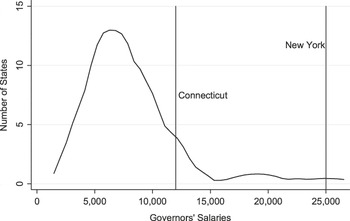
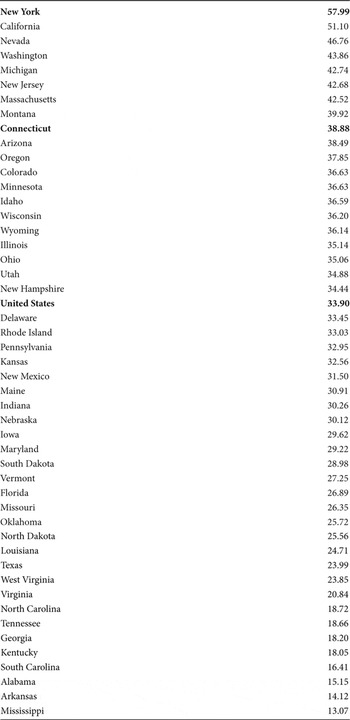
Data on governmental structure and spending indicate that Connecticut and New York were both highly professionalized states with substantial government capacity. State and local government spending on wages and salaries in these states was also much higher than the national average of $33.90 per capita (see Table 1). New York ranked first at $57.99 per capita, and Connecticut ranked ninth at $38.88 per capita.Footnote 68 In January 1942, approximately 518,000 people worked for the forty-eight state governments, and over 10 percent of them worked for the state of New York. Although Connecticut had only 11,600 state employees, it still ranked fourteenth nationally, which is notable given that Connecticut was one of the smallest states in area and by population.Footnote 69 The governors in both states have traditionally been among the most powerful in the country, having both considerable informal power as well as institutional authority at their disposal. While we do not have information on the size of the gubernatorial staff in Connecticut, we know that New York had one of the largest, and perhaps the largest, staffs in the country. There were eleven professional staff members and thirty-one clerical staff members in 1949, when the average was about eleven staff members total.Footnote 70 Executive compensation, another measure of professionalization, was tellingly high in New York in particular (see Figure 1). In 1943, when the median gubernatorial salary was $7,500, New York’s governor was paid $25,000 a year, more than any other governor. Connecticut’s governor was paid $12,000—still a high figure given the state’s size.Footnote 71
Distribution of Governors’ Salaries Across States, 1941.

FY 1942 State and Local Government Wage and Salary Dispersements, per capita (1942 dollars)

Source:
Regional Economic Information System, Bureau of Economic Analysis, U.S. Department of Commerce.
Furthermore, both legislatures were highly professionalized, which meant that their members were not in a good position to argue against the governor’s establishing a relatively small Washington office. In 1941, New York’s legislature was one of two state legislatures to have annual sessions and no limit on the number of legislative days.Footnote 72 With salaries of $2,500 annually, New York’s legislators were paid more than any others in the country, and the state’s total legislative expenditures in fiscal year 1943 were far and away the highest in the country at nearly $2.7 million. The national average was $354,600. (Despite the comparatively enormous expenses of the New York Assembly, it totaled only .7 percent of total state expenditures in 1940.) For its part, Connecticut’s total legislative expenditures fell far short of New York’s, but still ranked seventh nationally at $548,000, and on a per capita basis Connecticut’s legislature was more expensive than New York’s—31 versus 21 cents per capita, compared to a national average of 13 cents.Footnote 73 In either state, these well-paid and generously staffed legislators would hardly be in a position to oppose a small Washington office.
The larger the state government, the greater the need for an office to help coordinate activities involving the federal government. Records from these offices indicate that a significant portion of their activities involved coordinating with the state government back home. Connecticut’s Washington office worked with several district offices of the Connecticut War Industries Commission that had been spread across the state to aid businesses in pursuing contracts.Footnote 74 Perhaps this distributed model of office creation helped assuage any concerns that Connecticut legislators across the state might have had regarding Governor Hurley’s initiative. For his part, Governor Dewey also emphasized the Washington office’s role in working with other state offices. In March 1943, James C. Haggerty, the executive assistant to Governor Dewey, wrote to various secretaries of the state agencies, explaining, “It is the belief of Governor Dewey that the Washington office of the New York State Division of Commerce can be increasingly useful to the various departments of the State Government. … In addition to its war contract work and other activities for the State Division of Commerce, the Washington office has already been of assistance to such State agencies as the War Council, the Department of Public Works and the Department of Correction, in handling a number of problems with different Federal agencies.”Footnote 75 A less professionalized state would not have had the capacity to benefit in so many ways.
The Industrial Base in Connecticut and New York
The unprecedented level of military spending during World War II had enormous economic effects. Research on military spending during the postwar era raises doubts about whether military spending contributes to growth in the economy as a whole.Footnote 76 Yet there is no doubt that it creates jobs and stimulates economic growth in the communities where military production actually takes place. Although spending for World War II was far greater than during previous wars, neither the economic effects of war nor the concerns of political leaders that their constituencies receive a fair share of the benefits were new. Mobilization for the Civil War had substantial economic effects.Footnote 77 There is evidence that benefits the battleship-building program of the 1890s held for the steel and shipbuilding industries influenced political support for the program.Footnote 78 During World War I, Allied purchases of war materiel in the United States had important economic and political effects even before the United States declared war.Footnote 79 The mobilization effort that followed the declaration of war in 1917 magnified these effects. The mobilization effort even provided models for some New Deal programs for coping with the Great Depression.Footnote 80
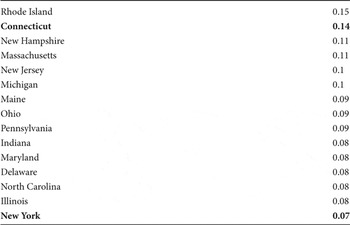
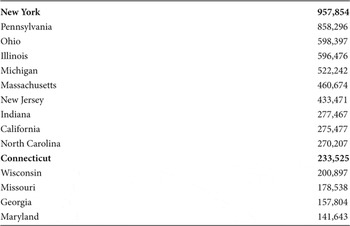
Yet Washington-based lobbying offices cannot successfully lobby for war contracts if their states do not have the relevant resources. In order to make a convincing case for receiving a contract, a state would have to demonstrate adequate manufacturing infrastructure and production workers. New York and Connecticut were astute in their pursuit of war contracts. For two decades preceding entry into World War II, they were above the national average by the number of production employees (see Tables 2 and 3).Footnote 81 Connecticut had an even larger manufacturing base on a per capita basis, and as home to several major defense companies it was better situated than any other state to take advantage of war contracts. Thousands were employed in war-related industries in cities throughout the state.Footnote 82 Yet there was pressure to disperse war contracts across the country, and so it was in Connecticut’s interest to protect its dominance.Footnote 83
Manufacturing Employees per capita, 1940—Top 15 States

* Data from the Statistical Abstract of the States.
Manufacturing Employees, 1940—Top 15 States

* Data from the Statistical Abstract of the States.
Although New York was home to farms and orchards in addition to metropolitan centers that were its industrial anchors, it was much bigger than Connecticut, giving it a greater manufacturing base overall. In 1939, New York had 957,854 production workers, more than four times as many as Connecticut.Footnote 84 The industrial base of both states was established in the years prior to the Depression, though the economic crisis that began in 1929 hit the manufacturing industries hard. This meant that both states had a demonstrable surfeit of additional skilled and unskilled workers to produce war goods.
In addition, New York and Connecticut were not as well situated to pursue federal dollars in other ways. Direct military spending was not a source of federal funding that these states could maximize. Pursuit of contracts took far better advantage of the manufacturing strengths of these states. These were two rich, industrial states with few military bases. In 1945, military expenditures accounted for 13.6 percent of total wages and spending nationally. In poor states with a growing military presence, the figures are much higher. In Virginia, Florida, and Mississippi, approximately 35 percent of total wages and earnings came from military expenditures. In New York and Connecticut, the percentages were 7.9 and 5.8 percent, respectively.Footnote 85 The country as a whole became more industrialized during World War II, and earnings from manufacturing increased by 5 percent nationally from 1939 to 1945. The biggest winners were the heavily industrialized states. The proportion of New York’s economy based in manufacturing increased by 8.1 percentage points over the course of the war, and Connecticut’s economy went from 44.1 percent to 56.5 percent manufacturing. Connecticut’s change of 12.4 percentage points was greater than for any other state.
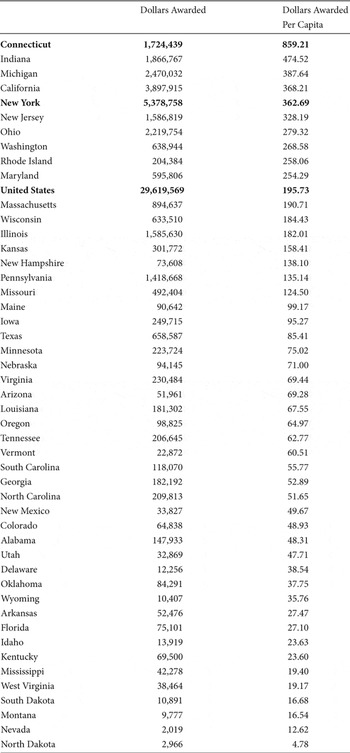
We know that New York obtained more than 10 percent of close to $200 billion in major prime war supply and facility contracts awarded by the United States and the Allied governments from June 1940 to September 1945, making it second only to Michigan.Footnote 86 Unfortunately, World War II prime contracting data broken down by state are sparse, so we cannot list the amount of each state’s war contract receipts during this period. Data from the Korean War are available, however, and spending during World War II was structurally similar to the Korean War—fewer than five years had elapsed, and the defense manufacturing base that was mobilized in the summer of 1950 was the same one that had been decommissioned in 1945. New York and especially Connecticut received enormous benefits (see Table 4). Twenty-four percent of all prime contracts awarded during 1951 were distributed in these two states.Footnote 87
Prime Contracts by State, FY 1951 (ranked per capita)

* Data from the Directorate for Information Operations and Reports, U.S. Department of Defense.
If Robert Salisbury is correct that interest group entrepreneurs mobilize where they can bring enough benefits to make the exchange worthwhile, it is easy to see how Connecticut and New York would be easy pickings. Less industrialized states might have established Washington offices, but they would be at a disadvantage in pursuing these benefits.
The Governors’ Prior Experience with the Federal Government
Salisbury pointed out that leaders with previous experience with government are likely to lead their organizations in government interaction.Footnote 88 Both Governors Hurley and Lehman had experience seeking funds from the federal bureaucracy before they were elected governor. They would have understood the benefits of having employees in Washington seeking war contracts and interacting with federal agencies. Thus, consistent with interest group entrepreneur theory, we find that the backgrounds and political careers of each state’s governor help explain why New York and Connecticut established lobbying offices when other professionalized, industrialized states did not.
Connecticut Governor Robert Hurley, a Democrat elected in 1940, had experience in state-federal relations for several years before becoming governor. In 1935, he was director of Fairfield County’s Works Progress Administration; in 1936, when the Connecticut River had an epic flood, he was named a special representative of the federal government and coordinated flood relief.Footnote 89 Later that year, Governor Wilbur Cross appointed him state director of the Works Progress Administration.Footnote 90 In 1937, Governor Cross created a state Department of Public Works and appointed Hurley as commissioner. Hurley’s first assignment was to travel to Washington and obtain approval from the WPA for nine construction projects. Hurley secured funding for those projects and more. Between 1937 and 1940, he successfully lobbied Washington for $18 million in construction money.Footnote 91
These activities put Hurley in an excellent position to campaign for governor in 1940, and they also gave him a glimpse of the benefits that could accrue from a close relationship with Washington. Despite his WPA background, Hurley favored spending on defense over relief programs after the war began. This preference made practical sense: the massive shifts in the federal budget toward military spending were bound to benefit a highly industrialized state with more than its share of defense-related corporations. It was also patriotic. The Connecticut office in Washington could play a role to help both national defense efforts and the state’s economy.
As noted earlier, the Connecticut office barely survived the next gubernatorial transition from Democrat Hurley to Republican Raymond Baldwin in 1943. Baldwin’s reestablishment of the state’s Washington office a few months after he closed it probably reflects both its support from industry and his own recognition of the growing importance of the federal government. Although he bridled at the increased activism of the federal government during the New Deal, he was ideologically moderate and an activist governor. He was aware of the employment benefits of defense contracts. As governor, he also established the State Development Commission and the Aeronautical Development Commission, both of which worked to convert Connecticut’s industrial base to war production, and established a job-training program to prepare citizens for government defense jobs.
New York’s Governor Herbert Lehman was a Democrat who had served as lieutenant governor under Governor Franklin D. Roosevelt. Lehman was part of Roosevelt’s inner circle during his governorship, and the banker became skilled at Albany politics under Roosevelt’s tutelage. Under Lehman’s leadership, New York passed its “little New Deal,” extending welfare assistance and social insurance to its citizens and “often acting in concert with Washington” while doing so.Footnote 92 In 1935, Congress established the WPA; the WPA did not provide support to as many New Yorkers as Roosevelt had originally promised, and Lehman was diligent in pressing WPA director Harry Hopkins for additional support. Writes biographer Robert Ingalls, “Although Lehman sometimes irritated other officials by fighting against any relaxation of federal or local commitments, his tactics often got more money from both levels of government than would have been otherwise forthcoming.”Footnote 93 Lehman was learning that pressing one’s case with the federal government resulted in additional commitments to the state.
Although Lehman was a banker who in principle eschewed big government, the Depression led him to champion both expanded state programs and the aid to local governments, which in the 1930s comprised more than half the state budget. During his time in office, tax increases nearly doubled state revenues. The state budget grew from $225 million in 1933–34 to $395 million in 1938–39.Footnote 94 The end of the 1930s brought heightened opposition to these increases, however, and the election of 1940 resulted in a Republican majority in the New York Senate, where it joined a Republican-controlled Assembly. It is easy to see why Lehman might have turned to Washington out of necessity; state dollars were drying up. Lehman had significant experience working with the federal government, and had a close relationship with a president who was both pouring dollars into the states and ramping up what would later be named the military industrial complex.
In 1942, Lehman was succeeded by Republican Thomas Dewey. For his part, Dewey had multiple reasons for maintaining New York’s office in Washington. First, the office was proving itself successful in bringing war contracts to the state. Second, having political staff members in Washington could be useful for an ambitious governor. Although Dewey was famous for his crime-fighting efforts as a U.S. special prosecutor and New York City District Attorney, he had a national reputation, and in 1937 he was mentioned as both a possible gubernatorial candidate and a possible presidential candidate.Footnote 95 His race against Governor Lehman in 1938 brought a loss of the thinnest margins, and it did not dampen his ambitions, since he “had lost an election but won a national audience.”Footnote 96 He sought the GOP presidential nomination in 1940, and though he lost to Wendell Willkie, the run positioned him well for his successful gubernatorial run in 1942.Footnote 97 Dewey clearly had national ambitions long before his campaigns against President Franklin Roosevelt in 1944 and against President Harry Truman in 1948. Dewey would be followed by a long line of ambitious governors, who either opened or maintained their state’s lobbying office in Washington. While the benefits of New York’s office were more than political, it would have made no political sense for Dewey to close the relatively new office after he was inaugurated.
Was the openness of these men toward the federal government typical? While attitudes varied, not all similarly situated states had governors who wanted to open a state lobbying office in Washington. For example, Michigan’s Governor Murray Van Wagoner, who served from 1941 to 1942, recognized the importance of war contracts to his state but opposed formal lobbying by the state. He preferred that the lobbying be managed by the private companies themselves.Footnote 98
Notably, Lehman and Baldwin left their governor’s mansions to move to positions in the federal government. Lehman left office one month before his term expired, when President Roosevelt appointed him to a position in the U.S. State Department. After losing a race for the U.S. Senate in 1946, he won a special election to the state’s other U.S. Senate seat and subsequently served in the U.S. Senate from 1949 until he retired at the end of 1956.Footnote 99 Baldwin was elected to the U.S. Senate in 1946, where he served until his appointment to Connecticut’s court of last resort in 1949.Footnote 100 Only Robert Hurley retired to private life after completing his term as governor. For the three governors with an eye on the Washington stage, a lobbying office could have provided some personal political benefit to accompany the benefits to their states. Such personal benefit is consistent with Salisbury, who argues that interest group entrepreneurs recognize personal benefits from the interest group exchange.Footnote 101
We have four governors of two states, then, who had connections to the federal government before they became governor, and who were not opposed to turning to the federal government for aid. Three had ambitions beyond their governorships and were prominent in national politics after their gubernatorial terms. Their political orientations and personal histories led them to act as interest group entrepreneurs in Washington.
CONCLUSION
With the rapidly growing federal involvement in state activities that had started in the 1930s, and with federal expenditures increasing exponentially, the time was ripe for governors to reach out to Washington. This is consistent with what we know about federal government activity as a driver of lobbying. The governors of New York and Connecticut could not pursue their interests through the Governors’ Conference. An association that represented the collective interests of the states could not seek benefits for any specific state, and at any rate the Governors’ Conference was only beginning to become politically active. Unlike urban mayors, most governors did yet recognize the benefits of formal lobbying operations in Washington. No doubt other governors helped companies in their states pursue federal contracts, but as large manufacturing states with professionalized governments and Washington-oriented, entrepreneurial governors, Connecticut and New York were perhaps uniquely situated to pursue branch offices in Washington.
We have found that the factors influencing the establishment of the first state lobbying offices in Washington conform to well-established theories of interest group formation, as well as theories of cooperative federalism. These offices also reflected their governors’ recognition of the growing role of the federal government in state government at a time when many governors still held the federal government at arm’s length. Their highly professionalized governments were in a position to maximize the benefits of Washington representation, and the financial costs of the offices were trivial relative to the size of government overall.
These early offices were a precursor of the well-established lobbying offices that a majority of states now maintain in Washington. The fact that the offices were continued by later governors is further evidence of their success. However, Governor Baldwin’s criticism of Hurley’s office illustrates that these offices are not without political risk. Indeed, this would be the first of many cases where a governor’s office in Washington drew political fire. For example, Governor Bill Clinton of Arkansas procured the state’s first Washington lobbyist and subsequently received much the same criticism from his Republican challenger in the 1980 gubernatorial election, the only such election Clinton lost.Footnote 102
We also know that, like the Connecticut office, many state offices closed and reopened over the years. All but two states have had an office at one time or another, but no more than thirty-four governors have had Washington representatives at any one time. The number of offices swelled in the 1960s and 1970s, with Johnson’s Great Society and then Nixon’s New Federalism, and they now were beginning to focus on pursuing intergovernmental grants.Footnote 103 The recession in the early 1980s and cuts to grants in the Reagan era led some states to eliminate their offices. Today, gubernatorial transitions mean that one or two states will open an office, and one or two others will close theirs, according to the inclinations of their governors.Footnote 104
We hope that this article highlights other opportunities for related research. We have explored only a few years of each state’s federal lobbying efforts. The decisions to close and reopen the Connecticut office in the subsequent decades provide an opportunity to investigate how different governors chose to pursue the state’s federal agenda. The fact that the New York office has existed without interruption for nearly seventy years provides an opportunity to examine how a lobbying entity evolves over time. Indeed, few lobbying offices for any individual organization, public or private, have existed for seventy years. What makes some offices likely to open and close while others remain in operation? Related to this, the fact that Connecticut’s office has not had the same stability as New York’s raises questions of how path dependency affects lobbying organizations of all types.
Likewise, there is much to be gained from examining the World War II lobbying efforts of other states. What mechanisms did other governors in industrialized states use to further their states’ economic interests? Did these mechanisms differ from those of governors in nonindustrialized states? Although it was tempting, we have not pursued direct comparisons with other states. Our investigation would have been heavily dependent on the circumstances of the one or two or three other states we chose for comparison, and we were concerned that such a comparison could unduly slant our analysis.Footnote 105 Yet this does not negate the fact that there are many benefits from examining other states’ histories, and then subsequently making broader comparisons to further sharpen and test the arguments we have presented here.
We hope that this article will help inform other research on federal-state relations and on interest groups during this era. As these offices have become institutionalized over time, they have cemented themselves as part of the federal policy-making process. In turn, they have become more easily justified by a governor establishing an office, and thus more politically viable. From a modest start in the 1940s, these federal-state relations offices have become an established arm of intergovernmental lobbying.