




No CrossRef data available.
Health needs assessment tools: Progress and potential
Published online by Cambridge University Press: 04 August 2005
Abstract
Objectives: Health needs has attracted the interest of policy-makers, health economists, and health professionals as modern health services try to satisfy individual and population health needs to optimize resource utilization. Health needs can be assessed by administering various types of survey or interview-based instruments. If health needs are to be satisfied in changing health agendas in developed and developing countries, it is essential to employ valid and reliable tools. Despite the importance of needs assessment, no comprehensive review of tools is currently available. We carried out a literature search to define and categorize existing health needs assessment tools.
Methods: We reviewed medical and social search engines for items containing specific health needs–related words to identify needs tools across a range of specialties. Papers were reviewed in terms of design, subject matter, psychometric features, and method of administration method.
Results: Thirty-one employed in 52 studies including cancer, mental health, palliative care, multiple sclerosis, and cardiovascular disease tools were identified.
Conclusions: This report summarizes available health needs instruments in a range of diseases to assist researchers in accessing health needs resources more easily and to encourage further research in this field.
Information
- Type
- GENERAL ESSAYS
- Information
- International Journal of Technology Assessment in Health Care , Volume 21 , Issue 3 , July 2005 , pp. 288 - 297
- Copyright
- © 2005 Cambridge University Press
Health needs assessment (HNA) has received less attention than outcome assessment, despite it being fundamental to the provision of appropriate, patient-centered health-care facilities. The status of HNA in the United Kingdom increased as health authorities were charged with a responsibility to identify the health-care needs of local populations to optimize use of the resources allocated (37;40).
Formal assessment is difficult, because “needs” can be variously defined (5); “health” covers a wide range of issues (95), and “health needs” ought to include at least social care, accommodation, health care, finance, education, employment, leisure, and transport. Even community facilities such as a bus service to reach health services, road safety regulations, clean air policies, and occupational health fall under the health need banner. It is not possible to attain a state of full health in every instance, so the goal of health-care needs is “optimal state of health.”
Although assessing health needs has become one of the major tasks of health authorities, few published data exist to evaluate the excellence and psychometric properties of available tools. This study reviews “health needs assessment” in the literature systematically to enumerate relevant publications that fall into predetermined criteria and criticizes and classifies papers to suggest potential areas for further research in this field.
HEALTH NEEDS ASSESSMENT METHODS
A variety of methods have been used to assess health-care needs, and as stated by McEwen et al., “there is no single best method of assessing health needs—different issues and questions require different methods and approaches and degrees of detail and different combinations of professionals to be involved” (63). Accuracy of results is likely to be achieved if data from one source are checked against data from at least two other sources (70). Applying a “composite” of methods—preferably a combination of quantitative and qualitative methods (70)—to gain more informative data in HNA allows a more precise estimate of a population's health status than when a single measure is applied (29).
To perform HNA surveys nationwide or regionally, it is preferable to organize activities systemically, a principal established in the Scottish Needs Assessment Programme (SNAP; 63). A SNAP core group was organized with seven subgroups to cover specific health-care topics; this strategy created new opportunities for collaboration with public health services, collated data that were not readily available for local use, facilitated surveys, and used the information provided by the policy-makers. Findings of other research confirm that using such an organized approach produces a standard environment in which comparison would be possible (62). However, such strict organization may confine the researchers to specific topics and neglect other needs.
Several structured review articles dealing with HNA tools are available, dealing mainly with mental health subjects (30;33). The criteria in the review by Gilbody et al. (33) were so strict that no single-needs assessment fulfilled them. The study by Evans et al. (30) was also problematic. First, “needs” and “health status” were mixed up, and they referred to appraisals of health-related quality of life from time to time; a confusing approach adopted by others (27). Second, “needs” and “outcome” were used interchangeably, and tools were criticized for not being tested for their responsiveness, an important factor because needs assessment should be on-going rather than a simple cross-sectional “snapshot.” Third, a somewhat primitive circular model has been proposed to describe the relationship of needs, care, and outcome. A more realistic model should incorporate needs analysis, outcome assessment, an acknowledgment that some needs would be met and others remain unfulfilled, a higher level of need might be encountered, and unmet needs must be continually scrutinized until resolved (Figure 1). This model does not rule out potential coexistence of “lower needs” when “higher needs” are being encountered.

Needs, care and outcome relationship.
METHOD
Various databases like PUBMED, CINAHL, Ovid (MEDLINE), Zetoc, PsycINFO, and EMBASE up to November 2003 were investigated for “health needs assessment” and related words in titles and abstracts. Original papers were peer-reviewed by the first author to find out whether they fulfilled the study inclusion criteria.
Selection Criteria
Our purpose was to collect useful data about health needs assessment tools; only surveys that targeted “health needs assessment” in the community or within conditions were selected. A key word search was conducted in each database separately, and original papers were reviewed to identify study characteristics, including the kind of tool, sample size, method of administration, and psychometric properties.
Review articles (provided that no new needs assessment instrument was introduced), papers published in non-English journals, surveys on children (two papers), and oral health (one paper) were excluded. Articles that did not include details of any needs surveys tools were discarded.
Findings
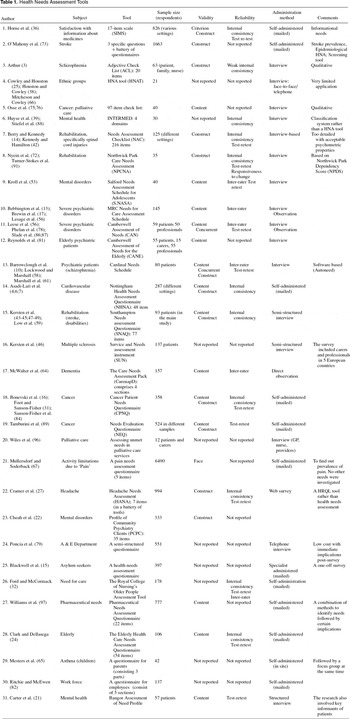
The search revealed thirty-one tools in fifty-two publications that described the development of a new “health needs assessment” tool or the deployment of a readily available instrument. Some of these studies attempted to produce a definition of need (17;64;89) or had a critical view on current definitions (7;31). These reports, summarized in Table 1, can be categorized into four main groups in terms of method of administration: “interview,” “self-administered questionnaire,” “community rapid appraisal,” and “epidemiological rapid assessment.”

Interview
Qualitative research is usually performed by direct observation, consensus, analysis of texts or documents, case study, and interview (80). Interviewing, usually defined as a continuum of standardization (68) comprising structured questions (mostly with a structured questionnaire), semistructured questions (4;8), depth questions (unstructured but dependent on the interviewee's responses; 18), and focus group discussion (51), is well established, especially in sociology. Denzin categorized the interviews as standard scheduled, nonschedule standardized, and nonstandardized (28).
Interviewing, a commonplace methodology for qualitative research may help to define dimensions that a quantitative method such as self-administered questionnaires would aim to measure. Qualitative methods also describe a population's intelligible language that definitely helps quantitative methods perform well. Face-to-face, telephone interview, focus group discussion, or check lists are often used to conduct HNA surveys; these methods are usually followed by other quantitative approaches such as self-administered questionnaires (51). A qualitative approach is supposed to facilitate quantitative methodology in different ways (4;77), although meticulous quantitative research followed by a thorough content analysis may provide a more accurate picture of unmet health needs (60;83). Moreover, including extra facilities such as a vignette (11) within, for example, a focus group may provide a valuable insight into expressed beliefs.
The use of HNA tools is burgeoning, especially among those dealing with mental disorders. Conceptualization of needs by the Medical Research Council, Social Psychiatry Unit (99) led to various research work, including development of the MRC Needs for Care Assessment Schedule (NFACS; 17), The Camberwell Assessment of Need (CAN; 78), and the Cardinal Needs Schedule (61). The NFACS comprises three elements of identifying patients' needs, lists interventions, and finally recognizes the unmet needs to reorder the cycle (17). NFACS focused on health professionals rather than patients and carers, which was corrected to some degree in the CAN, as a tool for research and clinical administration in severe mental illness (30), with good validity and inter-rater reliability (78). However, it was unclear how different scores from several parties might be combined. Two problems have been identified: the small range offered by its three-point scale may increase the floor–ceiling effect and incompatibility can affect test–retest reliability. Versions of CAN have been developed for children and the elderly and computerized and foreign language versions are available (78). The CAN for the Elderly (CANE) has good validity and reliability in those areas in which it has been developed, covering perceptions of patients needs by patients, carers, and professionals (81); it has been administered in primary care as well (93).
The Salford Needs Assessment Schedule for Adolescents (S.NASA), which includes an interview schedule for client and carer (53), and the Patient Needs Assessment Tool (PNAT), an interviewer-rated scale to detect cancer patients' needs (26) are examples of structured interviews in which validity and reliability can be measured.
The semistructured interview is a useful way of evaluating needs in mental health and palliative care services (55;96); however, the limitations of an interview should be given serious consideration. The Southampton Needs Assessment Questionnaire (SNAQ), which has been used in a face-to-face interview survey to assess the needs of the disabled, is a semistructured tool with acceptable validity and internal reliability (48). Checklists, that require a health-worker to conduct a detailed survey to measure psychometric properties, have to be carefully developed to avoid misleading results that might fail to identify unmet needs. The Needs Assessment Checklist is a very detailed tool comprising 216 items (42), used for stroke patients with established psychometric features (14).
Although an interview has noticeable advantages in terms of a direct relationship to clients (which avoids any misunderstanding and ensures a high response rate), it does require trained interviewers, standard questions, precise transcription, and adequate time and resources. In addition, organizing meetings may present various difficulties, as interviewees are often patients with major physical or psychological problems. Furthermore, obtaining simple information such as date of birth is not necessarily straightforward (57), so reproducibility in interviews can be less than perfect.
Self-Administered Questionnaire
Self-administered questionnaires are low-cost; easily distributed; less intrusive than interviews, as patients complete the tool at home at their own time, stop and start at will, and generate less stress when information is disclosed; tend to have a large sample size and short data collection period; and their validity and reliability (especially inter-rater) can be measured. However, developing these instruments does require precise wording (avoidance of jargon and double-negative and double-barreled statements) and may confine researchers to limited interaction with patients and consequently may lead to misunderstandings, blank or incomplete answers, and a relatively superficial investigation.
Using standard tools to assess health-care needs is a focus of researchers' attention, but there are certain drawbacks; for example, some health needs may remain unidentified (55) or misunderstandings are possible. To overcome such limitations, most HNA researchers prefer a standard approach of performing an initial qualitative (interview, focus group, and so on) followed by a postal survey (7). By contrast, Mesters et al. (65), however, conducted both approaches at the same time, which seems somewhat futile.
A postal survey can provide valuable data, especially about chronic illnesses in the community and perceived needs about existing and potential services. Postal HNA surveys are not new (19); however, they are rapidly gaining in popularity (20;52;67). Most are in the area of mental health (41; see Table 1); few deal with local health services and have been excluded from this review due to lack of publicity (85;90).
Disease-specific instruments have been developed; for example, the Northwick Park Dependency Score (NPDS) for HNA in hospital, and its community rehabilitation equivalent have been administered in various studies (91) and takes outcome expenditure into account to evaluate cost-effectiveness of rehabilitation (72).
INTERMED (39) is a well-validated methodology that gathers data from various biological, psychological, social, and health-care systems over the time (88). Self-administered instruments can provide a short-cut in the investigation of service shortcomings (32).
The Supportive Care Needs Survey has been developed exclusively for cancer patients from its “mother” version, the Cancer Patient Needs Questionnaire (CPNQ), consisting of fifty-two variables in a five-point scoring format (31); given its simplicity, patients had no difficulties completing it, and the tool showed acceptable validity and reliability (16;84). To assess HNA in multiple sclerosis patients, their carers, and the professionals' perception of Services and Unmet Needs (the SUN), a specific tool has been used in different European countries (46). The Needs Evaluation Questionnaire, originally developed with twenty-three items to ascertain HNA in oncology inpatients, has acceptable validity and reliability (89). “Needs assessment” has a cross-sectional nature that is valuable for certain circumstances, although test–retest technique is far inferior to measuring internal reliability or inter-rater assessment, particularly when different methods are considered. Hence, some of the HNA reports (31;89) are contentious.
A Combined Approach
Qualitative methods describe dimensions of a population's health needs and, provided they are followed by a thorough content analysis, help quantitative surveys to perform well (80). Despite the ability of qualitative methods to discover unmet needs, lack of generalizability jeopardizes their conclusions. Therefore, some researchers prefer to conduct both at the same time or at different stages (4;24;77;97). For example, to assess pharmaceutical needs in primary care, a three-stage set was used: semistructured interviews with clienteles and providers followed by a postal survey and finally an open forum meeting to present findings and prioritize services. This strategy may make a formal cooperative mechanism for both consumers and providers (97), although validity and reliability of the instrument remain to be proven.
Community Rapid Appraisal
This method seeks to gain community perspectives of local health and social needs in a finite period of time and to translate these findings into action. The development of rapid appraisal methods during the 1980s was fundamental to the “Health for all 2000” framework (94) in response to the time-consuming and the rather structured and rigid nature of traditional epidemiological and questionnaire surveys. These appraisal methods showed that, when conducted well, they provide valuable, reliable, and timely information on health status, knowledge, attitude, and behaviors (100). Data are generally collected from interviews with local key individuals, written records, and direct observation. Informants are not selected randomly but “purposefully,” that is, seeking a range of people who are in the best position to understand the issues. Including relevant interviewees and summary health data from primary and secondary care can incorporate professional insights (69). This method provides specific insight over the population's needs rather than merely epidemiological data (71), especially about deprived areas (74), although it retains the limitations of qualitative methods.
Whatever method is used for appraisals, to ensure that people's genuine needs are fully transcribed, the emphasis is on qualitative techniques of interviewing and listening to people. In community appraisal, the assessors support and facilitate the community's understanding and action rather than just recording information. Actively involving people in assessing their heath-care needs is likely to be an appropriate approach for community appraisal; this was the aim of the Waterfront Health Action Project (WHAP) (92). The Patient Liaison Group (PLG) is a practical attempt to encourage people to participate systematically in identifying health-care needs and medical decision making (98).
Although team-working results in rapid completion of surveys and is considered an “asset rather than a liability” (12), differences in surveyors' perceptions and views may cause confused expectations within the group, distorted group effectiveness, intragroup conflict, and attribution of minority perspectives to the majority view of the group (50). Emerging appraisal methods such as Q methodology, which classifies individuals according to their subjective feelings about a topic using a mixed quantitative/qualitative statistical technique (9), has been used recently in needs assessment (23) but requires further investigation of its reliability and validity in this field.
Epidemiological Rapid Assessment
This method is based on traditional measures of incidence and prevalence and can be used for rapid health assessment after disasters and in emergency medicine. In such cases, a rapid needs assessment demonstrates priorities where resources should be spent to satisfy the immediate needs of sufferers. Modified cluster-sampling methods have often been used to conduct needs assessment surveys to explore food, water, sanitation, and health-care needs after an exceptionally violent hurricane in the Dominican Republic in 1998 (1), similar to that in Florida (35) and after the recent earthquake in Iran (2). However, HNA techniques have not been formally used.
In another case, a survey carried out to determine the health-care needs of the Cambodian refugees comprised two components: a rapid epidemiological appraisal and then an interview-based needs assessment. The first step was a tent-by-tent search to determine who required hospital admission—the mortality rate fell from 9.1 to 0.7-deaths' 10,000 population'day (34).
RECOMMENDATIONS
Health needs is a deceptively tricky concept in which a wide range of issues must be taken into account. Evaluation of these needs, therefore, should be as comprehensive as possible; nevertheless, to obtain sensible results for routine use in clinical practice, it is essential to select a concise, valid, and reliable tool or to develop some standard measure. Attention to needs surveys is much less than to outcome assessment such as the measurement of health-related quality of life, although less evidence exists about the psychometric requirements in the literature. Triangulating HNA data with other valid sources of information, such as clinical data, health-related quality of life measurement, or satisfaction surveys, is fundamental to ascertain the validity and responsiveness of a questionnaire. Obviously, there is considerable needs assessment experience in routine health-care services buried within local delivery points; however, more published data are needed in this field to help researchers publicize their findings and encourage policy-makers to meet genuine health needs.
CONTACT INFORMATION
Mohsen Asadi-Lari, MD, PhD (msxma@nottingham.ac.uk), Division of Cardiovascular Medicine, University of Nottingham, Derby Road, Nottingham NG7 2UH, UK; Senior Expert, Ministry of Health & Medical Education, Iran, Tehran 11344, Iran
David Gray, DM, MPH, Reader in Medicine, Honorary Consultant Cardiologist (d.gray@nottingham.ac.uk), Division of Cardiovascular Medicine, University of Nottingham, Derby Road, Nottingham NG7 2UH, UK; Division of Cardiovascular Medicine, Queen's Medical Center, University Hospital, Nottingham NG7 2UH, UK
References
1999
The Centers for Disease Control and Prevention.
Needs assessment following hurricane Georges—Dominican Republic, 1998.
JAMA.
281:
890–
891.
Akbari ME,
Farshad AA,
Asadi-Lari M.
2004
The devastation of Bam: An overview of health issues 1 month after the earthquake.
Public Health.
118:
403–
408.Google Scholar
Arthur D.
2002
The validity and reliability of the measurement of the concept ‘expressed emotion’ in the family members and nurses of Hong Kong patients with schizophrenia.
Int J Ment Health Nurs.
11:
192–
198.Google Scholar
Asadi-Lari M,
Packham C,
Gray D.
2003;
Is quality of life measurement likely to be a proxy for health needs assessment in patients with coronary artery disease?
Health Qual Life Outcomes.
1:
50.
Asadi-Lari M,
Packham C,
Gray D.
2003
Need for redefining needs.
Health Qual Life Outcomes.
1:
34.Google Scholar
Asadi-Lari M,
Packham C,
Gray D.
2003
Patients' satisfaction and quality of life in coronary artery disease.
Health Qual Life Outcomes.
1:
57.Google Scholar
Asadi-Lari M,
Packham C,
Gray D.
2003
Unmet health needs in patients with coronary heart disease: Implications and potential for improvement in caring services.
Health Qual Life Outcomes.
1:
26.Google Scholar
Baldwin CD,
Levine HG,
McCormick DP.
1995
Meeting the faculty development needs of generalist physicians in academia.
Acad Med.
70
(Suppl):
S97–
S103.Google Scholar
Barbosa JC,
Willoughby P,
Rosenberg CA,
Mrtek RG.
1998
Statistical methodology: VII. Q-methodology, a structural analytic approach to medical subjectivity.
Acad Emerg Med.
5:
1032–
1040.Google Scholar
Barrowclough C,
Marshall M,
Lockwood A, et al.
1998
Assessing relatives' needs for psychosocial interventions in schizophrenia: A relatives' version of the Cardinal Needs Schedule (RCNS).
Psychol Med.
28:
531–
542.Google Scholar
Barry MM,
Doherty A,
Hope A, et al.
2000
A community needs assessment for rural mental health promotion.
Health Educ Res.
15:
293–
304.Google Scholar
Barton JA,
Smith MC,
Brown NJ,
Supples JM.
1993
Methodological issues in a team approach to community health needs assessment.
Nurs Outlook.
41:
253–
261.Google Scholar
Bebbington P,
Brewin CR,
Marsden L,
Lesage A.
1996
Measuring the need for psychiatric treatment in the general population: The community version of the MRC Needs for Care Assessment.
Psychol Med.
26:
229–
236.Google Scholar
Berry C,
Kennedy P.
2003
A psychometric analysis of the Needs Assessment Checklist (NAC).
Spinal Cord.
41:
490–
501.Google Scholar
Blackwell D,
Holden K,
Tregoning D.
2002
An interim report of health needs assessment of asylum seekers in Sunderland and North Tyneside.
Public Health.
116:
221–
226.Google Scholar
Bonevski B,
Sanson-Fisher R,
Girgis A, et al.
2000
Evaluation of an instrument to assess the needs of patients with cancer. Supportive Care Review Group.
Cancer.
88:
217–
225.Google Scholar
Brewin CR,
Wing JK,
Mangen SP, et al.
1987
Principles and practice of measuring needs in the long-term mentally ill: The MRC needs for care assessment.
Psychol Med.
17:
971–
981.Google Scholar
Britten N.
2000.
Qualitative interviews in health care research.
In:Pope C,
Mays N, eds.
Qualitative research in health care.
London:
BMJ Books;
Bruhn JG,
Trevino FM.
1979
A method for determining patients' perceptions of their health needs.
J Fam Pract.
8:
809–
818.Google Scholar
Buran CF,
McDaniel AM,
Brei TJ.
2002
Needs assessment in a spina bifida program: A comparison of the perceptions by adolescents with spina bifida and their parents.
Clin Nurse Spec.
16:
256–
262.Google Scholar
Carter MF,
Crosby C,
Geertshuis S,
Startup M.
1996
Developing reliability in client-centred mental health needs assessment.
J Mental Health.
5:
233–
243.Google Scholar
Cheah YC,
Parker G,
Roy K.
2000
Evaluation and validation of a measure profiling needs and problems of psychiatric patients in the community: A Malaysian study.
Soc Psychiatry Psychiatr Epidemiol.
35:
170–
176.Google Scholar
Chinnis AS,
Paulson DJ,
Davis SM.
2001
Using Q methodology to assess the needs of emergency medicine support staff employees.
J Emerg Med.
20:
197–
203.Google Scholar
Clark D,
Dellasega C.
1998
Unmet health care needs. Comparison of rural and urban senior center attendees.
J Gerontol Nurs.
24:
24–
33.Google Scholar
Cowley S,
Houston AM.
2003
A structured health needs assessment tool: Acceptability and effectiveness for health visiting.
J Adv Nurs.
43:
82–
92.Google Scholar
Coyle N,
Goldstein ML,
Passik S, et al.
1996
Development and validation of a patient needs assessment tool (PNAT) for oncology clinicians.
Cancer Nurs.
19:
81–
92.Google Scholar
Cramer JA,
Silberstein SD,
Winner P.
2001
Development and validation of the Headache Needs Assessment (HANA) survey.
Headache.
41:
402–
409.Google Scholar
Denzin N.
1970.
The research act in sociology.
1st ed.
Englewood Cliffs, NJ:
Prentice Hall;
Erickson P,
Kendall EA,
Anderson JP,
Kaplan RM.
1989
Using composite health status measures to assess the nation's health.
Med Care.
27
(Suppl):
S66–
S76.Google Scholar
Evans S,
Greenhalgh J,
Connelly J.
2000
Selecting a mental health needs assessment scale: Guidance on the critical appraisal of standardized measures.
J Eval Clin Pract.
6:
379–
393.Google Scholar
Foot G,
Sanson-Fisher R.
1995
Measuring the unmet needs of people living with cancer.
Cancer Forum.
19:
131–
135.Google Scholar
Ford P,
McCormack B.
1999
Determining older people's need for registered nursing in continuing healthcare: The contribution of the Royal College of Nursing's Older People Assessment Tool.
J Clin Nurs.
8:
731–
742.Google Scholar
Gilbody SM,
House AO,
Sheldon T.
2002
Routine administration of Health Related Quality of Life (HRQoL) and needs assessment instruments to improve psychological outcome—a systematic review.
Psychol Med.
32:
1345–
1356.Google Scholar
Glass RI,
Cates W Jr,
Nieburg P, et al.
1980
Rapid assessment of health status and preventive-medicine needs of newly arrived Kampuchean refugees, Sa Kaeo, Thailand.
Lancet.
1:
868–
872.Google Scholar
Hlady WG,
Quenemoen LE,
Armenia-Cope RR, et al.
1994
Use of a modified cluster sampling method to perform rapid needs assessment after Hurricane Andrew.
Ann Emerg Med.
23:
719–
725.Google Scholar
Horne R,
Hankins M,
Jenkins R.
2001
The Satisfaction with Information about Medicines Scale (SIMS): A new measurement tool for audit and research.
Qual Health Care.
10:
135–
140.Google Scholar
1990.
House of Commons,
National Health Service and Community Care Act.
London:
HMSO;
Houston AM,
Cowley S.
2003
Health needs assessment in the health visiting service and the impact on the ethnic community.
Int J Nurs Stud.
40:
85–
94.Google Scholar
Huyse FJ,
Lyons JS,
Stiefel FC, et al.
1999
“INTERMED”: A method to assess health service needs. I. Development and reliability.
Gen Hosp Psychiatry.
21:
39–
48.Google Scholar
Jordan J,
Wright J.
1997
Making sense of health needs assessment.
Br J Gen Pract.
47:
695–
696.Google Scholar
Kazarian SS,
McCabe SB,
Joseph LW.
1997
Assessment of service needs of adult psychiatric inpatients: A systematic approach.
Psychiatr Q.
68:
5–
23.Google Scholar
Kennedy P,
Hamilton LR.
1999
The needs assessment checklist: A clinical approach to measuring outcome.
Spinal Cord.
37:
136–
139.Google Scholar
Kersten P,
George S,
McLellan L, et al.
2000
Disabled people and professionals differ in their perceptions of rehabilitation needs.
J Public Health Med.
22:
393–
399.Google Scholar
Kersten P,
George S,
McLellan L, et al.
2000
Met and unmet needs reported by severely disabled people in southern England.
Disabil Rehabil.
22:
737–
744.Google Scholar
Kersten P,
Low JT,
Ashburn A, et al.
2002
The unmet needs of young people who have had a stroke: Results of a national UK survey.
Disabil Rehabil.
24:
860–
866.Google Scholar
Kersten P,
McLellan DL,
Gross-Paju K, et al.
2000
A questionnaire assessment of unmet needs for rehabilitation services and resources for people with multiple sclerosis: Results of a pilot survey in five European countries. Needs Task group of MARCH (Multiple Sclerosis and Rehabilitation, Care and Health Services Research in Europe).
Clin Rehabil.
14:
42–
49.Google Scholar
Kersten P,
McLellan L,
George S, et al.
2001
Needs of carers of severely disabled people: Are they identified and met adequately?
Health Soc Care Community.
9:
235–
243.Google Scholar
Kersten P,
McLellan L,
George S,
Smith JA.
2000
The Southampton Needs Assessment Questionnaire (SNAQ): A valid tool for assessing the rehabilitation needs of disabled people.
Clin Rehabil.
14:
641–
50.Google Scholar
Kersten P,
McLellan L,
George S, et al.
2000
To what extent are the needs of severely disabled people met by community rehabilitation services? A follow-up study.
Disabil Rehabil.
22:
855–
861.Google Scholar
Knouse S,
Dansby M.
1999
Percentage of work-group diversity and work-group effectiveness.
J Psychol.
133:
486–
494.Google Scholar
Koopman W.
2003
Needs assessment of persons with multiple sclerosis and significant others: Using the literature review and focus groups for preliminary survey questionnaire development.
Axone.
24:
10–
15.Google Scholar
Krishnasamy M,
Wilkie E,
Haviland J.
2001
Lung cancer health care needs assessment: Patients' and informal carers' responses to a national mail questionnaire survey.
Palliat Med.
15:
213–
227.Google Scholar
Kroll L,
Woodham A,
Rothwell J, et al.
1999
Reliability of the Salford needs assessment schedule for adolescents.
Psychol Med.
29:
891–
902.Google Scholar
Leese M,
Johnson S,
Slade M, et al.
1998
User perspective on needs and satisfaction with mental health services. PRiSM Psychosis Study. 8.
Br J Psychiatry.
173:
409–
415.Google Scholar
Lefebvre J,
Cyr M,
Lesage A, et al.
2000
Unmet needs in the community: Can existing services meet them?
Acta Psychiatr Scand.
102:
65–
70.Google Scholar
Lesage AD,
Fournier L,
Cyr M, et al.
1996
The reliability of the community version of the MRC needs for care assessment.
Psychol Med.
26:
237–
243.Google Scholar
Lim LL,
Dobbins T.
1996
Reproducibility of data collected by patient interview.
Aust N Z J Public Health.
20:
517–
520.Google Scholar
Lockwood A,
Marshall M.
1999;
Can a standardized needs assessment be used to improve the care of people with severe mental disorders? A pilot study of ‘needs feedback.’
J Adv Nurs.
30:
1408–
1415.Google Scholar
Low JT,
Kersten P,
Ashburn A, et al.
2003
A study to evaluate the met and unmet needs of members belonging to Young Stroke groups affiliated with the Stroke Association.
Disabil Rehabil.
25:
1052–
1056.Google Scholar
Malterud K.
2001
Qualitative research: Standards, challenges, and guidelines.
Lancet.
358:
483–
488.Google Scholar
Marshall M,
Hogg LI,
Gath DH,
Lockwood A.
1995
The cardinal needs schedule—a modified version of the MRC needs for care assessment schedule.
Psychol Med.
25:
605–
617.Google Scholar
Martin M,
Pehrson J,
Orrell M.
1999
A survey of social services needs assessments for elderly mentally ill people in England and Wales.
Age Ageing.
28:
575–
577.Google Scholar
McEwen J,
Russell EM,
Stewart S.
1995
Needs assessment in Scotland: Collaboration in public health.
Public Health.
109:
179–
185.Google Scholar
McWalter G,
Toner H,
McWalter A, et al.
1998
A community needs assessment: The care needs assessment pack for dementia (CarenapD)—its development, reliability and validity.
Int J Geriatr Psychiatry.
13:
16–
22.Google Scholar
Mesters I,
Pieterse M,
Meertens R.
1991
Pediatric asthma, a qualitative and quantitative approach to needs assessment.
Patient Educ Couns.
17:
23–
34.Google Scholar
Mitcheson J,
Cowley S.
2003
Empowerment or control? An analysis of the extent to which client participation is enabled during health visitor'client interactions using a structured health needs assessment tool.
Int J Nurs Stud.
40:
413–
426.Google Scholar
Mullersdorf M,
Soderback I.
2000
Assessing health care needs: The actual state of self-perceived activity limitation and participation restrictions due to pain in a nationwide Swedish population.
Int J Rehabil Res.
23:
201–
207.Google Scholar
Murphy E,
Dingwall R,
Greatbatch D, et al.
1998
Qualitative research methods in health technology assessment: A review of the literature.
Health Technol Assess.
2:
iii–ix
1–
274.Google Scholar
Murray SA.
1999
Experiences with “rapid appraisal” in primary care: Involving the public in assessing health needs, orientating staff, and educating medical students.
BMJ.
318:
440–
444.Google Scholar
Murray SA,
Graham LJ.
1995
Practice based health needs assessment: Use of four methods in a small neighbourhood.
BMJ.
310:
1443–
1448.Google Scholar
Murray SA,
Tapson J,
Turnbull L, et al.
1994
Listening to local voices: Adapting rapid appraisal to assess health and social needs in general practice.
BMJ.
308:
698–
700.Google Scholar
Nyein K,
Turner-Stokes L,
Robinson I.
1999
The Northwick Park Care Needs Assessment (NPCNA): A measure of community care needs: Sensitivity to change during rehabilitation.
Clin Rehabil.
13:
482–
491.Google Scholar
O'Mahony PG,
Thomson RG,
Dobson R, et al.
1999
The prevalence of stroke and associated disability.
J Public Health Med.
21:
166–
171.Google Scholar
Ong BN,
Humphris G,
Annett H,
Rifkin S.
1991
Rapid appraisal in an urban setting, an example from the developed world.
Soc Sci Med.
32:
909–
915.Google Scholar
Osse BH,
Vernooij-Dassen MJ,
de Vree BP, et al.
2000
Assessment of the need for palliative care as perceived by individual cancer patients and their families: A review of instruments for improving patient participation in palliative care.
Cancer.
88:
900–
911.Google Scholar
Osse BH,
Vernooij-Dassen MJ,
Schade E, et al.
2002
Problems to discuss with cancer patients in palliative care: A comprehensive approach.
Patient Educ Couns.
47:
195–
204.Google Scholar
Perry CL,
Griffin G,
Murray DM.
1985
Assessing needs for youth health promotion.
Prev Med.
14:
379–
393.Google Scholar
Phelan M,
Slade M,
Thornicroft G, et al.
1995
The Camberwell Assessment of Need: The validity and reliability of an instrument to assess the needs of people with severe mental illness.
Br J Psychiatry.
167:
589–
595.Google Scholar
Poncia HD,
Ryan J,
Carver M.
2000
Next day telephone follow up of the elderly: A needs assessment and critical incident monitoring tool for the accident and emergency department.
J Accid Emerg Med.
17:
337–
340.Google Scholar
Pope C,
Mays N,
2000.
Qualitative methods in health research.
In: Pope C,
Mays N, eds.
Qualitative research in health care.
2nd ed.
London:
BMJ Books;
Reynolds T,
Thornicroft G,
Abas M, et al.
2000
Camberwell Assessment of Need for the Elderly (CANE). Development, validity and reliability.
Br J Psychiatry.
176
(Pt1):
444–
452.Google Scholar
Ritchie KA,
McEwen J.
1994
Employee perceptions of workplace health and safety issues. Can a questionnaire contribute to health needs assessment?
Occup Med (Oxf).
44:
77–
82.Google Scholar
Sandelowski M.
2000
Whatever happened to qualitative description?.
Res Nurs Health.
23:
334.Google Scholar
Sanson-Fisher R,
Girgis A,
Boyes A, et al.
2000
The unmet supportive care needs of patients with cancer. Supportive Care Review Group.
Cancer.
88:
226–
237.Google Scholar
Schultz AA.
1997
Identification of needs of and utilization of resources by rural and urban elders after hospital discharge to the home.
Public Health Nurs.
14:
28–
36.Google Scholar
Slade M,
Phelan M,
Thornicroft G.
1998
A comparison of needs assessed by staff and by an epidemiologically representative sample of patients with psychosis.
Psychol Med.
28:
543–
550.Google Scholar
Slade M,
Phelan M,
Thornicroft G,
Parkman S.
1996
The Camberwell Assessment of Need (CAN): Comparison of assessments by staff and patients of the needs of the severely mentally ill.
Soc Psychiatry Psychiatr Epidemiol.
31:
109–
113.Google Scholar
Stiefel FC,
de Jonge P,
Huyse FJ, et al.
1999
“INTERMED”: A method to assess health service needs. II. Results on its validity and clinical use.
Gen Hosp Psychiatry.
21:
49–
56.Google Scholar
Tamburini M,
Gangeri L,
Brunelli C, et al.
2000
Assessment of hospitalised cancer patients' needs by the Needs Evaluation Questionnaire.
Ann Oncol.
11:
31–
37.Google Scholar
Tickle M,
Craven R,
Blinkhorn AS.
1996
Use of self-report postal questionnaires for district-based adult oral health needs assessment.
Community Dent Health.
13:
193–
198.Google Scholar
Turner-Stokes L,
Nyein K,
Halliwell D.
1999
The Northwick Park Care Needs Assessment (NPCNA): A directly costable outcome measure in rehabilitation.
Clin Rehabil.
13:
253–
267.Google Scholar
Walters K,
Iliffe S,
Tai SS,
Orrell M.
2000
Assessing needs from patient, carer and professional perspectives: The Camberwell Assessment of need for elderly people in primary care.
Age Ageing.
29:
505–
510.Google Scholar
WHO.
1992.
Guidelines for rapid appraisal to assess community health needs.
Geneva:
World Health Organization;
WHO and UNICEF,
1978
International Conference on Primary Health Care: Report of the International Conference on Primary Health Care,
Alma-Ata, USSR, September 6-12, 1978.
Geneva:
World Health Organization;
79.
Wiles R,
Payne S,
Jarrett N.
1999
Improving palliative care services: A pragmatic model for evaluating services and assessing unmet need.
Palliat Med.
13:
131–
137.Google Scholar
Williams SE,
Bond CM,
Menzies C.
2000
A pharmaceutical needs assessment in a primary care setting.
Br J Gen Pract.
50:
95–
99.Google Scholar
Wing JK.
1990
Meeting the needs of people with psychiatric disorders.
Soc Psychiatry Psychiatr Epidemiol.
25:
2–
8.Google Scholar
Wright J,
Walley J.
1998
Assessing health needs in developing countries.
BMJ.
316:
1819–
1823.Google Scholar

Needs, care and outcome relationship.
Health Needs Assessment Tools
 You have
Access
- 13
- Cited by