

Introduction
Women are active participants in Islamist insurgencies.Footnote 1 They are soldiers, bombers, logistical coordinators, spies, and sympathisers. Women participated as frontline fighters for al-Qaeda, and one female Ansar al-Sunnah member in Iraq reportedly recruited eighty female suicide bombers in two years.Footnote 2 Iraqi bombers accounted for 24.7 per cent of all female suicide bombings between 1968–2012.Footnote 3 The Moro Islamic Liberation Front (MILF) in the Philippines operates women’s auxiliaries responsible for medical services, education, and fundraising.Footnote 4 Since the 1980s, all-female Islamist groups Dukhtaran-Millat (DeM) and the Muslim Khawateen Markaz (MKM) have been enforcing the burqa in public spaces and encouraging female participation in the resistance against Indian authorities in Kashmir.Footnote 5 When the insurgency in Kashmir began, DeM called on women to remain in their homes to support their rebel husbands, framing this support role as a central part of their personal jihad, or struggle. DeM claims it successfully prevented women from attending militant training camps in Pakistan in favour of this private war.Footnote 6 In Afghanistan, female spies worked for the Taliban from the beginning.Footnote 7 Women are also joining the Islamic State of Iraq and the Levant (hereafter Daesh). Some of these women are domestically recruited, but in recent years foreign women have actively travelled to join the insurgency in Iraq and Syria.
In December 2015, the Soufan Group reported that up to 31,000 people from over 86 countries had travelled to join Daesh.Footnote 8 Over 5,000 of these recruits are from Western states, and more than 600 of them are women.Footnote 9 Per French intelligence services, by 2014 only 10 per cent of all French recruits were female. In 2016 women composed an estimated 40 per cent of all French migrants in Daesh-controlled territory.Footnote 10 The United States government estimates that one in six Americans who attempted to join Daesh in Syria are women.Footnote 11 Despite the empirical record of female participation in armed, Islamist struggle, Daesh’s female membership perplexes policymakers, government officials, and casual observers. They express difficulty reconciling the organisation’s successful foreign recruitment with its harsh treatment and conservative expectations of women and girls. Daesh’s dogmatic enforcement of its interpretation of ‘Islamic’ law has led to ‘increasingly harsh restrictions on movement and dress’ with brutal police forces maintaining these standards.Footnote 12 Women in Daesh-controlled areas rarely venture outside the home for fear of the police.Footnote 13 The Institute for Strategic Dialogue concludes that Daesh has declared a ‘war on women and girls’ while international human rights monitors document and condemn an extensive ‘sex slave’ industry carried out by male fighters buying and selling Yazidi women.Footnote 14 As one Syrian activist notes, under Daesh, ‘The life of a girl [is] itself a violation.’Footnote 15 Consequently, much of the research on Daesh’s foreign recruitment argues that women are deceived by the organisation, brainwashed by malevolent radicals online, or seduced by the promise of romance.Footnote 16 These explanations suggest that women would not, under rational circumstances, choose to join the group. In this article, we address two resultant questions: why do Western women join Daesh? Are their motivations distinct from other Islamist recruits?
We advance two arguments about women’s participation in Daesh. First, we theorise that the political hyper-focus on women in the group stems from the fact that Daesh is recruiting foreign, Western women. While most Islamist insurgencies primarily train local female recruits, Daesh draws many foreign women from comparatively gender-equitable societies. This disrupts Western states’ narratives of intervention and international security. Consequently, women’s participation appears anomalous. Ultimately, Western women’s voluntary involvement in Daesh complicates the institutional depiction of Middle Eastern women as perpetually in need of emancipation.Footnote 17 Second, we contend that the muhajirat (pl. female migrants, sing. muhajira/muhajirah)Footnote 18 move to Syria and Iraq for largely the same reasons as male foreign fighters and women in other Islamist groups. We argue that these women are primarily pulled by a religious commitment and a sense of community. They are often pushed by perceived isolation in the West. However, we conclude that while feelings of alienation in their home societies mobilise many foreign recruits, these women perceive a uniquely gendered form of anti-Muslim violence in the West that may help to explain their move towards extremism. This key difference is often overlooked and is important in explaining the behaviour of muhajirat joining Daesh.
We explore these ideas by drawing on an original dataset of social media activity from 17 Western muhajirat accounts operating between 2011–15. This data is a novel contribution to research on Daesh recruitment and on female militancy. Existing studies of women’s participation in Daesh offer rich recruitment histories and detail women’s roles within the organisation.Footnote 19 Still, most research relies on secondary sources and external explanations for female recruitment.Footnote 20 Women’s voices are often erased in studies of gender and conflict. It is important that female participants’ opinions, defences, and rationales be validated as evidence. Our data suggests that the muhajirat are primarily responding to a religious and political call to righteousness and view themselves as political agents for a group they believe represents their interests as Muslims and as women. Subsequently, we urge scholars to take female Daesh recruits seriously as insurgents intent on establishing an Islamic caliphate.
This article proceeds as follows. First, we explore the gendered security framework that suggests the muhajirat are unique in their motivations for joining Daesh. Following this, we offer four possible explanations for why Western women join the organisation. These hypotheses assess female recruits’ uniqueness relative to male foreign fighters and women in other Islamist organisations. We introduce our data and research methodology, and use our original data to evaluate theories of women’s participation. Our approach does not identify definitive causal pathways of radicalisation: we cannot answer the question of why Daesh successfully recruited these women but not others.Footnote 21 In this project, we illustrate how radicalised women justify themselves and explain the momentous decision to leave their home countries and travel to an insurgent-held conflict zone. We demonstrate the importance of religious ideology, community, and perceived anti-Muslim discrimination as key explanations for women’s hijra (migration, also hijrah) to Syria and Iraq. We emphasise that expectations drawn from a Western security narrative are only weakly reflected in our data. Finally, we discuss the implications of our findings, offer thoughts on the role of agency as an analytic category in this case, and provide recommendations for scholarly and policy work on the Daesh muhajirat.
Gender and securitisation: Theorising the dominant framework
Literature on women in violent political organisations often focuses on why women join domestic groups. Extant explanations emphasise fear, need for protection, political ideology, the feminist or emancipatory platforms of leftist groups, family ties, poverty, a lack of political and economic opportunity, and the opportunity to escape the private sphere.Footnote 22 These studies suggest that women’s motivations are largely similar to men’s – they participate to protect themselves, to fight for their communities, to defend an ideological cause, and to support organisations they believe will improve their lives. Western muhajirat seemingly complicate this framework. Many recruits are middle class, pursuing higher education, engaged in civil society, and voluntarily leaving behind comparatively comfortable lives in liberal states. Their pre-existing ties to Daesh members appear tenuous at best, and most are radicalised individually and online. Most do not come from Islamist families or communities. Moreover, women in Daesh actively seek out restrictive gender roles that most observers view as inimical to their interests.Footnote 23 The international community’s intense focus on the muhajirat – which is particularly fervent around white women and recent Muslim converts – illustrates the collective Western disbelief that women would willingly forgo social and political equity. Because these recruits seem to fall beyond the scope of existing theory, policymakers and government officials tend to portray them as irrational, deluded, and naïve.
We theorise that this disbelief stems primarily from the irreconcilability of the West’s security narrative with female recruits. Narrative is generally understood as ‘the stories people tell … how people make sense of their lives … [and] how they construct disparate facts and weave them together cognitively to make sense of reality.’Footnote 24 Scholars note that some Western security narratives emphasise saviourship as justification for why Western forces must act abroad. As Gayatri Chakravorty Spivak famously contends, ‘white men are saving brown women from brown men’.Footnote 25 She offers this as part of the ‘imperialist subject-production’ process wherein Western states and their agents legitimise their interventions by emphasising the oppression of brown women (the subjects). Lila Abu-Lughod argues that part of the US’s justification for ‘War on Terror’ interventions in Afghanistan was the liberation of Afghan women from the Taliban. She concludes that ‘it is deeply problematic to construct the Afghan woman as someone in need of saving’ because ‘projects of saving other women depend on and reinforce a sense of superiority by Westerners, a form of arrogance that deserves to be challenged’.Footnote 26 Marnia Lazreg similarly calls attention to forced Christianisation and unveiling practices during French colonialism in Algeria, noting that the French ‘obsession with women’ was ‘the one constant feature of the Algerian occupation by France’.Footnote 27
Western engagement with Daesh focuses heavily on the group’s treatment of women and girls, in particular sexual violence perpetrated against Yazidis. Kerry F. Crawford and colleagues contend, ‘These stories are horrifying, but they also serve a political narrative: Forces of evil in the Middle East are using rape as a weapon in terror campaigns against natural allies of “the West”.’Footnote 28 The authors argue that this narrative obscures complex processes, draws attention away from Daesh’s other abuses, and is selectively invoked to justify intervention based on ‘the impulse to “save” Syrian and Iraqi women’.Footnote 29 Foreign female recruits destabilise this story. It is difficult to reconcile the West’s role in Syria and Iraq as one of emancipation when Western women willingly join the organisations that their home countries deem oppressive.Footnote 30 For this reason, policymakers, government officials, media commentators, and some researchers paint Western muhajirat as coerced, tricked, and driven to irrationality by sexual and romantic desire. In one extreme illustration, a recent Georgetown Institute for Women, Peace, and Security report argues that many female Daesh recruits are legally human trafficking victims because of the insurgency’s deceptive recruiting.Footnote 31
The policies that many Western governments and judicial institutions pursue impress upon the public that migration is not a choice Western women would voluntarily make. Disparate legal treatment of female recruits and sympthathisers illustrates the strength of this narrative.Footnote 32 Judges and legislators in the United States and United Kingdom often take an overtly sympathetic approach when dealing with Western female recruits. When Shannon Conley, a white 19-year-old from Colorado, was convicted for conspiracy to support Daesh, her attorneys stressed that she was misled by falsities about the organisation. During trial, the prosecutor labelled her ‘pathologically naïve’. The judge called her a ‘bit of a mess’, and a ‘look-at-me girl’ who just ‘doesn’t get it’.Footnote 33 In a recent parliament meeting, the Anti-Terror Chief of London’s Metropolitan Police offered immunity to three middle-class women who left for Syria in February 2015. He noted that the police have no evidence that these women are responsible for terrorist offences despite joining the organisation. This marks the first time the police offered immunity from prosecution to a Daesh returnee and is a stark divergence from harsh punishments levelled at male recruits from Western countries. An immunity deal suggests that muhajirat are not real extremists. This framework advocates treating female recruits as peripheral actors, as wives-of-terrorists who uniquely warrant saviourship. It helps explain the West’s perplexed reaction to the muhajirat despite the empirical history of women’s participation in Islamist insurgencies.
Why do Western women join Daesh?
We assess four explanations for why Western women join Daesh in Syria and Iraq. We draw our first set of explanations from the gendered security narrative that assumes the muhajirat are acting irrationally or have little decision-making autonomy: (1) women are motivated by romance or sex; (2) women are tricked by recruiters who present an unrealistic portrayal of life in Daesh-controlled territory. These explanations consider the Daesh muhajirat a unique phenomenon, different from foreign male recruits or women who join Islamist groups in their own countries. Our second set of explanations draws from the literature on foreign fighters and domestic recruits in other Islamist organisations: (3) women are pushed into Daesh by feelings of isolation and alienation in their home societies; (4) religious and ideological commitment draws women to the so-called Islamic caliphate. These theories suggest that women’s motivations are akin to those driving male recruits and fighters in other insurgencies.
First, romantic and sexual explanations assume that women join violent groups because either they are seeking romantic relationships or are simply looking for sex. For example, Robin Morgan concludes that women are coerced into terror through ‘recruitment by romance’.Footnote 34 She warns, ‘[terrorists use] sex and “love” to enmesh women – and, in turn, to use women’s sexuality to further the cause’. Women literally reproduce violent groups, and in many cases avenge the deaths of their husbands through violence. A clear example of this is the intense academic and media focus on Chechen ‘Black Widows’. This name, applied externally to female suicide attackers, implies that women’s violence is motivated by their romantic relationships with men. Similarly, in 2015 New Zealand’s prime minister concluded that women leaving the country to join Daesh were ‘presumably’ ‘jihadi brides’.Footnote 35 The media, frequently painting the muhajirat as ‘jihadi brides’, encourages this narrative. One Quilliam Foundation researcher notes that some women may view joining Daesh as a ‘romantic adventure’ where they have more options in choosing a like-minded partner than if they remained at home.Footnote 36
Sexual explanations for women’s participation de-emphasise romance and focus instead on sexual desire or defect. Lindsey O’Rourke, for example, notes that high values placed on women’s fidelity and chastity in many societies may encourage women to perpetrate violence – especially suicide attacks – to compensate for a loss of family honour caused by ‘defects’ like extra-marital sexual activity or rape.Footnote 37 Other explanations centre sexual desire or compulsion. Laura Sjoberg and Caron E. Gentry suggest that female Islamist terrorists are viewed as acutely sexually desperate. Popular representations depict them as ‘particularly weak and dependent on men’s praise and acceptance’.Footnote 38 Western governments paint female terrorists as obsessed with men: intelligence officials in Australia, Britain, Malaysia, and Tunisia accuse women of performing a ‘sexual jihad’, migrating to perform sexual favours for Daesh fighters.Footnote 39 In New York, the FBI foiled two female terrorists’ plot to detonate explosives. Shane Harris describes them sexually as ‘jihadist groupies’ who ‘worshiped domestic terrorists’.Footnote 40 A recent New York Times article describes a soon-to-be muhajira ‘gyrating’ to music in her childhood bedroom before turning to a discussion of how Muslim girls find observant Muslim men sexually attractive as a form of girlhood rebellion. The author writes that for these girls, ‘beards are sexy’.Footnote 41
Coupled with romantic and sexual arguments is the claim that Daesh deceives women as a recruitment strategy. One report concludes that social media propaganda targeting English and French-speaking women differs from that targeting Arab women, and that recruiters present a rosier image to Westerners.Footnote 42 In a US House Oversight Committee on Daesh recruitment, Congressman Ed Royce argued that female members are ‘brainwashed’, and that with each new female recruit, ‘ISIS has a new poster child for its jihadi girl-power propaganda’.Footnote 43 Georgetown University legal fellow Ashley Binetti contends that when women join Daesh, ‘they might be forced into a marriage and/or find themselves in situations where an originally agreed-to marriage takes on a nature of domestic servitude or sexual slavery … [Daesh] also does not mention its systematic campaign of sexual slavery and mass rape of enemy women, which it frequently employs as a tool of torture.’Footnote 44 The expectation is that the muhajirat are not fully aware of what life is like under Daesh and that once they arrive, women disappear into a void of danger, discomfort, and regret.
Together, these theories illustrate Western audiences’ need to explain the muhajirat in ways that absolve them from their participation. We assess the empirical validity of these hypotheses using our original data. Sexual and romantic arguments yield four observable implications. First, women should be focused on romance and pursuit of love. Next, we expect marriage to be a central concern. Third, women should be preoccupied with sex, lust, and men in Daesh. Finally, women should have an underdeveloped knowledge of Islamic teachings and little ideological commitment to the caliphate’s religious agenda. From the deception argument, we expect that social media posts may articulate over-luxurified versions of life for women in Daesh territory. Contrarily, we may also see complaints of unexpected hardships, references to or shock regarding danger/violence, or expressions of regret. The former expectation assumes that muhajirat social media accounts are, at least in part, recruitment tools. The latter expectations assume the muhajirat have some autonomy in posting. These expectations are not mutually exclusive. We discuss these limitations of social media data and our approach to them in the following section.
An alternative framework suggests that women make largely autonomous decisions to join Daesh. These explanations assume that muhajirat motivations are like those of other foreign recruits and domestic female insurgents. Research on male foreign fighters emphasises the role of perceived isolation and exclusion in driving their participation in violent groups.Footnote 45 Daesh and other organisations that mobilise foreign support do so by targeting those who are loosely tied to their communities or who cannot identify extremism beliefs among their peers. David Malet notes that foreign fighters ‘are often persuadable because of their weak affiliations with their own country and national identity’.Footnote 46 These feelings of ‘otherness’, coupled with technological advances, allow isolated individuals to virtually connect with radical, Islamist communities abroad. In Jerrold M. Post’s exploration of al-Qaeda, he notes that the group was successful in attracting ‘alienated Muslim youth’, particularly because these individuals felt they had nowhere to turn. He notes that young Muslim men ‘felt welcomed as [members] of the umma [Muslim community]’ in Islamist groups after facing hostility towards their religion. Olivier Roy suggests that recent Daesh terrorist attacks in Europe are frequently perpetrated by second-generation immigrants who have ‘lost their connection with their country of origin and have failed to integrate into Western societies’.Footnote 47 Importantly, Angel Rabasa and Cheryl Benard note that one need not have personally hostile experiences to be affected by these narratives.Footnote 48 Still, research suggests that many Western Muslims do feel oppressed and marginalised in their daily lives.Footnote 49
Many radicalisation scholars also specifically cite the role of the Internet in this mobilisation process, with Post concluding that ‘isolated individuals consumed by hatred can find common cause in these [Islamist] websites, feel they are not alone, and be moved along the pathway from thought to action’.Footnote 50 They observe that individuals may develop or deepen anti-Western grievances because of the narratives of Muslim oppression that Daesh circulates online. Indeed, recent studies of Daesh recruitment emphasise the group’s interest in bringing individuals who feel religiously and socially isolated together on social media. Samantha Mahmood and Halim Rane conclude that feelings of disaffection in Western countries can make individuals more susceptible to extremist ideas.Footnote 51 While we cannot determine whether such feelings radicalise the muhajirat, we can evaluate the role they play in women’s rationalisations for travelling to join Daesh.
A final explanation is that the group’s religious ideology motivates women to participate. Women recruited domestically into Islamist groups report ideological salience as a primary motivator.Footnote 52 Scholars have laid rich theoretical ground for understanding women in these movements. For example, Ben Shitrit concludes that women are important to conservative religious movements ‘not only as targets of restrictive politics, but as participating activists’.Footnote 53 Writing on conservative Islamic movements in Egypt, Mahmood concludes that women devotedly ‘pursue practices and ideals embedded within a tradition that has historically accorded women a subordinate status, and seek to cultivate virtues that are associated with feminine passivity and submissiveness’.Footnote 54 In these groups, this particular kind of pious, moral woman is the backbone of the community.Footnote 55 Consequently, women may enthusiastically adopt restrictive roles because they view their participation as appropriate for their gender and foundational to the movement’s survival.
Muhajirat may also be drawn by Daesh’s fundamentalist interpretation of Islam which, when deeply espoused, calls for believers to make hijra to an Islamic caliphate. Daesh’s ideological underpinnings are rooted in the mid-twentieth-century development of political Islamic fundamentalism. This ideology leads many to believe that they are ‘in a state of war against the apostates’ and that this necessitates separation and struggle from the non-Muslim world.Footnote 56 This ideology requires believers to make hijra to Islamic societies. Daesh, an organisation uniquely in control of physical territory, has declared a caliphate. Hijra to Daesh-controlled territory is not simply migration, it is a religious obligation. In recent research, Lorne L. Dawson and Amarnath Amarasingam interviewed twenty male foreign fighters in Daesh and assessed several motivations for hijra, including isolation and lack of opportunity. Recruits reported religion, morality, and ‘the personal nature of the journey’ as the primary rationale for participation. As the authors write, ‘the stress falls on engaging in actions mandated by God, and ones that could easily demand [recruits] make the ultimate sacrifice’.Footnote 57
An important debate in the literature is whether it is the nature of Islamic fundamentalism or an individual’s psychology that motivates extremist behaviours. For example, Gilles Kepel characterises the rise in Islamist terrorist groups as the radicalisation of Islam. In this view, fundamentalist strains of the religion are at odds with Western values and can be a truly underlying catalyst for extremism.Footnote 58 Alternatively, Roy suggests that this phenomenon is instead an Islamificiation of radicalism.Footnote 59 He concludes that extremism is not built on factors inherent in fundamentalism, but that individual disaffection with the West – spurred by colonialism and exclusion – finds comfort in extremism.Footnote 60 While our project does not explore the roots of extremism, our evaluation of both isolation and ideological explanations highlight how current discourses of radicalisation are and are not reflected in the words of actual Daesh participants.
Theories of isolation and ideology contend that the muhajirat are not so different from their male counterparts. They also suggest that these women’s participation is, in many ways, akin to that of women in other Islamist organisations. Together, these explanations conclude that the muhajirat are not exceptional, despite the fevered attention they receive from Western observers. From the isolation explanation, we expect to see anti-Western hostility and rejection of Western lifestyles reflected in recruits’ social media activity. We also expect to see references to discrimination faced by these women or other Muslims in the West. Furthermore, we expect desire for family and community to motivate migration. From the religious/ideological explanations we expect women to cite hijra as a religious duty. We also expect to see other key fundamentalist ideas, such as jihad, da’wa (the call to spread Islam), rule by God’s law, and other religious invocations reflected in their posts. Because Daesh uniquely calls for the construction of an immediate religious caliphate, we expect that female Daesh recruits will explicitly reference this objective. Finally, we expect female recruits to be well-versed in Islamic theology and religious text – citing the Qur-an or religious authorities.
Data and research design
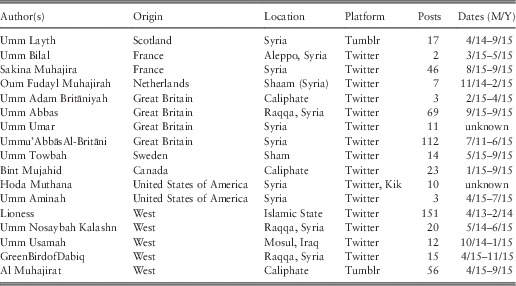
We evaluate these four explanations for Western women’s recruitment using a wealth of primary material. Most significantly, we introduce a new dataset of female Daesh recruits’ social media activity. We supplement this data with official Daesh publications, unofficial propaganda, and extant research from counterterrorism organisations tracking foreign recruits. We employ an original dataset of Western female migrants’ social media activity that includes 571 posts from 17 accounts where the author or authors self-identify as migrants in Daesh-controlled territory. Posts were made on Twitter, Tumblr, and Kik between 2011–15 and were collected between June and November of 2015. We identified the muhajirat in our data through a snowball technique, exploring their online relationships with known Daesh members, other female recruits, and other Western sympathisers.Footnote 61 This is an established method used regularly by terrorism researchers for identifying and assessing Daesh fighters.Footnote 62
Women in our data identify their origin countries as Scotland, France, The Netherlands, Great Britain, Sweden, Canada, and the United States (Table 1). Also included in our data are cases where the specific country of origin cannot be verified but evidence suggests that it is in Europe (excluding Russia and Turkey), the United States of America, Canada, Australia, or New Zealand. Posts are written in English, French, Dutch, Swedish, and Arabic. With one exception, each account included in our dataset is identified as single-authored. There is variation in the data provided by each account. Some accounts were active for years, while others went silent or were shut down after a month.Footnote 63 The regularity of posts varies across accounts with some providing far more regular updates than others. Finally, because this data is collected across platforms, there is a difference in the length of each post, with Twitter posts being limited to 140 characters and Tumblr posts sometimes consisting of many paragraphs.
Descriptive statistics: muhajirat characteristics.

There are limitations in collecting social media data on women in Daesh, some of which are reflected in the variation across our sources. Main issues confronting researchers include inaccurate self-identification, the production and destruction of data in real time, the inability to access the entire universe of possible accounts, the suspension or deletion of accounts by their platforms, and the overlap between personal data and propaganda. To ensure the integrity of our sample, we rely on a strict selection/confirmation rubric that differentiates female recruits who have physically joined the group from female sympathisers.Footnote 64 We further imposed reliability checks to evaluate each account included in the dataset. Both researchers independently evaluated all relevant information, and we include in our data only those accounts believed to by each author separately to be a Western woman in Daesh-controlled territory.Footnote 65
Our intensive analysis leads us to believe there is significant autonomy in the publication of this social media activity. Still, we concede that this activity is both personal and recruitment propaganda. This is not an impediment. It demonstrates the narratives women use about their hijra to recruit other women into Daesh. This data offers insights both into why women join and how they convince others to follow. Furthermore, while we treat each account as an individual case, we do not claim that this sample is representative of all Western women in Daesh. We use this data to gain a deeper understanding of recruits’ decision-making processes rather than to definitively profile what a typical recruit ‘looks like’. While this methodology may not conclusively identify a single causal driver of migration, it is useful for identifying themes and assessing extant theories.
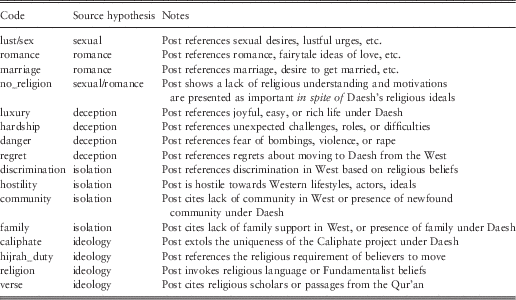
Because many of these accounts include a high volume of posts, we allow our research question to provide focus for our data collection. We limit our dataset to every post concerning gender, Daesh, migration, and life in Daesh-controlled territory from each of the 17 cases. We also include samples of other posts, ranging from religious commentary to comments on popular culture and photos of animals and viral Internet memes. To analyse this data, we performed a combination of deductive and inductive coding using the assistance of Atlas.ti, a qualitative data analysis software.Footnote 66 Our deductive codes are pre-determined themes based on the hypotheses we lay out in the previous section (Table 2).
Deductive coding rubric.

To help avoid projecting biases onto the study, we also allowed themes to ‘emerge’ from the data.Footnote 67 Because of the concern that certain narratives are being imposed onto these women and their choices, giving the data some room to ‘speak for itself’ is imperative. This combination of predetermined and emergent coding allows us to explore the theories laid out above, as well as assess themes that have been neglected by current scholarship.
Participants in ongoing conflicts are difficult to study. This sample offers a novel look at actors in a violent group that is nearly impossible to access and provides data suited for our unique research question. For these reasons, we neither look at Western male recruits nor compare women who join Daesh to those who do not. As Mario Luis Small concludes, selecting respondents at random or aiming to identify ‘representative’ cases for the sake of generalisability may be counterproductive and compromise the integrity of small-n, contextual research.Footnote 68 If, for example, we selected cases at random from a sample of all known Daesh-sympathetic accounts, our data would greatly oversample men and those who have not physically joined the organisation. Neither of these populations provide data as useful as that from Western female migrants and would leave us no space to examine our question. We are confident that our data offer insight into Western women’s motivations for migrating to Iraq and Syria, are appropriate given the limitations of our data collection, and help us understand the processes we study.
To supplement our original data, we utilise other key primary and secondary sources. We draw on Daesh’s official propaganda magazine Dabiq (now Rumiyah), most issues of which include an article purportedly written by a female recruit, and we also use an unofficial manifesto written by the group’s female police force, the Al-Khansaa Brigade. We further rely on existing reports concerning women in Daesh, female migrants, and foreign fighters, as well as published interviews conducted by Western journalists with muhajirat over Twitter and the social messaging application Kik. In the sections that follow, we evaluate the evidence explaining Western women’s participation in Daesh, relying primarily on the rationales and opinions that the muhajirat advance in their own words.
Analysis
Our data suggests that hypotheses concluding women are lured by sex or tricked into joining Daesh hold little weight in explaining Western female recruitment. While women, like all recruits, may feel that they have made a mistake in joining the organisation, we find little evidence that Daesh hides or downplays its violence, expectations, and living conditions online. Instead, we see evidence that these muhajirat, like male foreign fighters, were primarily pulled into Daesh by religious commitment and pushed by alienation and violence in their home societies. However, the muhajirat do articulate a uniquely gendered form of discrimination levelled against them and draw on it as an explanation for their migration. They similarly perceive state and social hostility against Muslim women more generally and use this as evidence that Western states oppress Islam.
First, we find little evidence that sex motivates the muhajirat. When lust is mentioned, women explicitly chastise those who submit to such urges.Footnote 69 Female recruits acknowledge and reject Western governments’ and the media’s sexualisation of them. They firmly deny a ‘sexual jihad’ and chide Western commentators for accusing them of extramarital sex. Umm Adam Britāniyah, from Great Britain, argues, ‘#jihadibrides is the age-old attack against Islam being “misogynistic” … Foolish are those that accuse our sisters in IS [of] Zina [extramarital sex]’.Footnote 70 Umm Layth agrees, suggesting that people make sexual accusations because they do not understand why Western women would join Daesh. She concludes,
Many people in present day do not understand and cannot comprehend at all why a female would choose to make this decision. They will point fingers and say behind your back and to your family’s faces that you are taking part in ‘Jihadul nikaah’ or ‘sexual jihad’ and many many more vile terms. It hurts because these words will come from perhaps some of your closest relatives.Footnote 71
As another muhajira explains, ‘I genuinely thought [that term] was for jokes … [T]here is no such rubbish in islam nor the Islamic State such as Sexual Jihad [sic].’Footnote 72
Importantly, the data does indicate a preoccupation with husbands and married life. However, this motivation does not conform to romantic explanations as expected. We see no evidence of romantic adventure-seeking or a desire for a wider array of potential partners. Instead, this devotion appears ultimately rooted in a gendered religious and political ideology – not the want for romantic affection. These women are embracing what they view as central roles of women’s jihad: marrying and supporting fighters, mourning and celebrating martyrs, and bearing the future children of the caliphate. As one muhajira notes, ‘Your first priority shouldn’t be how to find a husband once in the khilafah [caliphate] but actually getting to the khilafah. Continue to renew your intentions and make your hijrah for the sake of Allah.’Footnote 73 Women’s participation in Daesh as wives and mothers is complex and cannot be captured by the reductive ‘jihadi bride’ narrative. Nor can it simplified into a story about women seeking romantic partners.
The connection between marriage and religious duty is demonstrated across data sources. The Al-Khansaa manifesto cautions that women in the modern, non-Islamic world are being prevented from realising their natural roles by their over-extension and subsequent emasculation of men. GreenBirdofDabiq, a muhajira living in Raqqa, Syria, concludes, ‘A muslim wife should Know her place at home aswell the man. Today a lot muslim marriage is almost like kuffar [non-Muslims, also kufr, kuffr, Kuffar, Kuffaar Kufr] [sic].’Footnote 74 Female recruits perceive marriage in Daesh as more religiously fulfilling than marriage elsewhere. Hoda Muthana notes, ‘Nothing is forced here. I felt the most content, I wanted to marry under an Islamic state rather than the West and since it means obeying Allah.’Footnote 75 A religious, rather than sexual or romantic, understanding of marriage is also seen in the women’s discussions of polygamy. They lament polygamy’s unpopularity in the West, believe Islam mandates it, and actively express desire for co-wives.Footnote 76 Still, muhajirat emphasise that while marriage is important, it is secondary to their relationship with God and their desire to live in the caliphate.
While marriage may be required in Daesh, muhajirat enthusiastically approach unions because it is part of their larger contribution to this jihad.Footnote 77 A central focus on bearing witness to fighters’ deaths highlights the political underpinnings of marriage acts for these women. Muhajirat consider jihadi fighters the most respectable men and are eager to support them.Footnote 78 As Lioness muses, ‘Being in a place where you [are] guaranteed to marry a soldier of Allah is a blessing [w]hat more could you want.’Footnote 79 Besides supporting fighters, it is also the wife’s duty to bear witness if her husband is martyred. Martyrs’ widows are revered in Daesh and are typically required to undergo a mourning period of four months and ten days before remarrying. The muhajirat recall Daesh supplying food and financial support to martyrs’ wives, and women expressly cite their desires to marry a shaheed (martyr, also shahid).Footnote 80 Lioness advises, ‘Become the daughter of a shaheed, Become the sisters of a shaheed, Become the wives of a shaheed, Become the mothers of a shaheed, And watch how Allah fulfils your desire to be amongst the shuhadaa [martyrs] [sic].’Footnote 81 It is ideological devotion to the creation of an Islamic state, not sexual or romantic desire, which seemingly drives these relationships.
Second, we find little evidence to suggest that recruiters deceive female participants with an unrealistic portrayal of life in Daesh-controlled territory. While some researchers contend that social media activity targeted towards Western women presents a more luxurious and exciting image of Daesh, our data depicts a life of discomfort, violence, and separation from family and friends. Muhajirat directly reference giving up modern luxuries as part of hijra. They admit missing Western comforts, but believe that they are making a worthy sacrifice. Even if foreign recruits may not contemplate the finality of their decision to leave home, women are straightforward about some of the realities of life in Daesh-controlled territory.Footnote 82 Some muhajirat do note that new recruits expect the caliphate to be economically and politically functioning more completely than it is. They write, ‘Coming from the land of kuffr, the land of injustice, to the land of Islam is indeed an upscale no matter how big the sacrifices, but at the same time we must come to understand that this is a new born state with problems here and there but that doesn’t mean we should sacrifice any less for it.’Footnote 83
Umm A similarly notes, ‘Making Hijrah isn’t a ticket to a comfortable life [sic].’Footnote 84 When asked about how her life has changed since moving to Syria, Umm M writes,
I’ve learned to cope with certain life style changes that I would have never imagined myself been able to withstand – such as living in +45 degree weather without air conditioning, sometimes having to take cold showers in the winter and not having the luxury of exessive food variety etc. Alhamdulillah [Thanks be to Allah] all this has humbled me [sic].Footnote 85
In a post advising would-be migrants on what to bring with them, muhajirat suggest bringing thick winter clothes to wear indoors because of the lack of heating and toiletries and personal items scarce in Syria and Iraq. Some women also complain about in-fighting between Western recruits and Arab women.Footnote 86 They make clear that life under Daesh is less comfortable than at home, but believe, ‘You are leaving the land of kufr for the land of Islam so much sacrifice is to be made.’Footnote 87 Umm Layth insists that most Western recruits understand what they are giving up when they leave home. She notes that staying in the West means a comfortable life, but that the reward for making hijra to Daesh will be much greater in the afterlife.Footnote 88
Beyond the lack of material comforts, women are also upfront about the violence they experience. Several muhajirat recall airstrikes, and they often post graphic images of these attacks. Umm Usamah, a muhajira in Mosul, Iraq, writes, ‘Witnessed my first airstrike last night as the disbelievers attacked Raqqa. Alhamdulillah, zero casualties & more money wasted by the Kuffar.’Footnote 89 Umm Aminah, from Tennessee, posted of a photo one Syrian morning captioned ‘Bed, breakfast, and bombs … my lovely view in al Bab.’Footnote 90 The muhajirat run from aerial attacks and witness children killed by the bombs.Footnote 91 In September 2015, Umm Abbas claimed to have experienced nine airstrikes in Raqqa.Footnote 92 Bint Mujahid, a Canadian, remembers seeing people burned alive and crushed by bombs. She notes that this seems inevitable given the necessity of war.Footnote 93 One recruit noted that she was moving to Iraq because Raqqa had become too dangerous.Footnote 94
In addition to clear warnings of discomfort, resource scarcity, and coalition attacks, the muhajirat discuss Daesh’s widespread use of violence against women. A 2015 fatwa (Islamic legal opinion or ruling) issued by Daesh’s Committee of Research and Fatwas sanctions the taking, buying, selling, and rape of non-Muslim female slaves.Footnote 95 The fatwa dictates the circumstances in which men can rape women held as slaves and includes provisions concerning menstruation, pregnancy, lineage, and release. We find no evidence that Daesh women keep this secret in their social media activity or recruitment propaganda. Instead, we find that not only are female recruits aware of this violence when joining the organisation, but the muhajirat openly admit and accept Daesh’s rape of women and girls held as slaves. They explicitly note that rape is a punishable offence when the victim is a Muslim, but encourage the enslavement and rape of Yazidis.
Daesh is a Salafi-jihadist organisation. In Salafi tradition, non-Muslim religious groups whose theology is rooted in the Bible or the Torah are known as ahl al-kitab, or people of The Book. The Prophet Muhammed dictated that these groups be specially protected from conversion and allowed to practice their religions with little interference. Yazidis, a religious community spreading across Iraq and Syria, are not ahl al-kitab, and subsequently Daesh views them as heathens with no religious protection. Women in our data trust that this combination of Salafi theology and national hierarchy protects them from sexual violence, and they also feel that Yazidi women deserve mistreatment. In the ninth issue of Dabiq, Umm Sumayyah al-Muhajirah argues that slavery and rape are punishment for abandoning God’s favour. She affirms, ‘We have indeed raided and captured the [non-Muslim] women, and drove them like sheep by the edge of the sword … I and those with me at home prostrated to Allah in gratitude on the day the first slave-girl entered our home.’Footnote 96
Umm Abbas even jokes about this practice: ‘The Jazrawis [fighters from the Gulf region] here are the ones who have the most sabiyas [female slaves]. They love their women … He purchased one for 1000$ loool [laughing out loud] … Then another for 10000$ [sic].’Footnote 97 In one post, a muhajira responds to an anonymous commenter asking her to clarify ‘misconceptions’ about Daesh’s use of rape. The commenter notes that rumors of this practice turn women away from making hijra. The muhajra replies,
… we as muslims should be happy that the khilafah is back with all its glories including the sunnah of the Prophet (pbuh) [verbally transmitted record of the teachings, deeds and sayings, permissions and disapprovals of the Islamic prophet Mohmmad, (peace be unto him)] of taking the kuffar women as sabayyah [slaves] to humiliate kuffr and what it stands for … i must say what you may have heard about brothers taking the yazidi women as sabayyah is in fact true wa Alhamdu lillah [and praise belongs to Allah] [sic].Footnote 98
While keenly aware of Daesh’s violence, the muhajirat feel that the group protects them from rape. For example, Bint Muhajid recalls feeling unsafe walking home in Canada, but says, ‘Now I walk home … Surrounded by Mujahideen [fighters], knowing no-one can harm me. What a difference.’Footnote 99 Umm Abbas similarly notes, ‘Dawla [the State, Daesh] has the best types of men, and the shariah [Islamic] court protects you from all types of violence.’Footnote 100
The ‘deception’ explanation is uniquely difficult to evaluate through social media. It may be unreasonable to expect female recruits to complain about deception or their regrets on a public forum like Twitter. Doing so may risk their personal safety in an already violent and highly regulated environment. Furthermore, because the conditions of life under Daesh are not completely transparent, it is hard to evaluate how realistically these accounts portray daily life. However, while women may not directly reference social media deception or divulge the extent of the difficulties they face, the existing literature suggests that social media activity targeted at Westerners will present a rosy image of Daesh. This assertion is not reflected in our data; nor is the claim that women will not complain publicly.
Third, our data suggests that like other foreign fighters, Western women in Daesh do feel isolated and threatened in their home states and this mobilises them towards extremism. This isolation is both religious and political. Although many claims about Muslim radicalisation highlight the ease of finding likeminded communities,Footnote 101 we find that women have difficulty identifying sympathisers in Western states. Hoda Muthana remembers, ‘I literally isolated myself from all my friends and community members the last year I was in America … I grew closer to my deen [religion], I lost all my friends, I found none in my community that desired to tread the path I was striving for.’Footnote 102 Sakina, a French muhajira, notes that when she converted to Islam her mother told her that she wished she were a lesbian instead.Footnote 103 The muhajirat believe Western Muslims are not properly pious and there is a lack of opportunity to follow a deeply fundamentalist strain of Islam in these spaces.Footnote 104
The women in our dataset believe Muslims in the West are oppressed in particularly gendered ways. They frequently discuss the discrimination experienced by those who wear hijab and niqab [female head and face coverings]. Existing scholarship and hate crime statistics support the belief that Muslim women are frequent targets. Barbara Perry suggests that Muslim women are targeted in part because they are perceived as ‘exotic Others who do not fit the Western ideal of womanhood’.Footnote 105 In Australia, 50 per cent of post-9/11 attacks on Muslims are perpetrated against women. Comparatively, 44 per cent of victims are male and 6 per cent are buildings or property.Footnote 106 Regardless of a veiled woman’s religiosity, onlookers often perceive the veil as an indicator of the Islamic faith. Because veiling is an inherently visible practice, veiled girls and women are common targets of anti-Muslim attacks.Footnote 107 In the United States, numerous recent reports detail veiled Muslim women being physically assaulted. In response, some activist groups have begun teaching Muslim women self-defence and how to escape an attacker who grabs their head scarves. MuslimGirl.net, a popular website catered to English-speaking Muslim women, posted an article on 5 December 2015, titled ‘Crisis Safety Manual for Muslim Women’. The site listed ways to disguise the veil, such as ‘try the hood or beanie-on-top option to attract less attention’. Quraishi-Landes – an Islamic law specialist – writes that if women wearing the veil felt their ‘life or safety is threatened in any way … [they] have an Islamic allowance (durura) to adjust [their] clothing accordingly’.Footnote 108
The muhajirat in our data report feeling isolated and discriminated against in their home countries because of their public displays of Islamic piety. Safety and belonging in Daesh-controlled territory are particularly manifested through veiling and dress because these women believe living in non-Muslim society is dangerous. On Al-Muhajirat, women write, ‘In Dar Al-Kufr [the non-Muslim world], a Muslimah [female Muslim] is subjugated to the many oppressive laws which control her, she may not be given a job due to the way she dresses, she is ridiculed on the bus/train by the Kuffaar, and no one can protect her as Islam wishes for her to be protected.’Footnote 109 One muhajira recalls, ‘… I was smiling at [non-Muslims] as they walked by me knowing very well they hated the true essence of my religion and everything it stood for.’Footnote 110 Another notes that when she arrived in Syria from the West, she finally felt safe.Footnote 111 Women in the Al-Khanssaa police force contend that veiling is a recovery of rights for women who were forcibly revealed by Western colonisers and modern leaders. They insist, ‘After the establishment of the caliphate, coverings and hijab … returned to the country and decency swept the country.’Footnote 112
Reclamation of modesty is a key concern for the muhajirat, and they believe that it is not possible to fully do this outside of an Islamic caliphate. Female recruits recall family in their home states asking them to stop wearing niqabs (covering that shows only the eyes) and non-Muslim women condescendingly addressing them in public. Lioness consistently stresses the importance of modesty and adores ‘[b]eing in a place not seeing no naked women, seeing every woman n child from the age of seven cover up fully in niqab with no eyes on show [sic].’Footnote 113 Many muhajirat believe that non-Muslim society ‘contaminates’ women with sexualised expectations and public feminism.Footnote 114 Others emphasise the uneven enforcement of veiling laws in the West. Bint Mujahid notes that Catholic nuns are not required to move their head coverings and laments that veiling laws are directed exclusively at Muslims.Footnote 115 Experiences of isolation and, sometimes, violence separate the muhajirat from most women who join domestic Islamist organisations. While female fighters in domestic groups are often recruited from local communities with corresponding values, foreign women are seeking a society unlike their liberal homes.
Of course, most Muslims who feel isolated or disconnected from their communities do not seek out and are not enticed by extremist violence. As Post, Mahmood and Rane, and others conclude, it is when isolation leads individuals to become embedded in online extremist networks that this factor increases the likelihood of radicalisation. Our data demonstrates that, beginning online and continuing after hijra, women are building close community ties that further mobilise them into political violence. Muhajirat treasure the support structures available for them within Daesh and on the Internet, and they constantly refer to one another as ukhti (my sister) and akhwati (my sisters). Quotidian relationships are key mobilising factors – while the muhajirat are failing to find these relationships locally, they are identifying each other online and creating close communities held together by shared experience, piety, ideology, and the desire to live under an Islamic caliphate. This mobilisation process is not unique to the muhajirat. For example, Jocelyn Viterna and Sarah Parkinson find that quotidian networks are key to insurgent women’s recruitment in El Salvador and Lebanon, respectively.Footnote 116 Where traditional domestic insurgencies build these relationships within their contiguous communities, Daesh women are building them on the Internet. Isolation caused by anti-Muslim discrimination may push women into these online communities and may motivate their radicalisation and journeys abroad.
Finally, our data strongly suggests that, like male foreign fighters, muhajirat are motivated by an ideological commitment to Daesh that necessitates physical migration. Hijra enables women to participate in the creation and maintenance of the caliphate. Subsequently, the muhajirat view hijra as both central to Islamic practice and required by Islamic teachings. Some women explicitly emphasise hijra’s requisite nature. One muhajira contends, ‘The Muslims could never have abandoned their homes and families, exposing themselves to the pain of separation and the hardship of migration if it had not been indispensable to the practice of their religion and the assertion of Islam in the land.’Footnote 117 Sakina believes that jihad is compulsory and deems those unwilling to take part ‘hypocrites’ and ‘dogs’.Footnote 118 Another muhajira tells prospective recruits that if they are making hijra for glory or land that they will not last in Daesh. She notes that only belief in God should motivate this migration.Footnote 119
The muhajirat show little patience for Muslims who do not migrate. Before they leave home, many of the women in our data profess the desire to make hijra despite legal obstacles or family disapproval. Umm Layth contends that some women are not courageous enough to make hijra, and that they hide behind the guilt that migrating would bring grief to their families.Footnote 120 Ummu’AbbāsAl-Britāni, a British muhajira, chides women who do not make hijra by referencing the excuses they make, such as ‘I can’t shop online.’Footnote 121 Some, like Umm Abbas, offer a more direct approach:
If you neglect Hijrah & would rather be oppressed in Darul KUFR [the non-Muslim world] due to land preferences, then you are held for whatever the Kuffar do to you// IF THEY PRISON YOU, TORTURE YOU, RAPE YOU, SLAUGHTER YOU, TAKE YOUR KIDS, … WHATEVER THEY DO … It’s on you. You chose to neglect Hijrah.Footnote 122
Other women shame Western Muslims who have not made hijra by telling stories about those who have joined them in Syria and Iraq.Footnote 123 Umm Nosaybah Kalashn notes that her fifty-year-old father has joined her and asks would-be recruits what they are waiting for.Footnote 124 Another muhajira recalls a woman who made hijra on foot, with her family, and without a passport. She writes that it took the woman four months to arrive and chides, ‘so if they can make Hijrah so can you’.Footnote 125 These women view their physical obligation to Daesh as both mandatory for all Muslims and uniquely gendered. The muhajirat emphasise the important space women occupy and focus on marriage, martyrdom, modesty, and maintaining the caliphate’s moral compass.
The significance of their commitment is further captured in the capitalisation of ‘Hijra’ on social media. The capitalisation of Hijra in much of our data suggests that while hijra literally means migration, the muhajirat are directly likening their journeys to Mohammed’s hijra, which is known as ‘The Hijra’. This linguistic choice indicates that the muhajirat see themselves as emulating Mohammad – literally fleeing persecution and waging a violent jihad against non-believers. They believe that Daesh offers them an authentic space for pure religious practice, and that they are courageously answering its call for true believers. As Umm Layth writes of herself, ‘[W]allahi [I swear] my mother you have raised a Lioness among a land of cowards.’Footnote 126
Finally, muhajirat connect hijra and violent jihad. Their social media activity dually emphasises the need to remove one’s self from the society of non-believers and their desire to violently attack this world. Women often post graphic videos and imagery of Daesh beheadings and public violence, as well as calls to a brutal war between the caliphate and the non-Muslim world. Umm Layth speaks to President Obama and Prime Minister Cameron directly, promising, ‘you and your countries will be beneath our feet and your Kufr will be destroyed’.Footnote 127 Bint Mujahid also threatens domestic terrorism, saying, ‘Live in Fear. Sleeper cells & lone wolves are indetectable. They will strike against when you least suspect.’Footnote 128 Hoda Muthana demands someone, ‘Go on drive-bys and spill [American] blood, or rent a big truck and drive all over them … Kill them.’Footnote 129
Conclusions and recommendations
As government officials, policymakers, and researchers struggle to explain Daesh’s recruitment of Western women, they often focus on factors unrelated to religion or ideology. This is likely because narratives of tricked, brainwashed, and sexually lured women fit saliently into existing security narratives of women in the Middle East requiring liberation. The imagery of Western recruits as victims against a backdrop of (mostly) brown men for whom governments and policymakers make no comparable excuses is a powerful tool in shaping narratives about the liberal, emancipatory political project. In this view, Western muhajirat are considered exceptional. They differ from their domestic female counterparts, drawn from predominately Muslim and ‘non-liberal’ communities into Islamist groups. They differ too from male foreign fighters. Indeed, Western male recruits are rarely imagined as victims of deception, perceived to be motivated by sexual interest in other recruits, offered immunity deals, or treated as confused victims in need of rescue.Footnote 130 We suggest that this approach is theoretically flawed and contributes to the long empirical history of erasing women’s engagement in political violence. Further, this framework is ill suited to explain Western muhajirat. Our data suggests that while Daesh recruits participate for complex reasons, Western women seem to be primarily drawn by a religious commitment and pushed by perceived isolation and alienation in their home societies.
In sum, our analysis suggests that women join Daesh for largely the same reasons as male recruits. Richard Barrett, co-founder of the United Nations Counter-Terrorism Implementation Task Force, contends that male fighters are motivated by ‘relatively straightforward’ factors including disillusionment, persecution, religious ideology, and a desire for brotherhood and belonging. He argues, ‘They’re going off there to do something which they believe is good.’Footnote 131 Our data suggests that these factors similarly motivate women. By their own accounts, the Western muhajirat are not so different from other Islamist women or their foreign male counterparts. They are not ‘jihadi-brides’, running after men for excitement or reward. They are committed actors making decisions they view as fundamental to their faith. Female recruits believe that hijra is mandatory, and that their sacrifice is required for religious fulfillment.
However, the muhajirat do uniquely reference gendered violence in their home countries that may push them towards extremist communities. Muslim women in many Western countries are targeted by hate crimes, and the muhajirat directly reference fear of violence as a factor in their disaffection. Western muhajirat further feel violated by laws, political rhetoric, and social opposition to their outward practices of faith. They reject sexualised expectations and enthusiastically accept more conservative roles that they believe are unattainable in the West. This disillusionment is evident in these online accounts, where women carve out gendered space that is explicitly female, religious, and communal. Through social media, women speak to a community of ‘sisters’ that exalt Islamism and encourage others to pledge fully to the caliphate. James P. Farwell contends, on social media ‘the group’s narrative portrays [Daesh] as an agent of change, the true apostle of sovereign faith, a champion of its own perverse notions of social justice, and a collection of avengers bent on settling accounts for the perceived sufferings of others’.Footnote 132 Subsequently, Daesh may be attractive to those isolated in Western society who struggle to find community or face religious persecution. Women, like men, are subject to this narrative.
This article encourages radicalisation scholars to take seriously the intersection between individual psychology and the specifics of Islamist ideology. Much of the current literature is divided between viewing extremists as ‘troubled individuals’ or seeing them ‘cogs in a system’.Footnote 133 Roy and Kepel’s debate about the role of religion in radicalisation exemplifies this contention. Kepel directly links Islamist violence to the ‘intellectual resources of Salafism’, emphasising developments in religious thought as an explanation.Footnote 134 In contrast, Roy focuses on the application of religion to radical behaviour.Footnote 135 Others, like Anabel Inge, question the causal link between Salafism and violent extremism by exploring the lives of Western women who become Salafi but are not terrorists.Footnote 136 Our research offers valuable insights into this debate. The muhajirat emphasise both individual factors (isolation and discrimination that cause them to seek out extremist communities) and specifically Islamist ideas (religious mandate for making hijra) in their justifications for joining Daesh.Footnote 137 The combination of these factors in their testimony suggests that drawing a hard line between religion as a cause or cover for extremism may be unwise. The relationship between religion and the radicalisation process is outside of the scope of this article, but acknowledging the complex role Islamic fundamentalism plays in catalysing violence helps explain why these women chose to uproot their lives and travel to Syria or Iraq. Community-seeking among disenfranchised individuals and mandates of a particular brand of Islamism likely work cyclically to enhance one another.
The theoretical implications of this project indicate that framework for understanding women’s participation in conservative movements does exist, but researchers have been hesitant to employ it to explain the muhajirat. We suggest that this irreconcilability results from Daesh’s high-profile recruitment of Western women. This tension raises theoretical questions about agency and its deployment in narratives of Islamist women. Mahmood tackles the question of agency and Islam directly, arguing that liberal conceptions of agency as resistance to domination or social norms ‘sharply limits our ability to understand and interrogate the lives of women whose desire, affect, and will have been shaped by nonliberal traditions’.Footnote 138 She contends that women in these movements are agentic actors, but that we should understand agency under these conditions ‘not as a synonym for resistance to relations of domination, but as a capacity for action that historically specific relations of subordination enable and create’.Footnote 139 Others, like Jessica Auchter, question the need to inscribe agency into women’s actions as a prerequisite for legitimate participation in politics.Footnote 140
Our data makes clear that Daesh women, like most participants in political violence, perform both agentively and otherwise. These recruits are pushed and pulled by external forces of violence, religion, and community. Restricting our analysis of these activities by marking them as either completely voluntary or fully coerced offers an inaccurate assessment of the muhajirat and their political practices. Instead, we conclude that articulating the ‘clear, bounded agent’ that scholarly discourses often demand is an impossible – and inadvisable – project.Footnote 141 No one makes decisions in a vacuum. Daesh women are reacting to their social, political, and religious worlds and responding in ways that they feel benefit their interests as women and as Muslims. In this article, we contest the dominant narrative of the muhajirat as under-informed, deceived, and forcibly recruited actors. We contend that the muhajirat are extremists actively engaged in political action.
The political implications of our findings are clear. Disparate treatment of male and female foreign recruits is misguided. This approach carries dangerous implications for the future of counter-extremism and the valuation of female terrorists as threats domestically and abroad. As Anita Peresin and Alberto Cervone conclude, ‘women returning from conflict areas or those, even more numerous, anxious to join but unable to travel, could engage in violent acts’.Footnote 142 While women take on primarily administrative roles in Daesh-controlled territory, female attackers acting in the group’s name are not unprecedented. Women are also critical to spreading extremist ideology, fundraising, and recruiting new members. Hyper-focus on the muhajirat as exceptional and uniquely vulnerable underestimates them as violent political actors.
Further, while this study does not answer the question of whether hostility towards Muslims directly encourages extremism, our data does highlight the strong perception among these recruits that their home countries are oppressive. Whether drawing from personal experiences of hostility or narratives of Western oppression circulating online, the muhajirat view Western society as hateful and dangerous. They perceive anti-Muslim expectations enforced by law, advertising, and social relations. They denounce anti-veiling policies and antagonistic social interactions. Regardless of whether this reflects broader Muslim experiences or the empirical realities of anti-Muslim discrimination, Western governments should take these concerns seriously. Daesh portrays itself as a community that values Muslims’ social and religious contributions. This imagery may resonate with women, and men, who feel targeted by state politics or oppressed by dominant cultures.
Biographical information
Meredith Loken is a doctoral candidate in the Department of Political Science at the University of Washington.
Anna Zelenz is a doctoral candidate in the Department of Political Science at the University of Washington.
Acknowledgements
We are grateful to Sarah Parkinson, Vanessa Quince, Stephen Winkler, Eric Schwab, the participants of the 2016 meeting of the International Studies Association, and the anonymous reviewers and editors of EJIS for their invaluable comments on this article. We also thank Fotini Christia and Emily Kalah Gade for their advice and guidance.
Supplementary material
To view supplementary material for this article, please visit: {https://doi.org/10.1017/eis.2017.13}.