Introduction
On December 26, 2004, the Southeast Asian tsunami hit countries around the Indian Ocean rim, particularly around its earthquake-associated epicenter off Indonesia, resulting in the deaths of more than 250,000 people, and affecting millions in the region. The Australian Government responded to this event with several civilian disaster medical assistance teams (DMATs); these efforts have been summarized elsewhere.Reference Aitken, Leggat, Robertson, Harley, Speare and Leclerq1 Subsequently, the Government developed an Australian disaster medical assistance teams (AUSMAT) program,2 and recently deployed teams following the Samoa tsunami, Pakistan floods, and Christchurch earthquake. This trend is likely to continue. Disasters are increasing in frequency3, 4 and are more likely to occur in developing countries,4, Reference Haddow and Bullock5 where their effects may be more pronounced. International disaster assistance is increasingly regarded as a right or obligation,Reference Gunn6 with the Australian Government recently increasing the budget for foreign aid.7 Despite the level of preparedness of any country, some large-scale disasters will also necessitate calls for international disaster medical assistance and humanitarian aid.Reference Russbach8-Reference Dara, Ashton, Farmer and Carlton10 How well a society survives a disaster is directly related to the skills possessed by its leaders and the advanced preparations they have made.Reference Aghababian11 The importance of leadership holds equally true for international disaster assistance teams.
Much of the literature concerning DMATs, including the Australian DMAT experience,Reference Bridgewater, Aspinall and Booth12-Reference Robertson, Dwyer and Leclercq19 consists of individual team reports, which often are anecdotal. If disaster medical assistance is to improve, the international relief community must develop and streamline systems for data collection and analysis, then translate the information into implementing change to improve their programs.Reference VanRooyen, Hansch, Curtis and Burnham20 The lack of standards for DMATs has made in-depth evaluation difficult for both external reviewers and team members. Hence, there have been few studies examining DMAT deployments, and few studies of DMAT members in Australia. The present survey was part of a national program evaluating the Australian DMAT experience and examining potential models for future use in Australia. The survey was undertaken in order to target the existing Australian DMAT experience base, and to explore and identify issues raised by these groups. The experience base primarily includes those individuals actually deployed “on the ground,” and this aspect of the survey explores their views on DMAT leadership, the actual use of standards by DMATs, and support for their development.
Methods
The methods for this study have been described in detail elsewhere.Reference Aitken, Leggat, Robertson, Harley, Speare and Leclerq1 All team members associated with Australian DMAT deployments from the 2004 Southeast Asian Tsunami disaster were surveyed via their State/Territory jurisdictions. Representatives of the Commonwealth Australian Health Protection Committee (AHPC), through their State and Territory jurisdictions, identified 118 DMAT personnel, and mailed out questionnaires on the authors’ behalf. No follow-ups were undertaken. The study protocol was reviewed and approved by the James Cook University Human Research Ethics Committee in 2006 (Approval No. H2464). The support of the AHPC also was sought and given for the survey. Data were entered into a spreadsheet program, and analyzed using the Statistical Package for the Social Sciences, Version 14.0 (SPSS, Chicago, Illinois USA). Descriptive statistics were used, as the sample was relatively small.
Results
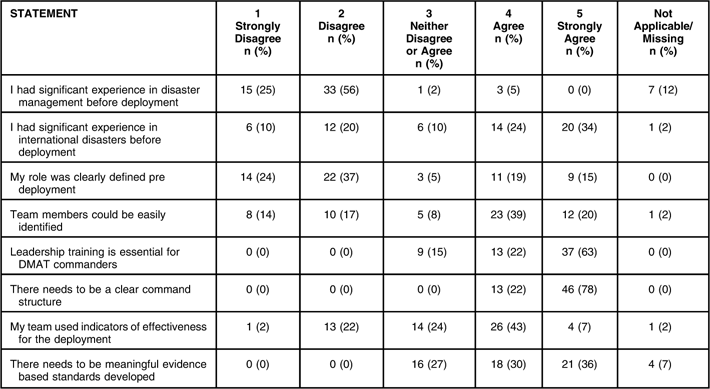
The overall response rate for this survey was 50% (59/118). The demographic details of the respondents have been reported elsewhere.Reference Aitken, Leggat, Robertson, Harley, Speare and Leclerq1 Survey responses are described in Table 1. There was unanimous support for a clear command structure (100%, 59/59), with strong support for leadership training for DMAT commanders (85%, 50/59). However, only 34% (20/59) felt that their roles were clearly defined pre-deployment, and 59% (35/59) felt that team members could be identified easily. When asked to name the biggest personal hardship faced during deployment, 49 provided responses, with two naming incompetent leadership. No respondents disagreed with the need for meaningful, evidence-based standards to be developed; however, only 51% (30/59) of those who responded stated that indicators of effectiveness were used for the deployment.
Levels of agreement of statements concerning experience, leadership and standards

Discussion
There was unanimous support for a clear command and control structure in this survey. This reinforces the findings from individual Australian team reports,Reference Pearce, Mark, Gray and Curry18, Reference Robertson, Dwyer and Leclercq19 and is consistent with the international experience. An Israeli study of the response of the Thai medical system to the tsunami disaster found that leadership was crucial for effective function,Reference Bar-Dayan, Rami and Issac22 while the Project Hope/United States Naval Ship (U.S.N.S) Mercy collaboration attributed much of its success in a joint deployment to the quality of leadership.Reference Timboe23 Civilian health professionals not familiar with military command structures, both on board the Mercy as a hospital ship and through to Fleet Command, may have struggled to recognize that they were subordinate to the command of Navy officials.Reference Timboe23 Use of civilian medical leaders with prior military experience addressed this, and ensured both their own credibility for clinical volunteers and military hosts alike, and helped the integration of the civil-military staffing arrangements.
Performance standards in humanitarian aid are noted to suffer, at least in part, due to mismanagement,Reference Burkle, Isaac-Renton and Beck24 and research after the Rwanda crisis showed that aid workers saw organizational and management issues as prime stressors in their work.Reference Birch and Miller25 This is consistent with the results of this survey, where poor leadership was stated to be one of the major personal hardships faced by team members.
As Kizer notes, “public health emergency management is not a democratic process.”Reference Kizer26 It is essential that one person is in charge of the emergency response and that everyone knows the chain of command. The incident leader must be able to make appropriate decisions quickly, and often on the basis of incomplete or uncertain data. This autocratic style of leadership is more customary in law enforcement, military, and firefighting, and is different from the more collaborative approach used in health. Therefore, leadership and management roles among the potentially responding entities need to be established clearly, and understood in advance.Reference Kizer26 The importance of this was evident in Project Hope, with a joint civil-military deployment aboard the USNS Mercy.Reference Timboe23 Few respondents in this survey felt that their roles were clearly defined pre-deployment. While this has more direct application to operational roles, any uncertainty can also be reflected in team function and command structure.
The incident command system (ICS) has become the accepted standard for disaster response in many countries.Reference Briggs27 Adherence to this is necessary to integrate successfully into the response. Failure to do so may lead to death of personnel, lack of adequate medical supplies, and staff working beyond their training or certification.Reference Briggs27 An ICS also can help ensure resources are directed to areas in most need.Reference Yamada, Gunatialke, Roytman, Gunatilake, Fernando and Fernando28 There also needs to be a command structure both between agenciesReference Cook, Smart and Stephenson29 and internationally.Reference Abolghasemi, Radfar, Khatami, Nia, Amid and Briggs30
International experiences in inter-agency coordination reveal numerous issues of jurisdiction, authority, capacity, and competency.Reference Bradt and Drummond31 While clearly defined roles and responsibilities enable effective collaboration, there is a need for greater standardization of language, including terms and definitions, and use of color coding and symbols for personnel and materialsReference Noji, Gunn and Aziz32 including identification of leaders. Effective exchange of information and international decision-making in disaster management requires a high degree of interoperability among a large number of organizations through common infrastructures.Reference Anderson, Ho and Braham33 Problems in coordination may arise due to poor leadership, as without a strong chain of command and proper protocols in place, confusion is inevitable.Reference Hickson, Schull and Arias34, Reference Zoraster35
Team leaders also have a broad range of responsibilities other than overall success of the mission, and must be concerned with team composition, transportation, communication, re-supply, and safety of team members.Reference Aghababian11 Maintaining effective team welfare and dynamics in a physically and psychologically challenging post-tsunami environment requires a considerable conscious effort in terms of leadership.Reference Grantham16 The health of team members is not just a personal responsibility, but also that of the team leader and the lead agency.Reference Cook, Smart and Stephenson29 Team leaders must watch for and recognize stress, both environmental and mental, and must monitor for illness and injury among members.Reference Wallace21 Both physical and mental fatigue are major problems during prolonged operations, and it is important to develop measures to minimize fatigue.Reference Nocera36 The temptation for off-duty staff to “hang around” should be discouraged, and sufficient breaks should be taken, as they contribute to good relationships in the field. Such breaks may need to be enforced.Reference Wallace21, Reference Birch and Miller25, Reference Nocera36 Team leader fatigue is also an issue and fatigue analysis systems screening key personnelReference Scott-Findlay37 such as team leaders should also be considered.
The success of a team will very much depend on the selection of the right members. Selection should not be based entirely on skills; fitting into a team and being able to carry out the work required in the field is more desirable.Reference Holland and Wooster38 Team leaders should also not be selected entirely on their leadership skills. It is preferable that leaders be health professionals who can serve two or more roles in a deployment.Reference Moore and Blasser39 While good leadership is essential in disaster teams, leadership is generally a learned skill,Reference Cuny40 with leadership training uniformly supported by participants. No single set of characteristics guarantees good leadership. The leadership characteristics required in situations of extreme adversity will be very different from those needed in a time of stability.Reference McCormick and Wardrope41 A management style that emphasizes cooperation, participation and fairness, and is based on personal example, is the best way for a disaster manager to influence others. They must be familiar with different styles of leadership, and know when and how to use them as these may vary with the phase of the disaster, the environment, the staff involved, and the interpersonal relationships established.Reference McCormick and Wardrope41 There is also a need for team leaders to have an awareness of the issues associated with conflict. This may be individual or group, local or national.Reference Anderson42
Standards may also assist leadership not just by promoting standardization, but also by providing organizational and reporting frameworks. The “People in Aid” code has a focus on organizational issues such as human resources in plans and budgets, risk management, and communication with staff.Reference Birch and Miller25
Despite this, standards, indicators, and measures of effectiveness are not consistently used. In this study, only half of the respondents described use of indicators, and while the reasons for this were not explored, this is not a new issue. The 100,000 avoidable deaths in the Rwanda crisis were attributed to poor performance on the part of relief agencies,Reference Hickson, Schull and Arias43, 44 while the 1994 wide-scale mismanagement of cholera by inexperienced relief workers in Zaire led to a recognition of the need to improve professional standards and the effectiveness of the response.Reference Salama, Buzard and Spiegel45
The effectiveness of emergency interventions may be difficult to measure,Reference VanRooyen and Leaning46 helping explain why much of the response to emergencies is poorly evaluated.Reference Sondorp, Kaiser and Zwi47 This is contributed to by the lack of available standards, benchmarks, and indices, which makes assessment and the ability to learn from experience more difficult. This lack of standards extends to training, with no way to assess the abilities and competencies of the organizations and people who volunteer to help an affected population.Reference Birnbaum48
Methodologies for quality management have slowly been developed,Reference Sondorp, Kaiser and Zwi47 but there is still a need for agencies and governments to agree to benchmarks, standards and codes of practice for health disaster preparedness and response, and for guiding recovery. There needs to be honest and transparent accountability, responsibility and evaluation against agreed standards of performance.Reference Nabarro49 An evidence-based grading system incorporating indicators to measure the effectiveness of a humanitarian response is required. Different methodologies may also be needed to assess indicators in countries without access to data.Reference Bradt and Drummond50, Reference Burkle51 The importance of measures of effectiveness (MOE) is seen in a study of the perceived effectiveness of health related disaster relief in the former Yugoslavia, where members of international organizations believed that a higher proportion of needs were being met by their assistance (73.4%) than did the local population (52.1%, P < .001).Reference Rubin, Heuvelmans, Tomic-Cica and Birnbaum52
Perhaps the more important finding was that no respondents disagreed with the need for development of meaningful, evidence-based standards. The selection or development of appropriate standards is the issue. The SPHERE Project has been one of the first, and probably best known, systematic efforts to improve accountability. SPHERE addresses key indicators for five sectors; water supply and sanitation, nutrition, food aid, shelter and site management, and health services,Reference Sondorp, Kaiser and Zwi47, 53 with clearly defined guidelines and minimum standards.Reference Brennan and Nandy54, Reference Griekspoor and Sondorp55 The SPHERE standards are also used by both NGOs and the military in humanitarian aid, so also may be seen as a common link between the two.Reference Dufour, Geoffrey, Maury and Grunewald56
There has been some reluctance to accept the SPHERE standards, however. This reluctance is due to concerns about levels of flexibility and the potential use of minimum standards as a punitive tool, despite these being a collective expert opinion recognizing context and constraints.Reference Salama, Buzard and Spiegel45, Reference Dufour, Geoffrey, Maury and Grunewald56 The debate should shift from potential threats to organizations to the rights of people affected by disasters, and “ultimately, all humanitarian organizations should be held accountable when they do not meet minimum standards when there is a reasonable expectation of doing so.”Reference Salama, Buzard and Spiegel45 The SPHERE Project also encourages intergovernmental organizations to provide an overall coordinating framework for international and local disaster relief. However, present practice is variable, and recognized minimum standards for such coordination do not exist. The establishment of a global information network has been suggested. This would be in place before a disaster occurs, and could link all relief communication efforts.Reference Bradt and Drummond50, Reference Libman, LaPorte and Akawaza57 It also could be supported by standardized flow charts for deploying international disaster assistance,Reference Abolghasemi, Radfar, Khatami, Nia, Amid and Briggs58 and use of standardized essential minimum data sets.Reference Bradt and Drummond50
A number of other codes or standards have emerged. These include the 1994 voluntary Code of Conduct, with 10 underpinning principles that promote the impartial character of aid, respect of local cultures, building on local capacities, involvement of beneficiaries, and respect for local dignity;Reference Griekspoor and Sondorp55 “People in Aid,” aimed at organizational practice;Reference Birch and Miller25 the “Quality Compass;”Reference Maury and Russbach59 the “Ombudsman” project;Reference VanRooyen, Hansch, Curtis and Burnham20 and the “Active Learning Network for Accountability and Performance.”Reference Leus60 In January 2005, the United Nations also adopted the Hyogo Framework for Action 2005-2015 Resolution, which addresses the specific gaps in present responses, and the challenges that disasters pose to communities across the globe.Reference Nates and Moyer61
Establishment of standards is simply the first step; adherence to standards is necessary for them to be effective. The Pan American Health Organization (PAHO) in conjunction with the World Health Organization (WHO), has developed guidelines for deployment of Foreign Field Hospitals in disasters.62 Compliance with these has been limited.Reference von Schreeb, Riddez, Samnegård and Rosling63 Similarly, the Tsunami Evaluation Coalition (TEC) found that many international agencies did not live up to their own standards with regard to respect and support for local and national ownership.64 The lack of quality enforcement mechanisms means the same problems keep reappearing, and the failure of agencies to meet their formal commitments to SPHERE or Good Humanitarian Donorship principles suggests that the various quality initiatives are not having sufficient impact. The TEC recommends that, if improvement is to occur, there is a need for a regulatory system to ensure agencies put the affected population at the center of measures of effectiveness, and to provide detailed and accurate information to the donor public on assistance outcomes, including the affected populations’ views of that assistance.64 Such a system should recognize that “emergency humanitarian medical assistance is only part of medical practice and therefore needs training, accreditation, and accountability.”Reference Redmond, O'Dempsey and Taithe65 The international law of humanitarian response in peacetime is, however, remarkably undeveloped, and the establishment of international rules and standards does not mean people will comply.Reference Hoffman66 Compliance and adherence to standards also requires funding; quality control through supervision is indispensable but expensive.Reference Sondorp, Kaiser and Zwi47
Health needs to learn from solutions developed by other organizations with different approaches to leadership. The military have found proven MOE to be an effective way to define goals in the accomplishment of mission objectives.Reference Sharp, Wightman, Davis, Sherman and Burkle67 There are inherent differences between the military and other organizations with respect to adherence to protocol and ability to enforce standards within an organization. There may also be differences in evaluation due to the significant cultural differences between the military and NGOs,68 and the latter's independent nature.Reference VanRooyen, Hansch, Curtis and Burnham20 If MOE are to be developed to predict the value or measure of a system or organization, they need to be operationally credible; have predictive values; be sensitive to factors influencing outcome; be measurable; support decision-making; be able to complement the operating system; be easily understood; be universally accepted; and improve, not worsen, efficiency, communication and coordination.Reference Burkle, McGrady and Newett69 MOE also need to be measured more than once to be meaningful and show progress, or lack of it, toward mission accomplishment.Reference Burkle, McGrady and Newett69 Similarly, the development of the International Search and Rescue Advisory Group (INSARAG),70 has been achieved by a response element with more clearly defined roles and leadership. This has enabled development of accepted networks and international classification.
Limitations
This study represented an analysis of data collected on a cross-sectional survey of Australian DMAT members. This group may encounter different hazards and risks from humanitarian aid workers and other groups responding to disasters. In addition, the limited response from some states, particularly New South Wales and Victoria, suggested coverage concerns. The inability to follow up with survey participants may have contributed to the low response rate from these states. This is offset to some degree by the overall response rate, levels of experience among responders, and the representative mix of disciplines. Hence, although generalization and extrapolation of this data will therefore be limited, the data can be useful in developing a more effective response to deployment health of members of future DMATs.
Conclusions
This study of Australian DMAT members shows unanimous support for a clear command and control structure in future DMAT deployments. This is needed to ensure clear communication and assist coordination of response, as well as collaboration with, and cooperation among, different agencies. Failure to ensure this may lead to a disjointed or ineffective response, with both task omission and task duplication. There also may be risks to the health of deployed team members, and ultimately to the reputation of the sponsoring organization. This mandates clearly defined team roles and reporting structures, with clear identification of team leaders to assist inter-agency coordination. There was strong support for leadership training for DMAT commanders; however, further work is needed to define the contents of this program.
The authors recommend that team leaders are both selected and developed. Selection needs to occur against defined criteria which should include significant previous deployment experience, as well as leadership experience in their usual clinical roles. They should also be subject to the same “fitness to deploy” criteria as other team members, and ideally be able to fill a clinical role if needed. Nomination by other team leaders or team members is also recommended, rather than direct application for team leader positions, to help ensure their ability to work as part of a team. They should have no adverse post-deployment personnel reports. The development of these individuals should then be supported through a program that addresses issues such as knowledge of the emergency management and humanitarian aid system both nationally and internationally, team management, team welfare and security, conflict resolution, use of standards and indicators, communications protocols and equipment, and media management.
Despite limited use of measures of effectiveness, members of Australian DMAT would support the development and implementation of meaningful, evidence-based standards. More emphasis should be placed on this; however, further work is needed to identify or develop the actual standards and measures of effectiveness to be used, and to implement them.
Abbreviations
- AHPC:
Australian Health Protection Committee
- AUSMAT:
Australian disaster medical assistance teams
- DMAT:
Disaster Medical Assistance Teams
- ICS:
Incident Command System
- MOE:
measures of effectiveness
- NGO:
non-governmental organization
- PAHO:
Pan American Health Organization
Acknowledgments and Dedication
The authors thank the AHPC for endorsing and assisting with our survey, all DMAT members who responded to the survey, and Dr. Frances W. Leggat for her data coding and entry. The authors wish to dedicate this research to the thousands of people affected by the Southeast Asian tsunami and Yogyakarta earthquake, as well as those more recently affected by the Samoan tsunami, Pakistan floods, and Christchurch earthquake.