Introduction
The common mental disorders (CMDs) of anxiety and depression are the most common form of psychological distress in the general population (McManus et al. Reference McManus, Meltzer, Brugha, Bebbington and Jenkins2009). The prevalence of CMD is reported to vary between 15% and 30%, depending on the case definition used (Weich, Reference Weich1997), and these high levels of psychological distress constitute a major public health burden of reduced physical and social functioning (Lloyd et al. Reference Lloyd, Jenkins and Mann1996), disability (Rai et al. Reference Rai, Kosidou, Lundberg, Araya, Lewis and Magnusson2012), higher mortality (Russ et al. Reference Russ, Stamatakis, Hamer, Starr, Kivimäki and Batty2012), lost productivity from sickness absence from work (Croft-Jefferys & Wilkinson, Reference Croft-Jefferys and Wilkinson1989; Dewa et al. Reference Dewa, Thompson and Jacobs2011) and high levels of welfare benefits (Ford et al. Reference Ford, Clark, McManus, Harris, Jenkins, Bebbington, Brugha, Meltzer and Stansfeld2010). CMDs are significantly more common in socially disadvantaged populations (Fryers et al. Reference Fryers, Melzer and Jenkins2003). The social determinants of CMD are well described and include, for example, age, sex and socio-economic status (Weich, Reference Weich1997; Sacker & Wiggins, Reference Sacker and Wiggins2002; Fryers et al. Reference Fryers, Melzer and Jenkins2003; Skapinakis, Reference Skapinakis2007), and transitions in life events such as employment history (Pevalin & Goldberg, Reference Pevalin and Goldberg2003; Thomas et al. Reference Thomas, Benzeval and Stansfeld2005, Reference Thomas, Benzeval and Stansfeld2007), marital status, bereavement (Wade & Pevalin, Reference Wade and Pevalin2004; LaPierre, Reference LaPierre2012) and physical health (Pevalin & Goldberg, Reference Pevalin and Goldberg2003). Whether the neighbourhood social environment plays an important role of in the aetiology of CMD remains an important research question. Evidence from multilevel analyses of cross-sectional datasets has suggested that people living in socio-economically deprived neighbourhoods have higher levels of CMDs than expected from their individual socio-economic risk factors (Fone et al. Reference Fone, Dunstan, John and Lloyd2007a ,Reference Fone, Dunstan, Lloyd, Williams, Watkins and Palmer b ; Mair et al. Reference Mair, Diez Roux and Galea2008). However, significant neighbourhood effects have not been confirmed in longitudinal studies (Propper et al. Reference Propper, Jones, Bolster, Burgess, Johnston and Sarker2005; Weich et al. Reference Weich, Twigg, Lewis and Jones2005; Stafford et al. Reference Stafford, Gimeno and Marmot2008c ). A second neighbourhood factor of interest is the concept of social capital, defined as ‘features of social organization, such as trust, norms, and networks that can improve the efficiency of society by facilitating coordinated actions’ (Putnam, Reference Putnam1993). The idea of social capital is much debated, with particular difficulties arising for empirical studies from the complexities of meaning, definition and measurement of a multidimensional concept (Muntaner et al. Reference Muntaner, Lynch and Davy Smith2000; Fine, Reference Fine2001). However, a useful model of social capital recognizes two components, structural and cognitive (Harpham et al. Reference Harpham, Grant and Thomas2002). Structural refers to associational links and activity within society, such as civic engagement or ‘what people do’. Cognitive refers to people's perceptions of their social relationships, such as interpersonal trust, sharing and reciprocity, or ‘what people feel’, and is a measurable indicator of social cohesion. In the present study our interest was in the concept of social cohesion, which is conceptualized as a collective community-level characteristic measured by the levels of trust, norms of reciprocity and the formation of strong social bonds within the local social structure (Kawachi & Berkman, Reference Kawachi, Berkman, Berkman and Kawachi2000; Stafford et al. Reference Stafford, Bartley, Sacker and Marmot2003; Subramanian et al. Reference Subramanian, Lochner and Kawachi2003). There is evidence to suggest that this concept of community-level social cohesion is useful in investigating the determinants of general health status (Kawachi et al. Reference Kawachi, Kennedy and Glass1999; Subramanian et al. Reference Subramanian, Kim and Kawachi2002; Stafford et al. Reference Stafford, Bartley, Sacker and Marmot2003).
Similarly to neighbourhood deprivation, there is cross-sectional evidence for an association between higher levels of neighbourhood social cohesion and lower levels of CMD (De Silva et al. Reference De Silva, McKenzie, Harpham and Huttly2005; Almedom, Reference Almedom2005; Fone et al. Reference Fone, Dunstan, Lloyd, Williams, Watkins and Palmer2007b ; Stafford et al. Reference Stafford, De Silva, Stansfeld and Marmot2008a ), but the longitudinal effect of neighbourhood social cohesion on change in mental health is unknown (Mair et al. Reference Mair, Diez Roux, Shen, Shea, Seeman, Echeverria and O'Meara2009; Murayama et al. Reference Murayama, Fujiwara and Kawachi2012).
The joint role of these potentially important contextual social determinants of the CMDs is unknown. It has been hypothesized that high levels of neighbourhood social cohesion could modify an association between neighbourhood deprivation and the mental health of individuals (Cattell, Reference Cattell2001; McKenzie et al. Reference McKenzie, Whitley and Weich2002). In the present study we tested the hypothesis that high levels of neighbourhood social cohesion modify an adverse association between change in individual mental health and neighbourhood deprivation. We carried out a longitudinal analysis using data from the Caerphilly Health and Social Needs Cohort Study, a community study of health inequality set in Caerphilly county borough, South Wales, UK (Fone et al. Reference Fone, Dunstan, White, Kelly, Farewell, John, Lyons and Lloyd2012). We examined the effect of baseline neighbourhood deprivation and social cohesion on change in mental health, adjusting for baseline socio-economic status, the occurrence of important life event transitions, and moving between neighbourhoods within the study area. Our specific objectives were to investigate whether change in mental health was associated with (1) baseline neighbourhood deprivation and (2) baseline neighbourhood social cohesion, and (3) whether any association between neighbourhood deprivation and change in mental health was modified by high levels of neighbourhood social cohesion.
Method
Participants
We have previously described the Caerphilly Health and Social Needs Cohort Study in detail (Fone et al. Reference Fone, Dunstan, White, Kelly, Farewell, John, Lyons and Lloyd2012). In brief, we carried out a baseline postal questionnaire population survey in 2001, obtaining responses from 10 892 (60.6%) participants aged 18–74 years. Sampling was carried out stratified by the 36 electoral wards of local government in the study area (mean population 3600 adults), aiming to achieve an equal number of participants in each ward. Individual records were linked to the 1991 UK Census enumeration district of residence using the address postcode. The enumeration district is a smaller geographically defined area than the electoral ward with an average population of 400 adults. There are 325 enumeration districts in the study area and these were used as the best available representation of neighbourhood in the study. We carried out a follow-up postal questionnaire survey of the 9551 baseline respondents still alive and resident in the study area 7 years later in 2008, obtaining 4558 completed questionnaires with validated age and sex, representing an adjusted response of 50.2% (Fone et al. Reference Fone, Dunstan, White, Kelly, Farewell, John, Lyons and Lloyd2012). Full ethical approval was obtained for both waves of the study from the South-East Wales Research Ethics Committee.
Outcome measure: change in mental health
Both waves of the survey included the 36-item Short-Form Health Survey (SF-36) version 2 and we used the 5-item Mental Health Inventory (MHI-5) subscale scores as the measure of CMD (Ware et al. Reference Ware, Kosinski and Gandek1993, Reference Ware, Kosinski and Dewey2000). The MHI-5 has been shown to be a robust measure of mental health in the general adult population (Berwick et al. Reference Berwick, Murphy, Goldman, Ware, Barsky and Weinstein1991; McCabe et al. Reference McCabe, Thomas, Brazier and Coleman1996; Ware & Gandek, Reference Ware and Gandek1998; Kelly et al. Reference Kelly, Dunstan, Lloyd and Fone2008) and is effective at screening for mood and anxiety disorders assessed using Diagnostic Interview Schedules, but less effective at identifying other disorders such as somatoform disorders, phobias, substance misuse and some anxiety disorders (Berwick et al. Reference Berwick, Murphy, Goldman, Ware, Barsky and Weinstein1991; Rumpf et al. Reference Rumpf, Meyer, Hapke and John2001; Cuijpers et al. Reference Cuijpers, Smits, Donker, ten Have and de Graaf2009).
The MHI-5 scale comprises five questions asking about symptoms in the past 4 weeks: (1) Have you been very nervous? (2) Have you felt so down in the dumps that nothing could cheer you up? (3) Have you felt calm and peaceful? (4) Have you felt downhearted and depressed? and (5) Have you been happy? Each of the questions has five response categories that score 1 = all of the time, 2 = most of the time, 3 = some of the time, 4 = a little of the time, and 5 = none of the time. Where a question was not answered, missing data were imputed using the scale-developers method as the mean score of question responses, given that at least three of the five questions were answered (Ware et al. Reference Ware, Kosinski and Dewey2000). The scores for each question were summed to give a range of scale scores from 5 to 25, with the scoring of questions (3) and (5) reversed so that higher scores indicated better mental health for each question. Following the standard method, the scores were then range transformed to a final discrete scale ranging from zero to 100, where 100 represents the best level of mental health (Ware et al. Reference Ware, Kosinski and Dewey2000). The outcome measure modelled was the change in mental health score between follow-up and baseline score, so that a positive change indicated better mental health.
Socio-economic variables and transitions in life events
We selected variables that were associated with change in the mental health score. From the baseline data we included age in 10-year bands, sex, Registrar General occupational social class (Macintyre et al. Reference Macintyre, McKay, Der and Hiscock2003), and the mental health score. We used information on employment status to create a three-level categorical variable of (1) full- or part-time employed; (2) available for and seeking work; or (3) not available for work and so economically inactive (comprising respondents who were looking after home or children full-time, long-term carer, full-time student, on a government training scheme, retired from paid work, or permanently unable to work due to illness or disability). Marital status was coded as (1) married or living as married, (2) single, divorced or separated, or (3) widowed. We assessed physical health status using the Physical Component Summary score (PCS) of the SF-36 (range 0 to 100) as it is constructed to be independent of mental health status (Ware et al. Reference Ware, Kosinski and Dewey2000). We divided responses into poor (scores 0 to < 50) or good (scores 50 to 100) physical health. Gross household income was categorized into two groups: ‘low’ income (< £10 000 p.a.) and ‘high’ income (⩾ £10 000 p.a.). These categories were chosen because £10 000 p.a. in 2001 approximately equated to 60% of median income after housing costs, the UK definition of household poverty (DWP, 2012). Housing tenure was coded as owner-occupier or not owner-occupier, and property wealth was assessed using the national system of council tax valuation bands, in which local government authorities value each domestic residence and assign to one of eight ordinal categories, A to H in Wales. We obtained the council tax valuation band for each participant by matching the sample frame address to the local authority council tax register (Fone et al. Reference Fone, Dunstan, Christie, Jones, West, Webber, Lester and Watkins2006a ). We then created a two-category variable with roughly equal numbers of participants in each: the lowest value council tax bands A and B, and the remaining six higher value bands C to H. Finally, we derived categorical variables for between-wave transitions in employment status, marital status, physical health status, gross household income, housing tenure, and council tax valuation band.
Neighbourhood deprivation
We assessed neighbourhood deprivation using an enumeration district dataset of gross household income estimates for 2001 in successive £5000 income bands (Fone et al. Reference Fone, Dunstan, Lloyd, Williams, Watkins and Palmer2007b ). We defined two variables to distinguish between two levels of neighbourhood deprivation: The first variable, labelled ‘high neighbourhood deprivation’, was defined as the percentage of households in each neighbourhood with a gross annual household income of less than £5000, approximately equivalent to income from State welfare benefits. The second less extreme variable, labelled ‘neighbourhood deprivation’, was defined as the percentage of households with an income less than £10 000 per annum, based on the UK definition of poverty in 2001 (DWP, 2012). Both variables were transformed to a z score, with zero mean and unit variance, for the analysis.
We assessed neighbourhood migration by deriving a four-level categorical variable labelled as (1) not moving, (2) moving within the borough to a more deprived neighbourhood, (3) moving to a less deprived neighbourhood or (4) moving to the same level of deprivation.
Individual and neighbourhood social cohesion
We derived neighbourhood social cohesion scores using Buckner's Neighbourhood Cohesion scale (Buckner, Reference Buckner1988). We first carried out an exploratory factor analysis. Extraction was by principal components analysis and a varimax rotation and two components were extracted with eigenvalues > 1. We used the criterion of a factor loading of ⩾0.5 for assigning each of the scale question items to a component. One component, the social cohesion subscale, clearly loaded items on trust and reciprocity whereas the second component loaded items on ‘neighbourhood belonging’, which is a different construct and was not used in the present study. An ecometric analysis of individual responses to the social cohesion subscale suggested it was an appropriate measure of social cohesion at neighbourhood level (Fone et al. Reference Fone, Farewell and Dunstan2006b ). We then estimated mean neighbourhood social cohesion scores and divided the distribution of scores into thirds to create a new categorical variable of low, medium and high social cohesion with equal numbers of neighbourhoods in each category (Fone et al. Reference Fone, Dunstan, Lloyd, Williams, Watkins and Palmer2007b ). To adjust for between-wave change in individual social cohesion scores, we also derived a three-category variable with the middle category representing minimal change of up to ± 2 points on the scale (range 8–40), the low category representing a decrease in cohesion score of > 2 points, and the high category an increase in reported cohesion score of > 2 points.
Statistical analysis
Multilevel modelling strategy
We modelled the change in mental health scores as a continuously distributed variable in a linear multilevel regression model of individuals nested within enumeration districts. We used the iterative generalized least squares estimation procedure in MLwiN software (Rasbash et al. Reference Rasbash, Steele, Browne and Goldstein2009), and report parameter estimates for the neighbourhood fixed effects and the intraclass correlation coefficients (ICCs) with accompanying 95% confidence intervals (CIs).
The modelling strategy started with the ‘null’ two-level variance components model, in which the variation in the change in mental health score was modelled by a random intercept term for neighbourhoods and a random error term for individuals. In model 1 we fitted the socio-economic and life event transition covariates. Missing data were modelled for each categorical variable as a separate category to minimize data loss and allow direct comparison between models using the deviance (−2 log likelihood). The data were weighted to allow for the unequal electoral ward sampling probability and survey non-response as a function of age, sex and neighbourhood deprivation score that were available for the whole sampling frame, using a standard method (Crockett et al. Reference Crockett, Afkhami, Rafferty, Higgins and Marshall2011; Fone et al. Reference Fone, Dunstan, White, Kelly, Farewell, John, Lyons and Lloyd2012).
We investigated the first objective of our study by adding the two neighbourhood deprivation variables separately to model 1 to form two independent models, 2.1 and 2.2. We investigated the second objective of our study in model 3 by adding the neighbourhood and individual-level social cohesion variables to model 1. Model 3 did not include neighbourhood deprivation. Finally, we investigated the third objective by adding the neighbourhood deprivation and social cohesion variables to model 1. We derived a separate model for both measures of neighbourhood deprivation. Model 4.1 included the high deprivation variable and model 4.2 included the neighbourhood deprivation variable. Each model included terms for the main effects and the interaction between them (neighbourhood deprivation × neighbourhood social cohesion).
To further assess the influence of missing data, we repeated the final analysis of model 4.2 accounting for missing data with multiple imputation using chained equations (White et al. Reference White, Royston and Wood2010). We estimated a pooled estimate from five models with all individual and neighbourhood variables included as predictors.
Results
The change in mental health score was available for 4426 (97.1%) respondents and the distribution was approximately normal. Over the study period, there was a small decrease in mental health overall: mean change in mental health score −0.83 [standard deviation (s.d.) 20.3, interquartile range (IQR) −10 to 10].
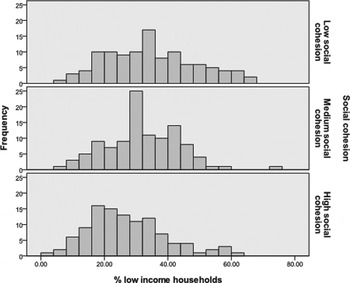
The mean percentage of households per neighbourhood earning less than £5000 p.a. was 12.9% (s.d. = 7.6%, 10th–90th centile 4.4–23.1%). For less than £10 000 p.a., the mean was 31.3% (s.d. = 13.0%, 10th–90th centile 15.5–49.2%). Fig. 1 shows the relationship between neighbourhood deprivation and neighbourhood social cohesion. Although the low social cohesion category had the highest proportion of deprived neighbourhoods, there was substantial variability in neighbourhood deprivation scores within each social cohesion category, such that neighbourhoods could be categorized as both deprived and of high social cohesion.
Distributions of neighbourhood deprivation scores (percentage low-income households < £10 000 p.a.) by the categories of social cohesion.

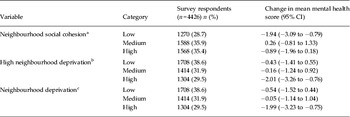
The distribution of the numbers (%) of respondents and the mean change in mental health score within thirds of neighbourhood deprivation and neighbourhood social cohesion categories are shown in Table 1. The general pattern of the mean change in mental health score associated with the neighbourhood variables was as expected, with a negative change in the high neighbourhood deprivation and low cohesion categories.
Change in mean mental health score for subjects within neighbourhoods

CI, Confidence interval.
a The distribution of neighbourhood mean social cohesion scores was divided into thirds with equal numbers of neighbourhoods in each third.
b The distribution of neighbourhood percentage low-income households < £5000 p.a. was divided into thirds with equal numbers of neighbourhoods in each third.
c The distribution of neighbourhood percentage low-income households < £10 000 p.a. was divided into thirds with equal numbers of neighbourhoods in each third.
Associations with socio-economic and life event transition variables
Online Supplementary Table S1 shows the numbers (%) of respondents, univariable associations with change in mental health score and the results from fitting the socio-economic and life event transition covariates in model 1. A positive change in mental health score was most strongly associated with age groups 45–74 years at baseline. Compared to remaining in employment, a decrease in mental health score was most strongly associated with the transition to economic inactivity or remaining economically inactive. Transitions from both employment and economic inactivity to being unemployed and seeking work were also associated with a negative change in mental health, although only a few subjects made these transitions. The most striking marital status transition was the decline in mental health associated with bereavement. A decline in mental health was also associated with remaining in low value housing, remaining or becoming a low-income or non-owner-occupier household, and remaining or becoming in poor physical health. Moving to a higher, lower or same level of neighbourhood deprivation compared to not moving showed little association with change in mental health.
Effect of neighbourhood deprivation and social cohesion
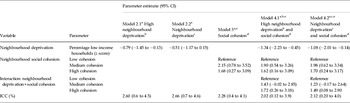
In models 2.1 and 2.2, a decline in mental health was significantly associated with residence in the high deprived neighbourhoods, after adjusting for socio-economic and transition in life event covariates (Table 2). The coefficient for the high neighbourhood deprivation variable was −0.79 (95% CI −1.45 to −0.13), which represents the negative change in mental health score for an increase of 1 s.d. or 7.6% in low-income households. This is equivalent to a change of −1.9 points (95% CI −3.6 to −0.3) on the mental health scale between the 10th and 90th centiles of the high neighbourhood deprivation distribution over the period of the study.
Multilevel associations between change in mental health, neighbourhood deprivation and neighbourhood social cohesion

CI, Confidence interval; ICC, intraclass correlation coefficient.
a Adjusted for baseline age group, sex, social class and mental health score; transitions in employment, marital status, housing tenure, council tax band of residence, household income, physical health status; within-study area migration.
b Percentage low-income households < £5000 p.a.
c Percentage low-income households < £10 000 p.a.
d The distribution of neighbourhood mean social cohesion scores was divided into thirds with equal numbers of neighbourhoods in each third.
e Also adjusted for change in individual social cohesion.
Compared to low social cohesion neighbourhoods, both the medium and high cohesion categories were significantly associated in model 3 with an improvement in mental health (Table 2). The parameter estimates, of +2.15 (95% CI 0.78–3.52) and +1.68 (95% CI 0.27–3.09) respectively, are of greater magnitude than the decline in mental health associated with the neighbourhood deprivation variables in models 2.1 and 2.2.
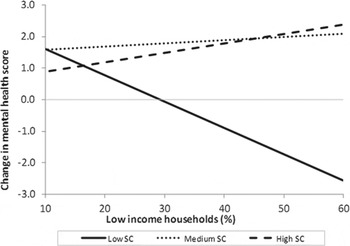
Both of the neighbourhood deprivation variables were significantly associated with a negative change in mental health in their respective final models 4.1 and 4.2 (Table 2). These effects were larger in magnitude than in models 2.1 and 2.2. The medium and high categories of social cohesion also remained significantly associated with an improvement in mental health. The positive coefficient for the interaction between neighbourhood deprivation and social cohesion (+1.49, 95% CI 0.08–2.90) suggested that the adverse association of neighbourhood deprivation with a negative change in mental health was significantly attenuated in high social cohesion neighbourhoods. Fig. 2 shows the predicted change in individual mental health score from model 4.2 associated with neighbourhood deprivation, together with the difference in slopes between the social cohesion groups representing the interaction term. The predicted change in mental health score was calculated for the 10th and 90th centiles of the household low-income distribution. The difference between them was −2.8 in the low social cohesion group and 1.1 in the high cohesion group. The difference between the groups was 3.9 (95% CI 0.2–7.6).
Relationship between model-predicted change in mental health scores, social cohesion (SC) and neighbourhood deprivation (percentage low-income households < £10 000 p.a.).

Neighbourhood-level variation
In the null model, 2.8% (95% CI 1.2–4.5) of the variance was at the neighbourhood level, and this reduced minimally to 2.7% (95% CI 0.7–4.6) in model 1 after fitting the covariates (Table S1). The ICCs (%) for the proportion of unexplained random variance in the change in mental health score at neighbourhood level are shown in Table 2 for the neighbourhood models. In the final model 4.2, the ICC was 2.1% (95% CI 0.2–4.0). The results from the multiple imputation models showed no substantive differences in the magnitude of the parameter estimates, nor in their interpretation.
Discussion
Our results show significant associations between neighbourhood deprivation and increasingly poor mental health over a 7-year period. We found a widening of mental health inequalities between neighbourhoods and the effect was strongest in the most deprived neighbourhoods. Living in a medium or high social cohesion neighbourhood was strongly associated with an improvement in mental health compared to living in a low social cohesion neighbourhood. The significant positive interaction between neighbourhood deprivation and social cohesion suggested that living in a high social cohesion neighbourhood modified the adverse effect of neighbourhood deprivation on poor mental health. After adjustment for socio-economic and life event risk factors associated with change in mental health, and possible health selection effects from migration, we can be confident of a temporal relationship in this longitudinal analysis because both the neighbourhood deprivation and social cohesion variables were measured 7 years before the change in mental health score.
The positive impact of high social cohesion offers potential mechanisms through which the adverse impact of residence in deprived neighbourhoods on mental health could be addressed. The relationships between neighbourhood deprivation and social cohesion are complex; people living in deprived neighbourhoods tend to have more locally based family ties and friendships, but with lower degrees of trust and practical help (Stafford et al. Reference Stafford, Bartley, Sacker and Marmot2003). A possible explanation for our findings is that high levels of neighbourhood social cohesion based on friendships, visiting and borrowing and exchange of favours with neighbours may offset the detrimental effects of social disadvantage by facilitating access to networks and services that influence health, and social and emotional support (Kawachi & Berkman, Reference Kawachi, Berkman, Berkman and Kawachi2000). These mechanisms suggest that interventions that help to facilitate social interaction and exchange may increase levels of social cohesion in deprived neighbourhoods by enhancing trust and reciprocity.
There have been three previous studies, all set in the UK, that have investigated longitudinal multilevel associations between neighbourhood deprivation and mental health in a general population sample. Two of the studies, using the British Household Panel Survey, found that over periods of 1 year (Weich et al. Reference Weich, Twigg, Lewis and Jones2005) and 5 years of follow-up (Propper et al. Reference Propper, Jones, Bolster, Burgess, Johnston and Sarker2005), neighbourhood deprivation had little effect on change in mental health. The third study, analysing data from the Whitehall II study of British civil servants, found that longer residence of more than 10 years in a deprived neighbourhood, compared to less deprived, was associated with a widening of mental health inequality (Stafford et al. Reference Stafford, Gimeno and Marmot2008c ). Our study findings of a widening in mental health inequality is further evidence that there are potentially important effects of neighbourhood deprivation on mental health. One previous longitudinal study set in the USA investigated associations between neighbourhood social cohesion and change in mental health, in 1919 subjects aged 45–84 years with 4–5 years of follow-up (Mair et al. Reference Mair, Diez Roux, Shen, Shea, Seeman, Echeverria and O'Meara2009). The onset of depression, measured using the Center for Epidemiologic Studies Depression scale, was not associated with baseline social cohesion measured at the census tract level from responses to four questions on trust and reciprocity. To our knowledge, our present study is the first to suggest that neighbourhood social cohesion is associated with an improvement in mental health over time and is a potentially important factor in reducing the adverse impact of neighbourhood deprivation on mental health.
In common with these four previous longitudinal multilevel analyses of neighbourhoods and mental health, we found that most of the unexplained variability in change in mental health scores was between individuals. However, although the between-neighbourhood variance was of the order of 2%, there was sufficient contrast of exposure to detect an important association between change in mental health and the neighbourhood variables (Sampson et al. Reference Sampson, Morenoff and Gannon-Rowley2002; Merlo, Reference Merlo2003).
The main strength of the study arises from the in-depth sampling of a geographically defined population of socio-economic contrast, with detailed longitudinal data on exposures from respondents linked to small neighbourhood areas of residence (Fone et al. Reference Fone, Dunstan, White, Kelly, Farewell, John, Lyons and Lloyd2012). We were able to examine the joint temporal effect of robust neighbourhood measures of deprivation and social cohesion on change in mental health over a 7-year period. Measuring social cohesion at neighbourhood level is not straightforward, but is important because social cohesion is conceptualized as a collective neighbourhood-level characteristic measured by the levels of trust, norms of reciprocity and the formation of strong social bonds within the local social structure (Kawachi & Berkman, Reference Kawachi, Berkman, Berkman and Kawachi2000; Stafford et al. Reference Stafford, Bartley, Sacker and Marmot2003; Subramanian et al. Reference Subramanian, Lochner and Kawachi2003). In an ecometric analysis we found that Buckner's Neighbourhood Cohesion scale gave an acceptable neighbourhood measure of social cohesion, derived from the aggregation of individual responses within neighbourhoods (Fone et al. Reference Fone, Farewell and Dunstan2006b ). We found no evidence that same-source bias, in which subjects with poorer mental health may be more likely to report negative responses to the social cohesion scale, was operating in the survey scale responses (Fone et al. Reference Fone, Dunstan, Lloyd, Williams, Watkins and Palmer2007b ).
Significant neighbourhood-level effects can result from health selection bias, where people of higher socio-economic status are able to move out of deprived neighbourhoods (Norman et al. Reference Norman, Boyle and Rees2005; Connolly et al. Reference Connolly, O'Reilly and Rosato2007). To determine whether this bias was operating in our study, we collected accurate data on time and place of within-borough migration. We assessed whether the subject moved to a same, more, or less deprived neighbourhood and found no evidence of a health selection effect.
We carried out a comprehensive adjustment for potentially confounding compositional effects by including baseline socio-economic status and transitions in life events associated with change in mental health, including employment status (Pevalin & Goldberg, Reference Pevalin and Goldberg2003; Thomas et al. Reference Thomas, Benzeval and Stansfeld2005, Reference Thomas, Benzeval and Stansfeld2007), marital status (Pevalin & Goldberg, Reference Pevalin and Goldberg2003; Wade & Pevalin, Reference Wade and Pevalin2004) and physical health (Pevalin & Goldberg, Reference Pevalin and Goldberg2003), and we also adjusted for other transitions in housing tenure and other factors that were significantly associated with change in mental health in our dataset. Our findings are in line with these previous studies. However, we had no information on when the individual transitions occurred during the 7-year follow-up, or whether more than one transition occurred within any category. As the data were only recorded at two time-points, individuals who underwent several transitions may not have been correctly classified. The same problem arises in the measurement of mental health at two time-points without information on intervening variability in scores. Two-wave longitudinal studies can confound true change with measurement error (Singer & Willett, Reference Singer and Willett2003), but the MHI-5 scale has been shown to be a valid and reliable measure of change (Hemingway et al. Reference Hemingway, Stafford, Stansfeld, Shipley and Marmot1997).
A further limitation of the study is the loss to follow-up of 6334 (58%) subjects from the baseline 10 892 respondents aged 18–74 years (Fone et al. Reference Fone, Dunstan, White, Kelly, Farewell, John, Lyons and Lloyd2012). Of these, 1341 (12%) had died or moved out of the study area and were removed from the follow-up sampling frame. Of the non-responders, 358 (3.7%) of the 9551 subjects could not be traced, 108 (1.1%) were too unwell to complete a questionnaire and 10 (0.1%) died after the wave 2 sample was taken. A total of 4277 refused to participate. We could not validate the age and/or sex of 240 responders, leaving a total of 4558 for analysis, representing 27.4% of the original sampling frame eligible in the study. Bias may have resulted from non-participants at follow-up reporting lower baseline mental health scores and socio-economic status, and we had no information on change in mental health in non-responders between different neighbourhood deprivation and social cohesion groups. We were able to account for attrition as far as possible by weighting the data for the unequal sampling probability of the sampling design and survey non-response (Fone et al. Reference Fone, Dunstan, White, Kelly, Farewell, John, Lyons and Lloyd2012), using a standard published method for population surveys (Crockett et al. Reference Crockett, Afkhami, Rafferty, Higgins and Marshall2011).
Although we measured a wide range of socio-economic and life event transition variables, including some not measured in other surveys, such as the council tax band as a proxy for property wealth, there is always the possibility of unmeasured confounding as a possible explanation for the study findings. There is also the opposite problem that many of the confounding variables included in the analysis are highly correlated, which can result in model overfitting (Macintyre et al. Reference Macintyre, Ellaway and Cummins2002). We made the assumption that the administratively defined UK Census enumeration district was a good measure of a meaningful neighbourhood, at which small-area exposures can operate. Neighbourhoods should ideally be homogeneous with respect to socio-economic and other contextual characteristics but, in general, administrative boundaries tend to create non-homogeneous areas that can diminish between-area variability. We found the baseline social cohesion scores to fit into this pattern (Fone et al. Reference Fone, Dunstan, Lloyd, Williams, Watkins and Palmer2007b ), which tends to lead to conservative estimates (Blakely & Woodward, Reference Blakely and Woodward2000; Stafford et al. Reference Stafford, Duke-Williams and Shelton2008b ). Therefore, our results are unlikely to overestimate the strength of the associations between change in mental health and the neighbourhood deprivation and social cohesion measures.
In summary, our results suggest that neighbourhood deprivation and neighbourhood social cohesion are important factors in understanding the social epidemiology of the mental health of individuals. Neighbourhood deprivation contributes to widening inequalities in mental health. We have found prospective evidence to support the hypothesis that high neighbourhood social cohesion significantly mitigates the adverse effect of neighbourhood deprivation on mental health. Policies and interventions to reduce mental health inequalities across the socio-economic gradient should recognize the importance of social context, and interventions should include components that operate not only for individuals but also at the neighbourhood level.
Supplementary material
For supplementary material accompanying this paper visit http://dx.doi.org/10.1017/S0033291713003255.
Acknowledgements
We thank the study participants and many of the staff of the former Gwent Health Authority, the Caerphilly Local Health Group and their successor organizations, and the Chief Executive's Office and the Electoral Services Department of Caerphilly county borough council for their help in running this collaborative study.
This work was supported by a Welsh Assembly Government/UK Medical Research Council Health Research Partnership Award (H07-3-030).
The work was undertaken at the Centre for the Development and Evaluation of Complex Interventions for Public Health Improvement, a UK Clinical Research Collaboration Public Health Research: Centre of Excellence. Funding from the British Heart Foundation, Cancer Research UK, the Economic and Social Research Council (RES-590-28-0005), the Medical Research Council, the Welsh Assembly Government and the Wellcome Trust (WT087640MA), under the auspices of the UK Clinical Research Collaboration, is gratefully acknowledged.
The funding organizations played no role in the design and conduct of the study; collection, management, analysis, and interpretation of the data; and preparation, review, or approval of the manuscript.
Declaration of Interest
None.