Introduction
This introduction comprises several of the various aspects needed to contextualize the development of mathematics in Spain in the period 1900–1910. Most information has been obtained from the minutes of the Spanish institutions that were involved, the Spanish Official Gazette, original papers by people appearing in these pages, and periodicals. Secondary sources have been used as well to provide a general picture that would have been otherwise difficult to grasp.
Previous historical and scientific conditioning
The decadence of the Spanish overseas Empire, a process started with the nineteenth century that led to the formation of several independent states out of the Spanish colonies in the Americas between 1808–1821 during the reign of King Fernando VII, came to an end in 1898 after a short war between the United States and Spain. As a consequence, Cuba became independent and the Philippines were transferred to the United States. Years before that, a number of Spanish intellectual, cultural, and political movements were already trying to promote the integration of Spain into Europe as its former colonial power status faded. In educational affairs, though education did not have an independent ministry, it was included in Public Works, Waterways. The 1857 Act known as Ley Moyano named after the Minister Claudio Moyano (1809–1890), which was to become the backbone of educational policies in Spain for more than a century, promoted the extension of education at all levels, and a few science faculties were established. In some of them, mathematics was taught leading to a university degree under the overarching name of Ciencias Exactas. The creation of mathematical studies was fostered by the efforts of José Echegaray y Eizaguirre (1832–1916), a civil engineer, politician, mathematician, and playwright who was awarded the Nobel Prize for Literature in 1904.
Nevertheless, modernization was not so easy. In February 1875, a royal decree named after its promoter the Minister Manuel Orovio severely restricted academic freedom and a number of university professors and secondary school teachers abandoned their official posts in a protest that greatly enhanced the creation of the Institución Libre de Enseñanza (ILE), a pedagogical endeavor started in 1876 by Francisco Giner de los Ríos (1839–1915) adapting the ideas of the German philosopher Karl Friedrich Krause (1781–1832), whose influence had been very notable in South America, where his works partially inspired the programs of independence leaders like Simón Bolívar (1783–1830). Observe the coincidence in time between the lives of Bolívar and Krause and the Independence Wars. Krause's ideas flourished in Spain with a delay of half a century, imported from the ex-colonies.
Thus it should not be surprising that the 1899 paper “Les Mathématiques en Espagne,” authored by the respected Spanish professor and mathematician Zoel García de Galdeano (1846–1924), the very first article in the very first number of L’Enseignement Mathématique, did not convey the feeling of a unified and connected mathematical community in Spain. Instead, a number of isolated names and textbook writers were cited in the article. A biographical sketch of Galdeano can be found in (Hormigón Reference Hormigón1982). Indeed there had been mathematics and mathematicians in Spain before that, but a mathematical community, common in other European countries and enhanced by frequent traveling, was never developed in Spain. Due to the needs of the Spanish Empire, most mathematics practiced in Spain had been applied, usually worked out by the military in the fields of astronomy, navigation, topography, geodesy, and computational skills for the formation of several classes of engineers, especially after some schools were created according to French models: the mining school was opened in 1777, the civil engineering one in 1802 (Pacheco et al., Reference Pacheco, Pérez-Fernández and Suárez2007a). A well known example is the eighteenth-century Spanish marine officer Jorge Juan Santacilla (1713–1773) who took part in the equatorial expedition led by the French Louis Godin for the measurement of the meridian arc and was the author of the 1771 comprehensive treatise Examen Marítimo Teórico-Práctico, a technical encyclopaedia on shipbuilding, sailing, geodesy, and astronomy containing updated mathematical knowledge.
In the wave of scientific and educational novelties entering Spain in the wake of the Moyano Act, mathematics also had its share: Foreign books and journals became available, mainly of French origin although there were some in English and Italian, and soon translations and imitations were produced by Spanish authors. The main outlet for mathematical production was textbooks, for journals were not common in Spain. Essays, memoirs, and specialized books were scarce, and here we may observe a tendency in some nineteenth-century Spanish mathematicians to engage in foundational research with the aim of making fundamental and definitive contributions. Such is the case around 1860 of José María Rey Heredia (1818–1861) and the imaginaries, influenced by readings of British origin, showing some connection with the culture of former exile circles in the 1820s and a second-hand knowledge of Kant's philosophical theory of categories. Rey Heredia had a number of epigones, both among secondary school teachers and university professors (Pacheco Reference Pacheco and Romero1982 and Pacheco Reference Pacheco1991; Escribano Reference Escribano1998; Pacheco et al. Reference Pacheco, Pérez-Fernández and Suárez2007b).
Sociology of the mathematics professionals
From 1857 onwards, most mathematics and its Spanish practitioners belonged to academia – it is still so, with few posts in fields like industry or banking – and the professional life of mathematicians is closely related to tenure, for in Spain tenured professors have always been a class of civil servants with life-long contracts. Until very recently, after obtaining tenure the aim was to end up in some interesting place via bureaucratic by-roads. Therefore, a typical professor with some aspirations, like those mentioned in this paper, would move not less than three or four times during his active life, aiming at a position in Madrid, Barcelona, or maybe Saragossa: These were the three universities where mathematics could be studied, though doctorates were awarded only in Madrid. Much effort, and quite often not of a scientific nature, was spent in these moves, and finally people either felt too old or too tired to be in the first line of any discipline. For some, getting stuck in a small province university or in a secondary school was often considered a personal and social failure and even a mark of interior exile.
An example is Ventura Reyes Prósper (1863–1922), who after obtaining a doctorate in ornithology privately traveled to Germany in 1887 and became so interested in mathematics that he published two papers in the Mathematische Annalen that same year, being the first Spaniard ever to write something in this journal (Vega Reference Vega2002; Reyes Reference Reyes1887; Reyes Reference Reyes1888). For some years he corresponded on mathematical logic with Charles S. Peirce, Christine Ladd-Franklin, and others (Cobo and Nubiola Reference Cobo and Nubiola1999), but the closest he could come to Madrid was a secondary school professorship in Toledo, where he even published a very ephemeral mathematical journal, El Aspirante. In his last active years he had given up all mathematical matters. Another case is Luis Gonzaga Gascó Albert (1844–1900) a professor at the University of Valencia who published a number of books, among them logarithmic tables as well as another journal, Archivo de Matemáticas (1896–1897). In 1897 he visited the First Congress of mathematicians in Zürich, where he read a paper prepared by Galdeano (García de Galdeano Reference García de Galdeano1897). An obituary of Gascó appeared in the JDMV for 1900 (Anon. 1900).
On the colonial heritage
The influence of Krause has been cited above. Moreover, there existed universities both in Havana and Manila in the nineteenth century, as well as a number of high schools, but colonial instabilities had been forcing a number of families to establish themselves in metropolitan Spain well before 1898. Such are the cases of the Cubans José María Villafañe Viñals (1830–1915), the author of the first modern Spanish treatise on Mathematical Analysis (Villafañe 1898), the engineer, mathematician and sociologist Antonio Portuondo Barceló (1845–1926), and José del Perojo Figueras (1850–1908), a philosopher, politician, and journalist who had studied at Heidelberg and was the first to offer a direct translation into Spanish of Kant's Critique of Pure Reason around 1880.
After 1898, only a few Spanish colonies remained in Africa under different political forms until 1976. In the 1920s these colonies, especially northern Morocco where local tribes fought against the prevailing protectorate status, proved to be of foremost importance for the fate of democracy in Spain: They served as a training camp for a number of generals and officers who later translated their expertise in colonial warfare to the mainland by performing unusually hard repressive episodes before, during, and after the Civil War (Preston Reference Preston2011). The comparison of Spain with Italy, the other South European country with a similar population and extension, is overwhelmingly in favor of Italy, which became a unified country only around 1860 (compare: Spain in 1492), but in less than 40 years it was an acknowledged scientific power. The introduction to the clear and interesting book by Guerraggio and Nastasi is very illuminating (Guerraggio and Nastasi Reference Guerraggio and Nastasi2005).
Funding schemes and traveling
It has been pointed out that well before the turn of the twentieth century some groups were thinking of how to keep Spain in pace with Europe and European science. After many struggles with the more conservative and religious-prone fractions, the influence of Krause's followers, usually known as los krausistas, on some fans of Mach's anti-metaphysicism, for instance the already cited Antonio Portuondo, and others for whom the country's future depended on strengthening and modernizing education and keeping it as far as possible from the influence of the Catholic Church, some results were obtained (Pacheco Reference Pacheco2008). For the first time in Spain, the government incorporated a Ministry for Education in 1900, and in the wake of the 1906 Nobel Prize for Medicine awarded to Santiago Ramón y Cajal (1852–1934), a funding agency for scientific purposes was established in 1907: the Junta de Ampliación de Estudios e Investigaciones Científicas (hereafter, JAE). It would play a relevant role for the next thirty years, although it underwent serious political and economic difficulties in its early stages. The amount of recent literature on the JAE is actually enormous, tending more to hagiography than criticism (Puig-Samper Reference Puig-Samper2007).
During its existence, the JAE allowed a number of scientists, philologists, historians, jurists, etc., to travel abroad for research or study, which helped them to establish new contacts or simply update their knowledge. A number of facilities were built in Spain as well: laboratories, libraries, and other centers, including an experimental farm, where new techniques and imported methods of doing science could be developed and tested. Mathematicians are found in the JAE registers from its very beginning: Echegaray and the world famous engineer, inventor, and applied mathematician Leonardo Torres Quevedo (1852–1936) were in the first selection committees (see also Ausejo and Millán Reference Ausejo and Millán1989; Ausejo and Hormigón Reference Ausejo, Hormigón, Parshall and Rice2002).
Subdivisions of the period studied
Stressing the role of the JAE as an active agent in the Spanish scientific panorama, the rest of this paper will consider some aspects of the mathematical life in Spain during the first half of the twentieth century. It should be mentioned that the JAE was created under a constitutional monarchy, and managed to work as well through the dictatorial period of General Primo de Rivera (1922–1931) and the republican years 1931–1939. Nevertheless, from the mathematical viewpoint the period under study may be better divided as follows: from 1900 to 1912 or proto-history; 1912–1939 with emphasis in the two-decade period 1915–1935, and finally 1939–1950, the postwar years.
Funding and Traveling
In the early JAE years, stipends in the mathematical sciences were awarded in two different lines: a) for studies on a topic prescribed by the committee, and b) for topics freely proposed by candidates; but the distinction was not always clear-cut. In whole, some 45 traveling grants went to people and studies related to mathematics, Germany and France being the preferred destinations, and about one-third of these grants went to people devoted to the study of techniques in mathematical education. The most prominent bursar was Julio Rey Pastor (1888–1962), duly considered a pillar of twentieth-century mathematical Spain, who in addition to updating mathematical developments also introduced Spain to the idea of a certain social role for mathematics and mathematicians inspired by the German tradition. Although Rey has been studied often, it is worthwhile to follow his mathematical life as a thread for the purposes of this paper.
Rey was an active person with endless mathematical curiosity, and skilled at organizational and diplomatic tasks; however, in the long run his frenetic activity prevented him from accomplishing solid achievements (see for instance the interview Ledesma Reference Ledesma1928). Between his two JAE-funded stages in Germany, he was one of the founders of the Real Sociedad Matemática Española (1911) and its journal Revista Mensual de Matemática Pura y Aplicada, Cuestiones Históricas y Pedagógicas (1911–1918). In 1912 he was appointed to a university chair in Oviedo at the age of 24. He was indeed involved in the 1915 foundation of the JAE section for mathematics, the Laboratorio-Seminario Matemático (hereafter LSM), as well as its journal Publicaciones del Laboratorio-Seminario Matemático. Rey refounded the LSM in 1917–1918 with the help of two older mathematicians: the very religious José María Plans y Freyre (1878–1934), and José Álvarez Ude (1876–1958), renowned for his teaching abilities, who was also active in a project of reformation of university structures (Álvarez et al. Reference Álvarez Ude1917; see also the obituary of Plans by his student Francisco Navarro (1905–1970) Navarro Reference Navarro1935). The coauthors of Álvarez Ude were the physicist Blas Cabrera, the biologist Angel del Campo, and the geologist Eduardo Hernández-Pacheco, all of them involved in the JAE project: note the coincidence of its publication date and that of the LSM reorganization, 1917, as well as the ideological balance in the 1918 LSM troika.
The LSM group also started the most long-lived Spanish mathematical journal, the Revista Matemática Hispano-Americana (RMHA) which had four series until 1985, when it continued under the name Revista Iberoamericana de Matemáticas with a completely new orientation, stressing international contributions and English as the preferred language. A daughter periodical Matemática Elemental (1931–1947) dedicated to mathematical education emerged later from the RMHA. In addition, Rey managed to write a great number of articles and texts on a variety of mathematical matters, although his first publications dealt with the then modern group-theoretical approach to geometry, in contrast with the rival group of Staudtian geometers led by Miguel Vegas Puebla-Collado (1856–1943).
The LSM was organized in two sections, one devoted to mathematical research and the other to preparation of secondary school teachers. Until 1938, some 75 people were involved in it, six of them as chairs, and 22 in the mathematical education section. The rest were researchers, journal editors, or simply participants in the various courses and conferences organized by the LSM.
Among the JAE activities was the organization of conference cycles in Latin America, and after profiting from some such occasions, Rey was able from 1921 onwards to work under an agenda that allowed him to spend half a year in Spain and the other half in Argentina according to the inverted season cycle. The chronology of his traveling life is: 1910–1914, Spain and Germany; 1921–1935, Spain and Argentina; 1936–1947, Argentina; 1947–1948, first visit to Spain after the Civil War; 1952–1958, Spain and Argentina; 1959–1962, Argentina. There are reasons to think that Rey's influence was mathematically speaking more important in Latin America, where he produced most of his books and had many disciples, including some from the postwar Spanish exile. More information may be obtained in the web maintained by Ernesto García Camarero, one of the last living disciples of Rey (García-Camarero Reference García-Camarero2000).
Not only was the JAE funding people for traveling purposes: well into the nineteen-thirties, the universities in Madrid and Barcelona also supported a few people for short trips, and other private sources were available as well, though most of them were channeled through the JAE. The Jesuits sent some of their affiliates to other countries to study science, and in particular mathematics and physics: Among them we find Ramón de Rafael Verhulst (1892–1975), who after completing a doctorate in Spain spent some time at Cambridge, and Antonio Romañá Pujó (1900–1981), an internationally respected astronomer as well. Ramón de Rafael should not to be mistaken for his brother Enrique de Rafael (1885–1955), also a Jesuit and astronomer, who had been in charge of the Bombay Astronomical Observatory in India for several years and was very active in the 1940s Spanish academic scene: after the Spanish Civil War, when the Jesuits and other religious orders were restored in Spain, a number of their members were recruited as faculty in various instances.
It is arguable whether the JAE actually achieved its original plan, a sort of shock therapy against the prevailing state of scientific stagnation in Spain at the turn of the twentieth century, which was certainly an ambitious one. In theory, it was not an official agency, but actually it was to a large extent funded by the Education Ministry, with the addition of irregular although sometimes generous donations from other sources, among them the Rockefeller Foundation. On the role of the Rockefeller Foundation in mathematics, see (Siegmund-Schultze Reference Siegmund-Schultze2001). Only one JAE bursar was supported by Rockefeller for mathematics, because the Rockefeller funding to the JAE went basically to the fields of physics, chemistry, and biology or physiology: a large building constructed for the biology section of the JAE in Madrid was known for years as “el Rockefeller.” The success of the JAE scheme was soon recognized in physics, chemistry, soil science, medicine, and physiology, and most of today's Spanish achievements in these sciences may duly claim being their direct heirs. Though formally the JAE existed until 1939, the beginning of the Spanish Civil War (1936–1939) meant the end of its activity.
Next the list of Spanish mathematicians who spent some time abroad supported by the JAE will be considered (Tables 1A and Tables 1B). The relevant information has been retrieved from the JAE minutes in the comprehensive website of the Residencia de Estudiantes (Archivo 1999). Here are some statistics and comments related to Table 1A. At least 18 bursars (marked with *) out of 30 were already doctors and/or tenured – for instance, Sáez had read a dissertation on elliptic functions in 1903 (Ortiz Reference Ortiz, Español, Escribano and Martínez2002) when selected for traveling in 1908: only after 1930 were two or three people sent to develop their doctorates abroad. Neither of the two bursars on insurance theory was a mathematician, but the mathematical aspects of some topics in economy were thought interesting enough to include them. During World War I destinations to Germany were switched to Switzerland or Italy. In the early 1920s, Pedro Puig Adam was the mathematician funded by the Rockefeller Foundation, but he fell ill and could not profit from the grant (Glick Reference Glick and Español1990).
Spanish mathematicians funded by the JAE to travel abroad.

Spanish mathematicians funded by the JAE to travel abroad (mathematical Education)

The only two women funded by the JAE/LSM also held fixed positions when they traveled were Carmen Martínez Sancho (in Table 1B), who had obtained her doctorate in mathematical physics and was the first woman in Spain to obtain such a degree in the mathematical sciences, and María Capdevila D’Oriola, who did not complete her doctorate. Capdevila taught for some time at the University of Barcelona in the Republican thirties, but Martínez Sancho was not offered a university position, in spite of her rather early doctorate degree. Both spent their lives after the Civil War teaching with little or no contact with higher mathematics. Those exiled after the Civil War are italicized, and it may be surprising how few they were: seven exiles, and five of them among the younger people funded in the last JAE years.
It is interesting to compare the vital trajectories of General Santiago Amado Lóriga (1881–1974) and another General, Emilio Herrera Linares (1879–1967), both mathematically bent persons. Lóriga was even selected by the JAE in 1936, and Herrera had maintained before that a long and more or less official contact with the Rey group: He was the organizer of the Escuela Superior de Aerotécnica in 1928, where Plans was hired as a professor. After the Civil War, Lóriga went to Russia commanding Spanish troops under the German pavilion, the so-called División Azul (the Blue Division, blue being the color of the shirts worn by the affiliates of Falange Española). On the other hand, the convinced monarchist Herrera exiled himself and eventually acted as President of the Government of the Spanish Republic in Exile, which disappeared in 1977.
It is worth considering the relatively large number of bursars funded to study or to work on mathematical education (see Table 1A). One reason for this lies at the beginning of the JAE history: Giner de los Ríos, one of the founders of the already cited ILE in 1876, had been among the supporters of the JAE concept. A basic concern of the ILE was to establish a school system – mainly at the primary and secondary levels, after a first and failed attempt to create a sort of private university – according to the most modern and updated pedagogical systems. A second reason was the role played by García de Galdeano through his long involvement in the Commision Internationale de l’Enseignement Mathématique. After Giner's death, his collaborators privately established in 1918 an Instituto-Escuela in Madrid and other institutes in the largest Spanish cities with the aim of extending their methods to the whole official system, for which purpose the JAE provided an ideal framework to send people abroad to learn and then import those newer methods, especially from 1921 onwards (see Table 1B). The Instituto-Escuela in Madrid still survives as a private élite school in Madrid, but its original facilities in the Spanish capital city were used after the war by the Franco government to establish a Model Secondary School according to the principles of the new regime, in a sort of schizophrenic decision quite often observed in the behavior of the regime officers. Even before the JAE, some teachers, among them a few women, had been already sent abroad by the then new Education Ministry for study and observational purposes.
Statistics and comments to Table 1B: In the same spirit shown in the previous table, bursars were people who had already qualified as mathematics teachers. Only one of them, Ms Martínez Sancho, was a doctor, as has been already explained. After obtaining a secondary school professorate at El Ferrol in 1928, she experienced many difficulties due to her gender. She was removed from that hostile environment and was awarded a stipendium to study in France. Eventually, she spent most of her active teaching life in Seville, where a street is named after her. The case of Martínez Sancho has been studied by several historians of mathematics, and it surely deserves more in-depth consideration (see Millán Reference Millán, Codina and Llobera1990).
It is remarkable though that in many areas JAE-funded stages were short, usually during or around the summer months, and rarely longer than one year, this was not the rule for JAE-funded stages in mathematics, where periods were longer, up to two years, either subsequently or separately. In a certain Spanish popular imaginary, having been funded by the JAE was considered to be an outstanding achievement deserving due social recognition. It is difficult to generalize, but mathematicians with longer stays, who were under the control of the LSM from 1915 onwards, should not be included in considerations like those made by Michaela Dlugosch on jurists and lawyers as JAE bursars:
No one found a contradiction in the fact that bursars, who while abroad had spent their time in a student-professor relationship, upon coming back [to Spain] readily presented themselves as scientific experts.Footnote 1 (Dlugosch Reference Dlugosch, Scholz and Herzog1997)
It is also known that Rey, Puig, Bachiller, and others spoke or at least could read French and German, following the recommendation of the divulgation books written by Cajal that had some impact on Spanish science: he strongly recommended that scientists should know foreign languages, especially German. See for instance Los Tónicos de la Voluntad, published for the first time in 1898, a book that has had a large number of editions and printings. The future Nobel laureate wrote there on how a scientist must be educated.
Doctorates and Mobility
The choice of doctoral production as an index is supported by the fact that, at least theoretically, it embraced the final steps of university studies and the first steps in research and professional activity. With this in mind, it should be established what a mathematical doctorate meant in Spain, and how the concept evolved during the first half of the twentieth century. Before 1905 it amounted to auditing a few courses – always in Madrid – and then preparing a small memoir to present to a benevolent jury. An advisor was not needed. In order to officially become a doctor, the memoir had to be published somewhere, usually in a limited edition in booklet form by some obscure printer.
A few older members or adherents to the JAE/LSM, such as Sáez, Plans, and Álvarez Ude, obtained their doctoral degrees under those regulations. After 1905, the role of the jury was enhanced, but mathematics candidates were awarded the degree without difficulty by writing fairly general and elementary studies, the favorite topics being geometrical problems of various sorts and general presentations in the field of analysis.
Doctorates were used as honors or, in the case of university academic posts, as a bureaucratic requisite or for secondary school teachers, as supplementary merits for the concursos de traslados, nationwide contests for moving without further examination, rather than as an introduction to research work. Under the influence of the LSM, the doctorate in mathematics evolved from a purely academic degree to an actual passport for university chairs in the pre-war years, a conception that was preserved by the Franco regime in the early post-war years.
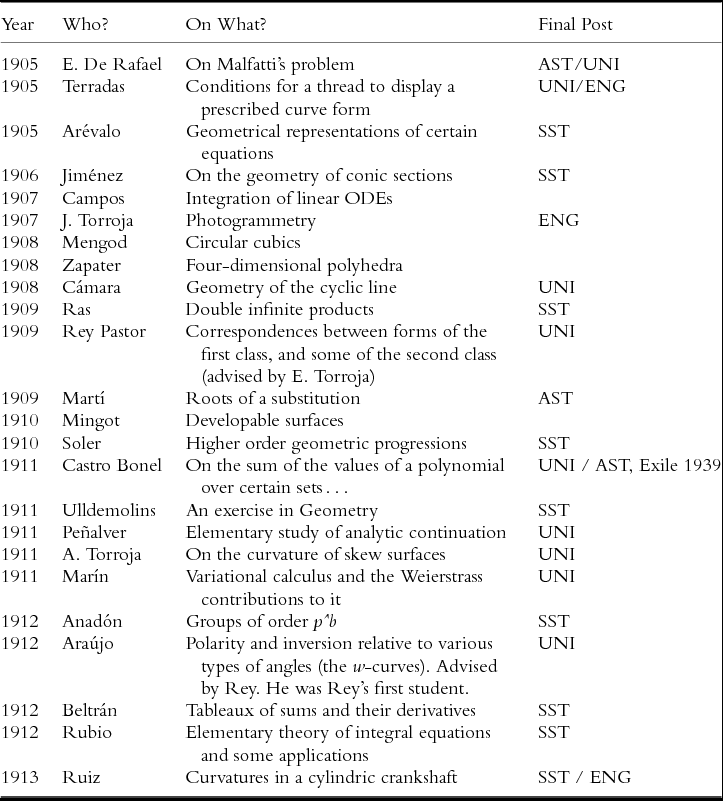
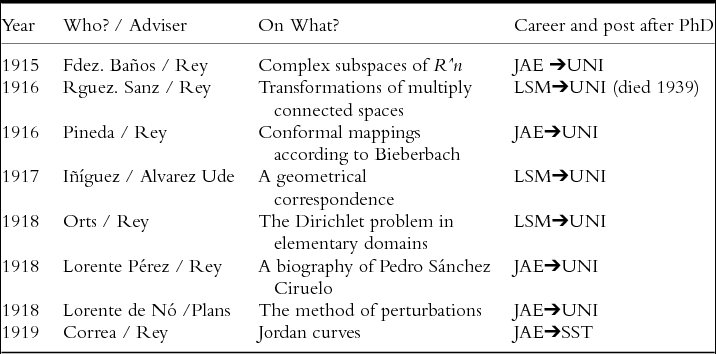
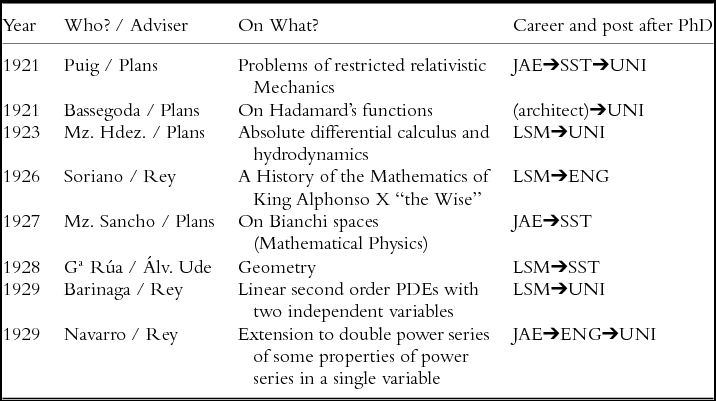
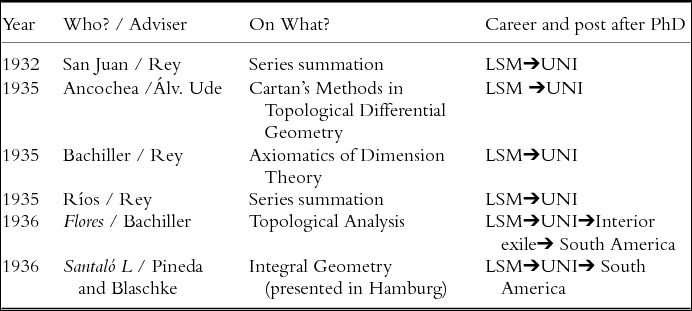
PhD production is presented in Tables 2 to 5, with deliberate omission of the years before 1905 and astronomical topics. They have been adapted from the comprehensive studies (Escribano et al. 2006, 2007). An interesting fact is that the number of mathematical doctorates awarded in Spain between 1904 and 1936 was similar to that in other European countries.
The pre-Rey years (excluding 1900–1904 and Astronomy).

The Rey Pastor years.
Rey travels between Spain and Argentina.
The republican years: los años de los investigadores (the epoch of researchers).
Some statistics and comments to Table 2: From the recorded 23 dissertations, ten deal with geometrical topics; two on geometry and mechanics; eight on analysis; and only two on algebra. The 1911 dissertation by Ulldemolins is entitled “Un Ejercicio de Geometría,” and the 1912 dissertation by Araújo marks the beginning of the saga of Rey's students. Araújo also translated Klein's Elementarmathematik vom höheren Standpunkt aus into Spanish. Acronyms are as follows: UNI, university; SST, secondary school teacher; AST, astronomer; ENG, engineer.
Next, Tables 3 and 4 show how the production of mathematical theses was the monopoly of the LSM and JAE bursars for a number of years, regardless of topic and actual advisor.
Here are some statistics and comments to Table 3. The role of the advisor was played by only three people in the LSM entourage: Rey, six times; Plans and Alvarez Ude, one each, a custom continued during the 1920s and 30s. After Plans’ death in 1934, Pineda succeeded him as advisor, but he had time for only one dissertation (see the Tables below). Iñiguez taught at Saragossa from 1922 and in the Civil War he worked as a cryptographer for Franco's army; after that his teaching was devoted to relativistic mechanics (Soler and López-Brea Reference Soler and López-Brea2008). The architect Bassegoda never did any other mathematics, although he had a lifelong interest in the value of mathematical knowledge (see for instance his booklet, Bassegoda Reference Bassegoda1934, and the 1966 last academic lecture, Bassegoda Reference Bassegoda1966). The acronyms are as follows: JAE, traveled as bursar; LSM, did not travel. From the recorded eight theses, four of them deal with geometrical topics strongly bent towards topological problems, three are on analysis, and one on history.
The whole production stems from the LSM, and the motivation for doctoral topics shows a more up-to-date selection, including recent developments in analysis and their applications, as well as on foundational questions, brought into Spain by Rey in the wake of earlier work by García de Galdeano. Even a thesis was presented on the history of mathematics, a new academic discipline in those times. All dissertations were written and presented in Spain, because the LSM's policy for JAE candidates was to secure doctorates and, if possible, tenures before sending them as bursars: Funded mobility for scientific purposes was an a posteriori question.
Table 4 describes the first period of alternate stages of Rey in Argentina and Spain. Some statistics and comments to this table: Eight theses were read, three in analysis, another three in mechanics, one in history and one in geometry. Note as well the distribution of advisors. The dissertations on mechanical topics are directly related to the international success of relativity theory: Einstein visited Spain in 1923 and offered talks in Madrid and Barcelona, where LSM members acted as translators, wrote down lecture notes, and had even delivered short preliminary courses prior to the visit.
Table 5 presents the few dissertations read in the Republican years. They show the maturity of Spanish mathematical production, even some of them were accompanied by articles in non-Spanish journals, as shown in Table 6 below. Let us offer some statistics and comments to Table 5. Six doctorates were produced, two of them on analysis when the topic of series summation had been introduced in Spain by Rey in the late 1920s, two on geometry and two more on foundational questions. The last two by Santaló and Flores show that international standards were already at hand for people with a Spanish formation. Maybe it is worthwhile to remark here that these two were the only bursars who completed their dissertations abroad, as well as the only exiles of this group after the war. There are many general studies on the Spanish scientific exile, and in chronological order, here are three: (García-Camarero Reference García-Camarero1978; Giral 1994; Peralta Reference Peralta2006). The last one deals specifically with exiled mathematicians. On the general viewpoint of today's Spanish historiography on the postwar, consult Otero Reference Otero2006.
Acknowledged scientific production of Spanish mathematicians from 1904 until the early 1940s, according to the Jahrbuch über die Fortschritte der Mathematik (1868–1942).
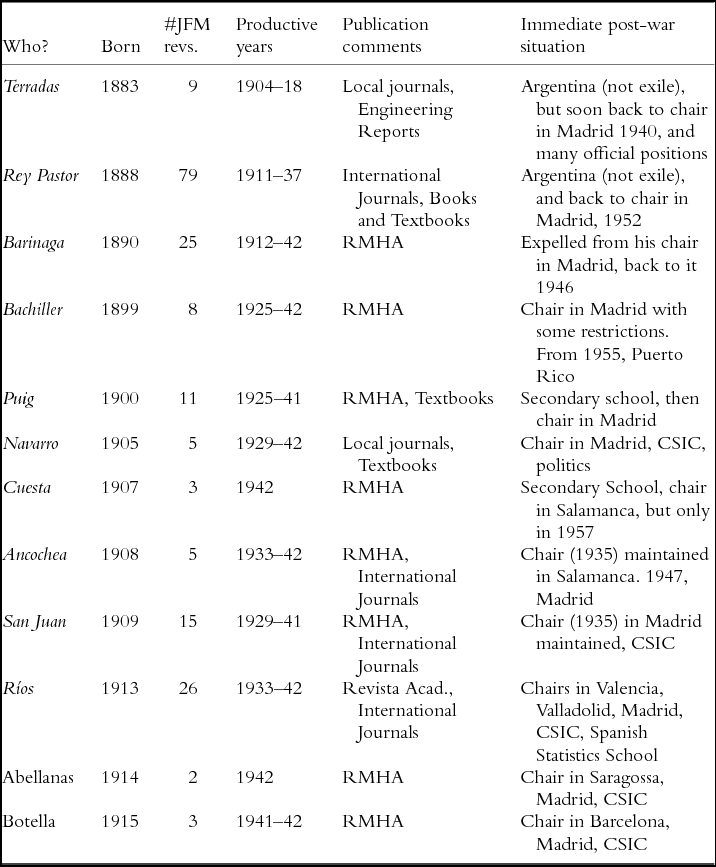
German influence, especially Blaschke's, is clear in this period. Ancochea spent some time at the secondary teaching section of the LSM and then managed to write a dissertation inspired by Blaschke's ideas on topological differential geometry. After that he maintained a lifelong high standard of mathematical production, and his most celebrated paper is still cited today (Ancochea Reference Ancochea1942). San Juan and Ríos also developed research careers after the Civil War, publishing frequently, obtaining grants and contracts, as well as lobbying in the Consejo Superior de Investigaciones Científicas (CSIC), the structure created by the Franco regime in place of the JAE. The CSIC had a mathematical section, the Instituto Jorge Juan, named after the already cited Jorge Juan Santacilla: The institute became the kernel of all official mathematical activity in Spain, and its basic structure was modeled on the LSM. Eventually, it developed regional sections in Barcelona and Saragossa – the LSM had had its own at Barcelona a few years before – as well as satellite and daughter institutions or subsections of a volatile nature, even some at Rey's request from Buenos Aires. It was dismantled in the early 1980s and has been recently reopened under the name of Instituto Nacional de Matemáticas.
Ríos soon gave up mathematical analysis and managed to create his own Institute of Statistics in the late 1940s. Flores, who had studied with Karl Menger (1902–1985) in Vienna at the suggestion of Bachiller and then traveled to the United States in 1937, came back to Republican Spain only to spend long years in the interior exile after the war, surviving on private lessons and for a while on grants awarded by a bank for the study of the n-body problem. Eventually he migrated to Venezuela, but was back in Spain in his last years. The life and mathematical achievement of Flores, who was the son of the famous economist Antonio Flores de Lemus (1876–1941), including comments on his three papers published in the Ergebnisse eines Mathematischen Kolloquiums, can be found in (Padilla Reference Padilla1998). Those papers were later published in Spanish translation by the journal Theoria. Luis Santaló exiled himself at the end of the Civil War, when he had collaborated with the Republican Air Force, and during exile he had a very productive mathematical life, mostly in Argentina. After retirement he returned to Spain, where he was respectfully received and awarded honorary doctorates, and wrote a number of very readable papers on mathematical education.
Bachiller himself deserves attention. A cultivated man, he was between 10 and 15 years older than his fellow doctors and had much more experience in the internal affairs of the JAE/LSM. In 1927 he published a short paper (Bachiller Reference Bachiller1927) in the RMHA on dimension theory inspired by the then current work by Menger, and in 1935 – incidentally, the same year that Menger paid a visit to Madrid – he presented a dissertation on the topic of an axiom system for dimension theory. Menger himself had already started to dwell on this problem – which is still an open one – but his monumental 1928 book does not deal with it (Menger Reference Menger1928 and Menger Reference Menger1929). In Bachiller's case everything points to fulfilling the requisites to occupy a vacant university chair, which he did in 1935, but he never came back to this topic. Recently a biography has been presented stressing the role of Bachiller in the introduction of abstract topics in Spain (Español and Martínez Reference Español and Martínez2010). He corresponded with Menger before and after World War II, and the available letters, written in French, are a mix of mathematical topics, personal, and bureaucratic considerations (Bachiller Reference Bachiller1935, Reference Bachiller1947, and Reference Bachiller1951).
An Overview of Spanish Mathematical Production, 1904–1942
The JAE/LSM imprint is clear regarding the Spanish mathematical production covered by the Jahrbuch über die Fortschritte der Mathematik (JFM) until its end. In comparison with the usual lecture notes having a rather restricted circulation and evolving later into textbooks produced by non-LSM mathematicians, Table 6 shows that acknowledged mathematical production, as was also the case of doctorates, was in the hands of the LSM. The names of active members of the LSM are italicized; the names in Roman type indicate that they had no direct relationship with the organization: Cuesta, Botella, and Abellanas, the last two being younger and directly involved with the new regime during and after the Civil War.
Table 6 deserves some statistics and comments. The JFM does not cover production of mathematicians outside the LSM, among them the already cited geometers Vegas and Cecilio Jiménez Rueda (1858–1934), maybe because classical geometry was an area that the LSM could not control and therefore was deliberately silenced. Others not appearing are Pedro Carrasco Garrorena (1883–1966), a physicist in charge of physical topics in mathematical studies who ended in Mexico, and the historian of mathematics Francisco Vera y Fernández de Córdoba (1888–1967), later exiled in Argentina. A complete and updated list can be found in the set of articles by González-Redondo and others cited in the references. On the final epoch of this refereeing journal, see (Siegmund-Schultze Reference Siegmund-Schultze1993).
After the Civil War 1
Once the Civil War was over, all civil servants were scrutinized and a number of them were sanctioned on political grounds through the so-called depuración process. See the interesting interpretation of (Fernández-Soria Reference Fernández-Soria2006).
As for mathematics and mathematicians, a large majority could maintain their posts and continue their activity in the early years of the Franco regime; a few renowned and politically involved personalities could afford to flee abroad; a number of younger and then nearly anonymous people also fled Spain; and there was a mixed group that survived in a sort of interior exile which only came to an end around 1960. Among the sanctioned, some have already appeared in these pages: Araújo, Álvarez Ude, Bachiller, Barinaga or Luis Santaló. The first four recovered their professor status not later than 1945, and Santaló fled to America. Barinaga spent the sanction years living on private lessons, in sharp contrast with Bachiller's fate, who, theoretically forbidden to occupy managerial or confidence positions, was immediately confirmed in his chair and was present in the Jorge Juan from the very beginning. A possible explanation is that he could be considered trustworthy, for he had been quite active in the war years, for instance a conversation between Bachiller and Helmut Hasse (1898–1979) on board a ship sailing from Oslo is described in (Hasse Reference Hasse1939a). The letters exchanged between Bachiller and Hasse (Bachiller Reference Bachiller1939; Hasse Reference Hasse1939b) show a vivid interest in mathematical topics on the part of Bachiller, the first letter including a very rhetorical adhesion to the postwar regime, most hopefully for the censors’ eyes:
As you can easily figure out, the last few years have not been agreeable ones for us. We have suffered under a most hatred oppression, endured hunger and many other evil things, been isolated from all scientific life (a three-year delay), and looked forward to being liberated by the National army. Happily it occurred, and now those things past seem to be an unpleasant nightmare.Footnote 2 (Bachiller Reference Bachiller1939; translation mine)
Bachiller's work under the Franco regime started by advising three theses to younger people active on the side of the war winners, applying as well the concept of doctorates as passports to tenured chairs: In a sense, he played during those years a role similar to Rey's before the war, so he will appear often in the next pages.
Some of the interior exiles were eventually allowed to play first-order roles in keeping mathematics alive in Spain: in the late 1960s a number of them were actually responsible of the birth of today's Spanish mathematics by fostering the creation of mathematics study tracks in many universities besides the original three. Rey decided to stay in Argentina, even though he had been offered the Jorge Juan chair in 1940. Although he was in contact with former students and colleagues, he only came back to Spain as a visitor in 1948 at the request of Esteban Terradas. Later, in 1952 he resumed his double life between Spain and Argentina, managing to open an Instituto de Cálculo in Madrid within the Jorge Juan. He more or less succeeded in this endeavor – a forerunner of today's massive computation facilities – but his mathematical prime was already over, and his contacts had given way to other people with different ideas. On reaching retirement age he bitterly returned to Argentina.
Most mathematics secondary school teachers, regardless of an earlier relationship with the LSM, were confirmed at their posts in 1940 (BOE, Spanish Official Gazette, March 1, 1940, 1529–1533) and managed to spend a normal life; even some of them, like Carranza, JAE bursar in 1928, were awarded in the 1960s the Spanish distinction for achievement in education, the Cruz de Alfonso X el Sabio.
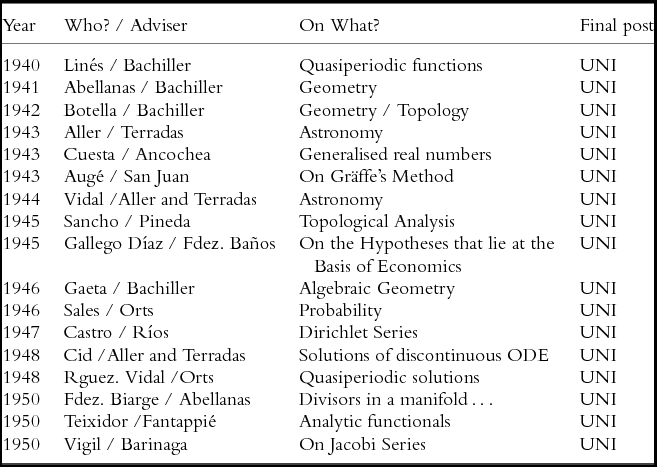
PhD production in the immediate postwar years is presented in Table 7. Some statistics and comments on this table: During the eleven-year period 1940–1950, seventeen theses in the mathematical sciences were presented in Spain: six of them on analysis, five in geometry, two on foundations and topology, two on astronomy, one on numerical mathematics and one on probability. Although in this paper theses on astronomical topics have been excluded, that by Aller in 1943 and its sequel deserve to be here, see below. Of the recorded 12 different advisors, 10 had been former LSM members.
The early postwar years 1940–1950.
A few observations may be made on some of these dissertations. The case of Cuesta, an unconventional mathematician whose main result in his 1943 dissertation is still cited today, and a crude example of the interior exile, has been studied in depth elsewhere (Pacheco Reference Pacheco2008, Pacheco Reference Pacheco2012). Aller and Vidal provide an example that shows how things could work under the Franco regime: Aller was an elderly clergyman (born 1878) who ran a private observatory, from where he corresponded with many distinguished astronomers all around the world, especially on the topic of double stars and computations related to them. Vidal was a secondary school teacher from the teaching section of the LSM, and maybe was not too sure about his professional future. The fact is that Aller obtained a doctorate in 1943 – he had already presented a dissertation in 1908 but apparently he did not comply with the bureaucratic requisite for publishing it – and in 1944 he acted as advisor to Vidal, who after switching from astronomy to differential geometry became the founder of a large mathematical school in Santiago de Compostela. Gallego-Díaz was a former young communist who had collaborated with Bachiller, Barinaga, and others during the Civil War to keep alive the RMHA (series III) in the Republican zone. His formation, completed after the war, included engineering and mathematics as well as chemistry, and he was a most conspicuous person.The title of his dissertation, “Sobre las hipótesis que se hallan en la base de la Economía,” is an exact translation of Riemann's Habilitationsschrift, substituting economics for geometry, and it deals mainly with Riemannian geometry. An interesting reading related to it, but with no mathematics, is (Brunet and Pastor Reference Brunet and Pastor2001). The dissertation by Augé had its origin in the need for applied mathematicians when the Franco regime, at Terradas’ suggestion, embarked in aircraft production during World War II and an Escuela de Aeronáutica was created, where personnel from the Jorge Juan were hired in a re-edition of the Escuela Superior de Aerotécnica scheme of 1928 established by General Herrera.
It must be noted that two JAE bursars, Saldaña and Araújo, had already worked on numerical mathematics, and these episodes, and the interest of Gallego-Díaz in the early applications of mathematics to biology – he even managed to publish in 1937 a short paper in Russian (Diaz Reference Diaz1937) – define the first steps of modern applied mathematics in Spain. Gaeta self-exiled to the United States in 1965 in solidarity with three other professors who had been expelled from their chairs that same year, and came back to Spain after Franco's death in 1975. Ríos, in his last incursion into analysis, advised Castro in 1947, and soon the Italian Fantappié, a known supporter of the Mussolini regime as well as a renowned mathematician and physicist, is found advising a PhD candidate in Spain. Many pre-war Spanish-German relationships established during the LSM years, and kept alive during the World War II years, were reactivated as soon as the denazification process was over in Germany, and also Blaschke advised theses in Spain, but this is outside the time scope of this paper.
After the Civil War 2: Spanish Mathematicians Travel Again (but do not move much)
In the dark post-Civil War years, when the Nazis in Germany and the fascists in Italy were still in power, traveling abroad was highly restricted for Spaniards. The overall ruinous Spanish economic situation, as well as the generalized repression, were responsible for the restrictions. Therefore, those who could actually travel did it in a sort of official representation with a high propagandistic value. The relevant information can be found in the Memorias Anuales of the CSIC. Moreover, all this traveling was covered by the daily newspapers, especially ABC in Madrid and Seville and La Vanguardia in Barcelona.
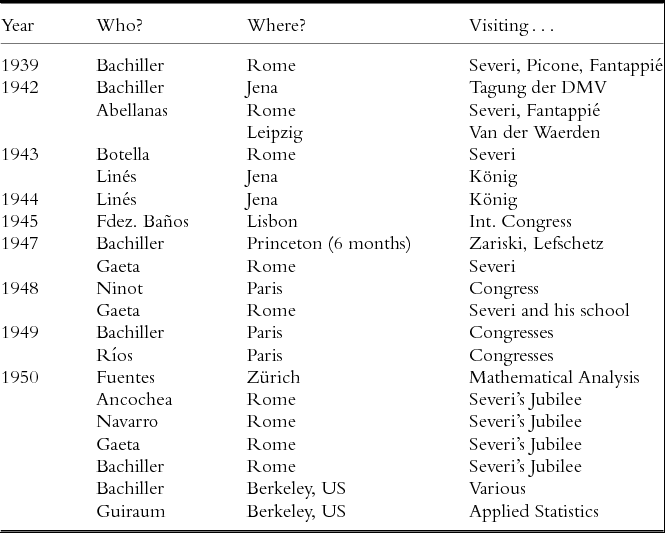
Observing Table 8 in some detail, the sanctioned Bachiller is found traveling to Italy immediately after the end of the Civil War in order to establish or renew scientific contacts – these had been restricted to the Axis Powers, Vichy's France, and Portugal. Shortly after that, he is in Jena and Rome while his second postwar student Abellanas, who had already obtained a university chair at Saragossa, traveled to Leipzig for a stay with Van der Waerden. The other two students, Botella and Linés, also spent six-month periods in Rome and Jena, respectively, with Severi and König: Both had also secured their chairs. Maybe this is the moment to point out the importance acquired by the Spanish Church after the Civil War, even in mathematical affairs: the presidency of juries for tenures in mathematics was almost invariably accorded to Francisco Navarro, the disciple of Plans. Navarro was very close to the catholic organization Opus Dei, and Botella, who shortly after his post-tenure stage in Rome became a priest, was among its first members before the Civil War, when it was only a small group.
Spanish mathematicians traveling during the early postwar years.
But most interesting are the six months Bachiller spent at Princeton in 1947. Stripped of its possible scientific interest, the episode must be understood from an absolutely political viewpoint, a sort of mathematical embassy during the years Franco's Spain was isolated by the UNO resolutions accorded because of its earlier connivance with Nazis and fascists. The presence of Ríos – who in the meantime had created his Institute of Statistics –, Bachiller, and some others in International Congresses in Paris is a continuation of this policy. It is also known that Ancochea, Bachiller, and two more were the only individual Spanish members of the American Mathematical Society in 1948 – there were no institutional ones. Also a few visits to Spain by mathematicians like Fréchet (1941) and some Portuguese ones, promoted by Bachiller, are recorded during those years.
In 1950 the political situation became more relaxed and four Spaniards are found at Severi's Jubilee in Rome (Anon. 1950): that was the end of the epoch shown in Table 8, and the beginning of a new relationship scheme where the United States became the main partner. But that took still two or three more years and will not be considered in this paper.
Conclusions
The problem of continuity of science and scientific endeavor across singular episodes, in this case the Spanish Civil War and incidentally World War II, is an interesting topic having to do not only with science, but also with social, political, and psychological questions. Here no general ideas will be considered, only facts about doing or teaching mathematics in Spain around the Civil War.
It has been shown how before the Civil War Spanish mathematical activity was split into the Rey Pastor group and the rest, and that Rey's group practically monopolized both mathematical production (Table 6) and the occupation of key tenured positions, as well as the formation of an élite of secondary school teachers, especially after 1921. One of the reasons for this success was that a number of integrants of the Rey group, himself included, had been able to officially travel to Austria, France, Germany, Italy, and Switzerland, importing mathematical knowledge and linking personal contacts.
During the Civil War there was very little mathematical activity in Spain; nevertheless, some enthusiasts managed to publish a few numbers of the RMHA (series III) in the Republican zone and even to travel abroad, like Bachiller visiting Oslo and meeting there the German Hasse. Teaching at the secondary level, when possible, was in both zones in the hands of people who, whatever their prior formation, had been politically accepted by the corresponding authorities.
After the war, the political depuration process banned a number of tenured people from the classrooms, even some for life, thus sending them into an interior exile. In the case of higher mathematics, it has been established that the number of professors suffering a long sanction was rather small. Ancochea, Ríos, or San Juan, as well as the sanctioned Bachiller, went on working on the same topics as before, simply changing the LSM environment for the Jorge Juan one, while the policy of occupying tenured positions as soon as possible was adopted and enhanced by the new rulers for candidates fulfilling the necessary condition of firmly adhering to the regime, while publishing was readily secured through the RMHA (series IV). Among the sanctioned, Barinaga and the younger Flores, and Gallego-Díaz worked privately in academies for the preparation of entrance examinations to the engineering schools and were tolerated to the point that they were even able to edit and maintain from 1941 onwards the journal Euclides, which was in print until 1962. Interior exiles without strict political grounds are more difficult to track. For example, Cuesta, who had obtained his PhD as early as 1943 and had developed an interesting mathematical trajectory, needed to wait until 1957 for a chair in Salamanca, and before that he had to spend a year as a colaborador, the lower rank of the Jorge Juan personnel. Gallego-Díaz was finally appointed to a physics chair in 1955, after he had traveled all around Europe on his own visiting mathematicians and research centers.
On the other hand, the majority of secondary education and a large part of primary education were transferred to several religious orders and many official institutions were dismantled: as a rule, only two official secondary schools or Institutos (for girls and boys) were kept in each province – there are 50 of them in Spain. In order to maintain an authorized school, the order needed only two people endowed with university degrees, one with any sort of science degree, and the other with a degree in some branch of the humanities. If the number of students was large, anyone could be in charge of the teaching duties under the theoretical supervision of the degree-holder. Therefore it happened that a considerable number of young people all over the country spent their secondary school years without ever having listened to a mathematician. The pre-war pedagogical efforts of the JAE/LSM were abandoned for some time on the grounds of their supposedly ideological charge, even though the remaining official secondary schools did have well trained mathematicians among their staff (Villalaín Reference Villalaín2011). Nevertheless, the few interested secondary school teachers, usually related to the Jorge Juan, could still publish elementary results and teaching experiences in the journal Matemática Elemental and its sequel from 1947 onwards, Gaceta Matemática, thus providing further evidence of continuity.
Schemes for mobility did not change, though traveling was restricted to the few who were allowed certain privileges when acting in behalf of the regime in the field of higher education, so the effect of the Spanish Civil War on mathematics can be compared with the situation described in (Siegmund-Schultze Reference Siegmund-Schultze, Macrakis and Hoffmann1999) for East Germany after World War II.
No new mathematics was developed in Spain as a result of the war effort, except for fulfilling the needs of a projected aircraft production that could only be properly developed after World War II, when sanctions on Germany forbade German industry to build airplanes. Junkers and Messerschmidts were constructed in Spain under different names until the early 1950s. It is also known that Franco's army had a couple of commercial German ciphering Enigma machines, but the cryptographer Iñíguez seems not to have had access to them, and indeed no research was done in this field. Most new warfare material came into Spain either from Germany and Italy – for the Franco side – or from Russia for the Republican side, but as a rule the appropriate technicians were included in order to assess the performance of aircraft, machine-guns etc., for future use in the then imminent World War II, where mathematics and mathematicians did play relevant roles.
Therefore, it may be concluded that there existed a clear continuity in higher mathematics affairs in Spain across the Civil War, only some difference being observed in a recovery of applied mathematics due to the regime's interest in becoming a power in aircraft building, developing an industry that, as was explained above, had been popular and advanced in Spain in the late 1920s, so not even this Francoist dream was a new one.
An interesting final remark: 2007 was the centennial year of the JAE, and on that occasion the CSIC published a commemorative volume containing a joint history of both institutions in the form of contributions by a great number of researchers, with the aim of stressing the fact that the CSIC is actually the natural continuation of the JAE (Puig-Samper Reference Puig-Samper2007). Curiously enough, neither the LSM nor the Jorge Juan deserved being studied there. In the same line, the companion volume of an itinerant exhibition on the Spanish-German scientific contacts, published in collaboration with the German Academic Interchange Service, does not deal with Spanish mathematics and mathematicians (Rebok Reference Rebok2010).
Appendix: Dramatis personae
For those not used to the Spanish way of naming people, the rule is that Spaniards have one or more first names and two family names, for example, in Julio Rey Pastor, “Julio” is the first name, so “Rey” and “Pastor” are the two family or second names. Usually, the first family name is the father's first family name, and the second one, the mother's first one. In our time this is not compulsory anymore and the order may be legally inverted.
When addressing someone, the polite and formal custom is to use Don (Doña, for women) with the first name(s). In our example, “Don Julio.” If the family name is used, the rule is to employ Señor (for women, Señora). The example would read “Señor Rey” or “Señor Rey Pastor.” These addresses are additive, but not commutative: “Señor Don Julio Rey” is all right, but “Don Señor Julio Rey” is not. In many official papers it is current to write the first name(s) last, separated from the family names by a comma. This convention is adopted in the list below.
In informal treatment, friends and close acquaintances would talk to or about “Julio” or “Rey.” The most usual, semi-official way is to name people, especially men, with only one of the family names, as a rule the first one, but if it is a very common one, the second or even both may be used: in Mathematics, “Rey Pastor” is more popular than just “Rey.”
Here most people appearing in the tables are listed. Some others, with their birth and death years, appear in the text body. The usual naming is emphasized in boldtype. Following common written usage, very common family names are abbreviated: Álv., Álvarez; Fernández, Fdez.; García, Ga; González, Glez.; Hernández, Hdez.; Martínez, Mz.; Rodríguez, Rguez., etc.
Abellanas Cebollero, Pedro (1914–1999)
Aller Ulloa, Ramón María (1878–1966)
Álvarez Aguirre, Emilio (? alive in 1971)
Álvarez Ude, José (1876–1958)
Amado Lóriga, Santiago (General) (1881–1974)
Anadón Laplaza, Santos (? published in Matemática Elemental, 1945)
Ancochea Quevedo, Germán (1908–1981)
Araújo García, Roberto (1888–1960)
Arévalo Carretero, Aurelio (? at a Professional School in the nineteen-fifties)
Augé Farreras, Juan (1919–1993)
Balanzat Santos, Manuel (1912–1994)
Barinaga Mata, José (1890–1965)
Bassegoda Musté, Buenaventura (1896–1987)
Botella Raduán, Francisco (1915–1987)
Cámara Tecedor, Sixto (1878–1964)
Campos Campo, Jesús (? in 1935 as a left activist)
Capdevila d’Oriola, María (1905–1993)
Castelló Lloberas, Luis (?-1959)
Castro Bonel, Honorato (1885–1962)
Castro Brzezicki, Antonio (1922–1992)
Cid Palacios, Rafael (1918–2004)
Correa Arizmendi, Miguel (? found many times in the decade of 1910)
Cuesta Dutari, Norberto (1907–1989)
Eyaralar Almazán, José María (1890–1944)
Fdez.-Arenas Herrero, Prudencio (? at a Professional School in the nineteen-fifties)
Fdez. Baños, Olegario (1886–1946)
Fdez. Biarge, Julio (1924–2012)
Flores Giménez, Antonio (1912–1992)
Fontanilla García, Ruperto (?-1982)
Fuentes Mira, José Ramón (? teaching at Granada University in the nineteen-seventies)
Gaeta Maurelo, Federico (1923–2007)
Gallego Díaz, José (1915–1965)
García Miranda, Manuel (? translator of Poincaré's divulgation books)
García Rúa, Joaquín (1893–1985)
Gil Santiago, Eduardo (1903-?) (in Venezuela in the nineteen-fifties)
Guiraum Martín, Alfonso (1909-?)
Iñiguez Almech, José María (1897–1983)
Jiménez González, Enrique (1888–1957)
Linés Escardó, Enrique (1914–1988)
Lorente de Nó, Fernando (1896–1955)
Lorente Pérez, José (1891–1983)
Marín Toyos, Daniel (?-1948)
Martín Escobar, Teófilo (at a Professional School in the nineteen-sixties)
Martín Mengod, Antonio (? author of Geometry textbooks around 1910)
Martínez Sancho, María (1901–1995)
Mingot Shelly, José (? translated Euclid's Elements [I-IV] from the Italian in 1954)
Montáñez Matilla, Diego (? author of a number of elementary texts in the nineteen-thirties)
Navarro Borrás, Francisco (1905–1970)
Ninot Nolla, Joaquín (? PhD 1961)
Orts Aracil, José (1891–1968)
Paunero Ruiz, Luis (? very active in the 1930s)
Peñalver Bachiller, Patricio (1890–1979)
Pérez Carranza, Emilio (?-1985)
Pineda Gutiérrez, Pedro (1891–1983)
Plans y Freyre, José María (1878–1934)
Puig Adam, Pedro (1900–1960)
Rafael Verhulst, Enrique (1885–1955)
Ras Claravalls, Juan (1885–1973)
Rey Pastor, Julio (1888–1962)
Ríos García, Sixto (1913–2008)
Rguez. Bachiller, Tomás (1899–1980)
Rguez. Sanz, José (1888–1939)
Rguez. Vidal, Rafael (1916–1993)
Romero Carrasco, Francisco (? very active until 1938)
Rubio Vidal, Francisco (? at Oviedo in the 1920s)
Ruiz Ponsetí, Eduardo (1892–1948)
Sáez Muñoz, Guillermo (1868–1934)
Saldaña Pérez, Ángel (1892-?)
Sales Vallés, Francisco (1914–2005)
San Juan Llosá, Ricardo (1908–1969)
Sancho San Román, Juan (1919–2004)
Santaló Sors, Luis (1911–2001)
Santaló Sors, Marcelo (1905-?)
Silván González, Graciano (1874–1934)
Soler Dordal, Eliseo (? at a secondary school in the 1950s)
Soriano Viguera, José (? member of Acción Católica in the 1940s)
Tallada Comella, Fernando (1881–1937)
Teixidor Batlle, José (1920–1989)
Terradas Illa, Esteban (1883–1950)
Torroja Caballé, Eduardo (1847–1918)
Torroja Miret, Antonio (1888–1974)
Torroja Miret, Eduardo (1899–1961)
Torroja Miret, José María (1884–1954)
Vidal Abascal Enrique (1908- 1994)
Vigil Vázquez, Luis (1914–2003)
Vinós Santos, Ruperto (1888–1957)
Acknowledgments
The author is indebted to Franz Lemmermeyer (Ellwangen) for the information on the number of doctorates read in Europe in those years, as well as for transcriptions of the three 1939 letters interchanged between Bachiller and Hasse relative to renewal of membership of Bachiller in the Deutsche Mathematiker Vereinigung, found in the Helmut Hasse Nachlass at Göttingen. Bernhard Beham (Vienna) is acknowledged for interesting discussions and photocopies of three letters: Bachiller (Madrid) to Menger (Vienna), December 12, 1935, where Bachiller complains that Flores does not work hard enough to complete his Spanish doctoral dissertation; Bachiller (Princeton) to Menger (Chicago), June 6, 1947; Bachiller (Madrid) to Menger (Paris), April 13, 1951. They were obtained from the Autographenabteilung der Wienbibliothek (Korrespondenzen). The author is grateful to Dr. Viktor D. Lakhno and his team at the Institute of Mathematical Problems of Biology in Moscow for a copy of the 1937 paper by Gallego-Díaz. I am also grateful for the hospitality of the Max-Planck-Institute für Wissenschaftsgeschichte in Berlin in various periods during 2011 and 2012, and to the Mathematisches Forschungsinstitut Oberwolfach, where a first draft of this paper was presented in the Workshop “Emigration of Mathematicians and Transmission of Mathematics: Historical Lessons and Consequences of the Third Reich,” November 2011.