Introduction
On the night of February 27-28, 2010, the Xynthia storm struck the French Départements of Charente-Maritime and Vendée. In Charente-Maritime, the storm resulted in acute sea submersion and flooding of nearly 5,000 homes, as well as loss of power in approximately 70,000 homes, flooded roads, submersion of agricultural fields, damaged oyster farms and damage to local businesses. 1 , 2 The storm caused 12 deaths and left approximately 200 people injured in that Département.
In the wake of the storm, the Medico-Psychological Emergency Unit (CUMP) of the Département of Charente-Maritime was dispatched to provide psychological assistance to victims of flooded areas. Health workers trained in post-traumatic counseling conducted more than 400 individual field interventions in the first two weeks after the storm. Aid workers from the CUMP and social assistants working in communities alerted local health authorities to high degrees of psychological distress among victims.
As in similar catastrophes, various degrees of indirect and delayed psychological distress was expected.Reference Ahern, Kovats, Wilkinson, Few and Matthies 3 A number of studies conducted after floods in France, England, and the US have shown mental suffering in the short-term, mid-term, and long-term periods after natural catastrophes. 4 - Reference Kessler, Galea, Gruber, Sampson, Ursano and Wessely 9 The most specific mental health risk after a catastrophe as described in the literature is post-traumatic stress disorder (PTSD). Other post-traumatic psychological effects including depression, anxiety, suicide, and addictive behavior have been described in previous studies occurring separately or associated with PTSD.Reference Ahern, Sari Kovats, Wilkinson, Few and Matthies 10
Early contacts between the regional health agency and local non-health providers of emergency relief revealed that storm victims expressed the need for psychological support. To address the need for psychological intervention, the CUMP, which provides mental health services during the acute phase, was activated. The CUMP was comprised of general practitioners (GPs) and social workers in local town halls. General practitioners participated in an information session on psychological trauma. In addition, health authorities set up two types of no-cost, temporary mental health outreach services one month after the storm in order to improve access to mental health care during the mid-term period following the disaster. The first service was psychological telephone counseling for administrative issues and for those whom social officers identified as possibly benefiting from such counseling. The second service was initial psychological counseling provided by psychologists trained in post-traumatic disorders. This service operated on a bi-weekly basis in the five town halls of the most affected areas. When necessary, users of the psychological service were referred to routine health services for treatment and follow-up. These outreach psychological support services were originally set up to run for one month and meant to reinforce the available routine mental health services (hospital psychiatric ward, medico-psychological centers, and GPs).
To assess mental health service use for the regional health authority in the aftermath of Xynthia storm, the regional office of the French Institute for Public Health Surveillance (InVS) set up a limited duration ad hoc surveillance program. The mental health outreach support care program and epidemiological mental health surveillance program represented a new strategy in the post-emergency phase of a natural disaster for France.
Surveillance program objectives were: (1) to monitor the use of mental health services by first-time users, including those provided through the outreach program; (2) to describe the characteristics of individuals with signs of psychological distress at their first visit; and (3) to provide timely information to health care providers to allow for adaptation of health care delivery. This paper describes the findings of the post-emergency mental health surveillance.
Methods
This study was an individual, consultation-based surveillance of a population of 36,555 (population in 2009 estimated by the National Institute of Statistics and Economic Studies) in the storm- and flood-affected areas in the five districts of the Département of Charentes-Maritime. The surveillance period was from six weeks to six months after the storm event.
Surveillance Informants
Personnel trained in mental health who were working in the psychiatric emergency ward of the reference public hospital or in one of the six medico-psychological centers of the area (hospital-affiliated centers providing free-of-charge psychological care for the general population) and GPs were asked to complete a questionnaire for each patient meeting the case definition, and to send it to the local office of the InVS on a daily or weekly basis.
Case Definition
A new case was defined as a person consulting a health care provider located in the targeted geographical area and presenting for the first time with any type of psychological symptoms that the health provider found to be directly or indirectly associated with Xynthia storm.
Data Collection
Epidemiologists of the InVS and psychiatrists of the CUMP developed a special individual data sheet with closed-ended questions grouped in four sections: origin of referral, demographic information (age, sex, and address), clinical outcome, and recommended follow-up. The types of clinical outcomes were similar to the ones routinely used by the health professionals of the CUMP. They were restricted to categories of psychological signs and symptoms, with only one psychiatric disorder, PTSD, included in the list of psychological manifestations.
Psychopathology was assessed using a clinical interview. Health providers were asked to complete one data sheet per person with the information available at the clinical encounter when psychological symptoms or signs were first detected.
Data sheets were either directly faxed to the regional office of the InVS by health providers or were first collected by the representative of the health service who then sent them to the regional office of the InVS.
Data Analysis
Data were entered into Epidata version 3.1 (The Epidata Association, Odense, Denmark) and analyzed in the regional office of the InVS in Poitiers. Differences in proportion were compared using chi-square tests with an alpha level of 0.05.
Communication of Results
Update reports produced by the regional office of the InVS were sent to surveillance participants (informants), local authorities, and health authorities in charge of the outreach mental health services. Reports were available on the websites of the Institute of Public Health Surveillance and of the regional health authorities.
Evaluation
Data were assessed with a questionnaire survey targeting informants. Other aspects of the surveillance program were assessed in meetings with local health providers within three months after the end of the surveillance.
Ethical Considerations
Information collected was individual and indirectly nominative. The surveillance protocol was submitted for authorization to the French regulatory authority (Commission nationale de l'informatique et des libertés, decision DE2010-50, authorisation request n°1431379).
Results
The surveillance program started six weeks after the storm and was active for six months. The low number of new cases declared over the last six-week period was the main reason for ending the surveillance.
Participation in Surveillance Activity
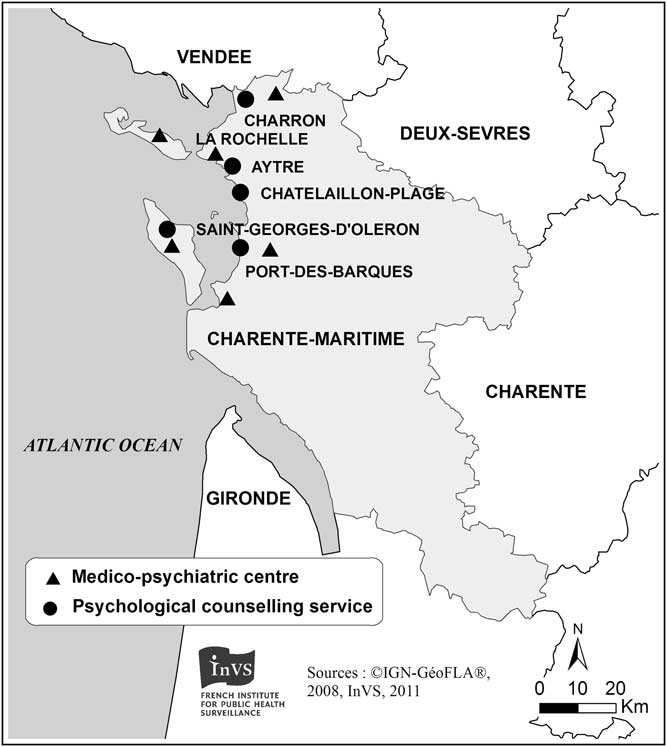
Health care providers who sent at least one record sheet during the surveillance period worked in the following organizational structures: all six permanent medico-psychiatric centers, the psychological phone counseling service, the psychological counseling service provided in the five town halls of the targeted districts, and the permanent psychiatric services of La Rochelle hospital (Figure 1). The local GPs elected not to participate in the surveillance program.
Location of Participants in the Post-Xynthia Psychological-Specific Surveillance, April 7 - September 19, 2010 (N = 218)

Evolution of Case Notification
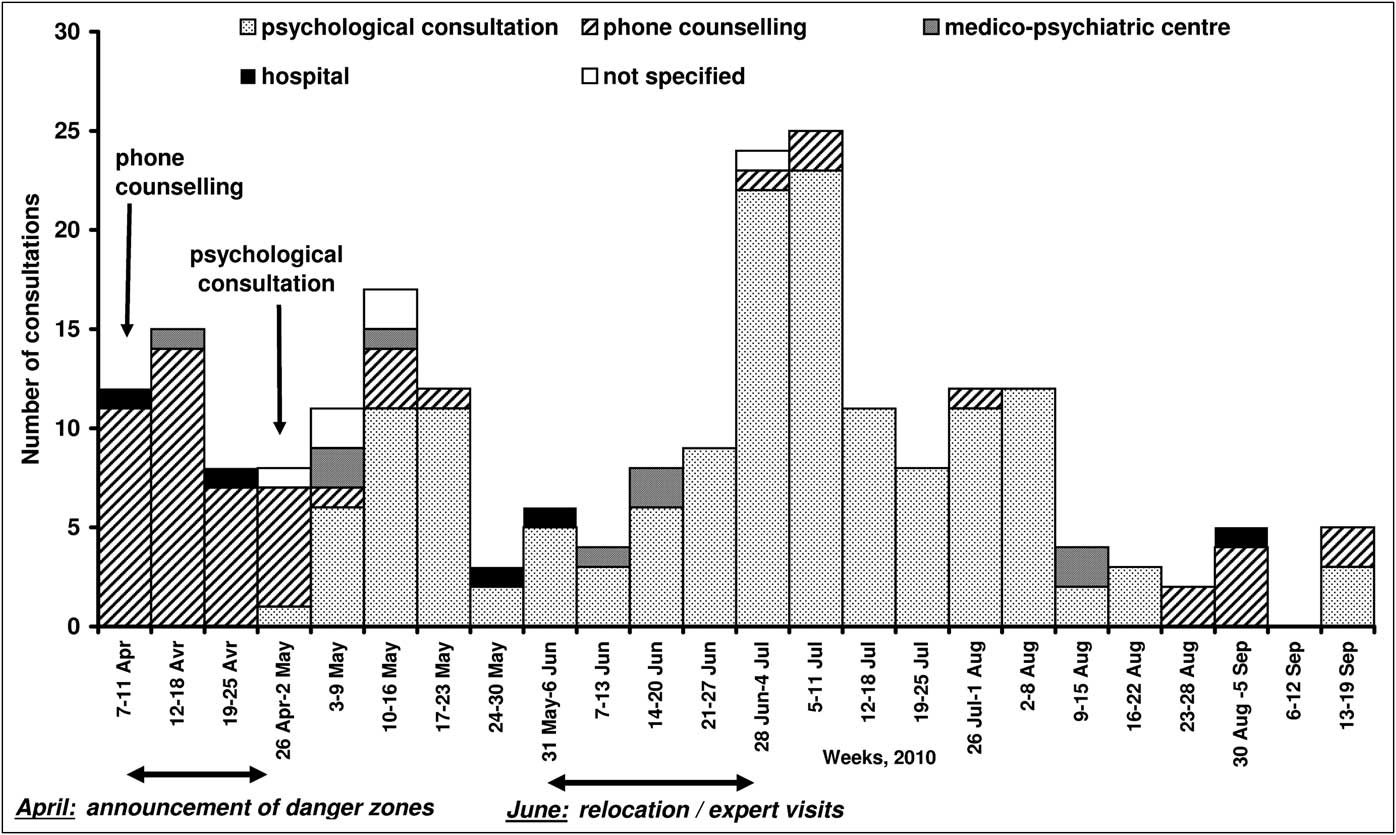
A total of 227 data sheets were received from April 7 through September 19, 2010. There was an average of 12 new cases per week during the first seven weeks of surveillance (range = 8-18). This period corresponded to the second and third months after the storm (Figure 2). This was also the period when the authorities determined which houses were uninhabitable, a potentially stressful event for the local population.
Evolution of Case Notification, Post-Xynthia Psychological-Specific Surveillance, April 7 - September 19, 2010 (N = 225)

Four months after the storm, the weekly number of new cases increased and reached a peak of 25 new cases per week. This peak coincided with two potentially stressful events: the relocation of flood victims from temporary summer rental housing, and the first visits of government technical experts to assess the value of houses considered uninhabitable. The number of new cases decreased to 0-5 per week in the last six weeks of surveillance, six months after the storm.
In the first month of surveillance, 88% of cases were telephone counselor calls. In the remaining period of surveillance, 81% of cases originated from direct town hall counseling sessions. Overall, traditional treatment sources of hospital-based psychiatrists and medico-psychiatric centers accounted for 14 cases (six percent).
The town halls with the highest reported cases were Châtelaillon and its second site Yves (56 cases, 38%), followed by Charron (34 cases, 23%), Port-des-Barques (30 cases, 20%), Aytré (21 cases, 14%), and finally, Saint Georges d'Oléron (seven cases, five percent).
Characteristics of Persons with Psychological Effects
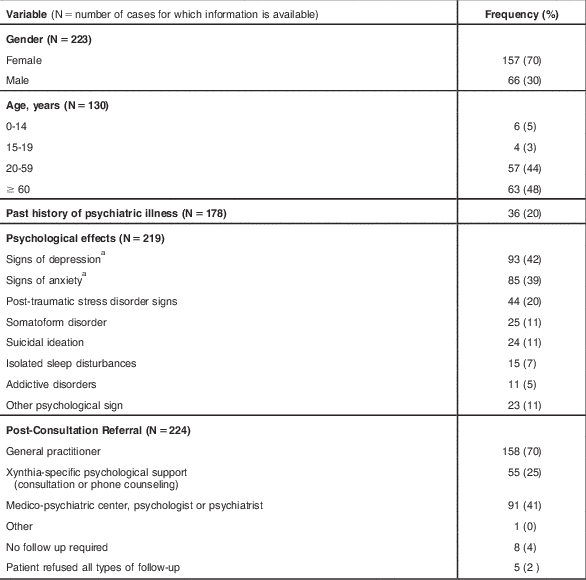
Cases were predominantly women (70%) (Table 1). Nearly half (63/130) of cases for which information was available were adults ≥60 years of age. Among the 178 cases for which the information was available, 142 cases (80%) did not report a past history of psychiatric illness.
Characteristics of Cases Documented Through Psychological-Specific Surveillance, April 7 - September 19, 2010

aWithout PTSD.
The most frequent psychological symptoms detected during the first clinical encounter were depressive signs (43%), signs of anxiety (39%), and signs of PTSD (20%). One tenth of cases reported suicidal ideation. Other psychological signs observed included isolated sleep disorder, somatoform disorder, and addictive disorders (Table 1). Over one third of cases had two or more mental health outcomes noted.
Nearly all cases with psychological symptoms required medical follow-up (eight cases required no follow-up) (Table 1). A total of 158 persons (71%) were referred to a GP for follow-up. Thirty-four persons (16%) required specialized care by a psychologist or psychiatrist in an ambulatory setting or with hospitalization. Persons with past history of psychiatric illness were more often referred for follow-up to a medico-psychiatric center than other persons (P value for X2 test = .0018).
Communication of Surveillance Data
Within the surveillance period following the storm, five cumulative update reports identifying trends over time were produced by the regional office of the InVS and made available to public health providers and local authorities.
Evaluation of the Data Collection Tool by Informants
Among the seven health providers who participated in the survey for feedback (five from the medico-psychological centers and two from the outreach services), six found the questionnaire easy to complete, and all found the mailing procedure easy. For four informants, the questionnaire was useful for conducting the clinical encounter.
Discussion
In France, volunteer CUMP staff generally intervene during the acute phase of a disaster. Yet the psychological impact of such an event may result in a high number of individuals in need of psychological support beyond the first few days. Routine health services may be inadequately located or insufficient to address this extra health need. For the first time in France, after the Xynthia storm in 2010, temporary outreach services were set up to reinforce the mental health care network and were monitored by a surveillance program in the post-emergency phase.
The findings of this post-emergency surveillance program suggest that residents of geographical areas affected by the storm were vulnerable to episodes of psychological suffering, and used the psychological outreach services up to six months post-disaster. The outreach services that relied on provision of free-of-charge community-based initial psychological counseling (by phone or by consultation on site in flooded towns) had the highest attendance of all services participating in the surveillance program. Surveillance allowed for longitudinal assessment of mental health service attendance by first-time users. It revealed that the use of outreach services for initial counseling was high for two months of monitoring, and that attendance by new cases declined six months after the storm.
For feasible and timely implementation of the surveillance program, psychological signs were described and reported when first detected at consultation. Although clinical outcomes were not based on full diagnostic scales, data showed a predominance of signs of anxiety and depression consistent with psychological effects of disaster documented in the literature.Reference Ahern, Kovats, Wilkinson, Few and Matthies 3
A majority of those who consulted the mental health services were women. Although surveillance data cannot be compared directly with prevalence data from other studies, this finding is consistent with known risk factors associated with post-disaster psychological distress.Reference Ahern, Kovats, Wilkinson, Few and Matthies 3 The observed proportion of users ≥60 years of age was also high (48%), but the local population profile shows a particularly high proportion of adults ≥60 years of age (32%).
Surveillance data included indicators of severe psychological distress. These included the presence of suicidal ideation among one fifth of cases documented, and the finding that follow-up by a psychiatry service was recommended for more than one sixth of documented cases presenting psychological signs.
Psychological distress following a disaster is generally assessed through special surveys aimed at measuring the wider public health impact among the exposed population. In the post-disaster situation, such assessment surveys are methodologically challenging.Reference Kessler and Wittchen 11 , Reference Galea, Maxwell and Norris 12 Assessment of mental health service use through population surveys, by telephone or mail, or through cohort studies, can also provide useful information on prevalence and predictors of care seeking behavior, but results are not available for immediate action.Reference Boscarino, Adams and Figley 13 - Reference Wang, Gruber and Powers 17 For the Xynthia disaster event, surveillance data was available shortly after the event, and enabled health authorities to adapt the outreach mental health services. The continuing registration of new cases led the authorities to keep the outreach program active beyond the originally planned one-month period. Another example of the ability of the surveillance program to guide public health action included opening a consultation site in the town hall of Yves based on registered cases, and then closing down the service at a later time after a drop in attendance.
Following the Xynthia storm, the release of surveillance update reports showing the evolution of new cases with signs of mental suffering kept local authorities informed about the psychological effects of the storm. Such feedback bulletins can be useful for raising awareness of decision makers of the mid- and long-term psychological effects of a disaster and its aftermath.
The following attributes have been described as necessary for the adequate function of a public health surveillance system, and many were associated with the Xynthia surveillance program: 18
-
• Simplicity—The surveillance program used a single, easy-to-complete data sheet (multiple choice answers). The symptom-based psychological outcomes allowed use by different categories of health professionals, while providing sufficient information to classify the type of psychological outcome.
-
• Flexibility—The only changing information needs related to the variable age. This variable was modified on the data sheet during the program (from age to age group). It was not possible to retrieve the information on age for the batch of cases, as data sheets were anonymous.
-
• Data Quality—Most data were complete, with the exception of one demographic variable (age). The use of a wide range of answers as well as the opportunity to specify an answer for most of the important variables allowed for good data quality.
-
• Acceptability—Acceptability was high among health professionals working in the field of mental health. However, GPs elected not to participate in the surveillance program.
-
• Sensitivity—The use of symptom-based case identification instead of psychiatric disorders increased the sensitivity of detecting psychological manifestations.
-
• Representativeness—Findings from the Xynthia surveillance data cannot be generalized to the population seeking psychological support at large because GPs, key primary care providers, did not participate.
-
• Timeliness—As data from record sheets were encoded on a continuous basis at the regional level, health authorities received verbal reports on demand before release of feedback reports. The reports were published while the outreach program was ongoing.
-
• Stability—Once established, the system required only a fax to send/receive data sheets. Computer data entry was facilitated by limiting data to a one-page questionnaire. Data analysis was by simple univariate analysis, and regular phone calls were made to ensure participation. The format of feedback reports was standardized to facilitate production.
Limitations
The surveillance program had several limitations. The fact that GPs did not participate in the surveillance limits the representativeness of results. Although the exact reason could not be assessed, a reasonable hypothesis is that the GPs (some of whom had their offices flooded) in France are generally reluctant to participate in any study, and that a briefing in the post-emergency phase was not sufficient to convince them of the utility of counting cases.
Among the respondents, exhaustiveness of case reporting was not measured, but there are elements suggesting a high rate of completeness from participants: all informants (from all services) received reminder calls regularly, and late forms were accepted. All services contacted by phone claimed a continuous participation throughout the surveillance period. Surveillance lasted six months after the storm and this could have contributed to keeping informants motivated, but the completeness of case reporting cannot be determined.
As surveillance data were not representative of all health providers, and as people with psychological distress often do not seek help from health services, the results of this study cannot be used to measure the disaster mental health impact for the total population. Another limitation relates to the fact that information was recorded only for initial consultations. Total workload of mental health services could thus not be assessed.
Strong Points
Despite the limitations, the surveillance program appears to have been a useful tool for monitoring the occurrence of psychological effects in the post-emergency phase of the Xynthia event. Another important outcome of the surveillance was that it allowed for objective identification of mental health suffering in the months following the storm, beyond the acute phase.
Most importantly, this work set a precedent in terms of preparedness for a catastrophe in the field of mental health. Further work is underway to improve epidemiological surveillance of mental health consequences and mental health service use following a major disaster. Measures include work with GP organizations for preparation of post-disaster information systems and for awareness campaigns and training. Collaborative work between epidemiologists and medico-psychological emergency teams at the regional level based on this field experience is ongoing to improve both mental health needs assessment and evaluation of use of mental health services.
Conclusion
The consultation-based surveillance activity described in this report allowed for description of trends in the use of routine mental health services by first-time users, as well as of special outreach services implemented during the post-emergency phase. Surveillance for the Xynthia storm event showed that a larger proportion of females and persons ≥60 years of age presented for first-time mental health services. Persons presented most frequently during the first months after the event, with few presenting six months after the event.
An ad-hoc surveillance program of limited duration, using a one-page sheet, provided useful information for assessing use of mental health services delivered after a natural disaster. This surveillance was set up quickly, and the timely communication of surveillance data was successful for guiding mental health action. With planning and preparation, relevant treatment and surveillance programs can be implemented rapidly in disaster situations where a large psychological impact is expected.
Abbreviations
- CUMP:
-
Medico-Psychological Emergency Unit of the Département of Charente-Maritime
- GP:
-
general practitioner
- InVS:
-
Institute for Public Health Surveillance
- PTSD:
-
post-traumatic stress disorder
Acknowledgements
The authors would like to thank Myriam Taouqi for her contribution to the organization of the surveillance and data analysis, and Pascal Empereur-Bissonnet for reviewing the original report.